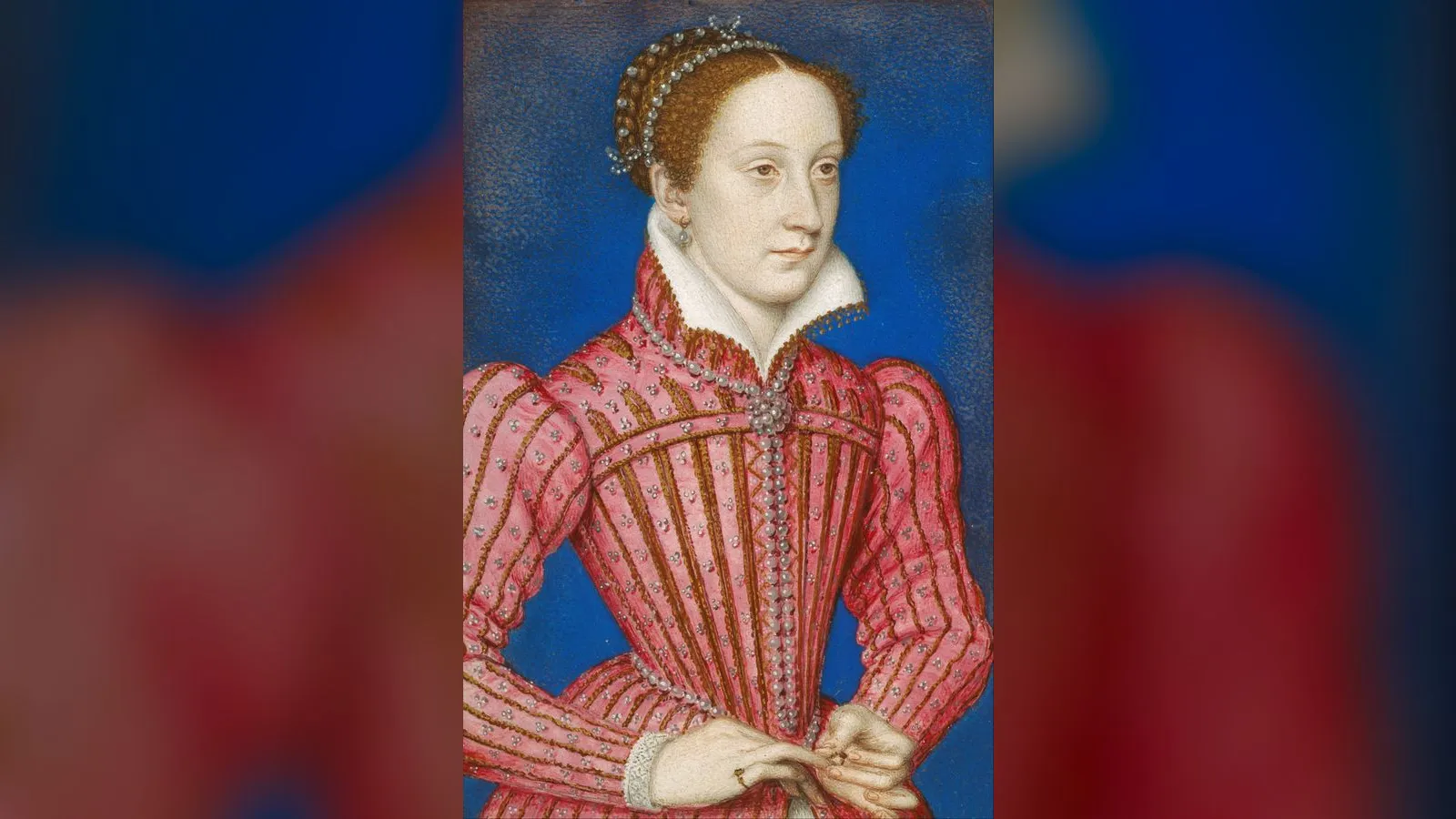

Mary, Queen of Scots
Contents
Mary Stuart became Queen of Scots at six days old, was briefly Queen of France, and had a strong claim to the English throne. By the age of 24 she had lost her Scottish crown after a run of marriages, murders and misjudgements, and she spent 19 years as Elizabeth I's prisoner before being executed in 1587. Her son nevertheless became king of both Scotland and England. This card separates the documented queen from the romance and the myths.
TL;DR
- established Mary was born at Linlithgow Palace on 8 December 1542 and became queen when her father, James V, died six days later. She was raised in France and was Queen of France from 1559 to 1560.
- established She returned to Protestant Scotland in 1561 and ruled with religious moderation. Her marriages to Lord Darnley (1565) and the Earl of Bothwell (1567) led to disaster.
- established Darnley was killed at Kirk o' Field on 10 February 1567. Mary was forced to abdicate on 24 July 1567, lost at Langside in 1568 and fled to England.
- established After the Babington Plot she was tried at Fotheringhay and executed there on 8 February 1587. Her son James VI became James I of England in 1603.
- shared Whether Mary was involved in Darnley's murder is unproven. The "casket letters" that seemed to prove it survive only as copies and may have been doctored.
- shared The historian John Guy, in his biography of Mary (2004), argues that she was a capable, pragmatic ruler and that Elizabeth's minister William Cecil was her chief antagonist. Other historians, notably Jenny Wormald, judge her a political failure.
Key Facts
- Born
- 8 December 1542, Linlithgow Palace
- Became queen
- 14 December 1542, on the death of James V
- Crowned
- 9 September 1543, Chapel Royal, Stirling Castle
- To France
- Sailed from Dumbarton, July–August 1548, aged five
- Married Francis, the Dauphin
- 24 April 1558, Notre-Dame de Paris
- Queen of France
- 10 July 1559 – 5 December 1560
- Returned to Scotland
- 19 August 1561, Leith
- Married Darnley
- 29 July 1565, Holyrood
- Rizzio murdered
- 9 March 1566, Holyrood
- Son James born
- 19 June 1566, Edinburgh Castle
- Darnley killed
- 10 February 1567, Kirk o' Field
- Married Bothwell
- 15 May 1567
- Abdicated
- 24 July 1567, Lochleven Castle
- Langside
- 13 May 1568
- Tried
- 14–15 October 1586, Fotheringhay; found guilty in her absence, 25 October
- Executed
- 8 February 1587, Fotheringhay Castle, aged 44
- Buried
- Peterborough Cathedral, 1587; Westminster Abbey, 1612
Scottish Impact Index (SI Score)
- Global Influence
- 8/10
- Enduring Relevance
- 10/10
- Material Contribution
- 3/10
- Exceptional Achievement
- 6/10
- Lasting Legacy
- 6/10
- Recognition
- 9/10
42/60
Ranked =33rd of 200 in Great Scots
A Note on Claims and Evidence
Each major claim carries one of three labels. established means supported by primary records, official bodies or several independent reliable sources. shared means the core fact is sound but sources disagree on details, dates or interpretation. traditional means widely repeated but not traceable to a primary or independent source.
Mary's life is unusually well recorded, in letters, state papers, trial records and eyewitness accounts. The hard questions are about guilt and motive: whether she knew of Darnley's murder, whether Bothwell abducted her or she went willingly, and how far she took part in plots against Elizabeth. Historians disagree sharply, from John Guy's sympathetic reading to Jenny Wormald's verdict that her own misjudgements doomed her. The historian John Guy, in his biography of Mary (2004), worked from the original manuscripts in Edinburgh, Paris, London and elsewhere, and the dates and documents he establishes are used here as Established. His larger arguments, that Cecil was her nemesis, that the casket letters were doctored and that she was a shrewd ruler, are labelled Shared, because Wormald, Antonia Fraser, Retha Warnicke and others weigh the evidence differently. Several popular details, including her father's dying words, are later embellishments.
Timeline
Mary is born at Linlithgow Palace.
James V dies at Falkland Palace; Mary becomes queen.
Mary is crowned in the Chapel Royal at Stirling Castle.
The Scots are routed at Pinkie; Mary is moved to Inchmahome Priory.
Mary boards a French royal galley at Dumbarton; she lands in Brittany in mid-August.
Mary is formally betrothed to the Dauphin at the Louvre.
Mary marries the Dauphin Francis.
Henry II dies of his jousting wound; Francis and Mary become King and Queen of France.
The Treaty of Edinburgh is signed without Mary's consent; she never ratifies it.
Francis II dies at Orléans.
Mary returns to Scotland, landing at Leith.
The poet Chastelard is found in Mary's bedchamber a second time and is executed.
Mary first meets Darnley, at Wemyss in Fife.
Mary marries Lord Darnley.
The Chaseabout Raid: Mary drives Moray's rebels into England.
David Rizzio is murdered at Holyrood.
Mary's son James is born.
Mary rides to see the wounded Bothwell at Hermitage and falls gravely ill at Jedburgh.
Prince James is baptised at Stirling.
Darnley is killed at Kirk o' Field.
Bothwell is acquitted of Darnley's murder.
Bothwell intercepts Mary at Almond Bridge and takes her to Dunbar.
Mary marries the Earl of Bothwell.
Mary surrenders at Carberry Hill.
Mary is imprisoned at Lochleven Castle.
Mary is forced to abdicate in favour of her son, who is crowned at Stirling on 29 July.
Mary escapes from Lochleven.
Mary is defeated at Langside.
Mary crosses the Solway into England, landing near Workington.
The York–Westminster conference; the casket letters are laid before it on 7 December 1568, and it ends without a verdict.
Mary is in the custody of the Earl of Shrewsbury, mainly at Tutbury, Wingfield, Chatsworth and Sheffield.
The Ridolfi Plot is uncovered; the Duke of Norfolk is executed on 2 June 1572.
The Throckmorton Plot.
The Bond of Association; the Act for the Queen's Safety follows in March 1585.
Mary is moved to Chartley under Sir Amyas Paulet.
Mary replies to Anthony Babington.
Mary is tried at Fotheringhay; she is found guilty in her absence in Star Chamber on 25 October.
Elizabeth signs the death warrant.
Mary is executed at Fotheringhay.
James VI becomes James I of England.
James reburies his mother in Westminster Abbey.
Details
1. Birth and Early Life: A Queen at Six Days Old
Mary was born on 8 December 1542 at Linlithgow Palace, West Lothian, the only legitimate child of King James V of Scotland to survive him, and his French second wife, Mary of Guise. Just days before her birth, the Scottish army had been routed by the English at the Battle of Solway Moss. A broken James V withdrew to Falkland Palace and died there on 14 December 1542 — six days after his daughter's birth — leaving the infant Mary as Queen of Scots.
Myth check — the dying words. Scottish lore has James V utter "It cam wi' a lass and it'll gang wi' a lass" — meaning the Stuart dynasty had come to the throne through a woman (Marjorie Bruce, daughter of Robert the Bruce) and would end with one (Mary). It is a wonderful line, but it should be flagged. The earliest source, John Knox, recorded the king saying something blunter and different: "The devil go with it! It will end as it began: it came from a woman; and it will end in a woman." The polished Scots version is a later, romanticised rendering. And the "prophecy" was simply wrong: the Stuart line continued robustly through Mary's son James for many generations.
As an infant queen, Mary was governed by regents — first James Hamilton, Earl of Arran, then from 1554 her own mother, Mary of Guise. Henry VIII of England tried to secure her as a bride for his son Prince Edward; when the Scots rejected this in favour of the French alliance, Henry launched the brutal "Rough Wooing" raids. To keep her safe, the Scots betrothed Mary to Francis, Dauphin of France, and in 1548, aged five, she sailed to be raised at the French court.
The coronation and the flight to France. Mary of Guise moved her daughter from Linlithgow to the stronger fortress of Stirling in July 1543. On 9 September 1543, the thirtieth anniversary of Flodden, the nine-month-old queen was crowned in the Chapel Royal there. Cardinal David Beaton held the crown, which was far too heavy for her, over her head; Guy records that she cried throughout. After the Scottish defeat at Pinkie on 10 September 1547 she was carried by night to Inchmahome Priory on the Lake of Menteith, and in 1548 she was moved to Dumbarton. The Treaty of Haddington, approved by the Scottish Parliament in July 1548, promised her to the Dauphin. She boarded Henry II's own galley at Dumbarton on 29 July; storms delayed the fleet until 7 August, and after a rough crossing it reached Brittany in mid-August. Guy notes that she was one of the few on board who was not seasick.
There she received a glittering Renaissance education, schooled in French (which became her first language), Latin, Italian, Spanish and some Greek, plus music (lute and virginals; later accounts sometimes add the harp, for which there is no contemporary evidence), poetry, needlework, dancing, falconry and horsemanship. Contemporaries describe her as tall, graceful, vivacious and charming. Guy puts her final height at "almost six feet (perhaps five feet ten inches or so)", towering over most men of her era. He is cooler about her scholarship than older accounts: her Latin exercises, which survive in Paris, are stilted, and her famous Latin oration at the Louvre, given when she was nearly 13, was heavily coached. Her real enthusiasm was French poetry, which she studied with Pierre de Ronsard. She was accompanied by the "Four Maries" — Mary Beaton, Mary Seton, Mary Fleming and Mary Livingston — companions from noble Scottish families who would remain central to her court.
2. Queen of France and the English Claim
On 24 April 1558, the fifteen-year-old Mary married the Dauphin Francis at Notre-Dame de Paris in a lavish ceremony. (On 4 April, at Fontainebleau, she had signed three secret documents bequeathing Scotland, and her claim to England, to the French crown if she died without issue. Guy notes that nine days before the wedding she had also signed a public promise to the Scottish commissioners to preserve Scotland's laws and liberties. The secret deeds were not found until the reign of Louis XIV.) When Henry II died of a jousting wound in July 1559, the teenage couple became King and Queen of France. Mary was Queen consort of France for roughly seventeen months, until Francis II — always sickly — died on 5 December 1560.
Crucially, Mary had a powerful claim to the English throne. As the granddaughter of Margaret Tudor (Henry VIII's sister), she was, in the eyes of Catholic Europe, the legitimate heir — or even rightful queen — over the Protestant Elizabeth I, whom Catholics regarded as illegitimate. After Mary I of England died in November 1558 and Elizabeth succeeded, Mary's father-in-law Henry II encouraged her to quarter the royal arms of England with those of France and Scotland — a heraldic assertion of her claim that Elizabeth never forgot or forgave. (The English College of Arms declared the heraldic claim invalid; Elizabeth's diplomats were pointedly served dinner on plates engraved with the provocative arms.) This provocation poisoned the cousins' relationship from the start.
The Treaty of Edinburgh. In July 1560, after an English army had helped the Protestant Lords of the Congregation against Mary of Guise, England, France and the Scottish lords made the Treaty of Edinburgh. It recognised Elizabeth as rightful queen and required Mary to drop her claim. Guy stresses that Mary and Francis were not consulted and that the commission issued in their names was drawn up by her Guise uncles. Mary refused to ratify it for the rest of her life, and the dispute shadowed every later negotiation with Elizabeth and Cecil.
3. Return to Scotland (1561): A Catholic Queen in a Protestant Land
Widowed, sidelined by her mother-in-law Catherine de' Medici, and with her own mother dead (Mary of Guise died in June 1560), Mary returned to Scotland on 19 August 1561, landing at Leith in a thick sea mist after a crossing of barely five days. She was 18 and barely knew the country she now had to rule. In her absence, the Scottish Reformation had triumphed: the 1560 Parliament had abolished papal authority and made Scotland officially Protestant.
The fiery reformer John Knox loomed over the religious landscape. In 1558 he had published "The First Blast of the Trumpet Against the Monstrous Regiment of Women" — "regiment" meaning rule — arguing that to promote a woman "to bear rule, superioritie, dominion or empire above any realme, nation, or citie, is repugnant to nature." Aimed at the Catholic queens Mary Tudor and Mary of Guise, it badly backfired when the Protestant Elizabeth took the English throne and was barred from her favour too. Knox and Mary clashed in several famous face-to-face audiences; he condemned her Mass, her dancing and her dress.
Yet Mary governed with striking pragmatism. Rather than impose Catholicism, she attended Mass privately while leaving the Protestant settlement intact, and kept her Protestant half-brother Lord James Stewart (whom she made Earl of Moray) and the diplomat William Maitland of Lethington as chief advisors. For roughly four years she ruled with relative stability and moderation.
The religious bargain. The terms were agreed before she sailed. In April 1561 Lord James met her at St-Dizier in France, and over five days they settled that she would keep the religious status quo, with Protestantism as the official religion, in return for the right to hear Mass in her own chapel at Holyrood. Her first Sunday home brought a riot outside the chapel; the next day she proclaimed that no one was to alter the state of religion she had found on her arrival. When she named her Privy Council, seven of its twelve members were Protestants. Her first interview with Knox, on 4 September 1561, ended with her saying that her subjects would obey him and not her; Guy notes she wept only after he had left.
shared A pragmatic, not ideological, Catholic. Guy argues that Mary was a politique who put dynasty before doctrine, and that the devout martyr of Fotheringhay was a role she adopted only in English captivity. He does record one exception: early in 1566, pregnant and newly confident, she joined Darnley at a Candlemas High Mass, promised that the Mass would be "free for all men that will hear it", and at a banquet declared that there was "no other queen of England but herself" (contemporary reports, as quoted by Guy). Wormald, by contrast, reads her religious passivity as part of a wider failure to govern.
shared A capable ruler. Guy points to her handling of the Gordon rising in 1562, when she rode north and saw Huntly's forces broken at Corrichie on 28 October, and to her 1564 order that the Court of Session sit at least three days a week to hear the cases of poor litigants. He judges that she managed a fatally divided country well for several years. Wormald's verdict that she was disengaged and preoccupied with the English succession remains the main counterweight.
Chastelard. In February 1563 the French poet Pierre de Chastelard, whose courtly verses she had answered, was found hiding under her bed with a sword and dagger. Banished, he followed her to Fife and burst into her bedroom again. He was tried and executed. Knox blamed her dancing for leading him on; Guy notes that she was so frightened she would not sleep alone for months.
Her court at Holyrood recreated some of the cultural sparkle of France: music, poetry, masques (which she introduced to Scotland), dancing, hunting and tennis. Mary herself sang and played the lute and virginals. Among her musicians and confidants was David Rizzio (Riccio), a Piedmontese musician who rose to become her private secretary handling French correspondence — and a figure whose growing influence the Scottish lords came to resent.
established Mary and the dance. The dance historian George S. Emmerson, in A Social History of Scottish Dance (1972), gathers what is known of Mary's dancing. Her biographer George Conn (Conaeus) wrote that she danced excellently, gracefully and with "quiet and gentle motion". When Elizabeth pressed Sir James Melville in 1564 to say which queen danced better, he answered that Mary "dancit not so high and disposedly" as Elizabeth, a courtier's way of conceding that Elizabeth's livelier Italian style was showier while Mary's was more restrained and French. Brantôme saw her as a girl in France dressed in Highland costume, but no source records her dancing Highland or country dances, and even the accounts of her 1564 hunt in Atholl mention no dancing. The one dance named at her Scottish court is Knox's "Purpose", in which partners talked privately; Emmerson takes it to have been a miming branle in the new French fashion.
established Harpers at Mary's court. The harp had a small place at her court. Keith Sanger and Alison Kinnaird, in Tree of Strings (1992), their history of the harp in Scotland, traced its decline at court after Flodden: James V favoured viols and lutes, and under Mary the Treasurer's Accounts record a single harp payment, in 1548, to "Stewvyn Tabronar and ane other harper with him" for playing to the Governor, the Earl of Arran. They found no evidence that Mary herself played the harp or the clàrsach, though the claim is often repeated.
traditional The "Queen Mary Harp". One of the two medieval clàrsachs in National Museums Scotland carries her name. Robertson of Lude family tradition, first written down in John Gunn's 1807 report for the Highland Society, held that Mary gave the harp to Beatrix Gardyn of Banchory during a hunting visit to Atholl, and that her portrait and the royal arms were then fixed to it. Sanger and Kinnaird found some documentary support for a royal connection: the Queen confirmed John Robertson of Monzie and Beatrix Gardyn in the lands of Inchmagrannoch on 18 December 1565, an occasion when a ceremonial gift would fit. But they also noted the Victorian antiquary Charles Bell's warning that there had been more than one Queen Mary in Scotland. The harp itself is far older than Mary: the museum dates it to the 14th or 15th century and says it may have been made in the West Highlands. So the link, if real, is a later gift or decoration, not the making of the instrument. A separate article covers the harp in full.
established Knox and the queen's dancing. In December 1562, after a ball at Holyrood following her return from the north, Knox preached against "the Queen's dancing", linking it to rumours of her Guise uncles' successes against French Protestants. Summoned before her, he said his chief complaint was that she valued "fiddlers and flatterers" above godly men, and that he did not utterly condemn dancing so long as it did not crowd out duty or celebrate the troubles of God's people. Mary told the English ambassador that Knox was "so hard unto us that we have laid aside much of our dancing". shared Emmerson notes that J. A. Froude's statement that news of the massacre at Vassy had just arrived is wrong, since Vassy had taken place nine months earlier.
shared Myths about Mary and dance. Emmerson rejects several romantic claims. The Scottish court had copied French dancing long before Mary, as every European court did, so French elegance in Scottish dance is not her personal legacy; the idea that the Scottish country dance revived by the Royal Scottish Country Dance Society descends from dances she brought from France has no foundation; the 18th-century notion that Rizzio composed Scottish songs is a fancy; and descriptions of her dancing quadrilles, cotillions or minuets are anachronisms, since those dances did not yet exist.
4. The Darnley Marriage and Disaster (1565–1566)
On 29 July 1565, Mary married her cousin Henry Stuart, Lord Darnley, at Holyrood. They had first met at Wemyss in Fife on 17 February 1565, when, according to Sir James Melville, she called him "the lustiest and best proportioned lang man" she had seen. The attraction was real, but the match was also strategic: Darnley, like Mary, was a grandchild of Margaret Tudor, so their children would carry a doubly strong claim to England. He was also Catholic-leaning. Elizabeth had offered her own favourite, Robert Dudley, as a husband, and then in March 1565 announced that nothing would be done about Mary's succession claim until she herself married or declared she never would. Mary married Darnley in defiance. The wedding was by Catholic rites in her private chapel at about six in the morning; Darnley left before the nuptial Mass, and the next day he was proclaimed king.
The Chaseabout Raid. The marriage alarmed Elizabeth and provoked a rebellion by Moray. Between late August and early October 1565 Mary rode at the head of an army of up to 10,000, with a pistol in her saddle holster and a steel cap on her head, and drove the rebels round the Lowlands until they fled to England. Even Knox admitted that she was "ever with the foremost". Bothwell, recalled from France, landed at Eyemouth on 17 September and became one of her chief commanders.
The marriage curdled almost immediately. John Guy describes Darnley as "a narcissist and a natural conspirator" — vain, drunken, promiscuous and grasping. He demanded the Crown Matrimonial (co-sovereignty with the right to keep the throne if he outlived Mary); she refused, and the couple were estranged by Christmas 1565, even as Mary carried his child.
The crisis exploded with the murder of David Rizzio. Manipulated by lords who fed his jealousy with rumours that Rizzio was the queen's lover (and perhaps her unborn child's father), Darnley joined a conspiracy. On the evening of 9 March 1566, a band of armed conspirators led by Lord Ruthven burst into Mary's small supper room at Holyrood. Rizzio was dragged to the adjoining Outer Chamber and stabbed to death (Mary's own account, sent to Paris, says "fifty-six strokes") — with Darnley's dagger left in the body to mark his complicity. Mary, six months pregnant, had a cocked pistol levelled at her by Andrew Ker of Fawdonside; some have speculated the trauma was meant to induce a miscarriage, but Guy thinks this implausible, since Darnley's hopes of the crown matrimonial depended on Mary staying alive. She escaped by cannily winning Darnley back: shortly after midnight on the third night they slipped out through the cellars of Holyrood and rode 25 miles to Dunbar, the pregnant queen stopping several times to be sick.
shared Who was behind the plot. The conspirators wanted to stop the Parliament due on 12 March 1566 from forfeiting the lands of Moray and the other Chaseabout rebels, and Darnley wanted the crown matrimonial. Guy goes further than most: he names Maitland as the man who fed Darnley the story that Rizzio was Mary's lover, and argues that William Cecil and the English ambassadors at Berwick knew of the plot days in advance and did nothing to warn her. Other historians accept the English foreknowledge but give Maitland a smaller role.
Myth check — the paternity slur. The rumour that Rizzio fathered James is almost certainly baseless. It echoed for years: the French king Henri IV, mocking James VI's pretension to be the "Scottish Solomon," "remarked that he hoped he was not David the fiddler's son." But Mary and Darnley were still amicable when James was conceived, and the relationship soured only later.
On 19 June 1566, Mary gave birth to a son, the future James VI of Scotland and I of England, at Edinburgh Castle, between ten and eleven in the morning after a long and difficult labour.
Jedburgh and Craigmillar. In October 1566 Mary went to Jedburgh to hold a border court. Bothwell, her lieutenant on the border, had been badly wounded by the Elliots of Liddesdale. Guy, using the reports of the English wardens Scrope and Forster, shows that she finished a week of court business before riding to see him at Hermitage, with Moray and her council, stayed about two hours and returned the same day; the later story of a lovesick dash was George Buchanan's invention. On 17 October she collapsed, vomiting blood, and for a time was thought dead. Guy diagnoses a burst gastric ulcer rather than porphyria. In late November, while she recovered at Craigmillar Castle, Maitland and other lords proposed freeing her from Darnley. The lords later said she agreed to a divorce if it did not harm her son; Mary's recorded answer, as quoted by Guy, was that they should do "nothing whereto any spot may be laid to my honour or conscience".
shared A settlement with Elizabeth in sight. Guy adds a context that most accounts miss. During her illness Mary asked Elizabeth to protect her son, and in late 1566 Elizabeth offered a new "treaty of perpetual amity" that would drop the offending clauses of the Treaty of Edinburgh and recognise Mary as her heir if she died childless. Mary accepted on 3 January 1567, subject to a review of Henry VIII's will, and on 8 February ordered her envoy Robert Melville back to London to conclude it. Guy argues that a queen on the verge of the settlement she had sought for six years had no motive to kill her husband. Critics reply that motive is not proof either way.
5. The Murder of Darnley and the Bothwell Marriage (1567)
In January 1567 Mary rode to Glasgow, arriving on the 22nd, to fetch Darnley, who was ill in his father's heartland and, she had been warned, plotting to seize their son. She meant to lodge him at Craigmillar, where he could be watched. He refused, and instead was installed by 1 February in the Old Provost's Lodging at Kirk o' Field, on the southern edge of Edinburgh. Guy cites testimony from one of Darnley's own servants that the house was his choice, not Mary's. On the evening of Sunday 9 February she visited him, then left before eleven to attend the wedding masque of her valet Bastian Pagez at Holyrood. A little after two in the morning of 10 February the house, where Darnley was convalescing (Guy identifies the illness as secondary syphilis, publicly described as smallpox), was destroyed by a gunpowder explosion. But the forensic twist is crucial: Darnley's body and that of his servant William Taylor were found in the garden, apparently unmarked by the blast and showing signs of having been strangled or suffocated. The reconstruction is that the two men tried to escape the surrounded house by a window using a chair and rope, were intercepted, and were killed — after which the explosion may have been intended to disguise the murder. Women in the nearby cottages reported hearing Darnley plead for his life; their sworn statements, dated 11 February 1567, were filed by the Privy Council and never used.
shared Guy's reconstruction. Working from the English border reports of Sir William Drury, Guy names Bothwell and the Earl of Morton as joint ringleaders, with Maitland, Sir James Balfour (who supplied the gunpowder) and Archibald Douglas assisting, and Moray aware in advance but keeping away. He argues that Darnley's cry "Oh, my kinsmen" points to the Douglases, his mother's family, as the men who caught and strangled him. This is a careful reading of the sources but remains an argument, not a settled fact.
Suspicion fell at once on James Hepburn, 4th Earl of Bothwell, a powerful, ambitious nobleman widely believed to have organised the explosion, and rumoured to be close to the queen. Placards appeared in Edinburgh openly accusing Bothwell and Mary — one notoriously depicting Mary as a mermaid (a symbol for a prostitute). Bothwell was put on trial in April 1567 but, in what was effectively a rigged proceeding pursued by Darnley's vengeful father Lennox, was acquitted.
Then came the most damaging episode of all. On 19 April 1567 Bothwell gathered the lords at Ainslie's Tavern in Edinburgh and asked them to sign a bond backing him as Mary's husband. On 24 April, as Mary rode back from visiting her son at Stirling (the last time she saw him), Bothwell intercepted her at the bridge over the River Almond with a large body of horsemen and took her to Dunbar Castle, where she stayed for twelve days. His wife, Lady Jean Gordon, sued for divorce in the Protestant court on 26 April; the divorce was granted on 3 May and a Catholic annulment on 7 May. He married Mary on 15 May 1567 in the great hall at Holyrood — barely three months after Darnley's death and by Protestant rites.
Disputed — abduction or collusion? This is one of the great unresolved questions. Mary's enemies claimed she colluded in a staged abduction to make marriage to her husband's suspected murderer palatable. Sir James Melville, who rode with her, recorded both a Bothwell follower's boast that it was done with her consent and the view that she could not but marry Bothwell after he had ravished her. John Guy concludes that the seizure at Almond Bridge was genuine and took Mary by surprise: she at once sent servants to Edinburgh for a rescue. He does not, however, accept that she was raped. He argues that within a day or two Bothwell won her over with the Ainslie's Tavern bond and promises of protection, that she made no attempt to leave Dunbar, and that she then fell in love with him. Mary herself told the minister John Craig, in writing, that she had been neither raped nor held prisoner (which some read as protecting her reputation), but in her instructions to her envoy to France she admitted he had pressed her "accompanied none the less with force". Other historians take the rape claim more seriously, and some still argue for collusion. The honest verdict: the evidence is contested, and it should not be stated as settled fact either way.
The marriage was a catastrophe. Both Catholics (who did not recognise Bothwell's divorce or the Protestant rite) and Protestants were appalled, and the Scottish lords rose in armed revolt.
6. Defeat, Abdication and Escape (1567–1568)
The two sides met at Carberry Hill on 15 June 1567. There was no real battle: as the day wore on in negotiations, Mary's support melted away through desertion. She surrendered to the Confederate Lords on condition that Bothwell be allowed to leave the field — the last time she ever saw him. (Bothwell fled by way of Orkney and Shetland to Norway, was held by Frederick II of Denmark at Copenhagen, Malmö and finally Dragsholm, and died there on 14 April 1578. The story that he died insane, chained to a wall, is a legend; Guy suggests drink and liver or kidney failure.) Soldiers cried "Burn the whore! Burn the murderess!" as Mary was brought into Edinburgh, and on 17 June she was rowed out to the island fortress of Lochleven.
There, between 20 and 23 July 1567, she miscarried twins — Bothwell's children. Weakened by blood loss, she was bullied into signing instruments of abdication on 24 July 1567 in favour of her one-year-old son, who was crowned James VI in the parish church at Stirling on 29 July; Moray was proclaimed regent on 22 August. According to Guy, Lord Lindsay threatened to cut her throat if she did not sign. Mary always maintained the abdication was invalid as it was signed under duress, and said at the time that she would not abide by it.
On 2 May 1568, after one failed attempt on 25 March in the disguise of a laundress, Mary escaped Lochleven in a daring plot involving the teenage Willie Douglas, who sabotaged the boats and smuggled her out during May Day festivities. She quickly raised an army of around 6,000, but was decisively beaten at the Battle of Langside near Glasgow on 13 May 1568 by Moray's smaller force.
Then came her fateful decision. Rather than flee to France, Mary crossed the Solway in a fishing boat and threw herself on the mercy of Elizabeth I, landing near Workington in Cumberland on the evening of 16 May 1568. She expected help to regain her throne. Instead, she had walked into 19 years of captivity, beginning at Carlisle Castle and then, from July 1568, at Bolton Castle in Wensleydale.
7. Captivity in England (1568–1587)
Mary's long imprisonment is often romanticised, but the reality was a slow, grinding decline. Elizabeth faced an impossible dilemma: Mary was an anointed queen and her heir, yet also a Catholic figurehead who threatened her throne. Elizabeth never met Mary in person, and never restored her.
For most of her captivity (1569–1584), Mary was held by George Talbot, 6th Earl of Shrewsbury, and his formidable wife Bess of Hardwick, moved between a series of properties — most loathed of all the cold, damp Tutbury Castle, where she arrived in early February 1569, plus Wingfield Manor, Sheffield Castle (from November 1570) and Sheffield Lodge (from 1573), Chatsworth, and summer visits to the spa at Buxton. In August 1584 Sir Ralph Sadler, the same diplomat who had dandled her on his knee in 1543, took over; she was returned to Tutbury in January 1585 and handed to the puritan Sir Amyas Paulet, who moved her to the moated manor of Chartley on 24 December 1585. The burden of guarding Europe's most dangerous prisoner — at Mary's own expense and with inadequate funds from Elizabeth — helped wreck the Shrewsbury marriage, especially as Bess spread rumours that her husband and Mary were too close. Mary and Bess famously spent long hours at needlework; surviving embroideries are held by the V&A. Guy reads some of Mary's designs as private jokes: a ginger cat wearing a crown, watching a mouse, for Elizabeth and herself, and a dolphin as a pun on "dauphin". Her cloth of state carried her mother's motto, "En ma fin est mon commencement" ("In my end is my beginning"). By the mid-1580s Mary, only in her early 40s, was prematurely aged, lame, overweight and grey, wearing wigs.
Her captivity made her the natural centre of Catholic plotting against Elizabeth:
- The York–Westminster Conference (1568–69) was convened to examine the charges against Mary over Darnley's murder. It opened at York on 4 October 1568 and moved to Westminster on 26 November, where Cecil and his brother-in-law Sir Nicholas Bacon joined the commissioners. It was here that the "casket letters" (see section 9) were first produced, on 7 December, after Mary's commissioners had withdrawn in protest; they were examined again at Hampton Court on 14 December. The inquiry ended on 10 January 1569 deliberately inconclusively — neither convicting nor clearing Mary — which conveniently justified her continued detention.
- The Ridolfi Plot (1571), a scheme by the Florentine banker Roberto Ridolfi to marry Mary to the Duke of Norfolk, assassinate or depose Elizabeth with Spanish help, and restore Catholicism. Mary had agreed to marry Norfolk and her agent, John Lesley, Bishop of Ross, handled money from the Spanish ambassador. shared Whether she consented to the plan to depose Elizabeth is disputed: many historians say she did, while Guy argues that the intercepted letters were allusive and would not have stood up in court, and that Ridolfi was by then working for Walsingham. Its discovery destroyed any chance of her restoration and sent Norfolk to the block on 2 June 1572.
- The Throckmorton Plot (1583), a plan for a Guise-led, Spanish and papal invasion to free Mary. Letters read through Walsingham's informant in the French embassy showed that she had encouraged Francis Throckmorton and promised to reward him. It incriminated her further and led to harsher confinement.
- The Babington Plot (1586) would finally be her undoing.
Her degree of genuine involvement varied. In the Babington plot there is documentary evidence she actively consented; in others she was more a symbol used by others. Either way, after the 1583 Throckmorton Plot, Elizabeth's government devised the Bond of Association of October 1584, whose signatories swore to kill not only anyone who attempted Elizabeth's life but any "pretended successor" for whom it was attempted, whether or not she knew of it — effectively a legal trap. The Act for the Queen's Safety of March 1585 softened this by requiring a trial before a commission of privy councillors, peers and judges, and that is the procedure under which Mary was eventually tried.
shared Cecil as nemesis. Guy's central argument is that William Cecil, Lord Burghley, Elizabeth's chief minister for forty years, was Mary's real antagonist. In Guy's account Cecil drafted a plan for the government of Scotland by a council of nobles as early as August 1559, backed the rebel lords against her throughout, and in 1567 noted beside his instructions for Elizabeth's envoy the biblical precedent "Athalia was killed so that Joash could be king". Elizabeth, Guy argues, put hereditary monarchy first and repeatedly resisted proceeding against an anointed queen, while Cecil put the Protestant cause first. Historians of Elizabeth's government accept the tension between them but many see Cecil as a cautious defender of English security rather than a man pursuing Mary's death for decades.
8. Trial and Execution (1586–1587)
The Babington Plot was less a plot Mary masterminded than a trap sprung on her. Elizabeth's spymaster Sir Francis Walsingham learned of a conspiracy by the young Catholic Anthony Babington and the priest John Ballard to assassinate Elizabeth and free Mary. Walsingham let it run, using double agent Gilbert Gifford and codebreaker Thomas Phelippes to intercept Mary's secret correspondence — smuggled in and out of Chartley in a watertight box inside a beer barrel — decode it, and read everything. Babington's letter of 6 July 1586 spoke of six gentlemen who would undertake the "dispatch of the usurper". On 17 July Mary replied in cipher, drafted with her secretaries Claude Nau and Gilbert Curle, urging that "the six gentlemen" be set "to work" once foreign forces were ready and she could be freed. She did not name the work, but read with Babington's letter her meaning is clear, and Guy accepts that her complicity in the plot is undeniable. Phelippes marked his deciphered copy with a gallows. He also forged a postscript asking for the conspirators' names, but Guy finds no evidence that the body of the letter was altered, and the postscript was not used at her trial.
Mary was lured out on a hunt and arrested on 11 August 1586, held at Tixall for a fortnight while her papers were seized, and brought to Fotheringhay Castle on 25 September. She was tried there on 14–15 October 1586 in the upper presence chamber. More than 40 commissioners had been named under the Act for the Queen's Safety, though seven or eight stayed away. Her defence was principled and constitutionally sharp: as an anointed sovereign queen, she argued, she was subject to no court of another realm and could not be tried for treason against a monarch to whom she owed no allegiance. She had no counsel, could call no witnesses and could not inspect the documents. She argued that she could be convicted only by her own words or writing, not the evidence of her secretaries, and that ciphers were easily counterfeited; Guy shows that the "original" letter shown in court was a reconstruction made by Phelippes. She demanded to be heard before Parliament and the queen. When she told Cecil "I see you are my adversary", he replied that he was adversary to Queen Elizabeth's adversaries. The commission adjourned to Star Chamber at Westminster, where on 25 October it found her guilty in her absence; the sentence was proclaimed on 4 December.
Disputed — Elizabeth's reluctance: genuine or theatre? Elizabeth genuinely agonised, delaying the verdict's publication and refusing for weeks to sign the warrant — wrestling with the dangerous precedent of executing an anointed queen and her own cousin. She finally signed on 1 February 1587 and entrusted it to her secretary William Davison. The Privy Council, led by Cecil, then rushed it to Fotheringhay without further reference to her. Elizabeth afterwards claimed she had never intended it to be carried out and blamed Davison (whom she imprisoned). Historians remain divided on how much of this was sincere conscience and how much was calculated deniability; the likeliest reading is a mix of both — real anguish and convenient political theatre. Guy adds a harder detail from Robert Beale's account: Elizabeth had a letter sent asking Paulet to have Mary killed privately under the Bond of Association, and Paulet refused, saying he would not make "so foul a shipwreck" of his conscience. On Guy's reading she would have preferred a quiet killing to a public execution of an anointed queen.
Mary was executed in the great hall of Fotheringhay on the morning of 8 February 1587, aged 44. The night before, she wrote her last letter, to Henry III of France, at about two in the morning, protesting that she died for the Catholic faith and her right to the English crown. At the scaffold she refused the ministrations of the Dean of Peterborough, Richard Fletcher, and prayed aloud over him in Latin. The contemporary eyewitness accounts, chiefly that of Robert Wynkfield (or Wingfield) of Upton, who stood within ten yards of her, record the famous details:
- She removed her black outer garments to reveal a petticoat and bodice of deep red (Guy, following the sources, calls it tawny, the colour of dried blood) — red being the Catholic liturgical colour of martyrdom, a deliberate final statement. Guy notes that the earls left this out of their official report; it is known from a French account based on her servants' reports and two independent English accounts.
- The execution was botched: the first axe blow missed and struck the back of her head; a second blow severed the neck except for a sinew the executioner had to cut through.
- When the executioner lifted the head crying "God save the Queen," he was left holding a wig — Mary's own hair was short and grey — and the head fell.
- Wynkfield reported her lips moved for a quarter of an hour after death.
- A small dog (often said to be a Skye terrier) was found hidden under her skirts, and refused to leave the body.
Her clothes, the block and everything touched by her blood were burned to prevent relics. Her heart and organs were buried secretly within the castle. Her embalmed body lay in a lead coffin at Fotheringhay for about six months before it was buried at Peterborough Cathedral, at night, with a limited number of mourners, in summer 1587. Her death helped trigger the Spanish Armada the following year.
Caution on embellishment. The core of these details is genuinely contemporary (Wynkfield and other eyewitnesses), but some flourishes — the dog's name "Geddon," that it bit the executioner — are later embellishments not in the primary accounts and should be flagged. One of Mary's servants claimed the dog soon died, but Guy notes that this is not corroborated.
9. The Casket Letters Controversy
The casket letters deserve their own section because they are the single most important — and most contested — piece of evidence about Mary's guilt or innocence in Darnley's murder.
In June 1567, days after Mary's surrender, the Earl of Morton's men allegedly discovered a silver casket (said to have belonged to Bothwell) containing eight letters and a sequence of sonnets, plus marriage contracts, supposedly written by Mary to Bothwell. Morton's sworn account, given in December 1568, was that a servant of Bothwell was caught on 20 June with the box, which was forced open before witnesses on 21 June and found to hold 22 documents: eight letters, two marriage contracts and twelve sonnets. Yet the lords had told the Scottish Parliament that they held Mary's letters before they took up arms at Carberry, a contradiction Guy highlights. If genuine — especially "Letter II," the long "Glasgow letter" — they would prove Mary was Bothwell's lover before Darnley's murder and complicit in the killing. They were produced as evidence at the York–Westminster Conference in December 1568.
The problem is profound. As John Guy puts it bluntly: "The sole evidence that she was a party to the murder plot comes from them. There is no other proof." And the letters cannot be tested, because the originals vanished. After the conference they were returned to Scotland; Morton obtained them in 1571, they passed to his heir after his execution in 1581, and they disappeared a few years later — probably destroyed on the orders of Mary's own son, James VI, who had every dynastic reason to suppress evidence damning his mother. We have only copies and translations (the originals were said to be in French; transcripts survive in French, Scots and English, several with William Cecil's annotations). Guy identified two transcripts that earlier editors had missed.
The current scholarly leaning is sceptical of their authenticity as written. shared Guy's reading, letter by letter, is that the casket mixes genuine and false material. He argues that letters 3, 4 and 5, the "love letters", read best as genuine letters from Mary to Darnley in 1566; that letter 6 is probably a genuine letter to Bothwell written after the abduction, not before it; that letters 7 and 8 are forgeries; and that the long Glasgow letter is a composite, with perhaps 1,500 to 1,800 genuine words and 1,000 to 1,200 interpolated or forged, including the passage hinting at poison. He shows that the dated "short Glasgow letter" cannot fit Bothwell's known movements: Bothwell had left Edinburgh for Liddesdale on the evening of 24 January. He also shows that Cecil's own pen altered a clerk's docket on letter 6 from "after the Ravissement" to "afore", and that a Scots transcript turned "mate" into "father" in letter 4, a change Cecil corrected. One marriage contract, dated 5 April 1567, quotes the Ainslie's Tavern bond of 19 April and must be forged. He notes the sonnets are too clumsy to be the work of a fluent French speaker like Mary. The Oxford Companion to British History concludes that, while perhaps "not outright forgeries," the material "was clumsily doctored by Mary's opponents." A notable dissent comes from Jenny Wormald, who argues that the Scots' reluctance to publish the letters and their eventual destruction actually suggests they contained real evidence against Mary. The honest bottom line: the casket letters cannot be authenticated, are widely believed to have been tampered with, and should never be cited as proof of Mary's guilt.
Witnesses who could not be heard. Nicholas Hubert, the valet known as "French Paris", whom the lords named as the courier of the Glasgow letters, was brought back from Denmark in 1569, questioned under torture at St Andrews in August and hanged without trial; Guy records that he denied his confession on the scaffold. A supposed deathbed confession by Bothwell clearing Mary circulated in the mid-1570s, after false reports of his death, and reconciled Darnley's mother, the Countess of Lennox, to her. Guy shows it to be a forgery: it reports Bothwell receiving the Catholic sacrament and dying at Malmö, when he was a Protestant, held at Dragsholm, and still alive. It cannot be used for or against her.
10. Legacy
Mary lost almost every battle in life but won the dynastic war in death. Her son James VI of Scotland — whom she had not seen since he was ten months old — succeeded the childless Elizabeth I on 24 March 1603 as James I of England, achieving the Union of the Crowns: the very union of the British thrones Mary had dreamed of, accomplished by her bloodline. This was a personal/dynastic union only; England and Scotland kept separate parliaments until the Acts of Union of 1707.
James's response to his mother's execution in 1587 had been a muted, formal protest rather than rupture. He was a committed Protestant whose overriding ambition was the English succession, he had signed the 1586 Treaty of Berwick with Elizabeth (and drew an English pension of £4,000 a year), and he could not remember a mother he had last seen as an infant. In a March 1587 letter he pointedly referred to the execution as Elizabeth's "unhappy fact," but accepted her claim that it had been Davison's error rather than her will; the firm scholarly consensus is that his protest was politically calculated and that he would not jeopardise his succession. (His private feelings — relief at being "the only king" versus genuine grief — are genuinely uncertain in the sources.) Then, in 1612, secure on the English throne, James had Mary's body exhumed from Peterborough — by royal warrant dated 28 September 1612 — and reinterred at Westminster Abbey on 11 October 1612, in a magnificent marble tomb in the south aisle of the Henry VII Lady Chapel, directly opposite Elizabeth I's tomb and notably grander than it: Guy records that Mary's cost £2,000 against £765 for Elizabeth's. It was a deliberate act of dynastic rehabilitation, and Mary's vault later became a Stuart family crypt holding many of her descendants.
In Catholic Europe, Mary was immediately recast as a martyr — her red dress, her piety on the scaffold and her faith making her a potent symbol of suffering Catholic legitimacy, celebrated in engravings and devotional images across the Continent.
Her cultural afterlife has been enormous and shows no sign of fading: she features in hundreds of works, from Friedrich Schiller's tragedy "Maria Stuart" (1800) — which invented a dramatic face-to-face confrontation between Mary and Elizabeth that never happened — to Donizetti's opera "Maria Stuarda," Sir Walter Scott's "The Abbot," and films culminating in the 2018 "Mary Queen of Scots" with Saoirse Ronan (based on John Guy's biography, published in Britain as "My Heart is My Own": The Life of Mary Queen of Scots and in the US as Queen of Scots: The True Life of Mary Stuart), which again staged the fictional meeting.
In Scottish national consciousness, Mary remains a figure of romance and tragedy — the beautiful, doomed queen — though serious historians urge separating the romantic icon from the often-misjudging monarch. Guy, who calls her "the unluckiest ruler in British history", still names her worst mistake as allowing Bothwell, a married man, to seduce her at Dunbar. Wormald's harder verdict is that her failures were of her own making. She endures as one of Scotland's most compelling and debated historical figures.
Did You Know?
- Mary was Queen of Scots for all but the first six days of her life, crowned at just nine months old in the chapel of Stirling Castle in September 1543.
- At almost 6 feet tall, Mary towered over most men of her era — and over her first husband Francis, who was short and stammered.
- Mary's tomb in Westminster Abbey is grander than that of Elizabeth I, the cousin who ordered her death — and her son James placed it there.
- Mary's vault in Westminster Abbey became a Stuart family crypt, eventually holding the remains of many of her descendants.
- The phrase "monstrous regiment of women," now often misunderstood, comes from John Knox's 1558 tract and simply meant "unnatural rule of women."
- Mary introduced the court masque — elaborate costumed musical theatre — to Scotland from France.
- A dog was found hiding under Mary's skirts at her execution and would not leave her body.
- After her first husband's accession, Mary changed the spelling of the family name from "Stewart" to the French "Stuart."
- The famous farewell poem "Adieu, plaisant pays de France" is not by Mary: it first appeared in 1765, the work of an 18th-century French journalist.
- Mary was crowned on 9 September 1543, the thirtieth anniversary of the Battle of Flodden.
- Asked by Elizabeth which queen danced better, Sir James Melville replied that Mary "dancit not so high and disposedly" as Elizabeth.
- Mary's tomb in Westminster Abbey cost £2,000; Elizabeth's cost £765.
- The "Queen Mary Harp" in National Museums Scotland was made decades, and perhaps more than a century, before Mary was born; her name attaches to it through a Perthshire family tradition of a royal gift.
- Mary signed her letters to Elizabeth in her best italic hand; Guy argues that her usual hasty scrawl would have made any honest handwriting comparison of the casket letters very difficult.
FAQ
1How did Mary become queen as a baby?
Her father, James V, died six days after she was born.
2Why was she raised in France?
She was betrothed to the French Dauphin and sent to France in 1548 for safety.
3Did Mary try to restore Catholicism in Scotland?
No. She heard Mass privately but left the Protestant settlement in place. Her one wobble came early in 1566, when Darnley pushed a Catholic revival and she briefly promised freedom to hear Mass.
4Who was David Rizzio?
Mary's Italian secretary, murdered in front of her at Holyrood in 1566 by conspirators including her husband Darnley.
5Did Mary kill Darnley?
Her involvement has never been proven. Darnley's murder remains unsolved.
6Was Mary abducted by Bothwell?
Historians disagree about whether it was a genuine abduction or staged. John Guy thinks the seizure on 24 April 1567 was real but that she was then persuaded, not raped; others read the evidence differently.
7Who chose the house at Kirk o' Field?
Mary's accusers said she did. John Guy cites a Lennox servant's testimony that Darnley chose it himself after refusing to go to Craigmillar. The point is disputed.
8Who was Mary's main enemy, according to John Guy?
William Cecil, Elizabeth's chief minister. Guy argues that Cecil worked against her from 1559 until her death, while Elizabeth herself was reluctant to act against an anointed queen. Many historians think this overstates Cecil's role.
9What are the casket letters?
Letters supposedly from Mary to Bothwell, used as evidence against her. Only copies survive, and many historians think they were altered.
10Why did Elizabeth I keep Mary prisoner?
Mary was a Catholic claimant to the English throne and a focus for plots against Elizabeth.
11What was the Babington Plot?
A plan to kill Elizabeth and free Mary, which Walsingham's agents used to trap her in 1586. Her cipher reply of 17 July 1586 approved setting "the six gentlemen" to work.
12Did Bothwell confess on his deathbed that Mary was innocent?
No reliable confession exists. The version that circulated in the 1570s is a forgery; Bothwell died at Dragsholm in Denmark in 1578.
13Did Mary and Elizabeth ever meet?
No.
14Is the story of the dog at her execution true?
Yes, a small dog was found under her skirts. Its name and later fate are embellishments.
15Where is Mary buried?
In Westminster Abbey, where her son James reburied her in 1612.
16Did Mary dance, and did Knox object?
Yes to both. Contemporaries praised her dancing, and in December 1562 Knox preached against "the Queen's dancing" and was summoned to explain himself. Mary said afterwards that she had laid aside much of her dancing because of him.
17Did Mary bring French dancing to Scotland?
Not single-handed. The Scottish court followed French dance fashions long before her, and the idea that Scottish country dancing descends from her court is a romantic myth.
18Did Mary play the harp, and is the Queen Mary Harp hers?
There is no contemporary evidence that she played the harp; she played the lute and virginals. The Queen Mary Harp was made in the 14th or 15th century, and her link to it rests on a Robertson of Lude family tradition that she gave it as a gift.
Sources and Further Reading
Primary/Institutional
- National Museums Scotland, "Queen Mary harp" (collection page)
Specialist
- Keith Sanger and Alison Kinnaird, Tree of Strings: Crann nan Teud. A History of the Harp in Scotland (Kinmor Music, 1992), chapters 6 and 7
Scholarly/Critical
- George S. Emmerson, A Social History of Scottish Dance: Ane Celestial Recreatioun (McGill-Queen's University Press, 1972)
- John Guy, "My Heart is My Own": The Life of Mary Queen of Scots (Fourth Estate, 2004; US edition Queen of Scots: The True Life of Mary Stuart, Houghton Mifflin, 2004)
- Michael Lynch, "In Search of the Scottish Reformation", in Edward J. Cowan and Richard J. Finlay (eds), Scottish History: The Power of the Past (Edinburgh University Press, 2002)
- Andrea Thomas, "The Renaissance", in T. M. Devine and Jenny Wormald (eds), The Oxford Handbook of Modern Scottish History (Oxford University Press, 2012)
Further reading
- Antonia Fraser, Mary Queen of Scots (Weidenfeld & Nicolson, 1969)
- Jenny Wormald, Mary Queen of Scots: A Study in Failure (George Philip, 1988)
- Jayne Elizabeth Lewis, Mary Queen of Scots: Romance and Nation (Routledge, 1998)
Caveats: Myths and Disputed Claims
- Do not quote "It cam wi' a lass and it'll gang wi' a lass" as James V's recorded words.
- Do not suggest Rizzio was James VI's father; the rumour was a slander.
- Do not treat the casket letters as proof of Mary's guilt.
- Do not state that Mary was complicit in Darnley's murder, or that she was innocent; it is unproven.
- Do not present Bothwell's seizure of Mary as settled either way.
- Do not say Mary and Elizabeth met.
- Do not repeat later details about the execution dog, such as its name, as fact.
- Do not give round numbers such as Rizzio's 56 stab wounds as exact; the figure comes from Mary's own account.
- Do not say Bothwell died insane and chained, or that he made a deathbed confession clearing Mary; both are later stories.
- Do not quote "Adieu, plaisant pays de France" as Mary's own poem.
- Do not present John Guy's view of Cecil as Mary's nemesis, or his letter-by-letter verdict on the casket letters, as settled fact; they are his argument.
- Do not state that Mary chose Kirk o' Field as Darnley's lodging; the evidence is contested.
- Do not say Mary played the harp, or that the Queen Mary Harp was made for her; the first is unevidenced and the museum dates the harp to the 14th or 15th century.
- Do not credit Mary with bringing French elegance or the country dance to Scotland, or describe her dancing minuets or quadrilles, which did not yet exist.
Card 003 · Great Scots