
Mary Slessor (1848–1915): The Mill Girl Who Became "Everybody's Mother" in Calabar
Contents
TL;DR
- Established (Documented): Born into Dundee mill poverty and largely self-taught, Slessor spent nearly four decades as a missionary in the Calabar region of what is now southeastern Nigeria, becoming fluent in the Efik language and living far beyond the protection of the missionary compound system most of her European contemporaries relied on.
- Established (Documented): She became best known for actively intervening against the local practice of abandoning twin infants — believed by some communities to be cursed or the product of demonic paternity — personally rescuing and adopting a number of children over her lifetime.
- Established/Documented, with a complicating layer: From 1892 she also served as vice-consul and later vice-president of a native court under the British colonial administration — a role that places her, however locally beloved, squarely inside the machinery of empire, not outside or above it.
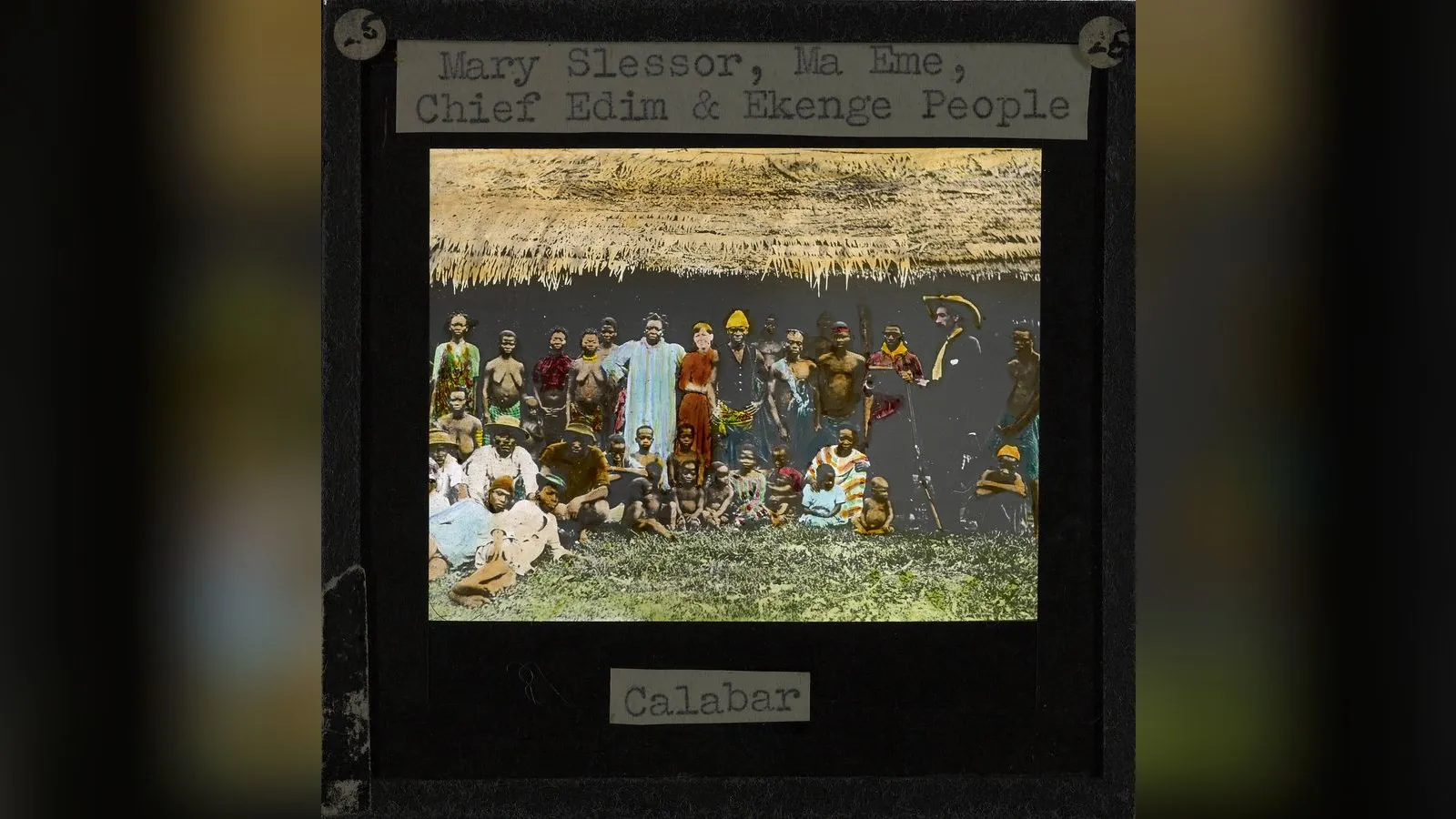
- Shared/Traditional, requiring context: Popular accounts often present her as a lone, fearless heroine embraced unreservedly by Okoyong society. The fuller record shows real tension too: she broke repeatedly with mission-society protocol, her insistence on isolated, unsupervised stations caused persistent friction with church leadership, and her closest local ally, Ma Eme, never converted to the faith Slessor had come to bring.
- Established (Documented): She died at her remote Use Ikot Oku station in January 1915, having refused a permanent return to Scotland despite decades of debilitating malaria, and received a funeral treated by the colonial administration as equivalent to a state occasion.
Key Facts
- Born
- 2 December 1848, Aberdeen, Scotland
- Died
- 13 January 1915, Use Ikot Oku, Calabar region (now Nigeria), aged 66
- Family background
- Father Robert, a shoemaker turned mill labourer with alcoholism; mother a devout weaver; family moved to Dundee in 1859
- Early occupation
- Jute mill "half-timer" from age 11; full-time skilled mill worker by 14
- Missionary body
- United Presbyterian Church (later United Free Church of Scotland) Foreign Mission Board
- Sailed for Africa
- 5 August 1876, aboard SS Ethiopia
- Key region of work
- Calabar (Efik territory) and later Okoyong, in present-day Cross River State, Nigeria
- Colonial roles
- Vice-consul, Okoyong (from 1892); Vice-president, Ikot Obong native court (from 1905)
- Honours
- Order of St John (1913); Efik title Obongawan Okoyong ("Queen of Okoyong")
- Known as
- "Ma," and eka kpukpru owo — "everybody's mother"
Scottish Impact Index (SI Score)
- Global Influence
- 5/10
- Enduring Relevance
- 8/10
- Material Contribution
- 2/10
- Exceptional Achievement
- 5/10
- Lasting Legacy
- 5/10
- Recognition
- 4/10
29/60
Ranked =105th of 200 in Great Scots
A Note on Claim Status
This article follows ScottishInventions.co.uk's standard evidence tiers: Established/Documented (supported by primary sources or strong scholarly consensus), Shared/Traditional (widely repeated but resting on thinner evidence), disputed (credible sources disagree), and Legend/Myth (popular but unsupported or contradicted by the record). Slessor's case requires particular care on one point: her genuine, well-documented local popularity and her equally genuine institutional role within British colonial administration are not contradictory claims that cancel each other out — both are established facts, and this article presents them side by side rather than letting one obscure the other.
Timeline
Born in Aberdeen to Robert Slessor, a shoemaker, and his devout wife.
Family relocates to Dundee; father's drinking worsens the family's poverty.
Begins work as a "half-timer" at Baxter Brothers' jute mill at age 11, combining schooling with labour.
Working full days as a skilled jute mill worker, 6am to 6pm.
Father and both brothers die of pneumonia; Mary becomes primary financial provider for her mother and sisters.
News of David Livingstone's death intensifies her resolve to become a missionary.
Undertakes missionary training in Edinburgh.
Sails for West Africa aboard SS Ethiopia.
Serves at Old Town and Creek Town in Calabar; contracts malaria.
Returns to Scotland to recover.
Resumes mission work, moving three miles further into Old Town territory; adopts local food to economise.
Colonial inspectors note her unusual level of trust and influence among local people.
Adopts the first of several Efik girls, according to the historian T. M. Devine.
Moves north to Okoyong, a region where earlier male missionaries had been killed, believing her gender and approach posed less perceived threat.
Lives among the Okoyong and Efik peoples for the rest of her life, rescuing abandoned twins and adopting a number of children, including a girl she names Janie.
Appointed vice-consul for Okoyong, presiding over a native court.
Named vice-president of the Ikot Obong native court.
Awarded the Order of St John.
Dies of fever at her remote Use Ikot Oku station, having refused permanent return to Scotland.
Given a funeral treated as a colonial state occasion; Governor-General Sir Frederick Lugard telegraphs formal condolences.
Asteroid 4793 Slessor named in her honour on the centenary of her death.
Details
A Dundee childhood shaped by poverty and drink
Mary Slessor's early life gives little hint of the figure she would become. Born in Aberdeen in 1848, she grew up in a household strained by her father Robert's alcoholism, which cost him his shoemaking trade and forced the family into mill labour after their move to Dundee in 1859. By eleven she was working as a "half-timer" at Baxter Brothers' jute mill, splitting her day between the mill floor and a rudimentary education; by fourteen she was a full-time, skilled mill worker enduring twelve-hour shifts. Personal tragedy compounded economic hardship: her father and both brothers died of pneumonia, leaving Mary, still young, as the principal provider for her mother and sisters. It was her devoutly religious mother's habit of reading the Missionary Record aloud, and the death of David Livingstone in 1873, that crystallised Slessor's determination to become a missionary herself — an ambition that, for a working-class Dundee mill girl with no formal secondary education, was itself a considerable departure from expectation.
Calabar, and a deliberate break from missionary convention
Slessor sailed for West Africa in 1876, initially working within the relatively structured mission stations of Old Town and Creek Town in Calabar, part of the Efik-speaking coastal region of what is now southeastern Nigeria. A serious bout of malaria sent her home to recover in 1879 — the first of many recurring episodes of fever that would plague her for the rest of her life. On her return, she began to diverge sharply from the conventions of her missionary colleagues: economising by living on local food rather than imported European provisions, learning Efik to genuine fluency, and gradually pushing further from the protected compound system into territory most missionaries avoided.
By the early 1880s, colonial inspectors were already remarking on the unusual degree of trust and influence she had built with local communities — attributing it specifically to her language skill and her willingness to live among, rather than apart from, the people she had come to serve. This was not simply a matter of personal style. It set her at odds, repeatedly, with mission-society leadership, who regarded her insistence on isolated, unsupervised outposts as reckless and her general conduct as eccentric. That friction is a genuine, documented part of her story, not a minor footnote — Slessor's effectiveness and her institutional unruliness were, by most accounts, two sides of the same trait.
Okoyong, and the rescue of twins
In August 1888, Slessor moved into Okoyong territory, a region where earlier male missionaries had reportedly been killed, reasoning that her gender and manner posed less apparent threat to a community wary of outside interference. She would live among the Okoyong and neighbouring Efik peoples for the remaining 27 years of her life.
The practice for which she became best known involved a specific local belief: that the birth of twins signified maternal sin or a demonic second father, and that — because it was impossible to determine which child carried the supposed curse — both infants were frequently abandoned to die, sometimes left in clay pots in the bush. Slessor responded by personally and repeatedly intervening, rescuing abandoned infants and raising a number of them in her own household; she adopted one girl, whom she named Janie, and brought her on visits back to Scotland. She also organised local "twins' missioners" to actively search out and protect endangered infants, extending the effort well beyond what she alone could manage.
Her direct, hands-on style and evident fearlessness earned her deep local affection and two distinct forms of recognition: the Efik honorific title Obongawan Okoyong ("Queen of Okoyong"), and the more informal but equally telling name by which she was widely known — eka kpukpru owo, "everybody's mother," or simply "Ma." Nigerian church historian Ogbu Kalu has argued that Slessor's approach represented a genuinely broader vision than most of her missionary contemporaries could accommodate, crediting her with rejecting the insular "ark syndrome" of the typical mission compound in favour of sustained, embedded community engagement.
Vice-consul: missionary and colonial administrator at once
What popular retellings frequently understate is that Slessor's authority in the region was not solely spiritual or personal. From 1892 she held the formal position of vice-consul for Okoyong, presiding over a native court under the British colonial administration, and by 1905 she was named vice-president of the Ikot Obong native court as well. This is a fact that sits uneasily, but honestly, alongside her reputation as a champion of local communities: whatever her personal motives and however she is remembered locally, she was simultaneously an instrument of British colonial governance in the region, adjudicating disputes within a legal framework imposed from outside.
The record complicates any simple reading of this role in either direction. Slessor is reported to have resisted the full imposition of Western court procedures, believing — in her own paternalistic framing — that the communities she served "were not ready" for them, and to have administered a more informal, locally adapted style of justice that contemporaries described as "quick and fair." Whether that represents genuine cultural sensitivity or a more benign version of the same colonial condescension found elsewhere in the era's missionary record is a matter this article leaves open rather than resolves — the surviving accounts do not settle it cleanly, and readers should be wary of any retelling, celebratory or critical, that claims otherwise.
A relationship that resists a single narrative
Slessor's closest documented local friendship — with Ma Eme, sister of a regional chief — illustrates the limits of any tidy narrative about her mission. Despite years of close alliance and evident mutual respect, Ma Eme never converted to Christianity, a detail that complicates any account of Slessor's career as a straightforward story of religious conquest or total cultural transformation. Slessor's own success, in other words, was real, but partial and negotiated — not the wholesale conversion narrative sometimes implied by more hagiographic tellings.
Decline, refusal to leave, and death
For nearly forty years, Slessor lived with recurring malarial fever contracted during her earliest posting. By the final years of her life she was severely weakened, at times requiring transport by handcart between stations, yet she consistently refused a permanent return to Scotland. In January 1915, at her remote Use Ikot Oku station, a further bout of fever proved fatal; she died on 13 January, aged 66.
Her death prompted an extraordinary official response for a missionary of relatively humble origins: her coffin was carried down the Cross River to Duke Town for what contemporary accounts describe as the colonial equivalent of a state funeral, and Governor-General Sir Frederick Lugard telegraphed formal condolences and published a eulogy praising her character. That the colonial state marked her death so formally is itself a reminder of how intertwined her missionary and administrative identities had become by the end of her life.
Legacy
Slessor's memory endures on both continents she called home. Streets, schools, and public spaces bear her name in Calabar and across Scotland — in Dundee, Glasgow, and beyond — and she was honoured with a portrait on a Clydesdale Bank commemorative £10 note. In 2015, the centenary of her death, an asteroid was named 4793 Slessor in her honour. Within Nigerian church history, scholars such as Ogbu Kalu treat her as a genuinely distinctive figure among European missionaries of her era — not for the absence of colonial entanglement, which her consular role makes plainly undeniable, but for an activist, boundary-crossing style of engagement that set her apart from the more insulated missionary norm of her time.
A Model for Working-Class Scotland
Esther Breitenbach, in the Oxford Handbook of Modern Scottish History (2012), notes that Mary Slessor, like Livingstone, was held up as an aspirational model for working-class Scots because of her humble origins. Breitenbach cautions that her intense involvement in church life was not typical of the Dundee mill-workers of her day, at a time when industrial cities had a growing "unchurched poor". Slessor's celebrity also reflected the central role of women in Scotland's missionary movement, as fundraisers, organisers and members of Ladies' Associations, and the obligation on missionaries to report home and speak to congregations on furlough.
Slessor in the Missionary Movement: Devine's View
Established (Documented): The historian T. M. Devine, in To the Ends of the Earth (2011), calls Slessor "by far the most famous and charismatic" of the women missionaries celebrated in the Scottish religious press, alongside lesser-known figures such as Margaret Wilson, Mrs Sutherland, Mary Moffat and Louise Anderson. He draws the parallel with Livingstone directly: both came from unusually humble mill backgrounds and both studied at night school. In Calabar, he writes, she built schools in the usual way but also formed unusually close ties with the Efik, who encouraged her to work beyond the colonial frontier. She confronted practices she regarded as barbarous, polygamy in particular, set up refuges for women and children who had left their husbands and fathers, and in 1883, as a single white woman, adopted the first of several Efik girls. Devine records that by the end of her life she was called Ma Akamba, "Great Mother".
Established (Documented): Her career sits within a sharp shift in who Scottish missionaries were. Devine gives figures for the two largest churches: by 1900, 66 per cent of Church of Scotland missionaries were women, most of them single, and 51 per cent of Free Church missionaries. Slessor served a third body, the United Presbyterian Church, so those figures describe her context rather than her own mission. Single women were increasingly sent because mission boards came to believe that conversion depended on reaching women, which male missionaries often could not do.
shared Devine also sets limits on the story. Only a few hundred Presbyterian women served overseas between 1830 and 1930, mostly from the upper and middle classes, which makes a former mill girl like Slessor exceptional rather than typical. And he argues that such women were driven by Christian conviction, not by any conscious aim of female emancipation, so they should not be read as a vanguard of women's rights. In his account, Slessor's lasting influence at home was as an inspiration who drew other women into the African mission field, and as one of the cult figures, with Livingstone, whose fame spread Scottish pride in empire.
Did You Know?
- Slessor began full-time work in a Dundee jute mill at age eleven, with no formal secondary education — a background sharply at odds with the university-educated missionaries typical of her era.
- She was inspired to pursue missionary work specifically by the death of fellow Scot David Livingstone in 1873.
- Rather than living within the protected missionary compound system most of her colleagues relied on, Slessor deliberately moved into unprotected, remote territory — a choice that repeatedly put her at odds with her own mission society's leadership.
- She held formal British colonial office as a vice-consul and native court president from 1892 onward, meaning she was simultaneously a missionary and an agent of imperial administration — a duality often smoothed over in popular retellings.
- Slessor adopted a number of abandoned twin infants over her lifetime and organised local "twins' missioners" to extend the effort beyond what she alone could achieve.
- Her closest local ally and friend, Ma Eme, never converted to Christianity despite their years of alliance — a detail that complicates any simple "mission accomplished" narrative of Slessor's career.
- She was given the Efik honorific title "Queen of Okoyong" and was widely known simply as "Ma" — "everybody's mother."
- She appeared on a Clydesdale Bank commemorative £10 note, and an asteroid was named in her honour on the centenary of her death in 2015.
Frequently Asked Questions
1Who was Mary Slessor?
A Scottish Presbyterian missionary (1848–1915), born into mill poverty in Dundee, who spent almost four decades working in the Calabar region of what is now southeastern Nigeria, becoming known locally as "everybody's mother."
2What was Mary Slessor most famous for?
Her active intervention against the practice of abandoning twin infants, believed by some local communities to be cursed, and her decision to live unprotected among the Okoyong people rather than within the standard missionary compound system.
3Did Mary Slessor have formal training as a missionary?
Limited by the standards of the day. She had no university education, having worked in a Dundee jute mill from age eleven, and undertook a relatively brief period of missionary training in Edinburgh before sailing for Africa in 1876.
4Was Mary Slessor part of the British colonial administration?
Yes. From 1892 she served as vice-consul for Okoyong, presiding over a native court, and from 1905 as vice-president of the Ikot Obong native court — formal colonial roles that existed alongside, not separately from, her missionary work.
5How is Slessor's colonial role generally assessed?
The record is mixed rather than settled. She is reported to have resisted imposing full Western court procedures and to have administered a more locally adapted form of justice described by contemporaries as fair, but she nonetheless operated within — and gave legitimacy to — the broader colonial administrative system, a tension the surviving sources do not resolve cleanly.
6Did the local population she worked among fully convert to Christianity?
No, not wholesale. Her closest documented local ally, Ma Eme, never converted despite years of friendship and alliance — a detail that complicates any simple narrative of total religious transformation.
7How did Mary Slessor die?
She died of fever on 13 January 1915 at her remote Use Ikot Oku mission station, having suffered recurring malaria for nearly four decades and having consistently refused permanent return to Scotland despite her declining health.
8What happened to the children she rescued?
She personally adopted a number of abandoned infants, including a girl she named Janie whom she brought on visits to Scotland, and organised local helpers — "twins' missioners" — to extend rescue efforts beyond what she alone could manage.
9Why did she move into Okoyong territory specifically?
Earlier male missionaries had reportedly been killed there. Slessor believed her gender and personal approach made her less likely to be perceived as a threat, and moved into the region in 1888.
10What honours did Mary Slessor receive?
She was awarded the Order of St John in 1913, given the Efik honorific title Obongawan Okoyong ("Queen of Okoyong"), and received a funeral treated by the colonial administration as equivalent to a state occasion. She later appeared on a Clydesdale Bank £10 note and had an asteroid named after her in 2015.
11How typical was Slessor of Scottish women missionaries?
Not very. T. M. Devine notes that women came to dominate Scottish mission staff by 1900, but only a few hundred Presbyterian women served overseas between 1830 and 1930, and most came from the upper and middle classes. A Dundee mill girl was the exception.
12What other names was she known by?
Besides "Ma" and eka kpukpru owo ("everybody's mother"), Devine records the name Ma Akamba, "Great Mother".
13Is Mary Slessor a straightforwardly heroic figure?
The documented record resists a single verdict. Her personal courage, linguistic skill, and direct, sustained intervention against infant abandonment are genuinely well established. So, equally, is her formal role within British colonial administration — a role that makes any account presenting her purely as a figure outside or above empire incomplete.
Sources and Further Reading
Primary / Institutional
- Undiscovered Scotland: Mary Slessor
- Leisure and Culture Dundee: Mary Slessor
- Dictionary of African Christian Biography: Mary Slessor
Scholarly
- Esther Breitenbach, "The Impact of the Victorian Empire", in T. M. Devine and Jenny Wormald (eds), The Oxford Handbook of Modern Scottish History (Oxford University Press, 2012)
- T. M. Devine, To the Ends of the Earth: Scotland's Global Diaspora, 1750–2010 (Allen Lane, 2011)
- EBSCO Research Starters: Mary Slessor
- Wikipedia: Killing of twins in Nigeria
General
- Wikipedia: Mary Slessor
- The Scotsman: Mary Slessor, the Dundee missionary who saved generations of children
- maryslessor.org: About Mary
Caveats: Myths and Disputed Claims
- Slessor operated entirely outside colonial structures, as an independent friend of the people rather than an agent of empire. An oversimplification found in many popular tellings. From 1892 she held formal colonial office as vice-consul and later native court vice-president — roles that placed her within, not apart from, British administrative authority in the region, whatever her personal intentions.
- Slessor achieved complete religious conversion of the communities she lived among. Contradicted by the record in important respects. Her closest local ally, Ma Eme, never converted to Christianity despite years of alliance — evidence that Slessor's influence, while real, was neither total nor uncontested.
- She was a trained, formally educated missionary sent out through the ordinary channels of her era. An overstatement. She had no university education, came from a Dundee mill-working background, and received comparatively brief formal training before departing for Africa — an unusual profile for a missionary of her time. Sources differ on her qualifications: T. M. Devine (2011) writes that she gained a teaching qualification at night school, while most biographical accounts describe evening classes in Dundee followed by short missionary training in Edinburgh. Treat the exact nature of any qualification as unsettled.
- Slessor's mission was a Church of Scotland or Free Church venture. It was not. She served the United Presbyterian Church's Calabar mission (the United Free Church from 1900); Devine's figures on women in the Church of Scotland and Free Church missions describe the wider movement, not her own body.
- Her unconventional, boundary-breaking style was universally admired within her own mission structure. Not accurate. Her insistence on isolated, unsupervised stations was a persistent source of friction with mission-society leadership, who regarded her conduct as eccentric and at times a genuine institutional headache.
- Her colonial-era administration of justice was simply an extension of missionary benevolence. Disputed. Contemporary accounts describe her court role as fair and locally adapted, but this framing came substantially from Slessor and sympathetic contemporaries themselves; the surviving record does not allow a fully independent assessment of how the communities subject to her authority experienced it.
Card 086 · Great Scots