
Rob Roy MacGregor
Contents
Rob Roy MacGregor was a real Highland cattle dealer, landowner, Jacobite, outlaw and, late in life, government spy. For thirteen years, first as a runaway debtor and then as a rebel attainted for treason, he evaded dukes, judges and the army. Within his own lifetime he had become a legend, and Sir Walter Scott's novel of 1817 made him world-famous as Scotland's Robin Hood. This card tests the man behind the story. A remarkable amount of paper survives for him: bonds, leases, court records, warrants and his own letters. Read together, they show a charming, clever and resourceful man whose ruin began not with a stolen loan but with a planned fraud, and who survived by playing great men off against one another.
TL;DR
- established Robert MacGregor was baptised at Buchanan on 7 March 1671, the third son of Donald Glas MacGregor in Glengyle and Margaret Campbell. When the name MacGregor was banned again in 1693 he took the name Robert Campbell, and he usually signed himself that way.
- established Before 1711 he was a successful cattle dealer and the landowner of Craigrostan, including Inversnaid, on Loch Lomond. In 1711–12 he secretly signed his lands over to friends, kept taking customers' money for cattle he never delivered, and vanished into the Highlands owing over £2,500 sterling. The Duke of Montrose, one of his creditors, led the hunt for him.
- established He fought for the Jacobites in 1715 and 1719 while also passing intelligence to the Duke of Argyll. He reached Sheriffmuir too late to fight and was held in reserve at Glen Shiel. He was attainted for treason in 1716, submitted to General Wade in October 1725, and was pardoned on 2 December 1725. In 1727 he was paid by Wade to spy on Jacobite agents.
- established He died at Inverlochlarig Beg in Balquhidder on 28 December 1734 and is buried in Balquhidder kirkyard. His youngest son, Rob Og, murdered a neighbour in 1736 and was hanged in 1754 for abducting the widow Jean Key.
- traditional The stories of a lost loan and a runaway drover, a wife raped by Montrose's men, a Robin Hood who robbed the rich for the poor, and a man with arms so long he could tie his garters without stooping are later legend.
Key Facts
- Name
- Robert MacGregor; from 1693 officially Robert Campbell; late in life also Drummond
- Gaelic name
- Raibeart Ruadh MacGriogair ("Red Robert")
- Baptised
- 7 March 1671, Buchanan (Inchailloch) parish church
- Born
- Probably Glengyle, at the head of Loch Katrine
- Parents
- Donald Glas MacGregor in Glengyle and Margaret Campbell, married 1656
- Married
- Mary MacGregor, daughter of Gregor MacGregor in Comer; banns 1 January 1693
- Children
- Four sons who reached adulthood: Coll, James Mor, Ranald and Rob Og; probably one daughter
- Lands
- Inversnaid from 1694; feu charter of Craigrostan 1701
- Debts on default (1712)
- Over £2,500 sterling to at least eighteen creditors; Montrose was owed £230
- Jacobite service
- 1689 (enrolled; battles uncertain), 1715, 1719
- Attainted for treason
- 1716
- Submitted to Wade
- 19 October 1725, Dunkeld
- Pardoned
- 2 December 1725
- Died
- 28 December 1734, Inverlochlarig Beg, Balquhidder
- The Highland Rogue
- 1723, London
- Scott's Rob Roy
- Published 31 December 1817 (dated 1818)
Scottish Impact Index (SI Score)
- Global Influence
- 6/10
- Enduring Relevance
- 9/10
- Material Contribution
- 2/10
- Exceptional Achievement
- 5/10
- Lasting Legacy
- 4/10
- Recognition
- 7/10
33/60
Ranked =74th of 200 in Great Scots
A Note on Claims and Evidence
Each major claim carries one of three labels. established means supported by primary records, official bodies or several independent reliable sources. shared means the core fact is sound but sources disagree on details, dates or interpretation. traditional means widely repeated but not traceable to a primary or independent source.
Rob Roy is unusual among Highland outlaws because so much paper survives. The duke of Montrose's estate papers, the Atholl and Breadalbane archives, court of session and justiciary records, state papers and dozens of Rob's own letters record his deals, debts, raids and negotiations. The historian David Stevenson, in The Hunt for Rob Roy (2004), built a documentary life from these archives and set it against the legend. This article follows his work closely. Where it gives his judgements rather than documented facts, it says so.
The difficulty is that the legend began while Rob was alive, and much of it was his own creation. His letters present him as an honest man ruined by a vindictive duke, and later writers accepted that version. Hundreds of further anecdotes surfaced only decades after his death, usually without dates. Some may hold a grain of truth, but they cannot be checked against the record, and many contradict it.
Timeline
After the Battle of Glen Fruin, the Clan Gregor is proscribed and the name MacGregor banned.
The laws against the MacGregors are annulled after the Restoration.
Rob is baptised at Buchanan.
Rob enrols in the Jacobite army, probably with the rank of captain; around the end of August he and his father raid the lands of Lord Cardross and drive off 162 cattle.
MacGregors raid near Stirling, probably the "heirship of Kippen"; Rob's part in it is uncertain.
Banns proclaimed for Rob's marriage to Mary MacGregor.
Parliament revives the penal laws against the MacGregors; Rob takes the name Campbell.
Rob acquires Inversnaid from the clan chief, Archibald MacGregor (Graham) of Kilmannan.
After his patron the Earl of Breadalbane is arrested, Rob submits to Lord Murray (later Duke of Atholl).
Rob obtains a feu charter of Craigrostan from Colquhoun of Luss.
As guardian, Rob obtains a feu of Glengyle for his nephew from the Marquis of Montrose.
Rob secretly signs over Craigrostan and Ardress to John Hamilton of Bardowie and his nephew James Graham of Glengyle.
The sasine in Bardowie's and Glengyle's favour is recorded; a newspaper advertisement accuses Rob of running off with over £1,000 sterling; on 27 June he is put to the horn for debt.
Breadalbane grants Rob a lease of Brackley for life and employs him as a bailie.
A bond electing Alexander Drummond (MacGregor) of Balhaldie as clan chief is first signed at Rob's house at Auch.
Rob drinks the Pretender's health at the cross of Crieff.
Rob and Glengyle seize the boats on Loch Lomond and raid towards Dumbarton.
Battle of Sheriffmuir; Rob arrives as the Jacobite left is in retreat.
Rob occupies Falkland Palace as deputy governor under Glengyle.
Rob is attainted for high treason; his houses at Auch (April) and Inversnaid (autumn) are burnt by troops.
Rob kidnaps Montrose's factor, John Graham of Killearn, and holds him for six nights.
The court of session sets aside the 1711 disposition of Craigrostan as a fraud on creditors.
Rob "surrenders" to the Duke of Atholl at Dunkeld; within days he escapes from Logierait.
From Balquhidder, Rob issues a declaration accusing Montrose, Atholl and the Lord Justice Clerk of pressing him to give false evidence against the Duke of Argyll.
Rob raids the park at Buchanan Castle; troops occupy Inversnaid.
A royal proclamation offers £200 sterling for Rob's capture.
Battle of Glen Shiel; Rob blows up the Jacobite magazine the next day.
Rob's forfeited estate is auctioned; Montrose's chamberlain buys it for £820 sterling.
The Highland Rogue is published in London.
Rob submits to General Wade at Dunkeld.
Rob is pardoned.
Rob is paid to spy on Jacobite agents for Wade.
Rob dies at Inverlochlarig Beg.
His son Rob Og shoots John MacLaren at Drumlich.
Rob Og and his brothers abduct the widow Jean Key at Edinbellie.
Rob Og is hanged in Edinburgh.
The act proscribing the name MacGregor is repealed.
Scott's Rob Roy is published.
The film Rob Roy, starring Liam Neeson, is released.
Details
Family and a forbidden name
established Baptism. Rob was baptised on 7 March 1671. His father wanted the ceremony held in the parish church of Inchailloch, which had moved from its island in Loch Lomond to Buchanan, rather than in Callander, the parish that covered Glengyle. Permission was granted. The day was Fastern's Eve, or Shrove Tuesday.
shared Birthplace. He is assumed to have been born at his father's house at Glengyle, at the head of Loch Katrine, a few days or weeks before the baptism. No record states the place or date of birth. The present Glengyle House stands on or near the site.
established Parents. His father, Donald Glas ("the Pale") MacGregor, held Glengyle as a hereditary tenant, first of the Buchanans and then, from about 1682, of the Marquis of Montrose. He headed the Clann Dughaill Cheir branch of the MacGregors and was a lieutenant colonel in the royalist wars of the 1650s. In 1656 he married Margaret Campbell, a granddaughter of Sir Robert Campbell of Glenorchy and a sister of Robert Campbell of Glenlyon, the officer who later carried out the massacre of Glencoe. Rob was the third surviving son, after John and Duncan. His sisters included Sarah, who married into the family of MacDonald of Glencoe.
shared "Roy". "Roy" is the Gaelic ruadh, red. Stevenson thinks it probably referred to a ruddy complexion or red hair, but notes that such epithets were sometimes used just to tell one Rob from another.
established The proscription. In 1603, after the MacGregors defeated the Colquhouns of Luss at Glen Fruin, the crown proscribed the clan and made the use of the name a capital offence. The MacGregors fought for the Stuarts in the 1640s and 1650s, and in 1661 the laws against them were annulled. In June 1693 a clause slipped into a new act revived the penal laws. A document using the name MacGregor was no longer legally binding, so MacGregors of any standing had to take new names. Rob became Robert Campbell, after his mother's family. His nephew became James Graham, after his landlord Montrose, and another nephew became Donald Murray. Most records call him "Robert Campbell commonly known as Rob Roy" or "Rob Roy alias MacGregor".
established Education. Rob spoke Gaelic and could read and write English, the language of the Lowland markets, courts and contracts. His earliest surviving letter, of 1693, shows an uncertain hand and stilted phrasing; his writing improved through his twenties.
Raider and rebel in his youth
shared 1689. When Viscount Dundee raised the Jacobite clans in 1689, Rob's father led the MacGregors who joined him. A later reference to Rob as "Captain" suggests that Rob enrolled. Whether he fought at Killiecrankie (27 July) or Dunkeld (21 August) is unknown. A week or two after Dunkeld, about 140 MacGregors under Donald Glas and "his youngest son" drove 162 cattle off the lands of Lord Cardross, claiming it was an act of war. This is Rob's first appearance in the record after his baptism.
established His father's arrest. Donald Glas was captured while raiding in Dunbartonshire and brought to Edinburgh on 11 January 1690. He was freed in 1691 on caution of 10,000 merks for the good behaviour of himself, his eldest son John, his youngest son Robert and a nephew. He took the oath of allegiance to William and Mary that October, as did "Captain Robert MacGregor". Rob's mother had died by then.
shared The heirship of Kippen. In April 1691 MacGregors plundered the country within a few miles of Stirling. This was probably the raid remembered as the "heirship of Kippen". Rob is first named as its leader in a text written over half a century after his death. Stevenson finds no evidence that he led it, though he thinks it likely Rob took part.
Inversnaid, Craigrostan and the Breadalbane connection
established Marriage. The banns of Rob's marriage to Mary MacGregor, daughter of Gregor MacGregor in Comer, were proclaimed at Buchanan church on 1 January 1693. They married at Corriearklet on Loch Arklet, which belonged to her family. Scott, who never knew her real name, called her Helen in his novel.
established A landed man. Rob's father and both brothers died around 1693–94, leaving Rob as guardian of his nephew Gregor (James Graham), the young heir to Glengyle. In January 1694 the new clan chief, Archibald MacGregor (Graham) of Kilmannan, pledged Inversnaid to Rob for a loan of 1,000 merks. In 1701 Rob obtained a feu charter of the whole of Craigrostan, a £10 land of old extent stretching several miles along the east shore of Loch Lomond, from Colquhoun of Luss. Inversnaid lay within it. He became known as "Robert Campbell of Inversnaid".
established Working for Breadalbane. A group of letters identified only recently shows that from 1693 Rob lived at Inverinan on Loch Awe and worked under Alexander Campbell of Barcaldine on the Earl of Breadalbane's Argyllshire estates, probably as estate officer for Barbreck. Breadalbane became his main patron. Under that protection Rob raided the Atholl estates, and in May 1695 Lord Murray, Atholl's heir, sent armed men to arrest him. When Breadalbane was himself arrested for treason, Rob went to Edinburgh and on 22 June 1695 signed a humble submission to Lord Murray.
established Guardian of Glengyle. In March 1703 Rob obtained from Montrose a feu of Glengyle for his nephew, so the family held it as owners rather than tenants. In 1707 he arranged the nephew's marriage to Mary Hamilton, daughter of John Hamilton of Bardowie, and helped build the stone house at Glengyle whose doorway bears the date 1704.
Cattle trade, the watch and blackmail
established The cattle business. In the first decade of the 18th century Rob was a solid businessman. He bought cattle in the West Highlands and Isles, sold them at Crieff, Stirling and other Lowland markets, and also dealt in horses, sheep, meal and timber. He was buying cattle for Montrose by 1703. His main source of cattle was Sir Donald MacDonald of Sleat; Rob held a quarter share in a contract to buy 2,000 beasts from him. Customers paid him in the autumn to deliver cattle the following spring, so his business rested on his reputation for honesty.
established Watch and blackmail. Highland raiding was routine, and landowners paid "watches" to guard cattle and recover stolen beasts. The payment, a "mail" or rent, was called black mail, and great landlords recorded it openly in their accounts into the 1740s. The watchmen were often raiders themselves, and protection could shade into extortion. Rob's father had run a watch in the 1650s. There is no evidence that Rob led the 1691 watch, which his brother John and Kilmannan were appointed to command. Stevenson describes him as trading cattle, raiding cattle and raising blackmail as occasion offered, while keeping his raiding away from his patrons and Montrose.
established An arms deal and a plot. In 1704 Rob went to the Duchess of Atholl to explain his contacts with the Jacobite intriguer Simon Fraser, later Lord Lovat, before they could be used against him. In 1710 he bought several hundred muskets, pistols and swords in Glasgow for unknown buyers in the Highlands. The Earl of Leven, commanding in Scotland, took most of them into custody.
The 1711–12 debt and the Duke of Montrose
established The default. By late 1711 Rob's business was failing, for reasons the records do not explain. On 18 December 1711 he secretly signed a disposition of Craigrostan and Ardress to John Hamilton of Bardowie and James Graham of Glengyle, for a penny a year. Bardowie, his largest creditor, lent him a further 3,000 merks. Rob went on signing contracts and collecting money. His last known contract, dated 5 April 1712, promised 200 cows and 4 bulls to Thomas Brisbane of Bishopton. No cattle were delivered that spring. On 13 June Bardowie and Glengyle took sasine of the lands, and the deed was recorded in Edinburgh within a week.
established The hunt begins. In June 1712 an advertisement drafted for Montrose's lawyer appeared in the Scots Courant. It said Rob had run off with upwards of £1,000 sterling entrusted to him to buy cattle and offered a reward for his arrest. He was put to the horn on 27 June and letters of caption for his arrest followed on 25 September. Court records later traced twelve decrees awarding his lands to eighteen creditors, for a total of over £2,500 sterling. Bardowie was owed about £1,163, Montrose £230 and Montrose's chamberlain, Mungo Graham of Gorthie, about £178.
shared Fraud or misfortune. Rob never explained where the money went. In letters to creditors he claimed he was chasing two debtors in the Outer Isles and that he had offered to repay Montrose in full with interest. No trace of such an offer survives in Montrose's papers. Stevenson concludes from the secret disposition, the timing and the continued trading that Rob planned the default, meaning to negotiate a settlement from safety in the Highlands. In his view Rob was a skilled confidence trickster, and the default was a deliberate swindle. That judgement is his, but the documents behind it are not in dispute.
traditional The runaway drover. The familiar story that Rob borrowed £1,000 from Montrose and that his head drover, sometimes called MacDonald, ran off with it does not appear in any record from Rob's lifetime. Rob himself never mentioned a drover. Stevenson traces the earliest version to a travel book of 1800.
established Montrose's motives. James Graham, 1st Duke of Montrose, was one of Scotland's leading politicians and Rob's former patron. He had trusted Rob with money and taken his advice. Stevenson argues that his fury came from a sense of personal betrayal and from having publicly led the creditors, which made it hard for him to back down.
traditional Burnt house and assaulted wife. Tradition says Montrose's men burnt Rob's house in 1712 and abused or raped his wife. There is no trace of either in the very full records, and Rob went on trying to negotiate with Montrose until 1715. Stevenson also notes that Montrose never took possession of Craigrostan in 1712: its rents went to Bardowie, as Rob had arranged.
Outlaw under Breadalbane
established A comfortable outlawry. Troops of Campbell of Finab's independent company made half-hearted attempts to catch Rob in 1712 and 1713. In December 1712 Breadalbane gave him a seven-year lease of Auch, near Bridge of Orchy, and in February 1714 a lease of Brackley in Glenorchy for life. Breadalbane also made Rob a bailie on his Argyllshire estates, a judge in the estate courts, to the fury of his heir, Lord Glenorchy. In January 1714 Rob commanded Breadalbane's contingent at the funeral of Campbell of Lochnell, a covert Jacobite gathering.
established The chieftaincy. In July 1714 sixteen leading MacGregors signed a bond electing Alexander Drummond (MacGregor) of Balhaldie as clan chief, in the hope of a government pension for him. The bond was first signed at Rob's house at Auch on 20 July. Queen Anne died on 1 August and the pension hopes died with her.
Jacobite and double agent, 1714–16
established Into rebellion. In late October 1714 Rob drank the health of James Stuart, the Pretender, at the market cross of Crieff. Through 1715 he travelled the Highlands meeting Jacobite chiefs. At the same time, through Lieutenant Colin Fairfoul of Finab's company, he was passing intelligence to the Duke of Argyll, the government's commander in Scotland. By June 1715 the Jacobites had heard of it.
established Loch Lomond and Inveraray. In late September 1715 Rob and Glengyle seized the boats on Loch Lomond and camped on the burgh moor of Dumbarton before withdrawing. It was the first time Rob had raided Montrose's lands. A naval party recaptured the boats at Inversnaid on 13 October. Rob then joined General Gordon's Jacobite force in its brief blockade of Inveraray.
shared Sheriffmuir. Hanoverian accounts and ballads said Rob stood by with his men at Sheriffmuir on 13 November 1715, waiting to see who won. One narrative has him saying, as quoted by Stevenson, that "if they could not do it without me, they should not do it with me". Stevenson finds better evidence in a letter from John Cameron of Locheil. It shows Rob marching up from Doune, where he had been serving with Glengyle, and arriving north of Dunblane when the Jacobite left had already broken. Locheil urged him to cross the river and attack Argyll. Rob refused. Stevenson thinks the refusal was sensible, with dusk falling and only a few hundred men, and notes that no Jacobite source blamed him for the defeat.
established The spy's letter. On 21 November 1715, a week after the battle, Rob wrote to Argyll from near Dunkeld naming two Jacobite agents sent out with propaganda and suggesting they be stopped at Stirling bridge. It is the only one of his messages to Argyll to survive.
established Raids and Falkland. In December 1715 Rob raided in Menteith, capturing John MacLachlan of Auchintroig, a local Hanoverian leader, and holding him for ransom, proclaimed the Pretender at Drymen, and raided Luss. He held islands in Loch Katrine with boats and a few old leather guns. On 4 January 1716 he occupied Falkland Palace in Fife with 134 MacGregors, as deputy governor under Glengyle, and his men ambushed a government party at Markinch. When the Jacobite army collapsed he withdrew.
Burning houses and the hunt of 1716–17
established Attainder. Rob was one of 49 Scots attainted for high treason after the rising. Glengyle and Balhaldie, who had led more men, were not. Breadalbane was very old and died in 1717, and his heir was hostile, so Argyll became Rob's last great protector.
established Burning houses. In April 1716 troops from Finlarig burnt Rob's houses at Auch and drove off his cattle. In May he and Glengyle surrendered their arms to Finab at Inveraray in return for a protection that Finab had no authority to give. Argyll gave him a refuge at Benbuy in Glen Shira. In the autumn of 1716 a three-pronged army operation against the Lomond MacGregors failed in torrential rain, but Major Green burnt Rob's house in the Inversnaid area.
established The kidnapping of Killearn. In November 1716 Rob seized Montrose's factor, John Graham of Killearn, at Chapelarroch while he was collecting rents, and took about £275 sterling. Through Killearn he demanded that Montrose cancel the debt, pay 34,000 merks compensation and promise never to pursue him again. He released Killearn after six nights and returned his account books, but kept the money.
established Why the hunt mattered. Stevenson shows that the intense hunt of 1716–17 was driven by politics. Montrose and his Squadrone allies believed Rob could give evidence that Argyll had had treasonable dealings with the Jacobites. In April 1717 Montrose was ready to offer Rob a pardon and £1,000 or £2,000. Rob met the Lord Justice Clerk, Adam Cockburn of Ormiston, at Cramond Brig but gave no answer.
shared Atholl and the escape. On 3 June 1717 Rob went to the Duke of Atholl's house at Dunkeld and was made prisoner. Atholl said Rob surrendered; Rob said he was seized despite a promise of safe conduct. Stevenson argues that the two men had a private deal: Atholl would take the credit and seek a pardon, and Rob would not be handed to Montrose. Atholl lodged him in his own prison at Logierait. When troops were sent to collect him, Rob escaped, apparently after drinking with his guards, and rode away.
established The declaration. On 25 June 1717, from Balquhidder, Rob issued a short declaration accusing Montrose, Ormiston and Atholl, "the triumvirate", of pressing him to give false evidence against Argyll. By making the plot public he destroyed his value as a witness, and the political pursuit faded. The declaration is the origin of the later belief that Rob was outlawed for refusing to perjure himself; in fact the pressure came five years after his bankruptcy.
Defiance, Glen Shiel and the loss of Inversnaid
established Raids on Buchanan. On 19 July 1717 Rob's men took 32 of Montrose's best cows from the park at Buchanan Castle. Soon after, he took meal from the duke's girnals at Buchanan in daylight, had it weighed out and left a receipt. The government decided to build a barracks at Inversnaid, on Rob's former land. In August 1718 armed men seized the masons there and marched them off; the barracks were finished in 1719.
established The proclamation. On 28 January 1719 Rob's party attacked soldiers and Montrose's tenants pursuing stolen cattle in Glenfalloch. A royal proclamation of 10 March 1719 offered £200 sterling for his capture. In a letter of 2 April he called Montrose, as quoted by Stevenson, "that rebellious bugger the duke of Montrose". On 16 April he wrote a mock challenge to the duke, sending it to a friend to amuse his drinking companions.
established Glen Shiel. Rob joined the small Spanish-backed rising of 1719 as a paid auxiliary with about 40 men. At Glen Shiel on 10 June he was held in reserve and sent forward after the line had given way. On 11 June he blew up the Jacobite magazine.
established The sale of his lands. The court of session had ruled on 27 December 1716 that the 1711 disposition was invalid, but by then Craigrostan was forfeit to the crown for Rob's treason. It was auctioned in Edinburgh on 13 October 1720 and bought for £820 sterling by Graham of Gorthie for Montrose. The creditors eventually received a fraction of their claims; Montrose got about £120. Rob went on collecting "rents" from the tenants for years.
Balquhidder, submission and the spy
established Balquhidder. In the 1720s Rob lived mainly in the Braes of Balquhidder, leasing Inverlochlarig Beg and fighting a long feud with John Og Campbell (MacGregor) of Glencarnaig over land there. His son Coll married Glencarnaig's daughter in 1720, but the feud continued. In 1725 an army officer reported that Rob's wife Mary was collecting blackmail from landowners around Stirling, and that Rob protected those who paid, making him, as quoted by Stevenson, "one of the most genteel rogues amongst them".
established Submission and pardon. In 1725 George I sent General George Wade to pacify the Highlands. On 8 October 1725 at Finlarig Rob handed in twenty guns, twenty-one broadswords, three targes, five dirks and a pistol, his men marching in behind a piper. On 19 October he made his submission to Wade at Dunkeld, blaming his rebellion on Montrose's persecution and stressing his intelligence work for Argyll. Wade was impressed. Rob and ten others were pardoned on 2 December 1725.
established Hanoverian spy. In 1727, with Britain at war with Spain, Rob revealed that Jacobite agents had contacted him and offered to work against them for money. With the king's approval Wade agreed to pay him £100. Rob carried letters for a Jacobite agent called Brown, copied them for the government and named those involved, including his old associate Hamilton of Bardowie. James Stirling of Keir was arrested on his information. Stevenson regards this, together with the fraud, as the fact that any honest portrait of Rob must accept.
established Still a raider. Two of Rob's sons served in Wade's new independent companies while stealing cattle. When they were accused in 1729, Rob denied everything and was protected because of his value as an agent.
Catholicism, death and burial
established Conversion. By about 1734 Rob and his family had become Roman Catholics, following their patrons the Drummonds of Perth, and had taken the name Drummond. In 1734 "Robert Macgregor, alias Rob Roy" appears among the subscribers to Bishop Robert Keith's history of the Church of Scotland.
traditional The last duel. Rob lost the lease of Inverlochlarig Beg in 1732 to John MacLaren, his nephew, after Rob had taken over a MacLaren holding at the Kirkton for his son Ranald. Tradition says Rob backed down when the Stewarts of Appin turned out to support MacLaren, and then lost a duel with a Stewart. The accounts disagree about the opponent and the cause.
established Death. Rob died at Inverlochlarig Beg on 28 December 1734, after an illness, still in possession of the farm. The Caledonian Mercury announced his death on 9 January 1735. An inventory of his goods lists thirteen cows, fourteen sheep, twenty-three goats, seven pigs and five horses.
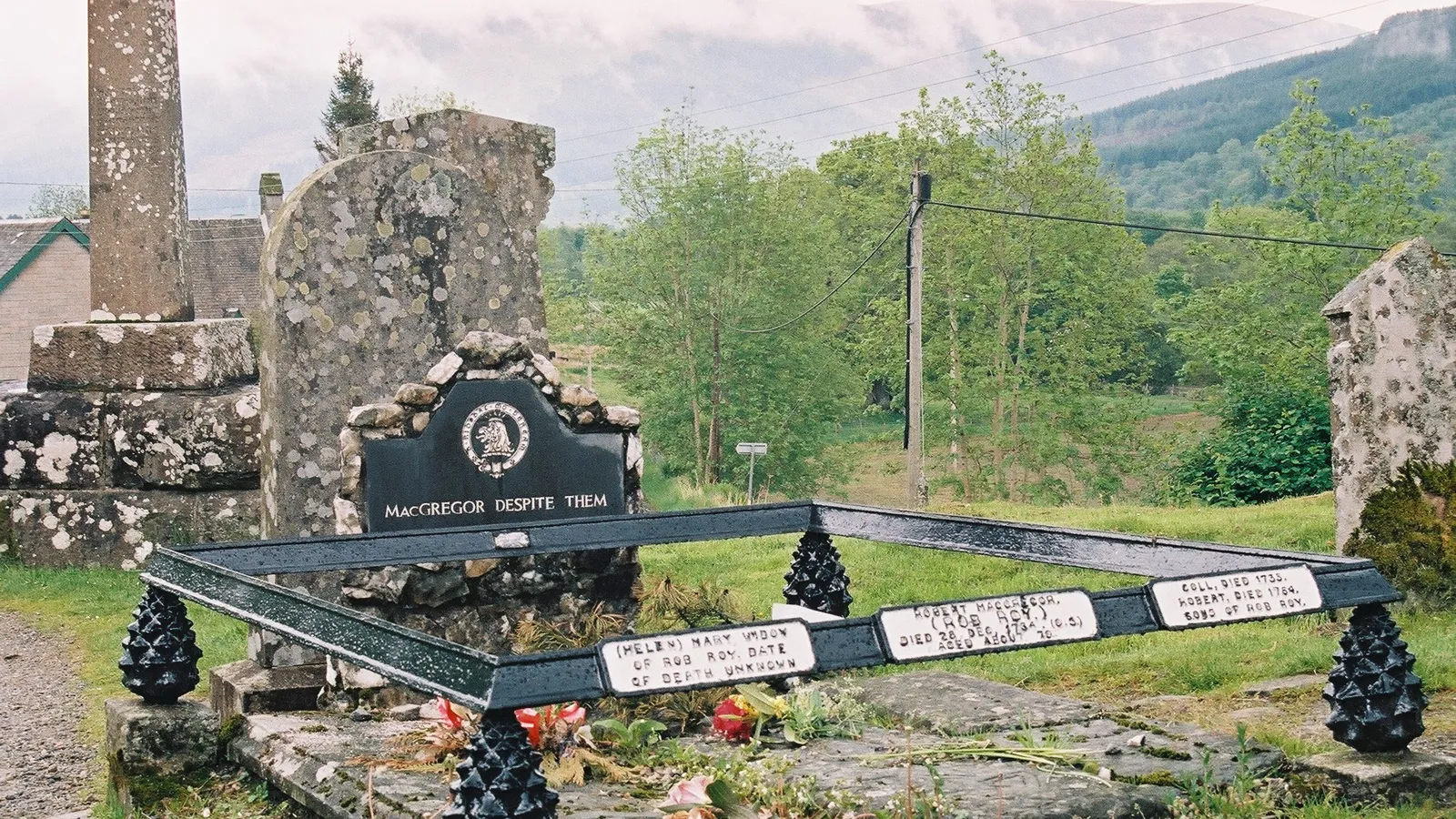
shared Burial. He is buried in Balquhidder kirkyard. Three engraved stones, already centuries old, were later reused to mark his grave and those of his wife and two of his sons. The bronze railings were put up in 1890. John Ramsay of Ochtertyre recorded that the pipers played the tune known as MacCrimmon's Lament at his funeral. The deathbed stories, of Rob rising to receive an enemy fully armed or joking about the last rites, are traditional.
His sons
established The four sons. Coll died within months of his father, in 1735. James Mor, Ranald and Rob Og survived him. Rob's widow Mary was still alive in 1754.
established The murder of John MacLaren. On 4 March 1736 Rob Og, then a youth of perhaps fifteen to twenty, shot John MacLaren in the back while he was ploughing at Drumlich, because MacLaren had taken the lease of his mother's farm. Rob Og fled abroad. James and Ranald were tried as accomplices and acquitted, with their defence paid for by the titular Duke of Perth, though they were found to be reputed thieves.
established The '45 and the Jean Key abduction. James Mor offered his services to the government in 1745, then joined the Jacobites and helped burn Inversnaid barracks. The brothers served in the MacGregor regiment. On 8 December 1750 Rob Og, with James and Ranald, abducted Jean Key, a nineteen-year-old widow with property worth about £1,000, from Edinbellie near Drymen. She was forcibly married to Rob Og at Rowardennan. Her family freed her through the courts, and she died of smallpox in Glasgow months later.
established Trials and executions. James Mor was convicted of abduction in 1752 but escaped from Edinburgh Castle on 17 November 1752 disguised as a cobbler. He died in Paris in October 1754, after trying to sell himself to both the British government and the Jacobites. Rob Og was arrested at Gartmore, convicted after a trial that lasted over 24 hours, and hanged in Edinburgh on 16 February 1754. Ranald lived on as an improving tenant at the Kirkton of Balquhidder and died in about 1786. The abduction inspired a ballad, and most versions name the abductor as Rob Roy, merging father and son.
From The Highland Rogue to Scott
established A legend in his lifetime. By the early 1720s Rob was famous enough to appear in Edinburgh broadsides as a wronged man who defied Montrose and took his "rent" with a receipt. In 1725 Herman Moll's map of Dunbartonshire marked "Rob Roy's Country", on the wrong side of Loch Lomond.
established The Highland Rogue. In 1723 a London publisher issued The Highland Rogue, the first biography. It describes Rob as a hairy giant, a joker and a friend to the poor, mixes real events with invention, and served partly as a satire on Sir Robert Walpole. Its preface is signed "E.B." It was long attributed to Daniel Defoe, but Stevenson shows this came from a misreading of Scott, who said only that Defoe "ought" to have written it. Elias Brockett has been suggested, and Stevenson thinks the likeliest author is Edmund Burt, an English official in the Highlands. The 1743 edition said Rob had lived like Robin Hood.
established Wordsworth. William and Dorothy Wordsworth and Samuel Taylor Coleridge toured the area in 1803. Dorothy recorded the garters story and comparisons with Robin Hood. William's poem "Rob Roy's Grave" opens by setting Rob beside Robin Hood. He had been shown the wrong grave, at Glengyle.
established Scott's novel. Walter Scott collected Rob Roy anecdotes from 1787 and bought relics said to be his, including a gun marked "R.M.C.". His publisher, Archibald Constable, suggested the title Rob Roy to sell the book, though Rob is a secondary character in a story about an Englishman, Francis Osbaldistone. It was published on 31 December 1817, dated 1818, in a first printing of 10,000 copies. Stage versions followed within weeks; Isaac Pocock's play was performed before George IV in Edinburgh in 1822. In 1829 Scott added a long introduction on the historical Rob Roy.
Tourism and film
established The Rob Roy Country. Scott's The Lady of the Lake (1810) and Rob Roy drew visitors to Loch Katrine and Loch Lomond. When Dorothy Wordsworth returned in 1822, a piper played as a boatload of tourists went to see "Rob Roy's Cave", a heap of rocks on Loch Lomond. A portrait long published as Rob Roy is Richard Waitt's 1714 painting of Alasdair Grant, the Clan Grant champion. Benno Schotz's statue of Rob was unveiled in Stirling in 1975.
established Film. A Rob Roy of 1911, starring John Clyde, was the first feature film made in Scotland. Gaumont made another in 1922, Disney released Rob Roy, the Highland Rogue in 1953, and Rob Roy, starring Liam Neeson, followed in 1995. The 1995 film drew partly on W. H. Murray's 1982 biography. Stevenson dismisses its history. The interest it created led the Scottish Record Office to publish The Real Rob Roy: A Guide to the Sources (1995).
shared Two Rob Roys. Stevenson concludes that "there are two Rob Roys. One lived and breathed. The other is a good story". He accepts that the real man was charming, avoided bloodshed, could be kind to the poor and showed real style in humiliating Montrose. He also insists that the man planned a fraud and sold his Jacobite comrades for money.
Did You Know?
- Rob was baptised on Shrove Tuesday, the day Highland cattle were traditionally blessed.
- He spent most of his adult life officially named Robert Campbell, and usually signed "Ro. Campbell".
- He and his two nephews, all born MacGregors, became a Campbell, a Graham and a Murray.
- His rebel garrison on Loch Katrine in 1715 used leather guns, a type of light cannon first made in 1650–51.
- The Earl of Breadalbane made Rob, an outlaw for debt, a judge on his estates.
- After raiding Montrose's girnals in 1717 Rob left a receipt.
- Inversnaid barracks were built on Rob's former land largely because Montrose demanded them.
- In 1727 Rob was paid £100 to spy on Jacobite agents for General Wade.
- Rob Og's 1754 trial lasted over 24 hours without a break.
- Wordsworth's poem "Rob Roy's Grave" was inspired by the wrong grave.
FAQ
1Was Rob Roy a real person?
Yes. He was baptised on 7 March 1671 and died on 28 December 1734. Hundreds of documents record his business, debts, raids and negotiations.
2Why was he called Rob Roy?
From the Gaelic ruadh, red, probably for red hair or a ruddy complexion.
3Why did he call himself Campbell?
In 1693 Parliament revived the ban on the name MacGregor, so documents in that name had no legal force. He took his mother's family name.
4Where was he born?
Probably at his father's house at Glengyle, at the head of Loch Katrine. He was baptised at Buchanan.
5Did he really borrow £1,000 from Montrose and lose it to a dishonest drover?
No record supports this. He owed Montrose £230 and owed over £2,500 in all. He secretly transferred his lands before defaulting, and never mentioned a drover. The drover story first appears decades later.
6Why was he outlawed?
First for debt, in 1712, after he defaulted on cattle contracts. Then for treason, after he fought for the Jacobites in 1715.
7Did Montrose seize his lands and abuse his wife?
No. His lands went first to his friends Bardowie and Glengyle, then to the crown, and were only bought by Montrose in 1720. The story about his wife is not supported by any record.
8Did he fight at Sheriffmuir?
No. He arrived from Doune as the Jacobite left was retreating and refused to join a late counter-attack.
9Was he a loyal Jacobite?
His sympathies were Jacobite, but he spied for Argyll in 1715 and for General Wade in 1727.
10Was he a Scottish Robin Hood?
Partly in legend only. He did help some poor people, but his raiding was aimed at Montrose and paid for by blackmail, and his main concern was his own survival.
11When was he pardoned?
On 2 December 1725, after his submission to General Wade at Dunkeld on 19 October.
12How did he die?
After an illness, in his bed at Inverlochlarig Beg in Balquhidder, on 28 December 1734.
13Where is he buried?
In Balquhidder kirkyard, with his wife Mary and two of his sons.
14Who wrote The Highland Rogue?
An author who signed "E.B.". It was not Daniel Defoe. Stevenson thinks Edmund Burt is the likeliest author.
15What happened to his sons?
Coll died in 1735. Rob Og murdered John MacLaren in 1736 and was hanged in 1754 for abducting Jean Key. James Mor died in exile in Paris in 1754. Ranald became a respectable farmer in Balquhidder.
16Who made him famous?
His own feud with Montrose, broadsides and The Highland Rogue in the 1720s, and above all Scott's novel of 1817.
Sources and Further Reading
Scholarly/Critical
- David Stevenson, The Hunt for Rob Roy: The Man and the Myths (John Donald, 2004)
General
- Undiscovered Scotland, "Rob Roy MacGregor: biography" (undiscoveredscotland.co.uk)
- Wikipedia, "Rob Roy MacGregor" (en.wikipedia.org)
Further reading (books, not consulted online)
- Scottish Record Office, The Real Rob Roy: A Guide to the Sources in the Scottish Record Office (1995)
- W. H. Murray, Rob Roy MacGregor: His Life and Times (1982)
- E.B., The Highland Rogue (London, 1723)
- The Trials of James, Duncan, and Robert M'Gregor, Three Sons of the Celebrated Rob Roy (Edinburgh, 1818)
- Sir Walter Scott, Rob Roy (1817), with Scott's historical introduction of 1829
Caveats: Myths and Disputed Claims
- Do not say Rob Roy was ruined by a £1,000 loan from Montrose that a drover stole; he owed Montrose £230 and planned his default.
- Do not say Montrose seized Rob's lands in 1712; they passed to Bardowie and Glengyle, then to the crown, and Montrose bought them in 1720.
- Do not say Montrose's men burnt Rob's house in 1712 or raped his wife; there is no evidence for either.
- Do not say Rob was outlawed for refusing to give false evidence against Argyll; the pressure to do so came in 1716–17.
- Do not say Rob fought at Killiecrankie; he enrolled in the Jacobite army in 1689, but his presence at the battle is unknown.
- Do not say Rob led the heirship of Kippen; that claim first appears long after his death.
- Do not say he deliberately held back at Sheriffmuir; the best evidence shows he arrived after the Jacobite left had broken.
- Do not date his pardon to 1726 or 1727; it was granted on 2 December 1725.
- Do not call his wife Helen; she was Mary MacGregor.
- Do not say Daniel Defoe wrote The Highland Rogue.
- Do not describe Rob as a Robin Hood who gave to the poor, or as a loyal Jacobite who never betrayed the cause.
- Do not repeat that he could tie his garters without stooping, visited London or fought a duel before George I.
- Do not say he died in battle, on the gallows or of a duel wound; he died after an illness in his own bed.
Card 013 · Great Scots