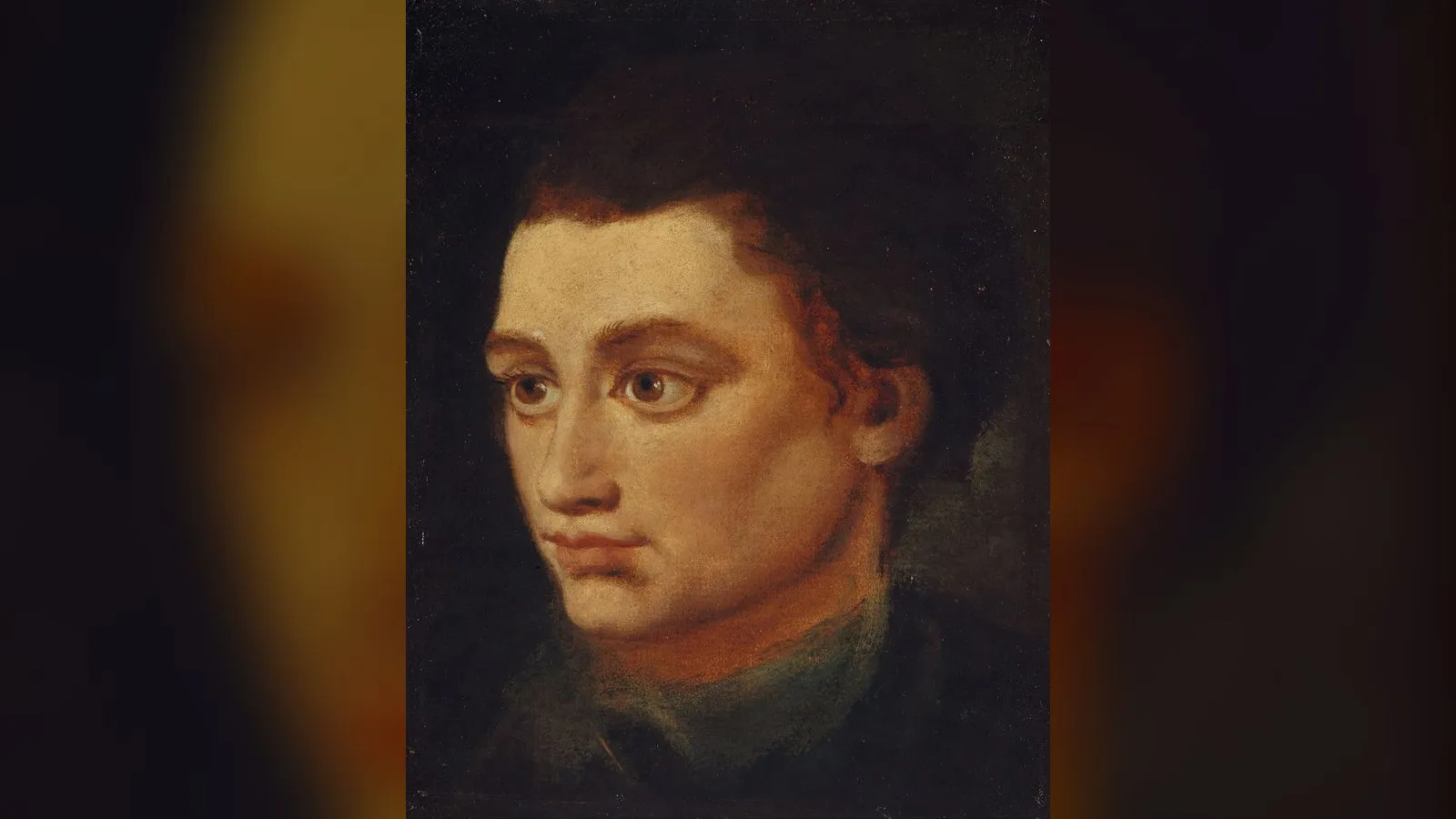

Robert Fergusson (1750–1774): The Poet Burns Called His "Elder Brother in the Muse"
Contents
TL;DR
- Established (Documented): Fergusson, in a literary career spanning barely six years before his death at 24, wrote over 100 poems and directly supplied the Scots-language models that Robert Burns later built on — "Leith Races" shaping Burns's "Holy Fair," and "The Farmer's Ingle" shaping "The Cotter's Saturday Night." This is not a vague influence claim; the specific textual debts are well documented.
- Established (Documented): Fergusson's final months brought a severe, poorly understood mental and physical decline, culminating in his involuntary committal, following a fall and head injury under circumstances biographers describe as genuinely "obscure," to Edinburgh's Darien House asylum, where he died within weeks.
- Established (Documented): Burns himself, years after Fergusson's death, personally and privately commissioned a memorial headstone for Fergusson's previously unmarked grave — a direct, concrete act of acknowledged literary debt from one of history's most famous poets toward one almost nobody now remembers.
- Established, and genuinely consequential: A young doctor named Andrew Duncan visited Fergusson at the Darien House asylum and was reportedly moved by the brutality of his treatment there to later pioneer improved psychiatric care, eventually founding the institution that became the Royal Edinburgh Hospital — meaning Fergusson's suffering had a documented, lasting positive effect on Scottish mental healthcare, independent of his poetry.
- Shared/Traditional, worth correcting directly: Fergusson is popularly remembered, when remembered at all, chiefly as "the poet who influenced Burns" — a framing scholar Robert Crawford has specifically criticised as reducing him to "Burns's John the Baptist," a permanently supporting role that obscures his own substantial, independent literary achievement.
Key Facts
- Born
- 5 September 1750, Edinburgh
- Died
- 17 October 1774, Edinburgh, aged 24
- Parents
- William Fergusson (bank clerk) and Elizabeth Forbes
- Education
- High School of Edinburgh; High School of Dundee; University of St Andrews (1765, no formal degree)
- Occupation
- Legal copyist; poet
- Literary career span
- Approximately six years
- Output
- Over 100 poems, more than 80 published in his lifetime
- Masterwork
- "Auld Reekie" (1773)
- Direct literary influence
- Robert Burns, who called him his "elder brother in the muse"
- Final illness
- Severe mental and physical decline following a fall and head injury, autumn 1774
- Place of death
- Darien House asylum ("Bedlam"), Edinburgh
- Burial
- Canongate Kirkyard, originally unmarked; headstone later commissioned by Robert Burns
Scottish Impact Index (SI Score)
- Global Influence
- 3/10
- Enduring Relevance
- 7/10
- Material Contribution
- 1/10
- Exceptional Achievement
- 6/10
- Lasting Legacy
- 4/10
- Recognition
- 2/10
23/60
Ranked =151st of 200 in Great Scots
A Note on Claim Status
This article follows ScottishInventions.co.uk's standard evidence tiers: Established/Documented (supported by primary sources or strong scholarly consensus), Shared/Traditional (widely repeated but resting on thinner evidence), disputed (credible sources disagree), and Legend/Myth (popular but unsupported or contradicted by the record). The exact circumstances of Fergusson's final fall and head injury remain genuinely unclear in the surviving record — biographers describe them as "obscure" rather than offering a confident account — and this article does not manufacture certainty where the historical sources themselves do not provide it.
Timeline
Born in Edinburgh to William Fergusson, a bank clerk, and Elizabeth Forbes.
Educated at the High School of Edinburgh and the High School of Dundee.
Enters the University of St Andrews on a clan bursary; studies under mathematician William Wilkie and rhetoric professor Robert Watson.
His father dies; his brother Harry enlists in the navy after a business failure.
Nearly expelled from St Andrews following a student disturbance, saved by Wilkie's intervention; leaves without a formal degree (carrying no particular stigma at the time) and returns to Edinburgh to support his mother. A quarrel with his maternal uncle ends a hoped-for source of family support. Becomes a legal copyist, like his father before him.
Befriends the celebrated castrato singer Giusto Fernando Tenducci, who commissions Scots airs from him for an opera — his first published literary contribution.
Begins submitting work to Walter Ruddiman's Weekly Review.
Publishes "The Daft Days," his first Scots-language poem and his genuine creative breakthrough.
A collected edition of his poems is published, selling approximately 500 copies and turning a profit for Fergusson.
Publishes "Auld Reekie," his vivid poetic portrait of Edinburgh and now regarded as his masterpiece; expresses ambitions to translate Virgil's Georgics into Scots.
Writes "Poem to the Memory of John Cunningham," expressing a specific, documented fear of ending his own life institutionalised in an asylum, as that poet had.
His surviving work grows markedly "more darkly melancholic."
Suffers a head injury after falling down stairs, in circumstances biographers describe as obscure; is involuntarily committed to Edinburgh's Darien House asylum.
Dies at Darien House, aged 24, after only a few weeks of confinement.
Buried in an unmarked grave in Canongate Kirkyard.
Robert Burns privately commissions a memorial headstone for Fergusson's grave.
A New York edition of Burns's poems prints a selection of Scots poems chiefly by Fergusson, his first appearance in America.
The headstone is erected.
An edition of Fergusson's poems is published in Philadelphia.
Poet Robert Gilfillan restores the memorial.
The Saltire Society adds a plaque bearing an epitaph Robert Louis Stevenson had intended for Fergusson's grave before his own death.
A statue by sculptor David Annand is unveiled outside Canongate Churchyard, on the anniversary of Fergusson's death.
A previously unknown portrait of Fergusson is discovered at Barnbougle Castle.
Details
A short, difficult life before the poetry even began
Robert Fergusson was born in Edinburgh in 1750 to a bank clerk and his wife, and his early life offered little obvious hint of literary distinction to come. He studied at St Andrews on a clan bursary, nearly faced expulsion over a student disturbance, and left in 1768 without completing a formal degree — a circumstance that, notably, carried no particular social stigma in the period, whatever modern assumptions about academic credentials might suggest. His father's death the previous year and his brother's naval enlistment following a family business failure left Fergusson, upon his return to Edinburgh, as his mother's primary means of support — a responsibility made harder still when a quarrel with his maternal uncle foreclosed what might otherwise have been a source of family assistance. With the traditional professional paths of church, medicine, or law closed to him by circumstance, he became a legal copyist, the same unglamorous clerical occupation his own father had held.
A genuine, rapid literary breakthrough
Fergusson's actual writing career was remarkably brief — by most accounts scarcely six years from his first published work to his death — yet strikingly productive, ultimately producing over 100 poems, more than 80 of them published in his own short lifetime. His early contributions to Edinburgh's literary and musical scene, including Scots airs composed for the celebrated castrato singer Giusto Fernando Tenducci, gave way to his genuine creative breakthrough with "The Daft Days" in January 1772, his first major poem written in Scots rather than conventional literary English. A collected edition the following year sold respectably and turned him a real, if modest, profit. His 1773 poem "Auld Reekie" — a vivid, ambitious verse portrait of Edinburgh itself — is now widely regarded as his masterpiece, and he harboured further serious literary ambitions, including a planned Scots translation of Virgil's Georgics following the earlier precedent of the poet Gavin Douglas. He was, by the consistent account of those who knew his working methods, a genuinely demanding self-critic, known to destroy manuscripts that failed to meet his own standard.
The direct, specific debt Robert Burns owed him
Fergusson's significance to Scottish literature rests substantially on a debt that is unusually well documented and specific, rather than a vague matter of general inspiration. His poem "Leith Races" supplied the direct structural and thematic model for Burns's "Holy Fair," and close textual comparison between Fergusson's "The Farmer's Ingle" and Burns's own "The Cotter's Saturday Night" demonstrates a similarly direct creative lineage. Burns himself was entirely open and generous about this debt, describing Fergusson directly as his "elder brother in the muse" — a specific, deliberate term of literary kinship from a poet not otherwise known for undervaluing his own originality. Fergusson's broader historical significance lies in the "important artistic and linguistic bridge" his work provided between the earlier generation of Allan Ramsay and the later flowering of Scots-language poetry that Burns himself would come to epitomise in wider public memory.
A decline the surviving record cannot fully explain
From the middle of 1773 onward, Fergusson's surviving work takes a markedly darker turn — his own late poem in memory of fellow poet John Cunningham, who had died institutionalised in a Newcastle asylum, expresses what biographers read as a genuine, specific personal fear of suffering the same fate. This is a documented, striking detail: Fergusson appears to have anticipated, with real dread, something close to what actually happened to him within the year.
The precise sequence of his final decline resists full reconstruction from the surviving historical record. In the autumn of 1774, Fergusson suffered a head injury after falling down a flight of stairs — the circumstances of this fall are described by biographers as genuinely "obscure," and this article does not claim more certainty than the sources themselves support regarding whether this was a straightforward accident, a consequence of his declining physical or mental state, or some combination the record cannot now disentangle. What is documented is the outcome: Fergusson was involuntarily committed to Edinburgh's Darien House, known locally as "Bedlam," and died there only a few weeks later, on 17 October 1774, at just 24 years old. He was buried in an unmarked grave in Canongate Kirkyard — a quietly anonymous end for a poet whose actual literary significance would only become fully apparent through another writer's work in the years that followed.
Read in America, beside Burns
Through Burns's door. established Fergusson reached America on Burns's coat-tails. The literary historian Andrew Hook, in Scotland and America: A Study of Cultural Relations, 1750–1835 (1975), notes that one of the two earliest American editions of Burns, published at New York in 1788, came with a selection of Scots poems chiefly by Fergusson. An American edition of Fergusson's own poems followed at Philadelphia in 1815, and Hook finds references to him in American periodicals frequent enough to show that his place in the vernacular line was generally understood.
One of the "older bards". established American readers placed him in a sequence. A Scots "Lament on Burns" in the Philadelphia Port Folio in 1806 linked Burns, as Death's latest victim, with the older bards Ramsay and Fergusson. In 1802 the Paisley poet and ornithologist Alexander Wilson, by then living in Pennsylvania, wrote that "In Burns, Ferguson, Ramsay, and all our Scottish songs" lay "the charms that captivate every heart" (as quoted by Hook). In 1818 a New York reviewer of Scott spoke of the mountains and torrents "that have echoed the songs of Ferguson [sic] and Burns" (as quoted by Hook).
shared Hook groups Fergusson with Allan Ramsay and Burns as the inward-looking, vernacular side of Scotland's eighteenth-century revival, as against the English-writing "North Britons" such as Hume and Smith, and calls him "a greater poet" than Ramsay. That pairing of Ramsay, Fergusson and Burns is the same lineage this article describes, though, as Robert Crawford warns, it can still leave Fergusson as a stepping stone rather than a poet in his own right.
An unexpected, documented legacy in psychiatric reform
One of the more striking and genuinely underappreciated aspects of Fergusson's story is its indirect contribution to the reform of Scottish mental healthcare. A young doctor, Andrew Duncan, visited Fergusson during his brief confinement at Darien House and was, by documented account, profoundly affected by the brutality of the conditions and treatment he witnessed there. This experience is credited with shaping Duncan's subsequent, sustained career advocating for improved psychiatric care, eventually leading to the founding of the institution that would become the Royal Edinburgh Hospital — meaning Fergusson's own suffering, entirely apart from his poetry, had a real, lasting, positive institutional legacy for later generations of Scottish psychiatric patients.
The headstone, and a legacy that risks being reduced to a footnote
Thirteen years after Fergusson's death, in 1787, Burns — by then himself a major literary figure — privately commissioned a proper memorial headstone for Fergusson's previously unmarked grave, which was erected in 1789. This was a genuine, deliberate, and personally funded act of acknowledgement from one poet to another, not a vague gesture of general admiration, and it remains the clearest physical marker of the direct literary debt Burns himself always readily acknowledged. The memorial was later restored by poet Robert Gilfillan in 1850, and Robert Louis Stevenson's own intended epitaph for Fergusson, left incomplete at Stevenson's death, was finally added to the site by the Saltire Society in 1995 — a chain of later Scottish literary figures, across more than two centuries, each independently moved to formally honour a poet who died before he turned 25.
Scholar Robert Crawford has offered a pointed and, this article suggests, fair critique of how Fergusson's reputation has generally been handled since: reduced, in Crawford's own framing, to the role of "Burns's John the Baptist" — a permanently supporting, preparatory figure in someone else's story, rather than a substantial poet deserving assessment on his own independent terms. Given the genuine scope of his six-year output — over 100 poems, a masterwork in "Auld Reekie," real linguistic and formal innovation bridging two distinct eras of Scots poetry — this framing understates a figure whose own achievement, cut brutally short, deserves more than a supporting role in someone else's more famous career.
Did You Know?
- Robert Fergusson's entire literary career lasted roughly six years, yet he produced over 100 poems, more than 80 of them published before his death at 24.
- Specific, traceable debts link his work directly to Robert Burns's most famous poems: "Leith Races" shaped "Holy Fair," and "The Farmer's Ingle" shaped "The Cotter's Saturday Night."
- Burns himself called Fergusson his "elder brother in the muse" and personally, privately paid for a memorial headstone for Fergusson's previously unmarked grave, thirteen years after his death.
- In a poem written less than a year before his own death, Fergusson expressed a specific, documented fear of dying institutionalised in an asylum — a fate that then actually befell him.
- The exact circumstances of the fall and head injury that preceded his final decline remain genuinely unclear in the historical record.
- A doctor who visited Fergusson during his brief, brutal confinement at Edinburgh's "Bedlam" asylum was reportedly moved by the experience to later found the institution that became the Royal Edinburgh Hospital.
- Robert Louis Stevenson intended to write Fergusson's epitaph but died before completing the project; it was finally added to his grave in 1995, over two centuries after Fergusson's death.
- Fergusson's poems first appeared in America in 1788, bound in with a New York edition of Burns.
- Scholar Robert Crawford has specifically criticised the tendency to remember Fergusson only as a forerunner to Burns, describing this framing as reducing him to "Burns's John the Baptist."
Frequently Asked Questions
1Who was Robert Fergusson?
An Edinburgh-born poet (1750–1774) who, in a career of barely six years, produced over 100 poems in Scots and English and directly shaped the work of Robert Burns, who openly credited him as a major influence.
2How did Fergusson influence Robert Burns?
Directly and specifically — Fergusson's "Leith Races" supplied the model for Burns's "Holy Fair," and his "The Farmer's Ingle" shaped Burns's "The Cotter's Saturday Night." Burns himself called Fergusson his "elder brother in the muse."
3How did Robert Fergusson die?
He died in October 1774, aged 24, in Edinburgh's Darien House asylum, following a severe mental and physical decline and a head injury sustained in a fall whose exact circumstances remain unclear in the historical record.
4Did Fergusson predict his own fate?
In a striking, documented detail, he wrote a poem less than a year before his death expressing a specific fear of dying institutionalised in an asylum, as a fellow poet had — a fear that then came true.
5Did Robert Burns really pay for Fergusson's gravestone?
Yes. Fergusson was initially buried in an unmarked grave, and Burns personally and privately commissioned a proper memorial headstone in 1787, erected in 1789 — a direct, concrete act of acknowledged literary debt.
6What is Fergusson's most significant poem?
"Auld Reekie" (1773), a vivid poetic portrait of Edinburgh now regarded as his masterpiece, though his breakthrough came earlier with "The Daft Days" (1772), his first major Scots-language poem.
7Did Fergusson's death have any lasting positive effect?
Indirectly, yes. A doctor who visited him during his confinement, Andrew Duncan, was reportedly moved by the brutal conditions he witnessed to later pioneer improved psychiatric care, eventually founding the institution that became the Royal Edinburgh Hospital.
8Is it fair to remember Fergusson mainly as "the poet who influenced Burns"?
Scholars increasingly argue this framing is unfair and reductive. Robert Crawford has specifically criticised it as reducing Fergusson to "Burns's John the Baptist," obscuring the genuine scope and quality of his own independent, substantial body of work.
9Was Fergusson formally educated?
He attended the University of St Andrews on a bursary but left in 1768 without completing a formal degree — a circumstance that carried no particular stigma at the time.
10Was Fergusson read in America?
Yes, modestly. A selection of his Scots poems was printed with a New York edition of Burns in 1788, an edition of his own poems appeared at Philadelphia in 1815, and American magazines regularly named him with Ramsay and Burns.
11How is Fergusson remembered today?
Through a restored memorial grave in Edinburgh's Canongate Kirkyard, a 2004 statue near the same site, a plaque in St Giles Cathedral, and inclusion among the poets depicted on Edinburgh's Scott Monument, positioned directly opposite Robert Burns.
Sources and Further Reading
Primary / Institutional
- University of Glasgow: Celebrating the Scottish Poet, Robert Fergusson (1750–1774)
- Undiscovered Scotland: Robert Fergusson
- Scottish Poetry Library: Robert Fergusson
Scholarly
- Andrew Hook, Scotland and America: A Study of Cultural Relations, 1750–1835 (Blackie, 1975)
- History Today: Robert Fergusson — Scotia's Bard
- London Review of Books: Sally Mapstone — Drinking and Spewing: The Variousness of Robert Fergusson
- Cairns Craig, "The Literary Tradition", in T. M. Devine and Jenny Wormald (eds), The Oxford Handbook of Modern Scottish History (Oxford University Press, 2012) — further reading on Fergusson and poetry in Scots
General
- Wikipedia: Robert Fergusson
- Encyclopaedia Britannica: Robert Fergusson
- The Edinburgh Reporter: Fergusson Project Will Remember 18th Century Poet
Caveats: Myths and Disputed Claims
- Fergusson is best understood simply as a minor precursor to Robert Burns. A reductive framing this article explicitly rejects, following scholar Robert Crawford's direct critique of the "Burns's John the Baptist" characterization. Fergusson's independent body of work — over 100 poems in six years, including the substantial achievement of "Auld Reekie" — merits assessment on its own terms.
- The exact cause of Fergusson's final fall and head injury is clearly established. Not accurate. Biographers describe the circumstances as genuinely "obscure," and this article does not claim more certainty than the surviving historical sources actually support.
- Fergusson's confinement and death had no lasting consequence beyond his own tragedy. Contradicted by the record. A doctor who witnessed his treatment at the Darien House asylum is credited with being moved to pursue reforms that eventually led to the founding of the Royal Edinburgh Hospital.
- Burns's tribute to Fergusson was simply polite literary courtesy. An understatement. Burns's commissioning of a personal, privately funded memorial headstone thirteen years after Fergusson's death represents a specific, concrete, financially real act of acknowledged debt, not a passing rhetorical compliment.
Card 098 · Great Scots