
Robert the Bruce
Contents
Robert I, King of Scots from 1306 to 1329, took a conquered country without a king and restored it to independence. He won at Bannockburn in 1314 and secured English recognition of Scotland's independence in 1328. He was also a ruthless politician who changed sides repeatedly, killed his chief rival in a church, and was excommunicated. This card tests the documented Bruce against the legends, from the spider in the cave to the journey of his heart.
TL;DR
- established Robert de Brus was born on 11 July 1274, most likely at Turnberry Castle in Ayrshire, into a family with lands in both Scotland and England.
- established Between 1296 and 1306 he submitted to Edward I more than once. On 10 February 1306 he killed his rival John "the Red" Comyn in the Greyfriars church at Dumfries, and he was crowned at Scone on 25 March 1306.
- established After early defeats and years of guerrilla war, he won the Battle of Bannockburn on 23–24 June 1314. The Treaty of Edinburgh–Northampton of 1328 recognised Scottish independence.
- established The Declaration of Arbroath of 1320 was a letter from the Scottish barons to Pope John XXII, not a popular declaration of independence.
- traditional The story of Bruce and the spider first appears in Sir Walter Scott's Tales of a Grandfather (1828–1830), five centuries after his death.
Key Facts
- Born
- 11 July 1274, probably Turnberry Castle, Ayrshire
- Parents
- Robert de Brus, 6th Lord of Annandale; Marjorie, Countess of Carrick
- Great Cause
- Throne awarded to John Balliol, 17 November 1292
- Killed John Comyn
- 10 February 1306, Greyfriars church, Dumfries
- Crowned
- 25 March 1306, Scone
- Defeats
- Methven (June 1306), Dalrigh (August 1306)
- Bannockburn
- 23–24 June 1314
- Declaration of Arbroath
- 6 April 1320
- Treaty of Edinburgh–Northampton
- Signed at Edinburgh, 17 March 1328
- Died
- 7 June 1329, Cardross, aged 54
- Buried
- Body at Dunfermline Abbey; heart at Melrose Abbey
Scottish Impact Index (SI Score)
- Global Influence
- 7/10
- Enduring Relevance
- 10/10
- Material Contribution
- 3/10
- Exceptional Achievement
- 8/10
- Lasting Legacy
- 7/10
- Recognition
- 8/10
43/60
Ranked =27th of 200 in Great Scots
A Note on Claims and Evidence
Each major claim carries one of three labels. established means supported by primary records, official bodies or several independent reliable sources. shared means the core fact is sound but sources disagree on details, dates or interpretation. traditional means widely repeated but not traceable to a primary or independent source.
Bruce's reign is well documented in charters, treaties, letters and chronicles on both sides of the border. But many famous details come from John Barbour's celebratory poem The Brus (c.1375) or from much later writers, and English and Scottish chronicles tell key episodes, such as the killing of Comyn, in opposite ways. Army sizes at Bannockburn, the exact site of the main fighting, and the cause of Bruce's death are all disputed.
Timeline
Robert de Brus is born, probably at Turnberry.
Margaret, Maid of Norway, dies; the Scottish throne is left without an heir.
Edward I's court awards the throne to John Balliol over Bruce's grandfather.
Bruce and his father swear fealty to Edward I at Berwick.
Bruce joins the Scottish revolt, then submits at Irvine.
Bruce becomes a joint Guardian of Scotland with John Comyn.
Bruce submits to Edward I again.
Bruce kills John Comyn at Dumfries.
Bruce is crowned at Scone.
Bruce is defeated at Methven and Dalrigh and becomes a fugitive.
Bruce wins at Loudoun Hill.
Edward I dies at Burgh-by-Sands.
Bruce recaptures and demolishes castles across Scotland.
Bruce wins the Battle of Bannockburn.
The Scots capture Berwick; Edward Bruce is killed in Ireland.
The Declaration of Arbroath is sent to the Pope.
The Treaty of Edinburgh–Northampton is signed.
Bruce dies at Cardross.
Sir James Douglas dies in Spain carrying Bruce's heart.
Details
1. Origins and Identity: A Magnate of Two Realms
Robert was born on 11 July 1274, almost certainly at Turnberry Castle in Ayrshire, the head of his mother's earldom (Lochmaben in Dumfriesshire and Writtle in Essex are alternative traditions but less likely). He was the eldest son of Robert de Brus, 6th Lord of Annandale, and Marjorie, Countess of Carrick. The Bruce family was Anglo-Norman in origin — a Robert de Brus had come to Britain in the generations after the Conquest, and the family had held the Lordship of Annandale since the 1120s, when the first lord settled in Scotland under David I. Crucially, they held substantial estates in England as well as Scotland — in Cumberland, Durham, Essex, Middlesex and Northumberland — which made cross-border loyalty a normal condition of their existence, not treachery.
From his father, Robert inherited the Lordship of Annandale and a royal lineage as a fourth great-grandson of David I; from his Gaelic mother he inherited the Earldom of Carrick and an ancient Celtic bloodline. He was raised trilingual — Gaelic, Scots and Norman French — and, in the south-western and Hebridean tradition, was likely fostered to allied Gaelic kindreds, which historians have linked to his later affinity for fast, light "hobelar" mounted warfare. He was, in short, a man of genuinely composite identity: Norman aristocrat, Scots earl, and Gaelic lord all at once.
2. The Succession Crisis and the Great Cause (1290–1292)
When the child-queen Margaret, "Maid of Norway," died in 1290, the direct line of the Scottish royal house failed and the throne stood empty. Exactly thirteen claimants came forward in the official record; the serious contenders were John Balliol, Robert de Brus the Competitor (Robert's grandfather), John Hastings and Floris V of Holland. Fearing civil war between the Bruce and Balliol factions, the Guardians of Scotland invited Edward I of England to arbitrate — a fateful decision, since Edward extracted recognition of his overlordship before agreeing. The case was heard by a commission of 104 "auditors": 24 appointed by Edward I, who presided, and 40 each named by Bruce and Balliol.
The legal heart of the "Great Cause" was a clash of principles. Balliol descended from the eldest daughter of David, Earl of Huntingdon; Bruce was a generation closer to the source (a son of the second daughter). Balliol argued primogeniture; Bruce argued proximity of blood. On 17 November 1292, at Berwick, the verdict went to Balliol on the ground of primogeniture — and notably, the majority of Scottish magnates, including many of Bruce's own appointed auditors, accepted it. The Bruces never accepted the justice of the decision, and their resentment of Balliol kingship — and of the Comyns who had secured it — set the stage for everything that followed.
3. Shifting Allegiances (1296–1306): The Morally Complex Heart of the Story
This is the part of Bruce's life that hero-worship tends to airbrush, and it should not be. In August 1296, Robert and his father swore fealty to Edward I at the Berwick parliament of 28 August 1296 — part of the mass submission known as the Ragman Roll, in which roughly 1,650 nobles, prelates and landholders swore fealty (the Calendar of Documents Relating to Scotland records over 1,500 fealties enrolled in more than 180 deeds, of which about 70 originals survive at Kew). When the Scottish revolt broke out in 1297, the young Robert joined it — against his father's caution — laying waste the lands of Edward's adherents, but was forced to terms in the Capitulation of Irvine (July 1297), again swearing allegiance. The popular claim that he fought for the English at Falkirk (1298) — dramatized in Braveheart — is not supported by good evidence and is rejected by most historians.
He served as a joint Guardian of Scotland from 1298 alongside his rival John Comyn and Bishop Lamberton, but resigned around 1300 amid quarrels with Comyn and the looming prospect of Balliol's restoration — which Bruce, whose whole cause was that his family should rule, could never accept. Around 1302 he submitted to Edward I again and returned to "the king's peace." Historians read this not as cowardice but as cold calculation: Bruce would not risk his estates fighting for a cause that would put Balliol (and the Comyns) back on top. By the end of 1305, with Wallace executed and Scotland under English dominion, Bruce — trusted by neither Edward nor the Comyns — appears to have been quietly plotting to seize the crown himself.
4. The Murder of John Comyn (10 February 1306)
The decisive act of Bruce's life was a killing in a church. On 10 February 1306, Bruce met John "the Red" Comyn — nephew of the deposed King John Balliol, and the most powerful of his rivals — at the Greyfriars church in Dumfries. A quarrel before the high altar ended with Bruce stabbing Comyn; his companions (tradition names Roger de Kirkpatrick and Robert Fleming) finished the killing. Comyn's uncle, Sir Robert Comyn, was also killed.
What the sources actually say is honestly uncertain. English accounts (and the official letter from the English court to the Pope) portray a premeditated, sacrilegious murder — Bruce luring Comyn to consecrated ground to kill him. Later Scottish chronicles (Fordun, Barbour) justify the deed by blaming Comyn's treachery, claiming he had betrayed Bruce to Edward. The famous story of a prior "contract" or "band" between them — that one would take the crown and the other the lands — is plausible but cannot be verified; it appears in later sources coloured by hindsight. The most-quoted dramatic exchange ("I doubt… I mak siccar!" — "I make sure!") is from tradition, not contemporary record. The standard modern academic studies (Barrow) long argued the killing was not premeditated; more recent scholarship (notably Alexander Grant's 2007 Scottish Historical Review article "The Death of John Comyn: What Was Going On?") argues that, given Comyn would never have accepted a Bruce kingship, the chronicles' consistent presentation of premeditation may be valid after all. The one certainty: Bruce did it, and within six weeks he was king.
5. Coronation and the Early Disasters (1306)
Bruce raced to Scone and was inaugurated King of Scots on 25 March 1306, with the royal robes that Bishop Robert Wishart had hidden from the English. The ceremony was hasty and improvised: the Stone of Destiny had been carried off to Westminster by Edward I in 1296, and the Earl of Fife — who by tradition enthroned Scottish kings — was a teenager in English custody. His aunt Isabella MacDuff, Countess of Buchan, performed the inauguration, an act of extraordinary courage given that she was married to a Comyn; she would later be imprisoned by Edward in a cage on the walls of Berwick Castle. (Note: some sources confuse "Isabel of Fife"/"Isabella, Countess of Buchan"; she was a MacDuff of Fife married to the Comyn Earl of Buchan.)
The reign began in catastrophe. In June 1306 Bruce's army was shattered at Methven by Aymer de Valence in a surprise attack; in August he was routed again at Dalrigh by the MacDougalls of Lorn, kinsmen of the murdered Comyn. His brother Nigel and other supporters were captured and executed; his wife, daughter and sisters were taken. Bruce became a hunted fugitive, spending the winter of 1306–07 in hiding — possibly in the Western Isles, sheltered by Christina of the Isles, and possibly on Rathlin Island off the Irish coast. It is from this desperate period that the most famous legend springs.
6. The Spider Legend
The story is beloved and almost certainly untrue. As the tale goes, a despairing Bruce, hiding in a cave, watched a spider try repeatedly to anchor its web, failing and trying again until it succeeded — inspiring him to "try, try again." The problem is chronology: for over 500 years after Bruce's death, his story contained no spider. The tale first appears in print in Sir Walter Scott's Tales of a Grandfather (published 1828–1830). Scott may have invented it or recorded an oral tradition, but there is no contemporary or near-contemporary source. Tellingly, some versions of the story were originally attached not to Bruce at all but to his lieutenant Sir James Douglas. Various locations claim the cave — Rathlin Island, the King's Cave on Arran (called "Fingal's Cave" before the Victorian period) — which is itself a sign of folklore, not history. It is an inspiring moral fable; it is not biography.
7. The Guerrilla Campaign and Recovery (1307–1314)
The turning point was not a spider but a death. Edward I died at Burgh-by-Sands, near the Solway, on 7 July 1307, while marching north to crush Bruce. His son Edward II was a far weaker and less committed adversary, and the reprieve was decisive. Bruce had already won a sharp victory at Loudoun Hill (May 1307) against Valence.
Over the next seven years Bruce waged a masterly guerrilla war. He avoided pitched battle, relied on surprise, mobility and knowledge of terrain, and methodically recaptured castles — Linlithgow (1310), Dumbarton (1311), Perth (1312), Roxburgh and Edinburgh (1314, the latter taken by Thomas Randolph in a daring night escalade). Critically, he slighted (demolished) the castles he took, denying the English strongpoints to reoccupy — a deliberate scorched-earth strategy. He also crushed his domestic enemies, harrying Buchan to destroy Comyn power. His key commanders were the brilliant Sir James Douglas ("the Good," or "the Black Douglas" to the English), his nephew Thomas Randolph, Earl of Moray, and his brother Edward Bruce. It was Edward Bruce who, besieging Stirling Castle, made the pact with its governor Sir Philip de Mowbray that the castle would surrender unless relieved by Midsummer (24 June) 1314 — a chivalric agreement that forced the great confrontation neither side could now avoid.
8. The Battle of Bannockburn (23–24 June 1314)
To relieve Stirling, Edward II brought a large army north. Estimates vary, but the Scottish historian William Mackenzie reckoned the English at roughly 3,000 mounted men-at-arms and about 13,000 foot (c.16,000 total), against perhaps 7,000 Scots; modern researchers generally conclude the Scots faced English forces one-and-a-half to three times their number. The Scots were organised into tightly packed spear formations called schiltrons. Bruce chose his ground carefully near Stirling, around the boggy carse of the Bannock Burn and the New Park, terrain that funnelled and hampered the English cavalry.
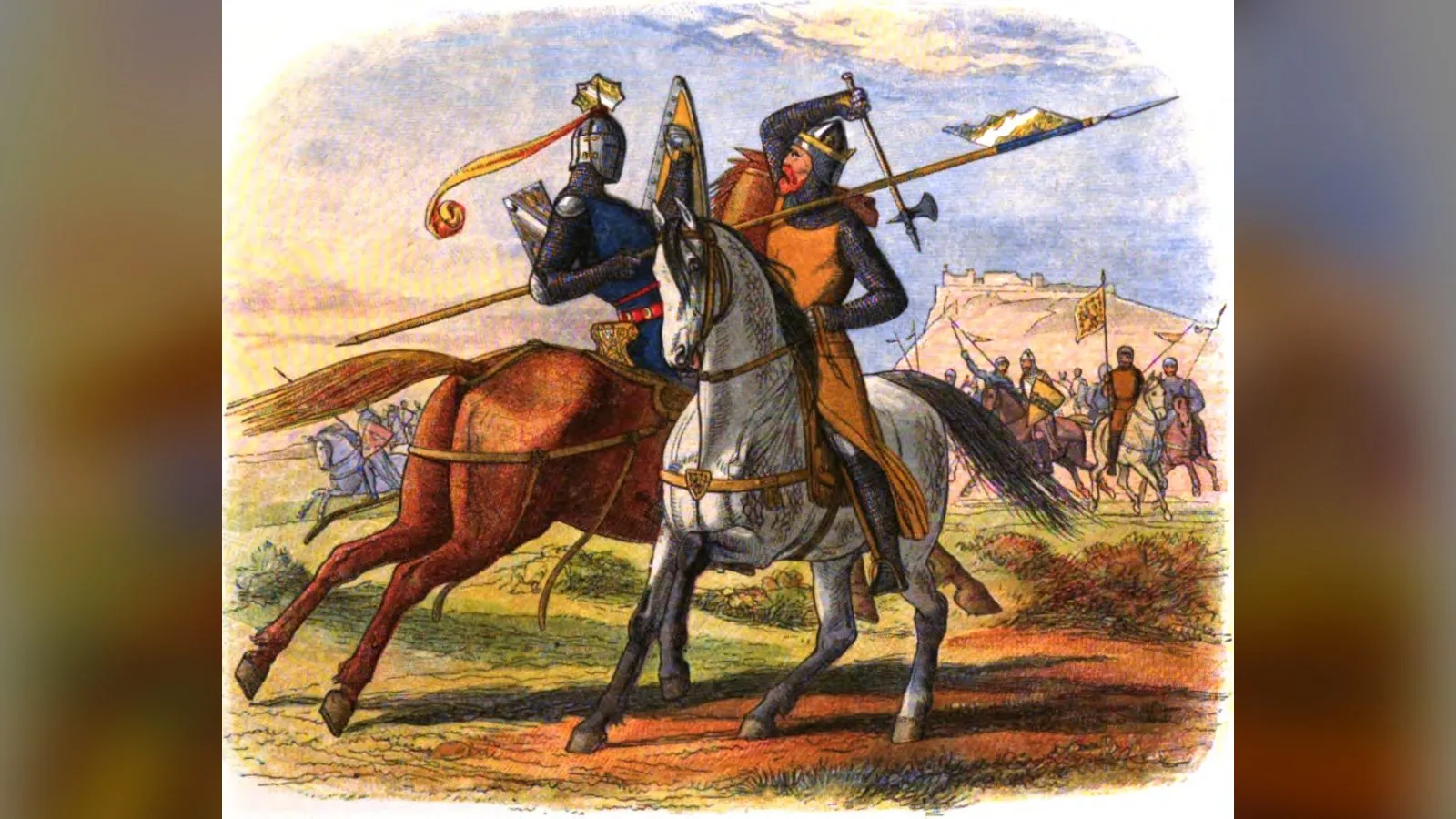
Day one (23 June) produced the most famous single-combat in Scottish history. The English knight Sir Henry de Bohun, spotting Bruce mounted on a light palfrey and armed only with an axe, charged with couched lance. Bruce side-stepped at the last moment and split Bohun's helmet and skull with one axe-blow — afterwards reportedly lamenting only that he had "broken the shaft of his good axe." (The fullest version is Barbour's celebratory poem, but the core event is corroborated by the English Vita Edwardi Secundi and the Lanercost Chronicle, so something real underlies it.) Also on day one, Randolph's schiltron repulsed an English cavalry force near St Ninian's Kirk.
Day two (24 June) brought the decisive clash. The Scots advanced their schiltrons onto the cramped, marshy ground; the English cavalry could not deploy or break the spear-walls and became jammed against the burns. As the English faltered, the "sma' folk" — camp followers and lightly armed local volunteers, traditionally said to have been waiting behind Gillies Hill (or Coxet Hill) — appeared and were taken by the English for fresh reserves, triggering panic and a rout. Edward II fled to Stirling, was refused entry, and escaped to Dunbar with Douglas in pursuit. The Bannock Burn ran choked with the dead.
A genuine controversy: despite the battle's fame, historians do not agree on the precise location of the main fighting on day two. The carse of the Forth, the "Dryfield" of Balquhiderock, and the ground between the Bannock Burn and the Pelstream have all been argued. The National Trust for Scotland visitor centre sits on land traditionally associated with the battle, but the exact site remains debated. (The popular tale of Knights Templar fighting in the Scottish ranks is a modern myth with no historical basis.)
Bannockburn did not end the war — that took another fourteen years — but it was the decisive military and symbolic turning point, securing Bruce's grip on Scotland and his legitimacy as king.
9. The Declaration of Arbroath (1320)
The Declaration of Arbroath is one of the most celebrated documents in Scottish history, and it is widely misunderstood. It was a letter, dated 6 April 1320, from the barons and freeholders of Scotland to Pope John XXII — one of three letters sent (the others from King Robert himself and from four Scottish bishops); only the barons' letter survives. It was probably composed by Bernard of Kilwinning (Bernard de Linton), Abbot of Arbroath and Chancellor of Scotland, and sealed by fifty-one magnates and nobles — eight earls and thirty-one barons are named in the text — of which, according to National Museums Scotland, "Only 19 seals now remain."
Its purpose was specific and diplomatic: to persuade the Pope — who had not recognised Bruce as king and had excommunicated him — to acknowledge Scottish independence and lift the censure. It asserted the antiquity of Scottish nationhood and denounced English aggression, and it dangled the prospect of Scottish help with a crusade if England left Scotland in peace. Its most famous lines, often echoed in later freedom rhetoric, declare: "For so long as a hundred of us remain alive, we will never on any conditions be subjected to the lordship of the English… It is in truth not for glory, nor riches, nor honours that we are fighting, but for freedom alone, which no honest man gives up but with life itself."
Honesty requires noting what it was not. It was not a "people's declaration of independence" in the modern sense but an aristocratic and clerical document, and a piece of skilful propaganda as much as political philosophy. Several of its named signatories had previously been English supporters and would shift allegiance again in the turbulent politics of the period. Its modern iconic status — and the comparison with the American Declaration of Independence — largely dates from its printing and publication in the late 17th century. Diplomatically it formed part of a campaign that did bear fruit: the Pope eventually urged Edward II toward peace, and recognition followed within a decade.
10. Final Years and the Treaty of Edinburgh–Northampton (1328)
After Bannockburn, Bruce pursued a war of attrition: devastating raids deep into northern England, the capture of Berwick (1318), and the opening of a second front in Ireland, where his brother Edward was installed as King of Ireland in 1316 before being killed in 1318. The pressure, combined with the collapse of Edward II's regime in England, finally forced a settlement. By the Treaty of Edinburgh–Northampton — signed at Holyrood Abbey, Edinburgh on 17 March 1328 by Robert I (and, for the English side, the dowager Queen Isabella and Roger Mortimer, who effectively ruled for the young Edward III), and ratified by the English Parliament at Northampton on 1 May — England recognised Scotland as a fully independent kingdom, Robert I and his heirs as its rightful rulers, and the border as it had stood under Alexander III. In return Scotland paid £20,000 sterling, and the alliance was sealed by the marriage of Bruce's young son David to Edward III's sister Joan. Many English nobles loathed it as the "Shameful Peace," and it would be overturned by Edward III in 1333 — but for Bruce it was complete vindication. In October 1328 the Pope lifted the interdict and Bruce's excommunication, and soon granted Scottish kings the right to be anointed and crowned — a clear acknowledgement of independent statehood.
Bruce did not enjoy the peace long. He had been seriously ill for some years, and died at his manor of Cardross, near Dumbarton, on 7 June 1329, aged 54. His body was buried at Dunfermline Abbey beneath an inscription remembering him as the good King Robert, deliverer of Scotland; his heart, by his own instruction, was destined for a separate journey (see below); and his viscera were reportedly interred near Cardross.
On the leprosy question — be careful. It is conventional to say Bruce died of leprosy, but the evidence is weak and contested. The leprosy claim derives from hostile English and continental chroniclers (the Lanercost Chronicle, Grey's Scalacronica, Jean Le Bel's "la grosse maladie"), and "leprosy" was both a grave insult and a catch-all medieval term for skin disease. Scottish accounts by those present at his death do not mention it. A contemporary eyewitness letter from Ulster in July 1327 says only that the king was so feeble he could "scarcely move anything but his tongue" — with no mention of any skin ailment. Modern forensic study is divided but trends against leprosy: a 2016–17 examination led by Professor Andrew Nelson of Western University (University of Western Ontario), in his paper "A Paleopathological Assessment of the Leprosy Diagnosis for King Robert the Bruce," found the anterior nasal spine was "teardrop-shaped as it would be in a healthy person" (it would be eroded and circular with leprosy) and that the metatarsal showed no "pencilling" — both diagnostic markers absent. The work was done with sculptor Christian Corbet and leprosy expert Dr Olivier Dutour, using Lord Elgin's original 1818–19 skull cast (announced February 2017). The 2016 University of Glasgow / Liverpool John Moores University facial reconstruction (historian Dr Martin MacGregor; Professor Caroline Wilkinson) deliberately produced both a leprosy and a non-leprosy version, hedging the question. The original skeleton, excavated at Dunfermline in 1818–19, was sealed in pitch and reburied, so no bone or DNA survives for testing — only plaster casts of the skull. The honest verdict: he suffered a serious chronic illness, possibly leprosy but possibly not; the leprosy diagnosis should be flagged as disputed, not stated as fact.
11. The Heart of Bruce
Bruce had vowed to go on crusade and could not; on his deathbed he asked that his heart be taken to fight against "God's foes." The core fact is documented: a surviving papal dispensation permitted the separation of his heart from his body (necessary because a 1299 papal bull forbade dividing corpses without permission), so the embalming and removal of the heart are genuine history. Sir James Douglas carried the embalmed heart, and when a great crusade failed to materialise, joined the campaign of Alfonso XI of Castile against the Moorish kingdom of Granada. Douglas was killed at the Battle of Teba in August 1330.
The vivid details, however, are legend layered over fact. The dramatic battle-cry — variously rendered "Lead on, brave heart," "Go first as thou wast wont," and many other forms — has no fixed wording and largely derives from Barbour's celebratory poem (c.1375) embellished by Sir Walter Scott and Victorian poets; treat it as apocryphal. No strictly contemporary record confirms the heart's physical return to Scotland; the return-and-burial story rests on the chronicle tradition (chiefly Barbour, with an early continental version in Jean Le Bel). A lead casket containing a heart was found beneath the Chapter House floor at Melrose Abbey — first in 1921, then re-examined by Historic Scotland in 1996, when a fibre-optic camera confirmed a conical lead casket and a 1921 plaque. Historic Scotland pointedly declined to claim certainty (there were three recorded heart burials at Melrose), no DNA test was done (the heart had been preserved in tar, which would have destroyed DNA), and the casket was reburied in 1998, with a marker unveiled by the then Scottish Secretary Donald Dewar on the anniversary of Bannockburn carrying a line adapted from Barbour about a noble heart and freedom.
12. Legacy
Robert the Bruce is, with William Wallace, the central figure of Scottish national identity — the king who took a conquered, leaderless country and, against overwhelming odds, restored it to independent statehood, founding the dynasty (through his daughter Marjorie's marriage to Walter Stewart) that became the Stewart line. The achievement is real and immense.
But the honest portrait is more interesting than the patriotic icon. Bruce was a man of his violent age: he submitted to Edward I repeatedly when it suited him, committed sacrilegious murder to clear his path to the throne, was excommunicated, ruthlessly destroyed Scottish rivals, and visited devastating, profit-driven raids on the people of northern England. He was a superb guerrilla general, a shrewd diplomat and an inspiring leader — and also a calculating, sometimes brutal, dynastic politician. To tell his story well is to hold both truths at once: the deliverer of Scotland and the outlaw king who waded to the throne through a murdered rival's blood.
Writing Balliol out: Bruce's propaganda
Bruce's seizure of the throne required an explanation, and his government supplied one. The Declaration of the Clergy (St Andrews, March 1309) retold the Great Cause in Bruce's favour. It claimed that Edward I had imposed Balliol against a universal Scottish belief that Bruce had the better title, and it presented Balliol as an English puppet. By 1320 the Declaration of Arbroath left Balliol out altogether. Fiona Watson points out how much this inverted the record. Balliol had tried to avoid swearing homage to Edward, while the Bruce Competitor had been willing, and the Bruces fought for Edward against Balliol's army in 1296. Fordun later preserved a story that Edward promised the Competitor the throne if he helped secure Scottish castles. In Watson's phrase, the "patriotic" tag became "the prerogative of the victor".
Did You Know?
- Bruce was raised speaking three languages — Gaelic, Scots and Norman French — and his family held land in at least five English counties.
- The Stone of Destiny was not used at his coronation: Edward I had carried it off to Westminster in 1296.
- The woman who crowned him, Isabella MacDuff, was married to one of the Comyns — the very family Bruce had just made enemies of — and was later hung in a cage on the walls of Berwick Castle for it.
- The famous spider story doesn't appear anywhere until Sir Walter Scott wrote it down in 1828 — five centuries after Bruce died — and may originally have been told about James Douglas.
- At Bannockburn, Bruce killed the English knight Henry de Bohun in single combat with an axe the day before the main battle — and complained that he'd broken his favourite axe.
- The "sma' folk" — camp followers and untrained volunteers — may have helped win Bannockburn by appearing over a hill and panicking the English into thinking fresh Scottish reserves had arrived.
- The Declaration of Arbroath was a letter to the Pope, not a public declaration — it was sealed by 51 magnates, but only 19 of those seals survive today.
- Bruce's body is at Dunfermline, his heart at Melrose, and his internal organs were buried near Cardross where he died.
- His friend Sir James Douglas died in Spain in 1330 carrying Bruce's embalmed heart into battle against the Moors.
FAQ
1When and where was Robert the Bruce born?
On 11 July 1274, most likely at Turnberry Castle in Ayrshire.
2Did Bruce change sides?
Yes. He submitted to Edward I several times between 1296 and about 1302.
3Why did Bruce kill John Comyn?
The reasons are disputed. English sources call it premeditated murder; later Scottish sources blame Comyn's treachery.
4Was the Stone of Destiny used at his coronation?
No. Edward I had taken it to Westminster in 1296.
5Is the spider story true?
Almost certainly not. It first appears in print in Sir Walter Scott's writing in 1828.
6What happened at Bannockburn?
On 23–24 June 1314 Bruce's army defeated a much larger English army under Edward II near Stirling.
7Did Bannockburn end the war?
No. Independence was recognised only in 1328.
8What was the Declaration of Arbroath?
A letter of 1320 from the Scottish barons to Pope John XXII asking him to recognise Scotland's independence and Bruce as king.
9Did Bruce die of leprosy?
That is disputed. The claim comes from hostile chroniclers, and forensic study has found no skeletal evidence.
10Where is Bruce's heart?
A heart in a lead casket is buried at Melrose Abbey, but it cannot be confirmed as Bruce's.
11Were Knights Templar at Bannockburn?
No. That is a modern myth.
Sources and Further Reading
Scholarly/Critical
- Fiona Watson, "The Demonisation of King John", in Edward J. Cowan and Richard J. Finlay (eds), Scottish History: The Power of the Past (Edinburgh University Press, 2002)
Further reading
- G. W. S. Barrow, Robert Bruce and the Community of the Realm of Scotland, 4th edn (Edinburgh University Press, 2005)
- John Barbour, The Bruce, ed. A. A. M. Duncan (Canongate, 1997)
Caveats: Myths and Disputed Claims
- Do not present the spider story as historical.
- Do not state whether the killing of Comyn was premeditated; it is debated.
- Do not say Bruce fought for the English at Falkirk in 1298.
- Do not say Bruce certainly died of leprosy.
- Do not say the Melrose heart is definitely Bruce's.
- Do not quote a fixed wording for Douglas's battle cry over the heart.
- Do not give precise army sizes or a single confirmed site for the main fighting at Bannockburn.
- Do not include Knights Templar at Bannockburn except to debunk the claim.
- Do not describe the Declaration of Arbroath as a popular declaration of independence.
Card 002 · Great Scots