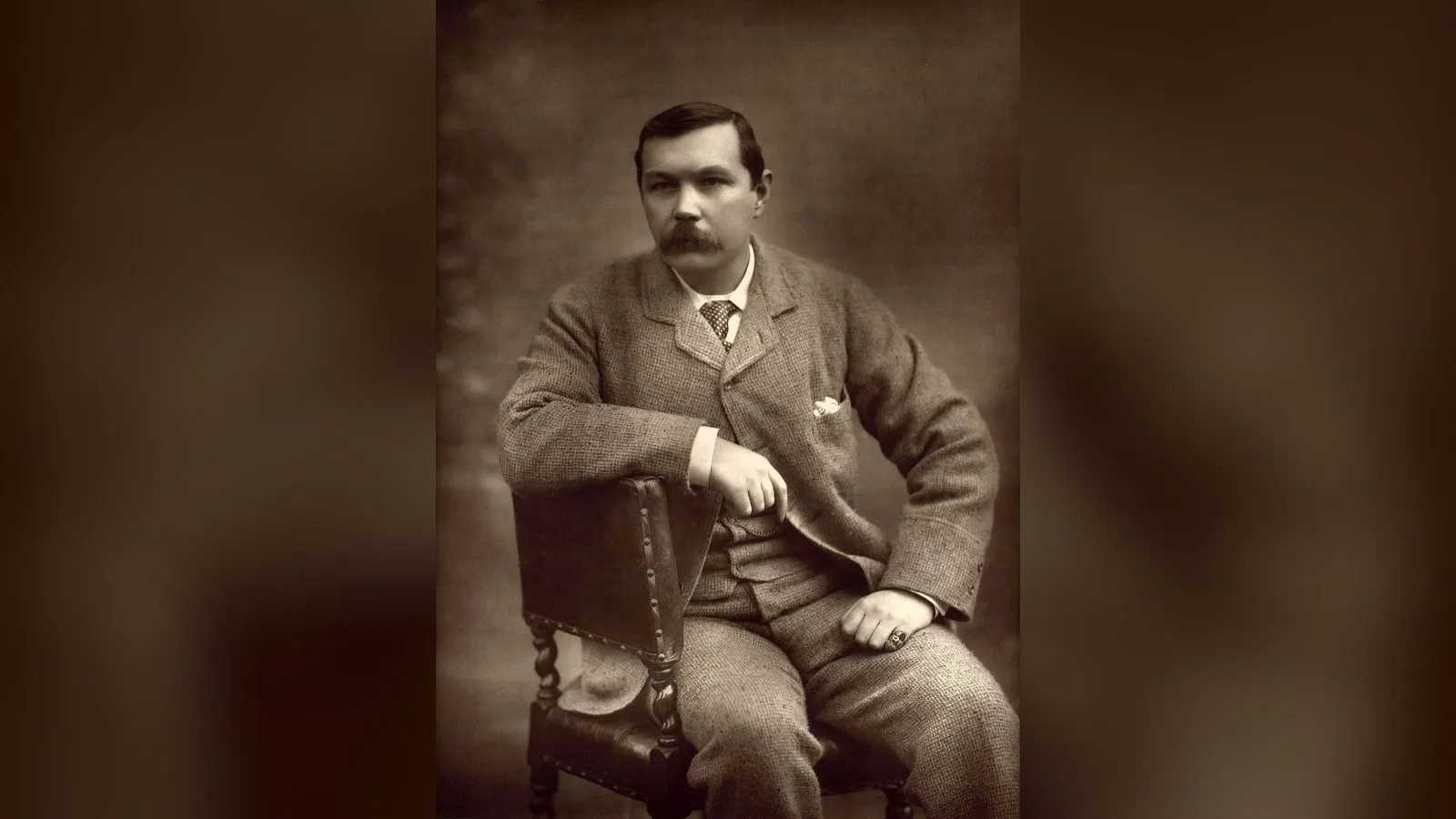

Sir Arthur Conan Doyle (1859–1930): The Rational Detective's Creator Who Believed in Fairies
Contents
TL;DR
- Established (Documented): Doyle, an Edinburgh-trained physician, created in Sherlock Holmes the most adapted literary character in film and television history, basing the detective's rigorous deductive method directly on his own university mentor, Dr Joseph Bell.
- Established (Documented): Doyle made two genuinely significant, well-documented contributions to real-world criminal justice, personally investigating and helping overturn the wrongful convictions of George Edalji and Oscar Slater — work that directly contributed to the creation of Britain's Court of Criminal Appeal in 1907.
- Established, and jarring alongside his rationalist detective: Following the deaths of his son and brother in the First World War, Doyle became a committed, public evangelist for spiritualism, going so far as to authenticate the notorious 1917 Cottingley Fairies photographs as genuine — an episode that seriously damaged his scientific credibility and was not, as some retrospective sympathy suggests, a minor lapse: he maintained the belief even after being shown clear technical grounds for skepticism.
- Established (Documented): His close friendship with the magician and escapologist Harry Houdini collapsed publicly and bitterly over spiritualism, culminating in a discredited 1922 séance purporting to contact Houdini's mother that Houdini himself exposed as fraudulent on clear technical and cultural grounds.
- Disputed, and largely discredited: A theory proposing Doyle as the actual perpetrator of the 1912 Piltdown Man scientific hoax — motivated, it was claimed, by resentment toward the scientific establishment that had debunked his favoured psychics — has been seriously undermined by 2016 DNA research identifying amateur archaeologist Charles Dawson as the hoaxer; leading anthropologists have called Doyle's involvement unlikely.
Key Facts
- Born
- 22 May 1859, Edinburgh, Scotland
- Died
- 7 July 1930, Crowborough, England, aged 71
- Parents
- Charles Altamont Doyle (illustrator, struggled with alcoholism) and Mary Foley
- Education
- Stonyhurst College; University of Edinburgh Medical School (1876–1881)
- Occupation
- Physician (early career); novelist and short-story writer
- Key creation
- Sherlock Holmes, based partly on his medical mentor Dr Joseph Bell
- First Holmes novel
- A Study in Scarlet (1887)
- Knighted
- 1902, largely for his writing in support of Britain's conduct in the Boer War
- Wrongful-conviction cases
- George Edalji (1906–07); Oscar Slater (1912–28)
- Major controversy
- Public endorsement of the Cottingley Fairies photographs (1922) as genuine
- Notable feud
- Harry Houdini, over spiritualism, culminating in a public rupture in 1922
Scottish Impact Index (SI Score)
- Global Influence
- 9/10
- Enduring Relevance
- 9/10
- Material Contribution
- 8/10
- Exceptional Achievement
- 9/10
- Lasting Legacy
- 8/10
- Recognition
- 9/10
52/60
Ranked =7th of 200 in Great Scots
A Note on Claim Status
This article follows ScottishInventions.co.uk's standard evidence tiers: Established/Documented (supported by primary sources or strong scholarly consensus), Shared/Traditional (widely repeated but resting on thinner evidence), disputed (credible sources disagree), and Legend/Myth (popular but unsupported or contradicted by the record). Doyle presents an unusually sharp internal contradiction worth stating plainly rather than softening: the same mind that invented fiction's most famous rationalist detective spent his later decades as one of the era's most prominent public advocates for spiritualism, maintaining demonstrably false beliefs — most notably regarding the Cottingley Fairies — even in the face of direct, credible contrary evidence.
Timeline
Born in Edinburgh to Charles Altamont Doyle and Mary Foley.
Educated at Jesuit institutions, Hodder Place and Stonyhurst College, funded by wealthy uncles given his father's struggles with alcoholism.
Attends Stella Matutina in Austria; begins drifting from Catholicism toward agnosticism.
Studies medicine at the University of Edinburgh, where he meets Dr Joseph Bell, whose deductive diagnostic method would later shape Sherlock Holmes.
Establishes a medical practice in Portsmouth; the practice struggles financially, but the period proves creatively productive.
Marries Louisa Hawkins.
Writes and publishes A Study in Scarlet, introducing Sherlock Holmes.
Begins attending séances in Southsea, an early step toward his later spiritualist convictions; initiated as a Freemason.
Abandons formal medical practice to write full-time.
Kills off Holmes in "The Final Problem," having grown to resent the character's dominance over his other work.
Serves as a volunteer physician during the Second Boer War; writes pro-British works on the conflict.
Knighted, substantially in recognition of his Boer War writing.
Twice stands unsuccessfully for Parliament as a Liberal Unionist.
Resurrects Sherlock Holmes in The Hound of the Baskervilles.
Formally explains Holmes's survival in "The Adventure of the Empty House."
Investigates and helps overturn the wrongful conviction of George Edalji; wife Louisa dies of tuberculosis.
Court of Criminal Appeal established in Britain, a reform substantially influenced by the Edalji case; marries Jean Leckie, with whom he had maintained a platonic relationship during Louisa's illness.
Publishes The Lost World; the Piltdown Man hoax is perpetrated in England (Doyle later implicated, without solid evidence, in one speculative theory).
First World War claims his son Kingsley (d. October 1918, of pneumonia following wounds from the Somme) and brother Innes (d. February 1919); Doyle's spiritualist conviction deepens significantly.
Publishes The New Revelation and The Vital Message, key spiritualist works.
Begins correspondence and friendship with Harry Houdini.
Publishes The Coming of the Fairies, formally endorsing the Cottingley Fairies photographs as genuine; a séance conducted by his wife Jean, purporting to contact Houdini's late mother, is publicly exposed as fraudulent, ending the Doyle–Houdini friendship.
Contributes the largest single donation toward a Spiritualist Temple in Camden, London.
Finances and helps secure the successful appeal of Oscar Slater's wrongful murder conviction.
Dies of a heart attack at his home in Crowborough, aged 71.
Details
Edinburgh, medicine, and the making of a detective
Arthur Conan Doyle was born in Edinburgh in 1859 into an Irish Catholic family whose circumstances were complicated by his father's alcoholism, which scattered the family across the city during his childhood; wealthy uncles funded his education at Jesuit institutions, and a period at an Austrian school contributed to his drift away from Catholicism toward agnosticism. He trained in medicine at the University of Edinburgh, and it was here, under his teacher Dr Joseph Bell, that the seeds of his most famous creation were planted: Bell's method of close observational diagnosis — drawing detailed conclusions about a patient's occupation and history from small physical details before they spoke — left a lasting impression Doyle later acknowledged directly and generously, writing to Bell that "it is most certainly to you that I owe Sherlock Holmes." His own medical practice, established in Portsmouth in 1882, struggled commercially, but the relatively quiet professional period proved unexpectedly productive for his writing.
A creation that came to resent its creator
A Study in Scarlet, the first Holmes novel, was written in three weeks and accepted for publication in 1886, and the character's popularity in serialised Strand Magazine stories made Doyle one of the most famous and highly paid authors of his era — a remarkable transformation for a struggling provincial doctor within a few short years. Yet Doyle's own relationship with his creation was genuinely ambivalent almost from the start. By 1891, he was confiding to his mother his intention to "slay" Holmes, complaining that the character "takes my mind from better things" — a revealing statement from a writer who clearly wished to be remembered for work beyond detective fiction, whatever the public's own preferences turned out to be.
He carried through on this in December 1893, killing Holmes off at the Reichenbach Falls in "The Final Problem." The public reaction was severe enough — sustained outcry, reportedly including cancelled magazine subscriptions — that Doyle eventually resurrected the character in 1901's The Hound of the Baskervilles, formally explaining the survival two years later. Holmes ultimately appeared across four novels and 56 short stories through 1927, and remains, by any reasonable measure, the single most adapted literary character in the history of film and television — a legacy considerably larger than the historical novels and other work Doyle himself often preferred and considered his finer achievement.
Genuine service to justice
Set against his fiction, Doyle's direct, personal involvement in overturning two real wrongful convictions stands as a genuinely significant and underappreciated part of his legacy. In 1906 he took up the case of George Edalji, a half-British, half-Indian solicitor wrongly imprisoned for a series of animal mutilations in Staffordshire despite clear evidence that the mutilations continued after Edalji's own imprisonment began — a detail that should, on its own, have exonerated him at trial. Doyle's dedicated personal investigation proved directly consequential, contributing to the creation of Britain's Court of Criminal Appeal in 1907, a lasting structural reform to the justice system traceable substantially to this single case.
Later, in 1928, Doyle personally financed — bearing most of the legal costs himself — the successful appeal of Oscar Slater, a German-Jewish man wrongly convicted in 1908 of murdering an elderly Glasgow woman on evidence Doyle judged, correctly, to be seriously inconsistent. This was not armchair advocacy or a passing celebrity endorsement; in both cases Doyle applied genuine investigative rigour and committed real personal and financial resources over sustained periods, achieving outcomes that changed the course of the British legal system and two individual lives.
The Boer War, and a knighthood earned through advocacy
Doyle's political engagement was not confined to criminal justice. He served as a volunteer physician during the Second Boer War (1899–1902) and subsequently wrote works explicitly defending Britain's conduct in the conflict; it was substantially this advocacy, rather than his literary fame alone, that he himself believed prompted his knighthood in 1902. He stood, unsuccessfully, for Parliament twice as a Liberal Unionist, and campaigned on causes including compulsory vaccination and reform in the Congo Free State — a record of genuine, sustained public engagement well beyond his fiction, though one whose specific political positions, including his enthusiastic support for the Boer War, have themselves drawn more critical scrutiny from later historians than they generally received in his own time.
Spiritualism: grief, conviction, and a damaged reputation
The most significant and jarring turn in Doyle's life began modestly in 1887 with attendance at Southsea séances, but it was the devastating losses of the First World War — his son Kingsley, who died in 1918 of pneumonia following wounds sustained at the Somme, and his brother Innes, who died the following year — that transformed a passing interest into a deep and very public conviction. Doyle came to believe genuinely and completely that spiritualism offered real, demonstrable contact with the dead, and he pursued this conviction with the same energetic thoroughness he had brought to his Edalji and Slater investigations, publishing major spiritualist works including The New Revelation (1918) and The Vital Message (1919), and eventually contributing the largest single donation toward a London Spiritualist Temple in 1926.
This conviction produced his most damaging public error. In 1922, Doyle published The Coming of the Fairies, formally endorsing as genuine a set of photographs, taken in 1917 by two young cousins in Cottingley, Yorkshire, purporting to show real fairies. He insisted skeptics were simply "wrong." The photographs were, of course, later definitively proven to be fakes — created with cut-out illustrations — and this episode is not fairly remembered as an isolated, forgivable eccentricity: Doyle maintained his conviction with genuine certainty despite the photographs' evident staged quality being visible to careful contemporary observers, and the episode substantially and lastingly damaged his standing with the scientific and rationalist community that had previously admired his most famous creation's method.
A friendship destroyed by belief
Doyle's spiritualist conviction also destroyed one of his most significant personal friendships. He and the American magician Harry Houdini, beginning in 1920, developed what has been described as a genuine intellectual rivalry conducted without real bitterness — two men from starkly different backgrounds who shared a deep fascination with the same subject from opposite convictions, Doyle as believer and Houdini as determined skeptic who had spent years exposing fraudulent mediums.
The friendship collapsed decisively in 1922, when Doyle's wife, Lady Jean Doyle, conducted a séance using automatic writing that purported to channel a message from Houdini's deceased mother, producing fifteen pages of text within minutes. Houdini identified the fraud immediately and on clear, specific grounds: the message arrived in polished literary English, despite his mother having spoken only German and Yiddish throughout her life, and it opened with a Christian cross — a glaring inconsistency for the message of a rabbi's wife. Doyle nonetheless declared the séance a vindication to the press; Houdini's public rebuttal launched an irreversible, bitter public feud between the two men, who spent their remaining years pursuing directly opposed public campaigns — Doyle seeking to establish spiritualism as something approaching an official religion, Houdini working to have fortune-telling banned outright as, in his words, a form of "mental intoxication."
The Piltdown Man theory: a largely discredited accusation
One further, more speculative controversy deserves mention and correction. Historian Richard Milner proposed a theory that Doyle himself perpetrated the notorious 1912 Piltdown Man hoax — in which fabricated fossil remains were presented as a genuine "missing link" in human evolution — as an act of covert revenge against the scientific establishment that had publicly debunked psychics and mediums Doyle favoured. The theory rested partly on Doyle's geographic proximity to the discovery site, where he golfed, and on supposedly cryptic references within his own 1912 novel The Lost World. This theory has been substantially undermined by more recent, rigorous investigation: 2016 DNA research conducted by the Natural History Museum and Liverpool John Moores University identified amateur archaeologist Charles Dawson, the man who originally presented the "discovery," as the actual perpetrator. Leading anthropologists, including Chris Stringer, have characterised Doyle's direct involvement as unlikely, noting that as a busy public figure he lacked the sustained opportunity such an elaborate, carefully executed hoax would have required. This article treats the Doyle-as-hoaxer theory accordingly as an interesting but largely discredited speculation, not an established fact.
Death and a fittingly divided epitaph
Doyle died of a heart attack at his Crowborough home in July 1930, aged 71, his last words to his wife reportedly "You are wonderful." His chosen epitaph — "Steel true / Blade straight ... Knight / Patriot, physician and man of letters" — notably omits any reference to Sherlock Holmes, the creation for which he remains overwhelmingly best known, a final, telling reflection of his own lifelong ambivalence about the character that made him famous relative to the causes, investigations, and convictions he considered more genuinely important to his own sense of identity.
Did You Know?
- Sherlock Holmes's famous deductive method was modelled directly on Doyle's own Edinburgh medical school teacher, Dr Joseph Bell, whom Doyle credited by name as the character's true inspiration.
- Doyle killed off Sherlock Holmes in 1893 specifically because he resented the character's dominance over his other writing — and was forced by public outcry to resurrect him nearly a decade later.
- Doyle's personal investigations directly contributed to the creation of Britain's Court of Criminal Appeal in 1907, following his work overturning the wrongful conviction of George Edalji.
- He personally financed the legal costs of overturning Oscar Slater's wrongful murder conviction in 1928, decades after the original trial.
- Despite creating fiction's most famous rationalist detective, Doyle publicly and sincerely endorsed the Cottingley Fairies photographs as genuine evidence of real fairies — an endorsement he never fully retracted.
- Doyle's close friendship with magician Harry Houdini collapsed permanently after a séance conducted by Doyle's own wife, purporting to channel Houdini's mother, was exposed as fraudulent on the grounds that it was written in a language she never actually spoke.
- A theory once seriously proposed that Doyle himself perpetrated the infamous 1912 Piltdown Man scientific hoax has since been substantially discredited by 2016 DNA evidence pointing to a different culprit.
- Doyle's own chosen epitaph makes no mention of Sherlock Holmes at all.
Frequently Asked Questions
1Who was Sir Arthur Conan Doyle?
A Scottish physician and writer (1859–1930), creator of Sherlock Holmes, who also became a prominent public campaigner for spiritualism and a genuine, effective advocate for overturning real wrongful criminal convictions.
2Who inspired Sherlock Holmes?
Dr Joseph Bell, Doyle's teacher at the University of Edinburgh Medical School, whose precise observational diagnostic method directly inspired Holmes's deductive approach — a debt Doyle openly acknowledged.
3Why did Doyle kill off Sherlock Holmes?
He had grown resentful of the character's overwhelming popularity, feeling it distracted from other writing he considered more significant. Public outcry eventually forced him to bring Holmes back nearly a decade later.
4Did Doyle really believe in fairies?
Yes, genuinely and publicly. In 1922 he published a book formally endorsing the Cottingley Fairies photographs as authentic evidence, a conviction he maintained despite reasonable contemporary grounds for skepticism, seriously damaging his standing among scientists and rationalists.
5What happened between Doyle and Harry Houdini?
Their friendship, built on a shared fascination with spiritualism from opposite convictions, collapsed publicly in 1922 after a séance conducted by Doyle's wife, purporting to contact Houdini's deceased mother, was exposed by Houdini as fraudulent on clear factual grounds.
6Did Doyle help overturn any real wrongful convictions?
Yes, two significant cases: George Edalji (1906–07), whose exoneration contributed to the creation of Britain's Court of Criminal Appeal, and Oscar Slater (1928), whose successful appeal Doyle personally financed.
7Was Doyle really involved in the Piltdown Man hoax?
This has been seriously proposed as a theory but is now largely discredited. 2016 DNA research identified amateur archaeologist Charles Dawson as the actual perpetrator, and leading anthropologists consider Doyle's direct involvement unlikely.
8Why was Doyle knighted?
Substantially for his writing in support of Britain's conduct during the Boer War (1899–1902), rather than for his literary fiction, according to his own understanding of the honour.
9How did Arthur Conan Doyle die?
He died of a heart attack at his home in Crowborough, England, in July 1930, aged 71.
10Does Doyle's epitaph mention Sherlock Holmes?
No. It reads "Steel true, Blade straight... Knight, Patriot, physician and man of letters" — a deliberate reflection, many have noted, of Doyle's own ambivalence about the character that made him most famous.
Sources and Further Reading
Primary / Institutional
- Exploring Surrey's Past: Sir Arthur Conan Doyle (1859–1930)
- Arthur Conan Doyle Encyclopedia: Piltdown Man Hoax
Scholarly
- The Collector: Arthur Conan Doyle vs. Harry Houdini — A Friendship Ruined by Ghosts
- The Collector: The Eccentricities of Arthur Conan Doyle — Fairies, Apes, and Spiritualism
- History Answers: Arthur Conan Doyle & Spiritualism — How Sherlock's Creator Embraced the Occult
General
Caveats: Myths and Disputed Claims
- Doyle's fairy belief was a brief, minor eccentricity. An understatement. He maintained genuine, public conviction in the Cottingley Fairies photographs' authenticity in the face of reasonable contemporary grounds for skepticism, and the episode caused lasting, serious damage to his scientific credibility — not a footnote, but a defining feature of his later public life.
- Doyle orchestrated the Piltdown Man hoax. Disputed, and now largely discredited. While seriously proposed by historian Richard Milner, 2016 DNA evidence points to amateur archaeologist Charles Dawson as the actual perpetrator, and leading anthropologists consider Doyle's direct involvement unlikely.
- Doyle always loved and embraced Sherlock Holmes. Contradicted by the record. He resented the character's dominance over his writing, deliberately killed him off in 1893, and omitted any mention of Holmes from his own chosen epitaph.
- The Doyle–Houdini friendship ended over a simple difference of opinion. An understatement of the episode's substance. It collapsed specifically because Doyle's wife conducted a séance whose fraudulence Houdini could demonstrate on clear, specific factual grounds — a real exposure of fabrication, not merely a philosophical disagreement.
- Doyle's wrongful-conviction advocacy was incidental celebrity dabbling. Not accurate. Both the Edalji and Slater cases involved sustained personal investigation and, in Slater's case, substantial direct financial commitment, producing genuine and lasting legal reform and real exonerations.
Card 093 · Great Scots