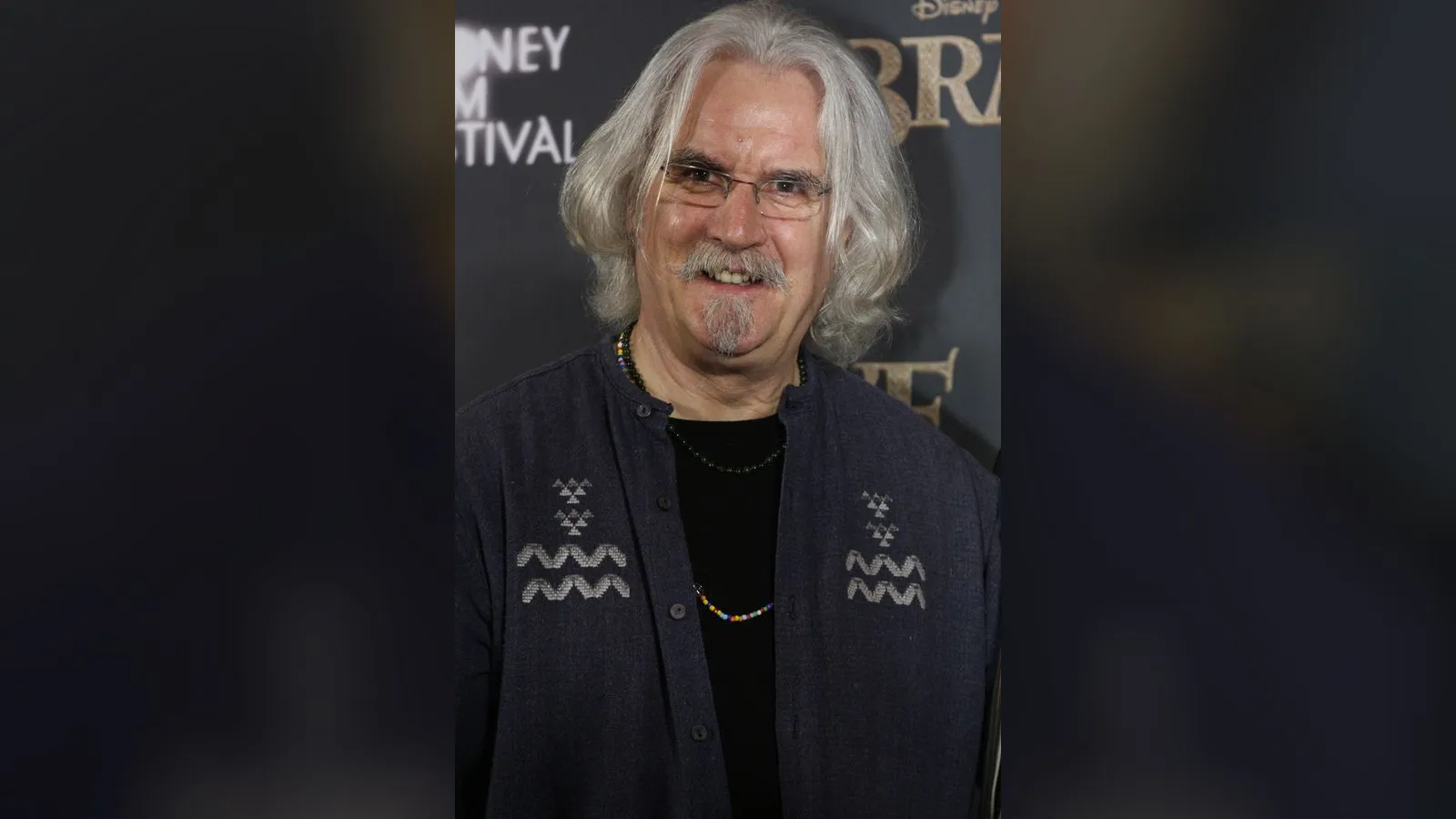

Sir Billy Connolly (b. 1942)
Contents
TL;DR
- established Sir Billy Connolly is a Glasgow-born comedian, actor, and musician widely regarded as one of the greatest stand-up comedians Britain has produced, repeatedly topping national polls and transforming British comedy with raw, profane, unflinchingly honest observational routines.
- established His childhood was genuinely devastating: his mother abandoned the family when he was four, he was raised by two aunts who told him he was stupid, and according to his wife Pamela Stephenson's authorised biography, his father subjected him to sustained physical and sexual abuse beginning around age ten and continuing until roughly age fifteen — material Connolly has openly discussed and drawn upon in his own comedy and public life rather than concealed.
- established Before comedy, he worked as a shipyard welder and apprentice boilermaker on the Clyde, then became a folk musician in the duo the Humblebums alongside Gerry Rafferty, before his between-song comic banter led a record label head to redirect him toward comedy full-time.
- established He struggled seriously with alcohol and drug abuse through the late 1970s, reaching what his second wife Pamela Stephenson has described as a near-suicidal crisis point, before giving up alcohol in 1986 with her support; he has said plainly, "Marriage to Pam didn't change me; it saved me. I was going to die."
- established He was diagnosed with Parkinson's disease in 2013, announced his retirement from stand-up comedy in 2018, and has since reinvented himself as a visual artist, publishing multiple collections of his work.
Key Facts
- Born
- 24 November 1942, Anderston, Glasgow
- Category
- Culture / Comedy & Entertainment
- Known for
- Pioneering raw, observational stand-up comedy; acting (Mrs Brown); the band the Humblebums
- Early career
- Shipyard apprentice boilermaker, Alexander Stephen and Sons, Linthouse
- Marriages
- Iris Pressagh (1968–1985); Pamela Stephenson (m. 1989)
- Honours
- CBE (2003); BAFTA Fellowship (2022); Knighted (2017)
- Health
- Diagnosed with Parkinson's disease, 2013
Scottish Impact Index (SI Score)
- Global Influence
- 7/10
- Enduring Relevance
- 7/10
- Material Contribution
- 5/10
- Exceptional Achievement
- 7/10
- Lasting Legacy
- 5/10
- Recognition
- 9/10
40/60
Ranked =39th of 200 in Great Scots
A Note on Claims and Evidence
Connolly's career, major performances, and public honours are extensively documented and treated here as established. His childhood abuse is documented primarily through Pamela Stephenson's authorised biography Billy (2001), drawing on Connolly's own testimony, and has since been confirmed and discussed by Connolly himself in numerous public interviews over subsequent decades; it is treated here as established fact based on his own repeated, consistent account.
Timeline
Born in Anderston, Glasgow.
His mother abandons the family while his father serves abroad; Billy and his sister Florence are raised by two paternal aunts in Partick.
Suffers sustained physical and sexual abuse from his father, beginning around age ten.
Leaves school at fifteen; begins an apprenticeship as a boilermaker at Alexander Stephen and Sons shipyard, Linthouse, the following year.
Completes his shipyard apprenticeship; forms the folk duo the Humblebums with Tam Harvey.
Marries Iris Pressagh; is briefly reunited with his mother backstage after a Humblebums performance — their first and only meeting since her departure.
Gerry Rafferty joins the Humblebums, forming a trio.
The Humblebums disband; Connolly continues as a folk performer, increasingly leaning into comic stage patter.
Makes his theatrical debut with the revue Connolly's Glasgow Flourish; releases his first solo comedy album, Billy Connolly Live!
Records the breakthrough live album Solo Concert, released to chart success in 1974.
Reaches number one on the UK Singles Chart with a parody record; makes his first appearance on BBC's Parkinson, delivering a notoriously bawdy joke that becomes a defining career moment.
Attempts to break into the American market opening for Elton John; the tour struggles badly due to cultural and accent barriers; collapses after substance use during a UK filming project.
Meets Pamela Stephenson backstage during his "Big Wee Tour," at a point of serious personal crisis.
Divorces Iris Pressagh, having separated four years earlier; awarded custody of their children.
Gives up alcohol with Pamela Stephenson's support.
Marries Pamela Stephenson in Fiji.
Stars as John Brown in Mrs Brown, earning major acting award nominations.
Appointed CBE for services to entertainment.
Named "Britain's Favourite Comedian" in a UK network poll.
Tops Channel 4's "100 Greatest Stand-Ups" poll.
Diagnosed with early-stage prostate cancer and early symptoms of Parkinson's disease.
Knighted by Queen Elizabeth II for services to entertainment and charity.
Announces his retirement from stand-up comedy; holds his first art exhibition.
His art is projected onto MacLellan's Castle, Kirkcudbright, to mark World Parkinson's Day.
Publishes his autobiography, Windswept and Interesting; named "The Greatest Glaswegian" in a public poll.
Awarded the BAFTA Fellowship.
Details
An abandoned childhood in Glasgow
William Connolly was born in 1942 in Anderston, Glasgow, into genuinely cramped and difficult circumstances. In 1946, when he was four, his mother abandoned the family while his father was serving abroad as an RAF engineer in Burma — a departure Connolly later came to view with a degree of compassion rather than simple resentment, describing her as "a teenager with two kids in a slum." With his father away and his mother gone, Billy and his older sister Florence were raised by two of their father's sisters, Margaret and Mona, in a Partick tenement, an arrangement Connolly has said left lasting psychological damage: "My aunts constantly told me I was stupid, which still affects me today pretty badly." His sister Florence became his protector during this period, developing enough of a reputation among local boys that, in Connolly's own account, they "didn't dare" provoke her.
Sustained childhood abuse, disclosed openly rather than hidden
This article states plainly what Connolly himself has publicly confirmed across decades: according to his wife Pamela Stephenson's authorised biography Billy (2001), drawing directly on his own testimony, Connolly's father subjected him to sustained physical and sexual abuse beginning around age ten and continuing until approximately age fifteen. His father had returned from the war effectively a stranger to his own children and never discussed their mother's departure with them. Connolly has said he came to believe the abuse was connected to his father's inability to divorce after his mother left, given Catholic Church teaching at the time — an understanding that contributed directly to what Connolly has described as a deep and lasting distrust of the Catholic Church, and to his own identification as an atheist. Remarkably, amid this childhood trauma, Connolly found an early source of genuine joy that shaped his life's direction: at seven or eight, he discovered that people laughed when he deliberately fell into a puddle, later reflecting, "My life was very unhappy at the time, and laughter wasn't something I heard all the time, so it was a joy." By his own account, this moment crystallised a specific, lasting ambition to make people laugh.
From shipyard apprentice to folk musician
Connolly attended St Peter's Primary School in Glasgow, where he experienced further routine physical punishment from both nuns and teachers, and later lived on the Drumchapel council estate on Glasgow's outskirts from age fourteen to twenty, attending St Gerard's Secondary School in Govan via a daily bus-and-ferry commute across the Clyde. He left school at fifteen and, after a brief stint as a bakery delivery driver, began a five-year apprenticeship as a boilermaker at the Alexander Stephen and Sons shipyard in Linthouse at sixteen — formative work he later credited directly with shaping his comic sensibility, saying of the demolished shipyard decades on, "I learned how men talked to one another, and how merciless Glasgow humour can be. It has made an indelible mark on me."
After completing his apprenticeship in 1965 and a brief period working on an oil platform in Biafra, Nigeria, Connolly became increasingly drawn to the Edinburgh Festival Fringe's folk music scene, purchasing his first banjo and forming the folk-pop duo the Humblebums with Tam Harvey in 1965. The singer-songwriter Gerry Rafferty joined the group in 1969 after seeing Connolly perform at a charity show; Rafferty's elaborate backstage pranks before performances reportedly made Connolly laugh uncontrollably and directly fed his developing comic instincts, even as Connolly recognised their differing musical talents: "Gerry was very good for me… He was a real musician… I knew tunes and how to play them but that was where my musicianship ended."
A redirect into comedy, and a career-defining breakthrough
The Humblebums disbanded in 1971, and Connolly continued performing as a folk singer, but his live shows increasingly featured lengthy, elaborate comic introductions to his songs rather than the songs themselves being the main draw. Nat Joseph, head of Transatlantic Records, recognised the shift and encouraged Connolly to abandon folk music for comedy entirely, a redirection that proved transformative: Connolly's 1972 solo comedy album Billy Connolly Live! was followed in late 1973 by the live double album Solo Concert, recorded at a hotel in Airdrie — a genuinely unconventional commercial gamble for a largely unknown comedian that paid off dramatically when it reached chart success in 1974, propelled in part by the routine "The Crucifixion," comparing Christ's Last Supper to a drunken night out in a Glasgow bar, which many radio stations refused to broadcast.
Connolly's wider national breakthrough came through his first appearance on BBC's Parkinson chat show in 1975, where, against his manager's explicit warnings, he told a notoriously bawdy joke about burying a murdered wife "bottom-up" — shockingly direct material for mid-1970s British primetime television. The response was immediate and overwhelming: "When I finished that show, I came back to Glasgow, and I came through the airport and the whole airport started to applaud." He went on to appear on Parkinson a record fifteen times across more than three decades.
Substance abuse, personal crisis, and a marriage that "saved" him
Connolly's rising fame in the late 1970s coincided with a genuine and serious personal crisis involving heavy alcohol and drug use. During a 1976 recording session, he collapsed after consuming what was described as "a sizable amount of cocaine and alcohol." He met the New Zealand-born actress and comedian Pamela Stephenson backstage in 1979 during a gruelling UK tour, at a point his later wife has described in stark terms: "What I saw of him… was that he was about to die. He was very suicidal… You could get a sense from some people when they are very self-destructive that there is something they are trying to bury." Stephenson later said she feared that "if I leave this man, he's going to die."
Connolly divorced his first wife, Iris Pressagh, whom he had married in 1968, in 1985, having separated four years earlier, and was awarded custody of their two children, Jamie and Cara. With Stephenson's support, he gave up alcohol entirely in 1986, and the couple married in Fiji in 1989. Connolly has spoken about this period of his life with unusual directness and without minimising how close he came to real catastrophe: "Marriage to Pam didn't change me; it saved me. I was going to die. I was on a downwards spiral and enjoying every second of it." Asked decades later whether he missed drinking, he answered honestly rather than offering a tidy recovery narrative: "I miss the joy of it all… the craziness of it. I miss it terribly" — while explaining that the underlying choice, between his marriage and his addiction, had ultimately become clear to him. He had two children from his first marriage and three from his second, becoming a grandfather in 2001.
A substantial acting career alongside comedy
Parallel to his stand-up career, Connolly built a genuinely significant acting career across film and television, including roles in Water (1985), Indecent Proposal (1993), Pocahontas (1995, voice), Muppet Treasure Island (1996), The Boondock Saints (1999), The Last Samurai (2003), Lemony Snicket's A Series of Unfortunate Events (2004), Brave (2012, voice), and The Hobbit: The Battle of the Five Armies (2014). His most critically acclaimed performance came as John Brown opposite Judi Dench in Mrs Brown (1997), earning him nominations for the BAFTA Award for Best Actor in a Leading Role, a BAFTA Scotland Award, and a Screen Actors Guild Award. He also hosted a successful series of BBC "World Tour" travelogue programmes throughout the 1990s and 2000s, blending comedy, social commentary, and travel across Scotland, Australia, England, Ireland, Wales, and New Zealand.
Honours, illness, and an artistic second act
Connolly's standing as one of Britain's greatest comedians was confirmed repeatedly through public recognition: named "Britain's Favourite Comedian" in a 2005 network poll ahead of figures including John Cleese and Dawn French, and topping Channel 4's "100 Greatest Stand-Ups" poll in both 2007 and 2010. He was appointed CBE in 2003 and knighted by Queen Elizabeth II in 2017 for services to entertainment and charity.
In September 2013, Connolly disclosed he was undergoing treatment for early-stage prostate cancer and had also been diagnosed with early symptoms of Parkinson's disease, having already begun forgetting his lines during performances that year. He announced his retirement from stand-up comedy in 2018 and relocated with Stephenson to Key West, Florida. Rather than withdrawing from public creative life, Connolly reinvented himself as a visual artist, holding his first exhibition in 2018 and developing a distinctive surrealist automatism technique, allowing his hand to move across the canvas without predetermined intent — a working method that offered him continued creative expression even as Parkinson's affected his physical control. He has since published eleven collections of his artwork and completed his first sculpture, drawing directly on his shipyard welding background, in 2020. He published his autobiography, Windswept and Interesting, in 2021, and received the BAFTA Fellowship in 2022 in recognition of his more than five-decade career.
Did You Know?
- Billy Connolly worked as a shipyard welder and apprentice boilermaker before becoming a comedian.
- He first discovered the power of laughter as a child by deliberately falling into a puddle.
- He was part of the folk duo the Humblebums with singer-songwriter Gerry Rafferty before switching to comedy full-time.
- His notorious 1975 joke on BBC's Parkinson launched his national breakthrough — he went on to appear on the show a record fifteen times.
- He has spoken openly about sustained childhood sexual abuse by his father, as documented in his wife Pamela Stephenson's authorised biography.
- He said his marriage to Pamela Stephenson "saved" him from a near-suicidal spiral of alcohol and drug abuse in the late 1970s.
- He was diagnosed with Parkinson's disease and early-stage prostate cancer in the same year, 2013.
- After retiring from stand-up, he reinvented himself as a visual artist, publishing eleven collections of his artwork.
FAQ
1What is Billy Connolly best known for?
His raw, profane, groundbreaking observational stand-up comedy, which transformed British comedy from the 1970s onward, alongside a substantial acting career including Mrs Brown (1997).
2Did Billy Connolly have a difficult childhood?
Yes, genuinely and severely — his mother abandoned the family when he was four, he was raised by critical aunts, and he suffered sustained physical and sexual abuse from his father as documented in his authorised biography.
3What was Billy Connolly's career before comedy?
He trained and worked as an apprentice boilermaker in a Glasgow shipyard, then became a folk musician in the duo the Humblebums alongside Gerry Rafferty.
4Did Billy Connolly struggle with addiction?
Yes — he battled serious alcohol and drug abuse through the late 1970s, reaching a point his wife Pamela Stephenson has described as near-suicidal, before giving up alcohol in 1986.
5Is Billy Connolly married?
He was previously married to Iris Pressagh (1968–1985) and has been married to Pamela Stephenson since 1989.
6Why did Billy Connolly retire from stand-up comedy?
He was diagnosed with Parkinson's disease in 2013 and announced his retirement from stand-up in 2018 as the condition progressed.
7What does Billy Connolly do now?
He has become a visual artist, exhibiting and publishing multiple collections of his artwork, and completed his first sculpture in 2020.
8Was Billy Connolly knighted?
Yes, in 2017, for services to entertainment and charity, having earlier received a CBE in 2003.
9How did Billy Connolly's childhood abuse affect his adult life?
He has said it contributed to his lasting distrust of the Catholic Church, his self-identification as an atheist, and an early defensive aversion to physical touch that friends later helped him overcome.
Sources and Further Reading
Institutional
- UK Honours lists, 2003 and 2017
- BAFTA, Fellowship records (2022)
- Channel 4, "100 Greatest Stand-Ups" poll results
Biographical
- Pamela Stephenson, Billy (2001), authorised biography
- Billy Connolly, Windswept and Interesting (2021), autobiography
General
- Wikipedia, "Billy Connolly" (overview, cross-checked against biographical sources above)
- The Glasgow Times, "The Greatest Glaswegian" poll (2019)
- CNN, interview feature with Pamela Stephenson on Billy Connolly's life
Caveats: Myths and Disputed Claims
- Myth: Billy Connolly's comedy about his difficult childhood was exaggerated for effect. Reality: His accounts of parental abandonment and sustained abuse are consistently corroborated across his own public statements over decades and his wife's authorised biography.
- Clarify: Connolly's substance abuse crisis in the late 1970s was genuinely severe, by his own and his wife's account, and should not be minimised as ordinary "wild" celebrity behaviour of the era.
- Myth: Billy Connolly has fully retired from public creative work. Reality: While he retired from stand-up comedy in 2018 due to Parkinson's disease, he has remained creatively active as a visual artist and author.
Card 118 · Great Scots