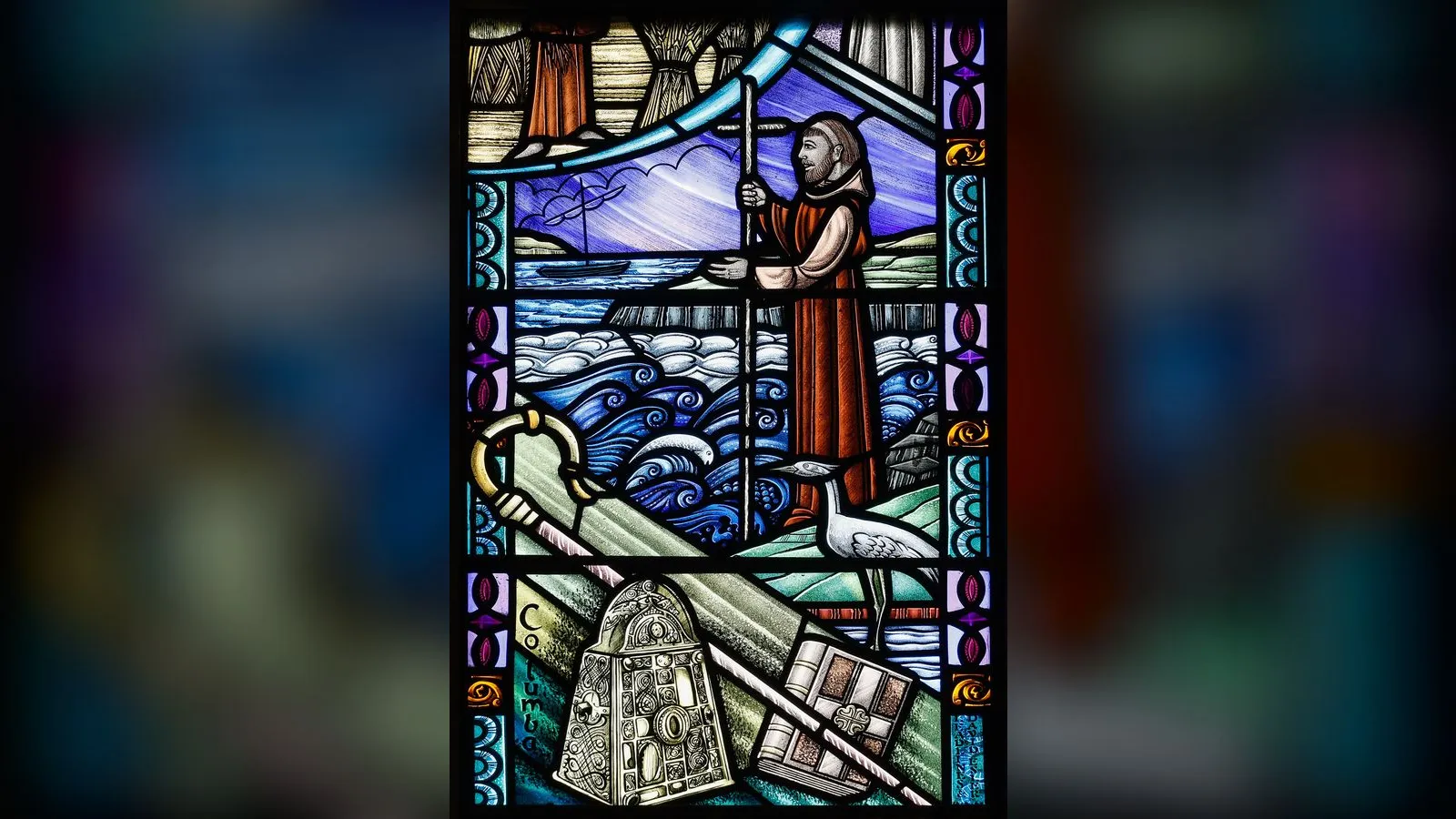

St Columba (Colum Cille), c. 521–597 AD
Contents
Founder of Iona, and the Most Mythologised Missionary in Scottish History
TL;DR
- established Columba was an Irish nobleman-monk of the royal Uí Néill kindred who left Ireland in 563 AD and founded a monastery on the island of Iona, which became one of the most influential centres of Christian learning, manuscript production and political power in early medieval Gaelic Scotland.
- established Almost everything we know about Columba's life comes from one source — Adomnán's Vita Columbae ("Life of Columba"), written on Iona around 697–700 AD, over a century after Columba's death, by the ninth abbot of the community Columba founded. It is a work of hagiography — written to promote a saint's cult — not a neutral biography, and modern historians read it accordingly.
- disputed The famous story of why Columba left Ireland — a fight over an illegally copied psalter (the "Battle of the Book"), a resulting battle in which thousands died, and a penitential exile imposed as punishment — rests on sources written many centuries after the events. Adomnán himself does not tell this story. Leading modern editors of Adomnán's text explicitly warn against taking it as established fact.
- Legend/Myth: Columba did not "bring Christianity to Scotland." Christian communities already existed in southern and western Scotland before he arrived (see St Ninian, and the separate tradition of St Kentigern/Mungo in Strathclyde), and the Christianisation of Pictland in particular was a longer, patchier, multi-generational process that Columba's mission contributed to rather than completed single-handedly.
- Legend/Myth: The most famous single episode attached to Columba — banishing a monster from the River Ness — is the earliest written reference anywhere to what later became the Loch Ness Monster legend. It appears in Adomnán's hagiography as a miracle story demonstrating Columba's holy authority over creation, not as a natural-history record, and should be read as such.
Key Facts
- Full name
- Colum (Latinised Columba), known in Gaelic as Colum Cille — "dove of the church"
- Born
- Traditionally 7 December 521 AD, Gartan, Tyrconnell (modern Co. Donegal, Ireland)
- Died
- Traditionally 9 June 597 AD, Iona (one scholar, Daniel McCarthy, has argued for 593 AD)
- Family
- Cenél Conaill kindred of the Uí Néill; great-great-grandson of Niall of the Nine Hostages
- Religious order
- Monk, later abbot, of the Irish/Gaelic monastic tradition
- Key foundation
- Monastery of Iona, founded 563 AD
- Primary source
- Vita Columbae ("Life of Columba") by Adomnán, 9th Abbot of Iona, written c. 697–700 AD
- Feast day
- 9 June
- Patronage
- One of Scotland's patron saints (with Andrew and Ninian); also a patron saint of Ireland (with Patrick and Brigid)
Scottish Impact Index (SI Score)
- Global Influence
- 6/10
- Enduring Relevance
- 10/10
- Material Contribution
- 2/10
- Exceptional Achievement
- 6/10
- Lasting Legacy
- 7/10
- Recognition
- 5/10
36/60
Ranked =52nd of 200 in Great Scots
How This Article Handles the Evidence
Columba is one of the hardest figures in Scottish history to write about accurately, because almost the entire popular account of his life — the psalter dispute, the battle, the exile, the monster, the conversion of the Picts — comes down to us through one text written more than a century after he died, by a successor with every institutional interest in presenting Iona's founder as a miracle-working saint. This article uses a four-tier evidence framework throughout:
- Established/Documented — supported by near-contemporary written sources, corroborated by multiple independent traditions, or backed by archaeology.
- Shared/Traditional — widely repeated across historical and devotional sources, plausible, but resting on a single hagiographical source written well after the fact.
- disputed — actively contested by historians, with serious scholars taking different positions.
- Legend/Myth — a later embellishment, a story added for devotional or dynastic reasons, or a claim not supported by the earliest sources at all.
Adomnán's Vita Columbae itself is the single most important thing to understand about Columba as a subject: it is not a biography in the modern sense. It is a saint's life, written to a genre with fixed conventions — miracle stories, prophecies, demonstrations of holiness — composed to promote Iona's founder and, by extension, Iona's own authority and prestige in the Gaelic and Pictish world of the 690s. Historian Richard Sharpe, whose edition and translation is the standard modern reference, treats it as an invaluable but heavily interpretive source, and specifically cautions against taking some of its most famous episodes — including the battle-and-exile story — as straightforward history.
Timeline
Born at Gartan, Co. Donegal, Ireland, into the Cenél Conaill branch of the Uí Néill dynasty
Trained under Finnian at Movilla Abbey and/or Finnian of Clonard (sources conflate the two Finnians), and under the bard Gemman; ordained priest
Traditionally credited with founding a monastery at Derry
Battle of Cúl Dreimhne fought in Ireland — a real battle, whose connection to Columba is a later addition to the story (see Caveats)
Leaves Ireland for Scotland with twelve companions; granted the island of Iona by his kinsman Conall mac Comgaill, King of Dál Riata; founds Iona Abbey
Traditional date of Columba's journey to the court of King Bridei of the Picts near Inverness, and of the River Ness "monster" episode as later recorded by Adomnán
Attends the Convention of Druim Cett in Ireland, involved in political negotiations between Dál Riata and the Uí Néill
Dies at Iona on (traditionally) 9 June, aged around 75–76; buried in the abbey he founded
Adomnán, ninth Abbot of Iona, writes the Vita Columbae
Iona repeatedly raided by Vikings
Columba's relics divided and removed from Iona amid continuing Viking raids, distributed between Scotland and Ireland
George MacLeod founds the Iona Community and begins rebuilding the ruined medieval abbey
Iona Abbey reopens after a seven-year, £3.75 million restoration
The Details
Birth, Family and an Irish Prince's Choice
Columba was born around 521 AD at Gartan in Donegal, into one of the most powerful dynasties in early medieval Ireland: the Cenél Conaill, a branch of the Uí Néill who claimed descent from the semi-legendary High King Niall of the Nine Hostages. This mattered enormously for his later career. Columba was not a humble wandering preacher — he was a well-connected aristocrat whose kinship network gave him access to kings on both sides of the Irish Sea, and his own royal blood made him, in principle, eligible to be considered for kingship himself. Sources differ on his birth name: Adomnán presents "Colum" (later Colum Cille, "dove of the church") as his name from birth, while some Irish traditions claim he was originally called Crimthann ("fox") and took a religious name later. This is a minor point of textual disagreement rather than a live historical controversy.
Education and Ordination
Columba's early training followed the standard pattern of Irish monastic formation: study under Finnian at Movilla Abbey, further study under the poet Gemman, and then, in most accounts, time at Clonard Abbey under a second churchman also named Finnian — a coincidence of names that has caused genuine confusion in the sources and in modern retellings. Clonard was reportedly a major centre of learning, and later tradition placed Columba among the "Twelve Apostles of Ireland," a group of Clonard-trained saints — a designation that itself belongs to later hagiographical tradition rather than sixth-century record-keeping. He was ordained a priest and, before leaving for Scotland, was already credited with founding monastic communities in Ireland, including at Derry.
The Departure from Ireland: What Is Actually Documented, and What Isn't
This is the point at which the popular Columba story and the documented Columba story diverge most sharply, and it deserves careful unpacking.
What is genuinely well-attested: a real battle, the Battle of Cúl Dreimhne, was fought in Ireland around 561 AD, most likely in modern Co. Sligo, and resulted in a heavy death toll — traditional figures run to several thousand casualties — in a victory for the Uí Néill over the forces of the high king Diarmait mac Cerbaill. This was a genuine dynastic and political conflict.
What is far shakier: the famous story that Columba caused this battle. In the popular version — sometimes called the "Battle of the Book" — Columba secretly copied a psalter belonging to his teacher Finnian without permission; Finnian demanded the copy back; the case went to King Diarmait, who ruled against Columba with the famous judgment "to every cow her calf, to every book its copy"; Columba's kinsmen then went to war on his behalf, and the resulting slaughter caused Columba such remorse that he vowed to convert as many souls in exile as had died in the battle, then left Ireland forever as an act of penance.
This is a vivid, memorable story — and it is also almost certainly a later literary elaboration. Adomnán, writing closest to Columba's own lifetime of any surviving source, does not tell this story at all. The fullest version of the copyright dispute and the royal judgment comes from the Life by Manus O'Donnell, written in the 1530s — nearly a thousand years after the events it describes. Richard Sharpe, the modern scholarly editor of Adomnán's text, explicitly cautions against treating the battle and Columba's departure as causally linked without much stronger evidence than we actually have. The more likely underlying political context, per surviving annals, involves a separate grievance: Diarmait's men seized and killed a kinsman of Columba's, Prince Curnán, after he had claimed the protection of sanctuary — a serious breach of custom that plausibly did strain relations between Columba's kin and the high king, quite apart from any book.
What can be said with more confidence is that a church synod considered censuring or excommunicating Columba over the affair (successfully defended by Brendan of Birr), and that Columba did leave Ireland for Scotland in 563 AD. Whether this departure was truly a punishment, a self-imposed penance, or — as some contemporary-adjacent chronicle material suggests — closer to a voluntary monastic pilgrimage (peregrinatio, a recognised and honoured practice in Irish Christianity, not automatically a punishment) is genuinely unresolved. This article treats the "battle caused his exile" narrative as Legend/Myth, the underlying battle and sanctuary-breach dispute as established, and the nature of his departure (penance vs pilgrimage) as disputed.
Founding Iona
In 563 AD, Columba crossed to Scotland with twelve companions in a hide-covered currach. Tradition holds he first landed on the Kintyre peninsula, but moved on because Ireland was still visible from there — he wanted a clean break. He was granted the small island of Iona, off Mull, by his kinsman Conall mac Comgaill, king of the Gaelic kingdom of Dál Riata, itself straddling the North Channel between Ireland and Scotland at the time. The precise legal and political terms of this grant are not fully recoverable, but the underlying kinship connection — a Dál Riatan king granting land to an Uí Néill relative — is plausible and widely accepted.
Iona rapidly became far more than a remote hermitage. It developed into one of the most important centres of Christian learning, manuscript production and political influence in the Gaelic and Pictish world, a status it would hold for centuries.
The Mission to the Picts, and King Bridei
One of the central planks of the traditional Columba story is his mission to the pagan Picts, centred on a journey to the court of King Bridei (Brude), ruler of the northern Pictish kingdom of Fortriu, near Inverness. Adomnán records that Columba needed an interpreter to communicate with Bridei's people, and describes the visit in terms of winning Bridei's respect rather than his outright conversion. The later historian Bede, writing in Northumbria in the early eighth century, goes further and credits Columba with actually converting the Pictish king — a claim Adomnán's own, earlier account does not make so directly. This divergence between Bede and Adomnán is itself instructive: even near-contemporary sources disagreed on how much credit Columba personally deserved for Pictish conversion.
The wider claim — sometimes made in popular accounts — that Columba single-handedly "converted Scotland" to Christianity should be treated as Legend/Myth. Christianity was already established in parts of what is now Scotland before Columba arrived, associated with earlier missionary traditions (notably St Ninian in Galloway, generations before Columba, and the separate tradition of St Kentigern/Mungo in the Clyde region). Pictland's Christianisation, in particular, was a longer, regionally uneven process involving multiple missionaries and generations, not a single successful visit to one king's court.
The River Ness "Monster" — Scotland's First Recorded Cryptid
Among Adomnán's many miracle stories is one that has taken on a life far beyond its original religious purpose. Around 565 AD, in Adomnán's account, Columba and his companions encountered a "water beast" in the River Ness that had already killed a Pictish man. When the creature turned on one of Columba's own monks, Columba is said to have commanded it, in the name of God, to go no further — and it retreated. This is the earliest written reference anywhere to a monster in the vicinity of Loch Ness, predating the modern Loch Ness Monster phenomenon by well over a thousand years.
It is essential to be clear about what this episode is and isn't. It is a documented text, genuinely present in a source written around 697–700 AD — that part is established. What it is not is evidence of an actual creature in Scottish waters; it is a conventional hagiographical miracle story, demonstrating a saint's holy authority over dangerous nature, of a type found throughout medieval saints' lives across Europe. Treating it as an early "sighting" in any zoological sense is a modern misreading of a religious genre, and this article flags it explicitly as Legend/Myth in substance, while noting its genuine established status as the earliest textual root of a much later legend.
Life, Rule and Manuscript Production at Iona
Under Columba's leadership, and for centuries afterward, Iona operated as a major scriptorium producing illuminated manuscripts and served as a training ground for missionaries sent out across Scotland and into Pictland. Columba himself is credited with authorship of surviving Latin poems, including Altus Prosator, and with political influence extending well beyond church affairs — notably his presence at the Convention of Druim Cett around 575 AD, a meeting negotiating relations between the Dál Riatan and Irish Uí Néill kingdoms.
The community's most celebrated later product, the lavishly illuminated Book of Kells, is popularly described as "Columba's gospel book," but this needs care. The manuscript was very likely produced around 800 AD — roughly two centuries after Columba's death — so he had no direct hand in it. Most scholars place its production at Iona itself, on the strength of the monastery's documented scriptorium and its historical link to the later monastery of Kells (to which Iona monks relocated after Viking raids), though this remains genuinely contested: some recent scholarship has proposed a Pictish origin instead, pointing to stylistic parallels with Pictish carved stone and to archaeological evidence of vellum production at the Pictish monastic site of Portmahomack. The debate is unresolved, and this article treats an Iona origin as Shared/Traditional rather than settled fact.
Death and Burial
Columba is traditionally said to have died at Iona on 9 June 597 AD, at around 75 or 76 years old, and to have been buried by his monks in the abbey he had founded. (One modern chronologist, Daniel McCarthy, has argued on calendrical grounds for a death date of 593 AD instead — a minority scholarly position worth noting as disputed rather than settled.) Iona suffered repeated, severe Viking raids beginning in 795 AD and continuing into the ninth century; amid this violence, Columba's relics were reportedly divided and removed from the island by 849 AD, distributed between communities in Scotland and Ireland — a plausible and widely reported sequence of events, though the exact details of what relics survived and where they ultimately ended up are not fully documented.
Iona as a Royal Burial Ground
A long tradition holds that Iona became the burial place of numerous early Scottish, Irish and Norwegian kings — a sixteenth-century inventory (1549) recorded a tradition of 48 Scottish kings, eight Norwegian kings and four Irish kings buried there, including figures such as Kenneth MacAlpin and, according to later legend, Macbeth. It is important to be precise about what this claim rests on: no royal grave markers from this period have survived at Iona, and the specific numbers and names come down to us through later antiquarian record-keeping and tradition rather than contemporary burial records or archaeological confirmation of individual graves. That Iona functioned as an important royal burial ground in the early medieval period is widely accepted by historians; the precise roll-call of named kings is Shared/Traditional rather than individually verified in each case.
Historiography and the Iona Community
For over a millennium, Iona's fortunes rose and fell — a major centre of learning and pilgrimage through the medieval period, then a ruin after the Reformation. Its modern revival owes almost everything to one twentieth-century figure: George MacLeod, a Church of Scotland minister working in the deprived Govan shipbuilding district of Glasgow, who in 1938 founded the Iona Community — bringing together ministers and unemployed working men to physically rebuild the ruined medieval abbey while also rebuilding, as MacLeod saw it, the connection between the Christian church and working people. The Iona Community today is an ecumenical Christian fellowship spanning multiple denominations, with a dispersed international membership; the abbey itself underwent a further major £3.75 million restoration completed in 2021.
Columba's broader legacy operates on several distinct levels that are worth separating rather than blending into one undifferentiated "founder of Scottish Christianity" narrative: he is a foundational figure in the history of Gaelic monasticism and manuscript culture; a key, though not sole, figure in the early Christianisation of northern Scotland; one of Scotland's patron saints alongside Andrew and Ninian, and simultaneously one of Ireland's patron saints alongside Patrick and Brigid — a dual national patronage that itself reflects his genuinely cross-Irish-Sea career, at a time when modern national categories of "Scottish" and "Irish" did not yet meaningfully apply to the interconnected Gaelic world he moved through.
Did You Know?
- Columba's Gaelic name, Colum Cille, means "dove of the church" — combining the Latin-derived "columba" (dove) with "cille" (church).
- He was, by birth, a member of one of the most powerful royal dynasties in Ireland, and was in principle eligible to be considered for the Irish high kingship — a background that gave him political access most missionaries never had.
- The famous "to every cow her calf, to every book its copy" ruling that supposedly triggered his exile comes from a text written nearly a thousand years after Columba's death, and doesn't appear at all in the earliest surviving Life of Columba.
- The earliest written reference to a monster in the vicinity of Loch Ness comes from a religious text written around 697–700 AD describing an encounter with Columba — over 1,300 years before the modern "Nessie" phenomenon took hold in the 1930s.
- Columba is a patron saint of both Scotland and Ireland simultaneously.
- The community he founded in 563 AD was effectively refounded, in ruins, by a Glasgow shipyard-district minister and unemployed labourers in 1938 — nearly 1,400 years later.
- Some recent scholarship argues the famous Book of Kells, long linked to Iona, may actually have been produced in Pictish Scotland rather than by Columba's own community.
- His feast day, 9 June, has more recently been designated International Celtic Art Day.
Frequently Asked Questions
1
- Was St Columba Scottish or Irish?
He was born in Ireland, into an Irish royal dynasty, and remained an Irish churchman throughout his career, though his most famous and enduring work — the founding of Iona — took place in what is now Scotland. Applying modern national labels to a sixth-century figure operating across an interconnected Gaelic world spanning both Ireland and western Scotland is somewhat anachronistic; he is honoured today as a patron saint of both countries.
2
- Did Columba really bring Christianity to Scotland?
No — not single-handedly, and not to the whole of what is now Scotland. Christian communities already existed in parts of southern Scotland before he arrived. His genuinely major and lasting contribution was founding Iona and extending Christian influence, particularly through mission work connected to Pictland, but this was one important strand in a longer, multi-figure, multi-generation process.
3
- Why did Columba leave Ireland for Scotland?
The popular story — that a fight over an illegally copied book led to a battle and a guilt-driven exile — is a colourful tale first recorded in full many centuries after Columba's death, and the earliest surviving source about his life does not tell it this way. What's better documented is that a real political and dynastic conflict (linked to a breach of sanctuary involving a kinsman of Columba's) coincided with his departure. Whether his journey to Scotland was penance, pilgrimage, or a combination of both remains genuinely debated by historians.
4
- Is the Loch Ness Monster story about Columba real?
The text describing it is real — it appears in a biography of Columba written around 697–700 AD, making it the earliest known reference to a creature in the River Ness/Loch Ness area. But it's a religious miracle story, written to demonstrate a saint's holy power, not a natural-history record, and shouldn't be read as evidence of an actual animal.
5
- What is Adomnán's Vita Columbae, and can it be trusted?
It's a "Life" of Columba written by Adomnán, the ninth Abbot of Iona, over a century after Columba died. It is the single most important source for Columba's life, but it is hagiography — written to promote a saint's holiness and his monastery's prestige — rather than a neutral biography, and historians read it critically rather than at face value.
6
- Did Columba write or illustrate the Book of Kells?
No. The Book of Kells was very likely produced around 800 AD, roughly two centuries after Columba's death, most probably (though not certainly) by monks of the wider monastic community he founded.
7
- Where is Columba buried?
Traditionally at Iona Abbey, where he died in 597 AD. Following repeated Viking raids on Iona from 795 AD onward, his relics were reportedly divided and moved by 849 AD, distributed between communities in Scotland and Ireland; the exact fate of the physical remains beyond this point is not fully documented.
8
- Is it true that dozens of Scottish kings are buried at Iona?
There is a long tradition — recorded in a 1549 inventory — of a large number of Scottish, Norwegian and Irish kings being buried at Iona, including figures such as Kenneth MacAlpin. However, no royal grave markers from that period survive, so the specific names and numbers rest on later tradition rather than confirmed archaeological or contemporary documentary evidence.
9
- What is the Iona Community, and is it the same as Columba's original monastery?
The modern Iona Community is an ecumenical Christian organisation founded in 1938 by George MacLeod, who led the physical rebuilding of the ruined medieval abbey. It stands in the same location and consciously continues Columba's legacy, but it is a twentieth-century refoundation, not an unbroken institutional survival from the sixth century.
10
- What's the difference between St Columba and St Columbanus?
They are two different Irish saints of a similar era and are sometimes confused. Columba (Colum Cille, c.521–597) founded Iona in Scotland. Columbanus (c.543–615) was a separate Irish missionary who worked mainly on the European continent, founding monasteries in Gaul and Italy (including Bobbio). They are not the same person.
11
- Did the Picts convert to Christianity because of Columba's visit to King Bridei?
Sources disagree on how much credit to give him personally. Adomnán, writing closer to the events, describes Columba winning Bridei's respect rather than explicitly converting him. Bede, writing later in Northumbria, credits Columba with actually converting the king. Most modern historians treat Pictish Christianisation as a longer process involving several missionary efforts, not a single decisive conversion event.
12
- Are the "Twelve Apostles of Ireland," said to have studied alongside Columba, a historical group?
This is a later hagiographical tradition grouping Columba with eleven other Irish saints said to have trained together at Clonard Abbey. Like much of Columba's early biography, it reflects later devotional storytelling more than a contemporary sixth-century record.
Sources and Further Reading
Primary/Institutional
- Adomnán of Iona, Vita Columbae ("Life of Columba"), c. 697–700 AD, ed. and trans. Richard Sharpe, Penguin Classics
- Historic Environment Scotland — Iona Abbey and Nunnery listings
- Iona Community — "Our Story" (official history)
- Bede, Historia Ecclesiastica Gentis Anglorum (early 8th century), reference to Columba's mission to King Bridei
Scholarly
- Richard Sharpe, introduction and notes to Adomnán of Iona: Life of St Columba (Penguin Classics)
- James E. Fraser, From Caledonia to Pictland: Scotland to 795 (Edinburgh History of Scotland)
- Alfred P. Smyth, Warlords and Holy Men: Scotland AD 80–1000
- Victoria Whitworth (and associated archaeological reporting), on the Portmahomack/Pictish-origin hypothesis for the Book of Kells
General
- Encyclopaedia Britannica, "Saint Columba"
- Dictionary of National Biography, "Columba"
- National Records of Scotland — early medieval Scotland background material
Caveats: Myths and Disputed Claims
- "A fight over a copied book caused a battle and Columba's exile." This vivid, specific version of events is first fully recorded nearly a thousand years after Columba's death and does not appear in the earliest surviving Life. Treat as Legend/Myth, layered onto a real but differently-caused political conflict.
- "Columba single-handedly brought Christianity to Scotland." Christianity predates him in parts of Scotland, and Pictish conversion in particular was a longer, multi-figure process. Legend/Myth as a total claim; established that Iona and his mission were genuinely significant contributions.
- The River Ness "monster." A real, documented text (Established) — but a hagiographical miracle story, not evidence of an actual creature (Legend/Myth in substance).
- Exact birth and death dates. Both traditionally given (521 and 597) rest on calendrical reconstruction from later sources; a minority scholarly view (McCarthy) argues for a death date of 593. Treat precise dates as Shared/Traditional rather than certain.
- Iona as the birthplace of the Book of Kells. Widely stated but genuinely contested; a Pictish origin has been seriously proposed by recent scholarship. disputed, not settled fact.
- The roll-call of kings buried at Iona. The tradition of dozens of named Scottish, Norwegian and Irish kings comes from later inventories, not contemporary burial records or surviving grave markers. Shared/Traditional.
- Whether Columba personally converted King Bridei. Adomnán and Bede give different degrees of credit. Treat the claim of a decisive personal conversion as disputed.
- The "Twelve Apostles of Ireland." A later hagiographical grouping, not a contemporary sixth-century designation. Legend/Myth framing, applied to a Shared/Traditional underlying claim that these figures trained together.
Card 015 · Great Scots