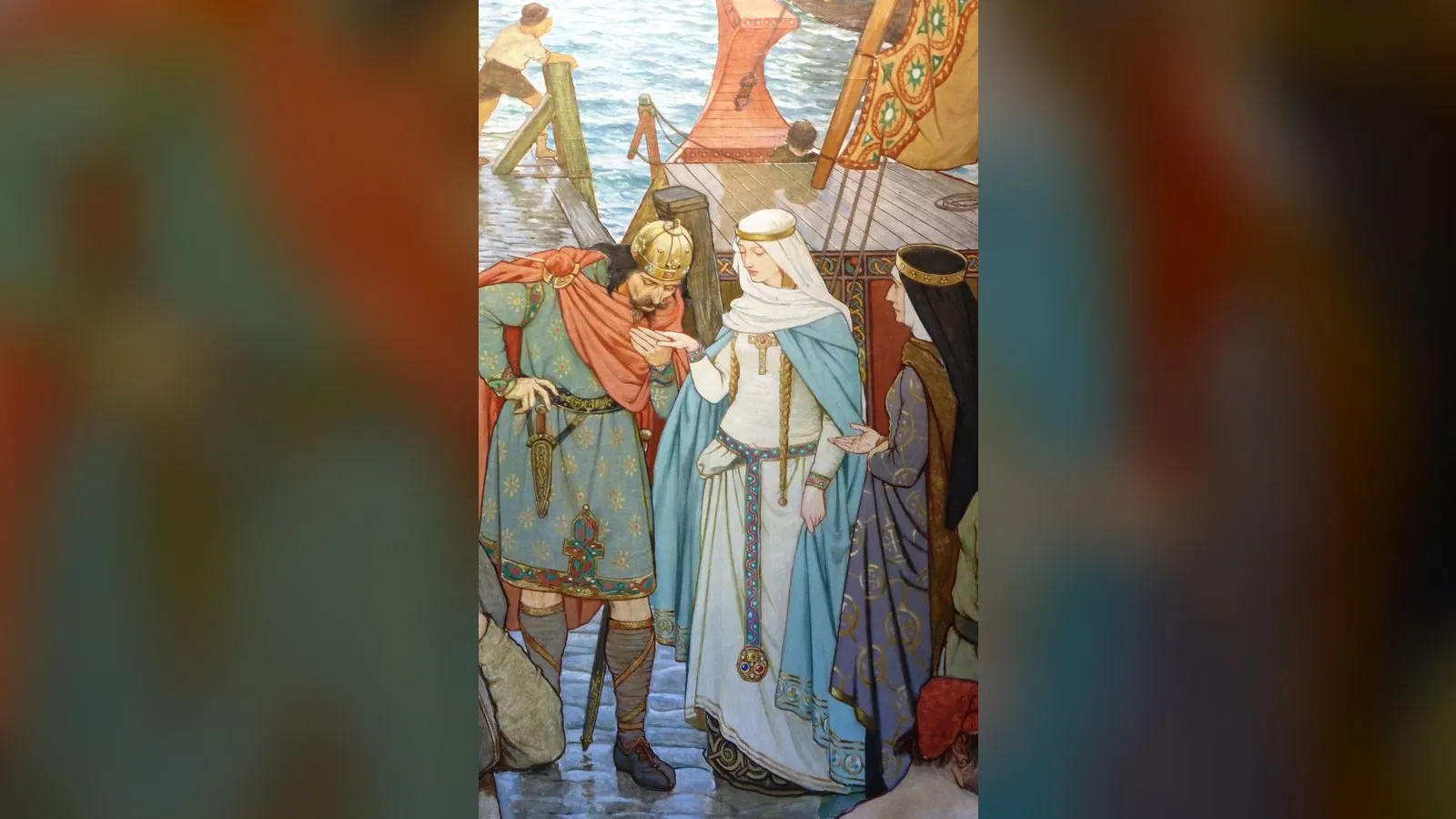

St Margaret of Scotland
Contents
Margaret, queen of Malcolm III, is Scotland's only royal saint and one of its patron saints. Yet she was born in Hungary, was a princess of the English House of Wessex, and never spoke Gaelic. She founded Dunfermline Priory, gave her name to the Queensferry crossings over the Forth, and was the mother of three kings of Scots and a queen of England. This card tests what can be known about her, given that almost everything about her character comes from a single devotional biography.
TL;DR
- established Margaret was born around 1045 in Hungary, where her father, Edward the Exile, lived. She was a granddaughter of the English king Edmund Ironside.
- established After the Norman Conquest her family fled north, and she married Malcolm III by the end of 1070. She founded a Benedictine priory at Dunfermline and a free ferry over the Forth for pilgrims.
- established Three of her sons, Edgar, Alexander I and David I, became kings of Scots, and her daughter Matilda married Henry I of England.
- established She died at Edinburgh Castle on 16 November 1093, three days after Malcolm and their eldest son were killed at Alnwick. She was canonised in 1249–1250.
- shared Our picture of her piety and church reforms comes almost entirely from the Life written by Turgot of Durham around 1100–1107 to support her sainthood. The old idea that she reformed a heretical "Celtic Church" is rejected by modern historians.
Key Facts
- Born
- c.1045, Hungary
- Father
- Edward the Exile, son of Edmund Ironside
- Mother
- Agatha; origin unknown
- Brother
- Edgar Ætheling, last Anglo-Saxon claimant to England
- Arrived in Scotland
- c.1068
- Married Malcolm III
- By the end of 1070
- Founded
- Dunfermline Priory, Scotland's first Benedictine house
- Children
- Eight, including Edgar, Alexander I, David I and Queen Matilda
- Died
- 16 November 1093, Edinburgh Castle
- Canonised
- Papal bull of 16 September 1249; shrine translated 1250
- Patroness of Scotland
- 1673, Pope Clement X
- Main source
- Turgot of Durham, Life of St Margaret, c.1100–1107
Scottish Impact Index (SI Score)
- Global Influence
- 5/10
- Enduring Relevance
- 9/10
- Material Contribution
- 2/10
- Exceptional Achievement
- 5/10
- Lasting Legacy
- 5/10
- Recognition
- 4/10
30/60
Ranked =93rd of 200 in Great Scots
A Note on Claims and Evidence
Each major claim carries one of three labels. established means supported by primary records, official bodies or several independent reliable sources. shared means the core fact is sound but sources disagree on details, dates or interpretation. traditional means widely repeated but not traceable to a primary or independent source.
Margaret's marriage, children, foundations and death are well documented. Her inner life is not. Turgot's Life was written for her daughter Matilda as part of the case for making Margaret a saint, and it uses the conventions of a saint's life, including miracles. Independent chroniclers say little about her. Stories of her storm-tossed arrival, Malcolm's instant love and the miracles around her death are devotional tradition.
Timeline
Margaret is born in Hungary.
Her father, Edward the Exile, returns to England and dies days later.
The Norman Conquest; her brother Edgar Ætheling is proclaimed king but never crowned.
Margaret's family reaches Scotland.
Margaret marries Malcolm III.
Margaret founds a priory at Dunfermline.
Margaret holds church councils, according to Turgot.
Malcolm and their son Edward are killed at Alnwick.
Margaret dies at Edinburgh Castle.
Turgot writes her Life.
David I builds St Margaret's Chapel in Edinburgh Castle.
Pope Innocent IV issues the bull of canonisation.
Her remains are moved to a new shrine at Dunfermline.
The Reformation; her shrine is destroyed and her relics removed.
Pope Clement X names her a Patroness of Scotland.
Details
1. Origins and early life: a princess born in exile
Margaret was born around 1045 — the exact date is not recorded — in the Kingdom of Hungary. Her father was Edward the Exile (also called Edward Ætheling), son of the English king Edmund Ironside and grandson of Æthelred the Unready. After the Danish conquest of England in 1016, Cnut had the infant Edward and his brother sent abroad; tradition has them passing through the Swedish and Kievan courts before settling in Hungary, where Edward supported King Andrew I's successful bid for the crown around 1046.
Her mother is a genuine historical mystery. Edward's wife Agatha is one of the most disputed figures in medieval genealogy. Contemporary and near-contemporary sources contradict each other: William of Malmesbury says her sister was a queen of Hungary; Orderic Vitalis names her father as "Solomon, king of the Huns"; Ailred of Rievaulx calls Margaret descended from English and Hungarian royal blood; while Roger of Howden and the Leges Edwardi Confessoris say she was of Rus royal blood, encountered while Edward was a guest of a Kievan "king Malesclodus." Modern theories have made her variously a German princess (kin of Emperor Henry III), a Hungarian princess, or a daughter of Yaroslav the Wise of Kiev. None is conclusive. We should state plainly: we do not know who Margaret's mother was.
Margaret grew up in the religious atmosphere of the Hungarian court. Her brother Edgar Ætheling and sister Cristina were also born in Hungary.
Return to England (1057): Margaret's father was recalled to England by his childless great-uncle, Edward the Confessor, as a possible heir to the English throne. He arrived in August 1057 and died almost immediately — whether of natural or sinister causes is unknown. Margaret, still a child, continued to live at the English court.
The Norman Conquest (1066): When Edward the Confessor died in January 1066, the throne passed to Harold Godwinson, then — after Hastings — to William of Normandy. Margaret's young brother Edgar Ætheling was briefly proclaimed king by the Witan but never crowned, and submitted to William. Edgar became the figurehead of Anglo-Saxon resistance, and the family's position in Norman England grew precarious.
2. Arrival in Scotland: storm, haven and a king's interest
After the failed revolt of the northern earls, Margaret's family attempted to leave England — tradition says to return to the Continent. Their ship was driven by storms into the Firth of Forth around 1068. The traditional landing place is identified as St Margaret's Hope, near North Queensferry in Fife. King Malcolm III welcomed the exiles.
The romantic version — Malcolm falling instantly in love with the beautiful princess and pursuing her despite her wish to be a nun — comes from later devotional tradition and should be treated as legend rather than fact. Indeed, the chronology is disputed: Orderic Vitalis suggests Malcolm had sought a marriage alliance with Margaret as early as 1059, while Symeon of Durham implies their first meeting may not have come until 1070, after William's "Harrying of the North." The marriage took place by the end of 1070. (Popular tradition fixes it precisely on Easter Monday 1070, but Fife Council archaeologist Douglas Speirs, having reviewed the contemporary sources, has noted there is "absolutely no indication" of the time of year the union actually took place — so the precise date is itself a later embellishment.)
The political dimension is essential. Malcolm was a widower (his first wife was Ingibiorg, connected to the Orkney earls). Marrying one of the last members of the House of Wessex gave Malcolm a powerful Anglo-Saxon dynastic connection and a claim to legitimacy against Norman England — and gave the displaced Anglo-Saxon cause a royal protector. This was a marriage of high politics as much as romance.
3. Turgot's Life of St Margaret — the primary-source problem
This is the single most important thing to understand about Margaret. Virtually everything we know about her character, piety, daily life and church reforms comes from one text: the Vita Sanctae Margaritae Reginae (Life of St Margaret, Queen of Scots), written by Turgot of Durham around 1100–1107. Turgot was Margaret's confessor and later became Prior of Durham and Bishop of St Andrews. He wrote the Life at the request of Margaret's daughter Edith/Matilda, by then Queen of England as the wife of Henry I.
What is hagiography, and why does it matter? A vita of this kind is not a neutral biography. It is a devotional text written to demonstrate sanctity — to prove the subject was holy, often as a step toward formal canonisation. Hagiography selects, shapes and amplifies; it deploys conventional motifs (miracles, ascetic extremes, prophetic foreknowledge of death) that recur across many saints' lives; and it serves the interests of its commissioners. Turgot's Life was, in effect, a model of ideal queenship held up for Matilda to emulate, and the opening salvo in the case for Margaret's holiness.
What this means for reliability:
- The miraculous and providential episodes (the Gospel book that fell in a river and was recovered undamaged; Margaret's foreknowledge of her own death; the protective mist that hid her funeral procession) are hagiographic set-pieces and should never be reported as historical fact.
- Margaret's relentless asceticism, her debating the clergy "like another Helena," and Malcolm's complete submission to her piety are shaped to serve the portrait of a saint.
- Modern scholars have noted that Turgot's Life may exaggerate or invent in service of its purpose — including constructing a flattering genealogy and emphasising Margaret's learning and reforming zeal to model perfect queenship for Matilda and to bind the Scottish royal line to the prestige of the Anglo-Saxon and Norman courts.
Independent corroboration is thin. The Anglo-Saxon Chronicle records the marriage and the family's arrival but says almost nothing of Margaret's character or reforms. Orderic Vitalis and Symeon of Durham mention her in passing. There is no neutral, secular account of the church councils or the personal piety that Turgot describes in such detail.
How modern historians treat Turgot: Opinion ranges. Older and devotional writers (and Turgot himself, who insisted his account was "especially trustworthy" because of his intimate knowledge of the queen) took the Life largely at face value. Modern academic historians are far more cautious, reading it as a politically and devotionally motivated text. The scholarship of Lois Huneycutt — especially her 1989 study "The Idea of the Perfect Princess: The Life of St Margaret in the Reign of Matilda II" (Anglo-Norman Studies 12) and her 2003 monograph Matilda of Scotland: A Study in Medieval Queenship — has been especially influential in arguing that the Life functioned as a "mirror" of ideal queenship held up for Matilda. Robert Bartlett, who edited the related miracle collection (The Miracles of St Æbbe of Coldingham and St Margaret of Scotland, Oxford, 2003), has shown that such texts tell us more about later cults than about the saint herself. The honest position for a modern article: treat Turgot as a rich but heavily biased witness, not as gospel.
4. Her religious reforms — and the great "Celtic Church" debate
Turgot describes Margaret convening church councils — the principal one is usually dated by historians to around 1072–1074 (often placed at St Andrews) — at which she debated the Scottish clergy (with Malcolm acting as interpreter, since she did not speak Gaelic) and pressed a series of reforms. The reforms he lists:
- Lenten observance: The Scots reportedly began their fast on the Monday after Ash Wednesday, making it 36 days; Margaret pressed for the Roman reckoning of a full 40-day Lent.
- Easter communion: Many Scottish clergy and laity reportedly refrained from receiving communion at Easter out of a sense of unworthiness; Margaret argued that, with proper confession and penitence, they should receive.
- Mass according to a "barbarous rite": Turgot says Mass was celebrated in some places with strange or "barbarous" customs that he and the queen wished to correct.
- Work on Sunday: The promotion of abstinence from servile work on the Lord's Day.
- Marriage law: Prohibition of marriages within forbidden degrees — notably marrying a stepmother or a deceased brother's widow.
- The liturgical language question: Often summarised as a reform replacing Gaelic with Latin — but see the caveat below; Turgot himself does not actually specify the language.
The most concrete, archaeologically attested achievement is the foundation of Dunfermline Priory. According to Historic Environment Scotland, "In 1070, Margaret founded a priory in Dunfermline on the site where she had married Malcolm III. She introduced a small community of Benedictine monks from Canterbury, and so laid the foundations of the first Benedictine house in Scotland." The monks — three of them — were sent from Canterbury by Archbishop Lanfranc, the great reforming primate, which is itself telling: Margaret's project was an extension of the mainstream continental and English reform movement, not a quirky local innovation. Her son David I raised the priory to abbey status in 1128, building the great Romanesque church whose nave (with pillars resembling those of Durham Cathedral) survives today.
Her ferry across the Forth is the origin of two place names that survive to this day. Margaret established a free ferry crossing the Firth of Forth for pilgrims travelling to St Andrews, giving rise to the towns of North Queensferry and South Queensferry ("the Queen's Ferry"). Medieval documents refer to the crossing as the Passagium Sanctae Margaritae Reginae.
Iona: Tradition (and some later sources) credit Margaret with restoring or refurbishing the monastery on Iona around 1075. This is plausible and consistent with her patronage of older Gaelic religious communities, but is less firmly documented than Dunfermline.
THE GREAT HISTORIOGRAPHICAL DEBATE: was there a deviant "Celtic Church"? The popular story — repeated for centuries — is that Margaret rescued a backward, isolated, quasi-heretical "Celtic Church" and dragged Scotland into line with Rome. Modern scholarship rejects this framing. Historians including Dauvit Broun, Thomas Owen Clancy (co-editors of Spes Scotorum: Hope of the Scots, 1999) and Ian Muirhead ("The Beginnings," 1984) have shown that there was no separate, doctrinally deviant "Celtic Church" standing in opposition to Rome. The very idea of a unified "Celtic Church" is now regarded as a construct — one that originated largely in Reformation-era polemic (figures such as George Buchanan supplied "the initial propaganda for the makers of the Scottish Kirk") and was later romanticised. As the Anglo-Saxonist Patrick Wormald put it, "one of the common misconceptions is that there was a Roman Church to which the Celtic Church was nationally opposed," and the notion of a "Celtic Church" in a post-Reformation sense is "maddeningly ineradicable from the minds of students." The church in Scotland in Margaret's day was already broadly Roman and orthodox in doctrine. What varied were particular local customs and observances (the Lenten start date, Easter communion practice, the usages of the Céli Dé or Culdee communities) — not fundamental belief.
So Margaret was, at most, correcting local practices and aligning Scottish observance with the wider continental and Gregorian-reform church she had known — not converting a heretical institution. It is also worth noting that she patronised, rather than suppressed, the older Gaelic religious communities (the Céli Dé). The "rescuer of the Celtic Church" narrative tells us more about later Protestant and Victorian imaginations than about the eleventh century.
5. Her personal piety and character (per Turgot)
Turgot's portrait — to be read as devotional, not documentary — paints Margaret as a model of pious queenship:
- She fasted rigorously (so severely, the Life says, that it damaged her health) and rose at midnight for church services.
- She fed crowds of the poor — Turgot describes her serving 300 poor people, and washing the feet of the poor during Lent in imitation of Christ — before she herself would eat.
- She cared for orphaned children at court and interceded for English captives reduced to serfdom after the Conquest.
- She loved fine church vestments and ornaments, and devoted herself to private prayer and to books.
- The most charming detail: Malcolm, who reportedly could not read, so revered his wife's devotional books that he would handle and kiss them, and had one richly bound in gold and gems as a gift to her. One of Margaret's Gospel books — a small illuminated volume with portraits of the Evangelists — survives in the Bodleian Library, Oxford.
All of this is Turgot's testimony and bears the marks of hagiographic idealisation. The underlying reality — a genuinely pious, learned, charitable queen — is entirely credible, but the specific anecdotes and numbers should be flagged as coming from a saint's life.
6. Influence on court culture, Malcolm and her remarkable children
Turgot claims Margaret softened the warrior-king Malcolm, making him more devout and generous, and that he deferred to her counsel. She is credited with bringing continental manners, ceremony, fashion and trade to a more refined Scottish court, and shifting court culture toward Anglo-continental norms.
Her children were a dynasty in themselves. Margaret and Malcolm had eight children — six sons and two daughters:
- Edward (killed with his father at Alnwick, 1093)
- Edmund
- Æthelred (abbot of Dunkeld)
- Edgar (King of Scots, 1097–1107)
- Alexander I (King of Scots, 1107–1124)
- David I (King of Scots, 1124–1153)
- Edith/Matilda (Queen of England as wife of Henry I)
- Mary (married the Count of Boulogne; her daughter also became a queen of England, as wife of King Stephen)
The naming is a pointed statement. None of the children bears a traditional Gaelic royal name; all carry Anglo-Saxon or religious/dynastic names (Edward, Edmund, Æthelred, Edgar) tied to the House of Wessex. This was a deliberate dynastic and cultural signal — aligning the Scottish royal line with the prestige of the old English royal house.
How much was really her influence? Here caution is needed. The transformation of Scotland into a more feudal, Anglo-Norman kingdom is most strongly associated with her youngest son David I (the "Davidian Revolution" — feudal landholding, burghs, reformed dioceses, new monasteries, coinage). As the historian Mark Cartwright summarises the modern view, this anglicisation "may be exaggerated, and have really only concerned the royal court at Dunfermline or (in a view favoured by most modern historians) been largely instigated by Malcolm's successors, his three sons with Margaret who ruled in turn from 1087 to 1153." Malcolm himself had spent years of his youth in exile in England, so Anglo-Saxon influence at his court did not depend on Margaret alone. The "Margaret effect" was, in significant part, retrospectively constructed by a dynasty that needed a saintly founding mother.
7. Death in November 1093
In November 1093 Malcolm III launched another invasion of England. He and his eldest son Edward were killed at the Battle of Alnwick on 13 November 1093, ambushed by forces under Robert de Mowbray, the Norman Earl of Northumbria. Margaret, already gravely ill at Edinburgh Castle, received the news (Turgot says from her son Edgar) and died on 16 November 1093, three days after her husband and son — reportedly of grief, compounded by her long illness.
The deathbed scene is one of the most famous in Scottish history: Margaret is said to have died holding the Black Rood of Scotland, a gold reliquary cross containing a fragment said to be of the True Cross, which was her most prized possession (and which she may have brought from Hungary or England). The Black Rood later became a symbol of Scottish sovereignty; it was carried off to England by Edward I in 1291 and returned in 1328.
As Margaret's body lay in the castle, Malcolm's brother Donald III (Donald Bán) — leading a faction reacting against English influence — besieged Edinburgh. Tradition says her body was smuggled out under cover of a mist, across the Queen's Ferry, to be buried at her own church of Dunfermline before the high altar.
8. Canonisation and cult
The road to sainthood was long. Her daughter Queen Matilda commissioned Turgot's Life around 1100–1107, beginning the case. In the 1240s her descendant King Alexander II (and the Scottish bishops) petitioned Rome. After inquiries into her life and miracles, Pope Innocent IV issued a canonisation bull dated 16 September 1249, with the formal celebration generally dated to 1250.
On 19 June 1250, Margaret's remains were exhumed and translated to a magnificent new shrine in a newly built chapel at the east end of Dunfermline Abbey, with Malcolm's remains placed beside her; 19 June became a Scottish feast of St Margaret. (Note: some older sources give the translation date as 1259 — see Caveats. The date of the relic translation is genuinely reported inconsistently.)
St Margaret's Chapel in Edinburgh Castle is the oldest surviving building in Edinburgh. Though long believed to be Margaret's own oratory, architectural evidence shows it was built around 1130 by her son David I, dedicated to his mother's memory. It survived Robert the Bruce's destruction of the castle's buildings in 1314 — Bruce ordered it spared and provided for its repair on his deathbed.
Patron saint: Margaret was declared a Patroness of Scotland in 1673 by Pope Clement X, in response to a petition from the Scots College in Rome. She shares the honour with the land's older patron, the Apostle St Andrew. She is also venerated as a patron of widows, queens, large families, learning and the poor. Her feast was historically 19 June in Scotland and 10 June in the wider Catholic calendar; the 1969/1972 reform moved it to 16 November, the date of her death.
The Reformation devastated her cult: her shrine at Dunfermline was destroyed in the iconoclasm of 1560, and her relics were dispersed.
9. The relics — a genuinely remarkable story
The fate of Margaret's remains is one of the strangest journeys in Scottish history:
- At the Reformation (around 1560), to protect them from Protestant iconoclasm, Abbot George Durie removed the bodies of Margaret and Malcolm from Dunfermline, initially to his estate at Craigluscar.
- In 1566, Mary, Queen of Scots had Margaret's head, in its reliquary, brought to Edinburgh Castle as a relic believed to assist in childbirth (Mary was expecting the future James VI).
- The head later passed to the Jesuits at the Scots College, Douai, in France (by 1597), where it was venerated. It was seen there as late as 1785, reportedly still bearing the queen's auburn hair. It disappeared during the French Revolution and was never recovered.
- The rest of the remains of Margaret and Malcolm were carried to Flanders and eventually acquired by Philip II of Spain, who placed them in the royal monastery of El Escorial near Madrid in two caskets labelled "St Margaret, Queen" and "St Malcolm, King." Their present location is unknown — when a 19th-century Scottish bishop sought them, they could not be found.
- In 1862/1863, Bishop James Gillis of Edinburgh obtained a relic of St Margaret — a shoulder-bone fragment, certified and sealed from the Escorial — and brought it to Scotland. It was kept at St Margaret's Convent, Edinburgh, and in 2008, after the convent's closure, was transferred to St Margaret's Memorial Church, Dunfermline, where it remains. In 2019 the reliquary was opened for 3D scanning.
So: the head was lost in revolutionary France; the body was lost in Spain; and a single certified shoulder-bone fragment is the principal relic back in Scotland today.
10. Legacy
Margaret's place in Scottish identity is enormous and, in important ways, paradoxical — a Hungarian-born, Anglo-Saxon, non-Gaelic-speaking princess became Scotland's only royal saint and a patron of the nation.
- Dunfermline became, through her, the royal burial church of Scotland — supplanting Iona. Many Scottish monarchs are buried there, including Robert the Bruce, whose body lies at Dunfermline (his heart, famously, was taken on crusade by Sir James Douglas and is buried at Melrose Abbey).
- The Queensferry crossings — and today's Queensferry Crossing bridge — preserve her name across the Forth.
- St Margaret's Chapel remains the oldest building in Edinburgh and a place of pilgrimage and ceremony.
- Her children transformed Scotland: through her sons (especially David I) and daughter Matilda (Queen of England), her bloodline ran into both the Scottish and English royal lines.
The honest verdict on her influence: Margaret was certainly a real, pious, politically significant queen who founded Dunfermline, patronised the church and modelled a new style of queenship. But the grand narrative of "St Margaret who reformed the Celtic Church and civilised Scotland" is substantially a retrospective construction — built by Turgot for Matilda, elaborated by her descendants who needed a saintly founding mother to legitimise their dynasty, and romanticised again by Victorian and Catholic-revival writers. The reality is subtler and, arguably, more interesting than the legend.
11. Mother of a dynasty: Margaret in the later Middle Ages
For late medieval Scots, Margaret was not only a saint but the founder of the royal line. Steve Boardman shows that Wyntoun treated the marriage of Malcolm III and Margaret as the start of what was effectively a new dynasty. Writers counted later kings by generations from Margaret: in 1321, Scottish envoys described Robert I as the seventh king descended from her. Through her Old English royal blood, Scottish kings could also present themselves as rightful heirs to the English throne lost in 1066. Scottish negotiators made exactly this argument in 1321.
Her cult protected the dynasty in practical ways. St Margaret's shirt, kept at Dunfermline, was worn by Scottish queens in childbirth; the practice is attested for the births of James III (1451) and James V. Walter Bower tells how Sir John Wemyss, apparently dying in Fife in 1263, saw a vision of Margaret leading Malcolm and three of their sons out of Dunfermline church to fight the Norwegians at Largs. Boardman also notes that by the 16th century many Lowland families, among them the Swintons, Setons and Drummonds, claimed that their ancestors had arrived with Margaret or fought for Malcolm against Macbeth. Such origins advertised loyalty to the dynasty from its very beginning.
Did You Know?
- Scottish queens wore St Margaret's shirt, kept at Dunfermline Abbey, when giving birth. This helps explain why so many royal children, including the future James I in 1394, were born at Dunfermline (Boardman, 2002).
- Margaret is Scotland's only royal saint — and unusually, she was canonised as neither a virgin nor a martyr, but as a wife and mother.
- She never spoke Gaelic: at her church councils, her husband King Malcolm acted as her interpreter.
- North Queensferry and South Queensferry — and the modern Queensferry Crossing — are all named after her free pilgrim ferry across the Forth.
- Her husband couldn't read, but so loved her devotional books that he kissed and handled them and had one bound in gold and jewels — and one of her Gospel books survives in Oxford's Bodleian Library.
- In Gaelic tradition she is sometimes called Maighread nam Mallachd — "Margaret of the Curses" / "Accursed Margaret" — blamed by some for the decline of Gaelic culture and the older church.
- Her head relic vanished in the French Revolution and her body was lost in Spain; today only a certified shoulder-bone fragment survives, in Dunfermline.
- Her son David I built St Margaret's Chapel in Edinburgh Castle in her memory — the oldest surviving building in the city.
- Mary, Queen of Scots had Margaret's head brought to Edinburgh Castle in 1566 as a childbirth talisman while pregnant with the future James VI.
FAQ
1Was St Margaret Scottish?
No. She was born in Hungary and belonged to the English royal House of Wessex.
2How did she come to Scotland?
Her family fled north after the Norman Conquest and reached Scotland around 1068.
3Did she speak Gaelic?
No. According to Turgot, Malcolm interpreted for her at church councils.
4What did she found?
A Benedictine priory at Dunfermline and a free ferry across the Forth for pilgrims.
5Why are Queensferry and the Queensferry Crossing named after her?
Because of the ferry she established for pilgrims heading to St Andrews.
6Did she reform a heretical Celtic Church?
No. Modern historians reject that idea; she corrected some local practices.
7How do we know about her?
Mainly from Turgot's Life of St Margaret, a devotional work written to support her sainthood.
8When did she die?
On 16 November 1093, three days after her husband and eldest son were killed.
9When did she become a saint?
She was canonised in 1249–1250.
10Where are her remains?
Her head was lost in the French Revolution and her body in Spain; a shoulder-bone relic is kept at Dunfermline.
11Did she build St Margaret's Chapel in Edinburgh Castle?
No. Her son David I built it around 1130 in her memory.
Sources and Further Reading
Scholarly/Critical
- Steve Boardman, "Late Medieval Scotland and the Matter of Britain", in Edward J. Cowan and Richard J. Finlay (eds), Scottish History: The Power of the Past (Edinburgh University Press, 2002)
Further reading
- Turgot of Durham, Life of St Margaret, Queen of Scotland, in English translation
- Dauvit Broun and Thomas Owen Clancy (eds), Spes Scotorum: Hope of Scots (T&T Clark, 1999)
Caveats: Myths and Disputed Claims
- Do not give her birth date or birthplace as precise.
- Do not state her mother Agatha's origin as known.
- Do not say she reformed a separate or heretical "Celtic Church".
- Do not say Turgot records her replacing Gaelic with Latin in the Mass; he refers only to a "barbarous rite".
- Do not present the storm landing, the romance with Malcolm, or the miracles as history.
- Do not say she built St Margaret's Chapel.
- Do not say she replaced St Andrew as patron saint.
- Do not credit her alone with transforming Scotland; much of that was her sons' work.
Card 008 · Great Scots