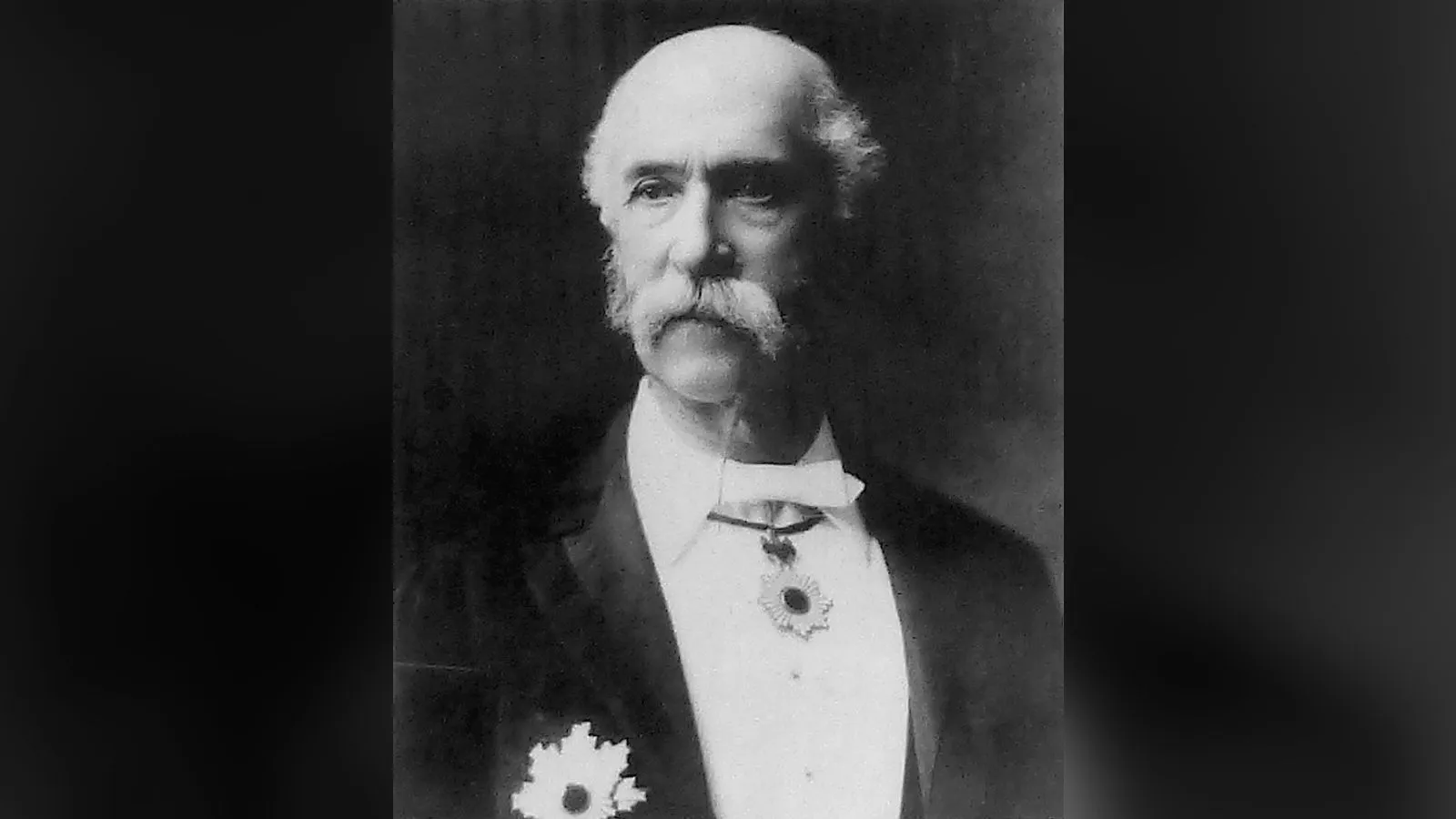

Thomas Blake Glover (1838–1911): Arms Dealer, Industrialist, and the "Scottish Samurai"
Contents
TL;DR
- Established (Documented): Glover, a Fraserburgh shipping clerk turned Nagasaki trader, was one of the most important — and most legally compromised — foreign figures in Japan's transition from the Tokugawa shogunate to the Meiji era, illegally supplying arms and warships to the rebel Satsuma and Chōshū domains in direct violation of Japanese law restricting foreign trade.
- Established/Documented, and morally serious: Contemporaries in some circles branded him a "merchant of death" — a characterization this article does not soften, since his profits derived directly from supplying weapons used in Japan's civil conflict, whatever the long-term political outcome.
- Established (Documented): He also secretly arranged the illegal departure of the "Chōshū Five" students (1863) and Satsuma trainees (1865) to study in Britain — a genuinely consequential act, since several of these men, including future Prime Minister Itō Hirobumi, went on to lead the modernizing Meiji government that later honoured Glover for exactly this assistance.
- Established (Documented): Beyond arms, Glover helped found ventures that became foundational to modern Japanese industry, including early shipbuilding connections that fed into what became Mitsubishi, Japan's first modern coal mine at Takashima, and brewing operations that evolved into Kirin.
- Legend/Myth, firmly corrected: Glover is popularly but wrongly tied to the story behind Puccini's opera Madama Butterfly. This connection has no solid historical basis and appears to have been manufactured by American occupation forces and postwar Japanese tourism promotion, not by any genuine link between Glover's life and the opera's origins.
Key Facts
- Born
- 6 June 1838, Fraserburgh, Aberdeenshire, Scotland
- Died
- 16 December 1911, Tokyo, aged 73
- Parents
- Thomas Berry Glover (coastguard officer) and Mary Findlay
- Employer on arrival in Asia
- Jardine Matheson & Co.
- Arrived in Japan
- 1859, aged 21
- Own firm
- Glover & Co. (Guraba-Shōkai), Nagasaki, founded 1861
- Key illegal activity
- Arms and warship trading to the Satsuma and Chōshū domains, in defiance of Tokugawa shogunate restrictions on foreign trade
- Key covert operation
- Smuggled the "Chōshū Five" students to Britain (1863) and Satsuma trainees (1865)
- Industrial legacy
- Early Mitsubishi shipbuilding connections; Takashima coal mine, Japan's first modern mine; groundwork for what became Kirin Brewery
- Honour
- Order of the Rising Sun, 2nd Class (1908)
- Nickname
- "Scottish Samurai"
Scottish Impact Index (SI Score)
- Global Influence
- 5/10
- Enduring Relevance
- 7/10
- Material Contribution
- 5/10
- Exceptional Achievement
- 5/10
- Lasting Legacy
- 5/10
- Recognition
- 3/10
30/60
Ranked =93rd of 200 in Great Scots
A Note on Claim Status
This article follows ScottishInventions.co.uk's standard evidence tiers: Established/Documented (supported by primary sources or strong scholarly consensus), Shared/Traditional (widely repeated but resting on thinner evidence), disputed (credible sources disagree), and Legend/Myth (popular but unsupported or contradicted by the record). Glover's career sits at an unusually sharp intersection of admiration and discomfort: the same activities that make him a celebrated figure in Japanese industrial history — arms smuggling to rebel domains — were, at the time, straightforwardly illegal gunrunning conducted for profit during a period of civil conflict. This article gives that fact full weight rather than allowing his later honours to retroactively sanitise it, and separately and firmly corrects the popular but unsupported claim tying him to Madama Butterfly.
Timeline
Born in Fraserburgh, Aberdeenshire, the fifth of eight children of a coastguard officer.
Joins Jardine Matheson & Co. as a shipping clerk; relocates to Shanghai, aged 18.
Moves to Nagasaki, Japan, aged 21, initially trading in green tea for export.
Establishes his own firm, Glover & Co. (Guraba-Shōkai), in Nagasaki.
Secretly arranges passage to London for the "Chōshū Five" students aboard Jardine Matheson vessels, in defiance of the shogunate's prohibition on overseas travel.
Supplies arms and warships to the rebel Satsuma and Chōshū domains during the Bakumatsu period, in direct violation of Japanese trade restrictions on foreigners.
Arranges passage for around fifteen to nineteen Satsuma trainees, led by Godai Tomoatsu, to study in Britain.
Demonstrates a small-scale locomotive in Nagasaki's Ōura district, an early introduction of railway technology to Japan.
Contracts with the Nabeshima clan to develop Takashima coal mine — Japan's first modern coal mine — and introduces the country's first dry dock.
The Meiji Restoration topples the Tokugawa shogunate, bringing to power a government substantially shaped by men Glover had helped educate abroad.
Declares bankruptcy, though remains in Japan managing the Takashima mine for its Dutch owners.
Begins a common-law relationship with Awajiya Tsuru.
Daughter Hana born to Glover and Tsuru in Nagasaki.
The Meiji government assumes control of the Takashima mine; Glover's direct role there ends.
Tsuru dies.
Awarded the Order of the Rising Sun, 2nd Class, by the Japanese government, reportedly at the recommendation of two of the former Chōshū Five he had helped smuggle abroad decades earlier.
Dies of kidney disease at his home in Tokyo, aged 73; buried at Sakamoto International Cemetery, Nagasaki.
Glover's adopted son, Kuraba Tomisaburō, persecuted as a suspected spy during WWII, dies by suicide following Japan's surrender.
Sites connected to Glover's industrial ventures included in UNESCO's "Sites of Japan's Meiji Industrial Revolution" World Heritage listing.
Details
From Fraserburgh to the Far East
Thomas Blake Glover was born in 1838 in Fraserburgh, a fast-growing Aberdeenshire fishing and trading port, the fifth of eight children of a coastguard officer. After a itinerant schooling following his father's postings, he entered commerce as a shipping clerk with the powerful trading house Jardine Matheson, which sent him to Shanghai in 1857 at just eighteen. Two years later he crossed to the recently opened Japanese port of Nagasaki, initially trading in green tea — an unremarkable, legal beginning to a career that would soon become considerably less so.
Profiting from civil conflict
By 1861, Glover had established his own firm, Glover & Co., in Nagasaki, and it was here that his career took its most consequential — and most legally and morally fraught — turn. Japan in the 1860s was in the grip of the Bakumatsu period, a time of mounting internal conflict between the ruling Tokugawa shogunate and rebel domains, chiefly Satsuma and Chōshū, who sought to overthrow it. Foreign trade with these domains was strictly prohibited under shogunate law, and discovery carried real consequences — trading bans, fines, or imprisonment for foreign merchants caught defying the restriction.
Glover defied it anyway, supplying Satsuma and Chōshū with arms and warships throughout this period. This was not incidental or reluctant commerce: it was a deliberate, repeated, and highly profitable violation of Japanese law, undertaken for a foreign merchant's own financial gain during an active civil conflict. Contemporaries in some circles branded him, with justice, a "merchant of death" — a characterization this article does not soften or explain away. That the domains he armed went on to win and to lead the modernizing government that followed does not retroactively make the original transactions anything other than what they were: illegal arms dealing for profit, conducted with full awareness of the risk and the stakes involved.
The students he smuggled out of Japan
Set against this, and in some tension with it, sits Glover's other major covert intervention in Japan's political transformation: his role in secretly arranging the illegal departure of Japanese students to study in Britain. In 1863, he helped smuggle five young Chōshū domain samurai — the "Chōshū Five" — aboard Jardine Matheson vessels bound for London, defying the shogunate's own prohibition on overseas travel. In 1865 he arranged similar passage for a larger group of Satsuma trainees.
This act proved to have consequences reaching far beyond its immediate illegality. Among the Chōshū Five was Itō Hirobumi, who would later become Japan's first Prime Minister; other members of the group went on to shape Japan's railway and industrial development. When the Meiji government Glover had helped educate came to power in 1868, it was substantially staffed by men whose first direct exposure to Western institutions and technology Glover himself had arranged, at real personal risk. It is a genuinely rare case of a single individual's illegal activity on two fronts — gunrunning to one side of a civil war, and covert educational smuggling — both converging, by historical accident as much as design, to benefit the same eventual victors.
Industrialist: railways, coal, ships, and beer
Glover's contribution to Japan's rapid industrialization extended well beyond politics and weapons. In 1865 he demonstrated a small-scale locomotive on a short track in Nagasaki's Ōura district, an early and influential introduction of railway technology to a country that would go on to build one of the world's most advanced rail networks within decades. In 1868 he contracted with the Nabeshima clan to develop the Takashima coal mine, widely regarded as Japan's first modern coal mine, and introduced the country's first dry dock. His shipbuilding connections — including naval contracts with Aberdeen's Alexander Hall and Company shipyard — fed directly into the beginnings of what became Mitsubishi, one of Japan's largest corporate conglomerates today. He also negotiated the sale of a Yokohama brewery that evolved into the Japan Brewery Company and, eventually, Kirin — though the popular claim that Glover personally founded Kirin Brewery, or that the company's mythical lion-dragon logo was modelled on his moustache, is an embellishment beyond what the documented record actually supports; his role was a specific, real business transaction, not company founder.
These ventures were not uniformly successful. Glover declared bankruptcy in 1870, a financial collapse that cost him direct ownership of several of his enterprises, though he continued managing the Takashima mine for its subsequent Dutch owners until the Meiji government took control of it in 1881.
Family life, and the myth that outgrew the man
In the early 1870s, Glover entered a common-law relationship with a Japanese woman, Awajiya Tsuru, with whom he had a daughter, Hana, in 1876; they remained together until Tsuru's death in 1899. Glover also adopted a son, Kuraba Tomisaburō, born to a different woman, Kaga Maki, who went on to play a significant role in Nagasaki's economy — but who was persecuted as a suspected spy during the Second World War and took his own life in August 1945, immediately following Japan's surrender, a bleak coda to the family story that sits at some remove from Glover's own celebrated legacy.
It is this family history, combined with Glover's Nagasaki residence, that gave rise to the most persistent myth attached to his name: a supposed connection to the story behind Giacomo Puccini's opera Madama Butterfly. The claim has genuinely shallow foundations — the stories by John Luther Long and Pierre Loti that actually inspired the opera were set in the same general area of Nagasaki harbour, and circumstantial details (Glover's adoption of a mixed-heritage son, a photograph of Tsuru in a butterfly-patterned kimono) have been enough to sustain popular belief, but there is no direct historical evidence linking Glover's own life to the opera's origin. The connection appears to have been substantially manufactured after the fact: American occupation forces nicknamed Glover's former residence the "Madame Butterfly House" after the war, a label possibly reinforced by a 1932 Hollywood film partly shot there, and Japanese postwar tourism authorities then actively promoted the association during reconstruction — a case of commercial branding retroactively creating a historical connection that scholarship does not actually support.
Honours, death, and a complicated legacy
Glover's contributions to Japan's modernization were formally recognised late in his life: in 1908 he received the Order of the Rising Sun, 2nd Class, reportedly at the recommendation of two of the very Chōshū Five he had helped smuggle to Britain forty-five years earlier — a fitting, if slow-arriving, acknowledgement of that particular act's consequence. He died of kidney disease at his home in Tokyo in December 1911, aged 73, and was buried at the Sakamoto International Cemetery in Nagasaki.
Today Glover is celebrated in Japan as the "Scottish Samurai," and his former Nagasaki residence, now Glover Garden, draws roughly two million visitors a year. Sites connected to his industrial ventures were included in UNESCO's 2015 "Sites of Japan's Meiji Industrial Revolution" World Heritage listing. In Scotland, his Fraserburgh birthplace — destroyed by wartime bombing — is marked with a commemorative plaque, and his story has inspired further cultural work, including Alan Spence's novel The Pure Land. What deserves to sit alongside that celebration, rather than be quietly dropped from it, is the more uncomfortable half of the record: that Glover's fortune and his place in Japanese history were built substantially on arms sold, illegally and knowingly, into an active civil conflict — a fact his later honours and his genuinely significant educational and industrial contributions do not cancel out.
Did You Know?
- Glover's fortune was built in part on illegal arms and warship sales to rebel domains during a Japanese civil conflict — activity for which contemporaries in some circles labelled him a "merchant of death."
- He helped smuggle the "Chōshū Five" students out of Japan in 1863, defying a law that made unauthorised overseas travel illegal; one of them, Itō Hirobumi, later became Japan's first Prime Minister and helped secure Glover's highest honour decades later.
- The locomotive Glover demonstrated in Nagasaki in 1865 is credited with helping introduce Japan to the possibilities of railway transport.
- His shipbuilding business connections fed directly into the beginnings of Mitsubishi, now one of Japan's largest corporate conglomerates.
- Glover went bankrupt in 1870, despite his enormous influence on Japan's industrial and political development.
- The popular belief tying Glover to the story behind Puccini's opera Madama Butterfly has no solid historical foundation and appears to have been substantially manufactured by postwar American occupation forces and Japanese tourism promotion.
- Glover's adopted son, Kuraba Tomisaburō, was persecuted as a suspected spy during the Second World War and took his own life immediately after Japan's surrender in 1945.
- Sites connected to Glover's industrial ventures in Japan were named UNESCO World Heritage sites in 2015.
Frequently Asked Questions
1Who was Thomas Blake Glover?
A Scottish merchant (1838–1911) from Fraserburgh who became one of the most influential — and legally compromised — foreign figures in Japan's transition from the Tokugawa shogunate to the modernizing Meiji era.
2What was Glover's role in Japan's civil conflict of the 1860s?
He illegally supplied arms and warships to the rebel Satsuma and Chōshū domains, in direct violation of shogunate trade restrictions, profiting from weapons sales during active internal conflict — activity that earned him the label "merchant of death" in some contemporary circles.
3Did Glover help Japan modernize?
Yes, substantially. He helped smuggle Japanese students to study in Britain, introduced early railway technology, developed Japan's first modern coal mine, contributed to shipbuilding ventures that became Mitsubishi, and helped establish brewing operations that evolved into Kirin.
4Who were the "Chōshū Five"?
Five young Chōshū domain samurai whom Glover secretly helped smuggle to London in 1863 to study Western technology and institutions, defying Japanese law at the time. One, Itō Hirobumi, later became Japan's first Prime Minister.
5Is Thomas Glover connected to the opera Madama Butterfly?
No, not in any historically substantiated way. This popular claim rests on thin circumstantial detail and appears to have been largely created after the war by American occupation forces and Japanese tourism promotion, not by any genuine documented connection between Glover's life and the opera's actual sources.
6Did Glover found Kirin Brewery?
Not exactly. He negotiated the sale of a Yokohama brewery that became part of the lineage leading to Kirin, but the popular idea that he personally founded the company, or inspired its logo, overstates his actual, more specific role in that transaction.
7Was Glover ever punished for his illegal arms trading?
Not directly, as far as the record shows — he avoided the formal penalties (trading bans, fines, imprisonment) that discovery could have brought, and went on to be honoured by the very government whose founding forces he had armed.
8What happened to Glover's family?
He had a common-law relationship with Awajiya Tsuru and a daughter, Hana. He also adopted a son, Kuraba Tomisaburō, who was persecuted as a suspected spy during WWII and died by suicide after Japan's surrender in 1945.
9How is Glover remembered today?
He is celebrated in Japan as the "Scottish Samurai," with his former Nagasaki residence, Glover Garden, a major tourist attraction, and sites tied to his industrial work included in a 2015 UNESCO World Heritage listing.
10How did Glover die?
He died of kidney disease at his home in Tokyo in December 1911, aged 73, and was buried in Nagasaki.
Sources and Further Reading
Primary / Institutional
- Mitsubishi Corporation: Thomas Glover
- Undiscovered Scotland: Thomas Blake Glover
- Mitsubishi Corporation History: vol.10 Thomas Glover
Scholarly
- Nippon.com: Thomas Glover — The Scotsman Who Helped Meiji Japan Modernize
- Nippon.com: Nagasaki's Glover Garden — Window on the British Merchants Involved in Japan's Modernization
- Willamette University: Thomas Glover, by Michael Gardiner
General
- Wikipedia: Thomas Blake Glover
- The Scotsman: Thomas Blake Glover — Fraserburgh trader to Japanese hero
- jhistories.com: Thomas Blake Glover, a brilliant turnaround from a weapons merchant to a contributor to Japan's industrialization
Caveats: Myths and Disputed Claims
- Glover is the real-life basis for the story behind Madama Butterfly. Legend/Myth. No solid historical evidence supports this claim; it appears to have been substantially manufactured after WWII by American occupation forces and later reinforced by Japanese tourism promotion, not grounded in any genuine documented connection between Glover's life and the opera's actual origins.
- Glover's arms dealing should be understood mainly as support for a righteous cause, given the eventual success of the Meiji Restoration. This is the framing many celebratory accounts adopt, and this article rejects it as inadequate: the transactions were illegal gunrunning for profit at the time they occurred, undertaken with awareness of the risk, and the domains' eventual political victory does not retroactively change what the trade itself was.
- Glover personally founded Kirin Brewery. An overstatement. His documented role was negotiating the sale of an existing Yokohama brewery that later evolved, through further corporate changes, into the company that became Kirin — a real but more limited contribution than "founder" implies.
- Glover was formally punished or seriously endangered by the authorities for his illegal trading. Not supported by the available record — he appears to have largely avoided direct legal consequence despite the real risks the law in theory posed, and went on to be honoured decades later by the government whose founders he had armed.
Card 088 · Great Scots