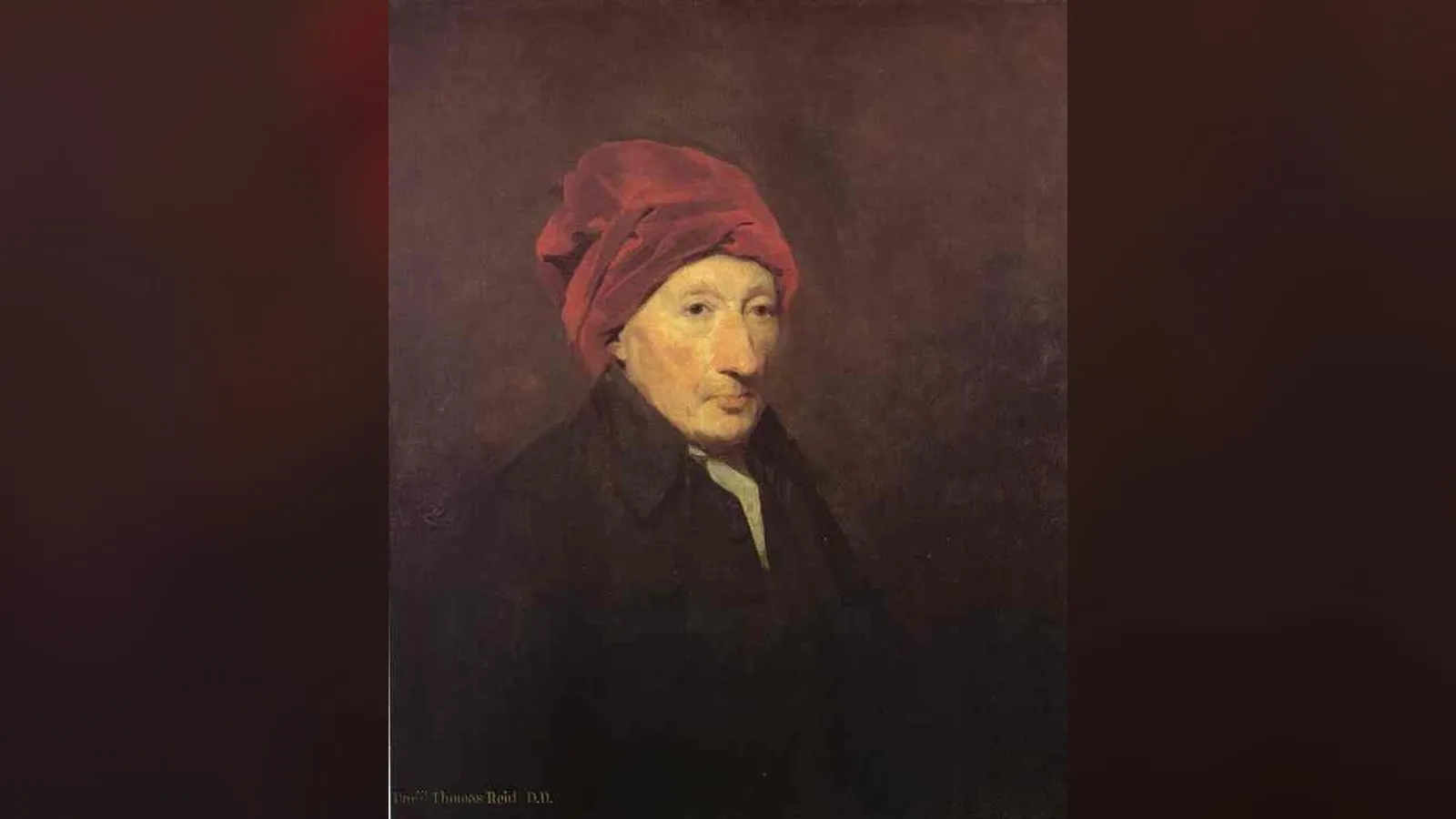

Thomas Reid (1710–1796)
Contents
The Minister Who Took On Hume — and Won More Admirers Than His Rival, in His Own Century
TL;DR
- established Thomas Reid founded "common sense realism" — a direct, sustained philosophical rebuttal to David Hume's scepticism — arguing that ordinary human perception gives us genuine, reliable access to a real external world, and that certain basic beliefs (that an external world exists, that other minds are real, that the laws of nature don't randomly change) are rational starting points for all reasoning rather than conclusions requiring proof.
- established Reid succeeded Adam Smith as Professor of Moral Philosophy at Glasgow in 1764 — a direct institutional link placing him at the very centre of the Scottish Enlightenment's most influential philosophical chair.
- Established, and genuinely striking: Despite mounting one of the most sustained and effective philosophical challenges to Hume's ideas, Reid and Hume maintained real personal and intellectual respect for one another — Reid sent Hume an early manuscript of his central work before publication, and Hume's critical but engaged response shows this was serious philosophical engagement between two people who took each other seriously, not simple rivalry.
- Established, worth correcting against a common modern assumption: For much of the 19th century, Reid was considered the more important and influential philosopher of the two — it was only later, particularly following criticism from figures associated with Kantian and analytic traditions, that Hume's reputation came to eclipse Reid's in most popular and academic accounts. Reid's modern comparative obscurity, relative to Hume, is a reversal of how the two were actually regarded in the century after their deaths.
- Disputed/nuanced: Immanuel Kant is sometimes cited as a critic who helped diminish Reid's reputation, but there is a genuine scholarly point worth flagging carefully: Kant, despite writing about the "Scottish school," appears not to have actually read Reid's works directly, complicating any simple story of direct philosophical refutation.
Key Facts
- Born
- 7 May 1710 (26 April, Old Style), Strachan, Kincardineshire
- Died
- 7 October 1796, Glasgow, aged 86
- Family
- Son of Lewis Reid, a parish minister; mother Margaret Gregory, first cousin to mathematician James Gregory
- Education
- Marischal College, Aberdeen (matriculated 1723, MA 1726)
- Early career
- Licensed as a Church of Scotland minister, 1731; served as a parish minister before moving into academia
- Academic posts
- Professor, King's College, Aberdeen (from 1752); Professor of Moral Philosophy, University of Glasgow (1764–1781), succeeding Adam Smith
- Key society
- Founding member of the Aberdeen Philosophical Society ("the Wise Club"), 1758
- Major works
- An Inquiry into the Human Mind on the Principles of Common Sense (1764); Essays on the Intellectual Powers of Man (1785); Essays on the Active Powers of Man (1788)
- Central idea
- "Common sense realism" — a direct philosophical response to Hume's scepticism
- Burial
- Blackfriars Church, Glasgow College grounds; tombstone preserved when the university relocated to Gilmorehill
Scottish Impact Index (SI Score)
- Global Influence
- 5/10
- Enduring Relevance
- 8/10
- Material Contribution
- 2/10
- Exceptional Achievement
- 7/10
- Lasting Legacy
- 6/10
- Recognition
- 2/10
30/60
Ranked =93rd of 200 in Great Scots
Claim-Status Note
Reid presents a specific and interesting evidentiary situation: unlike many figures in this series, the core philosophical content of his work is well documented and not seriously contested as to what he actually argued — the genuine complexity lies instead in how his reputation has shifted across nearly three centuries, and in correcting the popular modern assumption (itself a kind of inherited myth) that Hume simply "won" their philosophical disagreement in some decisive, historically inevitable way. This article uses a four-tier evidence framework — Established/Documented, Shared/Traditional, Disputed, Legend/Myth — and treats the historiography of Reid's reputation, not just his biography, as a subject worth getting right.
Timeline
Born, 7 May, at the manse in Strachan, Kincardineshire, son of a parish minister
Attends Marischal College, Aberdeen; earns his MA
Licensed to preach by the Church of Scotland
Marries his cousin, Elizabeth Reid
Appointed professor at King's College, Aberdeen, moving formally from parish ministry into academic life
Co-founds the Aberdeen Philosophical Society ("the Wise Club")
Publishes An Inquiry into the Human Mind on the Principles of Common Sense, his direct response to Hume; appointed Professor of Moral Philosophy at Glasgow, succeeding Adam Smith
Holds the Glasgow chair, lecturing on moral philosophy
Resigns his Glasgow teaching post to focus on writing
Publishes Essays on the Intellectual Powers of Man
Publishes Essays on the Active Powers of Man
First American edition of the Essays on the Intellectual and Active Powers, Philadelphia
Dies, 7 October, in Glasgow, of palsy, aged 86
Widely regarded, for a substantial period, as more philosophically important than Hume; his ideas dominate much of North American college philosophy teaching
His reputation revived by the English philosopher G. E. Moore's advocacy of common-sense-based philosophical method
Influences the "Reformed epistemology" movement (Alvin Plantinga, Nicholas Wolterstorff, William Alston)
The Details
A Minister's Son, Trained for the Pulpit Before the Lecture Hall
Reid was born in 1710 in the manse at Strachan, Kincardineshire, the son of a Church of Scotland parish minister, and on his mother's side was connected to the accomplished Gregory family of mathematicians (his mother, Margaret Gregory, was first cousin to the mathematician James Gregory). He was educated at Marischal College, Aberdeen, earning his MA in 1726, and followed a path typical of many educated Scots of his background into the ministry: he was licensed to preach by the Church of Scotland in 1731 and spent a substantial period of his early career as a working parish minister before formally transitioning into academic life with his appointment as a professor at King's College, Aberdeen, in 1752. This ministerial background is worth noting as more than biographical trivia — Reid's later philosophy, unlike Hume's, was consistently developed in a way compatible with, and partly in defence of, religious belief, and his own natural-theology arguments in his later work reflect this continuity rather than a sharp break between his clerical and academic careers. established
The Aberdeen Philosophical Society: Provincial, But Genuinely Serious
In 1758, Reid was a founding member of the Aberdeen Philosophical Society, informally and memorably known as "the Wise Club" — a regular gathering of Aberdeen-based intellectuals for structured philosophical discussion and mutual critique. This society mattered practically as well as socially: it functioned as a genuine incubator and testing ground for Reid's developing ideas before they reached print, a reminder that the Scottish Enlightenment's intellectual achievements were built substantially through this kind of sustained, provincial, collaborative discussion culture, not solely through isolated individual genius working in the major cities. established
An Inquiry into the Human Mind (1764): Taking On Hume Directly
Reid's first and most historically significant major work, published in 1764, was conceived and written as a direct, sustained response to David Hume's philosophical scepticism — specifically, Hume's argument that human knowledge is fundamentally limited to the mind's own internal impressions and ideas, with no rationally secure basis for believing these genuinely correspond to, or give us reliable knowledge of, an external world beyond our own perceptions. Reid rejected this conclusion, arguing instead for what has come to be called "common sense realism" or "direct realism": the position that ordinary human perception gives us direct, genuine access to real external objects and their actual qualities, not merely to an internal representation whose relationship to reality is, per Hume, ultimately unprovable.
Central to Reid's argument was his claim that certain basic beliefs — that an external world genuinely exists, that other people are real minds rather than mere appearances, that the laws of nature remain stable rather than shifting arbitrarily — function as necessary starting points, or preconditions, for rational thought and argument itself, rather than as conclusions that first require independent proof. On Reid's view, philosophical scepticism about these basic beliefs is, in a sense, self-undermining: the very act of reasoning about whether an external world exists already presupposes the kind of stable, shared, real world the sceptic claims to doubt. He also drew a careful distinction between raw sensation (a private, subjective mental event) and perception proper (a genuine, direct cognitive grasp of an external object's real qualities) — a distinction later philosophers, including Schopenhauer, would specifically praise as a substantive advance over simpler empiricist accounts that tried to reduce perception entirely to raw sense-data. established
A Rivalry Built on Genuine Mutual Respect
One of the more genuinely admirable and well-documented features of this philosophical rivalry deserves particular emphasis, because it cuts against a simplified modern instinct to read intellectual disagreement as personal hostility. Reid arranged for Hume to receive an early manuscript of the Inquiry before its publication — a mark of serious intellectual respect and engagement rather than adversarial point-scoring. Hume's own recorded response was itself notably generous in tone even while substantively critical: he described the work as "wrote in a lively entertaining manner," while also noting what he considered "some Defect in Method" and raising specific philosophical objections (including a concern that Reid's account implied a form of innate ideas Hume rejected). This exchange is worth presenting plainly as a model of how serious philosophical disagreement can coexist with real personal and intellectual respect between two of the era's sharpest minds — Reid himself is recorded as having "a great admiration for Hume" despite building his entire early career around refuting him. established
Succeeding Adam Smith at Glasgow
In 1764, the same year his Inquiry was published, Reid was appointed Professor of Moral Philosophy at the University of Glasgow — directly succeeding Adam Smith in one of the most prestigious and influential academic positions in the Scottish Enlightenment's intellectual infrastructure. He held this position until 1781, when he resigned his teaching duties specifically to concentrate on preparing his mature philosophical system for publication. This succession is worth noting as more than a simple job transition: it placed Reid, quite literally, in the institutional seat most closely associated with Smith's own towering influence, giving his subsequent philosophical project real institutional weight and visibility within the Scottish university system. established
The Later Essays: Perception, Action, and Personal Identity
After leaving active teaching in 1781, Reid devoted himself to preparing two substantial works based on his lecture material: Essays on the Intellectual Powers of Man (1785), which further developed his account of perception and the sensation/perception distinction first laid out in the Inquiry, and Essays on the Active Powers of Man (1788), which addressed human agency, moral responsibility, and free will. In this second work, Reid defended a libertarian (in the philosophical, not political, sense) account of free will, arguing that humans are genuinely capable of free actions for which they are the actual cause and for which they can be legitimately held morally responsible — a direct rejection of purely deterministic accounts of human action. He also mounted a specific and influential critique of John Locke's theory of personal identity, which had grounded a person's continuity over time in continuous memory; Reid argued, through careful logical analysis, that memory continuity was neither strictly necessary nor sufficient to establish that someone remains numerically the same person over time — a genuinely important and still-discussed contribution to the philosophy of personal identity. The Active Powers also set out several natural-theology arguments for God's existence, particularly design-based and cosmological arguments, reflecting the underlying continuity between Reid's earlier ministerial career and his mature philosophical system. established
A Reputation That Rose, Then Fell, Then Partially Rose Again
This is perhaps the single most important corrective this article can offer, because it runs directly against a common modern assumption. In his own lifetime and for a considerable period into the 19th century, Reid was widely regarded as the more important and historically significant philosopher of the two — not simply an also-ran to Hume's greater fame, as popular modern accounts sometimes casually assume. His common sense philosophy became genuinely dominant in North American college philosophy curricula for an extended period, and found a notable champion in the influential French philosopher Victor Cousin. It was only later — following sustained criticism from figures associated with the Kantian and, subsequently, analytic philosophical traditions, and a general 19th- and early-20th-century philosophical fashion that favoured more systematically rigorous, technically elaborate philosophical systems over Reid's comparatively plain-spoken style — that Hume's reputation came to substantially eclipse Reid's in most standard accounts of the period, a state of affairs that has persisted into most popular retellings today.
A specific nuance worth flagging carefully here: Immanuel Kant, who was only fourteen years younger than Reid and wrote critically about the "Scottish school" of philosophy Reid represented, appears — on the evidence available to modern scholars — not to have actually read Reid's works directly, engaging instead with a secondary or indirect characterisation of the position. This complicates any simple narrative in which Kant is presented as having decisively, directly refuted Reid on the merits; the actual historical picture is considerably messier, involving reputation and philosophical fashion as much as direct textual engagement. established as to the reputational reversal itself; Disputed/nuanced as to the precise mechanics and fairness of how Kantian-associated criticism actually damaged Reid's standing.
A 20th-Century Revival
Reid's philosophical reputation saw a genuine, well-documented revival in the 20th century, beginning notably with the English philosopher G. E. Moore's advocacy of common-sense-based philosophical method as a serious response to radical scepticism — a project with clear affinities to Reid's own earlier argument, even where Moore did not present himself as simply reviving Reid directly. Later in the century, Reid's framework became a significant and explicitly acknowledged influence on the "Reformed epistemology" movement in philosophy of religion, associated particularly with philosophers Alvin Plantinga, Nicholas Wolterstorff and William Alston, who drew on Reid's arguments to defend the rationality of religious belief without requiring it to be derived from more basic, independently provable premises. Reid's ideas have also been credited with influencing the American pragmatist philosopher Charles Sanders Peirce, who explicitly engaged with and adapted Reid's concern to "revalue common sense," while developing his own, somewhat different "critical common-sensism." established
Death and Institutional Memorial
Reid died in Glasgow on 7 October 1796, aged 86, of palsy, and was buried at Blackfriars Church on the grounds of Glasgow College. When the University of Glasgow later relocated to its present Gilmorehill site, his tombstone was specifically preserved and integrated into the main university building — a concrete, physical continuity between Reid's original institutional home and the university's present campus. established
Common sense abroad: Reid's afterlife in France and America
The philosopher Alexander Broadie traces how Reid's common sense philosophy became one of Scotland's great "invisible exports". Reid's principles of common sense, beliefs that cannot be proved but must be presupposed to prove anything (that our memory and consciousness are generally to be trusted, for example), were his answer to the sweeping scepticism attributed to Hume. In France, Pierre-Paul Royer-Collard lectured on Reid and Dugald Stewart at the Sorbonne. His successor Victor Cousin, appointed in 1815, spread Reid's ideas further and, as Minister of Public Education, gave them a place in French philosophical education that lasted to the end of the century.
In Scotland, Sir William Hamilton combined Reid's common sense with Kant's idealism, and later Scottish philosophers kept returning to Reid as a reply to Hume. In America, Charles Sanders Peirce adopted what he called "critical common-sensism", William James kept a place for common sense principles, and Broadie notes that Reid's ideas on warrant and testimony remain influential today in the field of "reformed epistemology".
How Reid reached American colleges
The literary historian Andrew Hook, in Scotland and America (1975), traces the route by which Reid's philosophy became standard teaching in the United States. His evidence makes the familiar claim that Reid "dominated" American college philosophy more precise, and pushes its starting date back.
First contacts. established A list of books given to Rhode Island College (later Brown University), announced to its president James Manning on 16 May 1771, included "Reid on the Mind", that is the Inquiry of 1764. John Witherspoon, who arrived at Princeton in 1768, taught moral philosophy in the Scottish manner. Samuel Miller's Brief Retrospect of the Eighteenth Century (1803) said Witherspoon was "the first man who taught, in America, the substance of those doctrines of the philosophy of the Human Mind, which Dr. Reid afterwards developed with so much success" (as quoted by Hook). Frederick Beasley, a Princeton student of the 1790s, recalled that "the principles of Reid, and the Scottish metaphysicians" had replaced Berkeley's idealism there and held "undisputed sway".
American editions. established Hook's bibliography shows how quickly Reid's own books were reprinted once the war was over and copyright no longer applied. The Essays on the Intellectual and Active Powers appeared at Philadelphia in 1792 and again in 1818. The Works of Thomas Reid were printed at Charlestown, Massachusetts, in 1813–15 and 1818, and at New York in 1822. When Princeton's library burned in 1802, Dugald Stewart sent a copy of Reid's Inquiry with his own books and his Life of Reid.
In the curriculum. established By about 1800 the "Moral School" at William and Mary studied William Duncan's Logic, Reid and Stewart, according to Miller. The historian Richard Beale Davis found that by 1800 Reid's works, with Blair's and Kames's, were widely used in Virginian schools and colleges. Harvard, Yale and Brown taught Reid's school through Stewart's Elements by the 1810s and 1820s. Americans usually spoke of Reid's two later books as the Intellectual and Active Powers, and the division of philosophy into "mental" and "moral" philosophy that they encouraged shaped college courses for most of the nineteenth century.
Dating the change. shared The historian Herbert Schneider (1946) dated the Scottish "invasion" of American philosophy teaching to about 1820. Hook argues that this is too late: the change began just after the Revolution, was well advanced by 1800, and was complete by 1820. Later studies, from Douglas Sloan (1971) to Henry May (1976), broadly accept the early start while placing Reid within a wider American Enlightenment that also drew on English and continental writers.
Why it took root. shared Hook suggests two reasons. Common sense philosophy was a reply to Hume's scepticism, so it suited the conservative, religiously orthodox men who ran most American colleges. And its assumptions about self-evident moral and political truths fitted the natural-law language of American democracy; Hook points to the Scottish-born signatory James Wilson as a political thinker shaped by the common sense school. Both points are interpretations, and the claim that Reid shaped the wording of the Declaration of Independence remains disputed.
Reid's reputation in American journals. established American reviewers often ranked Reid below his pupil Stewart as a writer. A North American Review essay of 1830 called Reid "the founder of the Edinburgh school" but said he lacked the graces of manner that made Stewart the most popular moral philosopher writing in English. Even so, by the 1820s American magazines discussed Reid, Stewart and Thomas Brown as familiar names, and in 1829 the Reverend Mitchell King, addressing the St Andrew's Society of Charleston, named Reid, Beattie and Stewart among the Scots whose works formed "the text books of our schools and colleges".
Did You Know?
- Thomas Reid directly succeeded Adam Smith as Professor of Moral Philosophy at Glasgow — placing him, quite literally, in Smith's old chair.
- Despite building his career around refuting David Hume's philosophy, Reid sent Hume an early manuscript of his most important work before publishing it, and Hume responded with genuine, engaged respect even while disagreeing.
- For much of the 19th century, Reid was actually considered the more important philosopher of the two — Hume's modern reputation as the dominant figure of the pair is a later historical reversal, not how their contemporaries and immediate successors generally saw things.
- Reid's philosophy became so influential in North America that it dominated college philosophy teaching there for an extended period in the 18th and 19th centuries.
- Immanuel Kant criticised the "Scottish school" of philosophy Reid represented — but appears, on the available evidence, never to have actually read Reid's own books directly.
- Reid began his career not as a philosopher but as an ordained Church of Scotland minister, spending years in parish ministry before moving into academic life.
- His critique of John Locke's memory-based theory of personal identity remains a genuinely significant, still-discussed contribution to modern philosophy of mind.
- Twentieth-century philosophers including G. E. Moore and, later, the "Reformed epistemology" movement in philosophy of religion drew directly on Reid's ideas — a real, traceable revival after decades of comparative neglect.
- The poet Thomas Campbell, author of "The Pleasures of Hope", was named after Reid. His father, Alexander Campbell, a Glasgow merchant who had traded for years in Virginia, was a close friend of both Reid and Adam Smith.
- A copy of Reid's Inquiry reached Rhode Island College (now Brown University) as early as 1771, in a gift of books that also included Kames on criticism and Robertson's History of Scotland.
Frequently Asked Questions
1
- What is "common sense realism," and who founded it?
It's the philosophical position, developed by Thomas Reid, that ordinary human perception gives us direct and genuinely reliable access to a real external world, and that certain basic beliefs about that world function as necessary starting points for all rational thought rather than conclusions requiring independent proof.
2
- Was Thomas Reid trying to refute David Hume?
Yes, directly and explicitly — his first major work, An Inquiry into the Human Mind (1764), was conceived specifically as a response to Hume's sceptical conclusion that we cannot rationally justify our belief in an external world beyond our own mental impressions.
3
- Did Reid and Hume dislike each other personally?
No — quite the opposite is documented. Reid sent Hume an early manuscript before publication, and Hume responded with real critical engagement and evident respect, describing the work as lively and entertaining even while raising serious objections. Reid himself is recorded as having genuine admiration for Hume.
4
- Was Thomas Reid actually more famous than David Hume at some point?
Yes — for much of the 19th century, Reid was widely regarded as the more historically and philosophically important of the two, with his ideas dominating North American college philosophy curricula for an extended period. Hume's now-dominant modern reputation, relative to Reid, is a later historical development.
5
- Did Thomas Reid succeed Adam Smith at Glasgow?
Yes — Reid was appointed Professor of Moral Philosophy at the University of Glasgow in 1764, directly succeeding Adam Smith in that role, and held the position until 1781.
6
- What was the "Wise Club"?
The informal name for the Aberdeen Philosophical Society, a regular gathering of Aberdeen-based intellectuals, including Reid, for structured philosophical discussion, which served as an important early testing ground for his ideas.
7
- Did Immanuel Kant refute Thomas Reid's philosophy?
Kant criticised the broader "Scottish school" of philosophy associated with Reid, but the available evidence suggests he had not actually read Reid's own works directly — a genuine complication for any simple story of Kant decisively refuting Reid on the philosophical merits.
8
- What did Reid say about personal identity?
He directly challenged John Locke's theory that personal identity over time is grounded in continuous memory, arguing through careful logical analysis that memory continuity is neither strictly necessary nor sufficient to establish that someone remains the same person over time — still a significant contribution to modern philosophy of mind.
9
- Was Thomas Reid religious?
Yes — he began his career as an ordained Church of Scotland minister, and his later philosophical work included explicit natural-theology arguments for God's existence, reflecting genuine continuity between his ministerial background and his mature philosophical system, rather than any sharp break between the two.
10
- Why is Thomas Reid less well known today than David Hume?
Largely due to a 19th- and early-20th-century shift in philosophical fashion that favoured more systematically elaborate philosophical systems, along with sustained criticism from figures associated with Kantian and later analytic traditions — a reputational shift rather than a reflection of how Reid was regarded in his own time or the century immediately following his death.
11
- Did anyone later revive interest in Reid's philosophy?
Yes, genuinely and traceably — the English philosopher G. E. Moore's early-20th-century advocacy of common-sense-based philosophical method, and later the "Reformed epistemology" movement in philosophy of religion (Alvin Plantinga, Nicholas Wolterstorff, William Alston), both drew explicitly on Reid's framework.
12
- What's the difference between Reid's "common sense" and the everyday use of the phrase?
Reid's use was a specific technical philosophical term (in Latin, sensus communis), referring to a set of basic, foundational beliefs necessary for rational thought itself, not simply "ordinary practical wisdom" in the everyday, colloquial sense the phrase now more commonly carries.
13
- When did Reid's philosophy reach America?
Copies of his Inquiry were in American college libraries by 1771, and John Witherspoon taught a similar philosophy at Princeton from 1768. American editions of Reid's Essays appeared from 1792 and of his Works from 1813. Andrew Hook (1975) argues that common sense philosophy was well established in American colleges by 1800, earlier than the date of about 1820 that older histories gave.
14
- Was Reid read in America in his own name, or through Dugald Stewart?
Both. Reid's Essays and Works were reprinted in America, but many students met his ideas through Stewart's Elements of the Philosophy of the Human Mind, which was easier to read and was set at Harvard, Yale and Brown. American reviewers often praised Stewart's style above Reid's while treating Reid as the founder of the school.
Sources and Further Reading
Primary/Institutional
- Thomas Reid, An Inquiry into the Human Mind on the Principles of Common Sense (1764); Essays on the Intellectual Powers of Man (1785); Essays on the Active Powers of Man (1788)
- University of Glasgow — historical materials on the Moral Philosophy chair and its holders
Scholarly
- Stanford Encyclopedia of Philosophy, "Thomas Reid"
- Routledge Encyclopedia of Philosophy, "Reid, Thomas (1710–1796)"
- Online Library of Liberty, "Scottish School of Common Sense"
- Scottish Philosophy resource, entry on Thomas Reid
- Alexander Broadie, "The Rise (and Fall?) of the Scottish Enlightenment", in T. M. Devine and Jenny Wormald (eds), The Oxford Handbook of Modern Scottish History (Oxford University Press, 2012)
- Andrew Hook, Scotland and America: A Study of Cultural Relations, 1750–1835 (Blackie, 1975)
- Samuel Miller, A Brief Retrospect of the Eighteenth Century (New York, 1803)
- Herbert W. Schneider, A History of American Philosophy (New York, 1946)
- Douglas Sloan, The Scottish Enlightenment and the American College Ideal (New York, 1971)
General
- Encyclopaedia Britannica, "Thomas Reid"
- The Heidelblog, "Who Was Thomas Reid and Why Does His 'Common Sense' Philosophy Still Matter?"
Caveats: Myths and Disputed Claims
- "Reid was a minor figure overshadowed by Hume even in his own time." Inaccurate — for much of the 19th century, Reid was widely considered the more important philosopher of the two. established correction.
- The assumption that Kant directly and decisively refuted Reid's arguments. The evidence suggests Kant had not actually read Reid's own works, complicating this narrative. Disputed/nuanced.
- Reid and Hume are sometimes framed as bitter intellectual rivals. The documented historical record shows genuine mutual respect alongside serious philosophical disagreement — not simple hostility. established correction.
- "Common sense," in Reid's usage, is sometimes conflated with the everyday colloquial meaning of the phrase. Reid's term was a specific technical philosophical concept, not a claim that ordinary folk wisdom trumps careful reasoning. established clarification.
- Do not date Reid's American influence only to the nineteenth century. His Inquiry was in an American college library by 1771, American editions of his Essays began in 1792, and Andrew Hook (1975) shows the common sense school established in American colleges by about 1800. established.
- Do not credit Reid's influence on American colleges to John Witherspoon alone. Witherspoon was the most important single channel, but Scottish moral philosophy was read in America before 1768 and spread after him mainly through printed textbooks. shared.
Card 022 · Great Scots