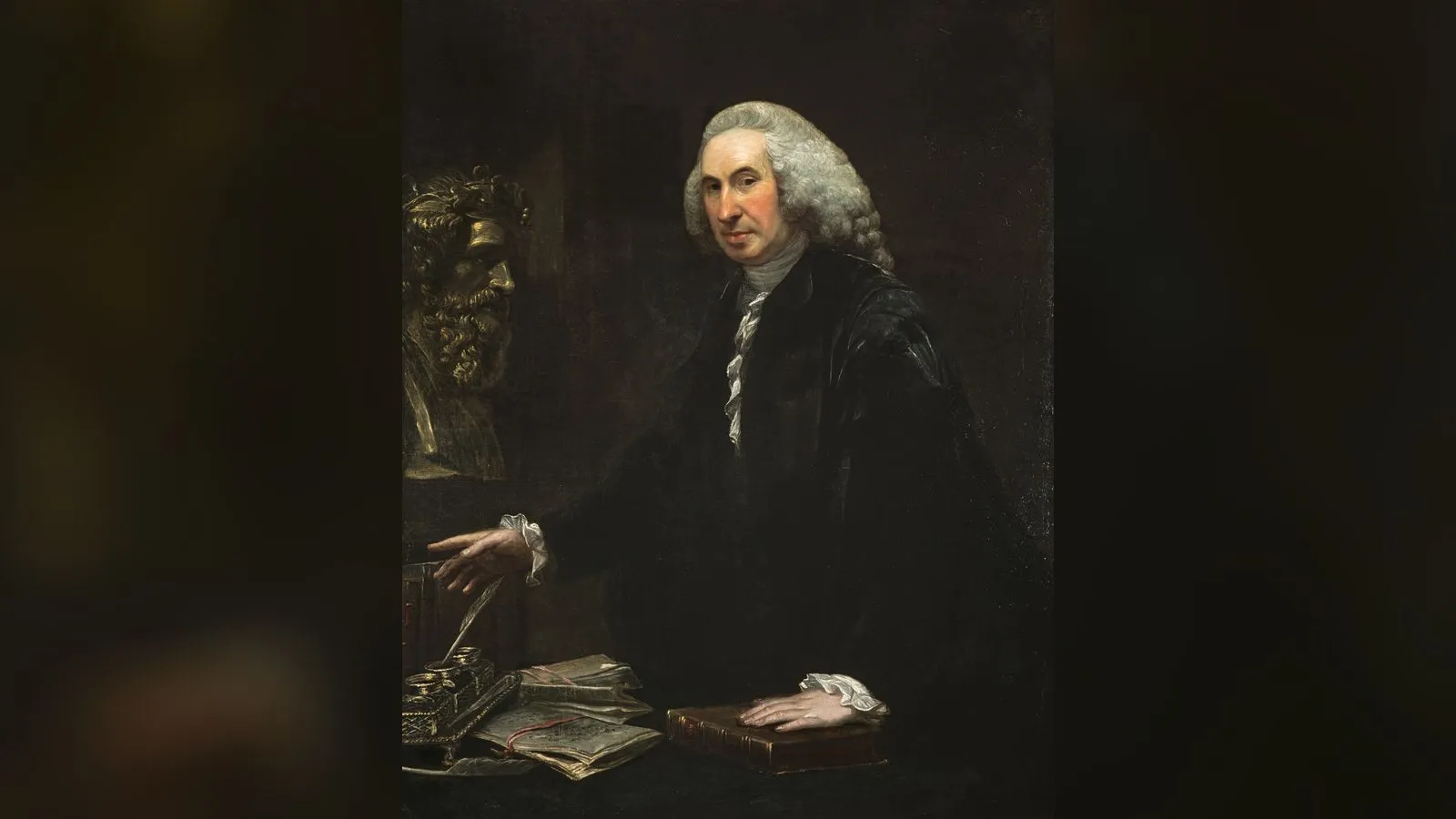

William Cullen (1710–1790)
Contents
TL;DR
- Established/Documented. Cullen conducted the first documented demonstration of artificial refrigeration, in Glasgow in 1748, using evaporating ether under a partial vacuum to produce ice — a genuine scientific first, though he never pursued or received credit for any commercial application of it.
- Established/Documented. He built Edinburgh into the leading medical school in the English-speaking world less through original discovery than through teaching: he taught in English rather than the conventional Latin, systematised sprawling medical knowledge into a coherent framework, and personally trained a remarkable roster of students, including Joseph Black and the American revolutionary physician Benjamin Rush.
- Established/Documented. His major nosological system — a comprehensive classification of diseases published in 1769 — was hugely influential in its time and used across Europe for decades, but rests on theoretical foundations (about "nervous energy," sensibility, and irritability) that modern medicine has entirely superseded; this article treats it as historically important rather than scientifically valid.
- Established/Documented. Cullen was the Edinburgh professor American medical students most wanted to meet. Benjamin Franklin met him in 1759 and 1771 and sent him students with letters of introduction, beginning with John Morgan in 1761; those students went on to found the first American medical schools, as the literary historian Andrew Hook sets out in Scotland and America (1975).
- Shared/Traditional, worth stating plainly. Historians of medicine broadly agree Cullen was a superb systematiser and teacher rather than an original researcher in the mould of his own student Joseph Black — a genuine and important distinction this article does not blur.
Key Facts
- Born
- 15 April 1710, Hamilton, Lanarkshire
- Died
- 5 February 1790, Edinburgh (aged 79)
- Education
- Apprenticed to a Glasgow apothecary; ship's surgeon; Edinburgh University (1734–36); MD, University of Glasgow, 1740
- Key posts
- Professor of Chemistry, Glasgow (from 1747) and Edinburgh (1755/56–1766); Professor of the Institutes of Medicine, then Practice of Physic, Edinburgh (1766–1790)
- Major work
- Synopsis Nosologiae Methodicae (1769); First Lines of the Practice of Physic (1777–1784)
- Notable students
- Joseph Black, Benjamin Rush, William Withering, William Hunter
- Key first
- First documented demonstration of artificial refrigeration, 1748
Scottish Impact Index (SI Score)
- Global Influence
- 5/10
- Enduring Relevance
- 8/10
- Material Contribution
- 3/10
- Exceptional Achievement
- 7/10
- Lasting Legacy
- 6/10
- Recognition
- 2/10
31/60
Ranked =84th of 200 in Great Scots
How This Article Handles the Evidence
Cullen's case requires holding two things at once, and this article does so deliberately rather than picking one flattering half: he was, by wide scholarly consensus, one of the most influential medical teachers of the 18th century, responsible for training a genuinely remarkable generation of physicians and scientists — and, at the same time, the specific medical theory he spent his career systematising (built around concepts of "nervous energy," sensibility, and irritability) has been entirely superseded by modern medicine and is not presented here as scientifically valid, only as historically significant.
Timeline
Born in Hamilton, Lanarkshire, son of a lawyer.
Begins arts studies at the University of Glasgow.
Apprenticed to a Glasgow apothecary, John Paisley.
Serves as a ship's surgeon on a voyage to the West Indies.
Works with a London apothecary before returning to Scotland.
Establishes general medical practice in Shotts, Lanarkshire, also serving Hamilton.
Studies medicine at Edinburgh University.
Awarded his MD from the University of Glasgow; becomes physician to the Duke of Hamilton and his family.
Marries Anne Johnstone; they go on to have several children, including Robert Cullen, later a Scottish judge.
Relocates to Glasgow following the Duke of Hamilton's death.
Appointed to Britain's first independent lectureship in Chemistry, at Glasgow.
Conducts his pioneering refrigeration experiment, producing ice by evaporating ether under partial vacuum.
Becomes Professor of the Practice of Medicine at Glasgow, continuing to teach chemistry alongside it.
Recruited to the University of Edinburgh, at the urging of Lord Kames, as Professor of Chemistry and Medicine.
Delivers the first documented public demonstration of artificial refrigeration, in Edinburgh.
Meets Benjamin Franklin during Franklin's six-week visit to Scotland.
John Morgan of Philadelphia arrives in Edinburgh with Franklin's letter of introduction to Cullen.
Receives Benjamin Rush and Jonathan Potts, who carry letters from Morgan, by then a professor in Philadelphia.
Succeeds Robert Whytt in the Institutes of Medicine chair, relinquishing the chemistry chair (to his own former student, Joseph Black).
Publishes Synopsis Nosologiae Methodicae, his systematic classification of diseases.
Meets Franklin again in Edinburgh; the Philadelphia student Thomas Parke calls on him in October with letters from Morgan and Rush.
Becomes sole holder of the Practice of Physic chair following the sudden death of co-professor John Gregory; appointed first physician to the King in Scotland.
Publishes his major work, First Lines of the Practice of Physic, across four volumes.
Co-founds the Royal Society of Edinburgh.
Publishes A Treatise on Materia Medica.
Honoured by Edinburgh's Lord Provost shortly before his death; dies at his home on Edinburgh's Royal Mile on 5 February, aged 79.
Details
From apprentice apothecary to physician
William Cullen was born in Hamilton, Lanarkshire, in 1710, the son of a lawyer. His path into medicine was practical and gradual rather than a straightforward academic track: after beginning arts study at Glasgow, he apprenticed to a Glasgow apothecary, served briefly as a ship's surgeon on a voyage to the West Indies, and worked with a London apothecary before finally returning to Scotland to set up general practice in Shotts, Lanarkshire, around 1732. He subsequently studied at Edinburgh University in the mid-1730s and took his MD from Glasgow in 1740 — a route through practical apprenticeship and hands-on practice before formal academic credentialing that shaped his later emphasis, as a teacher, on demonstration and accessibility over abstract theory delivered in the traditional scholarly manner.
His reputation grew quickly: he became physician to the Duke of Hamilton and his family, a position of real social and professional standing, before relocating to Glasgow after the Duke's death in 1743–44.
The refrigeration experiment — a genuine first, quietly unexploited
Established/Documented, and one of the more surprising items in Cullen's record: in 1748, working in Glasgow, Cullen used an air pump to create a partial vacuum above a container of diethyl ether. The ether boiled under the reduced pressure, absorbing heat from its surroundings as it evaporated — and the resulting cooling effect was sufficient to produce ice. He followed this in 1756 with what is generally regarded as the first documented public demonstration of artificial refrigeration, in Edinburgh. Cullen himself pursued no commercial or practical application of the discovery, and he received comparatively little credit for it in his own lifetime or since — the birth of mechanical refrigeration is more often associated with later 19th-century inventors who did develop it into working technology. This article states plainly that the underlying scientific first belongs to Cullen, even though the practical legacy does not.
Building Edinburgh's medical reputation through teaching
Cullen's central, well-documented legacy is as a teacher and systematiser rather than an original experimental researcher. At Glasgow from 1747 he held Britain's first independent lectureship in chemistry, and his classes — covering chemistry, physiology, botany, and materia medica — grew from a modest initial audience of around 17 students to well over a hundred, drawing students internationally, including a substantial number from America. A specific and genuinely significant innovation: Cullen taught in English rather than the Latin conventionally used for university medical instruction, making medical knowledge considerably more accessible to a wider range of students.
Recruited to Edinburgh in 1755 at the urging of the philosopher and judge Lord Kames, Cullen went on to hold a sequence of major chairs there — chemistry and medicine jointly, then the Institutes of Medicine from 1766 (at which point he handed the chemistry chair to his own former student, Joseph Black), and finally sole holder of the Practice of Physic chair from 1773 until his death. Across this Edinburgh career, Cullen is widely credited by historians of medicine as the single figure most responsible for building Edinburgh's medical school into the pre-eminent centre for medical education in the English-speaking world during this period.
A roster of remarkable students
Established/Documented, and among the clearest evidence of Cullen's real impact: his students went on to shape medicine and science across Britain, Europe, and America. Most significantly for this series, Joseph Black studied and later succeeded him at Edinburgh, going on to make the discoveries in chemistry and thermodynamics for which Black himself is remembered. Benjamin Rush, later a signatory of the American Declaration of Independence and a central figure in the founding of American medicine, studied directly under Cullen in Edinburgh. William Withering, who went on to discover the medical use of digitalis (foxglove) for heart conditions, and William Hunter, later a celebrated anatomist, both passed through Cullen's orbit as students. Cullen's teaching, by these accounts, functioned as something close to a training ground for an entire generation of leading British and American physicians and scientists — a form of influence that, as with Joseph Black's own later career, is easy to understate simply because it operated through people rather than through a single famous published discovery.
Cullen and the Americans
established Franklin's introductions. The literary historian Andrew Hook, in Scotland and America (1975), shows how Cullen became the centre of a transatlantic network. Benjamin Franklin met him in Edinburgh in September 1759 and again in 1771. When the young Philadelphian John Morgan asked Franklin in 1760 whether to study at Leiden or Edinburgh, Franklin sent him to Edinburgh with letters to Cullen and Lord Kames, and he went on to sponsor William Shippen, Adam Kuhn, Benjamin Rush, Jonathan Potts and Samuel Bard in the same way. Morgan, Shippen, Rush and Kuhn became professors in the Philadelphia medical school founded in 1765 on the Edinburgh model, and they in turn sent their own students to Cullen.
established A welcome for Americans. The historian Whitfield Bell, cited by Hook, records Cullen's reputation for having "a special measure of esteem for Americans". When Rush and Potts called in November 1766, Rush reported to Morgan that Cullen apologised for having little time for hospitality but promised that young men recommended by Morgan "may always depend upon my immediate patronage and friendship" (as quoted by Hook). Thomas Parke, arriving in October 1771 with letters from Morgan and Rush, called on Cullen on his second day in the city and found that "yt shining Oracle of Physic" matched his expectations.
established Family and books. The ties outlasted the students. Rush came to know Cullen's daughter, who later married John Craig Millar, son of the Glasgow law professor John Millar. Hook records that the couple emigrated to the United States in 1795, after Millar's reform politics cost him his legal practice, and that Millar died within two years; his widow, who said they had often met President Washington in Philadelphia, returned to Scotland. Thomas Jefferson's library included a work by Cullen, and in 1829 Mitchell King, addressing the centenary of the St Andrew's Society of Charleston, listed Cullen among the Edinburgh medical professors whose books formed "the text books of our schools and colleges".
shared How far the influence reached. That Cullen's teaching shaped the first generation of American medical professors is well documented through his students. How far his specific theories governed American practice is a separate question, and Hook, whose subject is cultural relations rather than medicine, does not argue that Cullen's nosology became American orthodoxy.
Systematising disease: the nosology, and its outdated foundations
Cullen's major published contribution to medicine was his attempt to bring systematic order to the classification of disease. His Synopsis Nosologiae Methodicae (1769) organised diseases into four broad classes — pyrexiae (fevers), neuroses, cachexiae, and locales — subdivided further into nineteen orders and some 132 distinct genera, an ambitious and, for its time, genuinely useful attempt to bring coherence to a field that had previously lacked any widely agreed organising framework.
Established/Documented, and important to state without dressing it up as still-valid science: the theoretical foundation underlying Cullen's system, drawing partly on the physiologist Albrecht von Haller's concepts, held that disease resulted from imbalances in "nervous energy" — specifically between "irritability" and "sensibility" in the body's nervous system — and that treatment should aim to stimulate or sedate the nervous system accordingly to restore balance. Within his category of "neuroses" (a term Cullen used far more broadly than its modern psychological sense), he further distinguished conditions like comata, adynamiae, spasmi, and vesaniae based on this nervous-energy framework. This entire theoretical apparatus has been completely superseded by modern medicine and neurology; it is presented here as a historically significant intellectual system of its era, not as science that has stood the test of time. What has endured, and remains genuinely significant, is Cullen's broader project of rigorous, systematic classification itself — an approach to organising medical knowledge that outlasted the specific (and now outdated) physiological theory he used to justify it.
His later, larger work, First Lines of the Practice of Physic (1777–1784), became one of the most widely used medical textbooks in Europe, translated into multiple languages and used as a standard teaching text for decades — further evidence of his real strength as an organiser and communicator of existing medical knowledge, a talent historians of medicine have specifically distinguished from original research. As one modern assessment puts it, Cullen excelled at "systemizing and promoting medical knowledge rather than producing original research" — a fair and, this article suggests, not at all diminishing characterisation of his real historical importance.
Within the Scottish Enlightenment circle
Cullen was deeply embedded in Edinburgh's Enlightenment intellectual life, serving as David Hume's personal physician and maintaining close friendships with Joseph Black, Adam Smith, Lord Kames, Adam Ferguson, and John Millar — placing him at the centre of the same overlapping social and intellectual network that produced so much of the era's scientific and philosophical output. He held a series of senior professional offices reflecting this standing: President of the Royal College of Physicians and Surgeons of Glasgow (1746–47), President of the Royal College of Physicians of Edinburgh (1773–75), and, from 1773, first physician to the King in Scotland. In 1783 he was a co-founder of the Royal Society of Edinburgh, alongside his sons, helping to secure its royal charter.
Death and legacy
Shortly before his death, Edinburgh's Lord Provost presented Cullen with a 50-guinea silver platter in recognition of his decades of service to the university — a fitting, formal acknowledgment of a career built substantially on institutional and educational contribution. He died at his home on Edinburgh's Royal Mile in February 1790, aged 79.
His modern legacy is best understood as two-layered. His specific medical theories — the nervous-energy framework underlying his nosology — did not survive the advance of modern physiology and neurology, and are not scientifically valid today. But his pedagogical innovations — teaching in the vernacular rather than Latin, emphasising practical demonstration, and rigorously systematising a previously disorganised field of knowledge — profoundly and lastingly shaped how medicine came to be taught, not only at Edinburgh but, through the students he personally trained, across Britain and America for a generation afterward.
Cullen in the Enlightenment's medical school
The philosopher Alexander Broadie notes that Edinburgh's eighteenth-century pre-eminence in medicine had roots in the seventeenth century, when Robert Sibbald became the first professor of medicine (1685) and co-founded both the Physic Garden and, in 1681, the Royal College of Physicians of Edinburgh. Cullen built on that base. He is now remembered for introducing the term "neurosis" into medicine, for pioneering research on the nervous system and for an influential scheme for classifying diseases. His four-volume First Lines of the Practice of Physic (1777–84) was translated into many languages. Broadie also notes that Cullen's Glasgow student Joseph Black went on to outshine him.
A one-man medical school in Glasgow, and a rival in Edinburgh
established In the mid-1740s Cullen persuaded Glasgow University to provide a chemistry laboratory, and he also taught materia medica and botany. The historian Helen Dingwall calls this "a one-man protomedical school": Glasgow had appointed a professor of medicine in 1714, but there is little evidence of systematic teaching before Cullen. Joseph Black continued the work after Cullen left.
shared In Edinburgh Cullen faced a rival theory from his former protégé John Brown (1736–88). Brown's system, known as Brunonianism, explained all disease as too much or too little "excitability" of the body, to be treated with sedatives or stimulants. Relations between the two men became acrimonious. Brown's ideas circulated widely outside the University, and he is said to have died after treating himself on his own principles, a story that should be treated with caution.
Did You Know
- William Cullen conducted the first documented demonstration of artificial refrigeration in history — in Glasgow, in 1748 — decades before anyone turned the idea into a practical technology.
- He taught in English rather than the traditional academic Latin, a genuinely significant innovation that helped make medical education more accessible.
- His students include Joseph Black, discoverer of carbon dioxide and latent heat, and Benjamin Rush, a signatory of the American Declaration of Independence.
- His chemistry classes at Edinburgh grew from around 17 students to well over 100, drawing students from across Europe and America.
- His 1769 classification of diseases sorted illness into four classes, nineteen orders, and 132 distinct types — an ambitious system for its era.
- The medical theory underlying that classification, based on "nervous energy" and bodily "irritability," has been completely superseded by modern medicine.
- He was David Hume's personal physician.
- He co-founded the Royal Society of Edinburgh in 1783, alongside his own sons.
- A Philadelphia student arriving in 1771 called him "yt shining Oracle of Physic".
- His daughter and her husband, John Craig Millar, emigrated to Philadelphia in 1795 and met President Washington there.
Frequently Asked Questions
1Was William Cullen a great scientific discoverer?
Not primarily — his most celebrated modern reputation is as an outstanding teacher and systematiser of existing medical knowledge, rather than an original researcher in the mould of his own student Joseph Black. His refrigeration experiment is a genuine scientific first, but he never developed it further himself.
2Is Cullen's system for classifying diseases still used today?
No. His classification was influential and widely used in its own era, but the underlying medical theory about "nervous energy" and bodily "sensibility" that justified it has been completely replaced by modern medicine and neurology. It is presented in this article as historically important, not scientifically current.
3What did he actually discover in refrigeration?
He demonstrated, in 1748, that evaporating ether under reduced air pressure absorbs enough heat from its surroundings to produce ice — the first documented instance of artificial refrigeration. He didn't develop it into a practical or commercial technology himself.
4Why is he important if his own theories are outdated?
Because of his influence as a teacher. He trained a remarkable roster of students — including Joseph Black — and helped build Edinburgh into the leading medical school in the English-speaking world of its time, an institutional and educational legacy separate from the validity of his own specific medical theories.
5Who are his most notable students?
Joseph Black (chemist, discoverer of latent heat and carbon dioxide), Benjamin Rush (American Founding Father and physician), William Withering (discoverer of digitalis), and William Hunter (celebrated anatomist), among many others.
6Was he connected to other major Scottish Enlightenment figures?
Yes, closely — he was David Hume's personal physician and a close friend of Adam Smith, Joseph Black, and Lord Kames, and was a founding figure of the Royal Society of Edinburgh in 1783.
7Did Cullen know Benjamin Franklin?
Yes. Franklin met him in Edinburgh in 1759 and 1771 and wrote him letters introducing American students, beginning with John Morgan in 1761.
8Why did so many American medical students go to Cullen?
Franklin's introductions started the flow, and Cullen's former students Morgan, Shippen and Rush became professors in Philadelphia and sent their own pupils to him. Cullen had a reputation for welcoming Americans.
9Did any of Cullen's family go to America?
Yes. His daughter married John Craig Millar, son of the Glasgow professor John Millar, and the couple emigrated to Philadelphia in 1795. Millar died within two years and his widow returned to Scotland.
Sources and Further Reading
Primary/Institutional
- William Cullen (1710–1790) — University of Edinburgh, School of Chemistry
- William Cullen (1710–1790) — Our History, University of Edinburgh
- William Cullen — Royal College of Physicians of Edinburgh
Scholarly
- Helen M. Dingwall, A History of Scottish Medicine: Themes and Influences (Edinburgh University Press, 2003), chapter 6
- William Cullen (1710–1790) — The James Lind Library
- William Cullen — Britannica
- Andrew Hook, Scotland and America: A Study of Cultural Relations, 1750–1835 (Blackie, 1975), chapter 2 and appendix, drawing on Whitfield J. Bell, "Some American Students of 'That Shining Oracle of Physic', Dr. William Cullen of Edinburgh, 1755–1766", Proceedings of the American Philosophical Society 94 (1950)
- Alexander Broadie, "The Rise (and Fall?) of the Scottish Enlightenment", in T. M. Devine and Jenny Wormald (eds), The Oxford Handbook of Modern Scottish History (Oxford University Press, 2012)
General
Caveats: Myths and Disputed Claims
- Do not say Cullen was recruited from Glasgow to Edinburgh in the 1770s, as one history of Scottish medicine states. He moved in 1755.
- Do not say American study at Edinburgh began with Franklin's introductions to Cullen. John Moultrie of South Carolina had graduated there in 1749; Franklin's letters from 1760 onwards turned a trickle into a steady flow.
- Cullen's nosology is not scientifically valid today. This article is explicit that his disease classification's theoretical foundation (nervous energy, sensibility, irritability) has been fully superseded, while treating the achievement itself as historically significant.
- His refrigeration work is correctly credited as a genuine scientific first, while being clear he did not develop it into any practical technology himself — a distinction sometimes blurred in retellings that imply he invented refrigeration in the modern sense.
- "Cullen versus Black" is not presented as a rivalry or a case of the student outshining an undistinguished teacher — rather, this article frames their relationship as complementary: Cullen the great systematiser and teacher, Black the original experimental discoverer he trained and who succeeded him.
- Exact birth and career dates vary by a year or so in places between sources (e.g., some give 1755 versus 1756 for his full assumption of the Edinburgh chemistry chair); this article uses the most commonly cited dates without treating minor discrepancies as resolved with certainty.
Card 039 · Great Scots