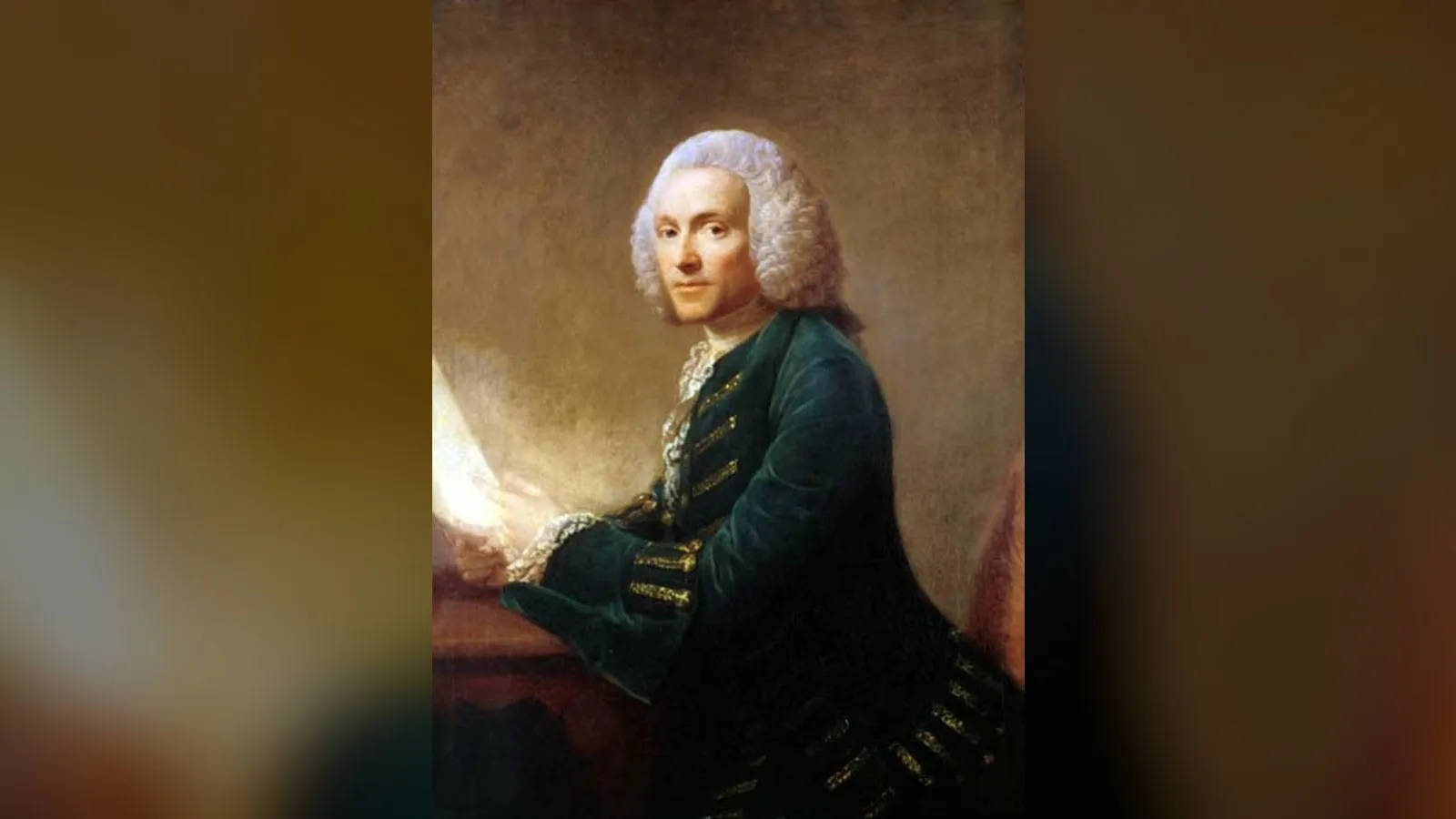

William Hunter (1718–1783)
Contents
TL;DR
- Established/Documented: Hunter was the most eminent obstetric physician and anatomy teacher in eighteenth-century Britain, physician to Queen Charlotte, and author of The Anatomy of the Human Gravid Uterus (1774), a landmark illustrated study of pregnancy still regarded as a masterpiece of anatomical publishing.
- Established/Documented: He bequeathed his entire personal collection — anatomical specimens, one of the finest coin cabinets in the world, rare books, manuscripts, paintings, and natural history material — along with substantial funds to the University of Glasgow, founding what became Scotland's first public museum, the Hunterian.
- Established/Documented: He was the elder brother and first scientific mentor of John Hunter, the pioneering surgeon (see our Great Scots card on John Hunter); their professional partnership lasted over a decade before collapsing into a bitter, permanently unresolved dispute over priority for a key anatomical discovery about pregnancy.
- Legend/Myth, directly refuted: A 2010 claim by historian Don Shelton that William Hunter, his brother John, and colleague William Smellie may have murdered pregnant women to obtain bodies for dissection was swiftly and substantially refuted by medical historians, who pointed to documented, legitimate patient case histories behind Hunter's illustrations and multiple ordinary (if still ethically troubled) sources of cadavers available at the time; this card treats the murder allegation as unsupported rather than repeating it as a live possibility.
- Shared/Traditional, requiring honest context: Hunter's landmark obstetric anatomy could only have been produced using the bodies of women and infants who died in or around childbirth — a stark reality the surviving publication record does not fully explain the provenance of in every case, and one this card does not present as ethically uncomplicated simply because the murder allegation specifically has been discredited.
Key Facts
- Born
- 23 May 1718, Long Calderwood, near East Kilbride, Lanarkshire, Scotland
- Died
- 30 March 1783, London, England (aged 64)
- Education
- University of Glasgow (initially divinity, then medicine under William Cullen from 1737); trained under William Smellie in obstetrics and at St George's Hospital, London, 1741–44
- Known for
- Leading obstetric physician of his era; author of The Anatomy of the Human Gravid Uterus (1774); founder of a major anatomy school and museum
- Key positions
- Physician to Queen Charlotte (from 1764); Professor of Anatomy, Royal Academy (1768–72); Fellow of the Royal Society (1767)
- Legacy institution
- The Hunterian, University of Glasgow — Scotland's first public museum, founded on his bequest
- Personal life
- Never married; no children
Scottish Impact Index (SI Score)
- Global Influence
- 6/10
- Enduring Relevance
- 8/10
- Material Contribution
- 3/10
- Exceptional Achievement
- 7/10
- Lasting Legacy
- 6/10
- Recognition
- 3/10
33/60
Ranked =74th of 200 in Great Scots
Claim-Status and Evidence Note
Claims are evidence-tiered as Established/Documented (settled by primary sources, published works, or broad scholarly consensus), Shared/Traditional (widely told and broadly accurate, if sometimes simplified), disputed, or Legend/Myth (actively corrected here). Hunter's story contains a clear case of a sensational but unsupported allegation (the 2010 murder claim) that deserves direct correction, alongside a genuinely unresolved and more difficult ethical question — the real provenance of the bodies of pregnant women and infants used in his landmark anatomical work — which this card does not attempt to resolve with false certainty in either direction.
Timeline
Born at Long Calderwood, near East Kilbride, the seventh of ten children; his younger brother John Hunter would later become a pioneering surgeon.
Studies divinity at the University of Glasgow before switching to medicine in 1737 under the physician William Cullen.
Moves to London.
Trains as a resident pupil in obstetrics under William Smellie; also receives anatomical training at St George's Hospital.
Begins offering private courses in dissection, surgical procedures, and bandaging, modelled on but distinct from Smellie's teaching.
His younger brother John joins him in London as a dissection assistant, beginning a partnership that will last over a decade.
Appointed physician to Queen Charlotte, cementing his position as the leading obstetric consultant in Britain.
Begins seriously assembling his personal collections of books, manuscripts, coins, shells, and natural history specimens.
Elected Fellow of the Royal Society.
Establishes his celebrated anatomy theatre and museum on Great Windmill Street, Soho, London; appointed Professor of Anatomy to the Royal Academy (serving until 1772).
Publishes Anatomia uteri humani gravidi tabulis illustrata (The Anatomy of the Human Gravid Uterus Exhibited in Figures), his landmark illustrated study of pregnancy, printed by Baskerville with plates by Jan van Rymsdyk; also acquires major holdings from the Anthony Askew library auction, outbidding the British Museum.
Commissions sculptor Agostino Carlini to create an anatomical cast of a flayed male figure for teaching use.
A bitter dispute erupts with brother John over priority for discovering that maternal and fetal blood circulations are anatomically separate; the brothers become permanently estranged.
Dies in London, aged 64, reportedly having continued lecturing almost until his death; buried at St James's Church, Piccadilly.
His bequeathed collection and endowment establish the Hunterian Museum at the University of Glasgow — Scotland's first public museum.
Historian Don Shelton publishes a claim alleging Hunter, his brother John, and William Smellie may have obtained bodies through murder; the claim is subsequently and substantially refuted by medical historians.
The University of Glasgow marks the tercentenary of Hunter's birth with a major exhibition reassessing the scale and significance of his bequest.
Details
From divinity student to London's foremost obstetric physician
William Hunter was born in 1718 at Long Calderwood, near East Kilbride — the same small Lanarkshire farm where his younger brother John would be born a decade later. His path into medicine was not direct: he initially studied divinity at the University of Glasgow before switching to medicine in 1737, coming under the influence of the physician William Cullen (see our Great Scots card on William Cullen), whose own rigorous, systematising approach to medical knowledge appears to have left a lasting impression. Moving to London around 1740, Hunter trained as a resident pupil in obstetrics under the pioneering man-midwife William Smellie from 1741 to 1744, while also receiving anatomical instruction at St George's Hospital. This combination of obstetric apprenticeship and formal anatomical training set the pattern for the rest of his career: Hunter would become simultaneously a leading clinician and a leading anatomist, rather than specialising narrowly in one or the other, at a time when obstetrics itself was only beginning to be treated as a legitimate branch of scientific medicine rather than the separate domain of traditional midwifery.
From 1746 Hunter began offering his own private courses in dissection, surgical procedure, and bandaging, drawing on but distinct from Smellie's teaching methods — notably, unlike Smellie, Hunter did not favour the routine use of obstetric forceps in delivery, reflecting a generally less interventionist clinical philosophy. His refined manner, careful clinical judgment, and growing reputation steadily built him into London's most sought-after obstetric consultant, culminating in his 1764 appointment as physician to Queen Charlotte, a position that placed him at the very top of British medical society.
The brother he trained, and the school he built
In 1748, William's younger brother John arrived in London to join him as a dissection assistant — the beginning of a professional partnership that would last over a decade and that decisively shaped the career of a man who would go on to be remembered as the father of scientific surgery. William was, by most contemporary accounts, the more socially polished and professionally connected of the two brothers: well-spoken, well-dressed, and comfortable in elite circles, in clear contrast to John's rougher manner and comparative social awkwardness. Despite these differences in temperament, the brothers worked together productively for years, teaching anatomy and managing clinical cases jointly, with John proving himself an exceptionally gifted practical dissector under William's initial guidance.
In 1768, William established his own celebrated anatomy theatre and museum on Great Windmill Street in Soho — an institution that became one of the premier training grounds in Britain for anatomists and surgeons of the period, and that operated alongside his appointment as Professor of Anatomy to the newly founded Royal Academy from 1768 to 1772, where he lectured on the anatomical basis of the human form to working artists as well as medical students.
The Gravid Uterus: a masterpiece built on tragedy
Hunter's most significant single scholarly achievement was The Anatomy of the Human Gravid Uterus Exhibited in Figures, published in 1774 after many years of preparation. Printed by the renowned Baskerville press with meticulously detailed plates engraved by the Dutch artist Jan van Rymsdyk, the work presented an unprecedentedly accurate visual record of human pregnancy, drawing partly on an anatomical tradition Hunter had personally helped bring back into English scientific attention — some historians credit him with helping rediscover the anatomical drawings of Leonardo da Vinci held at Windsor Castle, whose combination of scientific precision and visual clarity clearly influenced his own publication's ambitions.
The work's scientific value is not in question; it remained a standard reference for understanding pregnancy anatomy for generations. But its origins raise an ethical question this card does not shy away from: the illustrations were necessarily based on the dissected bodies of women who had died during or around childbirth, along with their infants. Hunter did document legitimate patient case histories behind at least some of the specific illustrated cases in the published work, which matters directly to how the more serious allegation below should be assessed — but the work as a whole stands as a genuine scientific achievement built directly upon human tragedy, and an honest account of it should hold both of those facts at once rather than presenting the masterpiece without acknowledging what it was made from.
The 2010 murder allegation: a claim that does not survive scrutiny
In 2010, historian Don Shelton published a paper suggesting that William Hunter, his brother John, and their former teacher William Smellie may have obtained some of the pregnant women's bodies used in their anatomical work through murder, rather than through the ordinary, if ethically troubled, channels of the era's body supply (primarily bodies of the recently deceased poor, and material from the "resurrectionist" grave-robbing trade that supplied much of Georgian Britain's anatomical teaching). This is a serious allegation, and it deserves a serious response rather than either uncritical repetition or silent omission.
Medical historians who examined Shelton's claim found it substantially unsupported. Smellie himself had explicitly acknowledged as early as 1761 that some of his own published anatomical figures "were not all from real life" — meaning some illustrations were partly reconstructed or idealised rather than drawn directly and exclusively from individual dissected specimens, which undercuts the specific chain of reasoning Shelton's claim depended on. Scholars further noted that Hunter documented genuine patient case histories for at least four of the specific subjects illustrated in his gravid uterus publication, and that multiple entirely legitimate, if grim, sources of deceased pregnant women's bodies existed in a period with genuinely high rates of maternal and infant mortality, without any need to invoke murder as an explanation. This card treats the murder allegation as a claim that has been raised and then substantially refuted, not as an open or live possibility — while still preserving, as above, the separate and real ethical question of informed consent that runs through essentially all Georgian-era anatomical science, including Hunter's.
Collector on a vast scale
From around 1765, alongside his medical career, Hunter began assembling one of the most significant private collections of the eighteenth century — encompassing anatomical specimens, an outstanding numismatic (coin) collection that came to be regarded as one of the finest in the world, rare books and manuscripts, prints, shells, zoological and mineral specimens, and paintings. He collaborated with leading specialists of the day, including the entomologist Johan Christian Fabricius, and competed successfully against institutions as prestigious as the British Museum itself — notably at the 1774 auction of bibliophile Anthony Askew's library, where Hunter outbid the Museum for numerous valuable volumes. King George III himself contributed to the coin collection, donating an Athenian gold piece in 1774. This was not incidental accumulation by a wealthy man with idle time; Hunter approached collecting with the same systematic, scholarly seriousness he brought to anatomy and obstetrics, conceiving of his collection as a coherent educational resource rather than a simple display of wealth.
A rift between brothers that time did not heal
The professional partnership between William and John Hunter, which had begun so productively in 1748, deteriorated over the following decades and collapsed definitively in 1780 in a bitter dispute over scientific priority — specifically, which brother had first established that the maternal and fetal blood circulations during pregnancy were anatomically separate rather than directly continuous, a genuinely important point of obstetric anatomy that both men had worked on. The resulting estrangement was total and permanent: the brothers remained unreconciled when William died just three years later, in 1783. It is a notable and somewhat poignant detail that despite their major, independent contributions to British medicine and surgery, neither brother was ever knighted by the Crown.
Death, and a bequest that outlasted him by centuries
William Hunter never married and had no children; one contemporary's assessment of him — that he "had no country house" and "worked till he dropped, and lectured when he was dying" — captures both the single-mindedness of his devotion to his profession and, implicitly, the personal cost of it. He died in London on 30 March 1783, aged 64, and was buried at St James's Church, Piccadilly, where a memorial to his contributions to medicine and learning still stands.
His most enduring legacy was institutional rather than personal: Hunter bequeathed his entire collection, together with substantial funds, to the University of Glasgow, the university of his own early education. This bequest founded what became Scotland's first public museum — the Hunterian, which opened to the public in 1807 and remains, in modern form, one of the significant university museums in Britain, still holding his coin cabinet, library, anatomical material, and much of his broader collection. The scale of the original gift was such that for long periods it could not be displayed or appreciated as a coherent whole; a major exhibition marking the tercentenary of his birth in 2018 specifically sought to reassemble and properly convey the scale of what he had actually given.
A priority quarrel with the Monros
shared Hunter's London career did not cut him off from Edinburgh rivalries. Alexander Monro secundus claimed credit for showing that the lymphatic vessels act as a general absorbing system, and William Hunter disputed his priority, crediting his own London school. The quarrel was bitter and the question of who deserves the credit is still debated. The historian Helen Dingwall notes that it is part of a wider pattern in which Scots trained at home made their names in London.
Did You Know
- William Hunter initially studied for the ministry, not medicine — he began as a divinity student at Glasgow before switching to medicine under William Cullen in 1737.
- Unlike his teacher William Smellie, Hunter deliberately avoided routine use of obstetric forceps during delivery, reflecting a less interventionist clinical approach than was common in his era.
- A 2010 historian's claim that Hunter and his colleagues may have murdered pregnant women to obtain anatomical specimens was substantially refuted by other medical historians — documented, legitimate patient case histories exist for several of the specific cases in his famous 1774 publication.
- Hunter outbid the British Museum itself at a major 1774 book auction to acquire rare volumes for his own personal library.
- King George III personally donated a gold coin to Hunter's numismatic collection, which became recognised as one of the finest in the world.
- Hunter never married, had no children, and reportedly continued lecturing almost up until his death.
- Despite their major, independent contributions to British medicine, neither William nor his brother John Hunter was ever knighted.
- Hunter's bequest to the University of Glasgow founded the Hunterian — Scotland's first public museum, still open today.
FAQ
1Was William Hunter the same person as John Hunter, the famous surgeon?
No — they were brothers. William was the elder (born 1718) and was primarily an obstetric physician and anatomist; John (born 1728) was a surgeon whom William initially trained and who went on to be remembered as the father of scientific surgery.
2What is William Hunter's most famous scientific work?
The Anatomy of the Human Gravid Uterus Exhibited in Figures (1774), an illustrated anatomical study of pregnancy still regarded as one of the masterpieces of eighteenth-century anatomical publishing.
3Did William Hunter murder pregnant women to obtain bodies for dissection?
No credible evidence supports this. A 2010 claim to that effect by historian Don Shelton has been substantially refuted by other medical historians, who point to documented legitimate patient histories behind several of Hunter's published case illustrations and to the existence of ordinary, if ethically troubled, sources of cadavers in the period.
4If the murder claim is false, does that mean there's no ethical concern about how the bodies were obtained?
Not entirely. Hunter's obstetric anatomy necessarily depended on the bodies of women and infants who died around childbirth, in an era without the informed-consent standards expected today, and using material obtained through the broader, ethically fraught "resurrectionist" trade common to Georgian anatomical science generally. The refutation of the specific murder allegation does not erase this broader, harder-to-resolve context.
5Why did William Hunter and his brother John become estranged?
A 1780 dispute over which brother had first discovered that maternal and fetal blood circulations in pregnancy are anatomically separate led to a permanent, unresolved rift; the brothers remained estranged until William's death in 1783.
6What happened to Hunter's personal collection?
He bequeathed it, along with substantial funds, to the University of Glasgow, founding the Hunterian — Scotland's first public museum, which opened in 1807 and still holds much of his original collection today.
7Was William Hunter ever knighted?
No — despite his prominence as physician to Queen Charlotte and his major scientific reputation, neither he nor his brother John received a knighthood.
8Did William Hunter have any children?
No. He never married and had no children.
9What other subjects did Hunter research besides obstetrics?
He also published influential early work on the structure and diseases of joint cartilage (1743), among other anatomical topics, and was widely respected across multiple areas of anatomy, not obstetrics alone.
10How is William Hunter commemorated today?
Primarily through the Hunterian Museum and Art Gallery at the University of Glasgow, built on his bequest, which continues to hold his coin collection, library, anatomical specimens, and broader collections, alongside his memorial at St James's Church, Piccadilly, in London.
Sources and Further Reading
Primary/Institutional
- The Hunterian, University of Glasgow — institutional history and collection records
- Wellcome Collection, digitised copy and catalogue record of The Anatomy of the Human Gravid Uterus Exhibited in Figures (1774)
- Science Museum Group Collection, biographical record, William Hunter (1718–1783)
Scholarly
- Helen M. Dingwall, A History of Scottish Medicine: Themes and Influences (Edinburgh University Press, 2003), chapter 6 — further reading
- Journal for Eighteenth-Century Studies, "Authorship, Image-Making, and Excess: William Hunter's Anatomia uteri humani gravidi tabulis illustrata (1774)"
- PubMed, "William Hunter's Gravid Uterus: the specimens and plates"
- Journal of Obstetrics and Gynaecology of India, "Remembering William Hunter (1718–1783), the Pioneer in Obstetrics"
General
- Encyclopaedia Britannica, "William Hunter"
- The Scotsman, "Art review: William Hunter and the Anatomy of the Modern Museum, The Hunterian, Glasgow" — on the 2018 tercentenary exhibition and the collection's broader ethical and historical context
Caveats: Myths and Disputed Claims
The principal myth this card corrects directly is the 2010 allegation that William Hunter, his brother John, and William Smellie may have murdered pregnant women to obtain anatomical specimens — a claim that other medical historians have substantially refuted using documented case histories and evidence that some of the era's anatomical illustrations were partly idealised reconstructions rather than drawn from individually murdered subjects. This card does not treat that specific allegation as credible. At the same time, it does not use that refutation to imply the broader ethical picture is clean: the bodies of women and infants who died around childbirth, obtained without anything resembling modern informed consent, remain the acknowledged basis of Hunter's landmark anatomical publication, and this sits within the wider, genuinely troubling context of how Georgian Britain's anatomical science as a whole obtained its material. Readers should come away distinguishing clearly between the discredited murder claim and the separate, real, and unresolved questions of consent and provenance that apply more broadly to anatomical science of this period.
Card 051 · Great Scots