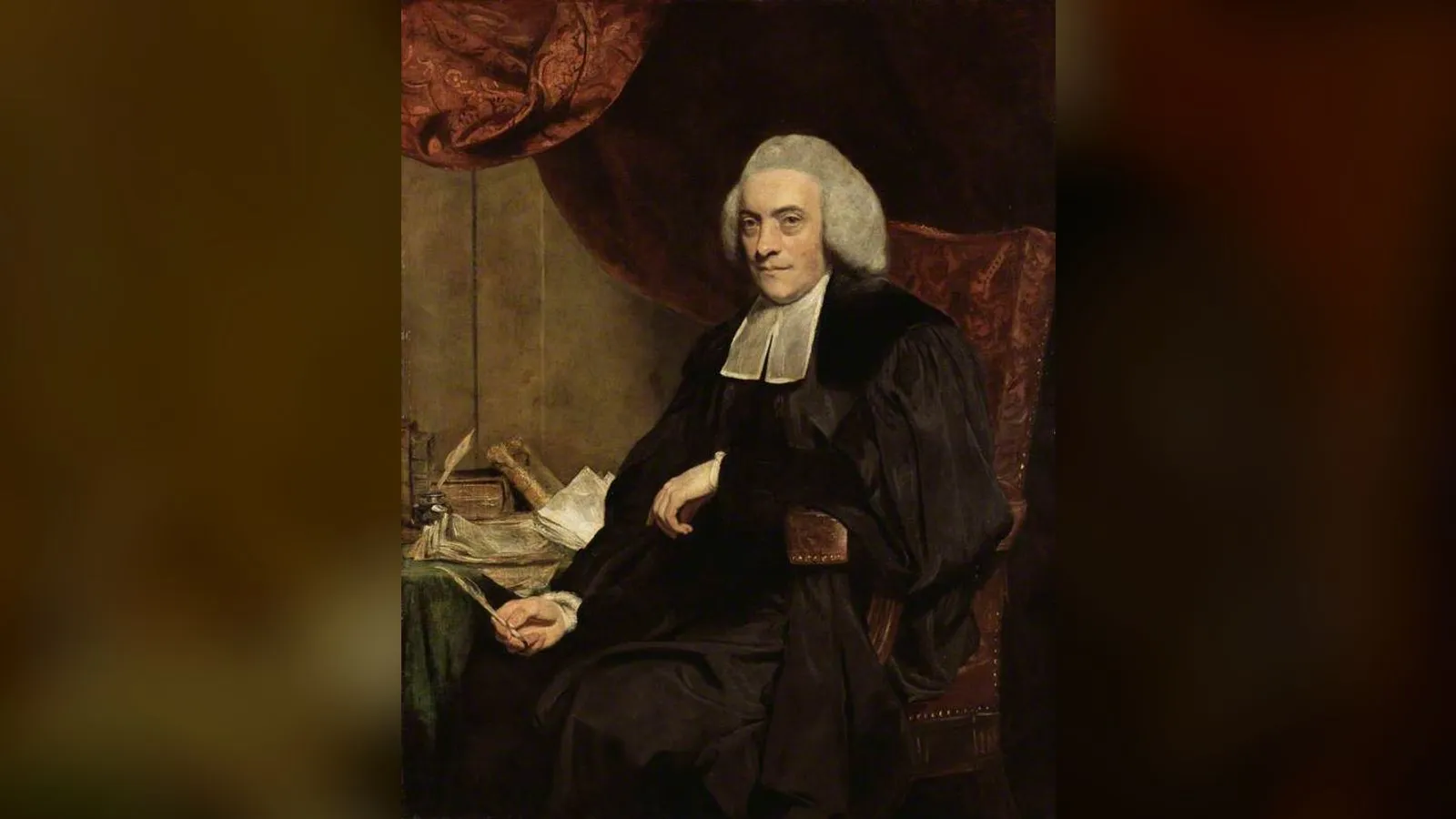

William Robertson
Contents
William Robertson was one of the leading figures of the Scottish Enlightenment: minister, leader of the Moderate party in the Church of Scotland, Principal of Edinburgh University for 31 years, and a historian whose books sold across Europe. Contemporaries ranked him with Hume and Voltaire. Today his research is long superseded, and his History of America is studied for its Eurocentric view of other peoples. This card tests what he achieved and corrects some common claims about him.
TL;DR
- established Robertson was born at Borthwick manse, Midlothian, in 1721. He became minister of Gladsmuir in 1743–1744, Principal of Edinburgh University in 1762, Moderator of the General Assembly in 1763 and Historiographer Royal in 1763. He died in Edinburgh on 11 June 1793.
- established He led the Moderate party, which dominated the Church of Scotland's General Assembly for years and whose central cause was enforcing the law of patronage.
- established His History of Scotland (1759), History of the Reign of the Emperor Charles V (1769) and History of America (1777) were bestsellers. He was among the best-paid authors of his age.
- established He did not found the Select Society; the painter Allan Ramsay did, in 1754. He was never knighted.
- shared His History of America is criticised by modern scholars as Eurocentric; they disagree over whether its hierarchy of peoples is racial or religious and moral.
Key Facts
- Born
- 1721, Borthwick manse, Midlothian (19 September in most sources)
- Minister of Gladsmuir
- Presented 1743; ordained 1744
- Married
- Mary Nisbet, 21 August 1751
- Principal of Edinburgh University
- 1762–1793
- Moderator of the General Assembly
- May 1763
- Historiographer Royal
- 6 August 1763
- History of Scotland
- 1 February 1759; author's fee £600
- Charles V
- 1769; fee £4,000–£4,500
- History of America
- 1777
- Royal Society of Edinburgh
- Proposed by Robertson, founded 1783
- Died
- 11 June 1793, Grange House, Edinburgh
Scottish Impact Index (SI Score)
- Global Influence
- 3/10
- Enduring Relevance
- 7/10
- Material Contribution
- 1/10
- Exceptional Achievement
- 5/10
- Lasting Legacy
- 4/10
- Recognition
- 1/10
21/60
Ranked =165th of 200 in Great Scots
A Note on Claims and Evidence
Each major claim carries one of three labels. established means supported by primary records, official bodies or several independent reliable sources. shared means the core fact is sound but sources disagree on details, dates or interpretation. traditional means widely repeated but not traceable to a primary or independent source.
Robertson's career is well documented in church and university records, his own books, the old Dictionary of National Biography and modern scholarship. Some popular claims about him are wrong, including that he founded the Select Society and that he was knighted. Some anecdotes come from early biographers with an interest in his reputation. The numbered notes in the text refer to the numbered list of cited sources below.
Timeline
William Robertson is born at Borthwick manse.
He is licensed to preach.
He is presented to and ordained at Gladsmuir.
He volunteers against the Jacobite army; both his parents die.
He emerges as a leader of the Moderates in the Inverkeithing case.
He becomes an original member of the Select Society.
The History of Scotland is published.
He becomes Principal of Edinburgh University.
He is Moderator of the General Assembly and becomes Historiographer Royal.
At Benjamin Franklin's request, Edinburgh grants doctorates of divinity to the American ministers Ezra Stiles and Samuel Cooper.
The History of the Reign of the Emperor Charles V is published.
Charles V is printed at Philadelphia.
The Rhode Island lawyer Henry Marchant records a conversation with him about America's future.
He leads the Moderates in keeping the General Assembly's address to the King loyal during the American war.
The History of America is published.
A Protestant mob attacks his house over his support for Catholic relief.
He withdraws from leadership of the General Assembly.
The Royal Society of Edinburgh is founded on his proposal.
The foundation stone of the university's new building, today's Old College, is laid.
Robertson dies in Edinburgh.
Details
1. Basic biography
| Claim | Tier | Notes |
|---|---|---|
| Born at the manse of Borthwick, Midlothian, eldest son of Rev. William Robertson and Eleanor Pitcairn[1][2] | Established | Father was minister of Borthwick, later of Lady Yester's and Old Greyfriars, Edinburgh.[1][3] |
| Birth date | Disputed (probably a calendar issue) | The old DNB, the 1911 Britannica, current Britannica and Edinburgh University's archive give 19 September 1721.[1][4][5][6][7] Jeffrey Smitten (ODNB; Europe 1450–1789) and the parish record transcription give 8 September 1721, with baptism on 14 September.[8][9][10] A baptism on the 14th rules out 19 September as an Old Style date. The 11-day gap is exactly the Julian/Gregorian difference, so 19 September is most likely a later New Style conversion of 8 September (Old Style). This is our inference; no source we found states it. Recommended wording: "8 September 1721 (Old Style; often given as 19 September)." |
| Schooling at Borthwick and Dalkeith; entered Edinburgh University (1733 or 1735)[1][8] | Established (entry date disputed) | DNB and Edinburgh's archive say autumn 1733; Smitten says 1735.[1][8] He took no degree, which was normal at the time. His commonplace books carry the motto vita sine literis mors est ("life without literature is death"), per Dugald Stewart (Shared/Traditional).[1][6][10] |
| Licensed to preach 1741 (Presbytery of Dalkeith)[1][11] | Established (minor dispute) | DNB says June 1741; one Edinburgh source says 1742.[1][4][8] |
| Presented to Gladsmuir, East Lothian, 1743; ordained 1744[1][8][10][11] | Established | DNB: presented by the Earl of Hopetoun, succeeding his uncle.[1][11] Edinburgh's "Our History" also credits help from his father's patron Robert Dundas of Arniston.[4] Stipend "considerably under £100 a year" (DNB).[1] |
| Supported his orphaned siblings after both parents died in November 1745, delaying his marriage to cousin Mary Nisbet until 21 August 1751[1][4] | Established | Six children.[8][10] Sons included the judge Lord Robertson and General James Robertson.[1][2] |
| 1745: volunteered against the Jacobite army; Sir John Cope declined the volunteers[1] | Established | Cope "prudently declined to admit the undisciplined band" (DNB).[1] His pro-Hanoverian loyalties shaped his histories.[8] |
| Lady Yester's (1758), Old Greyfriars (1761), royal chaplain (1761), DD (1758/59)[1][9] | Established | |
| Died 11 June 1793 at Grange House, Edinburgh; buried in Greyfriars Kirkyard[1][2][9] | Established | DNB gives jaundice as the cause.[1] His will (National Records of Scotland) leaves the gold diamond-set snuff box "a present from the Empress of Russia".[8] |
No knighthood: At least one Edinburgh archival catalogue calls him "Sir William Robertson".[6] None of the standard biographies record a knighthood, so he should not be called "Sir". Liberty Fund's description of him as "Principal (Chancellor)" is also wrong:[12] the offices are distinct.
2. Leader of the Moderates: what they actually stood for
established In the 1751–52 Inverkeithing case, the Commission of the General Assembly went easy on the Presbytery of Dunfermline, which had refused to induct a patron's nominee. Robertson and a small group of dissenting ministers and elders published Reasons of Dissent (1752).[4][13] The 1752 Assembly then reversed course and deposed Thomas Gillespie, whose followers later formed the Relief Church.[13] This was the Moderates' breakthrough.[13][14]
What the Moderates stood for (Established, with nuance):
- Church order and the law of patronage. They held that the Assembly's decisions bound lower church courts and that the 1712 Patronage Act must be obeyed.[13][15] The old DNB summarises his system as "the independence of the church as opposed to a fluctuating dependence upon the supposed views of the government of the day, the exaction of obedience by the inferior judicatories, and the enforcement of the law of patronage, except in flagrant cases of erroneous doctrine or immoral conduct."[1]
- A learned, polite clergy and tolerance of secular culture. Smitten summarises their "often controversial policies of patronage and toleration, together with a demand for a more educated clergy."[8][10] In 1755–56 they blocked attempts in the Assembly to censure David Hume and Lord Kames (Thomas Ahnert, 2026).[16] In 1756–57 they defended John Home's play Douglas: according to the DNB, Robertson "led a minority of eleven (against two hundred) which sought to mitigate the wrath of the assembly against the ministers who witnessed Home's play."
- Doctrinal restraint, not doctrinal radicalism. The Moderates "provoked controversy over patronage, but successfully avoided it in theology" (John Robertson, Institute of Historical Research).[17] Historian Callum Brown defines them as the party that "sought a rational basis for religious belief in view of Enlightenment thinking, and which despised 'enthusiasm' and excess in religion."[18]
The Popular (Evangelical, "High-Flying") party opposed absolute patronage as a breach of the Kirk's spiritual independence and stood for congregational consent and personal, evangelical faith.[13][19] Robertson's university friend John Erskine became its leader.[14]
Robertson's own influence (Established): He was Moderator in May 1763[7] and managed the Assembly "with a firm hand for upwards of sixteen years", with "an influence greater than any moderator since Andrew Melville" (DNB, 1896 — a Victorian judgement).[1] The Oxford Companion (Phillipson) says his group took control of the Assembly in 1752 and "dominated its politics until 1805", with its power base in the universities and in government support.[10]
His exit (Established): In 1778–79 he backed extending Catholic relief to Scotland, and a Protestant mob attacked his Edinburgh house in 1779. He withdrew from Assembly leadership in 1780.[1][10][15] The episode shows the real, and risky, limits of Moderate "toleration".
Myth-busting:
- "Robertson was a liberal who shielded free thought." Partly true, partly oversimplified. He protected the literati, but his chief ecclesiastical cause was enforcing lairds' right to present ministers against congregations' wishes. That policy fed the secessions and, in the long run, the 1843 Disruption. Frame him as a champion of order and politeness, not of liberty in the modern sense.
- "Moderates were closet deists." Legend/Myth as a generalisation. The DNB calls Robertson's faith "a robust form of Christianity".[1] Ahnert's 2026 study makes Christian revelation central to his theory of history.[20]
- "Robertson acted in rehearsals of Douglas with Hume and Blair." Legend/Myth. The DNB entry on Home calls this "apocryphal".[21] Robertson in fact refused to enter a theatre at all, citing a promise to his dead father (DNB).[1]
3. Principal (1762) and Historiographer Royal (1763); the literati circle
established
- Appointed Principal in 1762 on the death of John Gowdie;[1] the Town Council's commission is dated 11 November 1762.[2][6] Lord Provost George Drummond helped secure the appointment.[4] He held the post until his death.[10]
- The office of Historiographer Royal for Scotland, vacant since George Crawfurd, was revived for him on 6 August 1763 at £200 a year.[1][7]
- Hume's contemporary quip: "He is principal, chaplain, minister, historiographer, and historian" (Shared/Traditional, quoted in Victorian compilations).[11]
His record as Principal (Established):
- Set up a library fund (1762) and revived the collection of matriculation fees.[1][8]
- Arranged for the Royal College of Surgeons' 560 medical volumes to join the university library (1763).[8]
- New chairs were created in pharmacology (1768), surgery (1777), and natural history, astronomy and agriculture (1790).[8]
- As old chairs fell vacant he helped fill them with Moderate literati and allied scientists: Adam Ferguson, Hugh Blair, Dugald Stewart, William Cullen, Joseph Black, Alexander Monro II, John Hope and John Gregory.[8]
- He pushed for new buildings from 1768. The Robert Adam design (today's Old College) had its foundation stone laid on 16 November 1789, and neither man lived to see it finished.[8][10]
- The Books and Borrowing 1750–1830 project (University of Stirling) records that "between 1763 and his death, he borrowed more than 3500 volumes" from the university library, far beyond the professors' official, unenforced limit of "twenty-five volumes".
Assessment: The Oxford Companion calls him "the greatest of Edinburgh University's principals", under whom the university "became the most admired of the enlightened world".[10] That is Shared/Traditional praise. It is directionally supported, but much of the medical school's pre-eminence came from Town Council patronage and from professors such as Cullen and the Monros, not from the Principal alone.
Clubs and friendships (Established):
- Select Society (1754): founded by the painter Allan Ramsay. Robertson was one of the original fifteen members and "perhaps the most prominent speaker" alongside Hume, Adam Smith, Ferguson, Kames and Monboddo (DNB).[1]
- The Moderate literati: Richard Sher's classic study (1985) treats Blair, Carlyle, Ferguson, Home and Robertson as an "intimate coterie".[10][22]
- Hume: a warm friend despite their religious differences. On History of Scotland Hume joked, "A plague take you! Here I sat on the historical summit of Parnassus… and you have the impudence to squeeze yourself past me" (letter quoted in DNB).[1]
- Gibbon: called Robertson a "master artist".[1]
- Royal Society of Edinburgh (1783): Robertson proposed it. The first volume of the Society's Transactions (1788) records that around the end of 1782 "a scheme was proposed by the Rev. Dr Robertson, Principal of the University, for the establishment of a Society on a more extended plan, and after the model of some foreign academies", and the Royal Charter of 29 March 1783 names him among the petitioners.
Myth to correct: The claim that Robertson "founded one of the Scottish Enlightenment's most prominent intellectual societies in 1750", the Select Society (Human Progress website),[23] is wrong. The Select Society dates from 1754 and was Ramsay's initiative.[8]
4. The major histories and their reception
The History of Scotland during the Reigns of Queen Mary and of King James VI (published 1 February 1759, 2 vols quarto):
- established The first edition sold out in under a month.[1] Editions in his lifetime numbered about 13 (Smitten) or 14 (1911 Britannica); the difference is minor.[7][10]
- established Robertson received £600, while his publishers Millar and Cadell cleared "upwards of six thousand pounds" (DNB).[1]
- established It was the 13th most-borrowed book among Glasgow University students between 1757 and 1771 (Books and Borrowing project).[8]
- Established praise: Horace Walpole wondered how a man "whose dialect I scarce understood" had written "what all the world now allows to be the best modern history… in the purest English". Lord Chesterfield compared him to Livy.[1]
The History of the Reign of the Emperor Charles V (1769, 3 vols quarto):
- Its long introduction, "A View of the Progress of Society in Europe", is usually judged his masterpiece. It traces the rise of the European state system and the balance of power.[2][10][24][25]
- Disputed figure: the copyright fee is given as £4,500 in the DNB ("a larger sum, probably, than had ever been paid for a work of learning") but as £4,000 in W. Howard and W. Zachs, The Celebrated Doctor Robertson (1993), followed by the Soane Museum and Glasgow University Library.[1][24][26] Use "about £4,000–£4,500".
- Richard Sher calls him the "highest-paid Scottish author of the age".[8]
- established It made him famous across Europe.[26] Voltaire wrote "il me fait oublier tous mes maux" ("it makes me forget all my ills"). Catherine II called it "le compagnon constant de tous mes voyages" ("the constant companion of all my travels") and sent the snuff box. Suard's French translation followed.[1][11]
The History of America (1777, 2 vols quarto):
- It covers the Spanish discovery and conquest of Mexico and Peru. Robertson split it off from Charles V so as not to dilute that book's focus.[1][10][27]
- The American war gave it topical interest, and the DNB says it was "more popular than either of its predecessors".[1]
- Robertson was elected to the Royal Academy of History in Madrid in August 1777.[1][2]
- Shared/Traditional: Keats supposedly took his "stout Cortez" image from it (DNB).[1]
Why they sold (analysis):
- Polished, Latinate English that Scots deliberately cultivated for English readers. Robertson modelled his style on Swift after studying Livy and Tacitus.[1]
- Big European themes (Reformation, the balance of power, empire) framed within an optimistic, Protestant, Hanoverian story of progress.
- "Philosophical" narrative: a lively political story set against broad essays on manners, law and society.
- Aggressive marketing by the Strahan–Cadell publishing network (Sher).
Method and style compared with Hume and Gibbon:
- Robertson was a narrative historian who used Scottish "conjectural" or stadial theory as background (Phillipson).[10] He was more reverent than Hume and lacked Gibbon's irony.
- The DNB judges that he "lacked the humour, suggestive cynicism, and commanding sense of perspective which gave Gibbon immortality".[1]
- Samuel Johnson's jibe was "Read over your compositions, and wherever you meet with a passage which you think is particularly fine, strike it out" (Shared/Traditional, via Boswell).[1]
- Distinctive strength (Established): he printed original documents in appendices and footnoted his sources. The America volumes include a catalogue of Spanish books and manuscripts,[28][29] and he gathered a large, heavily annotated Spanish library.[1][27]
Modern regard: Current Britannica says his "writings were influential in the 19th century but received little critical attention during the 20th century".[5] Later research has superseded his factual content:
- Ranke and Prescott replaced Charles V.[1]
- S.R. Maitland's Dark Ages (1844) demolished his picture of medieval clerical ignorance.[1]
- Southey attacked the accuracy of America.[1]
A scholarly revival followed: Sher (1985), the 12-volume Works (1996), Stewart J. Brown's edited volume William Robertson and the Expansion of Empire (1997), and Karen O'Brien's Narratives of Enlightenment (1997).[10][22][30][31][32] It rehabilitated him as a major theorist of European civilisation and empire rather than a mere stylist.
5. Mary, Queen of Scots, and the reliability of his research
What he actually argued (Established):
- In "A Critical Dissertation concerning the Murder of King Henry, and the Genuineness of the Queen's Letters to Bothwell", appended to the History, Robertson argued that the Casket Letters were genuine and that Mary was complicit in Darnley's murder.[33][34]
- Yet his closing character sketch is famously indulgent. Mary was "not insensible of flattery"; "formed with the qualities which we love, not with the talents that we admire; she was an agreeable woman, rather than an illustrious Queen."[35]
Contemporary reaction — Disputed from the start:
- Walpole, Hume, Thomas Birch and Chesterfield thought Robertson too partial to Mary.[1]
- William Tytler's Inquiry… into the Evidence against Mary Queen of Scots (1759)[36][37] and John Whitaker's Mary Queen of Scots Vindicated (1788) attacked him as her prosecutor (DNB).[1]
- Walter Goodall's Examination (1754) had already argued that the letters were forged.[38] Robertson's preface records that Goodall nonetheless lent him manuscripts, which is a telling mark of scholarly civility.[39][40]
- Around 1791 the teenage Jane Austen annotated her copy of Vicesimus Knox's Elegant Extracts (now at Jane Austen's House, Chawton), and JASNA's Persuasions On-Line reports that her notes dispute Robertson's criticisms of the queen. Jane Austen's House, however, attaches her famous "A lie—an entire lie from beginning to end" to Hume's praise of Elizabeth I, not to Robertson, so exactly which note sits where needs checking before the card quotes it.
Verdict: "Hostile" and "sympathetic" are both oversimplifications. The fair description is judicially condemnatory on the evidence, sentimentally sympathetic in portraiture. His Presbyterian-Whig verdict fitted Moderate, anti-Jacobite politics. Professor Gerard Carruthers (Glasgow) notes that it was Tytler, not Robertson, "who brought Mary back in from the cold".[37]
Modern view of the evidence (Disputed):
- The originals of the Casket Letters vanished after 1584. The National Archives' education resource says historians currently believe the letters were "a botch job of various letters, some perhaps written by Mary, others fabricated".[41][42]
- A. E. MacRobert concludes it is "too simplistic to hold that the Casket Letters were either completely authentic or entirely forged."[43]
- So Robertson's confident case for authenticity looks overconfident today, while the question of Mary's guilt remains genuinely open.[44][45]
Research methods (analysis): By 18th-century standards he was diligent. He used Cottonian and State Paper Office transcripts, the Regent Lennox's letter register, and archives opened through his contacts, and he printed original papers.[40] By modern standards he lacked systematic archival access and critical palaeography, and his providential Protestant framework shaped his judgements. The DNB's verdict still holds: "Later and more exhaustive methods of research have deprived Robertson's 'History' of most of its historical value", but "its sobriety, fairness, and literary character" keep it important for the history of historical writing.[1]
6. The History of America: Indigenous peoples, Spain, race and empire
What the text does (Established):
- Book IV applies the four-stages theory (hunting, pastoral, agricultural, commercial). "In every part of the earth the progress of man hath been nearly the same… we can trace him in his career from the rude simplicity of savage life, until he attains the industry, the arts, and the elegance of polished society."[8][16][46]
- He places most Native Americans in the hunting stage, with "an imperfect conception of any species of property".[47][48]
- He rejects de Pauw's and Buffon's purely climatic "degeneracy" thesis, putting moral and political causes alongside climate.[16][48]
- He likens the "savage" to a child, a trope shared with Ferguson.[49]
Significant modern critique — yes, substantial and ongoing:
- ODNB (Smitten), as quoted by a book dealer: America is "often regarded as Robertson's most interesting, original, and even Romantic work", but "it also shows the Eurocentric limits of his stadial thinking, because it presents an unsympathetic account of Native Americans and glosses over Spanish atrocities."[50] (Secondhand quotation; check against the ODNB itself.)
- Bruce Lenman (in Brown ed., 1997) describes Robertson's outlook as "ferociously Eurocentric cosmopolitanism", adding: "Few mentalities can be so dictatorial as the enlightened condescension of the authoritarian liberal."[16][51] He argues Robertson was "impervious" to evidence that complicated stadial progression and the low rating of North American peoples (Times Higher Education review).[52]
- Jorge Cañizares-Esguerra, How to Write the History of the New World (2001), groups Robertson with de Pauw, Raynal and Buffon.[53][54] On this reading, northern European "philosophical" historians discredited Amerindian sources (codices, quipus) as products of "peoples with inferior mental qualities". Meanwhile Spanish and Creole scholars were developing more sophisticated methods for using those sources (as summarised by reviewer Antonio Feros).[54][55]
- Silvia Sebastiani, in The Scottish Enlightenment: Race, Gender and the Limits of Progress (2013) and a 2014 Modern Intellectual History article, contrasts Robertson's "long-distance" philosophical history with the Mexican Jesuit Francisco Javier Clavijero's "closeness, local expertise and direct observation". She reads Robertson as repeatedly reducing the Aztec and Inca states "to the level of savages".[56][57] Robertson dismissed Clavijero's reliance on Torquemada and Boturini, and Clavijero answered back.[58][59] Some 1787 British reviewers sided with Clavijero.[60][61]
- Thomas Ahnert, "Religion, Race, and the Limits of Progress in the Global Histories of William Robertson" (History of European Ideas, 2026), is the most recent reassessment. It argues that physical "race" played little role in Robertson's explanations. Unlike Lord Kames's quasi-polygenism, Robertson blamed the "obstacles which pagan religion imposes on societal progress", which could "only be removed by knowledge of Christianity", and he applied the same critique to classical antiquity. Ahnert still concludes that "Robertson's interpretations of non-European societies were certainly Eurocentric."[16][20][62]
Verdict (disputed in degree, not in kind):
- Scholars agree that America is Eurocentric and hierarchical in civilisational terms.
- They disagree over whether that hierarchy is racial (Sebastiani stresses hierarchy; Ahnert says it is religious and moral, not biological).
- They also disagree over how far he excused the conquistadors. He condemned their cruelty but blamed individuals and circumstances more than Spanish policy, and he championed Crown authority over the Creoles.[63]
- Robertson belongs in the same critical conversation as Hume's notorious footnote on race and Kames's polygenism, but he was not a polygenist.[64][65]
Spanish reaction (Established):
- Although Madrid's Academy had honoured him, a Spanish translation by the academician Ramón de Guevara Vasconcelos was halted.[1][2][66][67]
- A Royal Order of December 1778 banned the book's shipment to America and the Philippines "in English or any other language" (Eva Velasco Moreno, 2017).[66][68]
- Charles III then commissioned Juan Bautista Muñoz to write a Spanish counter-history (reported; Cañizares-Esguerra covers the episode on pp. 171–190).[55][69][70]
- Whether the Academy itself or the Crown and Council of the Indies drove the ban remains unclear.[54][66]
7. Unfinished and projected works
- British North America (Established): Robertson planned to carry America on to the British colonies. The Revolutionary War stopped him:[48][71][72] "I must wait for times of greater tranquillity" (DNB). His son published the drafts posthumously as Books IX and X: Virginia to 1688 and New England to 1652 (1796).[1][71][73]
- Failing eyesight (Legend/Myth, or at least unsupported): none of the sources consulted mention it. The documented health problems are "chronic congestion and increasing deafness during the late 1770s and early 1780s" (Smitten);[10] Lord Cockburn recalled his hearing trumpet.[1][15] Politics, not illness, was the stated reason for stopping the colonial history.[71]
- India (Established, frequently mis-stated): He did not write or, on the evidence found, plan a history of British India. His last book was An Historical Disquisition concerning the Knowledge which the Ancients had of India (1791).[10] Reading James Rennell's Memoir of a Map of Hindoostan prompted it, and Gibbon encouraged it. It covers European contact with India up to the Cape route.[10] It ends hoping that knowledge of India's "early and high civilisation" might improve "the behaviour of Europeans towards that people".[1] It defends the caste system as rational while calling Hinduism a "system of superstition", and nowhere claims that European rule was indispensable (THE review of Brown, 1997).[52]
- Other abandoned projects (Established): In the 1760s a History of England was floated through Lord Bute with royal encouragement, but it lapsed when Bute fell. He also considered Leo X, Greece, and "Lives" in the manner of Plutarch.[1]
- Late revision (Established): He revised all his histories in 1787–88.[10]
8. Legacy and reputation
-
In his lifetime: He ranked "as the equal of Voltaire and Hume, and much admired by Burke and Gibbon" (Phillipson).[10] Britannica still groups him with Hume and Gibbon as "one of the most important British historians of the 18th century".[5]
-
Today (analysis): He ranks clearly third of that trio as a read author, with no general readership now, unlike Gibbon. In the history of historiography, however, he matters for three reasons:
- Joining narrative history to stadial social theory, especially in the Charles V "View of the Progress of Society".
- Writing some of the first large-scale "global" histories in English of European expansion.
- Modelling how a clergyman could be a bestselling Enlightenment author.
As a social theorist he is less original than Smith, Ferguson or Millar, and as a philosopher he does not compare with Hume. The DNB's "no metaphysical faculty" is harsh but reflects the consensus.[1]
-
Institutional legacy: Edinburgh's William Robertson Building (School of History, Classics and Archaeology)[2] and the William Robertson Chair of History, which is reserved for non-European modern history[2] — a fitting, if ironic, tribute given the critiques in section 6.
Common myths and oversimplifications to avoid:
- "Founder of the Select Society." False; it was Ramsay in 1754.
- "Sir William Robertson." No knighthood found.
- "A liberal churchman." Only half right: he enforced patronage and church discipline.
- "Hostile to Mary" or "defender of Mary." Both oversimplify; he argued for her guilt while writing a sympathetic character sketch.
- "America was abandoned because of failing eyesight." Unsupported: the stated reason was the American war, and his documented ailment was deafness.
- "He wrote a history of British India." False: he wrote a disquisition on ancient knowledge of India.
- "His research is still authoritative." False: he is valued for method, style and the history of ideas, not facts.
- "Scottish Enlightenment historians were uniformly racist in the same way." Oversimplified: Robertson was monogenist and religious-moral in his reasoning, but still Eurocentric.
9. Robertson and America: degrees, readers and editions
The literary historian Andrew Hook, in Scotland and America: A Study of Cultural Relations, 1750–1835 (1975), shows that Robertson had a second American story alongside the History of America: as a patron of American clergy, a host to American visitors, and the most read historian in the early republic after Hume.
A friend of Franklin, and a source of degrees. established Benjamin Franklin met Robertson in Edinburgh in 1759 and again in 1771. Because Oxford and Cambridge were tied to the Church of England, American dissenting ministers who wanted a Doctor of Divinity looked to Scotland, and Franklin used his friendship with Robertson to obtain Edinburgh degrees for them: for Ezra Stiles, later president of Yale, in 1765; for Samuel Cooper of Boston in 1767; and soon afterwards for Andrew Eliot of Boston and a New York minister named Rogers. In 1773 John Ewing of Philadelphia, in Scotland raising money for Newark Academy, received an Edinburgh DD "without application" and made a deep impression on Robertson. Benjamin Rush met Robertson at Dr John Gregory's house while a medical student in 1766–68.
His view of the American quarrel. shared Henry Marchant, Attorney-General of Rhode Island, met Robertson on 31 October 1771 and wrote that he seemed "a friend to civil and religious Liberty" who thought America "must in some future period be the seat of a mighty Empire" (Marchant's diary, copied by Stiles, as quoted by Hook). But Robertson could not accept American independence. In the General Assembly of 1776 he and the Moderates headed off evangelical opposition to the war, and the Assembly's address to the King called for "submission to legal authority". Hook concludes that his position is "not easy to determine". The unfinished books on Virginia and New England, set aside "for times of greater tranquillity", fit that ambivalence.
Published in America before the Revolution. established Charles V was printed at Philadelphia in 1770, a year after its London appearance. Hook finds that it and Adam Ferguson's Essay on Civil Society (Philadelphia, 1773) were the only major works of the Scottish Enlightenment published in America before the Revolution. A gift of books to Rhode Island College (Brown) in 1771 included the History of Scotland. Even Ezra Stiles, who blamed the war on "Scotch Councils", noted in his diary on 23 August 1776 that he was "Reading Robertson's Charles V". In 1782 James Madison's list of books for Congress included Charles V, the History of Scotland and the History of America.
American editions after the war. established Hook lists the Historical Disquisition concerning India (Philadelphia, 1792); the History of America (New York, 1798); its posthumous books on Virginia and New England (Philadelphia, 1799; Walpole, New Hampshire, 1800); Charles V again (New York, 1804); what may have been rival Philadelphia editions of the America, the Disquisition and Charles V in 1812; the America again at Philadelphia in 1821 and 1822; the first American History of Scotland (Philadelphia, 1811); and all four major works at Albany in 1822. A Beauties of Dr. Robertson, a book of extracts, appeared at New York in 1810, a sign of his standing as a model of English prose.
His American reputation. established American critics paired Hume and Robertson as the great historians of the century, and often preferred Robertson's style. Samuel Miller's Brief Retrospect of the Eighteenth Century (1803) said Robertson exceeded Hume in "uniform purity, dignity, and elegance of diction". The Port Folio remarked in 1801 that it was "very fashionable, among young students, to read the histories of Dr. Robertson", and in 1806 called the History of Scotland a model of English composition. Brockden Brown's Literary Magazine printed a long biographical article in 1804. A North American Review writer on Mary, Queen of Scots, in 1832 stated that "No historian has been more read than Robertson in this country", while noting that his reputation was beginning to fade (all as quoted by Hook).
shared Hook argues that this reputation helped fix an American image of Scotland as a land of learning. That is his interpretation, but it is consistent with the evidence of editions and college reading.
Did You Know?
- Robertson's History of Scotland sold out in under a month.
- He was paid £600 for it, while his publishers made more than £6,000.
- Voltaire said Charles V made him "forget all my ills".
- He borrowed more than 3,500 volumes from the university library after 1763.
- A mob attacked his house in 1779 because he supported relief for Catholics.
- Spain banned his History of America from its American colonies in 1778.
- Keats's "stout Cortez" may have come from Robertson's History of America.
- He proposed the founding of the Royal Society of Edinburgh.
- Through Benjamin Franklin, Robertson helped American ministers including Ezra Stiles, later president of Yale, obtain Edinburgh doctorates of divinity in the 1760s.
- Charles V was printed at Philadelphia in 1770, one of only two major Scottish Enlightenment books published in America before the Revolution.
- Ezra Stiles, who blamed the American war on "Scotch Councils", was reading Charles V in August 1776.
- He had American kin. Moses Coit Tyler's 1887 biography of Patrick Henry records that Robertson was a cousin of Henry's Aberdeen-born father, John Henry, and that Robertson's niece Eleanor Syme was the mother of the Whig statesman Henry Brougham. David Hackett Fischer's Albion's Seed (1989) repeats the link but wrongly makes Patrick Henry Robertson's nephew.
FAQ
1Who was William Robertson?
A Scottish minister, church leader, university principal and historian of the 18th century.
2What were the Moderates?
The party he led in the Church of Scotland, which upheld the law of patronage and favoured a learned, polite clergy.
3Was he a liberal?
Only partly. He protected free-thinking friends, but his main church cause was enforcing patrons' rights.
4What did he write?
Histories of Scotland under Mary and James VI, of the Emperor Charles V, and of the Spanish conquest of America.
5Did he found the Select Society?
No. Allan Ramsay founded it in 1754; Robertson was an original member.
6Was he Sir William Robertson?
No. There is no record of a knighthood.
7What did he think of Mary, Queen of Scots?
He argued that the evidence showed her guilty, but wrote a sympathetic portrait of her character.
8Is his History of America racist?
Scholars agree it is Eurocentric; they disagree over whether its hierarchy is racial or religious and moral.
9Did he write a history of British India?
No. His last book was about ancient European knowledge of India.
10Are his histories still used?
Not for their facts, which are superseded, but for the history of ideas and of history-writing.
11Was he read in America?
Very widely. Charles V was printed at Philadelphia in 1770, and all his major histories went through American editions between 1792 and 1822. In 1832 the North American Review said no historian had been more read in the United States.
12Did he support the American Revolution?
No. An American visitor in 1771 found him sympathetic to liberty and confident of America's future, but he could not accept independence, and in 1776 he led the Moderate majority that kept the General Assembly loyal to the government's policy.
Sources and Further Reading
Cited sources (numbers match the notes in the text)
- Dictionary of National Biography, 1885-1900/Robertson, William (1721-1793) - Wikisource, the free online library
- William Robertson (historian)
- William Robertson (Scottish minister, born 1686)
- William Robertson (1721-1793) - Our History
- William Robertson
- Robertson, William, 1721-1793 (historian, Principal of the University of Edinburgh)
- 1911 Encyclopædia Britannica/Robertson, William - Wikisource, the free online library
- Books and Borrowing 1750-1830 :: William Robertson (1721-1793): Minister, Principal, Historian
- William Robertson (1721-1793)
- William Robertson | Encyclopedia.com
- Significant Scots - William Robertson
- Robertson (William)
- Inverkeithing case
- Thomas Gillespie (minister)
- (PDF) William Robertson (1721–1793)
- Religion, Race, and the Limits of Progress in the Global ...
- The Scottish Contribution to the Enlightenment ... - SAS-Space
- Undergraduate Journal of Baylor University VOLUME 7 NUMBER 1 FALL 2009
- This document was supplied for free educational purposes.
- Full article: Religion, Race, and the Limits of Progress in the Global Histories of William Robertson
- Dictionary of National Biography, 1885-1900/Home, John - Wikisource, the free online library
- Church and University in the Scottish Enlightenment: The Moderate Literati ... - Richard B. Sher - Google Books
- Centers of Progress, Pt. 18: Edinburgh (Scottish Enlightenment) - Human Progress
- University of Glasgow
- Published by Scholarly Publishing Office, University of Michigan Library, 2006
- The history of the reign of the Emperor Charles V. With a view of the progress of society in Europe, from the subversion of the Roman Empire, to the beginning of the sixteenth century. In four volumes. By William Robertson, D.D. ... The second edition. ...
- The history of America / By William Robertson.
- 1778 William Robertson 4 Volumes History of America with 4 Significant
- The History of America by William ROBERTSON on Rootenberg Rare Books & Manuscripts
- History America Volume by William Robertson
- Narratives of enlightenment : cosmopolitan history from Voltaire to Gibbon : O'Brien, Karen (Karen Elisabeth) : Free Download, Borrow, and Streaming : Internet Archive
- Selected Bibliography: William Robertson
- The Works of William Robertson, vol. 2. The History of Scotland vol.2
- Mary, Queen of Scots
- The history of Scotland, during the reigns of queen Mary and of king James vi - William Robertson - Google Books
- William Tytler
- The Romantic Reception and Transmission of Mary Queen of Scots
- The Mary Queen of Scots Collection — The WS Society
- Walter Goodall
- The History of Scotland
- Murder at Kirk o’ Field
- resolve.cambridge.org
- Reviewed by:
- Murderer or a martyr? The tragic life of Mary, Queen of Scots
- This Lavish Silver Box Tarnished Mary, Queen of Scots—and Contributed to Her Downfall
- (PDF) WILLIAM ROBERTSON ON NATURAL RESOURCES AND CULTURAL CONTACTS IN COLONIAL AMERICA
- landed property, Scottish stadial theory and indigenes in ...
- (PDF) William Robertson’s Unfinished History of America. The Foundation of the British Empire in North America and the Scottish Enlightenment
- Full article: Mobilizing Stadial Theory: Edward Gibbon Wakefield’s Colonial Vision
- History America by Robertson William, First Edition
- An Enlightened Empire: Scottish and Irish Imperial Reformers in the Age of the American Revolution
- The teller of Europe's tale
- Project MUSE - How to Write the History of the New World: Historiographies, Epistemologies, and Identities in the Eighteenth-Century Atlantic World (review)
- Feros on Cañizares Esguerra, 'How to write the History of the New World: Histories, Epistemologies, and Identities in the Eighteenth-Century Atlantic World'
- H-Net Reviews
- WHAT CONSTITUTED HISTORICAL EVIDENCE OF THE NEW WORLD? CLOSENESS AND DISTANCE IN WILLIAM ROBERTSON AND FRANCISCO JAVIER CLAVIJERO | Modern Intellectual History | Cambridge Core
- William Robertson on Revelation and the Limits of Progress
- The Project Gutenberg eBook of Narrative and Critical History of America, Vol. I (of 8), by Various
- Publications Sebastiani
- Enlightenment America and the Hierarchy of Races
- Francesco Clavigero's "History of Mexico" (1806 ed.) Vol. I
- https://api.crossref.org/works/10.1080/01916599.2026.2650751
- Enterprise, adventure and industry: the formation of ‘commercial character’ in William Robertson's History of America : History of European Ideas: Vol 29, No 1
- link.springer.com
- Cromohs 2003 - Sebastiani - Race and national characters in eighteenth-century scotland: the polygenetic discourses of Kames and Pinkerton
- Traducción y censura de la obra de William Robertson Historia de América
- “Reseña sobre The History of America de William Robertson” p. 177-204
- EL "HISTORIA DE AMÉRICA" DE ROBERTSON PROHIBIDO - Red de Archivos y Bibliotecas Históricas del Perú
- How to Write the History of the New World: Histories, Epistemologies, and ... - Jorge Cañizares-Esguerra - Google Books
- Juan Bautista Mu%C3%B1oz
- History of America Vol II
- Transatlantica (Apr 2019)
- The history of America by William Robertson
Scholarly/Critical
- Alexander Broadie, "The Rise (and Fall?) of the Scottish Enlightenment", in T. M. Devine and Jenny Wormald (eds), The Oxford Handbook of Modern Scottish History (Oxford University Press, 2012)
- David Hackett Fischer, Albion's Seed: Four British Folkways in America (Oxford University Press, 1989)
- Andrew Hook, Scotland and America: A Study of Cultural Relations, 1750–1835 (Blackie, 1975)
- J. Bennett Nolan, Benjamin Franklin in Scotland and Ireland, 1759 and 1771 (Philadelphia, 1938)
Specialist
- Moses Coit Tyler, Patrick Henry (Boston, 1887; revised 1898), Project Gutenberg text
Caveats: Myths and Disputed Claims
- Do not say Robertson founded the Select Society.
- Do not call him "Sir William Robertson".
- Do not call him simply a liberal churchman.
- Do not describe him as simply hostile to, or a defender of, Mary, Queen of Scots.
- Do not say he abandoned his American history because of failing eyesight; the stated reason was the American war.
- Do not say he wrote a history of British India.
- Do not present his research as still authoritative.
- Do not say he acted in rehearsals of John Home's Douglas; that story is apocryphal.
- Do not call him a polygenist.
- Do not call him a supporter of American independence; he admired America's prospects but backed the government in the 1776 General Assembly.
- Do not call him "rector" of Edinburgh University, as Albion's Seed does, or Patrick Henry's uncle; he was Principal, and a cousin of Henry's father.
Card 028 · Great Scots