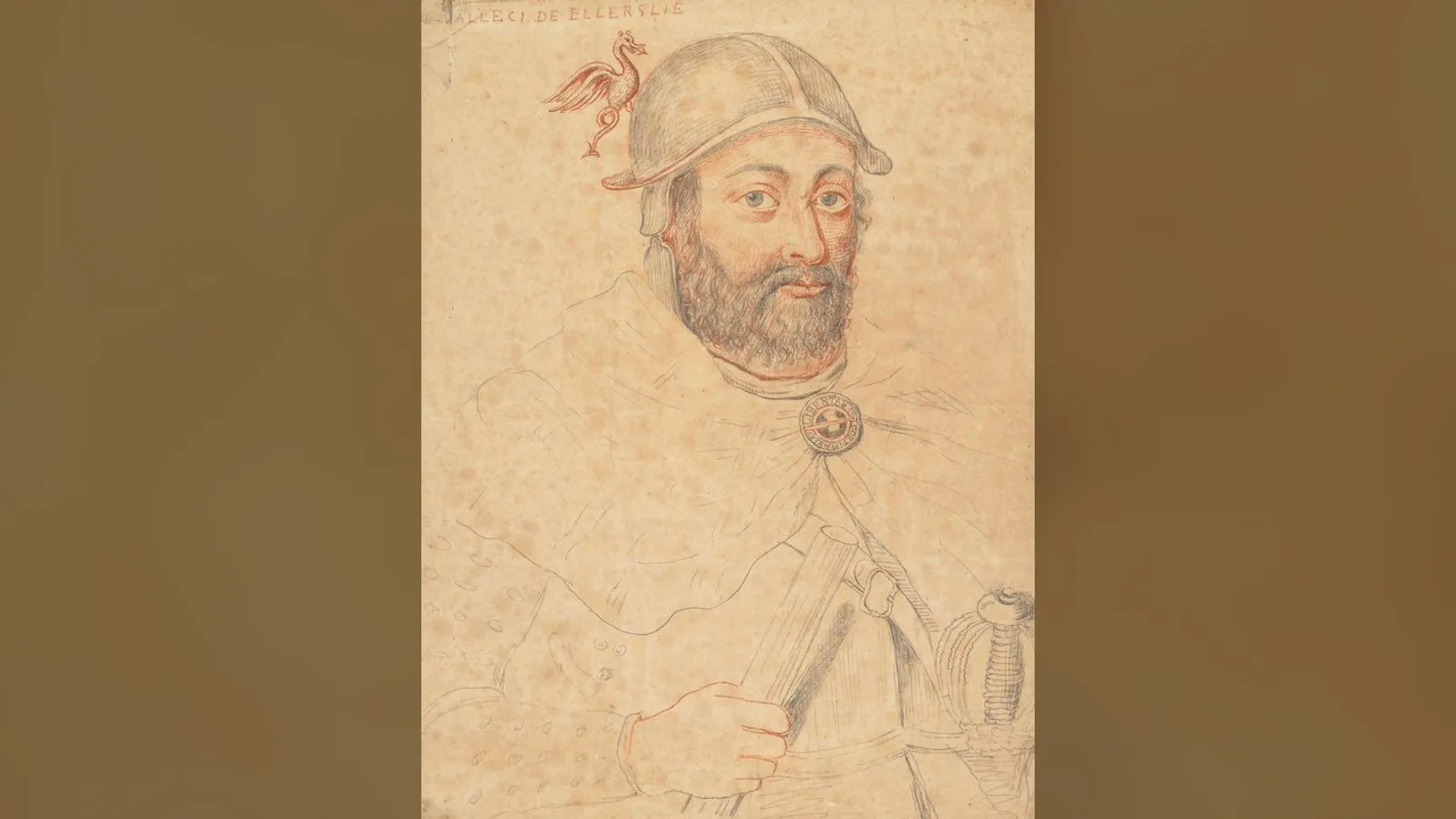

William Wallace
Contents
William Wallace led the Scottish rising of 1297, won a famous victory at Stirling Bridge with Andrew Moray, governed Scotland as Guardian, and was executed in London in 1305. He is Scotland's great symbol of resistance. But much of what people think they know about him comes from a poem written 170 years after his death and from the film Braveheart. This card separates the documented Wallace from the legend.
TL;DR
- established Wallace was a younger son of the minor gentry, not a commoner. His own seal names his father as Alan Wallace, not the "Sir Malcolm of Elderslie" of legend.
- established With Andrew Moray he defeated an English army at Stirling Bridge on 11 September 1297, and was then knighted and made Guardian of Scotland.
- established Edward I defeated him at Falkirk on 22 July 1298. He was captured near Glasgow in August 1305, tried at Westminster Hall on 23 August and executed at Smithfield the same day.
- shared His birth date (usually given as c.1270) and birthplace (Elderslie in Renfrewshire or Ayrshire) are not documented.
- traditional Most colourful stories about him, including Marion Braidfute and the revenge motive, come from Blind Harry's poem The Wallace of about 1477. His famous "I could not be a traitor" speech was polished by 19th-century writers.
Key Facts
- Born
- c.1270 (estimates c.1260–1278)
- Father
- Alan Wallace, per Wallace's own seal
- Birthplace
- Disputed: Elderslie (Renfrewshire) or Ayrshire
- Rising begins
- May 1297, killing of Sheriff Heselrig at Lanark
- Stirling Bridge
- 11 September 1297, with Andrew Moray
- Lübeck letter
- 11 October 1297
- Falkirk
- 22 July 1298, defeat
- In France
- 1300 (safe-conduct from Philip IV, 7 November 1300)
- Captured
- 3 or 5 August 1305, Robroyston, by Sir John de Menteith
- Tried and executed
- 23 August 1305, Westminster Hall and Smithfield
- National Wallace Monument
- Completed 1869
Scottish Impact Index (SI Score)
- Global Influence
- 8/10
- Enduring Relevance
- 10/10
- Material Contribution
- 3/10
- Exceptional Achievement
- 9/10
- Lasting Legacy
- 7/10
- Recognition
- 9/10
46/60
Ranked =21st of 200 in Great Scots
A Note on Claims and Evidence
Each major claim carries one of three labels. established means supported by primary records, official bodies or several independent reliable sources. shared means the core fact is sound but sources disagree on details, dates or interpretation. traditional means widely repeated but not traceable to a primary or independent source.
The contemporary evidence for Wallace is thin: English government records, his trial indictment, two letters bearing his name, and English chronicles such as Walter of Guisborough and Lanercost. The main narrative of his life, Blind Harry's The Wallace, was written around 1477 and is regarded by most historians as patriotic literature rather than history. Where a detail comes only from Blind Harry, this card says so.
Timeline
William Wallace is born; the date is an estimate.
Edward I conquers Scotland and deposes King John Balliol; an Alan Wallace appears on the Ragman Roll.
Wallace kills William de Heselrig, the English sheriff of Lanark.
Wallace and Andrew Moray defeat the English at Stirling Bridge.
The Lübeck letter is issued in the names of Moray and Wallace.
Wallace is knighted and made Guardian of Scotland; he raids northern England.
Edward I defeats Wallace at Falkirk.
Wallace gives up the Guardianship.
Philip IV of France issues Wallace a letter of safe-conduct to the papal court.
Wallace is declared an outlaw after other Scots submit to Edward.
Wallace is captured near Robroyston by Sir John de Menteith.
Wallace is tried at Westminster Hall and executed at Smithfield.
Blind Harry writes The Wallace.
The National Wallace Monument is completed.
Braveheart is released.
Details
1. Origins: What We Actually Know
William Wallace was born around 1270 — but this date is a convention, not a documented fact; estimates have ranged from roughly 1260 to 1278. The conventional c.1270 is essentially back-calculated and should be treated as approximate.
His birthplace is genuinely disputed. The traditional claim is Elderslie in Renfrewshire, near Paisley — a tradition that flows from Blind Harry's identification of Wallace's father as "Sir Malcolm of Elderslie." Against this, the 1999 reassessment built around Wallace's own seal points toward Ayrshire (often associated with "Ellerslie"/Riccarton near Kilmarnock). There is no contemporary document — no "birth certificate" — establishing either, though both areas had Wallace family connections.
The single most important piece of evidence is Wallace's seal, attached to the 1297 Lübeck letter, which names him as son of Alan Wallace — not Malcolm. An Alan Wallace appears in the 1296 Ragman Roll as a "crown tenant in Ayrshire." Historian Fiona Watson, in her March 1999 Report into Sir William Wallace's connections with Ayrshire, concluded that "Sir William Wallace was a younger son of Alan Wallace, a crown tenant in Ayrshire." Biographer Andrew Fisher noted that if the Ragman Roll's Alan was indeed Wallace's father, the case for an Ayrshire rather than Renfrewshire origin "can be settled."
On social status, the key point for understanding his rise: Wallace was neither a peasant nor a great noble. The scholarly foundation is G.W.S. Barrow's Robert Bruce and the Community of the Realm of Scotland (1965), which placed Wallace among the lesser landed/knightly class. As a younger son with no inheritance, he likely made his own way through a military career — the bow-and-arrow device on his seal has been read as evidence he served as an archer. The "Wallace" surname derives from Old English wǣlisċ ("foreigner"/"Welshman"), pointing to the family's likely origin among the Britons/Welsh of the Strathclyde region.
2. The Historical Record vs Blind Harry
The central problem of Wallace studies is the gap between sources. Our main narrative — the source of nearly every colourful story — is "The Actes and Deidis of the Illustre and Vallyeant Campioun Schir William Wallace" by Blind Harry (Henry the Minstrel), composed around 1477, roughly 170 years after Wallace died. Harry claimed his work rested on a Latin life by Wallace's chaplain John Blair, but this book has never been seen and may never have existed. Most modern historians regard The Wallace as a "versified historical novel," written during a period of strong anti-English sentiment, and demonstrably borrowing material from John Barbour's Bruce (transferring Bruce's deeds to Wallace), the Alliterative Morte Arthure, and Chaucer.
Several "battles" in Harry (e.g. the "Battle of Biggar," and a march to the outskirts of London/St Albans) are regarded as unhistorical or impossible.
By contrast, the contemporary or near-contemporary sources are sparse but valuable:
- English administrative records — the Ragman Roll (1296), Exchequer/Pipe Rolls, and the 1305 trial indictment.
- Walter of Guisborough (also "Hemingburgh"), an English/Yorkshire Augustinian canon — the preferred narrative source, near-contemporary, with detail on Stirling Bridge and Falkirk.
- The Chronicle of Lanercost (compiled by ~1346 from earlier material) — records the flaying of Cressingham and Wallace's 1297 raids.
- The Scalacronica of Sir Thomas Grey, whose father was present at the Lanark action.
- Scottish chronicles written later: John of Fordun's Chronica, Walter Bower's Scotichronicon (1440s), and Andrew of Wyntoun — patriotic but post-dating events.
- Two letters: the Lübeck letter (11 October 1297, jointly from Moray and Wallace) and the Philip IV safe-conduct (7 November 1300).
What can be firmly established from these: the killing of Heselrig (May 1297); the victory at Stirling Bridge (Sept 1297); the raid into northern England; the appointment as Guardian; the defeat at Falkirk (July 1298); his presence in France (1300); his capture (1305); and his trial and execution. Almost everything else is tradition.
3. The Killing of Heselrig and the Start of the Rebellion (1297)
Wallace's first firmly attested act is the killing of Sir William de Heselrig, the English-appointed Sheriff of Lanark, in May 1297 (commonly given as 3 May; some accounts say late May). The best narrative is the Scalacronica: a fracas broke out at a court being held by Heselrig; Wallace escaped, returned with supporters, killed Heselrig, nearly killed Thomas Grey senior, and burned houses. The 1305 indictment confirms the killing and adds that Wallace and his men dismembered the corpse.
The famous motive — revenge for the killing of Wallace's wife/lover Marion Braidfute of Lamington by Heselrig — comes from Blind Harry and has little to no supporting evidence. Marion Braidfute is not mentioned in any contemporary source. Wallace biographer Ed Archer argued (2005) that she does not appear before a revised 1570 edition of Harry's poem, possibly inserted to flatter the Baillie family of Lamington's claimed Wallace descent. She should be treated as probably literary, not historical.
Crucially, the Lanark attack was not an isolated act of personal vengeance: it coincided with a wave of risings across Scotland in 1297 (Andrew Moray in the north, nobles including Wishart, Stewart, Douglas and Bruce elsewhere), following Edward I's 1296 conquest and the deposition of King John Balliol. Whether Wallace coordinated with these or acted independently is unknown.
4. The Battle of Stirling Bridge (11 September 1297)
This was Wallace's masterpiece — and it was a joint command with Sir Andrew Moray, who had raised a successful rising in the north. Popular accounts (and Braveheart) erase Moray; in reality the victory was as much his as Wallace's, and he brought aristocratic prestige to complement Wallace's numbers.
The English army under John de Warenne, Earl of Surrey, and the treasurer Hugh de Cressingham had to cross the narrow wooden bridge over the Forth, where horsemen could pass only two or three abreast. A Scottish knight in English service, Sir Richard Lundie, offered to lead a flanking force across a nearby ford; Cressingham, anxious to avoid expense, persuaded Surrey to order a direct crossing instead. Wallace and Moray waited — per the Chronicle of Hemingburgh — until "as many of the enemy had come over as they believed they could overcome," then attacked, seizing the bridgehead and trapping the vanguard in the loop of the river. The trapped English were slaughtered; the contemporary English chronicler Walter of Guisborough recorded English losses as "100 cavalry and 5,000 infantry killed" — though historians treat these figures as exaggerated, one modern study (The Wallace Book) dismissing them as "the wild imaginings of a typically innumerate chronicler."
Cressingham was killed and flayed. The Lanercost Chronicle records that Wallace had a broad strip of his skin "taken from the head to the heel, to make therewith a baldrick [belt] for his sword." This is grisly but reasonably well attested by the standards of the period.
In the aftermath, Wallace was knighted (late 1297, by an unnamed earl — possibly Robert Bruce, Earl of Carrick) and made Guardian of the Kingdom of Scotland in the name of the imprisoned King John Balliol. Moray died of his Stirling Bridge wounds, probably in November 1297 (the Lübeck letter of 11 October still bears both names). Wallace then led a destructive raid into Northumberland and Cumberland.
5. The Battle of Falkirk (22 July 1298)
Edward I returned from France and personally led a large army north — roughly 2,000–2,500 heavy cavalry and around 12,000+ infantry, including many Welsh and English longbowmen. Wallace used scorched-earth tactics and nearly starved Edward into retreat, but the Scots were caught at Falkirk.
Wallace arranged his spearmen in four schiltrons — dense circular "hedgehogs" of long pikes — with archers between and a small body of cavalry in reserve. The schiltrons initially repelled the English cavalry charges. The battle turned when Edward brought up his longbowmen, whose massed arrow-fire (supplemented by slingers and crossbowmen) tore gaps in the static formations, after which the cavalry charged the broken ranks. About a third of Wallace's army is said to have died; among the dead were Sir John Stewart and Sir John de Graham. Falkirk has been called the first great victory of the longbow.
Why did the Scottish cavalry fail? Popular tradition (echoed in Braveheart's Bruce-betrayal subplot) blames treachery by the Comyn/noble cavalry who "left the field." The more sober military reading is that the small, lightly armed Scottish horse was driven off early by the English heavy cavalry — a reflection of the disparity in mounted forces rather than necessarily treason. The treachery theory is plausible given the bitter Bruce–Comyn–Balliol rivalries but is not proven; the simplest explanation is military reality. Robert the Bruce was NOT present fighting against Wallace at Falkirk in the way the film depicts.
Wallace escaped but his military reputation was ruined; he resigned (or was removed from) the Guardianship by December 1298, succeeded by Robert Bruce and John "the Red" Comyn.
6. The Years After Falkirk (1298–1305)
Wallace's movements become murky. There is solid evidence he went abroad as a diplomat seeking foreign support for the Scottish cause. The surviving safe-conduct letter from King Philip IV of France, dated 7 November 1300, written at Pierrefonds, commands the French king's agents at the papal court to assist "our beloved William le Wallace of Scotland, knight" in his business before Pope Boniface VIII. This proves Wallace was in France around 1300 and intended to approach the Pope — though there is no evidence he ever reached Rome, and the precise purpose of his mission is unknown (possibly tied to the cause of the exiled King John Balliol, then in papal custody). An English spy's report also placed Wallace in France. He likely also sought support from Norway (a Haakon V safe-conduct was reportedly among his possessions at capture).
By 1303–1304 Wallace was back in Scotland, involved in skirmishes (Happrew, Earnside). After the general Scottish submission to Edward in February 1304, the St Andrews parliament of March 1304 declared Wallace an outlaw — uniquely, he was excluded from the terms others accepted, and refused to submit.
7. Capture and Execution (1305)
Wallace was captured on 3 (or 5) August 1305 near Robroyston, outside Glasgow, by Sir John de Menteith, the Scottish keeper of Dumbarton Castle who was loyal to Edward. His companion Kerle/Kerlie was killed. Menteith has been branded "Fause Menteith" (false Menteith) in Scottish tradition.
Was Menteith a traitor? In strict terms he was acting within the political realities of 1305: most Scottish nobles had already submitted to Edward, and Menteith held royal office under the English administration. He was not a uniquely villainous figure — he later sealed the Declaration of Arbroath (1320) and served the Bruce cause. As historian Andrew Fisher observed, Wallace might equally have been taken by Bruce, Comyn, or the Stewart; Edward's particular wish was simply that Wallace be captured by a Scot. The betrayal is real but the "arch-traitor" framing is a later moral simplification.
Wallace was taken to London and tried in Westminster Hall on 23 August 1305 before a special royal commission. The professional justice Sir Peter Mallore (Mallorie) put the charge of treason, and Sir John de Segrave (the commission's head and Wallace's custodian) pronounced sentence. The surviving indictment charged Wallace with sedition/treason, the homicide of Heselrig, usurping royal authority (holding parliaments, issuing letters as if a superior), treating with France against England, invading England, and atrocities including the slaughter of religious men and the burning of churches — "sparing neither age nor sex, monk nor nun." He was mockingly crowned with a garland of oak as "king of the outlaws."
This was a show trial: Wallace was not permitted a formal defence, present only to hear the charges and sentence. He is reported to have cried out that he could not be a traitor because he had never sworn allegiance to Edward — the substance of which is historically credible. However, the famous polished wording — "I could not be a traitor to Edward, for I was never his subject" (and the longer "He is not my Sovereign; he never received my homage…") — is a 19th-century literary embellishment, traceable to Sir Walter Scott's Tales of a Grandfather (1828) and P.F. Tytler's Lives of Scottish Worthies (1831), not to any 1305 source.
The execution at Smithfield (the Elms) was deliberately savage. Wallace was stripped, dragged behind horses through the city, then hanged but cut down alive, emasculated, disembowelled with his entrails burned before him, beheaded, and his body cut into four quarters. His tarred head was set on a spike on London Bridge; his quarters were displayed at Newcastle, Berwick, Stirling, and Perth (some sources say Aberdeen) as warnings. The brutality backfired, helping inspire the renewed rising under Robert Bruce within months.
8. The Braveheart Problem
Mel Gibson's 1995 Braveheart (written by Randall Wallace) shaped global perception of Wallace — and is one of the most historically inaccurate major historical films ever made. It won 5 of its 10 nominations at the 68th Academy Awards (25 March 1996): Best Picture, Best Director (Mel Gibson), Best Cinematography (John Toll), Best Makeup, and Best Sound Effects Editing. Even cast member Brian Cox, who played Argyle Wallace, has been scathing — telling the 2025 Edinburgh International Book Festival, "The film is just bollocks. It doesn't make any sense," and noting Wallace "never impregnated the French princess." The principal errors:
- The blue face paint is woad-style war paint associated with the Picts roughly a thousand years earlier; it was not used by 13th-century Scots.
- The kilt is anachronistic by roughly 300 years — the belted plaid/great kilt emerged in the 16th–17th centuries; Wallace's contemporaries wore tunics and cloaks.
- The romance with Princess Isabella of France is impossible: the real Isabella was a small child (born c.1295) living in France in 1297–1305, only married Edward II in 1308, and never met Wallace. The implication she bore Wallace's child (the future Edward III, born 1312) is pure fiction.
- The Battle of Stirling Bridge has no bridge in the film — removing the single tactical feature that won the battle. Gibson reportedly said the bridge "got in the way."
- Andrew Moray is omitted entirely.
- Robert the Bruce is shown betraying Wallace at Falkirk — a fabrication; Bruce's real path was politically complex but he did not betray Wallace in that way.
- The title "Braveheart" historically referred to Robert the Bruce, whose heart was carried into battle after his death, not to Wallace.
- Wallace was not a commoner farmer but minor gentry.
What the film gets broadly right in spirit: Wallace was a real resistance leader; he did win a stunning victory at Stirling Bridge against a larger force; Edward I ("Longshanks") was genuinely ruthless and earned the title "Hammer of the Scots"; Wallace was betrayed, tried for treason, and brutally executed in London in 1305; and his defiance did help inspire the eventual independence won under Bruce at Bannockburn (1314). The film also undeniably revived global interest in Wallace and Scottish history.
9. Legacy and Commemoration
Wallace became Scotland's enduring symbol of resistance and liberty. Robert Burns invoked him ("Scots Wha Hae," 1793); the National Wallace Monument — a 67-metre (220-ft) sandstone tower on Abbey Craig overlooking the Stirling Bridge battlefield — was completed in 1869 after a public fundraising campaign begun by Rev. Charles Rogers amid 19th-century national revival. It houses a Hall of Heroes and remains a major attraction: it welcomed 133,871 visitors in the 12 months to September 2024 — described by Stirling Council leader Cllr Chris Kane as "one of its busiest years on record" — though that is still below the post-Braveheart peak of 184,265 in 1998.
The Wallace Sword displayed there is a powerful symbol but of highly doubtful authenticity. The two-handed sword measures 5 ft 4 in (163 cm) overall with a 4 ft 4 in (132 cm) blade and weighs about 6 lb (2.7 kg). It was only associated with Wallace from 1888 (and a soldier's 1803 claim at Dumbarton). Dr David Caldwell, then president of the Society of Antiquaries of Scotland, has stated it has "nothing to do" with Wallace, calling it a "not very good example of a two-handed 16th Century sword": "When the Wallace Monument was being built in the 19th Century, there was a great desire to find appropriate relics to go with the great man and they were very hard to find." Caldwell found the blade "welded together from at least three separate pieces," noting that the bottom 87.7 cm of flattened-diamond section possibly came from a single-handed blade that "might well be of thirteenth-century date" (The Wallace Book, 2014). Records from 1505 (James IV) do mention paying for a new hilt and scabbard for "Wallace's sword," but the surviving object's medieval pedigree is unproven.
Wallace's meaning has been politically fluid: in the mid-19th century he was claimed by Unionists as the man who secured Scotland's standing as an equal partner in the 1707 Union; in the late 20th and 21st centuries he has become an icon of the independence movement and the SNP era. Braveheart's 1995 release coincided with and amplified renewed nationalist sentiment. Two surviving documents personally connected to Wallace — the Lübeck letter and the Philip IV safe-conduct — remain prized national artefacts; the safe-conduct has been on loan from The National Archives (Kew) to the National Records of Scotland since 2012.
Did You Know?
- Wallace's seal shows a bow and arrow and names him "William, son of Alan Wallace" — suggesting he may have served as an archer, and overturning the legend that his father was "Sir Malcolm of Elderslie."
- Andrew Moray co-commanded the victory at Stirling Bridge and is named first on the Lübeck letter — yet he's almost entirely forgotten in popular retellings because he died of his wounds soon after.
- The English treasurer Hugh de Cressingham was flayed after Stirling Bridge, and Wallace reportedly took a strip of his skin for a sword-belt.
- Wallace's 1305 trial is studied today as one of the earliest examples of a war-crimes prosecution — he was charged with sparing "neither age nor sex, monk nor nun."
- Wallace was crowned with a garland of oak at his trial — a mocking "crown" for the "king of outlaws."
- His famous line "I could not be a traitor… for I was never his subject" is a Victorian invention (Scott, 1828), not his actual recorded words.
- The celebrated Wallace Sword at Stirling is probably a 16th-century weapon — experts say it likely had "nothing to do" with Wallace.
- Braveheart's Princess Isabella love story is impossible: she was about three years old during the events depicted.
FAQ
1Was William Wallace a real person?
Yes. His victory at Stirling Bridge, his Guardianship, his capture and his execution are all documented.
2Was Wallace a commoner?
No. He was a younger son of the minor gentry; his seal names his father as Alan Wallace.
3Where was he born?
It is disputed: Elderslie in Renfrewshire is the tradition, but evidence from his seal points towards Ayrshire.
4Who won the Battle of Stirling Bridge?
The Scots, under the joint command of Wallace and Andrew Moray.
5What happened at Falkirk?
Edward I's longbowmen broke the Scottish spear formations, and Wallace was heavily defeated.
6Did Wallace go abroad?
Yes. A surviving letter shows he was in France in 1300, seeking help at the papal court.
7Who captured Wallace?
Sir John de Menteith, a Scot holding office under Edward I, in August 1305.
8How did Wallace die?
He was hanged, drawn and quartered at Smithfield in London on 23 August 1305.
9Did he really say "I could not be a traitor, for I was never his subject"?
He is reported to have denied treason because he had never sworn allegiance to Edward, but the famous wording comes from 19th-century writers.
10Is Braveheart accurate?
No. The face paint, the kilts, the romance with Princess Isabella and the bridgeless Battle of Stirling Bridge are all wrong.
11Is the Wallace Sword genuine?
Its link with Wallace is doubtful; experts think it is largely a 16th-century sword.
Sources and Further Reading
Scholarly/Critical
- Colin Kidd and James Coleman, "Mythical Scotland", in T. M. Devine and Jenny Wormald (eds), The Oxford Handbook of Modern Scottish History (Oxford University Press, 2012)
- Graeme Morton, "Identity within the Union State, 1800–1900", in T. M. Devine and Jenny Wormald (eds), The Oxford Handbook of Modern Scottish History (Oxford University Press, 2012)
Further reading
- G. W. S. Barrow, Robert Bruce and the Community of the Realm of Scotland, 4th edn (Edinburgh University Press, 2005)
- Andrew Fisher, William Wallace, 2nd edn (John Donald, 2002)
- Edward J. Cowan (ed.), The Wallace Book (John Donald, 2007)
Caveats: Myths and Disputed Claims
- Do not give Wallace's birth date or birthplace as certain.
- Do not name his father as Sir Malcolm of Elderslie; his seal names Alan Wallace.
- Do not present Marion Braidfute or the revenge motive for killing Heselrig as fact; they come from Blind Harry.
- Do not quote "I could not be a traitor… for I was never his subject" as his recorded words.
- Do not leave Andrew Moray out of Stirling Bridge.
- Do not say Robert the Bruce fought against Wallace at Falkirk.
- Do not present the Wallace Sword as genuinely his.
- Do not treat Guisborough's casualty figures for Stirling Bridge as reliable counts.
- Do not call Wallace "Braveheart" as a historical title; it was originally applied to Robert the Bruce.
Card 001 · Great Scots