
Forestry & Timber
Contents
Legend/Myth Opener
Scotland is often imagined as a land of ancient, unbroken forest cover — the "Great Wood of Caledon" stretching from coast to coast. In reality, by the early twentieth century Scotland was one of the least wooded countries in Europe, with as little as 5% tree cover. The dense conifer plantations that now dominate large parts of the Southern Uplands, Galloway, and the Highlands are not remnants of that ancient wildwood — they are almost entirely a twentieth-century industrial creation, planted deliberately by the state after it was nearly caught without a strategic timber supply during the First World War.
TL;DR
- established The Forestry Commission was created by the Forestry Act 1919 as a direct response to catastrophic timber shortages during WWI — Britain had to fell roughly 450,000 acres of its own woodland and relied on imports that German U-boats threatened to cut off, so this is documented in the founding statute and government record.
- established Scotland's modern forestry estate is overwhelmingly non-native conifer plantation (chiefly Sitka spruce, a species from the Pacific coast of North America), because the Commission's planting programme from the 1920s onward prioritised fast-growing softwood for pit-props and construction timber, a fact confirmed by Forestry Commission/Forestry and Land Scotland planting records.
- established Scotland now holds the majority of the UK's forested land (roughly 19% of Scotland's land area, compared to about 10% for the UK as a whole) and produces the large majority of UK-grown timber, a figure regularly published by Forest Research/Scottish Forestry statistics.
- disputed Whether large-scale Sitka spruce monoculture is a net environmental good or harm is genuinely contested among foresters, ecologists and conservation bodies — afforestation locks up carbon and supports a substantial rural economy, but critics (including ecologists writing in outlets such as The Ferret) argue it damages peatland, acidifies watercourses, and displaces native biodiversity, so this is presented as an active policy debate rather than settled fact.
- traditional The idea that Scotland once had near-total forest cover in prehistory ("Great Wood of Caledon") is a folk memory with a real basis (pollen records do show much higher Mesolithic/Neolithic cover) but the specific unbroken "forest from coast to coast" image is a romanticised simplification, not a documented historical state for the historic period.
Key Facts
- Category
- Detail
- Peak Era
- 1920s founding through to late 20th-century plantation boom (1960s–1980s); present-day industry still growing
- Key Locations
- Galloway Forest, Kielder-adjacent Borders plantations, Speyside, Argyll, Highland Perthshire, the "Scotch Pine" native remnants of the Cairngorms
- Key Companies/Figures
- Forestry Commission (est. 1919); Forestry and Land Scotland / Scottish Forestry (post-2019 devolved successors); Tilhill Forestry; BSW Timber; James Jones & Sons; Confor (industry body)
- Status Today
- Thriving commercial sector — Scotland supplies roughly 70%+ of UK home-grown timber; forest cover around 19% of land area and rising under Scottish Government afforestation targets
- SI Score
- 48/60
- Scale
- Scotland's forestry and timber sector contributes over £1 billion annually to the Scottish economy and supports tens of thousands of jobs
Scottish Impact Index (SI Score)
- Economic Impact
- 8/10
- Industrial Longevity
- 9/10
- Material Contribution
- 9/10
- Industrial Distinctiveness
- 7/10
- Industrial Legacy
- 8/10
- Recognition
- 7/10
48/60
Ranked =42nd of 50 in Industry
A Note on Claims and Evidence
Scotland's forestry story divides cleanly along the documented/traditional/legend-myth framework. The founding of the Forestry Commission in 1919, its statutory basis, and the subsequent decades of planting are extensively documented in Parliamentary record, Forestry Commission annual reports, and academic forest history — these facts are not contested. The romantic notion of ancient, continuous Caledonian forest is traditional folk memory with a kernel of palaeoecological truth (Scotland was indeed much more wooded in the distant past) but should not be treated as a documented continuous historical state through to the modern era — deforestation driven by agriculture, grazing, and industry had already stripped most of it away long before the Commission was founded. The environmental merits and harms of modern conifer monoculture are a live, unresolved policy dispute, not a matter of documented consensus, and this article treats claims on either side as contested positions rather than settled fact.
Timeline
Progressive deforestation of Scotland through agriculture, grazing, shipbuilding and early industrial charcoal demand reduces native woodland cover from an estimated prehistoric high to a small fraction of land area.
The Glenmore Company fells Glenmore Forest and floats the timber down the Spey to build ships at Kingston; the largest native pines on Speyside are exhausted by about 1815.
Some estate-scale planting by landowners (shelterbelts, designed landscapes) but no coordinated national forestry policy; Scotland's woodland cover falls to around 4–5% by 1900, among the lowest in Europe.
WWI timber crisis — Britain, cut off from Baltic and North American imports by the naval war and U-boat blockade, fells an estimated 450,000 acres of domestic woodland for pit-props, trench timber and construction, exposing a severe strategic vulnerability.
Forestry Act passed; Forestry Commission established as a UK-wide body with a mandate to build a strategic timber reserve, with Scotland (given its land availability) as a principal target for new planting.
Large-scale land purchase and planting begins across the Southern Uplands, Galloway and parts of the Highlands, favouring fast-growing exotic conifers (Sitka spruce, Scots pine, Norway spruce, larch) over slower native broadleaves.
WWII validates the strategic rationale — the still-young forests are felled extensively for the war effort, and post-war planting accelerates further.
Mass afforestation of Galloway, the Borders, and parts of the central belt and Highlands; Sitka spruce becomes the dominant species owing to its tolerance of poor, acidic, wet Scottish uplands and fast growth rate.
Tax-driven private afforestation booms (and becomes controversial) until 1988 Budget changes remove forestry tax relief, ending the most aggressive private planting wave.
Shift in policy emphasis toward "multi-purpose forestry" — recreation, biodiversity, and some native woodland restoration alongside continued commercial conifer production.
Forestry devolved fully to Scotland; Forestry Commission Scotland's functions split into Forestry and Land Scotland (land management) and Scottish Forestry (regulation/policy) in 2019, the Commission's centenary year.
Scottish Government afforestation targets (around 15,000–18,000 hectares/year) aim to roughly double forest cover by mid-century, with growing emphasis on native woodland restoration alongside continued commercial softwood production amid ongoing debate over monoculture plantation.
Details
Origins: a country caught almost bare
By the dawn of the twentieth century, Scotland's woodland cover had been reduced to a sliver of what it had once been. Centuries of agricultural clearance, livestock grazing (sheep and deer both suppress natural regeneration by eating saplings), shipbuilding demand, and the charcoal needs of early ironworking had combined to leave Scotland — like the rest of Britain — with perhaps 4–5% tree cover, among the lowest of any country in Europe. This was not a planned policy outcome; it was simply the cumulative effect of centuries of land-use decisions that had never prioritised timber as a strategic resource.
The consequences of that neglect became starkly apparent during the First World War. Britain's armies needed enormous quantities of timber — for pit-props to shore up trenches and coal mines, for railway sleepers, for construction. With German U-boats threatening the Atlantic and Baltic shipping lanes that normally supplied imported softwood, Britain was forced to fell its own limited woodland at an alarming rate; by some estimates around 450,000 acres of British woodland was cut down during the war years. The crisis exposed a genuine strategic vulnerability, and it produced swift political action: the Forestry Act of 1919 established the Forestry Commission, a state body with the explicit mission of building a reserve of home-grown timber so Britain would never again be so exposed.
Before the Commission: the Spey floaters
Scotland's old forests were not only cleared; some were worked commercially long before 1919. In the 1730s the York Building Company was felling Speyside pine, and in 1786 two Hull timber merchants, Ralph Dodsworth and William Osbourne, bought Glenmore Forest from the Duke of Gordon for about £10,000. Their Glenmore Company felled on a scale Hustwick calls "one of the first major timber felling operations in northern Scotland", and sent the timber to the coast the only way possible: down the Spey.
The floaters who did the work were following a trade their families had practised for generations, and it was dangerous: the Speymouth parish register for 1732 records two men swept out to sea. Lochs high in the forest were dammed and their sluices opened at night, so that the flood reached the waiting logs at dawn. At first single logs were floated, sometimes 20,000 at a time on a big spate, with fifty to eighty men on each bank pushing them off with hooked poles. They were paid 1s 2d a day and, in a local minister's words, "a competent allowance of spirituous liquor". So much timber drifted out to sea that the logs were later lashed into rafts, each steered by two floaters for 30 shillings a raft.
At the river mouth the timber built ships. Lloyd's insured Kingston-built ships of "highland natural grown fir" on the same terms as oak-built vessels, and the Royal Navy's yards at Woolwich and Deptford bought Spey masts and spars, valued for their supple, resinous wood. When Napoleon's blockade cut off Baltic timber after 1810, Speyside became strategically important, and government money helped pay for Telford's cast-iron bridge at Craigellachie (1814), shortening the haul to the coast. But by about 1815 the great trees were gone, and Scottish shipbuilders turned to Baltic and North American timber, an early example of the depletion the twentieth-century foresters set out to reverse.
Peak scale: building an industry from bare hillsides
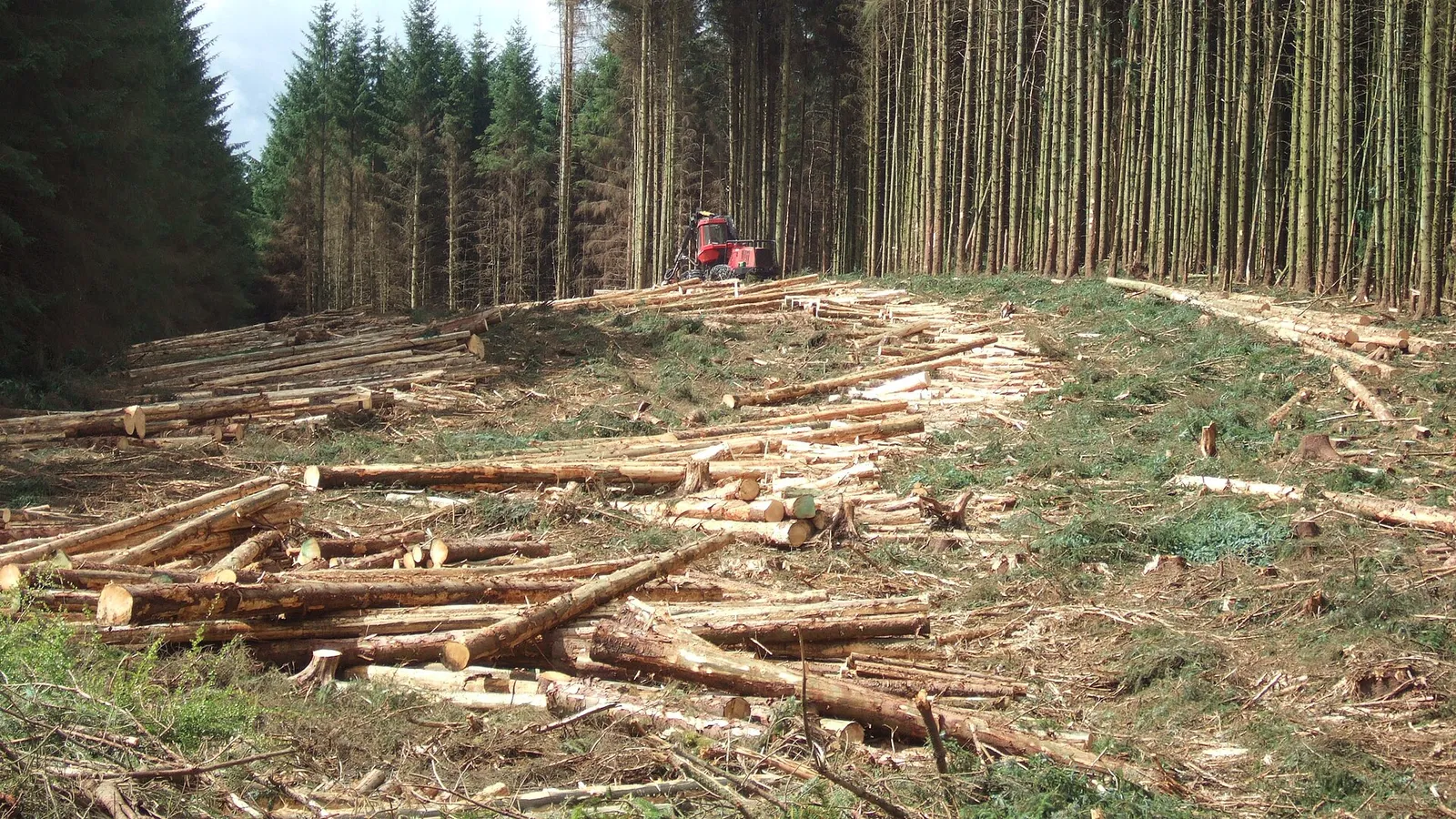
Scotland, with its large tracts of marginal upland ground unsuited to arable farming but suitable for conifers, became the Commission's single biggest canvas. From the 1920s onward, the Commission bought up extensive areas of hill ground — often land of low agricultural value — across the Southern Uplands, Galloway, Argyll, and parts of the Highlands, and began large-scale planting programmes. The species choice was pragmatic rather than romantic: Sitka spruce, native to the Pacific coast of North America, proved extraordinarily well suited to Scotland's cool, wet, acidic uplands, tolerating poor soils and growing faster than almost any native alternative. Alongside it came Norway spruce, lodgepole pine, and some larch, with native Scots pine used more selectively.
The scale eventually achieved was substantial. Galloway Forest Park, once one of the largest planted forests in the UK, exemplifies the model: tens of thousands of hectares of close-ranked conifer stands, laid out for efficient felling and replanting cycles rather than amenity or biodiversity. Post-WWII planting accelerated the programme further, as the war had again demonstrated the strategic value of a domestic timber reserve, and the 1950s through 1980s saw the most intensive afforestation in Scottish history. A notorious chapter came in the 1980s, when tax relief schemes made forestry investment attractive to wealthy individuals seeking to shelter income — leading to large private plantations, including controversial schemes in the Flow Country of Caithness and Sutherland, until the 1988 Budget withdrew the relief and effectively ended that particular boom.
Decline, transformation, and the monoculture debate
Unlike coal, steel or shipbuilding, forestry in Scotland did not suffer a dramatic industrial collapse — it has instead undergone a steady transformation in both scale and purpose. Commercial timber production has continued and grown; Scotland now accounts for the clear majority of UK-grown softwood, feeding sawmills, construction, fencing, pallet and (increasingly) biomass and engineered-timber markets. Major processors such as BSW Timber and James Jones & Sons, along with forest management contractors like Tilhill, sit at the centre of a sector the industry body Confor values at well over £1 billion a year to the Scottish economy.
What has changed is the policy conversation around how that timber is grown. The large, even-aged blocks of Sitka spruce that defined twentieth-century planting have drawn sustained criticism from ecologists and conservation organisations. Reporting by outlets such as The Ferret has highlighted concerns that dense Sitka spruce plantations can acidify watercourses, damage sensitive peatland (a major carbon store in its own right when left undrained), and support markedly less biodiversity than native broadleaf or mixed woodland. Defenders of commercial forestry counter that well-managed plantations still sequester significant carbon, support rural employment in areas with few other options, and that modern UK Forestry Standard practice has moved away from the stark monoculture blocks of the mid-twentieth century toward more varied, better-designed planting. This is a genuinely live and unresolved debate rather than a matter either side has settled.
Present-day legacy
Devolution reorganised the institutional landscape in 2019, the Commission's own centenary, splitting its Scottish functions into Forestry and Land Scotland (which manages the national forest estate) and Scottish Forestry (which sets policy and issues felling licences). The Scottish Government has set ambitious targets to expand forest cover — aiming for roughly 21% of Scotland's land area under trees by mid-century, up from around 19% today — with a stated policy emphasis on diversifying species mix and expanding native woodland restoration (including high-profile efforts around the Cairngorms Connect project to extend remnant Caledonian pinewood) alongside continued commercial conifer production. The industry today employs tens of thousands of people across growing, harvesting, haulage, and processing, and Scottish timber remains central to UK construction and panel-board supply chains — a quiet, large-scale industrial success story built, almost accidentally, on the back of a wartime supply crisis.
Woodland history: a longer view
Environmental historian T. C. Smout stresses that Scotland's deforestation was mostly ancient. It began as early as the Neolithic, was partly climatic, and was substantially complete before 1500; by 1750 less than a tenth of the country was woodland. The timber industries of the eighteenth and nineteenth centuries therefore worked on what was left, and Smout argues that several of them helped conserve it. The iron-masters of Argyll took care of the oak woods that fuelled their furnaces, and those who cut oak for tanbark from Dunbartonshire to Perthshire, or worked the Scots pine forests of Strathspey and Deeside, "contributed to their long-run conservation by taking good care of a profitable resource".
Larch, the Dukes of Atholl and HMS Atholl
The dukes of Atholl made larch a family cause. The second duke planted two larches from Alpine seed near Blair Castle in 1737. The third duke planted 410 acres in 1764–74. The fourth duke, John Murray, planted on a vastly larger scale, putting in 279,000 seedlings between 1774 and 1783. After 1815 he added 6,500 Scots acres of mountain ground under larch alone, hoping it would one day supply the Royal Navy. The economist James Anderson had argued as early as 1771 that larch could replace oak as ship timber, and a 1792 naval inquiry agreed it was the most promising upland substitute.
The Admiralty was slow to be persuaded. Henry Dundas favoured Indian and Burmese teak. Not until 1816 did it order a ship of Atholl larch: the 28-gun sixth-rate frigate Atholl, built at Woolwich from 772 trees felled at Dunkeld and Blair and launched in 1820. A fir-built twin, the Niemen, was built alongside for comparison. The Niemen was condemned by 1827, while surveyors in 1832 judged the Atholl fit for at least seven more years, and she was not paid off until 1861. Even so, the navy never changed its timber policy. Fredrik Albritton Jonsson reads the larch scheme as an attempt at national timber self-sufficiency that cheap Canadian imports overtook after the Napoleonic Wars.
Did You Know?
- HMS Atholl, a 28-gun frigate launched in 1820, was built from 772 Perthshire larches grown by the Dukes of Atholl. She outlasted her fir-built twin by decades and was not paid off until 1861 (Jonsson, 2013).
- The Forestry Commission's founding was driven less by environmentalism than by military logistics: Britain needed pit-props and trench timber, and ran dangerously short during WWI.
- Scotland's dominant commercial tree, Sitka spruce, is not native to Europe at all — it comes from the Pacific coast of North America, from Alaska down to California.
- At the point the Commission was founded, Scotland's woodland cover (around 4–5%) was comparable to some of the least-wooded countries in Europe, despite the popular image of Scotland as a forested land.
- The 1980s tax-relief forestry boom became notorious when plantations were established on parts of the Flow Country, one of the world's largest areas of blanket peat bog, drawing fierce conservation opposition before the tax incentive was withdrawn in 1988.
- Scotland now grows roughly three-quarters of all timber harvested in the UK despite having a much smaller land area than England.
- Sitka spruce can be ready for first commercial thinning in as little as 15–20 years and full harvest around 35–45 years, vastly faster than most native hardwoods, which is the core economic reason it was chosen.
- Galloway Forest Park, one of the largest forests created by the Commission, is also now a designated Dark Sky Park, a second life its original military-economic planners never anticipated.
- The 2019 centenary of the Forestry Commission coincided with its structural abolition in Scotland, as its functions were devolved and split into two new bodies — an irony of institutional history.
FAQ
1Why was the Forestry Commission created?
To build a strategic reserve of home-grown timber after Britain's WWI experience of nearly running out of domestic woodland and being exposed to import disruption.
2Is Scotland's forest mostly native woodland?
No. The large majority of Scotland's forested land is commercial conifer plantation, chiefly non-native Sitka spruce, planted from the 1920s onward.
3What percentage of Scotland is forested today?
Around 19% of Scotland's land area, roughly double the figure from a century ago, and considerably higher than the UK average.
4Why is Sitka spruce so widely planted?
It tolerates Scotland's cool, wet, acidic upland soils better than most alternatives and grows much faster than native species, making it commercially efficient.
5Is Sitka spruce plantation bad for the environment?
This is genuinely disputed. Critics point to biodiversity loss, watercourse acidification, and peatland damage; supporters point to carbon sequestration and rural jobs. Both are active, contested positions, not settled conclusions.
6What happened to the "Great Wood of Caledon"?
It was never a single unbroken forest in the historic period; by 1900 Scotland's native woodland had been reduced by centuries of grazing and clearance to a small fraction of the land area, well before the Commission's plantations arrived.
7Who manages Scotland's forests today?
Forestry and Land Scotland manages the national forest estate, while Scottish Forestry handles regulation and policy, following a 2019 restructuring of the former Forestry Commission Scotland.
8Did the 1980s forestry tax schemes damage the environment?
Some did, most controversially plantations on part of the Flow Country peatlands in Caithness and Sutherland, which led to conservation campaigns and the eventual withdrawal of the tax relief in 1988.
9How big is the forestry sector to the Scottish economy?
Industry figures put the sector's contribution at over £1 billion a year, supporting tens of thousands of jobs in growing, harvesting, haulage and processing.
10Is forest cover increasing in Scotland today?
Yes — the Scottish Government has set targets to plant thousands of hectares annually, aiming to substantially increase cover by mid-century, with a growing share going to native and mixed woodland.
11Is any of Scotland's forest genuinely ancient?
Yes — fragments of native Caledonian pinewood survive, particularly around the Cairngorms, and are the focus of restoration projects like Cairngorms Connect, but they are a small remnant compared to the commercial plantation estate.
12Does Scotland export timber?
Scotland is primarily a net domestic supplier to the UK construction and processing market rather than a major timber exporter, though some processed wood products are exported.
Sources and Further Reading
Primary/Institutional
- Forestry and Land Scotland — official heritage pages on the founding of forestry in Scotland (forestryandland.gov.scot)
- Scottish Forestry / Forest Research statistics publications on woodland cover and timber production
Scholarly/Critical
- Fredrik Albritton Jonsson, Enlightenment's Frontier: The Scottish Highlands and the Origins of Environmentalism (Yale University Press, 2013)
- T. C. Smout, "Land and Sea: The Environment", in T. M. Devine and Jenny Wormald (eds), The Oxford Handbook of Modern Scottish History (Oxford University Press, 2012)
- University of Stirling research repository on forestry history (dspace.stir.ac.uk)
- The Ferret — investigative reporting on Sitka spruce ecological impact ("'Invasive' Sitka spruce threaten Scottish species and habitats, say experts")
General
- Wikipedia — "Forestry in Scotland" and "Forestry Commission"
- The Scotsman — coverage of forestry subsidy and native woodland policy debates
- Ian Hustwick, Moray Firth Ships and Trade during the Nineteenth Century (Aberdeen: Scottish Cultural Press, 1994), drawing on Customs registers, Lloyd's surveys and the Old and New Statistical Accounts
Caveats: Myths and Disputed Claims
- Do not state that Scotland was "always" a heavily forested land through to modern times — this conflates distant prehistoric pollen-record evidence with the historic period, during which Scotland was one of Europe's least wooded countries.
- Do not present Sitka spruce monoculture as either an unambiguous environmental good or an unambiguous disaster — correct phrasing acknowledges it as a contested policy question with evidence on multiple sides.
- Do not describe the Forestry Commission's founding as primarily environmental or recreational in intent — correct phrasing is that it was a strategic/military-economic response to wartime timber shortage; amenity and biodiversity goals were added much later.
- Avoid implying all of Scotland's current forest is ancient or "natural" — correct phrasing distinguishes small native remnants (e.g., Caledonian pinewood fragments) from the dominant commercial plantation estate.
Card 041 · Industry