
Papermaking
Contents
Legend/Myth Opener
The River North Esk, running from the Pentland Hills through Penicuik to the sea near Musselburgh, is a modest watercourse by any standard — yet for well over a century it powered one of the densest concentrations of paper mills in Britain. It is tempting to imagine Scottish papermaking as a quaint cottage trade; in fact, by the Victorian era the Esk valley alone was an industrial papermaking corridor supplying stationery and fine paper across the British Empire, and Scotland's paper industry employed thousands at its height. Almost none of that mill infrastructure survives in production today.
TL;DR
- established Scotland's papermaking industry was heavily concentrated along the River North and South Esk near Edinburgh (Penicuik, Valleyfield, Esk Mills, Musselburgh) and around Aberdeen, exploiting fast-flowing water for power and process, a geography confirmed by industrial gazetteers and company records such as Grace's Guide.
- established Alexander Cowan and Sons, based at Penicuik's Valleyfield and Bank Mills, became one of the largest and most technologically advanced papermaking firms in 19th-century Britain, a fact documented in company and Wikipedia histories drawing on contemporary business records.
- established Scotland's paper industry underwent severe, sustained contraction from the late 20th century into the 2010s–2020s, with repeated mill closures (including Caldwells, Guardbridge, and the 2023 closure of Smith Anderson in Leslie, Fife) driven by energy costs, pension liabilities, and global competition — a pattern documented in trade press (PrintWeek, IndustriALL) and receivership filings.
- disputed The precise causal weighting between high UK energy costs, pension-scheme deficits, and overseas competition in particular closures (e.g. Smith Anderson) is debated by unions, management, and commentators, and this article treats specific attributions of blame as contested rather than settled.
- traditional Penicuik's self-image as "the Paper Town" is a strong local and traditional identity, reflecting a real multi-generational employment base in the mills, even though almost none of that papermaking capacity remains active today.
Key Facts
- Category
- Detail
- Peak Era
- Mid-19th century to mid-20th century
- Key Locations
- Penicuik and the Esk valley (Valleyfield, Bank Mill, Esk Mills), Musselburgh/Inveresk, Aberdeen (River Don mills), Guardbridge (Fife), Leslie (Fife)
- Key Companies/Figures
- Alexander Cowan and Sons; Inveresk Paper Company; Smith Anderson (Leslie); Guardbridge Paper Company; Donside/Aberdeen paper mills
- Status Today
- Industry has contracted drastically — most historic mills closed; a small number of specialist/packaging paper operations remain
- SI Score
- 49/60
- Peak Employment
- Thousands employed across the Esk valley and Aberdeen mills at the industry's Victorian–early 20th century height
Scottish Impact Index (SI Score)
- Economic Impact
- 8/10
- Industrial Longevity
- 9/10
- Material Contribution
- 9/10
- Industrial Distinctiveness
- 8/10
- Industrial Legacy
- 8/10
- Recognition
- 7/10
49/60
Ranked =40th of 50 in Industry
A Note on Claims and Evidence
The documented record for Scottish papermaking is strong where it concerns company histories, mill locations, and the broad chronology of expansion and closure — these are drawn from business archives, trade directories, and local industrial history societies (such as the Esk Valley Trust) and are not seriously contested. Where this article is more cautious is in attributing specific closures to a single cause: trade unions, former management, and energy-policy commentators have offered differing emphases on whether high UK industrial energy prices, legacy pension-scheme costs, or Asian/European competition weighed heaviest in any particular mill's closure, and these attributions are treated here as disputed positions rather than settled fact. The strong local identity of "the Paper Town" around Penicuik is a genuine and well-attested traditional community memory, grounded in real multi-generational employment, even though it should not be mistaken for an ongoing industrial reality.
Timeline
Scotland's first paper mill is established at Dalry, near Edinburgh. Growth is slow: there are only about a dozen mills by the start of the eighteenth century, and most book paper is imported from France and the Netherlands.
The Edinburgh Society for Encouraging Arts, Sciences, Manufactures and Agriculture offers a premium for collecting rags in Scotland, starting an organised home rag trade.
Mills established along the North Esk at Penicuik and nearby, taking advantage of clean, fast water essential to the pulping and sizing process.
Alexander Cowan establishes papermaking operations that would grow into Alexander Cowan and Sons, eventually one of the most important firms in British papermaking.
William Simpson is using chlorine bleaching at his mill at Polton; in 1794 eight Scottish papermakers oppose a patent on the process because they already use it.
Scotland has thirty-two paper mills, concentrated around Edinburgh, Perth, Berwick, Glasgow and Aberdeen.
The first licence for a Fourdrinier paper machine in Scotland is signed; the machine is certainly making paper by 1811.
Robert Cameron's own papermaking machine, his "wooden man", is probably in use at Springfield Mill.
George and William Bertram, trained under John Hall of Dartford, open the St Catherine's Works at Sciennes in Edinburgh to build papermaking machinery.
Of 57 Scottish mills, 16 make printing paper, and 14 of those already have Fourdrinier machines.
Sixteen of Scotland's roughly sixty mills stand on the Water of Leith in Edinburgh.
William McMurray founds the wire works at Granton that become United Wire Works, making the woven wire on which machine paper is formed.
The Bleach and Dye Works Act at last extends textile-industry rules on hours and conditions to paper mills.
Imported esparto grass becomes the principal raw material for British paper.
Steam power is in use in all the larger Scottish mills.
Esk valley mills (Valleyfield, Bank Mill, Esk Mills) expand enormously, driven by rising demand for printing, writing, and packaging paper during the Victorian industrial and publishing boom; Aberdeen's River Don mills develop as a second major Scottish papermaking cluster.
Ever wider and faster continuous machines raise output further; Scottish mills supply stationery, books, and packaging paper across the British Empire.
Industry consolidation; firms such as Inveresk Paper Company group multiple mills under single ownership; the Esk valley and Aberdeen remain the dominant centres.
Global competition, changing print technology, and rising costs begin a long contraction; several historic mills close or are absorbed into larger groups (e.g. International Paper ownership of some Scottish sites).
Wiggins Teape builds a pulp and paper mill at Corpach near Fort William; pulp production ends in 1981.
Continued closures — Guardbridge paper mill in Fife closes in 2008 after over a century of production; further mill closures reduce the active Scottish papermaking footprint sharply.
Smith Anderson paper mill in Leslie, Fife, closes, with reporting citing a combination of energy costs and pension-scheme pressures, among the most recent major closures in the sector.
Scotland's active papermaking capacity is reduced to a small number of specialist and packaging-paper operations; most historic mill buildings have been demolished, converted, or stand derelict.
Details
Origins: water, pulp, and the Esk valley advantage
Papermaking is an old craft reinvented as heavy industry, and in Scotland its industrial version took root wherever reliable, clean, fast-flowing water was available in quantity — essential both as a power source for pulping machinery and as a processing input for the paper stock itself. The River North Esk, descending from the Pentland Hills through Penicuik before joining the South Esk and reaching the Firth of Forth near Musselburgh, offered exactly this combination within easy reach of Edinburgh's growing market for printed and written paper. By the eighteenth century, mills were established along this short stretch of river, and the valley's advantages — power, water quality, and proximity to a major urban market — allowed an unusually dense cluster of paper mills to develop in a relatively small geographic area.
The pivotal figure in the valley's industrial rise was Alexander Cowan, whose family firm, Alexander Cowan and Sons, grew from modest beginnings in the late eighteenth century into one of the most significant papermaking enterprises in Britain. Operating from Valleyfield and Bank Mill in Penicuik, the Cowan firm became known for both the scale and the quality of its output, and for adopting new continuous-papermaking machinery as it became available through the nineteenth century — moving the trade decisively from a craft process to an industrial one. Aberdeen developed in parallel as a second significant Scottish papermaking centre, drawing on the power of the River Don to support its own cluster of mills.
The machine age, 1800–1880
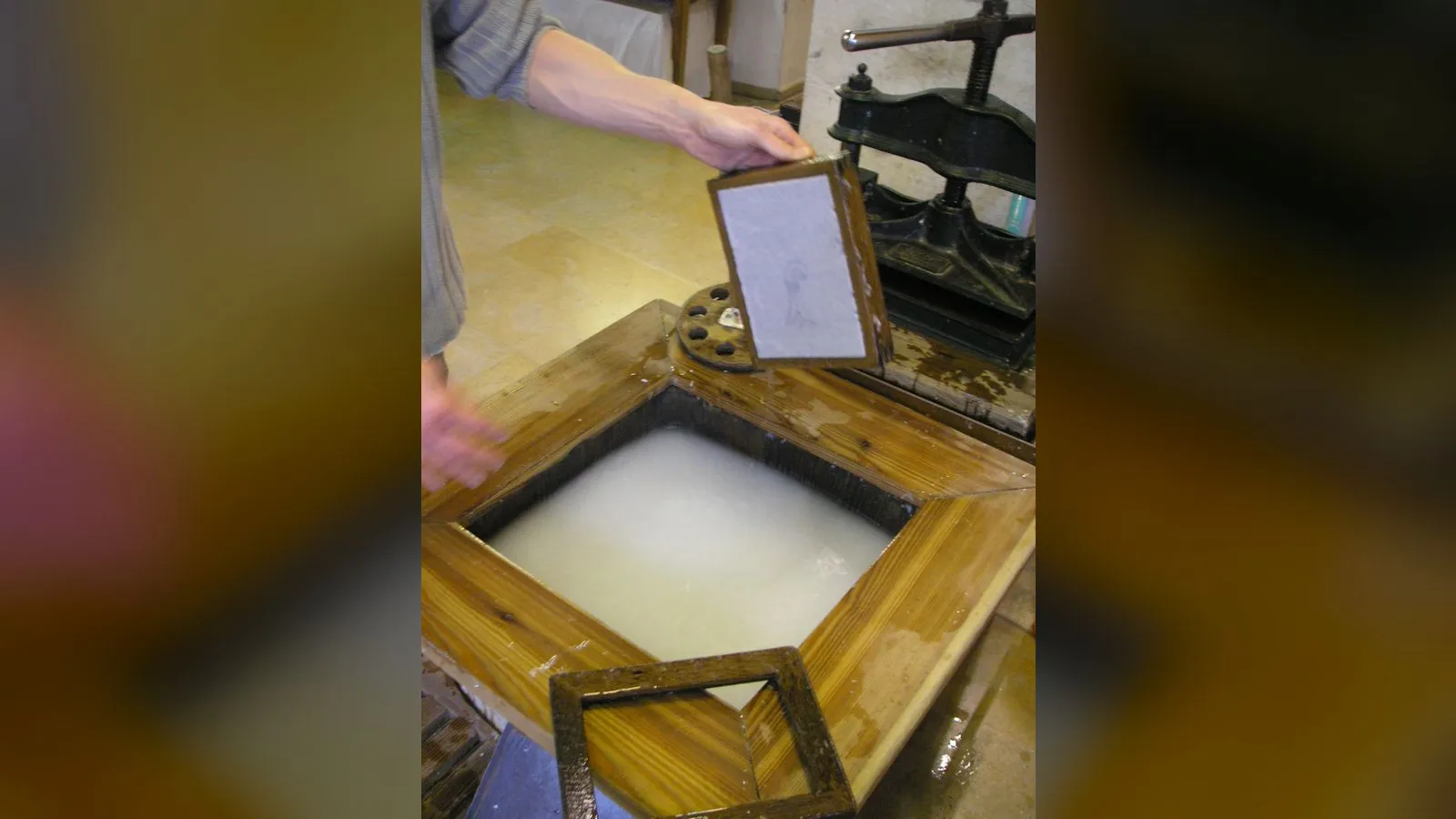
established The most detailed modern account of the industry's transformation is John Morris's chapter on papermaking in The Edinburgh History of the Book in Scotland, Volume 3 (2007). In 1800 Scottish paper was still made by hand. Rags were sorted, often by women and children, on wire-topped tables fitted with a scythe blade, then beaten to pulp in a "hollander". A skilled vatman dipped a mould into the vat to form each sheet, and his partner, the coucher, turned it out onto a felt. In the early 1840s the mill at Carron Grove in Berwickshire was making paper almost entirely from old tarred rope, at a ton a day.
established Scottish mills were quick with chemistry. Chlorine bleaching, discovered in Sweden in 1774, was in use at William Simpson's mill at Polton by 1791. When William Cunningham sought a Scottish patent for it in 1794, eight papermakers objected that they were already using it. Simpson also passed the method to Joshua Gilpin, the first American manufacturer to use chlorine.
established The machine that changed everything was the Fourdrinier, invented in France by Nicholas-Louis Robert in 1799 and developed in England. The first licence for one in Scotland was signed in 1807, and it was certainly making paper by 1811. Because it made paper in continuous rolls, it could feed the new rotary printing presses, so the mills making printing paper adopted it first. By 1832, fourteen of the sixteen Scottish mills making printing paper had Fourdrinier machines. In 1836 Auchtermuchty mill reported that its vats were "now all thrown aside". A Scottish rival, Robert Cameron's "wooden man", which carried ordinary moulds round a track, was probably in use at Springfield Mill in 1816 but was taken up by only two other mills. Its one original feature, steam-heated drying rollers, later became standard on Fourdrinier machines.
established Scotland also built the machines. George and William Bertram, sons of the Springfield papermaker, were apprenticed to John Hall of Dartford, who had helped develop the Fourdrinier. In 1821 they opened the St Catherine's Works at Sciennes in Edinburgh to make papermaking machinery, and by the 1860s they were selling machines throughout Scotland, to at least a dozen English mills, and to the United States and Russia. The weakest part of a paper machine was its endless web of woven wire, which normally lasted about three weeks, so specialist wire-workers grew up too. One of them, William McMurray, founded the works at Granton around 1837 that became United Wire Works.
established Raw material was a constant worry. Rags grew dearer and were still imported in quantity. Wood pulp made from sawdust appeared around 1850, but the paper discoloured and grew brittle; it was used for newspapers but was poor for books. The problem eased only around 1863, when imported esparto grass became the main raw material for British paper. Steam replaced water power slowly: in 1843 six Scottish mills had steam, and all still took more than half their power from water. By 1880 every large mill used steam.
established The industry grew fast. By the 1840s the Prestonholm mill near Edinburgh reportedly employed more than 200 people. In the 1830s sixteen of Scotland's roughly sixty mills stood on the Water of Leith, and mills such as St Leonard's in Edinburgh and Balbirnie in Fife made much of their paper for London.
Work and unions in the paper mills
established The machine was aimed at the skilled men. Robert said he built it because of constant trouble with the hand papermakers' guild, and the Fourdrinier brothers' prospectus promised relief from "perpetual combinations for the increase of wages". At Springfield in 1821 a "continual source of annoyance" was the striking of vatmen. In 1841 the minister of Denny wrote that the new machinery at Herbertshire mill had "put an end to combinations of paper workers".
established Unskilled work fell to women and children. One Berwickshire mill took workers as young as eight, and in the 1840s an Edinburgh minister complained that mills still employed children of ten. Only the Bleach and Dye Works Act of 1860 brought paper mills under the factory rules already applied to textiles. Skilled papermakers joined "box societies", mutual-benefit clubs whose cash box had three locks with keys held by different officers, such as the Bridge of Allan Union Box Society founded in 1806. The trade's own society issued a "Card of Freedom" to men who had served seven years under one master; it cost £10, about a year's wages. Workers in the machine mills formed the United Brotherhood of Papermakers in 1854.
Peak scale: an industrial corridor and an imperial export trade
By the Victorian era, the Esk valley mills were producing paper at genuinely industrial scale, supplying not just the local Edinburgh market but, through Britain's expanding print and publishing trade and its empire-wide commercial networks, a much wider market for stationery, printing paper, and packaging. Penicuik's identity became fused with the trade to the point that the town is still referred to locally and in heritage materials as "the Paper Town," a reflection of how thoroughly papermaking dominated local employment across multiple generations. At its height, the Esk valley mills, together with the Aberdeen Don-side mills, employed thousands of workers directly, alongside a supporting economy of haulage, engineering, and raw-material supply (principally rags and, later, wood pulp) that fed the mills.
The period also saw significant technical investment: continuous Fourdrinier-style paper machines replaced slower batch methods, vastly increasing output per mill and per worker, while firms experimented with new fibre sources as rag supply became a constraint relative to rising demand. Consolidation followed naturally from this capital intensity — multiple historic mills in the valley came under common ownership through vehicles such as the Inveresk Paper Company, reflecting a broader British trend toward larger, more capital-intensive papermaking groups through the early to mid-twentieth century.
Decline: energy, pensions, and global competition
The long decline of Scottish papermaking did not happen in a single dramatic collapse, as befell some other heavy industries, but through a protracted, decades-long contraction. Changing print technology reduced some categories of paper demand over time; more significantly, global competition from lower-cost pulp and paper producers (particularly in Scandinavia, continental Europe, and later Asia) steadily eroded the competitiveness of smaller, older British mills that could not match the scale economics of newer continuous-process plants built closer to abundant, cheap pulpwood supply.
Specific closures through the 2000s, 2010s, and into the 2020s illustrate the pattern starkly. Guardbridge paper mill in Fife, with over a century of production behind it, closed in 2008. Smith Anderson's paper mill in Leslie, Fife, closed in 2023, with trade union and industry reporting (including coverage by IndustriALL) pointing to a combination of high UK industrial energy prices and the burden of legacy defined-benefit pension scheme obligations as key pressures, alongside broader competitive difficulties — though the precise weighting of these factors remains a matter of debate among the parties involved rather than a settled, single-cause account. Across the sector, repeated rounds of job losses — often running into the hundreds at individual sites — reduced Scotland's active papermaking workforce to a small fraction of its historic peak.
Present-day legacy
Today, very little of Scotland's historic papermaking capacity remains in production. Most of the great Esk valley mill buildings have been demolished, repurposed, or left derelict, and Penicuik's economy has long since diversified away from paper as its organising industry, even as the "Paper Town" identity persists in local heritage interpretation, place names, and community memory — actively kept alive by groups such as the Esk Valley Trust. A small number of specialist paper and packaging operations persist in Scotland, generally focused on niche or high-value product lines rather than the mass commodity paper that once defined the Esk valley and Aberdeen clusters. The industry's decline stands as a case study in how a historically dominant regional employer can be eroded gradually by a combination of global competitive pressure, energy costs, and the accumulated liabilities of an earlier industrial era, rather than by any single dramatic event.
Corpach
One of the government's Highland "growth points" was a pulp and paper mill. G. C. Peden's survey in the Oxford Handbook of Modern Scottish History (2012) records that Wiggins Teape built a wood-pulp and paper mill at Corpach near Fort William in 1963–65, to provide a market for Highland forestry. The pulping process chosen proved unsuited to the paper most in demand. The decision to close the pulp mill was taken in 1979 and production ceased in 1981.
Polluted Rivers
Papermaking was one of the worst polluters of nineteenth-century Scotland. Stana Nenadic, in the Oxford Handbook of Modern Scottish History (2012), notes that waste chemicals and refuse from paper mills in rural eastern Scotland killed fish in the rivers. Legal actions by local landowners against the paper-makers on the River Esk forced them to introduce waste recycling, and by the 1870s court cases, Acts of Parliament and newspaper campaigns against river pollution were frequent.
Did You Know?
- Penicuik is still known locally as "the Paper Town," a nickname reflecting over two centuries of papermaking identity, even though active production in the town has effectively ended.
- The Cowan family's Penicuik mills were early and enthusiastic adopters of continuous papermaking machinery, helping move the Scottish trade from craft to heavy industry through the nineteenth century.
- Aberdeen had its own substantial papermaking cluster powered by the River Don, making it, alongside the Esk valley, one of Scotland's two principal papermaking regions.
- Early papermaking depended on rags as the primary fibre source. Before wood pulp took over, imported esparto grass became the main raw material for British paper from about 1863.
- In the early 1840s a Berwickshire mill at Carron Grove made its paper almost entirely from old tarred rope, using a ton a day.
- The woven wire on which a paper machine formed its sheet normally wore out in about three weeks.
- Guardbridge paper mill in Fife operated for more than a hundred years before closing in 2008, a span illustrating just how long-lived some Scottish paper mills were before the final wave of closures.
- The 2023 closure of the Smith Anderson mill in Leslie, Fife, was linked by union reporting to the combined pressure of energy costs and historic pension-scheme liabilities — a pattern echoed across other UK manufacturing closures of the same period.
- Several historic Scottish paper mill sites have been redeveloped for housing or other uses, physically erasing much of the built evidence of the industry's former scale.
- Despite the industry's decline, Scotland still retains a small number of active specialist paper and packaging producers, meaning the trade has not vanished entirely, only contracted severely from its historic footprint.
FAQ
1Where was Scotland's papermaking industry concentrated?
Principally in the Esk valley near Edinburgh (Penicuik, Valleyfield, Musselburgh/Inveresk) and around Aberdeen on the River Don.
2Why were these locations chosen?
Fast-flowing, clean river water was essential both as a power source for pulping machinery and as a processing input for paper stock.
3Who was Alexander Cowan?
The founder of Alexander Cowan and Sons, a Penicuik-based firm that grew into one of the most significant papermaking businesses in nineteenth-century Britain.
4Is papermaking still an active industry in Scotland?
Only on a much reduced scale — most historic mills have closed, though a small number of specialist paper and packaging operations remain.
5What caused the decline of Scottish papermaking?
A combination of global competition, changing print-paper demand, high UK industrial energy costs, and legacy pension-scheme liabilities; the precise weighting of these factors varies by case and is debated.
6When did Guardbridge paper mill close?
In 2008, after more than a century of production.
7What happened at Smith Anderson's Leslie mill?
It closed in 2023, with reporting citing energy costs and pension-scheme pressures as contributing factors.
8Why is Penicuik called "the Paper Town"?
Because papermaking dominated the town's employment and identity for well over a century, a legacy still commemorated locally even though production has ended.
9What raw materials did Scottish paper mills use?
Historically rags and, for coarse paper, old rope. Early wood pulp from sawdust, available from about 1850, made poor book paper, so from about 1863 imported esparto grass became the main raw material before wood pulp eventually took over.
10When did paper machines arrive in Scotland?
The first Fourdrinier licence in Scotland was signed in 1807, and by 1832 fourteen of the sixteen mills making printing paper had the machines.
11Did Scottish paper mills export their product?
Yes — through Britain's print, publishing, and imperial trade networks, Scottish-made paper reached markets well beyond Scotland.
12Are any historic Scottish paper mill buildings still standing?
Some survive in altered or converted form; many others have been demolished or redeveloped, particularly for housing.
13Is Aberdeen's papermaking history as well known as Penicuik's?
It is less prominently branded than Penicuik's "Paper Town" identity but was historically just as significant to the industry's overall footprint in Scotland.
Sources and Further Reading
Primary/Institutional
- Grace's Guide to British Industrial History — entries on Alexander Cowan and Sons and the Inveresk Paper Co
- Esk Valley Trust — local heritage history of Penicuik and the Esk valley mills
Scholarly/Critical
- Stana Nenadic, "Industrialization and the Scottish People", in T. M. Devine and Jenny Wormald (eds), The Oxford Handbook of Modern Scottish History (Oxford University Press, 2012)
- G. C. Peden, "A New Scotland? The Economy", in T. M. Devine and Jenny Wormald (eds), The Oxford Handbook of Modern Scottish History (Oxford University Press, 2012)
- John Morris, "Papermaking", in Bill Bell (ed.), The Edinburgh History of the Book in Scotland, Volume 3: Ambition and Industry 1800–1880 (Edinburgh University Press, 2007)
- Queen Margaret University eResearch repository — academic work touching on Scottish paper industry history
- IndustriALL Global Union — reporting on the closure of the Smith Anderson paper mill and its stated causes
General
- Wikipedia — "Alexander Cowan" and "Paper mills of Aberdeen"
- PrintWeek — trade press coverage of UK/Scottish paper mill closures and job losses
Caveats: Myths and Disputed Claims
- Do not state a single definitive cause for recent mill closures (e.g. Smith Anderson, 2023) — correct phrasing attributes closures to a combination of contested factors (energy costs, pension liabilities, competition) as reported by unions and trade press, not a settled single cause.
- Do not imply Scottish papermaking has disappeared entirely — correct phrasing is that it has contracted drastically from its historic peak, with a small number of specialist operations persisting.
- Do not present "the Paper Town" branding as evidence of an ongoing major industry in Penicuik today — it reflects historic identity and heritage memory, not current industrial scale.
- Avoid overstating the antiquity of large-scale Scottish papermaking — the first mill dates from about 1590 and there were only about a dozen by 1700; genuinely industrial scale is an 18th–19th century development.
- Do not say the Fourdrinier machine reached Scotland only in the late nineteenth century; the first Scottish licence dates from 1807.
Card 042 · Industry