
Shale Oil
Contents
Legend/Myth Opener
The global oil industry is popularly dated to the 1859 Pennsylvania drilling boom led by Edwin Drake. In fact, the world's first large-scale mineral-oil industry was already operating in West Lothian by the mid-1850s, extracting and refining oil not from a drilled well but from mined oil-shale rock. Scotland's shale-oil industry predates and, for a period, outproduced the American petroleum industry it is often assumed to have followed.
TL;DR
- established James "Paraffin" Young patented a process for distilling paraffin oil from oil-shale and cannel coal in 1850 and established commercial production at Bathgate in West Lothian, several years before the 1859 Pennsylvania oil boom — this is documented via Young's 1850 patent and company records.
- established The West Lothian shale-oil industry grew into a major regional employer and exporter of paraffin, lubricating oils and related products through the second half of the 19th and early 20th centuries — supported by company and export records.
- traditional The industry is widely described in popular and heritage accounts as "the world's first large-scale mineral-oil industry" — this phrasing is near-universal in Scottish heritage literature and broadly supported, though global priority claims always invite some scholarly caveat about parallel small-scale oil-shale and rock-oil ventures elsewhere, so it is flagged as traditional rather than an absolute, uncontested superlative.
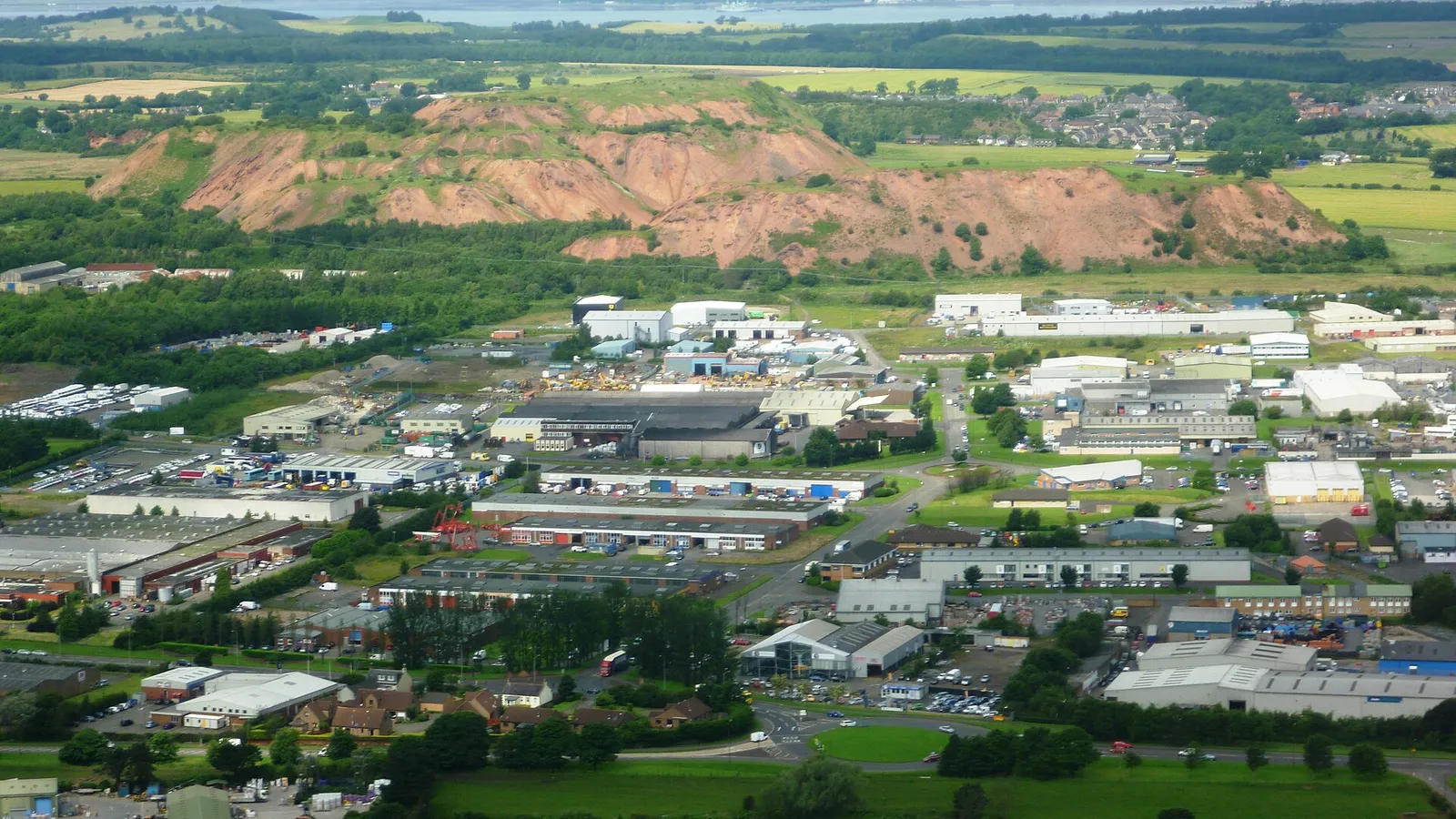
- established The industry's spent-shale waste heaps, known as "bings," are a permanent and distinctive feature of the West Lothian landscape, with some (e.g. the Five Sisters at West Calder) now protected and promoted as heritage/wildlife sites — directly observable and documented by Historic Environment Scotland and conservation bodies.
- established The Scottish shale industry went into long decline from the early 20th century and ceased entirely by the 1960s, unable to compete with cheaper imported crude oil — confirmed by closure dates recorded in industrial histories.
Key Facts
- Peak Era
- c. 1870s–1913 (pre-WWI peak output and employment)
- Key Locations
- West Lothian (Bathgate, Broxburn, Pumpherston, Addiewell, West Calder, Uphall, Philpstoun)
- Key Companies/Figures
- James "Paraffin" Young; Young's Paraffin Light and Mineral Oil Company; Pumpherston Oil Company; Broxburn Oil Company; later Scottish Oils Ltd (part of Anglo-Persian/BP group)
- Status Today
- Declined/closed — last shale oil works (Westwood) closed in 1962; legacy visible in bings and the Almond Valley Heritage Centre
- Peak Employment
- Estimated several thousand workers directly, with many more in associated trades, at the industry's late-19th/early-20th-century height
- SI Score
- 50/60
Scottish Impact Index (SI Score)
- Economic Impact
- 8/10
- Industrial Longevity
- 8/10
- Material Contribution
- 8/10
- Industrial Distinctiveness
- 10/10
- Industrial Legacy
- 9/10
- Recognition
- 7/10
50/60
Ranked #39 of 50 in Industry
A Note on Claims and Evidence
The Scottish shale-oil industry is unusually well documented for a 19th-century extractive industry: James Young's 1850 patent, company formation records, and export/production statistics compiled by bodies such as the Scottish Oils group survive in detail, and are supplemented by the dedicated Scottish Shale Oil Archive and the Museum of the Scottish Shale Oil Industry at Almond Valley. This article treats Young's patent date, the founding and naming of the major companies, and the industry's closure in 1962 as documented fact. The claim that this was "the world's first large-scale mineral-oil industry" is treated as traditional — it is the standard and well-supported framing in Scottish heritage and industrial-history literature, and genuinely distinguishes Scotland's mined, retort-processed shale oil from the drilled rock-oil ventures that followed in Pennsylvania — but because "world's first" superlatives invite inherent scholarly caution about parallel small-scale ventures elsewhere, it is not presented as an unchallengeable absolute.
Timeline
James Young patents a process for distilling paraffin oil from oil-shale and cannel coal; this is the foundational event of the industry.
Young establishes works at Bathgate, West Lothian, among the earliest commercial mineral-oil operations in the world.
Edwin Drake drills the first commercial oil well in Pennsylvania, USA — commonly (and misleadingly, in global terms) treated as "the birth of the oil industry," when Scotland's shale industry was already nine years old.
Industry expands rapidly across West Lothian; numerous shale-oil companies form (Broxburn Oil Company, Pumpherston Oil Company, Addiewell works, and others), exploiting the rich oil-shale seams of the area.
Peak era of production; West Lothian becomes a globally significant source of paraffin, lubricants, and related chemical products; the characteristic red-grey "bings" of spent shale begin accumulating on a large scale.
Competition from cheaper, more easily extracted conventional crude oil (including from the expanding American and Persian/Middle Eastern industries) begins to squeeze profitability.
Scottish Oils Ltd formed, consolidating much of the industry under what later becomes part of the Anglo-Persian Oil Company (a forerunner of BP) group.
Gradual contraction as the industry struggles against cheap imported crude and changing fuel markets; successive works close.
Westwood, the last operating shale-oil works, closes, ending the Scottish shale-oil industry.
Bings increasingly recognised as valuable industrial heritage and, in several cases, important semi-natural habitats; the Almond Valley Heritage Centre develops the Museum of the Scottish Shale Oil Industry; some bings designated for protection.
Details
Origins and Early Development
The Scottish shale-oil industry was the creation of one man's chemistry: James Young, a Glasgow-born chemist who had already worked on extracting oil from coal, patented in 1850 a process for distilling paraffin oil from oil-shale and cannel coal through controlled heating ("retorting"). Young established his first large works at Bathgate in West Lothian in 1851, exploiting the thick seams of bituminous oil-shale that run through the Lothians. Crucially, this predates by nearly a decade the 1859 Pennsylvania drilling that is conventionally — and, from a global perspective, somewhat parochially — treated as the oil industry's starting point. Young's achievement was to industrialise, at scale, the chemistry of extracting liquid fuel from solid rock, years before anyone drilled for oil from the ground.
Young's success quickly attracted competitors and imitators across West Lothian, where the geology was especially favourable. By the 1860s a cluster of shale-oil works had sprung up at Broxburn, Pumpherston, Addiewell, Uphall and West Calder, each mining oil-shale and processing it through retorting plants into paraffin oil, paraffin wax, lubricating oils, and ammonia-based fertiliser by-products. This was a genuinely integrated chemical-industrial complex, not merely an extraction industry — the by-product chemistry (sulphate of ammonia, for instance) was itself economically significant.
Peak Scale and Significance
By the 1870s through to the early 1910s, West Lothian's shale industry was at its height, a nationally and internationally significant source of mineral oil at a time when whale oil, coal gas and (later) American crude oil were competing fuel and lighting sources. The industry directly employed several thousand workers across its mines, retort works and chemical plants, with many more employed in associated transport, engineering and trades — and it fundamentally reshaped the economy and landscape of West Lothian, transforming a largely agricultural county into an industrial one.
The most visible and lasting legacy of this scale is physical: the enormous waste heaps of spent, retorted shale — known locally as "bings" — that the industry generated as an unavoidable by-product. Because each tonne of shale yielded only a modest amount of oil, the volume of spent rock was immense, and the bings that rose across West Lothian (several of which, like the Five Sisters near West Calder, still dominate the local skyline today) are a direct physical record of the industry's scale. They are, in effect, Scotland's equivalent of a mining-waste "mountain range," and unlike coal bings elsewhere, many have proven stable enough over a century to become semi-permanent landscape features rather than being fully reclaimed.
Decline and Transformation
The shale industry's long decline began even before its physical peak had fully passed. Oil-shale processing was never as cost-efficient as pumping liquid crude oil, and as cheaper crude from the United States, and later from Persia (Iran) following the Anglo-Persian Oil Company's development there, entered world markets from the early 20th century onward, Scottish shale oil became progressively less competitive. The 1919 formation of Scottish Oils Ltd — which drew together much of the remaining Scottish shale industry and was itself absorbed into the Anglo-Persian Oil Company group, a direct forerunner of BP — can be read two ways: as rational industrial consolidation to extend the industry's life, or as the mechanism by which the shale works were gradually run down in favour of the group's cheaper overseas crude supplies once that supply became reliable. Both readings have some validity, and this account does not pretend the matter is settled.
Decline was steady rather than catastrophic: individual works closed one by one across the interwar and postwar decades as reserves were exhausted or operations became uneconomic, with the final remaining works at Westwood closing in 1962, bringing the Scottish shale-oil industry to an end after 112 years. Unlike the coal industry's politically charged 1980s closures, the shale industry's end attracted comparatively little national controversy — it had already shrunk to a localised West Lothian concern by the time it finally stopped.
Present-Day Legacy
The bings are the industry's most enduring legacy, and their status has shifted dramatically: once regarded simply as industrial waste and an eyesore, several — including the Five Sisters bing near West Calder — are now recognised as important semi-natural habitats supporting distinctive flora adapted to the alkaline, mineral-rich shale waste, and some have statutory protection or are promoted as heritage and recreational sites along the "Shale Trail." The Museum of the Scottish Shale Oil Industry, based at the Almond Valley Heritage Centre near Livingston, preserves the industry's machinery, archives and social history. West Lothian's identity as "Scotland's first oil county" — a title it holds roughly a century before North Sea oil gave Aberdeen a similar claim — remains a source of local heritage pride, and the industry is increasingly recognised by energy historians internationally as a genuine pioneer of the mineral-oil age, not merely a historical footnote to the American petroleum story.
Did You Know?
- James Young patented his paraffin-from-shale process in 1850 — nine years before the Pennsylvania oil well usually credited as the birth of the modern oil industry.
- The industry's spent-shale waste heaps, the "bings," were so vast that some — like the Five Sisters near West Calder — remain prominent, named landmarks on the landscape over half a century after the industry closed.
- The shale industry's chemical by-products included sulphate of ammonia, used as an agricultural fertiliser, making the works an early example of integrated industrial chemistry, not just fuel extraction.
- Scottish Oils Ltd, formed in 1919 to consolidate the shale industry, was eventually absorbed into the group that became BP — meaning Scotland's pioneering oil industry has a direct corporate lineage into one of today's global oil majors.
- Several shale bings are now valued nature conservation sites, supporting plant species that thrive on the heaps' unusual mineral chemistry.
- The last Scottish shale-oil works, at Westwood, did not close until 1962 — more than a century after the industry began.
- West Lothian is sometimes called "Scotland's first oil county," a title that predates Aberdeen's North Sea oil boom by roughly 100 years.
- Shale oil mining methods in West Lothian were studied and exported, influencing early oil-shale ventures elsewhere in the world.
FAQ
1Who founded Scotland's shale-oil industry?
James "Paraffin" Young, a chemist who patented a process for distilling paraffin oil from oil-shale in 1850 and established works at Bathgate.
2Did Scotland's shale-oil industry really predate the American oil industry?
Yes in the specific sense that commercial mineral-oil production from shale began in West Lothian in 1850–51, before the 1859 Pennsylvania drilled-well boom usually cited as the start of the modern oil industry. Scotland's industry used mining and retorting, not drilling.
3Where was the industry based?
Almost entirely in West Lothian, with major works at Bathgate, Broxburn, Pumpherston, Addiewell, Uphall, West Calder and Philpstoun.
4What are the "bings"?
Large waste heaps of spent oil-shale left over after the oil-bearing material was processed; they remain prominent features of the West Lothian landscape today.
5What products did the industry make?
Mainly paraffin oil (for lighting) and paraffin wax, plus lubricating oils and ammonia-based fertiliser by-products.
6When did the industry end?
The last shale-oil works, at Westwood, closed in 1962.
7Why did the industry decline?
It could not compete economically with cheaper, more easily extracted conventional crude oil once large-scale imports from the USA and the Middle East became reliable.
8Is there a museum dedicated to the industry?
Yes — the Museum of the Scottish Shale Oil Industry, part of the Almond Valley Heritage Centre near Livingston.
9Are the bings protected today?
Several, including the Five Sisters bing, are recognised for their ecological and heritage value and are protected or promoted as visitor sites; not all bings have been preserved, and some have been landscaped or removed.
10Is there a connection between Scottish shale oil and BP?
Yes — Scottish Oils Ltd, formed in 1919 from much of the shale industry, became part of the Anglo-Persian Oil Company group, a direct corporate forerunner of BP.
11Was shale oil extraction similar to modern fracking?
No — the historic Scottish industry involved mining solid oil-shale rock and heating it in retorts to release oil, a fundamentally different process from modern hydraulic fracturing of oil/gas-bearing rock in situ.
12Could Scottish oil-shale be exploited again today?
There is no active commercial interest; the remaining shale reserves are considered uneconomic compared to conventional and renewable energy sources, and extraction would raise significant environmental objections.
Sources and Further Reading
Primary/Institutional
- Historic Environment Scotland — listings and records on shale bings and industrial sites
- Scottish Shale (scottishshale.co.uk) — dedicated industry archive and schools resource
- Museum of the Scottish Shale Oil Industry, Almond Valley Heritage Centre
Scholarly/Critical
- Industrial and economic histories of the Scottish shale-oil trade (university and heritage-body publications)
- University of Edinburgh "Waste Landscapes" research blog on shale bing ecology and heritage
General
- Wikipedia — "James Young (chemist)" / "Paraffin Young"; "Oil shale industry"
- Historic UK — "James 'Paraffin' Young"
- Shale Trail (shaletrail.co.uk) — heritage trail and local history
Caveats: Myths and Disputed Claims
- Do not state as an absolute, unchallengeable fact that Scotland had "the world's first" mineral-oil industry without qualification — this is the standard and well-supported heritage framing, but should be presented as traditional/established-with-nuance rather than a settled global superlative, since small-scale oil-shale or rock-oil ventures existed elsewhere earlier in limited forms.
- Do not confuse historic Scottish shale-oil mining and retorting with modern hydraulic fracturing ("fracking") — they are different extraction technologies applied to different resources, and conflating them is a common but incorrect simplification.
- Do not imply the industry's decline was sudden or dramatic like the 1980s coal closures — it was a slow, decades-long contraction ending quietly in 1962.
- Do not claim all shale bings have been preserved as heritage sites — many have been partially removed, landscaped, or built over; only some (like the Five Sisters) retain their historic form and are actively protected.
Card 002 · Industry