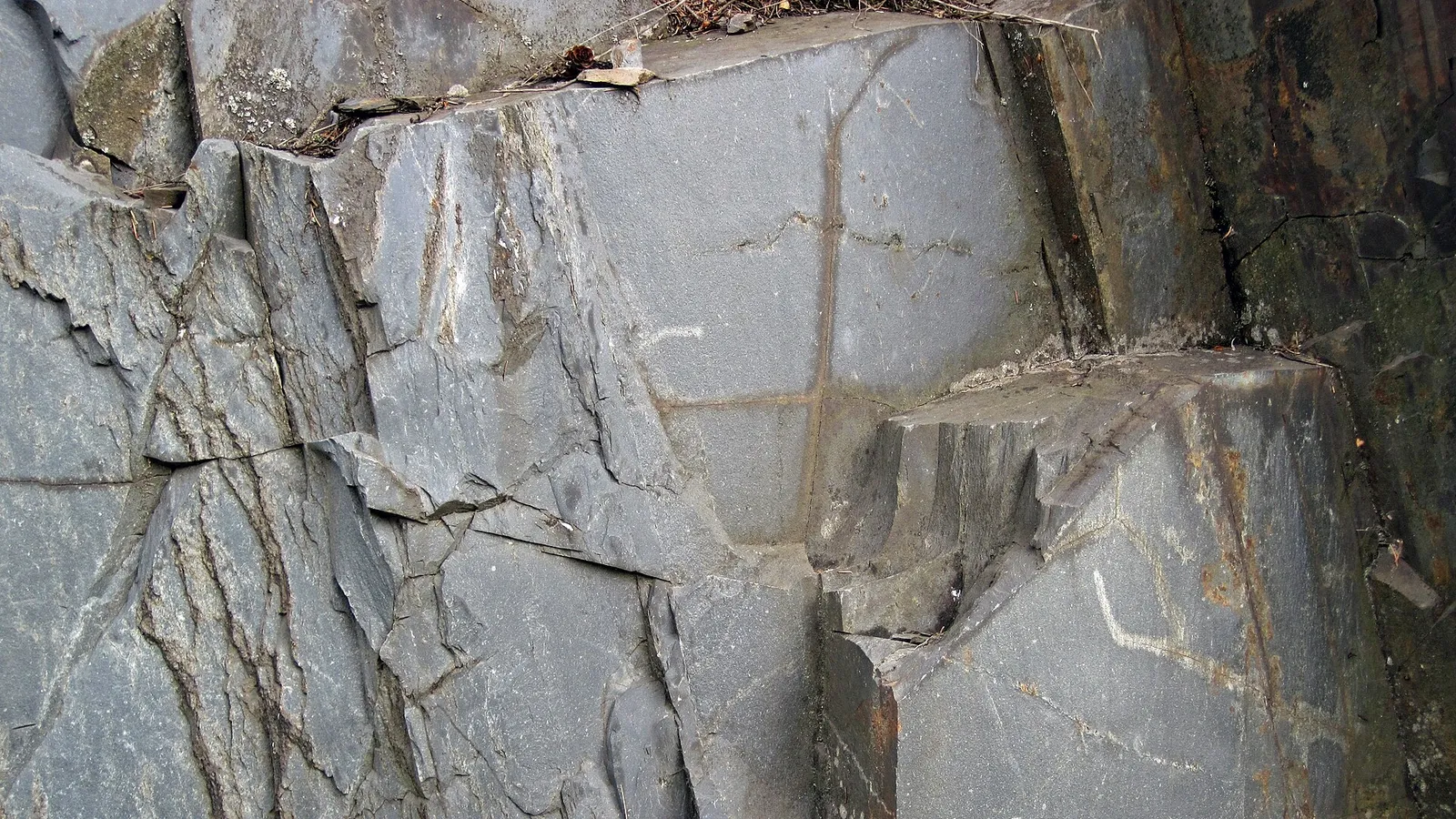

Slate
Contents
Legend/Myth Opener
Easdale and the "Slate Islands" are sometimes presented purely as a quaint historical curiosity — tiny islands that happened to produce roofing stone. The reality is more dramatic: this was once a globally significant export industry, and its sudden near-destruction came not from gradual economic decline alone but from a single catastrophic storm in 1881 that flooded the main Easdale quarries with seawater, permanently ending large-scale extraction there almost overnight.
TL;DR
- established The Slate Islands (Easdale, Seil, Luing and neighbouring islands) and Ballachulish in Lochaber were Scotland's two major historic slate-producing districts, exporting roofing slate across Scotland, the UK, and internationally during the 18th and 19th centuries — confirmed by quarry company and export records.
- established Easdale's main quarries were catastrophically flooded by a severe storm in November 1881, which breached the sea defences separating the deep quarry workings from the Atlantic, permanently ending large-scale extraction there — this is a specific, well-documented historical event, not a gradual decline narrative.
- established The Ballachulish slate quarry, worked from the early 18th century, continued operating into the 20th century before finally closing and flooding in 1955 — confirmed by Highland historic environment records.
- established Both districts relied on a skilled, often dangerous workforce, including notable use of child and very young labour historically, and quarrying communities faced harsh working and housing conditions typical of 18th–19th century extractive industry — documented through social history and heritage sources, stated plainly rather than romanticised.
- traditional Easdale's population collapse and near-abandonment following the quarry closures is often told as a simple, single dramatic story of the 1881 storm; while the storm was the decisive blow, the island's slate industry and population had already been affected by broader 19th-century economic pressures, so the full decline is better understood as storm-plus-structural-decline rather than storm alone, and this nuance is flagged as traditional-but-incomplete in the simplest popular telling.
Key Facts
- Peak Era
- c. 1770s–1860s (Slate Islands); early 18th century–early 20th century (Ballachulish)
- Key Locations
- Easdale, Seil, Luing (the "Slate Islands," Argyll); Ballachulish (Lochaber, near Glencoe)
- Key Companies/Figures
- Various local quarry proprietors and landowning estates (e.g. the Earls of Breadalbane, associated with Easdale); Ballachulish Slate Quarries Company
- Status Today
- Closed/transformed — both districts ceased commercial slate extraction decades ago; sites now heritage, tourism and partially flooded landscape features
- Defining Closure Event
- Easdale flooded by storm, November 1881; Ballachulish quarry closed and flooded, 1955
- SI Score
- 43/60
Scottish Impact Index (SI Score)
- Economic Impact
- 6/10
- Industrial Longevity
- 9/10
- Material Contribution
- 7/10
- Industrial Distinctiveness
- 8/10
- Industrial Legacy
- 7/10
- Recognition
- 6/10
43/60
Ranked #48 of 50 in Industry
A Note on Claims and Evidence
Scotland's historic slate industry is documented through estate and company records, Royal Commission on the Ancient and Historical Monuments of Scotland (Canmore) site surveys, and dedicated heritage institutions including the Easdale Island Folk Museum. This article treats the operating dates of both districts, the 1881 Easdale flooding event, and the 1955 Ballachulish closure as documented fact — these are specific, recorded events with clear dates, not matters of interpretation. Social conditions for quarry workers, including use of child labour in earlier periods, are also treated as documented, consistent with broader, well-established patterns in 18th–19th century British extractive industry. Where this article adds nuance to the standard popular telling is in noting that Easdale's decline, while dramatically triggered by the 1881 storm, should not be oversimplified as the industry's sole cause of trouble — broader market pressures were already a factor — a point flagged as traditional-but-incomplete in the most common retelling.
Timeline
Commercial slate quarrying begins in earnest on Easdale and neighbouring islands, and separately at Ballachulish in Lochaber, exploiting high-quality slate deposits suited to roofing.
Ballachulish quarry (dated from around 1693 by some records, with major commercial development through the 18th century) and the Easdale quarries expand significantly as demand for roofing slate grows with Scottish and British urban expansion.
Peak era: the Slate Islands export slate across Scotland and internationally (including, by some accounts, as far as the Caribbean and North America as ship's ballast and cargo combined), while Ballachulish becomes one of the largest slate quarries in Scotland.
A severe storm breaches sea defences at Easdale, flooding the main quarry workings with seawater; this single catastrophic event effectively ends large-scale commercial slate extraction on Easdale, a defining and sudden turning point rather than a gradual process.
Remaining Slate Islands operations (on Seil and Luing) continue on a reduced scale; Ballachulish continues operating, remaining one of Scotland's few substantial surviving slate quarries.
Competition from other roofing materials (including Welsh slate, and increasingly tiles and other industrial materials) puts sustained pressure on the remaining Scottish slate industry.
The Ballachulish quarry closes and subsequently floods, ending Scotland's last major commercial slate quarrying operation.
Easdale's population, which had collapsed after 1881, stabilises at a small level; heritage preservation (notably the Easdale Island Folk Museum) and tourism, including the annual World Stone Skimming Championships held in a flooded former quarry, become the islands' main economic activities. Ballachulish's former quarry becomes a landscape and heritage feature near Glencoe.
Details
Origins and Early Development
Scotland's two principal historic slate-quarrying districts developed independently but followed broadly similar trajectories. On Easdale and the neighbouring "Slate Islands" of Seil and Luing in Argyll, high-quality slate deposits were worked from at least the early 18th century, with commercial quarrying expanding significantly as demand grew for durable roofing material to serve Scotland's and Britain's expanding towns and cities. Ballachulish, in Lochaber near Glencoe, developed on a similarly early timeline, with slate working dated by some records to the late 17th century and expanding into major commercial production through the 18th century.
Both districts depended on a skilled but physically demanding and dangerous workforce, splitting and dressing slate by hand using methods that had changed relatively little over generations. Working and housing conditions for quarry communities were, by modern standards, harsh, and — consistent with the broader pattern across 18th- and 19th-century British extractive industries — historical records indicate the use of child and very young labour in various quarry-related tasks during earlier periods, a fact this article states plainly rather than omitting in deference to a more romantic image of traditional craft industry.
Peak Scale and Significance
At their respective heights, both districts achieved genuinely significant export reach. The Slate Islands exported roofing slate widely across Scotland and internationally — by some historical accounts, Easdale slate travelled as far as the Caribbean and North America, often carried as ship's ballast on vessels that also carried it as cargo, a reminder of how integrated the slate trade was with Scotland's broader maritime commerce. Ballachulish grew into one of the largest and longest-operating slate quarries in Scotland, its output roofing buildings across a wide area of the country and beyond. Both districts, in their own way, exemplify how a geographically remote, relatively small-scale extractive industry could nonetheless achieve substantial economic and infrastructural reach through Scotland's extensive maritime trading networks.
Decline: A Sudden Blow and a Slow One
The two districts' declines illustrate two genuinely different patterns, and conflating them would misrepresent the history. Easdale's story is one of sudden catastrophe: in November 1881, a severe storm breached the sea defences that had, for over a century, kept the Atlantic out of the island's deep quarry workings, flooding the main pits with seawater in a single dramatic event. This was not a slow market-driven wind-down but an environmental disaster that effectively ended large-scale commercial extraction on Easdale almost overnight, devastating the local economy and triggering a sharp and lasting population collapse on the island as quarrying families lost their livelihoods and, in many cases, emigrated.
It would, however, be an oversimplification to treat the 1881 storm as the industry's only cause of trouble — by the later 19th century, the broader Scottish slate trade was already facing increasing competition from Welsh slate (produced at a larger industrial scale) and from alternative roofing materials, meaning Easdale's communities were arguably more economically vulnerable to a single catastrophic event than they might have been at the industry's earlier peak. This article presents the 1881 flood as the decisive, documented turning point, while noting this broader context rather than implying the industry was otherwise entirely secure beforehand.
Ballachulish's decline followed a more conventional, gradual pattern: the quarry continued operating into the 20th century, outlasting Easdale's major workings by over seven decades, but eventually succumbed to the same long-term pressures facing most small-scale traditional quarrying — competition from alternative and cheaper roofing materials, and the economics of continuing to work an increasingly deep and difficult quarry — finally closing, and subsequently flooding, in 1955.
Present-Day Legacy
Both districts today exist primarily as heritage and landscape features rather than working industries. Easdale's population, having collapsed after 1881, has stabilised at a very small, close-knit community, and the island's former quarrying heritage is actively preserved through the volunteer-run Easdale Island Folk Museum. One of the flooded former quarries on Easdale has found an unexpected second life as the venue for the annual World Stone Skimming Championships, a distinctive piece of community-driven tourism directly rooted in the island's slate-working past. Ballachulish's former quarry remains a visible landscape feature near Glencoe, its flooded workings and spoil heaps a quiet physical record of Scotland's "second" major slate district, now visited chiefly by walkers and those interested in the area's industrial heritage rather than by anyone connected to an active industry.
Did You Know?
- Easdale's main quarries were destroyed not by slow economic decline but by a single catastrophic storm in November 1881, which breached sea defences and flooded the workings with seawater almost overnight.
- Easdale slate is said, by some historical accounts, to have reached as far as the Caribbean and North America, often carried as ship's ballast alongside slate cargo.
- One of Easdale's flooded former quarries now hosts the annual World Stone Skimming Championships, a modern sporting event rooted directly in the island's industrial past.
- The Ballachulish quarry, near Glencoe, outlasted the main Easdale workings by more than 70 years before finally closing and flooding in 1955.
- Historical quarrying in both districts involved child and very young labour during earlier periods, consistent with wider patterns across 18th–19th century British extractive industry.
- Easdale's population collapsed sharply after the 1881 flood, as quarrying families lost their livelihoods and many emigrated.
- Both the Slate Islands and Ballachulish depended on manual slate-splitting skills passed down through generations, techniques that changed relatively little over more than a century of operation.
- The Easdale Island Folk Museum, run largely by the island's small modern community, preserves the social and industrial history of a workforce that once numbered far more than the island's present-day population.
FAQ
1Where were Scotland's main historic slate-quarrying districts?
The Slate Islands (Easdale, Seil and Luing) in Argyll, and Ballachulish in Lochaber near Glencoe.
2What happened to Easdale's quarries in 1881?
A severe storm breached the sea defences protecting the deep quarry workings, flooding them with seawater and effectively ending large-scale commercial extraction on the island almost immediately.
3Did Easdale's slate industry decline gradually or suddenly?
Primarily suddenly, due to the 1881 storm, though the wider slate trade was already facing increasing competition from Welsh slate and alternative roofing materials by that period.
4When did the Ballachulish quarry close?
In 1955, after which it flooded; it had operated since at least the early 18th century, outlasting Easdale's main workings considerably.
5How far was Scottish slate exported?
Widely across Scotland and the UK, and by some historical accounts as far as the Caribbean and North America, often carried as ship's ballast.
6Did child labour occur in Scottish slate quarrying?
Yes, historical records indicate use of child and very young labour during earlier periods, consistent with wider patterns in British extractive industries of the time.
7Is there still a slate industry in Scotland today?
No significant commercial slate extraction remains active in either historic district.
8What is the World Stone Skimming Championships?
An annual sporting event held in a flooded former slate quarry on Easdale, directly linked to the island's industrial heritage.
9How did Easdale's population change after 1881?
It collapsed sharply as quarrying families lost their livelihoods and many emigrated; the island's population remains small today.
10Is there a museum dedicated to the slate industry?
Yes — the Easdale Island Folk Museum preserves the social and industrial history of the Slate Islands.
11What can be seen of Ballachulish's quarry today?
The flooded former quarry workings and associated spoil heaps remain visible landscape features near Glencoe, now mainly of interest to walkers and industrial heritage visitors.
12Were the Slate Islands and Ballachulish connected industries, or separate?
They were separate, independently developed slate-quarrying districts in different parts of Scotland, sharing a broadly similar industry and decline pattern but no direct corporate connection.
Sources and Further Reading
Primary/Institutional
- Canmore (Royal Commission on the Ancient and Historical Monuments of Scotland) — site records for Ballachulish and Easdale quarries
- Highland Historic Environment Record — Ballachulish slate quarries, West and East Laroch
- Easdale Island Folk Museum / easdalemuseum.org — "Slate Industry"
Scholarly/Critical
- Local and regional industrial heritage histories of the Slate Islands and Ballachulish
- Social history research on 18th–19th century Scottish quarrying labour conditions
General
- Wikipedia — "Ballachulish"
- Undiscovered Scotland — "Ballachulish Slate Quarries"
- Hidden Scotland — "Easdale: The Roof of the World"
- easdale.org — island history pages
Caveats: Myths and Disputed Claims
- Do not state that Easdale's slate industry declined gradually like most other Scottish extractive industries — its end was a specific, documented catastrophic event (the 1881 storm flood), not a slow wind-down, although broader market pressures were also present.
- Do not imply the Slate Islands and Ballachulish are the same site or operation — they are geographically and administratively distinct districts.
- Do not romanticise historic quarry labour conditions without noting the documented use of child labour and generally harsh working conditions typical of the era.
- Do not claim a single, precisely sourced figure for how far Easdale slate was exported (e.g. an exact count of destinations) — historical accounts of its reach to the Caribbean or North America are based on shipping/ballast records and should be presented as well-supported tradition rather than an exhaustively documented trade statistic.
Card 008 · Industry