Discoveries · No. 32 of 50 · Medicine
The Night They Fell Under the Table: Chloroform and the Discovery of Modern Anaesthesia
On 4 November 1847, an Edinburgh obstetrician and two colleagues inhaled a chemical curiosity and woke up on the dining-room floor. James Young Simpson had not invented chloroform, and he was not the first to use surgical anaesthesia — but what he did next changed the experience of pain for every patient who came after.
Sir James Young Simpson · 1811–1870Medicine · AnaesthesiaEdinburgh, ScotlandReading time · 19 minUpdated 6 August 2026
Chloroform anaesthesia — in brief
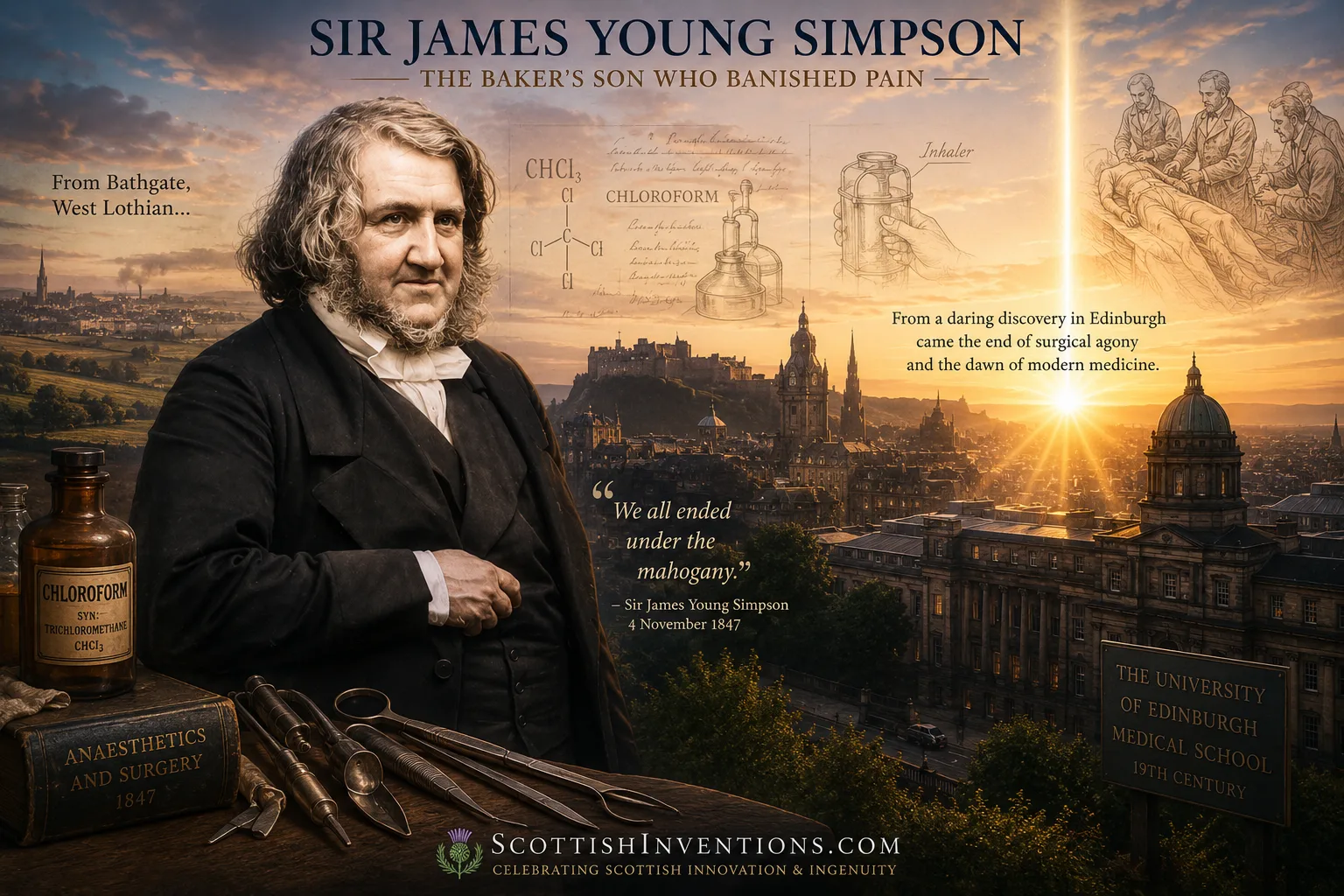
James Young Simpson (1811–1870), Professor of Midwifery at the University of Edinburgh, discovered on the evening of 4 November 1847 that inhaled chloroform vapour produced rapid, effective anaesthesia in humans, testing it on himself and two assistants, James Matthews Duncan and George Keith, at his home at 52 Queen Street. He introduced it into obstetric practice four days later and campaigned for its wider adoption. He did not discover the chemical compound itself — that had been done independently in 1831 by Samuel Guthrie, Eugène Soubeiran and Justus von Liebig, and named by Jean-Baptiste Dumas in 1834 — and he was not the first to demonstrate surgical anaesthesia of any kind, a distinction that belongs to the American pioneers of ether, chiefly William T. G. Morton in October 1846. Simpson's genuine discovery was narrower and still historic: that this particular compound could safely and pleasantly abolish pain in patients, and that it belonged, urgently, in the delivery room as well as the operating theatre.
Scottish Impact Index (SI Score)
- Global Impact
- 9/10
- Longevity
- 4/10
- Economic / Material Impact
- 7/10
- Originality / Distinctiveness
- 8/10
- Legacy (Built Upon)
- 8/10
- Recognition
- 6/10
Chloroform Anaesthesia — Key Facts
- Discovery
- Anaesthetic properties of chloroform, and its introduction into clinical obstetric practice
- Discoverer
- Sir James Young Simpson, with assistants James Matthews Duncan and George Keith
- Date
- 4 November 1847 (self-experiment); 8 November 1847 (first obstetric use)
- Location
- 52 Queen Street, Edinburgh, Scotland
- Compound first prepared
- 1831, independently, by Samuel Guthrie (USA), Eugène Soubeiran (France) and Justus von Liebig (Germany)
- Compound first named/characterised
- 1834, by Jean-Baptiste Dumas (France)
- Prior anaesthesia
- Ether — first demonstrated publicly by William T. G. Morton, Boston, 16 October 1846; earlier private use by Crawford Long (Georgia, 1842) and a failed public attempt by Horace Wells (1845)
- First anaesthetic death
- Hannah Greener, 28 January 1848, chloroform, aged 15
- Field
- Anaesthesiology · obstetrics
- Claim status
- Established for anaesthetic application and clinical introduction — but not for the chemical discovery of chloroform, and not for the first use of surgical anaesthesia of any kind
The Age of Agony
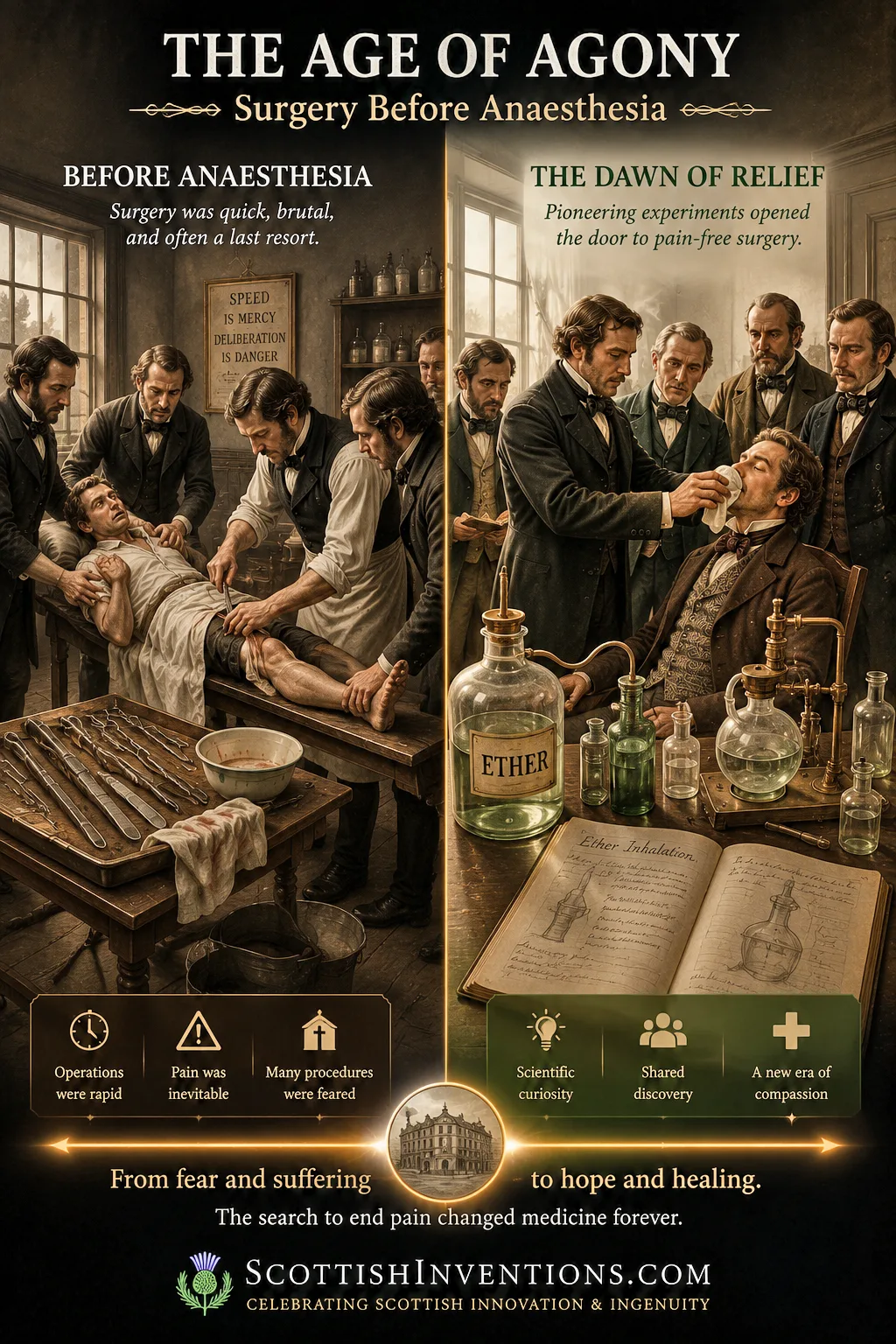
For most of human history, surgery was an ordeal endured fully conscious, and its practitioners were judged above all on speed. The Scottish surgeon Robert Liston, working in London in the 1840s, was famous for amputating a leg in under thirty seconds — not from carelessness, but from mercy, because every second was agony for a patient held down by assistants and given nothing stronger than brandy, opium or a leather strap to bite. Fainting from pain during an operation was common; death from shock was not rare.
Childbirth offered no relief at all. Labour pain was regarded by much of medicine and society alike as natural, inevitable and, for some, morally appropriate — a view that would soon collide directly with Simpson's ambitions. Maternal mortality from obstructed or difficult labour was a routine tragedy, and no tool existed to separate the physical process of birth from its suffering.
This was the world into which the idea of chemical anaesthesia arrived — not from Edinburgh first, but from the United States.
Ether Came First — America, 1842–46
It is essential to state plainly, before any account of Simpson's discovery, that he did not invent surgical anaesthesia. That achievement belongs to a cluster of American practitioners working with ether, over a year before Simpson ever inhaled chloroform.
Crawford Long, a country physician in Jefferson, Georgia, administered ether to a patient before removing a neck tumour on 30 March 1842 — the earliest documented surgical use of ether anaesthesia. Long did not publish his results until 1849, however, and so his priority went largely unrecognised at the time, forfeiting him the public credit that timely publication would have secured.
Horace Wells, a Connecticut dentist, attempted a public demonstration of nitrous oxide anaesthesia at Massachusetts General Hospital in 1845; the patient groaned during the procedure, the audience jeered, and the demonstration was judged a humiliating failure, though Wells's underlying idea was sound.
It was Wells's former student and business partner, the Boston dentist William Thomas Green Morton, who made anaesthesia undeniable. On 16 October 1846 — a date still celebrated in American medicine as "Ether Day" — Morton administered sulphuric ether to a patient at Massachusetts General Hospital while the surgeon John Collins Warren removed a jaw tumour. The patient felt nothing. Warren turned to the assembled surgeons and said, "Gentlemen, this is no humbug." News of the demonstration crossed the Atlantic within weeks, and ether anaesthesia was in use at University College Hospital, London, by 19 December 1846 — nearly eleven months before Simpson's chloroform discovery, and even before Simpson had used any anaesthetic agent whatsoever.
Simpson's own first anaesthetic use came on 19 January 1847, when he administered ether to a woman in labour — the first such use in Britain, but a use of someone else's discovery, applied to a new context. Ether, however, dissatisfied him: it was slow to act, unpleasant to inhale, irritating to the airway, and highly flammable near the open flames of contemporary operating rooms and delivery rooms alike. Simpson began actively searching for something better — trying, by his own account, a series of volatile substances on himself and his assistants through the autumn of 1847, evening after evening, looking for an improvement on Boston's discovery.
Who Actually Made Chloroform
The chemical Simpson would eventually try was not new. Chloroform (trichloromethane) had been prepared independently by three chemists in three different countries in a single remarkable year, 1831, each apparently unaware of the others' work: Samuel Guthrie, an American physician-chemist working in Sackets Harbor, New York, who was investigating it as a possible insecticide and solvent; Eugène Soubeiran, a French pharmacist in Paris; and Justus von Liebig, the great German chemist at Giessen, who would go on to transform organic chemistry and agricultural science.
None of the three recognised any medical application. Chloroform remained, for over a decade, a laboratory reagent and industrial solvent — until the French chemist Jean-Baptiste Dumas established its correct molecular formula and gave it its enduring name in 1834. For thirteen years after Dumas's work, chloroform sat on pharmacists' shelves as an unremarkable chemical, its anaesthetic potential entirely unsuspected.
This is the plainest possible statement of the credit problem this article exists to resolve: Simpson discovered what chloroform could do to the human body. He had no part whatsoever in discovering what chloroform was. Any account that elides this distinction — and many popular ones do — misrepresents both the chemistry and the history.
Simpson: Physician and Showman
James Young Simpson was born on 7 June 1811 in Bathgate, West Lothian, the seventh son of a village baker. A prodigy, he entered the University of Edinburgh at fourteen, switched from arts to medicine two years later, and was licensed by the Royal College of Surgeons of Edinburgh at nineteen. In 1840, aged just twenty-eight, he was elected to the Chair of Midwifery at Edinburgh over older and more established rivals — a position that gave him both an obstetric practice among Edinburgh's professional classes and the platform of a university professorship.
Simpson combined genuine clinical talent with a flair for publicity and controversy that would prove decisive in the chloroform story. He was already an established innovator — he would go on to design obstetric forceps still used today, introduce iron-wire sutures and devise acupressure as a means of controlling surgical bleeding — and an established campaigner, willing to argue in print, in the pulpit's own language if necessary, for causes he believed in.
It was this combination — a working obstetrician with an experimentalist's restlessness and a controversialist's appetite for a fight — that made him receptive to trying an obscure industrial solvent on himself, and effective at forcing its adoption once he had.
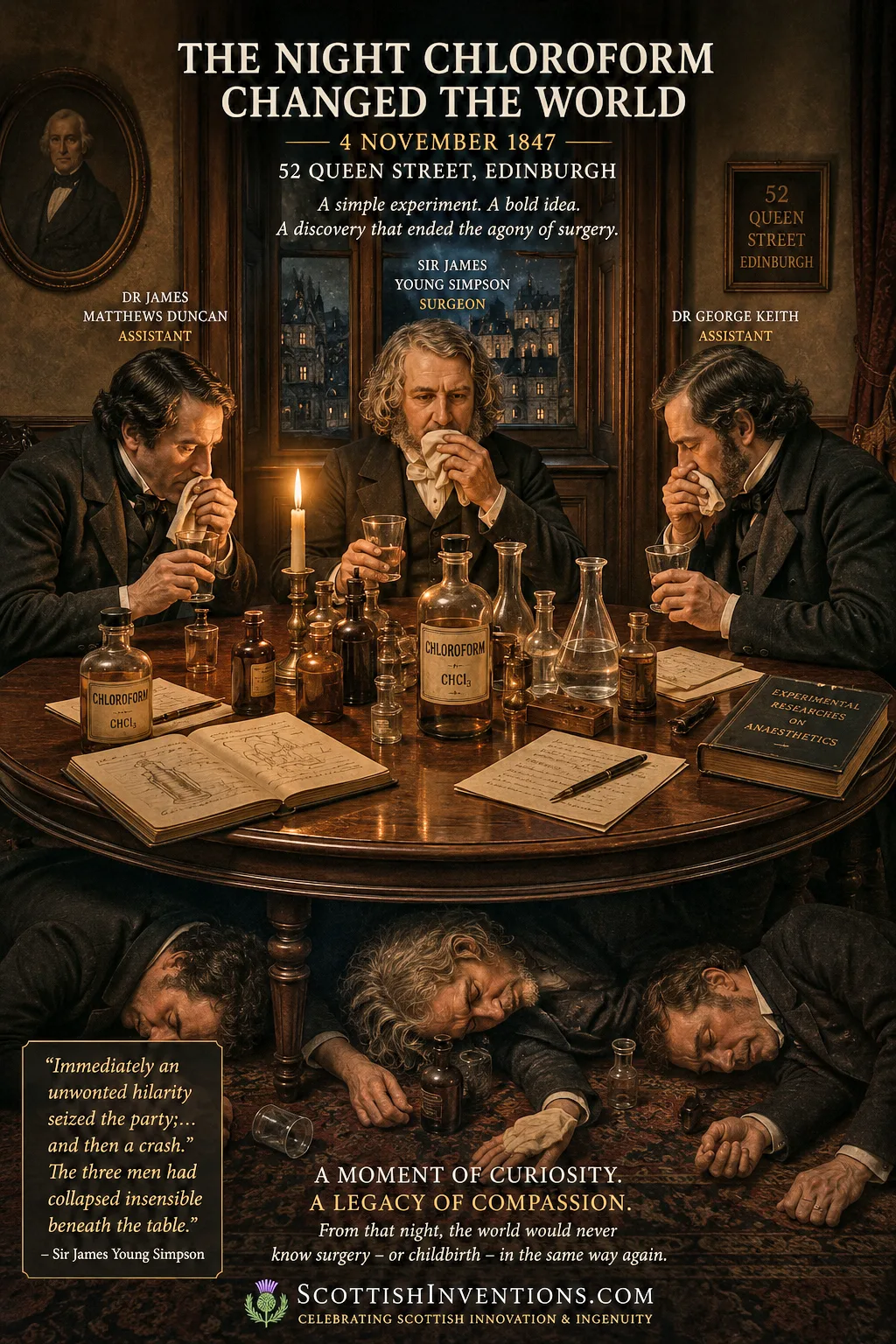
By November 1847, Simpson's dining table had become an impromptu laboratory. Night after night, he and two junior colleagues — James Matthews Duncan and George Keith, both physicians working alongside him — inhaled small quantities of one volatile compound after another, testing each for anaesthetic promise and finding each wanting.
On the evening of 4 November, a bottle of chloroform arrived, supplied by the Edinburgh pharmaceutical firm Duncan and Flockhart. It had almost been overlooked; Simpson is said to have set it aside earlier as unpromising. That night, the three men tried it anyway.
The Night of 4 November 1847
The effect was immediate and unmistakable — utterly unlike the substances they had tried before. By Simpson's own later account and those of witnesses, "an unwonted hilarity seized the party" within moments of inhaling the vapour — then, abruptly, silence. All three men lost consciousness and slid from their chairs to the floor beneath the table.
When Simpson came to his senses, before he had even fully gathered himself, his recorded first words were: "This is far stronger and better than ether." He had, in a single evening of amateur self-experiment, found an anaesthetic markedly more potent, faster-acting and, crucially for a man who administered it to patients personally, more pleasant to inhale than the ether that had reached Britain the previous winter.
He wasted no time. Four days later, on 8 November 1847, Simpson administered chloroform to a patient in labour — the first deliberate obstetric use of chloroform anywhere in the world. Two days after that, on 10 November, he read a paper, "Account of a New Anaesthetic Agent," to the Edinburgh Medico-Chirurgical Society, formally announcing the discovery to the medical profession. The speed of this sequence — from private accident to clinical use to public announcement inside a single week — is itself a large part of why Simpson, rather than Guthrie, Soubeiran, Liebig or Dumas, is remembered as chloroform's discoverer in the sense that actually matters to medicine.
The Curse of Eve — Fact and Exaggeration
Popular retellings of the chloroform story often stage it as a battle between a lone rational physician and a monolithic, furious Church, brandishing Genesis against the relief of women's pain. The reality was messier, and less dramatic, than that framing suggests.
Some clergy did object to obstetric anaesthesia on theological grounds, citing Genesis 3:16 — "in sorrow thou shalt bring forth children" — as evidence that labour pain was divinely mandated and should not be artificially removed. Simpson answered them, memorably, with Genesis 2:21, in which God "caused a deep sleep to fall upon Adam" before removing his rib — arguing that the Almighty himself had administered the first recorded anaesthetic, making the very first surgical operation in scripture a painless one.
But this exchange, endlessly repeated in popular accounts, has hardened into a myth of near-universal clerical fury that the historical record does not fully support. Documented religious objection came from a vocal minority rather than a unified Church position, and it was neither the only nor even the primary source of medical caution about obstetric chloroform. Many physicians' concerns were practical: dosage was unstandardised, individual responses varied enormously, and the drug's margin of safety was, as would soon become tragically apparent, dangerously narrow. Later biographers and popularisers, keen to build Simpson into a singular hero of secular reason against superstition, have tended to amplify the religious controversy and understate the more mundane and, in hindsight, more justified medical anxiety about safety. Both existed. Neither was as one-sided as the legend suggests.
Queen Victoria and "That Blessed Chloroform"
Whatever the true balance of opposition, it took a single royal endorsement to end most of it. On 7 April 1853, the physician John Snow — later celebrated for tracing the Broad Street cholera outbreak — administered chloroform to Queen Victoria on a folded handkerchief, in small measured doses, for the birth of her eighth child, Prince Leopold. The Queen wrote afterwards of "that blessed Chloroform" as "soothing, quieting & delightful beyond measure."
The effect on public and professional opinion was immediate and disproportionate to any change in the scientific evidence. Whatever theological or medical reservations had circulated for six years dissolved, in practical terms, almost overnight. Chloroform in childbirth — "chloroform à la reine," as it was soon nicknamed — became fashionable as well as medically accepted, a reminder that social sanction, not just clinical proof, often determines how quickly a genuine discovery becomes ordinary practice.
But acceptance brought chloroform into contact with far more patients, far more inexperienced hands, and far more varied circumstances than Simpson's careful early administrations. The consequences were not long in coming.
The Safety Reckoning: Hannah Greener and the Cardiac Deaths
Chloroform's narrow margin between an effective dose and a fatal one became apparent almost immediately, and its early history includes a sobering warning that popular accounts of Simpson's triumph too often omit or minimise.
On 28 January 1848 — less than three months after Simpson's discovery — fifteen-year-old Hannah Greener of Winlaton, near Newcastle, died after being given chloroform for the removal of an ingrown toenail. Hers is generally recognised as the first recorded death directly attributable to anaesthesia of any kind. It would not be the last from chloroform specifically: the drug is capable of sensitising the heart muscle to adrenaline, producing sudden, fatal arrhythmias even at doses that were not, by the standards of the time, considered excessive.
Over the following decades, British medical authorities convened a series of investigations — the so-called Chloroform Committees, sitting periodically between the 1860s and the early twentieth century — to study the mounting toll of chloroform-related cardiac deaths and to try to establish safer protocols for its administration. Ether, by comparison, carried a wider safety margin, however unpleasant its other qualities. The eventual verdict of medical history was not kind to chloroform on safety grounds: through the first half of the twentieth century it was steadily displaced from routine use by agents that achieved the same anaesthetic goal with a much lower risk of sudden cardiac death.
None of this erases Simpson's discovery. It does mean that any honest account of chloroform anaesthesia must hold two facts together: it was a genuine and historic advance in the relief of human suffering, and it was also, for the better part of a century, a genuinely dangerous drug whose risks were incompletely understood at the moment of its introduction.
So What Did Simpson Discover?
Laid out plainly, the credit divides into at least four separate and non-competing claims, each belonging to different people in different countries and different decades:
- The chemical compound chloroform was independently synthesised in 1831 by Samuel Guthrie (USA), Eugène Soubeiran (France) and Justus von Liebig (Germany).
- Its correct formula and name were established by Jean-Baptiste Dumas (France) in 1834.
- Surgical anaesthesia as a concept, using ether, was demonstrated by American practitioners — privately by Crawford Long in 1842, unsuccessfully by Horace Wells in 1845, and decisively and publicly by William T. G. Morton on 16 October 1846.
- Chloroform's anaesthetic properties in humans, and its clinical introduction — especially into obstetrics — were discovered and championed by James Young Simpson, with his assistants James Matthews Duncan and George Keith, from 4 November 1847.
Simpson's true achievement sits squarely and only in the fourth category. It is not a small achievement — obstetric anaesthesia in particular was almost entirely his doing, and the more pleasant, faster-acting agent he identified accelerated the global adoption of anaesthesia generally. But it is a specific, bounded achievement, and treating Simpson as the singular father of anaesthesia — as some popular accounts still do — erases the American pioneers who came before him by more than a year, and the European chemists whose laboratory work made his discovery chemically possible in the first place.
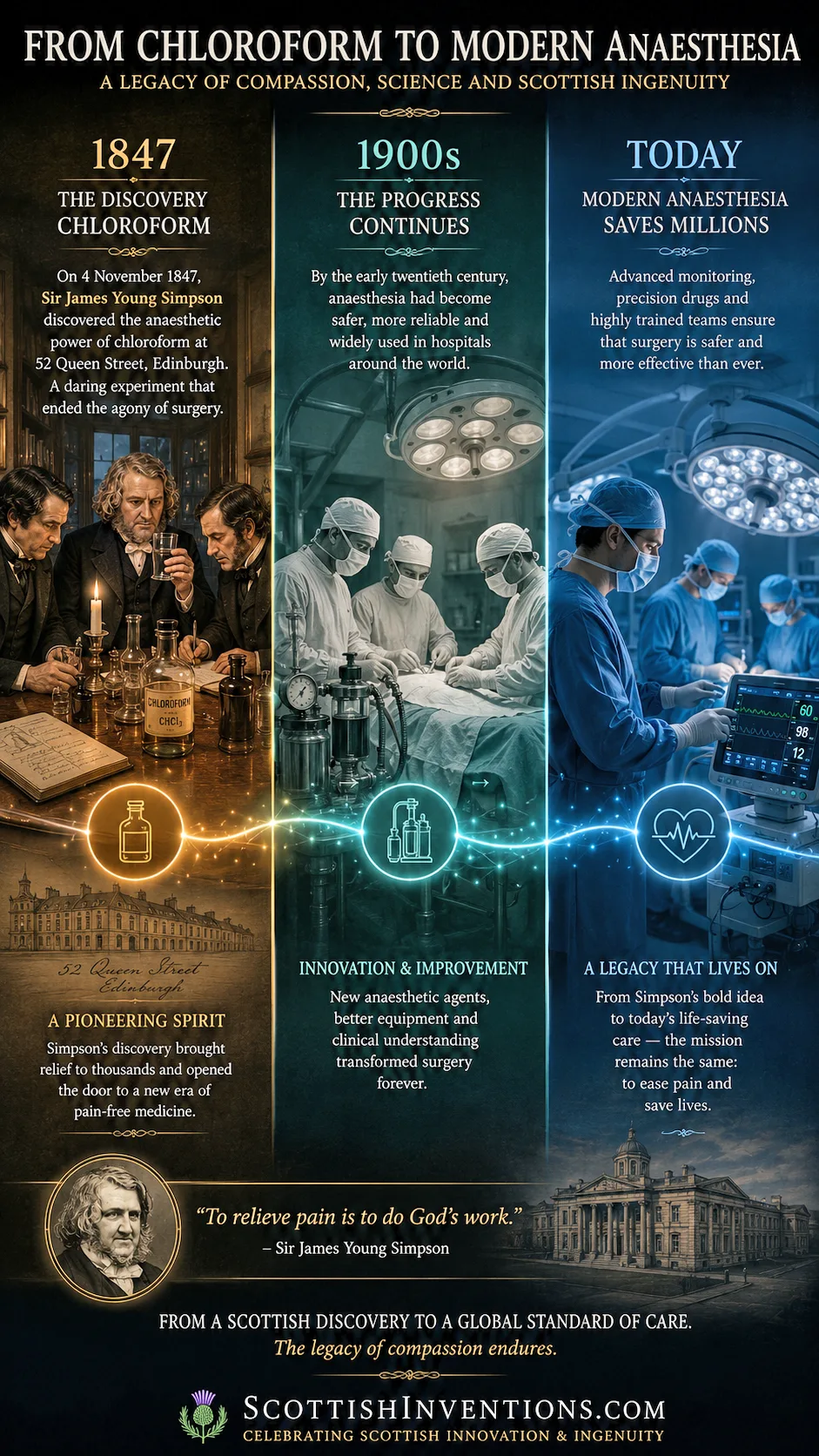
Simpson was knighted — the first physician created a baronet for services to medicine, on 3 February 1866 — and remained Professor of Midwifery at Edinburgh until his death at 52 Queen Street on 6 May 1870. Edinburgh declared a public holiday for his funeral; over 30,000 people lined the streets. His family declined the offer of burial in Westminster Abbey, choosing instead Warriston Cemetery in Edinburgh, though a memorial bust was later placed in the Abbey. A bronze statue in West Princes Street Gardens, beneath Edinburgh Castle, is inscribed "Pioneer of Anaesthesia."
Legacy: From Queen Street to the Operating Theatre
Chloroform itself has been retired from medicine for the better part of a century, replaced by agents that achieve the same end with far less cardiac risk. What survives, and what makes Simpson's discovery genuinely historic rather than merely a footnote to the American ether story, is the principle he helped establish beyond doubt: that pain in surgery and childbirth is not an inevitable, morally necessary feature of medical treatment but a problem that can be solved, safely and reliably, by chemistry.
That principle, proved on an American stage in 1846 and extended and popularised on an Edinburgh dining table a year later, underlies every general anaesthetic administered anywhere in the world today. Modern anaesthesiology owes its origin to both stories, not one — and understanding Simpson's real, specific, bounded contribution honours it more accurately, and more durably, than the inflated version of the legend ever could.
Myth vs Evidence
Myth
Simpson discovered chloroform.
Evidence
He did not. Chloroform the compound was independently synthesised in 1831 by Samuel Guthrie in the United States, Eugène Soubeiran in France and Justus von Liebig in Germany, and named and chemically characterised by Jean-Baptiste Dumas in 1834 — thirteen years before Simpson ever inhaled it. What Simpson discovered was that it could safely abolish pain in humans, and he was the one who put it to clinical use.
Myth
Simpson invented surgical anaesthesia.
Evidence
No. Surgical anaesthesia predates Simpson's chloroform discovery by more than a year. William T. G. Morton's public ether demonstration in Boston on 16 October 1846 is the conventionally cited start of the modern anaesthetic era, and Crawford Long had used ether privately in Georgia as early as 1842. Simpson's own first anaesthetic use — of ether, not chloroform — came in January 1847, over four months after Morton's demonstration and after ether had already reached Britain.
Myth
The Church unanimously and violently opposed chloroform in childbirth as sinful.
Evidence
Clerical objection was real but has been considerably exaggerated by later writers keen to cast Simpson as a lone rationalist hero against a monolithic Church. Documented opposition came chiefly from a vocal minority citing Genesis 3:16, and it was neither universal among clergy nor the dominant medical objection of the time — many doctors' hesitations were about safety and dosage, not theology. Simpson's own rebuttal, invoking Genesis 2:21, was as much a rhetorical masterstroke as a theological rebuttal of a widespread consensus.
Myth
Chloroform was a safe anaesthetic that fell out of use for no good reason.
Evidence
Chloroform has a narrow margin between an effective and a fatal dose and can sensitise the heart to fatal arrhythmias, especially under stress or with adrenaline in the body. Hannah Greener's death in January 1848, within three months of Simpson's discovery, was the first of thousands of chloroform deaths recorded over the following decades, and successive British 'Chloroform Committees' investigated the toll. It was retired because ether and later agents were measurably safer, not by accident or fashion.
Timeline: 1831–1870
| Date | Event | Detail |
|---|---|---|
| 1831 | Chloroform first prepared, three times over, independently | Samuel Guthrie in Sackets Harbor, New York; Eugène Soubeiran in Paris; and Justus von Liebig in Giessen each synthesise the compound within months of one another, without knowledge of the others' work. |
| 1834 | Jean-Baptiste Dumas names and characterises it | The French chemist establishes chloroform's correct molecular formula and gives it the name by which it is known today. For over a decade it remains a laboratory curiosity and a solvent. |
| 30 March 1842 | Crawford Long uses ether surgically, unpublished | A rural Georgia physician removes a neck tumour from a patient under ether but does not publish his results until 1849, forfeiting priority in the public record. |
| 1845 | Horace Wells's public demonstration fails | Wells attempts a public demonstration of nitrous oxide anaesthesia at Massachusetts General Hospital; the patient cries out, and the demonstration is judged a failure. |
| 16 October 1846 | William T. G. Morton's 'Ether Day' | Morton administers ether publicly at Massachusetts General Hospital for the removal of a jaw tumour by John Collins Warren. The event is witnessed, reported and rapidly becomes famous — the conventional starting point of the modern anaesthetic era. |
| 19 December 1846 | Ether reaches Britain | Ether anaesthesia is first used in Britain, at University College Hospital, London, within weeks of the news from Boston. |
| 19 January 1847 | Simpson's first British obstetric use of ether | Simpson becomes the first in Britain to use ether to relieve pain in childbirth — already searching for something better. |
| 4 November 1847 | The chloroform night | Simpson, Duncan and Keith inhale a sample of chloroform, supplied by the Edinburgh pharmacists Duncan and Flockhart, around the dining table at 52 Queen Street. All three collapse insensible. Simpson's recorded first words on waking: 'This is far stronger and better than ether.' |
| 8 November 1847 | First obstetric use | Simpson administers chloroform to a patient in childbirth — the discovery's first clinical application. |
| 10 November 1847 | Public announcement | Simpson reads his pamphlet 'Account of a New Anaesthetic Agent' to the Edinburgh Medico-Chirurgical Society. |
| 28 January 1848 | Hannah Greener dies | A fifteen-year-old girl in Winlaton, near Newcastle, dies after chloroform is administered for the removal of an ingrown toenail — the first recorded anaesthetic death, and an early sign of chloroform's narrow safety margin. |
| 7 April 1853 | Queen Victoria and Prince Leopold | Dr John Snow administers chloroform to the Queen for her eighth confinement. She calls it 'that blessed Chloroform'; public resistance to obstetric anaesthesia collapses. |
| 1864–1912 | The Chloroform Committees | A series of British medical commissions investigate chloroform's cardiac risks as death tolls accumulate, gradually documenting its narrow margin between an effective and a fatal dose. |
| 1870 | Simpson dies | Simpson dies at 52 Queen Street on 6 May, aged 58; Edinburgh declares a public holiday and over 30,000 people line the funeral route. |
| Early 20th century | Ether and later agents supersede chloroform | Chloroform is gradually withdrawn from routine practice worldwide in favour of agents with wider safety margins, but the principle of chemically abolished pain — Simpson's discovery — remains the foundation of all that follows. |
Frequently Asked Questions
Did James Young Simpson invent chloroform?
No. Chloroform was first synthesised independently in 1831 by Samuel Guthrie in the United States, Eugène Soubeiran in France and Justus von Liebig in Germany, and its chemical formula and name were established by Jean-Baptiste Dumas in 1834. Simpson's discovery, thirteen years later, was that the compound could safely produce surgical anaesthesia in humans — and his achievement was introducing it into clinical practice, not making the substance.
Was Simpson the first person to use anaesthesia in surgery?
No. Surgical anaesthesia using ether was demonstrated publicly by William T. G. Morton in Boston on 16 October 1846, over a year before Simpson's chloroform discovery, and Crawford Long had used ether privately in Georgia as early as 1842. Simpson's own first use of any anaesthetic, in January 1847, was of ether, not chloroform, and came several months after ether reached Britain.
What exactly did James Young Simpson discover?
Simpson discovered that chloroform vapour, inhaled in controlled doses, produced a rapid, pleasant and effective loss of sensation suitable for surgery and childbirth — and he was the first to demonstrate this in humans, on himself and two assistants, on the evening of 4 November 1847 at 52 Queen Street, Edinburgh. He administered it obstetrically four days later and then campaigned, publicly and vigorously, for its adoption, which is arguably as important to the story as the initial discovery.
Who assisted Simpson in the discovery of chloroform's anaesthetic effects?
James Matthews Duncan and George Keith, both Edinburgh physicians working with Simpson, inhaled the chloroform alongside him on 4 November 1847 and collapsed with him beneath the dining-room table. Their participation is well documented in Simpson's own and contemporaries' accounts, though Simpson, as the senior figure, took and received most of the public credit.
Did the Church really oppose chloroform in childbirth as ungodly?
Some clergy did object, citing Genesis 3:16 ('in sorrow thou shalt bring forth children') as evidence that labour pain was divinely intended. But this opposition is often overstated in retrospective accounts that cast Simpson as a solitary rationalist battling a united clerical front. In fact objection was patchy, came from a vocal minority rather than mainstream religious authority, and most contemporary medical hesitation about chloroform concerned dosage and safety rather than theology. Simpson's Genesis 2:21 rebuttal is now more famous as a piece of rhetoric than as evidence of how widespread the opposition actually was.
Was chloroform dangerous?
Yes, more dangerous than initially realised. Chloroform has a narrow margin between an anaesthetic dose and a fatal one, and it can sensitise the heart to lethal arrhythmias. Hannah Greener, aged fifteen, died under chloroform anaesthesia on 28 January 1848 — less than three months after Simpson's discovery — during a minor procedure to remove an ingrown toenail. Successive nineteenth-century British medical inquiries, the 'Chloroform Committees', documented a mounting toll of cardiac deaths, and the drug was gradually superseded through the twentieth century.
Why did Queen Victoria's use of chloroform matter?
On 7 April 1853, the physician John Snow administered chloroform to Queen Victoria for the birth of Prince Leopold, her eighth child. Her enthusiastic description of it as 'that blessed Chloroform' carried enormous social weight and effectively ended much of the public and professional resistance to obstetric anaesthesia in Britain, regardless of the medical debate that continued about its safety.
Is chloroform still used as an anaesthetic today?
No. Chloroform's narrow safety margin and cardiac risks led to its replacement by safer, more controllable anaesthetic agents over the course of the twentieth century. It has no routine role in modern surgical or obstetric anaesthesia, though the principle it established — that pain can be reliably and reversibly abolished by inhaled agents — remains the foundation of the discipline.
Who deserves credit for the discovery of anaesthesia — Americans or Simpson?
Credit is genuinely shared and should not be collapsed into a single national story. American practitioners — Crawford Long, Horace Wells and, most influentially, William T. G. Morton — established that surgical anaesthesia was possible using ether, and Morton's October 1846 demonstration is conventionally treated as the start of the modern era. Simpson's distinct and separate contribution, over a year later, was discovering a more effective and pleasant agent, chloroform, and pioneering its use in obstetrics, a field ether had barely touched.
Sources & Further Reading
Tier 1 · Primary
- Simpson, J.Y. — "Account of a New Anaesthetic Agent, as a Substitute for Sulphuric Ether in Surgery and Midwifery," 1847.
- Duns, J. — Memoir of Sir James Y. Simpson, Bart., Edmonston & Douglas, 1873.
- Gordon, H.L. — Sir James Young Simpson and Chloroform (1811–1870), T. Fisher Unwin, 1897.
- Guthrie, S.; Soubeiran, E.; von Liebig, J. — independent 1831 syntheses of chloroform, contemporary chemical literature.
- Dumas, J.-B. — chemical characterisation and naming of chloroform, 1834.
- Reports of the British "Chloroform Committees," Royal Medico-Chirurgical Society of London, 1864 and after.
Tier 2 · Scholarly and institutional
- Fenster, J.M. — Ether Day: The Strange Tale of America's Greatest Medical Discovery and the Haunted Men Who Made It, HarperCollins, 2001.
- Defalque, R.J. & Wright, A.J. — "Scandals in the history of local anesthesia," and related papers on Crawford Long, Horace Wells and W.T.G. Morton priority disputes, Bulletin of Anesthesia History.
- Knight, P.R. & Bacon, D.R. — "An unexplained death: Hannah Greener and the origin of anesthetic deaths," Anesthesiology, 2002.
- Snow, S. — Blessed Days of Anaesthesia: How Anaesthetics Changed the World, Oxford University Press, 2008.
- Royal College of Physicians of Edinburgh — biographical and archival material on Sir James Young Simpson.