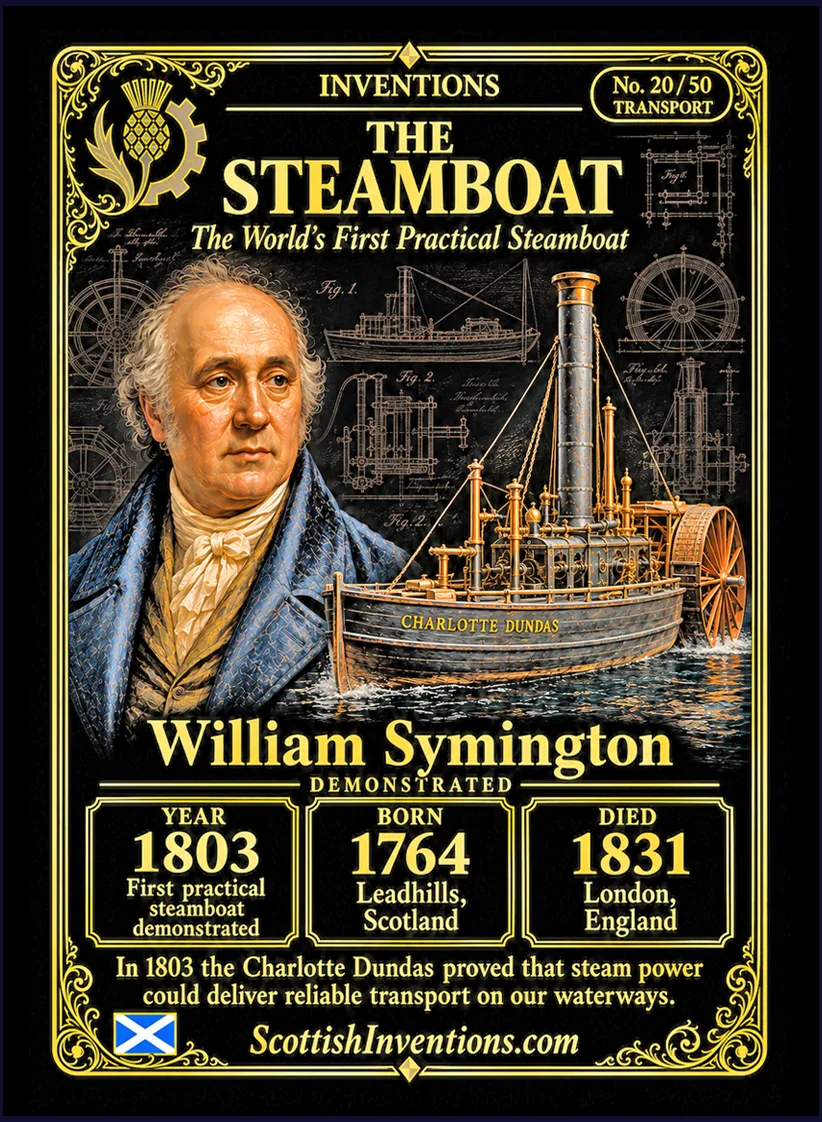
Europe's First Passenger Steamboat (Comet)
by Henry Bell
The Helensburgh innkeeper who launched the age of steam at sea
Henry Bell (1767–1830) was a millwright, engineer and hotelier from Torphichen in West Lothian who, by middle age, had settled in the small Clyde resort of Helensburgh. There, with his wife Margaret, he ran the Baths Inn — and quietly nursed a far bigger ambition. He wanted to prove that steam power could carry paying passengers reliably, on schedule, and at a profit.
On 6 August 1812 he did exactly that. Bell's little 40-foot steamboat Comet began plying the Clyde between Glasgow, Greenock and Helensburgh — and Europe's commercial steam-navigation industry was born.
The Comet — the ship and its engine
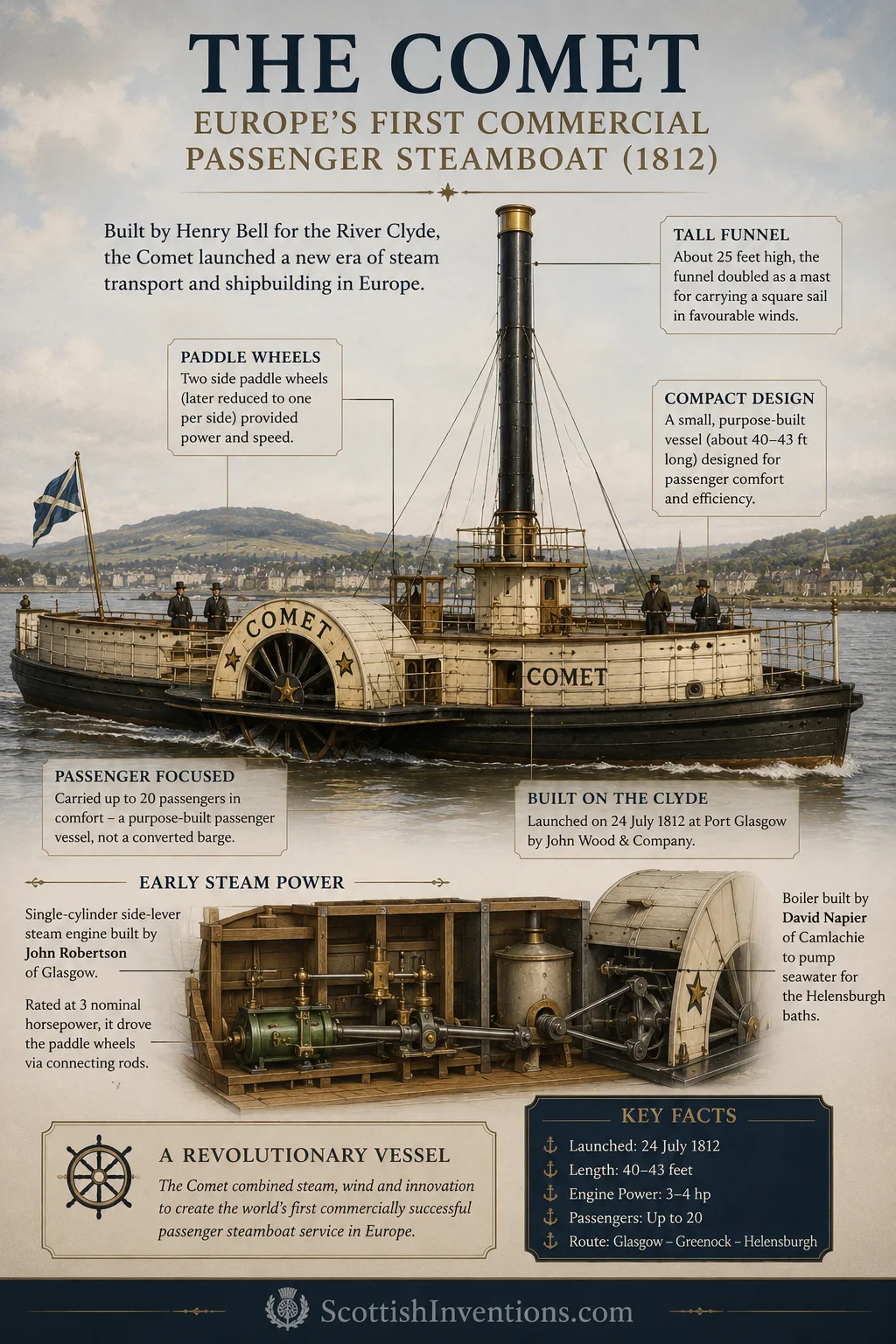
The Comet was a small, purpose-built passenger vessel roughly 40–43 feet long, launched on 24 July 1812 at Port Glasgow by the shipbuilders John Wood & Company. She carried two side paddle wheels (later reduced to one per side), a tall 25-foot funnel that doubled as a mast for a square sail, and accommodation for up to twenty passengers in comfort — a deliberate departure from the converted-barge prototypes that had come before her.
Her power came from a single-cylinder side-lever steam engine built by John Robertson of Glasgow, rated at just three to four nominal horsepower, with a boiler by David Napier of Camlachie. Modest as those numbers sound, they were enough to drive the Comet against the Clyde tides at around five knots — fast enough to keep a published timetable.
The maiden voyage and commercial service
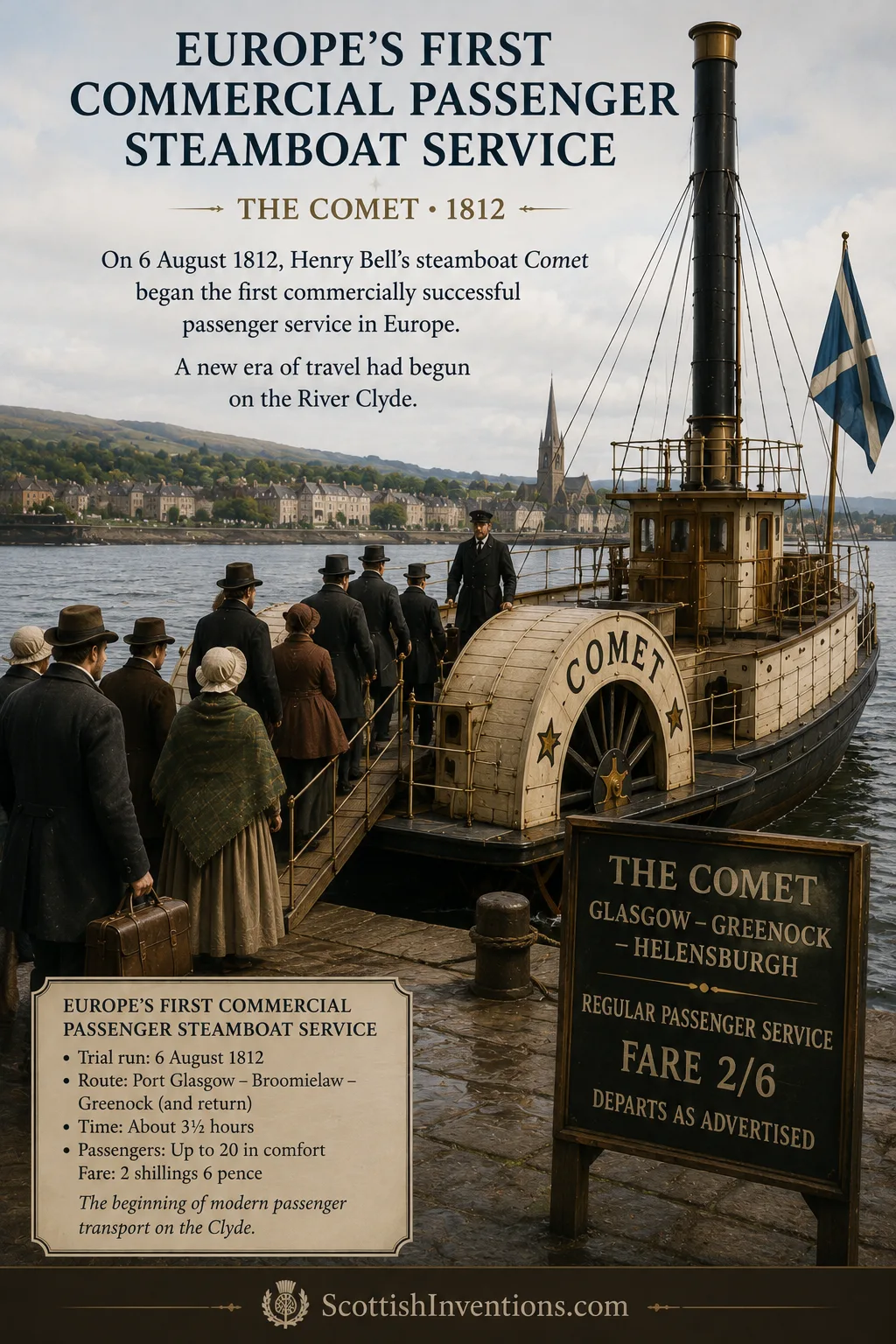
On 6 August 1812 the Comet made her trial run from Port Glasgow up the Clyde to the Broomielaw in Glasgow and back down to Greenock — a round trip of about three and a half hours. Bell promptly advertised a scheduled passenger service, three days a week, between Glasgow, Greenock and his own Baths Inn at Helensburgh. The fare was two shillings and sixpence in the best cabin.
It was the first commercially successful passenger steamboat service anywhere in Europe. Within months rival operators were ordering steamboats of their own; within five years more than a dozen steamers were working the Clyde estuary.
Impact and legacy on the Clyde
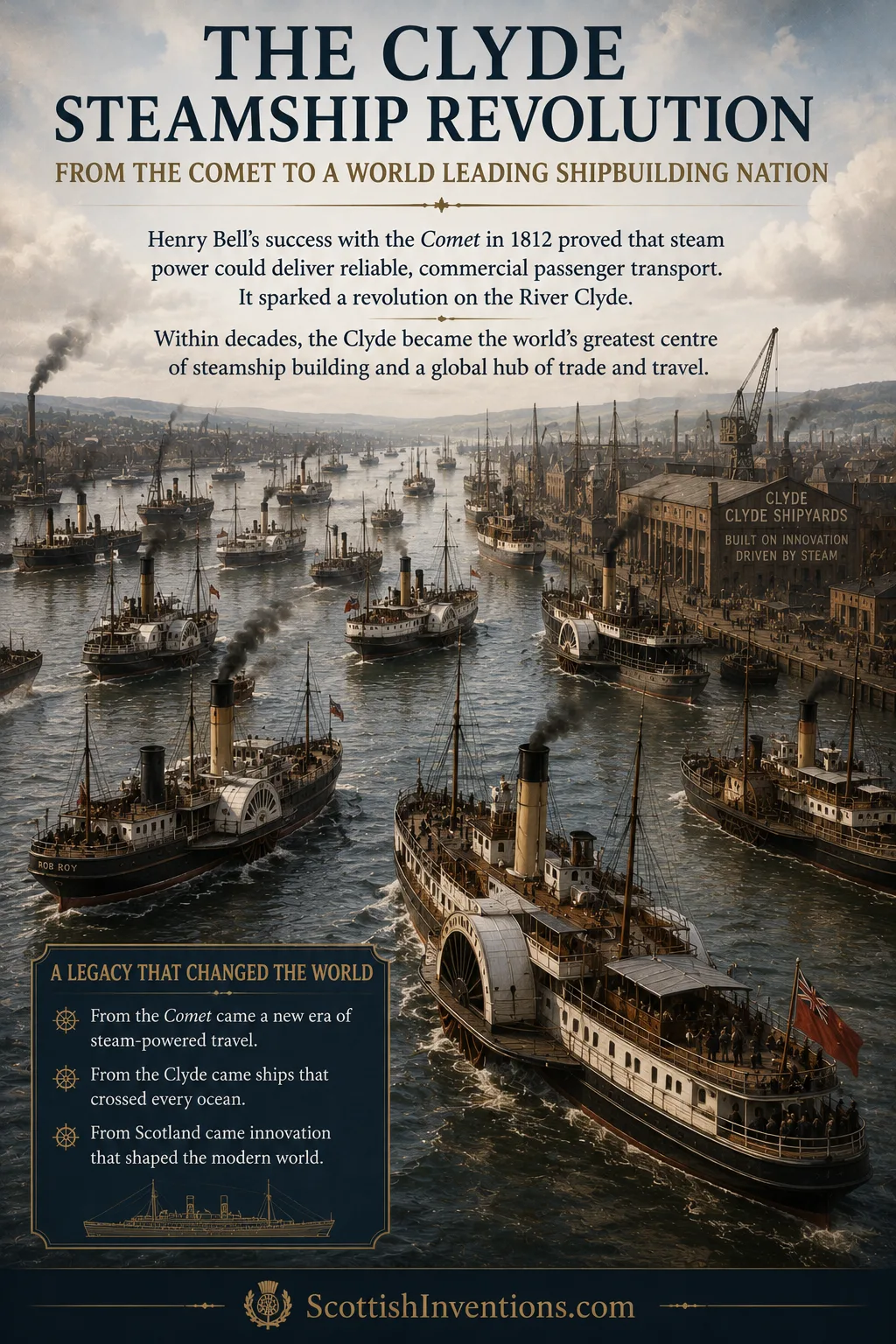
Bell had proved the principle, and Scotland ran with it. Within a generation the River Clyde became the greatest shipbuilding river in the world, its yards turning out everything from paddle steamers and ocean liners to warships and Cunarders. By the late nineteenth century roughly one in five ships afloat had been built on the Clyde.
The Comet herself worked the west coast until 1820, when she was wrecked off Craignish Point. But the industry she had started outlived her by more than a century, employing hundreds of thousands of Scots and shaping the global story of trade, emigration and naval power.
A living link: the PS Waverley
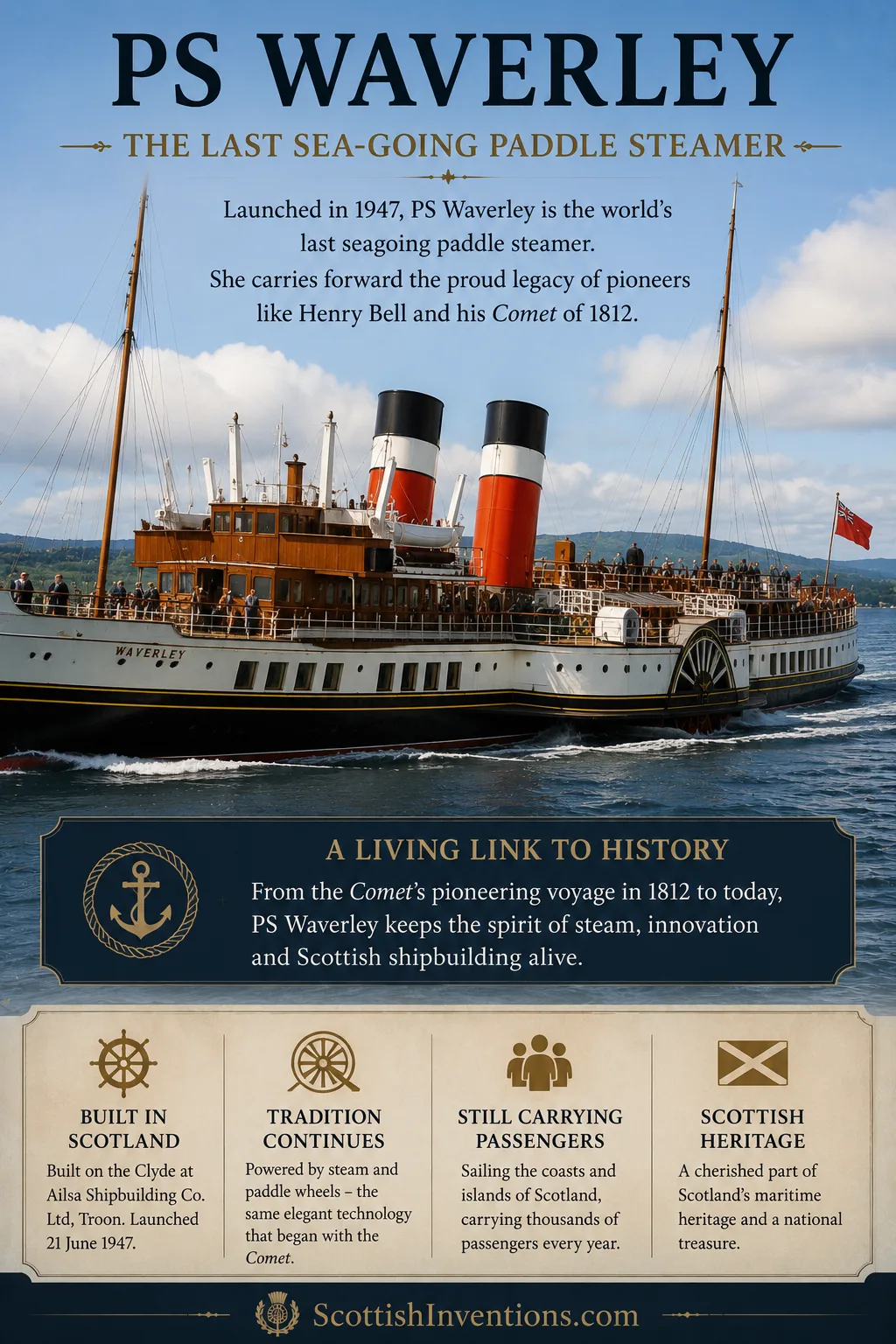
Two centuries on, Henry Bell's paddle-steamer legacy is still afloat. The PS Waverley, launched on the Clyde at Ailsa Shipbuilding Co. in Troon on 21 June 1947, is the last seagoing paddle steamer in the world. Restored and operated by enthusiasts, she carries thousands of passengers each year around the Scottish coast and beyond — direct heir to the Comet of 1812.
Honours and commemorations
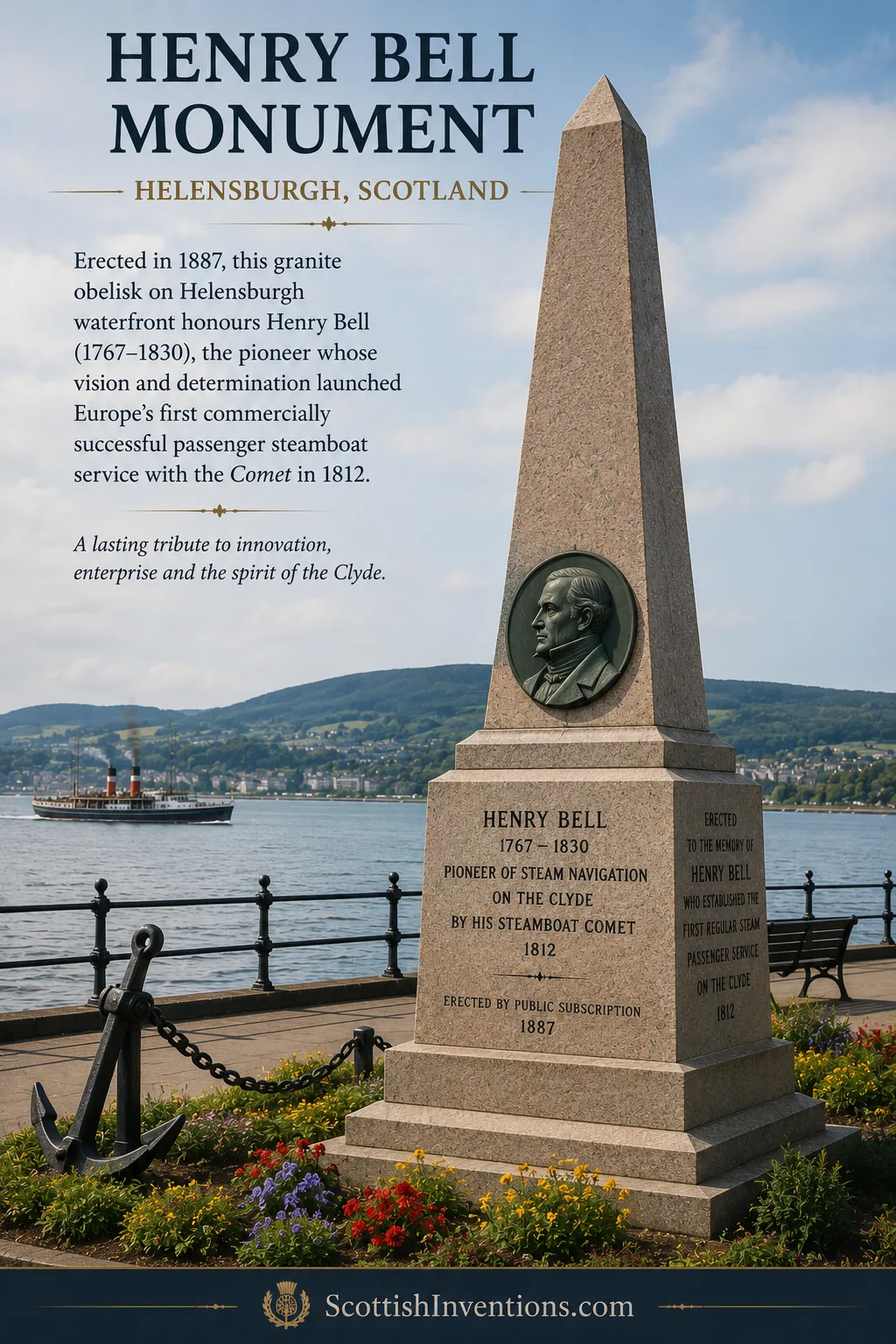
Helensburgh, the town that was Bell's home and the eastern terminus of the Comet's run, honours him with a granite obelisk on the waterfront overlooking the Firth of Clyde. A second monument stands at Bowling on the north bank of the Clyde, and the Comet's flywheel and anvil are preserved in Port Glasgow, where a full-size replica of the steamboat is on permanent display.
Bell died in 1830 and is buried at Rhu, just outside Helensburgh. His name endures wherever steam meets salt water.
Conclusion
Henry Bell did not invent the steam engine, and he was not the first person to put one in a boat. What he did do — and what nobody in Europe had managed before him — was make steam navigation pay. From that single small vessel on the Clyde came an industry that crossed every ocean and a tradition of Scottish shipbuilding that defined an era.