Card No. 2 · Scottish Inventions Collection
James Bowman Lindsay and the 1835 "Constant Electric Light": Dundee's Underrated Genius and the Truth About His Lamp
Scottish Impact Index (SI Score)
- Global Impact
- 8/10
- Longevity
- 9/10
- Economic / Material Impact
- 8/10
- Originality / Distinctiveness
- 8/10
- Legacy (Built Upon)
- 7/10
- Recognition
- 6/10
By Scottish Inventions Editorial · 22 min read
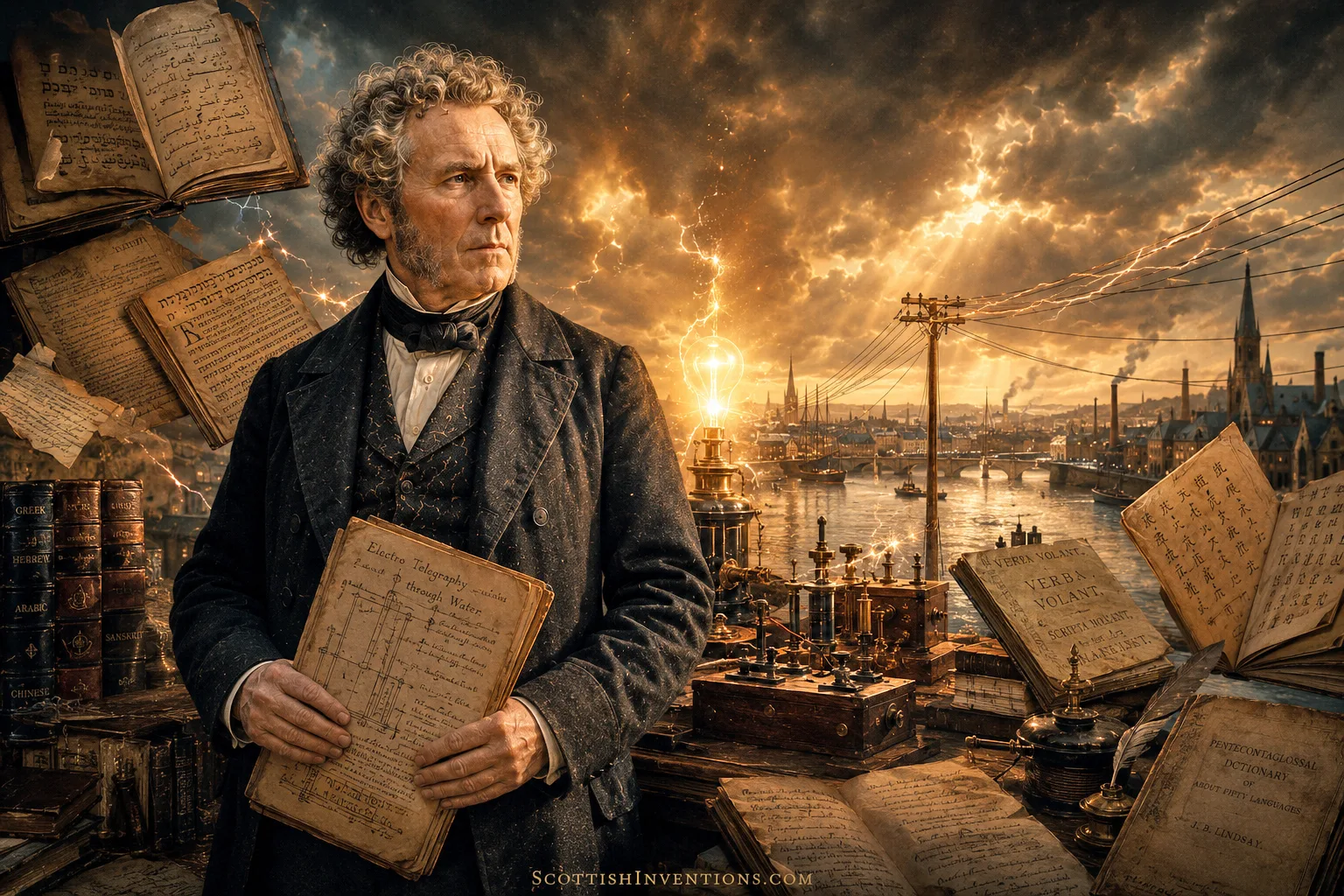
On the evening of Saturday 25 July 1835, in a modest room in Dundee, a self-educated weaver's son obtained what he and the local press called a "constant electric light". The man was James Bowman Lindsay, and the demonstration came 44 years before Edison's famous 13½-hour bulb test. Yet history has largely forgotten him — and the truth about what he actually achieved is more interesting, and more defensible, than the popular myth.
Table of Contents
- The Honest Verdict
- From the Loom to the Lecture Hall
- Why He Wanted a Flameless Light
- The 1835 Demonstration — the Primary Sources
- Incandescent, Arc, or Something Else?
- Where Lindsay Fits in a Crowded History
- Why Swan and Edison Get the Credit
- Telegraphy Through Water
- The Pentecontaglossal Dictionary
- Recognition, Death and Memorial
- Myth vs Reality
- Did You Know?
- Caveats
- Timeline
- Why Lindsay Matters
- Frequently Asked Questions
The Honest Verdict
- Lindsay genuinely demonstrated a "constant electric light" in Dundee on 25 July 1835, documented in contemporary newspaper reports — but it was a small experimental model, not the practical, mass-producible bulb the legend implies.
- He was neither the first to make electricity glow — Humphry Davy did that at the Royal Institution in 1802, passing current through a thin strip of platinum — nor the inventor of the practical incandescent lamp, which belongs to Swan and Edison in 1878–79.
- His exact device cannot be reconstructed. The best technical analysis suggests a crude incandescent heated-wire source, not the sealed vacuum bulb some modern accounts claim.
- His most secure claims to fame may lie elsewhere: through-water telegraphy demonstrated across the Tay in 1854, and a comparative dictionary of around fifty languages.
From the Loom to the Lecture Hall
James Bowman Lindsay was born on 8 September 1799 at Cotton of West Hills in the rural parish of Carmyllie, near Arbroath in Angus. He was one of four children of a poor family; his father John was a farm worker and handloom weaver, his mother was Elizabeth Bowman. Being of delicate health, young James was spared the heavier farm labour and apprenticed instead to a local handloom weaver. The image that has followed him ever since — reading a book while walking the miles to Arbroath with a web of cloth strapped to his back — captures the autodidact exactly.
His parents recognised his abilities and saved to send him to the University of St Andrews, where he matriculated in 1821. He distinguished himself in mathematics and physics, completed studies in theology, and in 1829 returned to Dundee as Science and Mathematics Lecturer at the Watt Institution. From a single, modestly furnished room he conducted experiments in magnetism and electricity.
In 1832 he demonstrated the principle of an electric telegraph to his students in the classroom, and recognised — by his own account — that electricity could serve three great ends: power, light and communication. He chose to pursue the light first.
Why He Wanted a Flameless Light
Lindsay's motivation was humane and practical rather than commercial. Dundee's booming jute and flax mills were notorious fire-traps: the air inside them carried a fine, dry, combustible dust, and every gas jet and naked flame was a potential catastrophe. Lindsay wanted a source of illumination that could not ignite that atmosphere. It is a detail worth holding on to, because it explains the terms in which both he and the press described his light — not as a marvel of brightness, but as a light that emits no smoke, requires no air for combustion and cannot explode.
The 1835 Demonstration — the Primary Sources
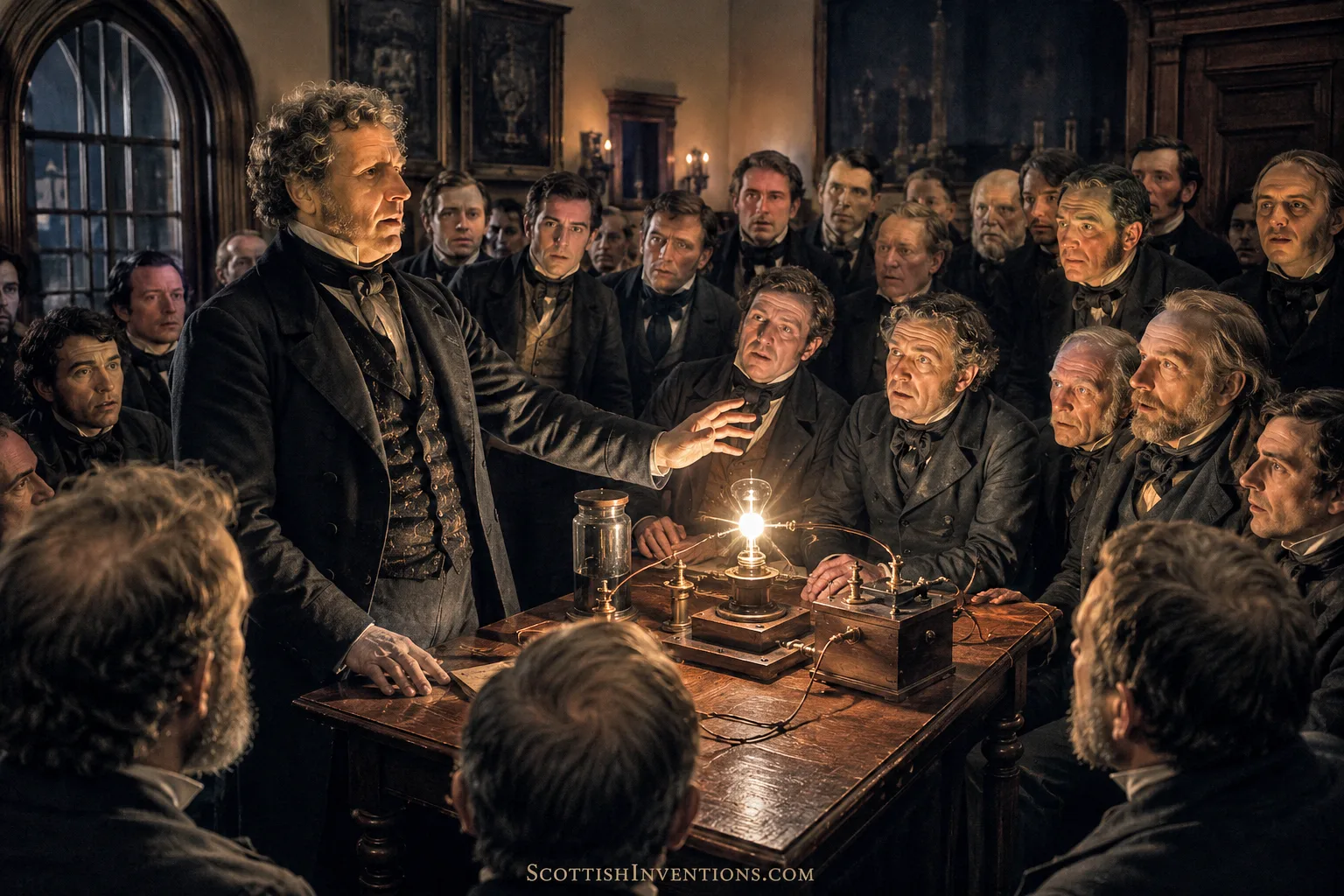
The single most important primary source is the report in the Dundee, Perth & Cupar Advertiser, printed in late July or early August 1835. It read:
"Mr. Lindsay, a teacher in town, formerly lecturer to the Watt Institute, succeeded on the evening of Saturday, July 25, in obtaining a constant electric light. It is upwards of two years since he turned his attention to this subject... The light in beauty surpasses all others, has no smell, emits no smoke, is incapable of explosion, and not requiring air for combustion can be kept in sealed glass jars. It ignites without the aid of a taper, and seems peculiarly calculated for flax houses, spinning mills, and other places containing combustible materials. It can be sent to any convenient distance, and the apparatus for producing it can be contained in a common chest."
Lindsay then published his own letter, signed at Dundee and dated 28 October 1835. It is the closest thing to a technical description that exists:
"The apparatus that I have at present is merely a small model... I am writing this letter by means of it at 6 in. or 8 in. distant; and, at the present moment, can read a book at the distance of 1-1/2 feet. From the same apparatus I can get two or three lights, each of which is fit for reading with. I can make it burn in the open air, or in a glass tube without air, and neither wind nor water is capable of extinguishing it. It does not inflame paper nor any other combustible. These are facts."
The letter then soars into prediction. Such a light, Lindsay wrote, would banish mill fires, would "stand side by side with the piano in the drawing-room", would serve "in lighthouses and for telegraphs", and "the present generation may yet have it burning in their houses and enlightening their streets". He followed up with public lectures and demonstrations at Thistle Hall in Dundee on 15 January 1836 and 21 April 1837.
Crucially: no detailed description, drawing or surviving example of the apparatus exists. Everything rests on two 1835 newspaper items, Lindsay's own letters, and an autobiographical sketch deposited at Dundee Public Library in 1893, which confirms 25 July 1835 as the date he "obtained a constant stream of light", after which he "returned to some glossological investigations". A later letter of 26 January 1847 adds the one hard technical detail we have: the model was small, "the plates being only one inch square", and scaling up the battery would, he believed, yield "a light far surpassing gas in brilliance".
The Oxford Dictionary of National Biography titles its entry on him "experimenter with electricity and writer on theology" — pointedly, not "inventor". This page honours that nuance rather than arguing with it.
Incandescent, Arc, or Something Else?
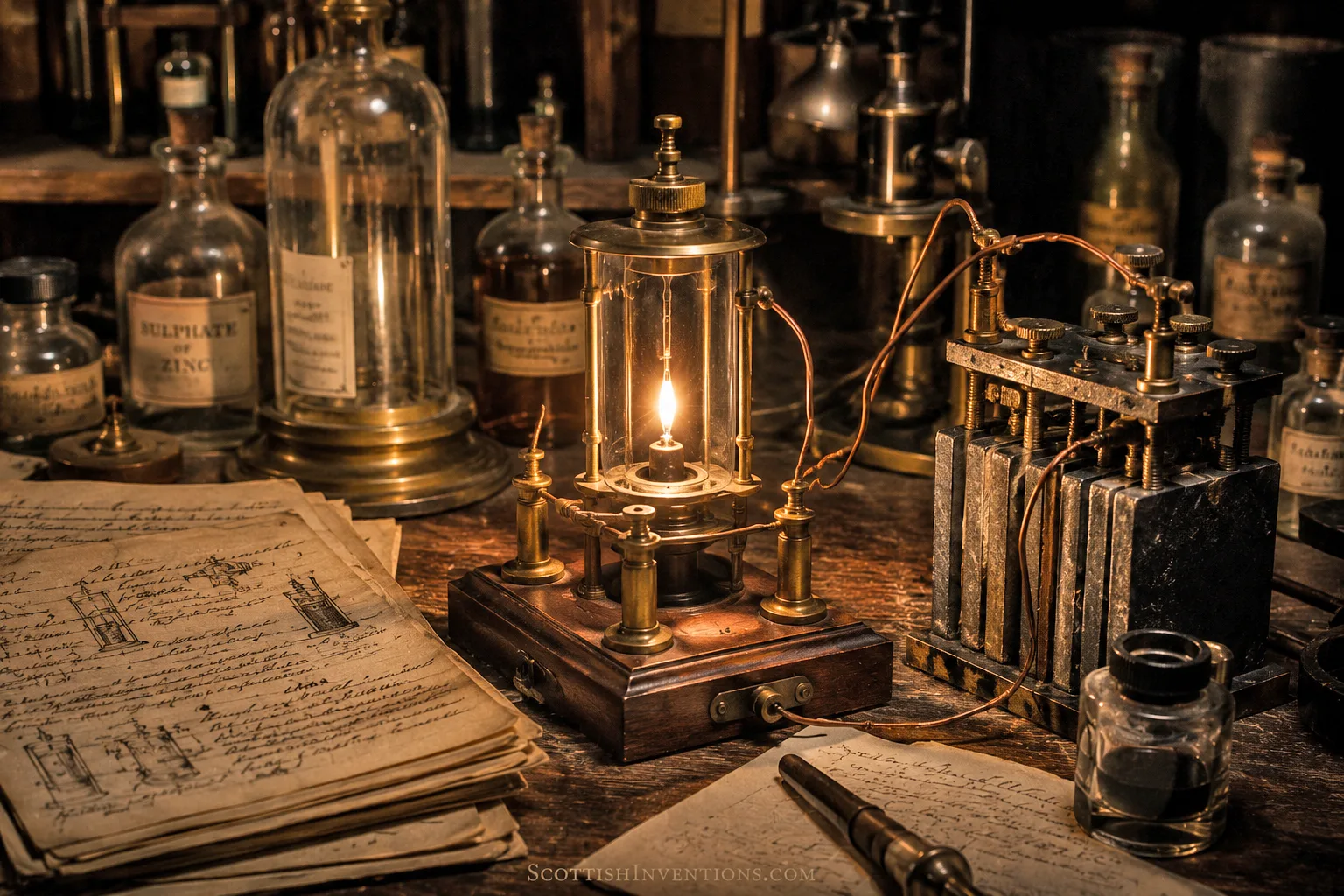
This is where the popular story most often overreaches. The modern shorthand — that Lindsay built "a wire sealed in a vacuum", essentially a light bulb — appears in promotional and local-heritage sources, but it is an interpretation, not something the 1835 sources establish.
The best reasoned technical analysis is by the lamp engineer and historian Edward J. Covington, whose work is preserved at the Museum of Electric Lamp Technology. His conclusion is careful and worth quoting exactly:
"the continuous light obtained by Lindsay probably was not a steady state electric discharge but rather a crude incandescent source lighted by a voltaic battery."
The reasoning runs as follows. A Davy-style arc needs a high voltage to bridge an air gap, and that demands a large battery. Lindsay's battery, by his own later account, had plates only one inch square — far too weak. The practical option available to him was to heat a wire, probably platinum because it resists oxidation, until it glowed. The reported brightness supports this: reading at six to eighteen inches is the performance of a dim incandescent source, not of a brilliant arc. Covington goes further, and less flatteringly, suggesting Lindsay may have "simply repeated, knowingly or unknowingly, experiments that had been done as much as twenty-five years earlier" by J. G. Children, who heated platinum wires to incandescence with a large voltaic battery around 1809–1815.
The textual hints cut both ways. The phrases "kept in sealed glass jars" and "burn... in a glass tube without air" do suggest an enclosed, air-excluded glowing element — the feature modern writers seize on to call it a bulb. But Lindsay also says it could "burn in the open air", and the whole framing of both documents is about avoiding combustion and flame — a fire-safety pitch aimed at mill owners — rather than about a sealed filament lamp in the modern engineering sense.
Bottom line
It was most likely a primitive incandescent (heated-wire) light. It was not a sealed vacuum filament bulb of the kind Swan and Edison perfected. And the evidence is too thin to be certain of either.
- Power source: a voltaic battery with plates about one inch square, providing weak but steady direct current.
- Emitter: most probably a platinum wire heated to incandescence.
- Envelope: sometimes open air, sometimes a glass tube from which air had been excluded — not a high-vacuum sealed bulb, which awaited Sprengel's mercury pump (1865).
- Output: enough to read by at 6–18 inches; not enough for any practical lighting role.
Where Lindsay Fits in a Crowded History
The invention of electric light was not a single moment but a decades-long relay. Placing Lindsay honestly within it:
- Humphry Davy (1802 and c.1809) — created the first electric light. With the most powerful battery in the world at the Royal Institution, Davy passed current through a thin strip of platinum in an 1802 lecture, making the first incandescent light; by around 1809 he produced the dazzling carbon arc before the Royal Society using a battery of roughly 2,000 cells. This predates Lindsay by a generation.
- James Bowman Lindsay (1835) — demonstrated a constant — that is, steady and continuous — electric light intended for practical illumination. Early and visionary, but a small experimental model he never developed.
- Marcellin Jobard (1838) and Warren de la Rue (1840) — Jobard proposed a carbon filament in vacuum; de la Rue enclosed a coiled platinum filament in a vacuum tube. Workable, but ruinously expensive.
- Frederick de Moleyns (1841) — granted the first patent for an incandescent lamp: powdered charcoal between platinum wires in a vacuum bulb.
- John W. Starr (1845) — patented carbon-filament and platinum incandescent lamps; died of tuberculosis the following year without commercialising them.
- Heinrich Goebel (claimed 1854) — claimed a working bamboo-filament bulb. US courts in the 1890s found the claim improbable, Judge Colt holding that "It is extremely improbable that Henry Goebel constructed a practical incandescent lamp in 1854"; research published in 2007 concluded the story of the Göbel lamps is fictitious. A cautionary parallel about retrospective priority claims — included here as exactly that, not as a genuine priority.
- Joseph Swan (1878–79) and Thomas Edison (1879) — made the practical, commercially viable incandescent lamp.
The historians Robert Friedel and Paul Israel, in Edison's Electric Light: Biography of an Invention, list many incandescent-lamp inventors before Swan and Edison and conclude that Edison's version succeeded because of a combination of factors: an effective filament material, a far higher vacuum achieved with the Sprengel pump, a high resistance that made distribution from a central station economical, and a complete integrated system. Lindsay belongs on that long list of forerunners as a genuine early visionary — but not at the point where the problem was actually solved.
Why Swan and Edison Get the Credit
Joseph Swan first publicly demonstrated his incandescent carbon lamp to the Newcastle upon Tyne Chemical Society on 18 December 1878; it broke down quickly. He repeated it successfully on 17 January 1879, and on 3 February 1879 demonstrated a working lamp to an audience of over seven hundred people in the lecture theatre of the Literary and Philosophical Society of Newcastle upon Tyne, with Sir William Armstrong of Cragside presiding. He went on to light his own house and the Savoy Theatre, devised a method of treating cotton to produce "parchmentised thread", and obtained British Patent 4933 on 27 November 1880.
Thomas Edison's team at Menlo Park reached their breakthrough on 22 October 1879. Charles Batchelor's notebook records that a carbonised cotton-thread filament "gave a light equal to about 1/2 candle... After the lamp had been left burning for 13 1/2 hours, they added enough battery cells to increase its light to the equivalent of three gas jets (at least 30 candles)." Edison filed US Patent 223,898 on 4 November 1879 for "a carbon filament or strip coiled and connected to platina contact wires", granted on 27 January 1880, and demonstrated lamps publicly at Menlo Park on 31 December 1879.
The reason they are credited despite Lindsay predating them by more than forty years is straightforward. They produced practical, durable, reproducible lamps and the infrastructure to use them, fully documented in patents, demonstrations and a working industry. Lindsay produced a dim experimental model, never patented or developed it, and left almost no technical record. Priority of a first glimmer is not the same as invention of a working technology.
Telegraphy Through Water
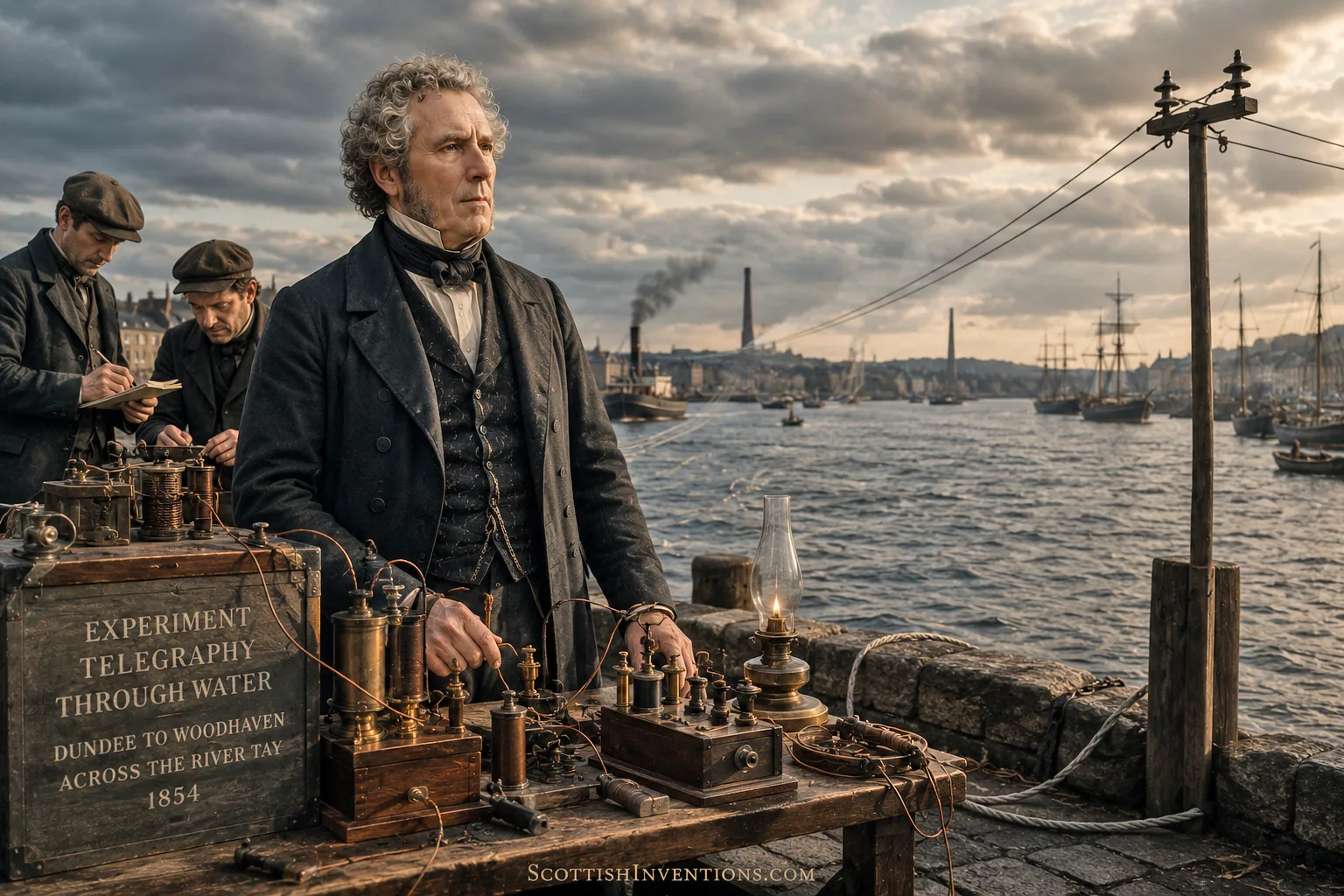
Ironically, Lindsay's better-evidenced achievements are not in lighting at all. From the 1830s he worked on transmitting signals through water without insulated submarine cables. In 1843 he proposed a transatlantic telegraph. In 1845 he described an "autograph" telegraph and proposed welding cable joints by electricity.
On 5 June 1854 he patented a method of transmitting messages "through and across a body or bodies of water", and in that same year demonstrated transmission across the Tay from Dundee to Woodhaven, a distance of nearly two miles, and again at Portsmouth. The water itself carried the current between electrodes plunged into the river on each bank. In 1859 he presented a paper, "On Telegraphing without Wires", to the British Association at Aberdeen; his experiments were commended by Lord Rosse, Michael Faraday and the Astronomer Royal Sir George Airy.
Richard Kerr later dubbed him a "Father of Wireless Telegraphy", and Marconi acknowledged his early efforts. Both should be read carefully. Lindsay's system was conduction through water, not radio — the electromagnetic wave belongs to Hertz, Marconi and J. C. Bose later in the century. And it had a fatal practical flaw: it required land lines as long as the water gap being crossed, which made it useless for an ocean. Read alongside Alexander Bain's chemical telegraph, however, Lindsay belongs in the front rank of early electrical communicators.
The Pentecontaglossal Dictionary
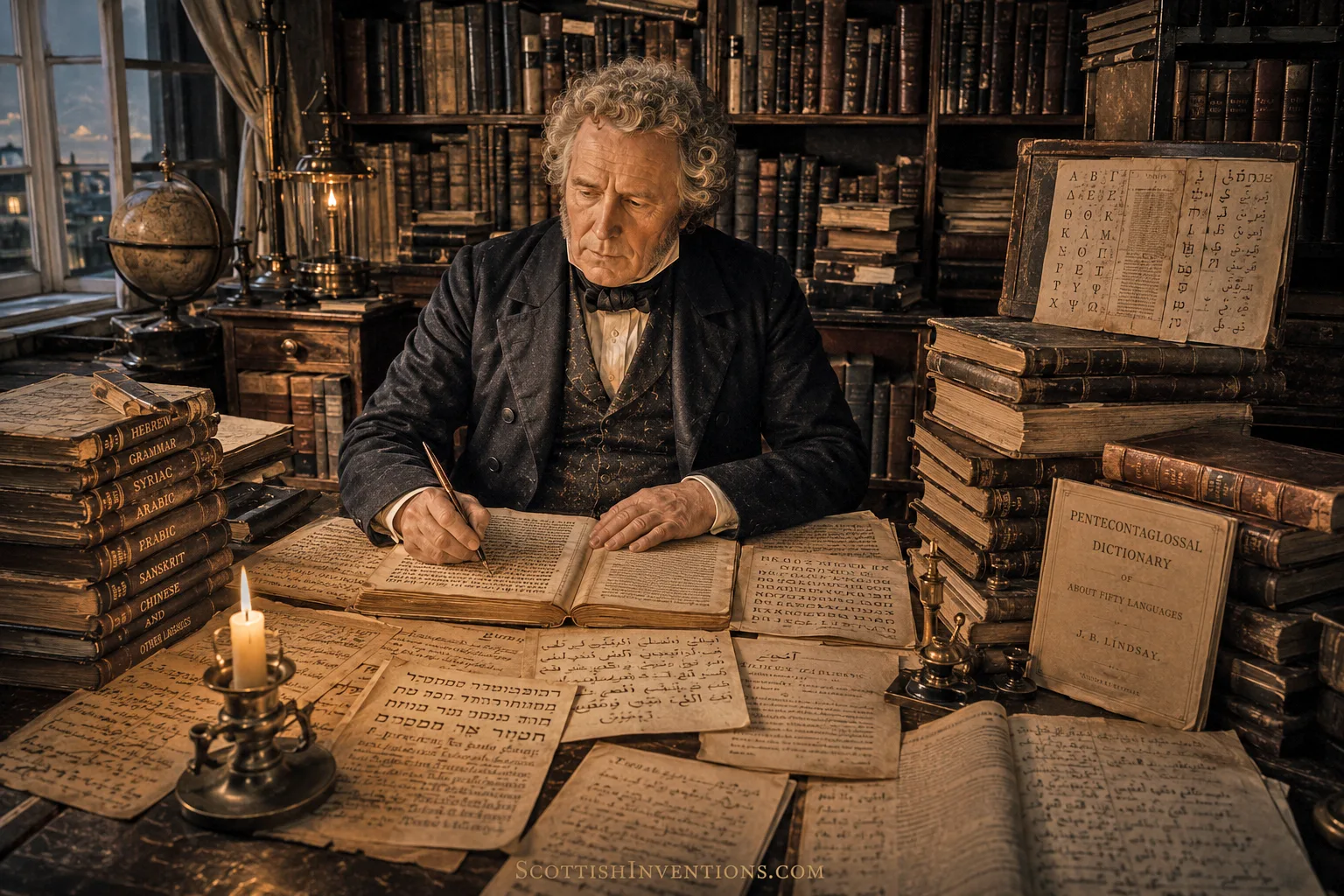
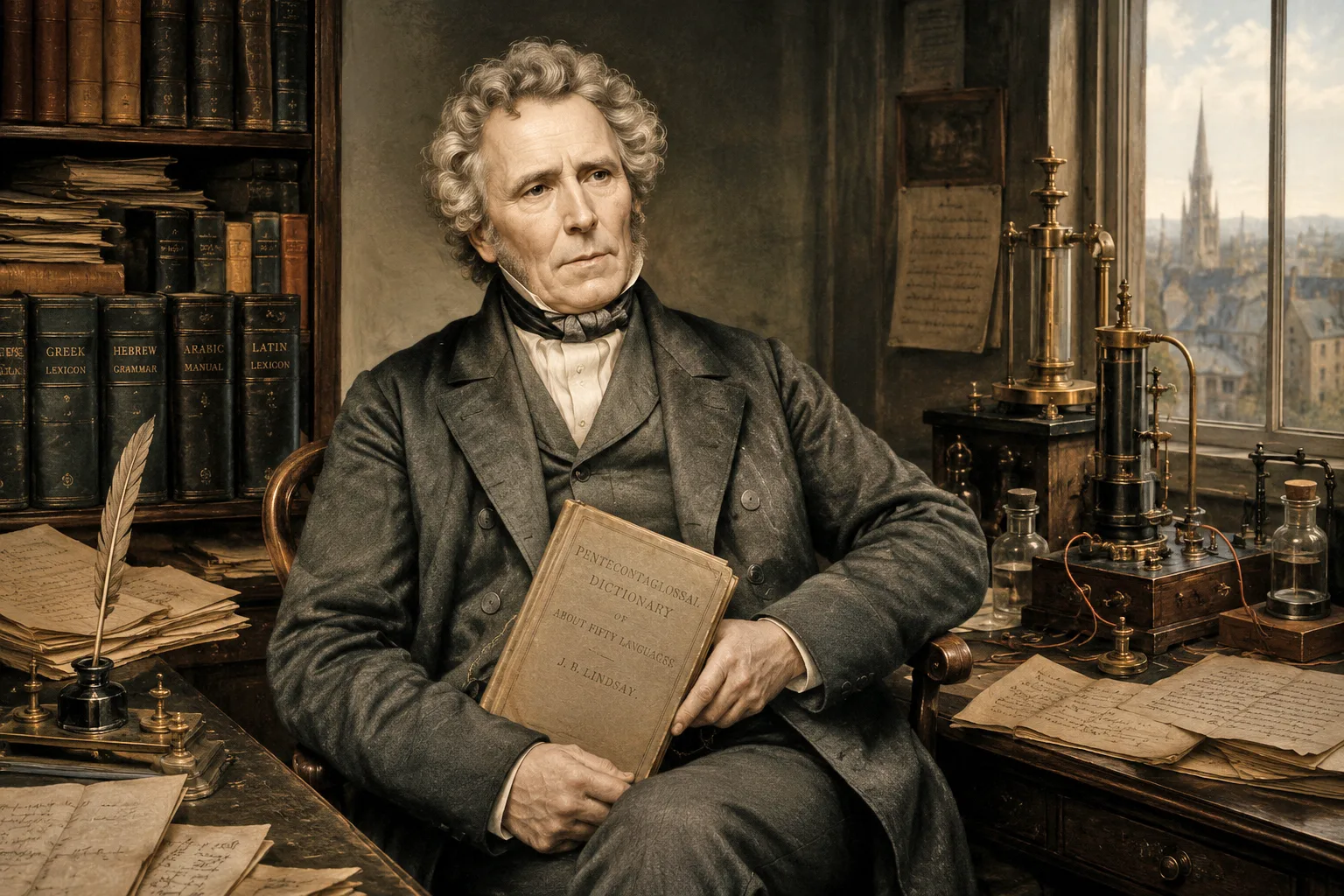
If the electric light shows Lindsay's scientific imagination, his dictionary shows the scale of his scholarship. From 1828 until his death he laboured on a vast comparative dictionary, which he hoped would illuminate the origins of humanity and corroborate scripture. Pentecontaglossal — from the Greek for "fifty tongues" — describes the target: around fifty languages, including Greek, Hebrew, Syriac, Arabic, Sanskrit, Persian and Chinese.
Sources vary on the scope, and the honest formulation is "around fifty". His 1862 obituary in the British Millennial Harbinger describes a "Dictionary of 53 Languages" begun in 1828, and notes that he had started with around 150 languages before concluding that three lifetimes would be needed and scaling the project back. Some accounts go as high as 107. He published a Pentecontaglossal Paternoster — the Lord's Prayer in fifty languages — in 1846. The unfinished manuscript is held in Dundee.
Recognition, Death and Memorial
In 1858 Lindsay published his Chrono-Astrolabe, a set of astronomical tables for fixing historical dates. In the same year, per Leisure & Culture Dundee, "In 1858, on the recommendation of Prime Minister Lord Derby, Queen Victoria granted Lindsay a pension of £100 a year" — awarded in recognition of his great learning and extraordinary attainments. He had earlier declined a post at the British Museum in order to care for his ageing mother.
He died on 29 June 1862, unmarried, and was buried in the Western Cemetery, Dundee. An obelisk topped by a bronze hand clasping a lightning conductor was raised by public subscription in 1901 and unveiled by the Postmaster General, Sir William Preece. By an odd error, the stone records his year of death as 1863. In recent years Dundee has honoured him with a bronze plaque on the city's Discovery Walk.
Myth vs Reality
| Myth | Reality |
|---|---|
| Lindsay invented the light bulb. | He demonstrated an early constant electric light in 1835, took out no lighting patent and never developed a practical lamp. |
| He was the first to make electricity glow. | Humphry Davy made a platinum strip incandesce at the Royal Institution in 1802 — a generation earlier. |
| His 1835 device was a sealed vacuum bulb with a filament. | A modern interpretation. The sources mention sealed glass jars and a glass tube without air, but also burning in the open air. The construction is unknown. |
| His light was an arc lamp. | Not established, and argued against: with plates only one inch square his battery was far too weak to sustain an arc. |
| He invented wireless telegraphy. | He patented and demonstrated conduction telegraphy through water in 1854. Radio came later, with Hertz, Marconi and Bose. |
| Lindsay's lamp survives in a museum. | No apparatus or technical drawings are known. Everything rests on newspaper reports, his letters and an 1893 autobiographical sketch. |
Did You Know?
- Lindsay reportedly read books while walking miles to Arbroath with a web of woven cloth strapped to his back.
- His demonstration of 25 July 1835 came about 44 years before Edison's famous 13½-hour bulb test of 22 October 1879.
- He was driven by safety rather than profit: he wanted a flameless light to stop the deadly fires in Dundee's jute and flax mills.
- He predicted in 1835 that electric light would one day burn "in their houses and enlightening their streets" — and that electricity was destined for mightier feats than even universal illumination.
- He declined a job at the British Museum so that he could look after his elderly mother.
- His tombstone gets his death year wrong: it says 1863, but he died in 1862.
- His grave monument is topped by a bronze hand gripping a lightning rod, a nod to his electrical work.
- His comparative dictionary was so vast that he reportedly began with around 150 languages before concluding three lifetimes would be needed, and scaled it back.
- Guglielmo Marconi personally acknowledged Lindsay's early telegraphy work.
Caveats
These are the claims this article deliberately does not make.
- "Lindsay invented the incandescent light bulb." Not supported. He demonstrated an early experimental electric light; Davy's incandescent platinum of 1802 predates him, and the practical lamp is Swan's and Edison's.
- "His 1835 device was a sealed vacuum bulb with a filament." A modern interpretation. The sources mention sealed glass jars and a glass tube without air, but also burning in the open air; the exact construction is unknown.
- "His light was an arc lamp." Not established, and the leading technical assessment argues against it on battery grounds.
- The newspaper publication date is uncertain. Sources cite 31 July 1835 (ODNB) and 7 August 1835 (Covington), probably the same report. The demonstration date of 25 July 1835 is firm; the publication date is approximate.
- The number of languages varies by source — commonly around 50, but also 53 and up to 107. This article says "around fifty" and flags the variation.
- His apparatus details, brightness and duration are undocumented beyond his own promotional descriptions. Claims of beauty, brilliance and constancy are his assertions, not verified measurements.
- "Father of Wireless Telegraphy" is an honorific from later writers, principally Richard Kerr. His system was through-water conduction, not radio.
- The Goebel 1854 claim appears here only as a cautionary parallel; US courts judged it improbable and 2007 research concluded it fictitious.
- Local-heritage and promotional sources that describe the 1835 device as "a practical, constant incandescent lamp" outrun the surviving evidence.
Timeline
- 8 Sep 1799 — Born at Cotton of West Hills, Carmyllie, near Arbroath — son of John Lindsay, farm worker and handloom weaver, and Elizabeth Bowman.
- 1821 — Matriculates at the University of St Andrews after his parents save to send him; studies mathematics, physics and theology.
- 1828 — Begins the comparative dictionary project that will occupy him for the rest of his life.
- 1829 — Appointed Science and Mathematics Lecturer at the Watt Institution, Dundee.
- 1832 — Demonstrates the principle of an electric telegraph to his students, and concludes electricity is destined for three ends: power, light and communication.
- 25 Jul 1835 — DEMONSTRATED a 'constant electric light' in Dundee — reported in the Dundee, Perth & Cupar Advertiser.
- 28 Oct 1835 — Publishes his own letter describing reading at 1½ feet and predicting domestic and street lighting.
- 1836–37 — Public lectures with demonstrations at Thistle Hall, Dundee (15 January 1836 and 21 April 1837).
- 1843 — Proposes a transatlantic telegraph.
- 1845 — Describes an 'autograph' telegraph and proposes welding cable joints by electricity.
- 1846 — Publishes the Pentecontaglossal Paternoster — the Lord's Prayer in fifty languages.
- 26 Jan 1847 — A later letter records that the 1835 model was small, 'the plates being only one inch square'.
- 5 Jun 1854 — PATENTED a method of transmitting messages through and across bodies of water; demonstrates across the Tay (Dundee to Woodhaven, nearly two miles) and at Portsmouth.
- 1858 — Publishes the Chrono-Astrolabe; granted a Civil List pension of £100 a year on Lord Derby's recommendation.
- 1859 — Presents 'On Telegraphing without Wires' to the British Association at Aberdeen; commended by Lord Rosse, Faraday and Sir George Airy.
- 29 Jun 1862 — Dies in Dundee, unmarried; buried in the Western Cemetery.
- 1893 — An autobiographical sketch is deposited at Dundee Public Library, confirming 25 July 1835 as the date.
- 1901 — Memorial obelisk unveiled by Postmaster General Sir William Preece, topped by a bronze hand clasping a lightning conductor.
Why James Bowman Lindsay Matters
Lindsay matters because his story shows a 19th-century Scottish scientific imagination at full stretch: a self-taught weaver's son, working far from London or Cambridge, who reached almost simultaneously into electric lighting, electrical communication, through-water telegraphy, theology and comparative linguistics. The fact that he never patented his light, never raised capital to commercialise it, and never finished his dictionary is part of the story too. Scottish invention is full of figures like him — visionaries who left the industrial cashing-in to others. See also William Murdoch's coal gas lighting, James Watt's centrifugal governor and Maxwell's first colour photograph.
Frequently Asked Questions
Who was James Bowman Lindsay?
A self-educated Scottish weaver's son (8 September 1799 – 29 June 1862), born at Cotton of West Hills, Carmyllie, near Arbroath. He matriculated at St Andrews in 1821 and from 1829 was Science and Mathematics Lecturer at the Watt Institution in Dundee, working on electric lighting, through-water telegraphy and comparative linguistics.
Did James Bowman Lindsay invent the light bulb?
No. He demonstrated a 'constant electric light' in 1835, decades before Swan and Edison, but he never developed a practical lamp, took out no lighting patent and left no drawings. Humphry Davy had already made platinum glow incandescently in 1802. The practical incandescent lamp belongs to Swan and Edison in 1878–79.
What happened on 25 July 1835?
On the evening of Saturday 25 July 1835 Lindsay obtained what he and the local press called a constant electric light. The Dundee, Perth & Cupar Advertiser reported it, and Lindsay's own letter of 28 October 1835 states he could write at six to eight inches' distance and read a book at a distance of one and a half feet.
How did Lindsay's electric light work?
No apparatus, drawings or detailed technical description survive. The best technical assessment — by lamp engineer and historian Edward J. Covington, preserved at the Museum of Electric Lamp Technology — concludes it was probably a crude incandescent source, most likely a platinum wire heated by a small voltaic battery, rather than a sealed vacuum filament bulb.
Was Lindsay's light an arc lamp?
Almost certainly not. Covington argues the battery was far too weak to sustain a Davy-style arc: Lindsay's own 1847 letter describes plates 'only one inch square'. Sustaining an arc across an air gap needs high voltage; heating a wire to a dim glow does not. The very low brightness he reports fits an incandescent source, not a brilliant arc.
Was James Bowman Lindsay before Edison?
Yes — by about 44 years. His demonstration of 25 July 1835 precedes Edison's 13½-hour carbonised cotton-thread test of 22 October 1879. But priority of a first glimmer is not the same as inventing a working technology, and Davy's incandescent platinum of 1802 precedes Lindsay by a generation.
Did Lindsay invent wireless telegraphy?
Not in the modern radio sense. On 5 June 1854 he patented a method of transmitting messages through and across bodies of water, and that year signalled across the Tay from Dundee to Woodhaven (nearly two miles) and at Portsmouth. This was conduction through water, not radio. Richard Kerr later called him a 'Father of Wireless Telegraphy'; that is an honorific from later writers, and should not be conflated with Marconi's work.
What was the Pentecontaglossal Dictionary?
Lindsay's comparative dictionary of around fifty languages, worked on from 1828 until his death. He published a Pentecontaglossal Paternoster — the Lord's Prayer in fifty languages — in 1846. Sources vary on the scope: commonly around 50 languages, but his 1862 obituary in the British Millennial Harbinger describes a 'Dictionary of 53 Languages', and some accounts go as high as 107.
Why did Lindsay want an electric light at all?
Safety, not profit. Dundee's jute and flax mills were notorious fire-traps, and Lindsay wanted a flameless source of illumination that could not ignite combustible dust and fibre. The 1835 newspaper report makes the pitch explicitly: the light 'seems peculiarly calculated for flax houses, spinning mills, and other places containing combustible materials'.
What recognition did Lindsay receive?
In 1858, on the recommendation of Prime Minister Lord Derby, Queen Victoria granted him a Civil List pension of £100 a year in recognition of his great learning and extraordinary attainments. He had earlier declined a post at the British Museum in order to care for his ageing mother. In 1859 he presented 'On Telegraphing without Wires' to the British Association at Aberdeen, with his experiments commended by Lord Rosse, Faraday and the Astronomer Royal Sir George Airy.
Where is James Bowman Lindsay buried?
In the Western Cemetery, Dundee. An obelisk topped by a bronze hand clasping a lightning conductor was raised by public subscription in 1901 and unveiled by the Postmaster General, Sir William Preece. By an odd error the stone records his death year as 1863; he died on 29 June 1862.
Sources
Tier 1 · Primary
- Dundee, Perth & Cupar Advertiser, late July / early August 1835 — original report of the 25 July 1835 demonstration.
- James Bowman Lindsay, letter dated 28 October 1835; further letter of 26 January 1847 ("the plates being only one inch square").
- Oxford Dictionary of National Biography — "Lindsay, James Bowman (1799–1862), experimenter with electricity and writer on theology".
- Charles Batchelor's notebook, 22 October 1879 — Rutgers Thomas Edison Papers.
- Autobiographical sketch held by Dundee Public Library (1893); obituary, British Millennial Harbinger (1862).
- Leisure & Culture Dundee — Lindsay's 1858 Civil List pension and Dundee memorials.
Tier 2 · Scholarly and institutional
- Edward J. Covington, technical assessment of Lindsay's light, Museum of Electric Lamp Technology (lamptech.co.uk).
- Robert Friedel and Paul Israel, Edison's Electric Light: Biography of an Invention.