
Ailsa Craig
Contents
TL;DR
- established Ailsa Craig is a 99-hectare eroded volcanic plug (Palaeogene pluton) rising to around 338–340 metres, geologically linked to the same period of igneous activity that shaped parts of nearby Arran — this is mapped geological fact, not local lore.
- established Ailsa Craig granite is the source material for the overwhelming majority of the world's curling stones, including those used at the Winter Olympics, because of its unusually low water absorption and resistance to repeated freeze-thaw damage — this is documented material science and supply-chain fact, not marketing exaggeration.
- established Quarrying on Ailsa Craig today is not continuous; granite is harvested only intermittently, roughly once a decade, under strict environmental restriction, with the most recent documented harvest in 2020 — this is a verified current operational fact, confirmed via fresh search rather than assumed from older or outdated reporting.
- established The island has been uninhabited since lighthouse automation in 1990, following a long history of resident quarry workers and lighthouse keepers — this is a specific, dated fact about population history.
- traditional Some older and folkloric accounts of Ailsa Craig emphasise dramatic cliff-fall survival stories and its role as a smugglers' or refuge island; such stories are repeated widely but rest on local tradition rather than verified primary documentation, and are treated here accordingly.
Key Facts
- Location/Region
- Firth of Clyde, off the Ayrshire coast, roughly 16 km from the Scottish mainland
- Scale
- 99 hectares (c. 240–245 acres), roughly 4 km in circumference, summit c. 338–340 m
- Type
- Uninhabited volcanic plug island, with lighthouse, former quarry workings, and seabird colony
- Protected/heritage status
- Site of Special Scientific Interest; RSPB-managed bird sanctuary (lease through 2050); lighthouse a recognised Northern Lighthouse Board structure
- Managed/owned by
- Owned by the Marquess of Ailsa (Kennedy family, Earls/Marquesses of Cassillis/Ailsa since the 16th century); leased to RSPB; granite quarrying rights held exclusively by Kays of Scotland
- Access notes
- No scheduled public ferry; accessible mainly by private boat charter or occasional wildlife-tour boat from Girvan; landing restricted around seabird breeding season
Scottish Impact Index (SI Score)
- National Significance
- 7/10
- Historical Continuity
- 9/10
- Human & Economic Importance
- 5/10
- Landscape / Architectural Distinctiveness
- 10/10
- Cultural & Historical Legacy
- 8/10
- Recognition
- 8/10
47/60
Ranked =41st of 43 in Locations
A Note on Claims and Evidence
Ailsa Craig's geology, lighthouse history, current ownership, and the operational facts of its curling-stone granite supply chain are documented: they rest on geological survey, Northern Lighthouse Board and RSPB record, and recent, specific industry and news reporting (including coverage tied to the 2026 Winter Olympics) that this article has verified through current search rather than relying on potentially outdated assumptions. Some of the island's colourful incidental stories — survival tales, smuggling associations — are traditional, repeated widely in tourism and local-history writing but without the same level of primary documentation, and are flagged as such.
Timeline
Ailsa Craig forms as an igneous intrusion (pluton), part of the same broad period of volcanic activity that also shaped igneous features on nearby Arran; subsequent erosion strips away surrounding softer rock, leaving the resistant granite plug exposed as an island.
Ownership of the island passes to the Earls, later Marquesses, of Cassillis/Ailsa (the Kennedy family), who retain ownership (with limited exceptions) into the present day.
Kittiwakes and their eggs are taken in large numbers on the island, alongside an older cull of gannets.
Quarrying of Ailsa Craig granite for curling stones becomes established; Kays of Scotland, founded 1851, becomes central to the industry and eventually holds exclusive quarrying rights.
The lighthouse is constructed by Thomas Stevenson for the Northern Lighthouse Board, with roughly 2 hectares of the island sold for the purpose.
The lighthouse is automated; the island becomes permanently uninhabited.
A pioneering rat eradication programme is carried out on the island, allowing puffin populations to recover.
The lighthouse is converted to solar-electric power.
The most recent documented harvest of curling-stone granite takes place, continuing the roughly once-a-decade extraction pattern.
The island is managed as a bird sanctuary under long-term RSPB lease, shaping and restricting all quarrying and access activity.
Ailsa Craig granite curling stones are used at the Winter Olympics, renewing international public attention on the island's unique supply role.
Details
A volcanic plug in the Firth of Clyde
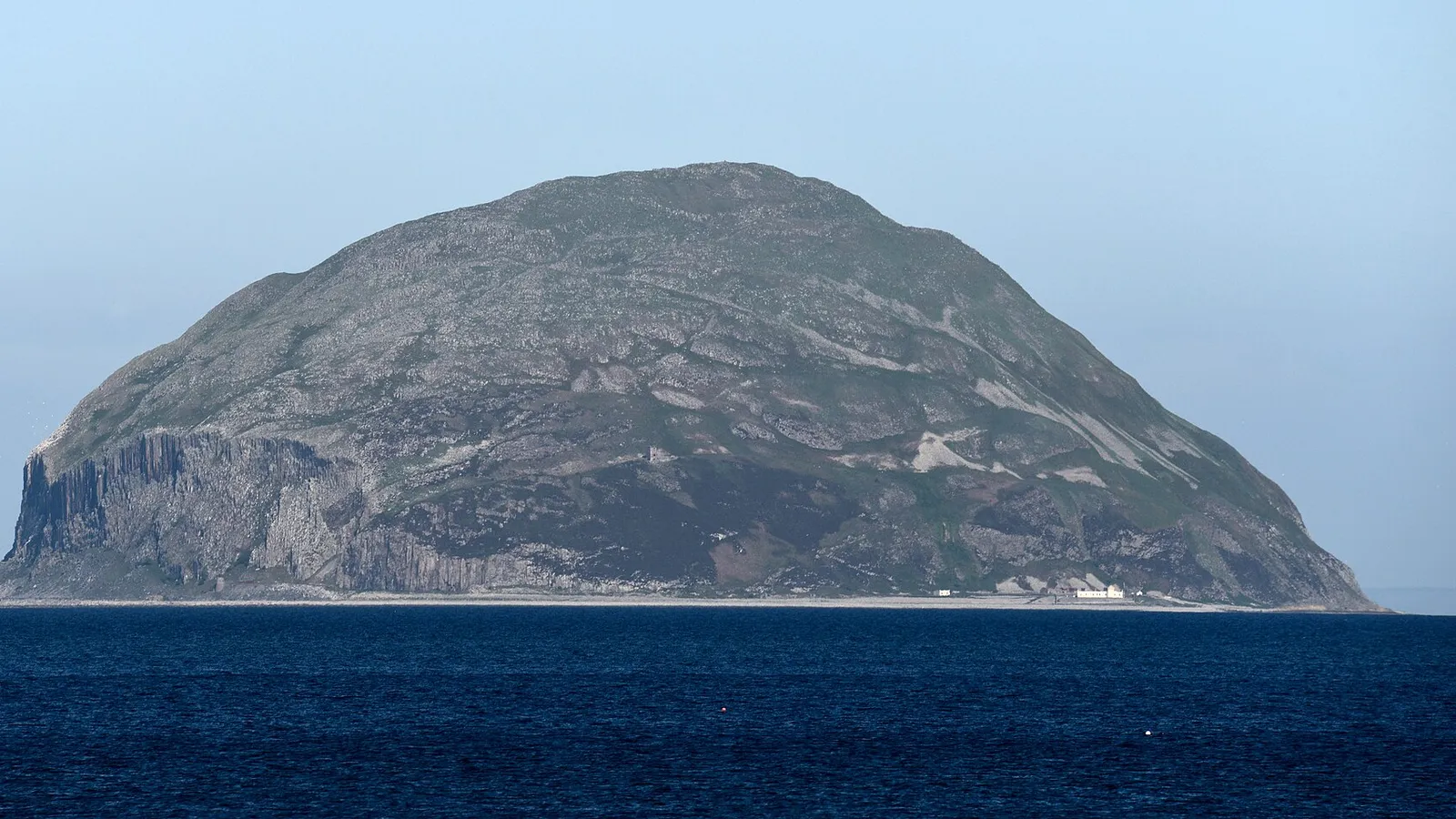
Ailsa Craig is the eroded remnant of a Palaeogene igneous intrusion, formed during the same broad episode of volcanic activity that also produced igneous features on the nearby Isle of Arran, some 25 kilometres to the northeast. As the surrounding, softer rock eroded away over tens of millions of years, the far more resistant microgranite core remained, standing today as a dramatic, steep-sided island rising to around 338–340 metres — officially classified as a "Marilyn" (a hill with sufficient relative height and prominence) despite its modest overall footprint of just 99 hectares. Its distinctive, almost conical silhouette, visible from much of the Ayrshire and Kintyre coastline, has made it one of the most immediately recognisable small islands in the Firth of Clyde.
The granite that plays the Winter Olympics
Ailsa Craig's single most distinctive claim to global relevance has nothing to do with its history and everything to do with its mineralogy. The island's granite occurs in two named varieties relevant to industry — "Common Green" and the higher-quality "Blue Hone" — both notable for unusually low water absorption and a resistance to the freeze-thaw cycling that would otherwise crack and erode a stone used repeatedly on ice. This combination of low porosity and durability under sustained cold and impact makes Ailsa Craig granite close to ideal for curling stones, and it remains, to this day, the source material for the overwhelming majority of the world's competition curling stones, including those used at the Winter Olympics.
It is worth being precise about how this supply actually works today, since popular accounts sometimes imply ongoing, routine quarrying. In practice, granite is not continuously extracted. Kays of Scotland, the manufacturer founded in 1851 and holder of exclusive rights to Ailsa Craig granite, harvests stone only intermittently — roughly once per decade — with the most recently documented harvest having taken place in 2020. Quarrying is tightly constrained by the island's status as an RSPB-managed seabird sanctuary: blasting is not used, and any extraction work is scheduled outside the seabird breeding season, generally between September and November. This is a supply chain built on a carefully managed stockpile model rather than active, continuous mining, a distinction worth making clearly rather than leaving readers with the impression of an ongoing industrial quarry.
Lighthouse, keepers, and a now-empty island
Ailsa Craig's only substantial built structure is its lighthouse, constructed between 1883 and 1886 by engineer Thomas Stevenson (father of Robert Louis Stevenson) for the Northern Lighthouse Board, on roughly two hectares of land sold off from the Kennedy family's long-standing ownership of the rest of the island. For over a century the lighthouse required resident keepers, alongside quarry workers who lived seasonally or semi-permanently on the island to work the granite. That resident population disappeared entirely with the lighthouse's automation in 1990, after which the island became, and has remained, permanently uninhabited. The light itself was later converted to solar-electric power in 2001, removing the need for any further staffing even for maintenance visits on a frequent basis.
Seabirds, conservation, and a cleared-out predator
With people gone, Ailsa Craig's ecological identity has become overwhelmingly defined by its enormous seabird colonies, particularly a large nesting population of gannets, alongside puffins and other species. A significant conservation intervention took place in 1991, when a pioneering rat eradication programme removed an invasive predator population that had been suppressing ground-nesting seabirds, particularly puffins, whose numbers subsequently recovered. The island is now leased to the RSPB as a managed bird sanctuary through 2050, a designation that directly shapes — and restricts — the terms under which Kays of Scotland is permitted to carry out its periodic granite harvests, making Ailsa Craig an unusual case of an active global sporting-goods supply chain operating entirely within the constraints of a conservation lease.
A seabird larder
established Before it was a sanctuary, Ailsa Craig's seabirds were a crop. Mark Cocker and Richard Mabey, in Birds Britannica (2005), record that gannets were culled on the island, as on the Bass Rock and St Kilda, and that in the nineteenth century kittiwakes and their eggs were taken in large quantities at "ancient breeding stations like Ailsa Craig". The kittiwake was thought good eating: the seventeenth-century Scottish naturalist Sir Robert Sibbald judged its flesh "as good as a partridge". The book gives no figures for the Ailsa harvest, so its scale is not known from this source.
established The island's smaller residents are notable too. Birds Britannica uses Ailsa Craig, along with St Kilda, as an example of how wrens find enough habitat even on a tiny isolated rock, where their breeding neighbours are seabirds rather than garden birds.
Ownership, access, and a landmark rarely visited up close
Ownership of Ailsa Craig has remained remarkably stable by Scottish landholding standards: the island has belonged to the Earls, and later Marquesses, of Cassillis/Ailsa (the Kennedy family) since the sixteenth century, with the sole significant exception being the small parcel sold to the Northern Lighthouse Board in the 1880s. As of recent record, ownership sits with David Kennedy, 9th Marquess of Ailsa. Despite its visibility from the mainland and its global sporting-goods fame, Ailsa Craig has no scheduled public ferry service; visiting generally requires chartering a private boat or joining an occasional wildlife-focused tour sailing from Girvan, with landings further restricted around the seabird breeding season. For most people, Ailsa Craig remains something seen from a distance — a striking silhouette on the horizon, and an improbable but very real source of the granite under every Olympic curling stone — rather than a place actually visited.
Did You Know?
- Almost every curling stone used at the Winter Olympics is made from granite quarried on this single small Scottish island.
- Granite is harvested from Ailsa Craig only about once a decade, not continuously — the most recent documented harvest was in 2020.
- Quarrying cannot use blasting and is scheduled outside the seabird breeding season to protect the island's gannet and puffin colonies.
- Ailsa Craig has had no permanent human residents since its lighthouse was automated in 1990.
- A 1991 rat eradication programme on the island allowed its puffin population to recover.
- The same family, the Kennedys (Earls/Marquesses of Cassillis/Ailsa), has owned Ailsa Craig since the sixteenth century, with only a tiny exception for the lighthouse site.
- Ailsa Craig's lighthouse was built by Thomas Stevenson, father of novelist Robert Louis Stevenson.
- Gannets were once culled on Ailsa Craig, and in the nineteenth century kittiwakes and their eggs were taken there in large numbers.
- The island is geologically linked to the same volcanic activity that shaped parts of the nearby Isle of Arran, despite the two looking nothing alike today.
FAQ
1Is Ailsa Craig inhabited?
No, it has been uninhabited since its lighthouse was automated in 1990.
2Why is Ailsa Craig granite used for curling stones?
Its low water absorption and resistance to freeze-thaw damage make it unusually durable for repeated use on ice, and it remains the source for the overwhelming majority of Olympic and competition curling stones.
3Is the quarry on Ailsa Craig still active?
Not continuously — granite is harvested only roughly once a decade under strict environmental controls, with the most recent documented harvest in 2020.
4Who owns Ailsa Craig?
The Marquess of Ailsa (the Kennedy family), who have held the island since the sixteenth century, with the lighthouse site itself sold separately to the Northern Lighthouse Board in the 1880s.
5Who manages the wildlife on Ailsa Craig?
The RSPB, which leases the island as a managed bird sanctuary through 2050.
6Can you visit Ailsa Craig?
There is no scheduled public ferry; visits require a private boat charter or an occasional wildlife tour, usually from Girvan.
7How tall is Ailsa Craig?
Around 338–340 metres at its summit.
8How big is Ailsa Craig?
About 99 hectares (240–245 acres), roughly 4 km in circumference.
9What kind of rock is Ailsa Craig made of?
Microgranite, specifically riebeckite microgranite, the eroded remains of a Palaeogene igneous intrusion.
10Who manufactures curling stones from Ailsa Craig granite?
Kays of Scotland, a company founded in 1851 that holds exclusive rights to the island's granite.
11Were rats ever a problem on the island?
Yes — an invasive rat population suppressed ground-nesting seabirds until a successful eradication programme in 1991.
12Were Ailsa Craig's seabirds ever harvested?
Yes. Gannets were culled there, and in the nineteenth century kittiwakes and their eggs were taken in large quantities, according to Birds Britannica (2005).
13Is Ailsa Craig visible from the mainland?
Yes, its distinctive silhouette is a well-known landmark visible from much of the Ayrshire and Kintyre coastline.
Sources and Further Reading
Primary/Institutional
- NatureScot — Ailsa Craig Site of Special Scientific Interest citation
- RSPB — Ailsa Craig nature reserve management information
- Northern Lighthouse Board — Ailsa Craig lighthouse record
Scholarly/Critical
- Mark Cocker and Richard Mabey, Birds Britannica (Chatto & Windus, 2005)
- Sedgwick Museum, University of Cambridge — "Riebeckite Microgranite in Curling Stones"
- Scientific American — "The quirky geology behind Olympic curling stones"
General
- Wikipedia — "Ailsa Craig"
- Team GB — "Ailsa Craig: everything you need to know about where Olympic curling stones are made"
- NBC News — coverage of Ailsa Craig granite and the 2026 Winter Olympics
Caveats: Myths and Disputed Claims
- Do not describe Ailsa Craig's granite quarrying as an ongoing, continuous industrial operation — current, verified reporting indicates harvesting happens only roughly once a decade, most recently in 2020, under strict environmental limits. Correct phrasing: "harvested periodically, under tightly controlled conditions."
- Do not state that Ailsa Craig has permanent residents or a resident lighthouse keeper today — the island has been uninhabited since automation in 1990. Correct phrasing: "formerly inhabited by quarry workers and lighthouse keepers; now permanently uninhabited."
- Do not present dramatic survival legends (such as cliff-fall stories) as verified historical fact — treat them as local tradition. Correct phrasing: "local tradition recounts..."
- Do not imply Ailsa Craig's granite is used for all curling stones worldwide without qualification — it supplies the overwhelming majority of competition-grade stones, but phrasing should avoid absolute universality unless a source states it precisely that way.
Card 026 · Locations