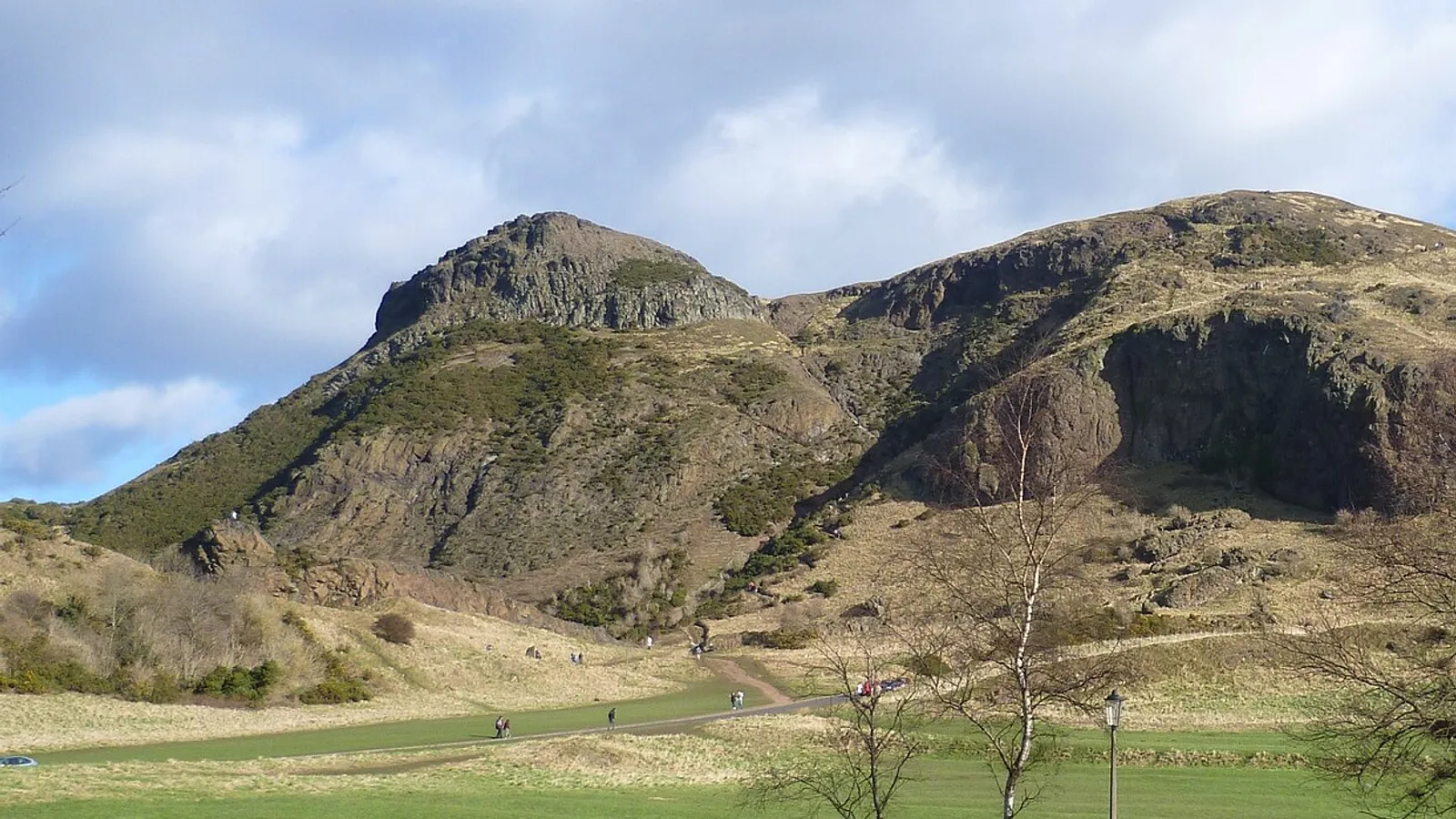

Arthur's Seat & Salisbury Crags
Contents
Legend/Myth Opener
Arthur's Seat is often described loosely as "an extinct volcano in the middle of Edinburgh," as though it were a single simple cone. The reality, confirmed by detailed geological mapping, is a complex of at least five separate volcanic vents and multiple intrusive rock bodies, only fully understood as a coherent system through 19th- and 20th-century fieldwork — and its most scientifically important feature, Salisbury Crags, is not a volcanic vent at all but an intruded sill that happened to become one of the most consequential rock exposures in the history of science.
TL;DR
- established Arthur's Seat is the eroded remnant of a volcanic complex active roughly 340 million years ago during the early Carboniferous period, comprising at least five distinct vents — stated precisely because "an extinct volcano" alone understates its structural complexity.
- established Salisbury Crags is a sill — an intrusion of molten rock that forced its way between existing rock layers rather than erupting at the surface — and its exposed section was directly studied by James Hutton in the late 18th century as key evidence for his theory of deep geological time — this is stated directly because it is one of the most consequential individual rock exposures in the history of science, not merely a scenic cliff.
- established At 251 metres, Arthur's Seat is a modest hill by almost any mountain standard, yet it offers one of the most complete short-walk geological teaching sites in Britain — stated directly to correct any impression that its scientific importance tracks its height.
- traditional The hill's name is popularly linked to the Arthurian legend, but the etymology is genuinely disputed among linguists, with several competing explanations in circulation and no single confirmed origin — this is flagged as traditional/disputed rather than settled fact.
- established The whole of Holyrood Park, including both Arthur's Seat and Salisbury Crags, is a Scottish royal park managed by Historic Environment Scotland, not an unmanaged wild space, despite sitting in the middle of Edinburgh and often being described in "wild nature in the city" terms.
Key Facts
- Location/Region
- Holyrood Park, central Edinburgh, Scotland
- Height/Area/Scale
- Arthur's Seat summit: 251 m; Holyrood Park covers c. 260 hectares (c. 650 acres); Salisbury Crags: a cliff line roughly 1 km long
- Geology/Formation
- Carboniferous-age (c. 340 million years ago) volcanic complex with at least five vents; Salisbury Crags is a teschenite sill of slightly later (Namurian) age, later cut by a Stephanian-age quartz-dolerite dyke; landscape heavily reshaped by Pleistocene glaciation, producing crag-and-tail structure
- Protected status
- Holyrood Park is a Scottish royal park; parts carry Site of Special Scientific Interest status for geological and ecological interest
- Managed/Owned by
- Historic Environment Scotland, on behalf of the Crown
- Access notes
- Well-maintained paths to the summit and along Salisbury Crags are accessible to most reasonably fit visitors in under two hours round trip from the city centre; some sections of path are closed periodically for rockfall safety or restoration
Scottish Impact Index (SI Score)
- National Significance
- 8/10
- Historical Continuity
- 9/10
- Human & Economic Importance
- 8/10
- Landscape / Architectural Distinctiveness
- 10/10
- Cultural & Historical Legacy
- 9/10
- Recognition
- 10/10
54/60
Ranked =20th of 43 in Locations
A Note on Claims and Evidence
This article tiers claims as documented (the Carboniferous volcanic dating, the multi-vent structure, Salisbury Crags' identity as a sill, the direct historical link to James Hutton's fieldwork, current ownership and management), traditional (long-circulated but not fully settled explanations, including name etymology theories), and legend-myth (claims with no solid evidential basis, including literal Arthurian associations with the hill, which rest on folk etymology rather than documented historical connection to any Arthurian narrative). Given the site's foundational role in the history of geology, this article is unusually careful to distinguish observed rock evidence from inferential or romantic narrative layered on top of it.
Timeline
Volcanic activity produces the vent complex that forms the core of what becomes Arthur's Seat; a later intrusive sill forms what becomes Salisbury Crags.
A quartz-dolerite dyke cuts through the Salisbury Crags sill, adding a further intrusive event to the rock sequence.
Ice moving west to east sculpts the volcanic remnants into their present crag-and-tail form, with steep west-facing cliffs and gentler eastern slopes.
A hillfort is established on Arthur's Seat, among the earliest confirmed human use of the hill as a defensive or settlement site.
James Hutton conducts fieldwork at Salisbury Crags, using the clear intrusive relationship visible there between igneous and sedimentary rock as key evidence for his theory of a vastly ancient Earth shaped by slow, ongoing geological processes — a cornerstone of what became modern geological science.
Holyrood Park is formally developed as a royal park with managed paths and boundaries, alongside continuing quarrying pressure on Salisbury Crags that eventually prompts conservation intervention.
Holyrood Park and its geological sites receive SSSI recognition; the park remains a Crown property managed by Historic Environment Scotland, with Arthur's Seat one of Edinburgh's most visited urban green spaces.
Details
Geological formation
Arthur's Seat is the eroded remnant of a volcanic system active around 340 million years ago, during the early Carboniferous period, when much of what is now central Scotland sat near the equator in a tropical, volcanically active setting very different from its present climate. Detailed geological mapping has identified at least five separate vents within the complex — commonly named Lion's Head, Lion's Haunch, Castle Rock, Pulpit Rock, and Crags Vent — along with associated cone deposits, sills, and dykes, making the site considerably more structurally complex than the popular shorthand "an extinct volcano" suggests. Salisbury Crags, the long cliff line running along the park's western edge, is geologically distinct from the vent complex itself: it is a sill, a sheet of magma that was forced laterally between existing layers of sedimentary rock rather than erupting at the surface, composed of a rock type called teschenite. A later intrusive event, a quartz-dolerite dyke of Stephanian age, cuts across this sill, adding a further layer to the rock's intrusive history. All of this ancient volcanic structure was then dramatically reshaped during the most recent Ice Age: as ice sheets moved west to east across the landscape, they plucked and scoured the softer surrounding rock away while leaving the harder volcanic material more intact, producing the classic "crag and tail" landform visible today — steep, ice-scoured cliffs facing west, with a long, gentler slope of glacial debris trailing to the east.
Human history and the birthplace of geology
Arthur's Seat carries a long record of human use, including an Iron Age hillfort among the earliest confirmed occupation evidence on the hill, reflecting its long-standing value as a defensible high point overlooking the Firth of Forth and the site of what became Edinburgh. But the site's most consequential human history is scientific rather than military or settlement-based. Salisbury Crags became, in the late 18th century, one of the most important field sites in the history of Western science, when the Edinburgh-based natural philosopher James Hutton studied the exposed rock there — a section still referred to today as Hutton's Section. What Hutton observed was a clear physical relationship between the intrusive igneous sill and the sedimentary rock layers it had forced its way between: evidence that molten rock had been injected into already-existing, already-layered rock long after that rock had formed, meaning the Earth's processes operated over timescales vastly longer than the few thousand years then commonly assumed. This observation fed directly into Hutton's broader theory of uniformitarianism — that the same slow geological processes observable today have operated consistently over immense spans of time — a foundational idea of modern geology, developed further in his 1795 work "Theory of the Earth." Hutton himself is the subject of fuller biographical treatment elsewhere in this collection, and this article accordingly keeps its focus on the Salisbury Crags site itself rather than duplicating a complete account of his life and wider scientific contribution. Quarrying pressure on Salisbury Crags in the 19th century, driven by demand for the hard igneous rock as building material, eventually prompted conservation intervention to protect the site, an early example of heritage protection responding to industrial land use within what was by then an increasingly urbanised royal park.
Ecology and distinctive natural features
Holyrood Park's varied terrain — crags, grassland, small lochs (Dunsapie Loch and St Margaret's Loch), and gorse-covered slopes — supports a surprising range of habitat for a site entirely surrounded by a capital city, including breeding birds on the crags and a notable concentration of gorse that gives the park much of its summer colour. The park's SSSI designation recognises both its geological significance and elements of its ecology, an unusual combination for an urban green space of this size.
National identity, recreation, and tourism
Arthur's Seat functions today as one of Edinburgh's most climbed urban landmarks, offering panoramic views over the city, the Firth of Forth, and the Pentland Hills to visitors willing to undertake a straightforward but genuinely uphill walk of around an hour from the city centre. Its accessibility — a substantial hill summit reachable on a lunch break from the Royal Mile — gives it a different cultural role from the other, more remote landscapes in this collection: it is simultaneously a serious geological site of international scientific importance and one of the most casually used recreational green spaces in urban Scotland, a duality the park's management under Historic Environment Scotland deliberately preserves through accessible paths alongside protected geological exposures.
Did You Know?
- Arthur's Seat is not a single volcanic cone but the eroded remnant of at least five separate volcanic vents.
- Salisbury Crags, not Arthur's Seat's summit, is the site's most scientifically important feature: a sill studied directly by James Hutton in developing his foundational theory of deep geological time.
- The rock exposure Hutton studied is still known today as Hutton's Section, a recognised site in the history of science.
- At only 251 metres, Arthur's Seat is far lower than most "mountain" landscapes in this collection, yet it is one of the most internationally significant single geological sites in Britain.
- The hillside's distinctive "crag and tail" shape — steep west-facing cliffs, gentle eastern slope — is a direct signature of the direction Ice Age glaciers moved across the landscape.
- An Iron Age hillfort occupied Arthur's Seat long before Edinburgh existed as a city around it.
- The exact origin of the name "Arthur's Seat" remains genuinely disputed among linguists; the popular Arthurian legend connection is one of several competing, unproven theories.
- Quarrying once threatened to industrially remove parts of Salisbury Crags before conservation measures intervened in the 19th century.
FAQ
1How tall is Arthur's Seat?
251 metres, a modest height easily climbed by most reasonably fit visitors in under an hour each way.
2Is Arthur's Seat a real volcano?
It is the eroded remains of a volcanic complex active around 340 million years ago; it has been extinct for that entire span and poses no eruption risk.
3What is Salisbury Crags?
A cliff of intruded igneous rock (a sill) along the western edge of Holyrood Park, famous as the site where James Hutton gathered key evidence for his theory of deep geological time.
4Why is Salisbury Crags called the "birthplace of geology"?
Because James Hutton's observations there of igneous rock intruded into older sedimentary layers provided crucial physical evidence for his uniformitarian theory of a vastly ancient Earth, a foundational idea in modern geological science.
5Can you walk up Arthur's Seat from the city centre?
Yes — it is a roughly hour-long walk from the Royal Mile/Holyrood area, one of the most accessible hill summits located inside any capital city in the world.
6Is Arthur's Seat difficult to climb?
The main paths are steep in places but not technical; sturdy footwear is recommended, and conditions can be slippery after rain.
7Who owns Holyrood Park?
It is a Scottish royal park, managed on behalf of the Crown by Historic Environment Scotland.
8Does the name "Arthur's Seat" come from King Arthur?
This is a popular but unproven theory; the name's true etymology is disputed among linguists, with several competing explanations and no single confirmed origin.
9What is the best time to visit Arthur's Seat?
Early morning or late afternoon for quieter paths and good light; the summit can be very windy, so appropriate clothing is advised year-round.
10Is there parking at Holyrood Park?
Limited parking exists around the park; most visitors arrive on foot from central Edinburgh or by public transport.
11What other features are in Holyrood Park besides Arthur's Seat?
Salisbury Crags, Dunsapie Loch, St Margaret's Loch, and the ruined St Anthony's Chapel are all within the park.
12Is there an Iron Age site on Arthur's Seat?
Yes — a hillfort occupies part of the hill, among the earliest confirmed evidence of human use of the site.
Sources and Further Reading
Primary/Institutional
- Historic Environment Scotland — Holyrood Park management and heritage information
- British Geological Survey (Earthwise) — Arthur's Seat geological guide
- NatureScot — SSSI documentation for Holyrood Park
Scholarly/Critical
- Scottish Geology Trust — Geological Conservation Review site documentation for Arthur's Seat and Salisbury Crags
- Historical and scientific literature on James Hutton's fieldwork and the development of uniformitarian theory
General
- Edinburgh Geological Society — Hutton's Section and Edinburgh geological heritage resources
- VisitScotland / Visit Edinburgh — Holyrood Park and Arthur's Seat visitor information
Caveats: Myths and Disputed Claims
- Do not describe Arthur's Seat as a single simple volcanic cone; it is a complex of at least five identified vents plus associated sills and dykes.
- The connection between the hill's name and the Arthurian legend should be presented as disputed/traditional, not as a settled etymology — credible alternative linguistic theories exist.
- Avoid characterising Holyrood Park as "wild" or unmanaged urban nature; it is an actively managed Crown property with maintained paths, conservation interventions, and periodic safety closures.
- Salisbury Crags' significance should not be reduced to "a nice viewpoint" — its primary importance in this collection's framing is its direct evidentiary role in the founding of modern geological science via James Hutton's fieldwork.
- Avoid duplicating a full biography of James Hutton on this card; a separate card in this collection addresses his life and scientific contribution in full, and this entry should cross-reference rather than repeat that content.
Card 015 · Locations