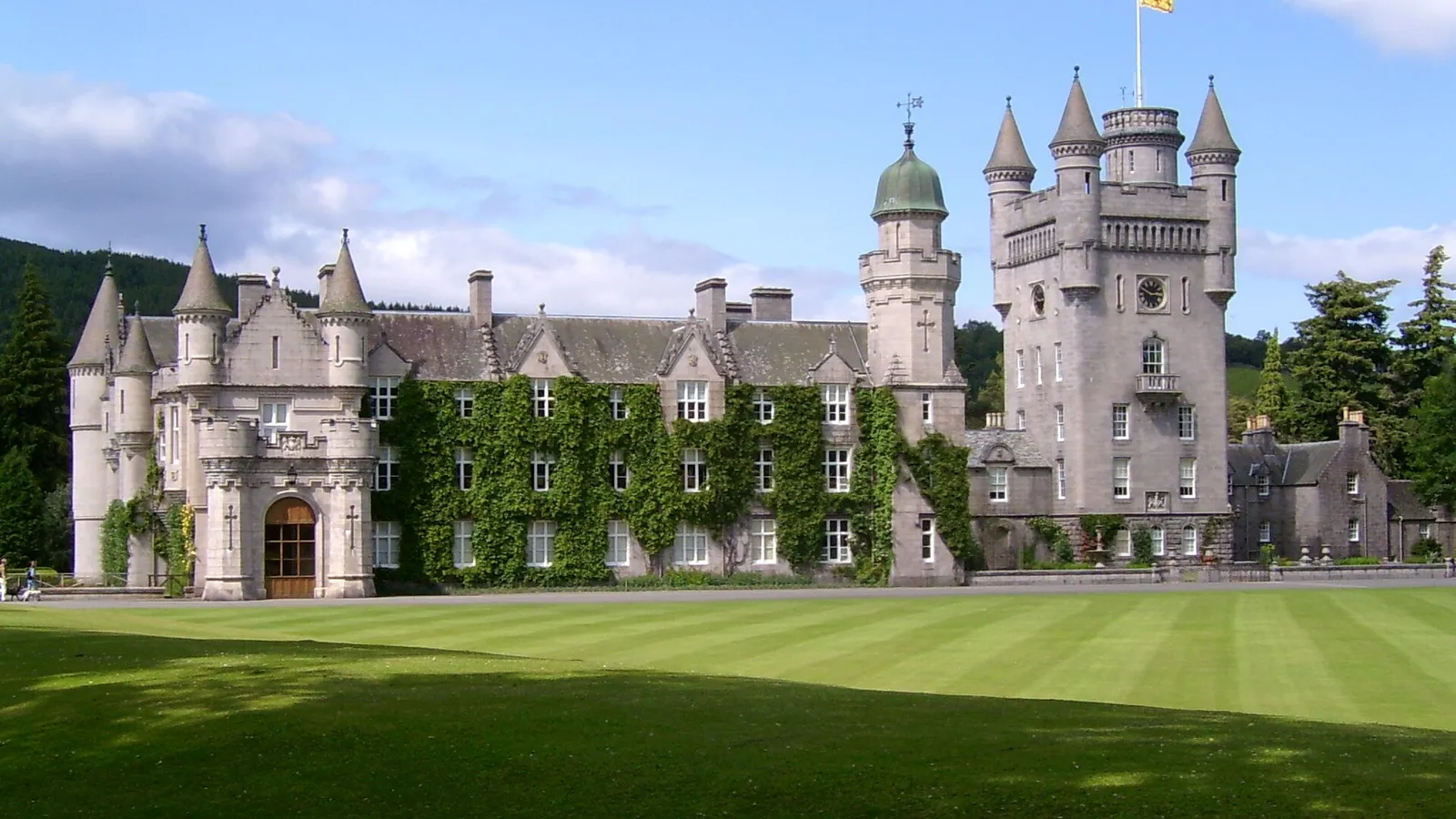

Balmoral Castle & Royal Deeside
Contents
Isn't Balmoral part of the Crown Estate, like Buckingham Palace? No — this is one of the most persistently misunderstood facts about the British monarchy's property: Balmoral is private property, bought outright in the 1850s, and its income belongs to the Monarch personally, not to the public purse.
TL;DR
- established Prince Albert purchased the Balmoral estate from the Farquharson family in 1852 for around £32,000 — this is documented in estate conveyance records and contemporary accounts.
- established Balmoral is the private property of the Monarch (currently King Charles III), not held by the Crown Estate — a legal distinction confirmed by official royal household and Crown Estate sources, and one frequently misstated in popular media.
- established The present castle, built in the Scottish Baronial style by architect William Smith with amendments by Prince Albert, was completed in 1856 on a new site near the original house — recorded in building accounts and architectural history.
- traditional Victoria and Albert's attraction to Deeside is widely said to rest partly on its resemblance to Thuringia, Albert's German homeland — a motivation recorded in royal correspondence and biography rather than an official institutional statement, so treated here as well-attested personal testimony rather than bare institutional fact.
- established Public access remains limited: grounds open seasonally, and interior tours of a small number of rooms began only in 2024, nearly 170 years after the castle's completion — a matter of current, verifiable visitor policy.
Key Facts
- Location
- Royal Deeside, near Crathie, Aberdeenshire, Scotland
- Era/Period
- Estate purchased 1852; present castle completed 1856
- Type
- Private royal residence and working Highland estate
- Managed/Owned by
- Private property of the reigning Monarch (King Charles III); NOT part of the Crown Estate
- Visitor status
- Grounds and limited interior rooms open seasonally (April–July, with 2024 expansion to interior tours); private residence otherwise, closed during royal family use
- Architectural style
- Scottish Baronial, built in local granite
Scottish Impact Index (SI Score)
- National Significance
- 9/10
- Historical Continuity
- 8/10
- Human & Economic Importance
- 8/10
- Landscape / Architectural Distinctiveness
- 10/10
- Cultural & Historical Legacy
- 9/10
- Recognition
- 10/10
54/60
Ranked =20th of 43 in Locations
A Note on Claims and Evidence
Balmoral's history is comparatively well documented thanks to royal household records, architectural accounts, and extensive biographical material on Victoria and Albert, but it is also one of the more mythologised royal properties in popular media, particularly regarding its ownership structure. The documented tier covers the 1852 purchase, the 1853–56 rebuilding under William Smith, and the castle's precise legal status as private property outside the Crown Estate — all independently verifiable through conveyancing and official royal household statements. The traditional tier covers personal motivations and family lore — such as the Thuringia comparison — recorded in letters and biography rather than formal institutional documentation. This card is careful to state the private-ownership fact plainly, since it is frequently and incorrectly conflated with Crown Estate or state-owned royal palaces in general coverage.
Timeline
Victoria and Albert first lease Balmoral, an existing smaller house on the estate.
Prince Albert purchases the Balmoral estate outright from the Farquharson family for approximately £32,000.
On her first visit to Balmoral, Queen Victoria commissions Edwin Landseer's Royal Sports on Hill and Loch, first exhibited at the Royal Academy in 1854.
Construction begins on a new, larger castle; Queen Victoria lays the foundation stone in September.
New castle completed in the Scottish Baronial style, designed by William Smith of Aberdeen with amendments by Prince Albert.
The Braemar Gathering is held at Balmoral at the Queen's invitation; it returns in 1890, 1898 and 1899.
Prince Albert dies; Balmoral becomes closely associated with Victoria's long widowhood and continued attachment to Deeside.
Balmoral becomes an established annual retreat for the reigning monarch and royal family, particularly in late summer and autumn.
Grounds and limited areas (notably the ballroom) opened seasonally to the public, typically April to July.
The neighbouring Mar Lodge estate is put up for sale; the National Trust for Scotland acquires it on 30 June 1995.
Queen Elizabeth II dies at Balmoral, having spent her final months there.
For the first time since the castle's completion, limited public tours of interior rooms are introduced.
Remains private property of King Charles III; continues as a working Highland estate and the royal family's traditional late-summer/autumn residence.
Details
Purchase and private ownership
Balmoral's origins as a royal residence begin not with the Crown but with a private family purchase. Victoria and Albert first leased an existing, smaller house on the estate from 1848, and found the surrounding Deeside landscape appealing enough that Albert bought the entire estate outright from the Farquharson family in 1852 for roughly £32,000. This detail of private purchase is not incidental: it is the legal basis for a fact many popular accounts get wrong. Balmoral is the personal, private property of the reigning Monarch — currently King Charles III — and is explicitly not part of the Crown Estate, the body that manages property on behalf of the nation and returns its revenues to the Treasury. Because Balmoral was bought with private funds and has descended as private property ever since, income from the estate goes to the Monarch personally rather than to the public purse. This distinction matters for any accurate account of royal finances and is worth stating plainly rather than glossing over, given how often the two ownership models are confused in general reporting.
Rebuilding in the Scottish Baronial style
The house Victoria and Albert initially leased proved too small for their growing family and household, prompting a full rebuild on a new site slightly removed from the original building. Architect William Smith of Aberdeen produced the design, though Prince Albert took a close personal interest in the details — turrets, windows, and the overall silhouette were shaped by his input as much as Smith's professional judgment. Construction began in 1853, with Victoria laying the foundation stone that September, and the new castle was completed by 1856. Built from locally quarried granite in the Scottish Baronial style — a revival idiom combining turrets, battlements, and steeply pitched roofs drawn from historic Scottish tower houses — the new Balmoral was explicitly designed to project a romanticised vision of Highland tradition, one that both reflected and helped popularise Victorian Britain's broader enthusiasm for Highland culture and aesthetics.
Attraction to Deeside
Why Deeside specifically, rather than another Highland location? Victoria and Albert's own correspondence and later biography point to the landscape's resemblance to Thuringia, Albert's homeland in Germany, as part of its appeal — a personal and emotional motivation rather than an official rationale, and one this card treats as well-attested biographical testimony rather than bare institutional fact. The surrounding Deeside landscape of pine forest, heather moorland, and the River Dee itself became closely identified with royal patronage, shaping the character of the wider area as "Royal Deeside" in popular and tourism usage ever since.
Victoria's widowhood and the deepening royal association
Prince Albert's death in 1861 did not diminish Balmoral's importance to Victoria — if anything, her prolonged and famously intense mourning deepened her attachment to the estate, which she continued to visit regularly for the remainder of her long reign. This set a pattern of sustained royal use that subsequent monarchs have largely maintained: Balmoral became, and remains, an established part of the royal calendar, particularly associated with late summer and early autumn visits. That continuity extended into the twenty-first century in a way that gave the estate a final, solemn significance: Queen Elizabeth II spent her last months there and died at Balmoral in September 2022, a fact that briefly made the estate the focus of intense global attention even as it otherwise remains a notably private, limited-access property.
Access, privacy, and public perception today
Unlike state-owned royal palaces such as Holyroodhouse, Balmoral's status as private property shapes its public accessibility directly. For well over a century, public access was restricted to the grounds and gardens, open on a seasonal basis typically from April to July, with only the ballroom available for interior viewing. It was not until 2024 that limited tours of additional interior rooms were introduced — a modest but notable widening of access after nearly 170 years in which the great majority of the castle's interior remained entirely private. This combination of global fame, deep royal association, and persistently limited public access is part of what makes Balmoral distinctive among Scotland's most recognisable royal landmarks: it is simultaneously one of the most written-about and one of the least publicly seen great houses in the country.
Balmoral and the making of a "Scottish" monarchy
Richard Finlay argues that Balmoral was the centre of a deliberate and successful effort to present the British monarchy as a native Scottish institution. Victoria spoke of Scotland's earlier kings as her own predecessors. On tours through former Jacobite country, and at Bannockburn, she presented herself as the reconciliation of old enemies, writing "Stewart blood is in my veins, and I am now their representative". She worshipped in the Church of Scotland at Crathie, a sharp break with Stuart tradition that won presbyterian goodwill. Her Leaves from the Journal of Our Life in the Highlands (1868) portrayed Highlanders as hard-working, God-fearing and respectable, with the evictions left out.
Finlay also argues that Victoria, not George IV, made Highlandism popular. George IV's 1822 visit was brief, confined to Edinburgh and mostly an aristocratic affair, and no monarch came again until 1842. Highlandism was largely absent in the late 1820s and 1830s. Victoria, by contrast, spent decades in Scotland, and the railway and the mass press carried her image everywhere. Her station stops and civic openings (Stirling alone received royal visits in 1842, 1869, 1875, 1879 and 1891) gave large crowds a sight of their sovereign. Finlay notes that she was doing this more than twenty years before Gladstone's celebrated Midlothian campaign of 1879–80. The goodwill was fragile. When her son took the title Edward VII in 1901, many Scots objected that there had never been a Scottish Edward. Churches and local authorities used "King Edward" without a number, an early form of the dispute that later led to attacks on "EIIR" pillar boxes in the 1950s.
Royal sport and the Balmoral image
established Royal sport on Deeside predates Victoria. Tradition links Malcolm III with hunting deer in the Forest of Mar, and the royal party went deer shooting on Highland visits in 1842 and 1844, before Victoria and Albert took Balmoral. On her first visit to Balmoral in 1849 the Queen commissioned Edwin Landseer to paint Royal Sports on Hill and Loch, first shown at the Royal Academy in 1854. Her instructions survive: she was to be shown stepping from a boat at Loch Muick, with Albert in Highland dress beside a stag he had just killed, kilted Highlanders in the water and salmon on the bank. She wanted it to show "the independent life we lead in the dear Highlands".
shared The sociologist Grant Jarvie, in his chapter "Royal games, sport and the politics of the environment" in Scottish Sport in the Making of the Nation (1994), treats the painting as a key image of what he calls a Highland myth of harmony. Following the geographer Trevor Pringle, he argues that it turned history into an image of nature, showing a loyal, peaceful Highlands while leaving out the struggles over land then under way. He links Balmoral to the Braemar Gathering, which Victoria invited to Balmoral in 1859 and again in 1890, 1898 and 1899, and argues that this royal sporting world helped make loyalty to the Crown part of Scottish identity. These are interpretations, close to Richard Finlay's argument above.
established Jarvie also records a later episode on Balmoral's doorstep. The neighbouring Mar Lodge estate (77,000 acres in Jarvie's figure, about 72,500 acres or 29,340 hectares in later accounts), which includes part of the Cairngorms National Nature Reserve, was put up for sale in 1991 by companies of the American businessman John Kluge, who had bought it in 1989. Jarvie, citing newspaper reports, says the Prince of Wales intervened to help secure a lower price for conservation buyers, and that the case set the Environment Secretary, Michael Heseltine, against the Scottish Office. The dispute was unresolved when he wrote. The National Trust for Scotland acquired the estate on 30 June 1995, with large grants from the Heritage Lottery Fund and an anonymous donor.
shared Jarvie's 1994 chapter names the Royal Family first in a 1990 newspaper-based list of the ten wealthiest Highland landowning families. Those rankings were by estimated wealth, not acreage, and are now out of date.
Did You Know?
- When Edward VII succeeded in 1901, many Scottish churches and local authorities refused to use his numeral, because no previous king of Scots had been called Edward. Public inscriptions simply read "King Edward" (Richard Finlay, 2002).
- Balmoral is private property, not part of the Crown Estate — a distinction frequently misreported, with real consequences for how its income and finances are understood.
- Prince Albert personally amended architect William Smith's designs, shaping details such as the turrets and windows himself.
- The castle is built almost entirely from locally quarried granite, tying its construction directly to the Deeside landscape.
- Queen Victoria laid the foundation stone for the current castle in 1853, three years before its completion.
- Victoria and Albert's attraction to Deeside is linked in royal correspondence to its resemblance to Thuringia, Albert's German homeland.
- For nearly 170 years after the castle's 1856 completion, almost none of its interior was open to public tours — this changed only in 2024.
- Queen Elizabeth II died at Balmoral in September 2022, having spent her final months at the estate.
- The term "Royal Deeside," now used widely in tourism, derives directly from the area's long association with royal patronage beginning with Victoria and Albert.
FAQ
1Is Balmoral owned by the Crown Estate?
No. Balmoral is the private property of the reigning Monarch, currently King Charles III, and is explicitly separate from the Crown Estate.
2Who originally bought Balmoral?
Prince Albert purchased the estate from the Farquharson family in 1852.
3When was the current castle built?
It was constructed between 1853 and 1856, replacing an earlier, smaller house on the estate.
4Can the public visit the castle?
Yes, but access is limited and seasonal; grounds and the ballroom have long been open part of the year, with limited interior room tours introduced only in 2024.
5Why does income from Balmoral not go to the government?
Because it is private property rather than Crown Estate land, its income belongs to the Monarch personally rather than the public purse.
6Did Queen Victoria design the castle herself?
No, but Prince Albert closely amended the professional designs of architect William Smith, giving him significant personal influence over details.
7Why is the area called "Royal Deeside"?
The name reflects the area's long-standing association with royal residence and patronage, beginning with Victoria and Albert's purchase of Balmoral in the 1850s.
8Where did Queen Elizabeth II die?
At Balmoral, in September 2022, where she had spent her final months.
9What architectural style is Balmoral built in?
Scottish Baronial, a revival style drawing on historic Scottish tower-house and castle features.
10Is the current castle on the same site as the original house?
No, it was built on a new site near, but not identical to, the original smaller house Victoria and Albert first leased.
11When is Balmoral typically open to visitors?
Historically grounds opened April through July; this remains the core visitor season, alongside the newer limited interior tours introduced in 2024.
12What does Landseer's Royal Sports on Hill and Loch show?
Victoria stepping from a boat at Loch Muick to meet Albert after a stalk, with a dead stag, kilted Highlanders and salmon. The Queen set out the scene herself.
13Who owns the Mar Lodge estate next to Balmoral?
The National Trust for Scotland, since 30 June 1995.
14Does the royal family still use Balmoral regularly?
Yes, it remains a traditional late-summer and autumn residence for the royal family.
Sources and Further Reading
Primary/Institutional
- Royal Household / Royal Collection Trust, official Balmoral Castle visitor and estate information
- Statements distinguishing Crown Estate property from the Monarch's private estates (Balmoral and Sandringham)
Scholarly/Critical
- Richard J. Finlay, "Queen Victoria and the Cult of Scottish Monarchy", in Edward J. Cowan and Richard J. Finlay (eds), Scottish History: The Power of the Past (Edinburgh University Press, 2002).
- Grant Jarvie, "Royal games, sport and the politics of the environment", in Grant Jarvie and Graham Walker (eds), Scottish Sport in the Making of the Nation (Leicester University Press, 1994)
- Biographical and historical studies of Queen Victoria and Prince Albert covering the Balmoral purchase and rebuilding
- Architectural history sources on William Smith of Aberdeen and Scottish Baronial revival architecture
General
- Wikipedia, "Balmoral Castle" — en.wikipedia.org/wiki/Balmoral_Castle
- Wikipedia, "Mar Lodge Estate" — en.wikipedia.org/wiki/Mar_Lodge_Estate
- History Hit, "Balmoral Castle: History and Facts"
- Royal Central, "A Brief History of Balmoral Castle"
Caveats: Myths and Disputed Claims
-
Sources differ on whether the new castle was completed in 1855 (when the royal family first occupied it, the date Richard Finlay gives) or 1856 (the usual date for final completion).
-
Do not describe Balmoral as part of the Crown Estate. It is the private property of the Monarch, a distinct legal and financial category, and this distinction should be stated plainly, not glossed over.
-
Do not imply the current castle is the same building Victoria and Albert first leased in 1848. The present structure, completed in 1856, was a new building on a nearby site.
-
Treat the Thuringia-resemblance motivation as well-attested personal testimony from royal correspondence and biography, not as an official institutional rationale for the purchase.
-
Do not overstate current public access. Full interior access remains limited even after the 2024 expansion of tours; most of the castle remains a private residence not open to visitors.
Card 005 · Locations