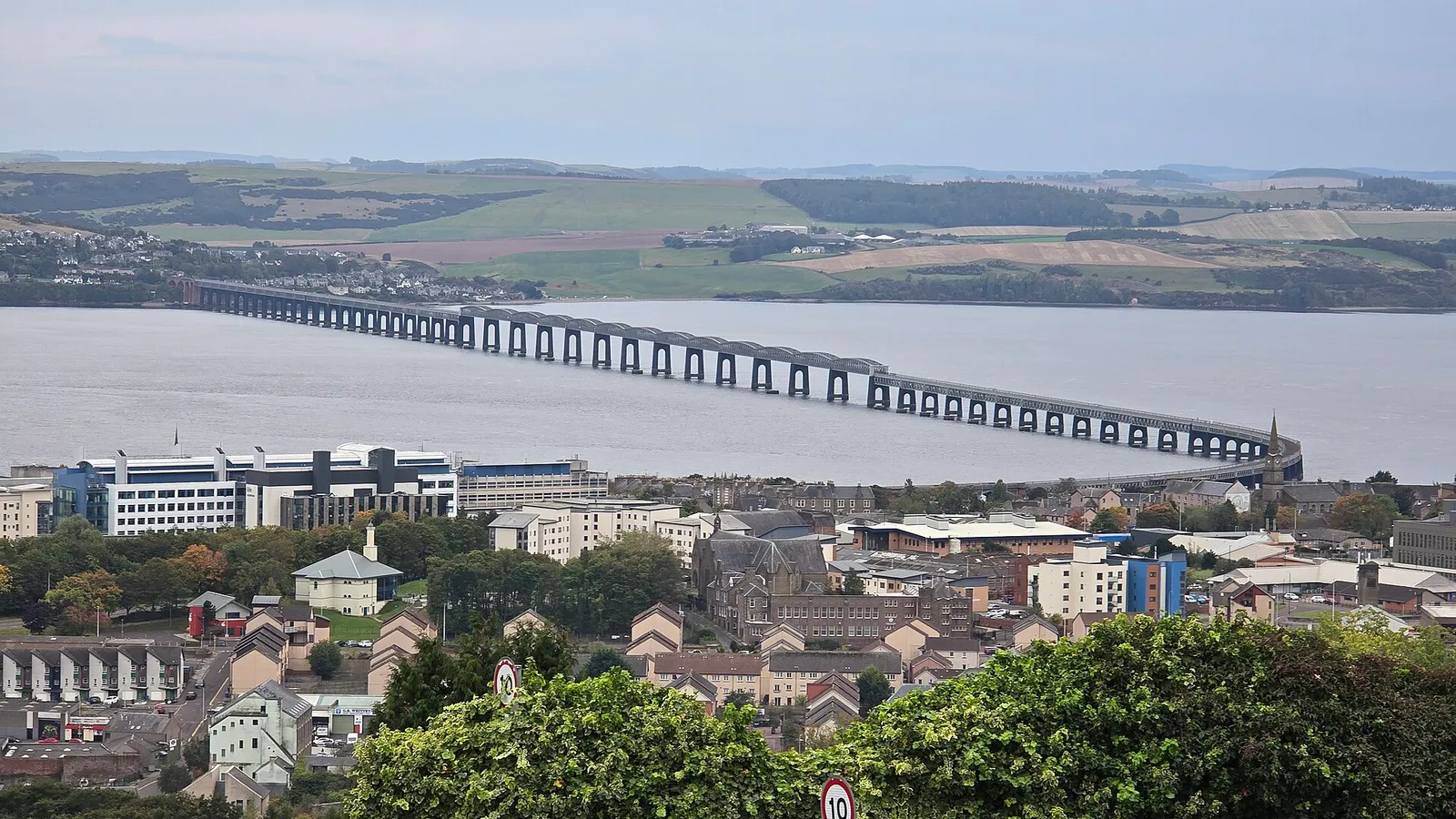

Dundee & the Tay
Contents
TL;DR
- established Dundee's traditional economic identity, "Jute, Jam and Journalism," reflects three real, documented 19th-century industries, though their scale and importance to the city varied considerably — jute dwarfed the other two for most of the period, a nuance this article preserves rather than treating the phrase as describing three equal pillars.
- established Dundee's jute industry was directly dependent on raw material imported from colonial Bengal (India), and the industry's eventual decline was driven substantially by the growth of jute processing within India itself; this is documented economic history, not a simplified modern narrative.
- established The original Tay Rail Bridge collapsed in a storm on 28 December 1879 while a train was crossing it, killing an uncertain but substantial number of people (estimates commonly range from the high 50s to around 75), a documented engineering disaster directly tied to design failures attributed to engineer Thomas Bouch.
- established V&A Dundee, opened in 2018 as the centrepiece of the city's waterfront regeneration, is Scotland's first dedicated design museum and the only V&A museum outside London, a verifiable institutional fact.
- traditional Dundee's whaling industry is often romanticised in local heritage retelling as adventurous maritime enterprise; it was also a brutal, dangerous, and ecologically destructive industry, and this article notes both aspects rather than only the adventure.
Key Facts
- Category
- Detail
- Location/Region
- East coast of Scotland, on the Firth of Tay, Angus/Perthshire border area
- Scale/Date
- City with population c. 148,000; jute industry dominant mid-19th to early-20th century; V&A Dundee opened 2018
- Type
- City — historic industrial port, university city, and modern cultural/design regeneration hub
- Protected/heritage status
- Various listed industrial-heritage buildings (former jute mills); no single blanket heritage designation for the waterfront
- Managed/Owned by
- Dundee City Council; Network Rail (Tay Bridge); V&A Dundee Trust/Dundee Heritage Trust (cultural sites)
- Access notes
- Freely walkable waterfront; V&A Dundee open to the public; RRS Discovery ship and Discovery Point museum on the waterfront; Tay Bridge views from the Esplanade
Scottish Impact Index (SI Score)
- National Significance
- 8/10
- Historical Continuity
- 9/10
- Human & Economic Importance
- 9/10
- Landscape / Architectural Distinctiveness
- 8/10
- Cultural & Historical Legacy
- 8/10
- Recognition
- 8/10
50/60
Ranked #33 of 43 in Locations
A Note on Claims and Evidence
Dundee's industrial history is unusually well documented through company and university archives, particularly regarding the jute trade's colonial sourcing and eventual decline, and these facts are marked established throughout. The 1879 Tay Bridge disaster's precise death toll remains genuinely uncertain even in the best historical accounts — passenger numbers on the fatal train were not fully recorded — so this article gives a credible range rather than a single invented precise figure. Romantic or nostalgic framing of Dundee's whaling and jute heritage, common in local tourism material, is balanced here against the documented human and ecological costs of both industries.
Timeline
Dundee established as a royal burgh and trading port on the Firth of Tay.
Dundee's whaling fleet grows into one of Scotland's largest, hunting whales in Arctic waters chiefly for whale oil, used initially in textile processing (including jute softening) and lighting.
Jute processing, originally reliant on whale oil for treatment, becomes Dundee's dominant industry, importing raw jute fibre from Bengal (colonial India) and exporting finished sacking, rope, and canvas worldwide; the city becomes known as "Juteopolis."
The original Tay Rail Bridge, designed by Thomas Bouch, collapses in a severe storm while a train is crossing, killing an uncertain number of passengers and crew, commonly estimated between roughly 59 and 75.
A new, more robust Tay Rail Bridge, designed by William Henry Barlow, opens parallel to the original, remaining in use to the present day.
Jute processing capacity develops within India itself, directly competing with Dundee's mills; combined with wider changes in global textile markets, this drives a long industrial decline.
Dundee's jute industry largely collapses; the city undergoes significant deindustrialisation and associated social hardship, alongside continued strength in journalism/publishing (notably DC Thomson) and the emergence of other sectors.
Dundee develops a significant biomedical and technology research sector around the University of Dundee, alongside continued publishing and, later, video game development (notably Grand Theft Auto's origins at DMA Design/Rockstar North).
Major waterfront regeneration project redevelops Dundee's former industrial riverside.
V&A Dundee opens, designed by architect Kengo Kuma, as Scotland's first dedicated design museum and the only V&A museum outside London, serving as the centrepiece of the waterfront regeneration.
Dundee markets itself around "Jute, Jam, Journalism... and now Jute, Jam, Journalism and Joules/design," reflecting a continued economic pivot toward culture, design, technology, and life sciences.
Details
Jute: the industry that defined, and overwhelmed, the city
Of Dundee's famous "three Js" — jute, jam, and journalism — jute was by far the dominant force in the city's 19th-century economy, to the point that Dundee was known internationally as "Juteopolis." The industry depended entirely on raw jute fibre imported from Bengal in colonial India, processed in Dundee's mills into sacking, rope, tarpaulin, and canvas for markets around the world, including, notably, sandbags and related materials supplied in vast quantities during periods of British military conflict. This dependence on a colonial import economy is a documented, structural feature of Dundee's industrial history, not an incidental detail: the city's prosperity and the livelihoods of tens of thousands of mill workers (disproportionately women, who made up a majority of the jute workforce by the later 19th century) were directly tied to Britain's colonial administration of Bengal and the asymmetric trading relationship that kept raw fibre processing concentrated in Scotland rather than in India for much of the period. The industry's eventual, protracted decline through the late 19th and 20th centuries was driven substantially by the growth of jute processing capacity within India itself — colonial and post-colonial India increasingly processed its own raw fibre rather than exporting it to Dundee — a shift in the balance of a relationship that had never been equal to begin with, culminating in the near-total collapse of Dundee's jute mills by the mid-20th century and significant associated unemployment and economic hardship in the city.
Jam and journalism: real, but secondary, pillars
Jam production, associated particularly with the Keiller family's marmalade business (credited, by long tradition, with commercialising orange marmalade from the 1790s), and journalism and publishing, centred on the enduring Dundee-based firm DC Thomson (publisher of newspapers and, from the 1930s, globally successful comics including The Beano and The Dandy), were genuine and long-running Dundee industries. However, both operated on a considerably smaller employment scale than jute throughout most of the 19th and early 20th centuries, and the "three Js" phrase, while a useful and accurate shorthand for Dundee's industrial character, should not be read as implying three economically equivalent pillars — jute vastly outweighed the other two for most of the period the phrase describes.
The Tay Bridge disaster
On the night of 28 December 1879, during a severe storm, the central high girders of the original Tay Rail Bridge — designed by engineer Thomas Bouch and opened only the previous year — collapsed while a train was crossing, plunging it into the river below. The precise death toll remains uncertain even in rigorous historical accounts, because passenger numbers for the specific train were not fully recorded at the time; credible estimates range from roughly 59 to around 75 people. The subsequent Board of Trade inquiry found the bridge's design fundamentally inadequate to withstand the wind loads it experienced, directly discrediting Bouch (who had also been engaged, before the disaster, to design the Forth Bridge, a commission withdrawn as a direct result — see this collection's separate Forth Bridge card). A new, structurally more robust double-track bridge, designed by William Henry Barlow, opened without ceremony in 1887 and remains in continuous use today, running parallel to the original bridge's surviving piers, several of which are still visible in the river as a stark, permanent reminder of the disaster.
Whaling: adventure and its costs
Dundee's whaling fleet, among the largest in Scotland through the 18th and 19th centuries, is frequently remembered in local heritage material as a story of maritime adventure and endurance in Arctic waters — a framing with genuine basis, given the extreme conditions crews faced. It should also be stated plainly that whaling was a brutal and ecologically destructive industry: it caused severe depletion of whale populations in the waters it exploited and involved considerable risk to, and loss of, human life among crews. The industry's initial economic link to jute processing — whale oil was used to soften raw jute fibre before manufacture — meant Dundee's two most famous historic industries were directly intertwined, with the decline of accessible whale stocks itself contributing to the eventual search for substitute oils and processes in the jute trade.
Waterfront regeneration and V&A Dundee
Following the long industrial decline of jute and the loss of much of the city's historic working waterfront, Dundee undertook a substantial, multi-decade regeneration of its riverside, culminating in the opening of V&A Dundee in September 2018. Designed by Japanese architect Kengo Kuma in a striking, ship-like form intended to echo the Tay's cliffs and the region's coastal geography, V&A Dundee is Scotland's first dedicated design museum and the only V&A museum located outside London — a genuinely significant cultural institutional fact, not inflated civic promotion. The museum sits alongside other waterfront attractions including Discovery Point and the RRS Discovery (the Antarctic exploration ship built in Dundee in 1901), together forming the centrepiece of a conscious civic strategy to reposition Dundee's identity around design, culture, and knowledge industries following the collapse of its historic jute-based economy.
Present-day identity
Modern Dundee combines continuing strength in publishing (DC Thomson remains headquartered in the city), a significant university research base (notably in life sciences and biomedical research at the University of Dundee), a internationally recognised video game development sector (tracing back to Dundee-founded studio DMA Design, creators of the original Grand Theft Auto and Lemmings), and an increasingly design- and tourism-oriented waterfront economy centred on V&A Dundee. This represents a genuine, still-ongoing economic transition rather than a completed success story, echoing — on a smaller scale — the broader pattern of post-industrial reinvention seen elsewhere on Scotland's east coast.
Highlanders in Dundee
established Dundee had a small but lasting Gaelic community. The historical geographer Charles Withers, in Gaelic in Scotland 1698–1981 (1984), records thirty tradesmen with Highland surnames in the town's register of 1782, a Gaelic chapel built in 1791 for Highlanders "recently arrived in the town", and a Dundee Highland Society founded in 1814. Its Gaelic church in the Long Wynd had 308 communicants by 1859. Withers estimates that people of Highland background made up only about 2 per cent of Dundee's population around 1850, many of them living in the Hawkhill and Scouringburn districts.
Did You Know?
- Dundee's jute industry depended entirely on raw fibre imported from colonial Bengal, and its eventual decline was driven substantially by India developing its own processing capacity rather than exporting raw jute.
- The phrase "Jute, Jam, and Journalism" understates how dominant jute actually was — it vastly outweighed the other two industries for most of the 19th and early 20th centuries.
- Several original piers from the 1879 Tay Bridge disaster still stand visibly in the river today, alongside the replacement 1887 bridge.
- The precise death toll of the Tay Bridge disaster has never been definitively established, with credible estimates ranging from the high 50s to around 75.
- Dundee's historic whaling and jute industries were directly linked: whale oil was used to soften raw jute fibre before it could be processed.
- V&A Dundee, opened in 2018, is the only V&A museum anywhere outside London.
- Dundee was the birthplace of the video game studio behind the original Grand Theft Auto and Lemmings.
- The RRS Discovery, Captain Scott's Antarctic exploration ship, was built in Dundee in 1901 and now sits permanently moored on the city's waterfront.
FAQ
1What does "Jute, Jam, and Journalism" mean?
A traditional shorthand for Dundee's three historic industries — textile manufacturing (jute), food production (notably marmalade), and publishing — though jute was by far the largest of the three for most of the period.
2Where did Dundee's jute come from?
Raw jute fibre was imported from Bengal in colonial India and processed in Dundee's mills into sacking, rope, and canvas.
3Why did the jute industry decline?
Substantially because India developed its own jute processing capacity, undercutting the need to export raw fibre to Dundee, alongside wider shifts in global textile markets.
4What happened to the original Tay Bridge?
It collapsed in a storm on 28 December 1879 while a train was crossing, killing an uncertain but substantial number of people, a disaster attributed to design failures by engineer Thomas Bouch.
5Is the current Tay Bridge the same one?
No — the present bridge, opened in 1887, is a separate, more robust structure designed by William Henry Barlow; original piers from the 1879 bridge still stand nearby.
6What is V&A Dundee?
Scotland's first dedicated design museum, opened in 2018, and the only V&A museum outside London, central to Dundee's waterfront regeneration.
7What else is on Dundee's waterfront?
Discovery Point and the RRS Discovery, the Antarctic exploration ship built in Dundee in 1901.
8Was Dundee really a major whaling port?
Yes, one of Scotland's largest whaling fleets operated from Dundee through the 18th and 19th centuries, though the industry was also ecologically destructive and dangerous.
9Is DC Thomson still based in Dundee?
Yes, the publishing company behind titles including The Beano and The Dandy remains headquartered in the city.
10What is Dundee known for today?
Design and culture (V&A Dundee), biomedical research, video game development, and continued publishing, alongside ongoing post-industrial regeneration.
11Is Dundee connected to video games?
Yes — Dundee-founded studio DMA Design created the original Grand Theft Auto and Lemmings.
12Can you visit the original Tay Bridge remains?
The surviving piers of the 1879 bridge are visible in the river but not directly accessible; they can be viewed from the current bridge and waterfront.
Sources and Further Reading
Primary/Institutional
- Network Rail — history of the Tay Bridge and the 1879 disaster
- University of Dundee — jute industry history and archives
- V&A Dundee — institutional history and architecture information
- Dundee City Council and Dundee Heritage Trust — waterfront regeneration documentation
Scholarly/Critical
- Academic economic history of Dundee's jute trade and its colonial Bengal sourcing ("Juteopolis" scholarship)
- Board of Trade inquiry findings into the 1879 Tay Bridge disaster
- Charles W. J. Withers, Gaelic in Scotland 1698–1981: The Geographical History of a Language (John Donald, 1984; ebook Birlinn, 2021)
General
- Network Rail's official history of the Tay Bridge
- Quality press and heritage coverage of Dundee's waterfront regeneration and V&A Dundee opening
- VisitScotland and Dundee visitor information
Caveats: Myths and Disputed Claims
- Do not state the Tay Bridge disaster death toll as a single precise number — give the credible range (roughly 59–75) and note the genuine historical uncertainty.
- Do not treat "Jute, Jam, and Journalism" as describing three economically equal industries — jute was dominant for most of the relevant period.
- Do not describe Dundee's jute trade without noting its dependence on colonial Bengal and the asymmetric trade relationship that structured it.
- Do not romanticise Dundee's whaling heritage purely as adventure — it was also ecologically destructive and dangerous, with real human and environmental costs.
- Do not imply Dundee's post-jute economic transition (design, biomedical research, gaming) is complete or risk-free — it remains an ongoing regeneration process, not a finished success story.
Card 036 · Locations