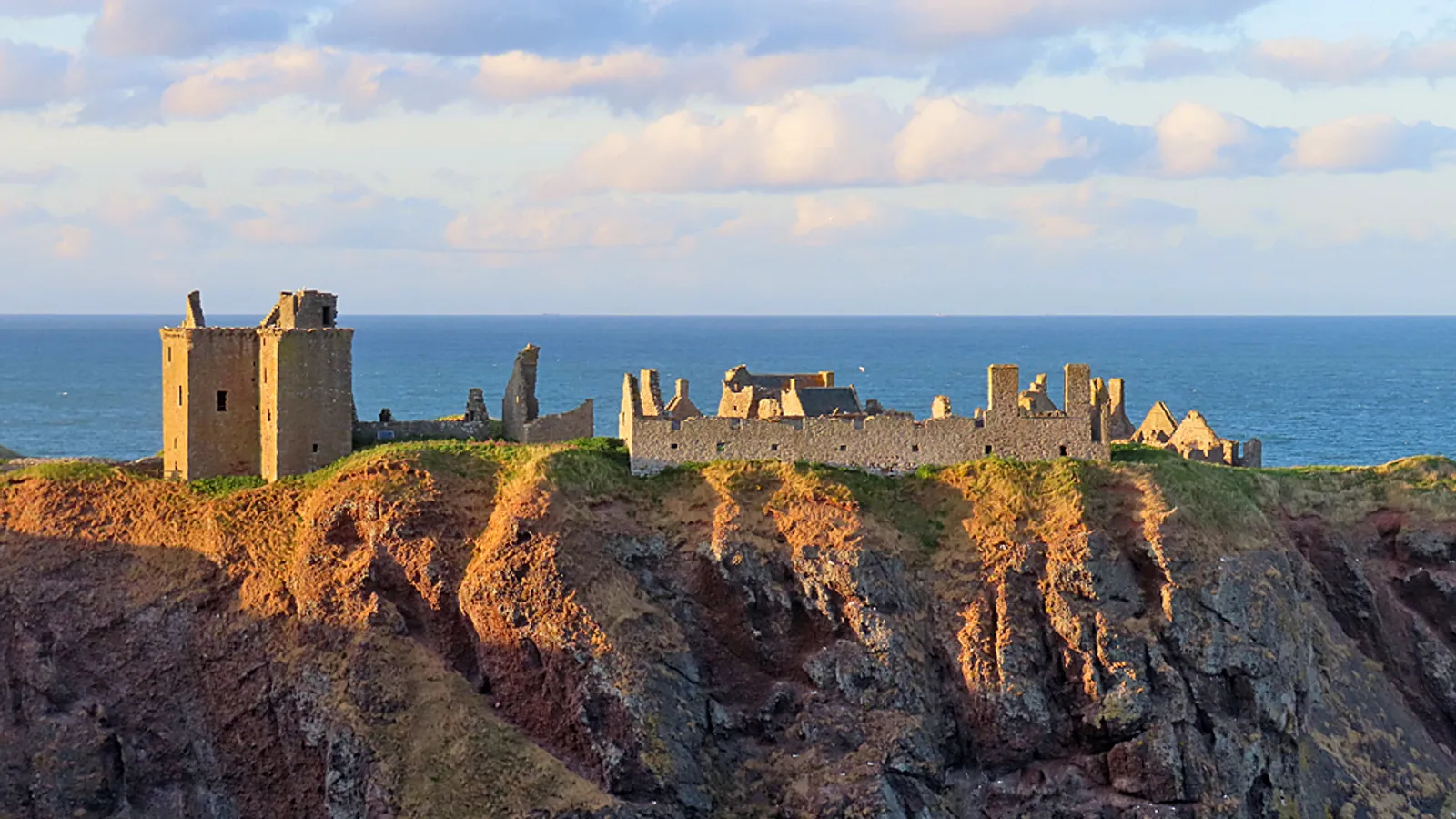

Dunnottar Castle
Contents
TL;DR
- [Legend] Tradition holds that St Ninian visited Dunnottar in the late 5th century to convert the Picts and established a chapel there — this rests on later hagiographic tradition rather than contemporary 5th-century documentation, and sits alongside the genuinely disputed historicity of St Ninian himself (see this collection's Whithorn card).
- established A siege at Dunnottar is recorded in the Annals of Ulster in 681, and the site was the scene of a battle around 900 in which King Donald II was killed by Vikings — both early medieval events documented in contemporary or near-contemporary chronicle sources.
- established The Honours of Scotland (crown, sword, and sceptre) were hidden at Dunnottar during Cromwell's siege of 1651–52, then smuggled out and concealed beneath Kinneff Old Church until the Restoration — this is recorded in multiple contemporary and near-contemporary accounts of the siege and its aftermath.
- established In May 1685, roughly 167 Covenanter prisoners were confined in Dunnottar's "Whigs' Vault," where some died of starvation and disease and others were killed attempting escape, with survivors later transported to the colonies — this grim episode is documented in historical records and should be presented without romanticising its brutality.
- established The castle has been privately owned by the Cowdray family since 1925, who undertook restoration work, and it remains open to paying visitors today — a matter of current ownership record.
Key Facts
- Location
- Clifftop promontory near Stonehaven, Aberdeenshire, Scotland
- Era/Period
- Early medieval fort traditions from 5th century; documented sieges from 681; stone castle from 14th century
- Type
- Clifftop fortress
- Managed/Owned by
- Privately owned by the Cowdray family (since 1925)
- Visitor status
- Open to paying visitors
- Name origin
- "Dun" — a Pictish word meaning fort
Scottish Impact Index (SI Score)
- National Significance
- 8/10
- Historical Continuity
- 10/10
- Human & Economic Importance
- 6/10
- Landscape / Architectural Distinctiveness
- 10/10
- Cultural & Historical Legacy
- 9/10
- Recognition
- 9/10
52/60
Ranked =28th of 43 in Locations
A Note on Claims and Evidence
Dunnottar's history spans securely dated early medieval chronicle entries, well-documented seventeenth-century political drama, and later Christian tradition whose dating is genuinely contested by scholars. The documented tier covers the 681 siege recorded in the Annals of Ulster, the Battle of Dunnottar around 900, the 1297 Wallace episode, the 1651–52 hiding of the Honours of Scotland, and the 1685 Covenanter imprisonment — all independently attested in chronicle, state, or near-contemporary record. The legend-myth tier covers the St Ninian chapel tradition, which this article flags clearly rather than presenting as settled history, both because of the general scholarly dispute over Ninian's dates and activities (detailed on this collection's dedicated Whithorn card) and because no contemporary 5th-century source confirms his presence at Dunnottar specifically.
Timeline
St Ninian reputedly visits Dunnottar and establishes a chapel; this rests on later tradition rather than contemporary record.
A siege at Dunnottar is recorded in the Annals of Ulster, the earliest firm documentary reference to the site.
Battle of Dunnottar: King Donald II is killed fighting Vikings at the site, which is subsequently destroyed.
The site comes under more reliable documented control during the reign of William the Lion.
William Wallace recaptures the castle from English forces, reportedly burning the church with the English garrison inside.
Sir William Keith rebuilds the stone keep.
James V grants Dunnottar to the Earls Marischal (the Keith family).
During Cromwell's siege, the Honours of Scotland are hidden at Dunnottar, then smuggled out and concealed beneath Kinneff Old Church until the castle's surrender in May 1652.
Approximately 167 Covenanter prisoners are confined in the Whigs' Vault; some die of starvation and disease, others are killed attempting escape, and survivors are later transported to the colonies.
The Cowdray family purchases Dunnottar and begins restoration work.
Remains privately owned by the Cowdray family; open to paying visitors as one of Scotland's most dramatically sited ruined castles.
Details
A fortress on a near-island of rock
Dunnottar occupies a flat-topped promontory connected to the Aberdeenshire mainland by a narrow strip of land, its cliffs dropping sheer to the North Sea on almost every other side — a position whose defensive value is self-evident even to a casual visitor. The site's name reflects its ancient function: "dun" is a Pictish word for fort, and the location's early medieval significance is attested by genuinely early sources. The Annals of Ulster record a siege at Dunnottar in 681, making it one of the better-documented early medieval fortified sites in Scotland, and around the year 900 the site was the scene of a battle in which King Donald II was killed fighting Viking raiders, after which the castle was destroyed — a sharp reminder that Dunnottar's strategic value made it a target for violent contest from the very start of its documented history.
The disputed St Ninian tradition
Popular accounts of Dunnottar frequently open with a claim that St Ninian visited the site in the late fifth century to convert the Picts to Christianity and established a chapel there. This tradition should not be repeated as settled fact. It rests on later hagiographic material rather than any contemporary fifth-century documentation, and it intersects with a genuinely unresolved scholarly debate over St Ninian's own historicity, dating, and activities — a debate covered in full on this collection's dedicated Whithorn & the Isle of Whithorn card, where Ninian's traditional role as an early Christian missionary to southwest Scotland is examined in detail. At Dunnottar specifically, the claim functions as a piece of traditional local lore giving the site an ancient Christian pedigree, not as an independently evidenced historical event.
From Wallace to the Earls Marischal
Dunnottar's medieval history includes one of the more dramatic, and more brutal, episodes associated with William Wallace: in 1297, during the Wars of Scottish Independence, Wallace recaptured the castle from English forces, and accounts describe the English garrison being burned alive within the castle's church — a detail that, whatever one's view of Wallace's wider legend, reflects the real violence of this period of conflict rather than romanticised heroics alone. The castle's stone keep was substantially rebuilt by Sir William Keith in the late fourteenth century, and in 1531 James V granted Dunnottar to the Earls Marischal, the Keith family, who held it as their principal seat for the following centuries and were responsible for much of the architectural development visible in the ruins today.
Hiding the Honours of Scotland
Dunnottar's best-known historical episode belongs to the mid-seventeenth century, during Oliver Cromwell's campaign to subdue Scotland following the execution of Charles I. As Cromwell's forces besieged the castle in 1651–52, it held Scotland's Crown Jewels — the Honours of Scotland, comprising the crown, sword of state, and sceptre — along with important state papers. With the castle's fall increasingly inevitable, the Honours were smuggled out through a resourceful and carefully organised operation: state papers were reportedly concealed in the clothing of a woman passing through the besieging lines, while the Honours themselves were lowered down the castle's cliffs to a local woman pretending to be gathering seaweed on the shore below. The treasures were then hidden beneath the floor of nearby Kinneff Old Church, where they remained concealed for roughly eight years until the Restoration of the monarchy made their safe re-emergence possible. The castle itself surrendered to Cromwell's forces in May 1652, its defenders having bought enough time for the Honours' safe removal before capitulating.
The Whigs' Vault: Covenanter imprisonment
Dunnottar's history includes an episode that should be told plainly rather than romantically: in May 1685, during the "Killing Time" persecution of religious dissenters, approximately 167 Covenanter prisoners — Presbyterians who refused to accept royal supremacy over the Church of Scotland — were confined in a vaulted chamber at the castle that became known as the Whigs' Vault. Conditions were brutal. Some prisoners died of starvation and disease in the cramped, insanitary space; others were killed attempting to escape, in at least one case by climbing down the cliffs, an act of desperation given the alternative. Survivors who endured the ordeal were subsequently transported to the colonies, a punishment that for many amounted to a life sentence of indentured servitude far from home. This episode is a documented act of state and religious persecution, not a colourful footnote, and this article presents it accordingly, resisting any temptation to soften its cruelty for the sake of a more comfortable visitor narrative.
Decline, restoration, and present ownership
Like many Scottish castles, Dunnottar's active military and residential use declined over the eighteenth and nineteenth centuries, leaving it a dramatic but deteriorating ruin by the time it passed out of the Keith family's control. In 1925, the Cowdray family purchased the castle and undertook restoration work aimed at stabilising and conserving the ruins rather than rebuilding them into a lived-in residence — a different approach from, for instance, the full reconstruction seen at Eilean Donan. Dunnottar remains privately owned by the Cowdray family today and operates as a paying visitor attraction, its clifftop setting and layered history of early medieval conflict, Wallace-era violence, royal treasure, and Covenanter suffering making it one of the more narratively dense ruined castles in Scotland.
Did You Know?
- The Annals of Ulster record a siege at Dunnottar as early as 681, making it one of Scotland's earliest documented fortified sites.
- The Scottish Crown Jewels were smuggled out of Dunnottar during Cromwell's 1651–52 siege and hidden beneath a parish church floor for roughly eight years.
- A local woman reportedly disguised her removal of the Honours of Scotland by pretending to gather seaweed on the shore below the castle cliffs.
- In 1685, around 167 Covenanter prisoners were held in appalling conditions in Dunnottar's Whigs' Vault, with some dying and others killed attempting escape.
- William Wallace's 1297 recapture of the castle reportedly ended with the English garrison burned alive inside the castle church.
- The St Ninian chapel tradition at Dunnottar touches on a genuinely unresolved scholarly debate about Ninian's historicity, covered separately on this collection's Whithorn card.
- The castle's name derives from the Pictish word "dun," meaning fort, reflecting fortification on the site since at least the early medieval period.
- The Cowdray family, who still own Dunnottar today, purchased the castle in 1925 and undertook restoration focused on conservation rather than full reconstruction.
FAQ
1Who owns Dunnottar Castle today?
The Cowdray family, who purchased it in 1925.
2Were the Scottish Crown Jewels really hidden here?
Yes — the Honours of Scotland were hidden at Dunnottar and then smuggled out to Kinneff Old Church during Cromwell's 1651–52 siege.
3What was the Whigs' Vault?
A chamber at Dunnottar where around 167 Covenanter prisoners were confined in brutal conditions in 1685; some died, and survivors were later transported to the colonies.
4Did St Ninian really visit Dunnottar?
This is a traditional claim without contemporary 5th-century confirmation, and it intersects with a broader scholarly dispute about Ninian's historicity covered on this collection's Whithorn card.
5Is Dunnottar a ruin or a restored building?
It is a ruin that has undergone conservation and stabilisation work since 1925, not a full reconstruction.
6What does the name "Dunnottar" mean?
It derives from "dun," a Pictish word for fort.
7Did William Wallace capture Dunnottar?
Yes, in 1297, in an episode during which the English garrison was reportedly burned alive in the castle church.
8Who were the Earls Marischal?
The Keith family, granted Dunnottar by James V in 1531, who held it as their principal seat for centuries.
9Can visitors see the Whigs' Vault today?
Yes, it is part of the site visitors can access, and its history is presented as part of the castle's story.
10How old is the earliest documented reference to Dunnottar?
681, via a siege recorded in the Annals of Ulster.
11What happened to the Covenanter prisoners who survived?
Many were transported to the colonies as a further punishment.
12Is Dunnottar connected to Vikings?
Yes — around 900, King Donald II was killed fighting Vikings at the site, after which the castle was destroyed.
Sources and Further Reading
Primary/Institutional
- Dunnottar Castle official visitor information
- Canmore (RCAHMS) site record for Dunnottar Castle
Scholarly/Critical
- Academic and historical accounts of the Covenanter persecution and the "Killing Time," including the Whigs' Vault imprisonment
- Historical accounts of the 1651–52 concealment of the Honours of Scotland
General
- Undiscovered Scotland, Dunnottar Castle history overview
- Great Castles, Dunnottar Castle history summary
- Wikipedia, "Dunnottar Castle"
Caveats: Myths and Disputed Claims
- Do not state as settled fact that St Ninian personally visited Dunnottar and founded a chapel there in the 5th century. This is a later tradition, not contemporary record, and intersects with genuine scholarly dispute over Ninian's historicity (see the Whithorn card).
- Do not romanticise or soften the Whigs' Vault imprisonment of Covenanter prisoners in 1685. Present the deaths from starvation and disease, killings during escape attempts, and subsequent transportation plainly, as a documented act of persecution.
- Do not describe the present castle as a restored, lived-in building. It remains a conserved ruin, not a reconstruction in the manner of Eilean Donan.
- Present the smuggling of the Honours of Scotland as a dramatic but genuinely documented episode, distinguishing its well-recorded core facts from any embellished retellings of specific details.
Card 010 · Locations