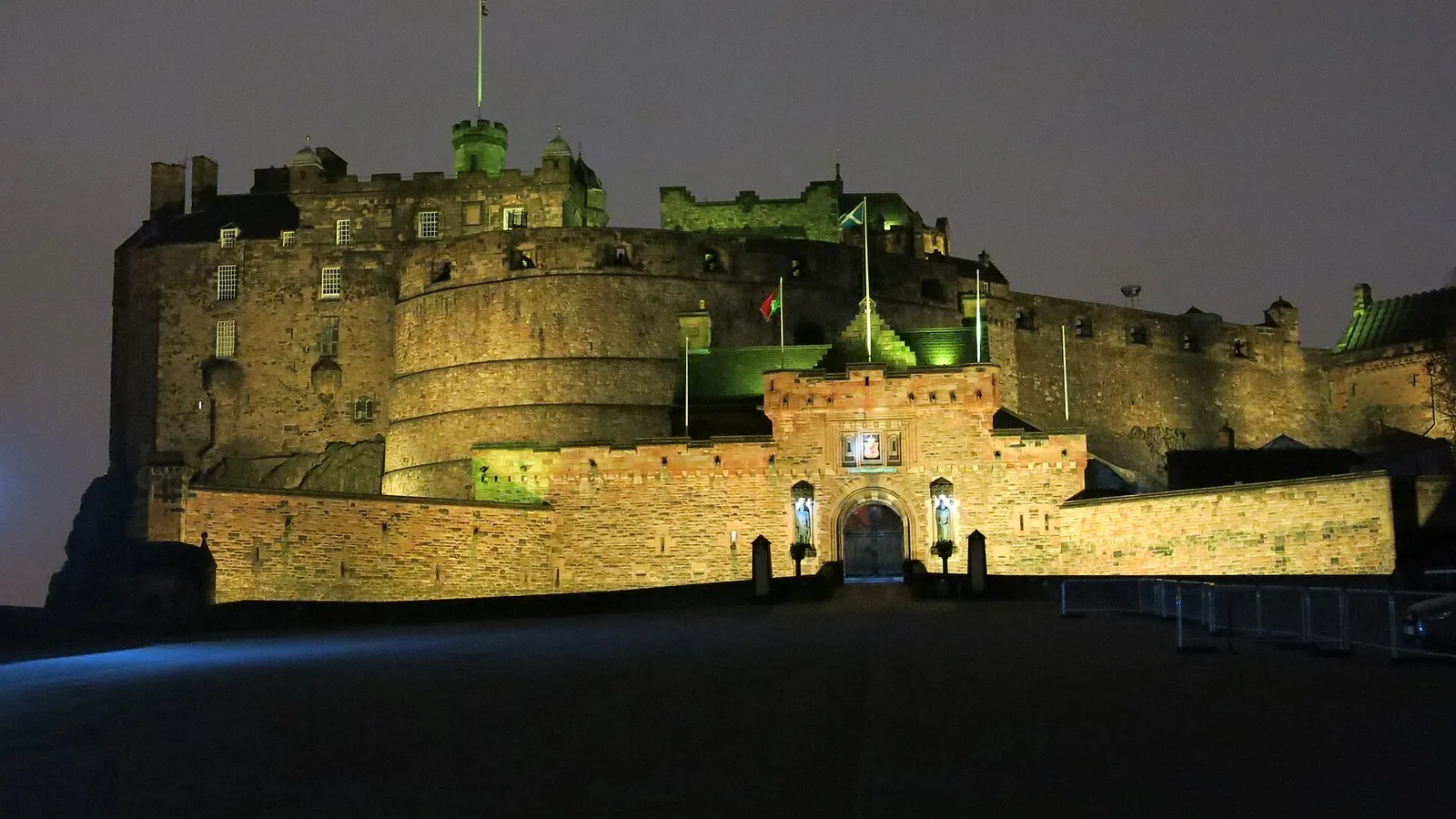

Edinburgh Castle
Contents
Isn't Edinburgh Castle simply a Victorian-polished backdrop for the Tattoo and a gift-shop? The rock beneath it has carried fortifications for roughly three thousand years, and the castle visitors tour today is a patchwork of building campaigns separated by centuries of siege and demolition — there is no single "original castle" to point to, only a long argument in stone.
TL;DR
- established St Margaret's Chapel, built around the 1130s under David I, is the oldest surviving building on Castle Rock and in Edinburgh — this rests on securely dated Romanesque architecture and documentary record.
- established The castle has endured roughly 26 recorded sieges across its history, a figure historians cite to call it one of the most besieged places in Britain — this comes from systematic cataloguing of attacks from the Wars of Independence through the Jacobite risings.
- disputed The name "Castle of Maidens" and its supposed derivation from Pictish princesses, nuns, or Arthurian legend is unresolved — chroniclers from the medieval period record the name, but no contemporary source explains its origin, so historians treat competing theories as speculative.
- traditional Continuous occupation of the rock from the Iron Age onward is widely assumed in popular accounts, but archaeologists state this is inferred rather than proven — 1990s excavations found only limited Iron Age and Roman-era material, not an unbroken settlement record.
- established The castle today is state-owned and operated by Historic Environment Scotland as Scotland's most visited paid attraction, with a still-active ceremonial military garrison — this is a matter of current public record, not historical reconstruction.
Key Facts
- Location
- Castle Rock, Edinburgh, Midlothian, Scotland
- Coordinates
- 55.9486° N, 3.2008° W
- Era/Period
- Iron Age origins; dominant royal fortress 12th–17th centuries
- Type
- Fortress, royal residence, garrison, museum complex
- Managed/Owned by
- Historic Environment Scotland (operator); Scottish Ministers (owner); British Army retains ceremonial presence
- Visitor status
- Open year-round, paid admission; approx. 2 million visitors in 2025
- Notable holdings
- Honours of Scotland (crown jewels), Stone of Destiny (since 1996), Mons Meg cannon
Scottish Impact Index (SI Score)
- National Significance
- 10/10
- Historical Continuity
- 10/10
- Human & Economic Importance
- 9/10
- Landscape / Architectural Distinctiveness
- 10/10
- Cultural & Historical Legacy
- 10/10
- Recognition
- 10/10
59/60
Ranked =2nd of 43 in Locations
A Note on Claims and Evidence
Edinburgh Castle's documented history is unusually long but has large gaps. The documented tier covers events backed by charters, chronicles, or excavation reports — the 1130s chapel, the 1314 and 1573 sieges, the 1566 birth of James VI. The traditional tier covers claims repeated by generations of guides and popular historians — such as assumed unbroken occupation since prehistory — that are plausible but not demonstrated by the archaeological record. The legend-myth tier covers foundation stories attached to legendary kings (Ebraucus) or to the "Maidens" name, which survive only in medieval romance and antiquarian guesswork rather than contemporary evidence. This article keeps those tiers separate throughout.
Timeline
earliest evidence of human activity on Castle Rock (limited archaeological traces).
Roman-era pottery, bronzes and brooches suggest trading contact with the local Votadini people; some scholars tentatively link the site to Ptolemy's "Alauna."
Castle established as a royal stronghold under Malcolm III and his successors.
St Margaret's Chapel built under David I; oldest surviving building in Edinburgh.
Castle surrendered to England under the Treaty of Falaise after King William the Lion's capture.
Wars of Scottish Independence; castle changes hands repeatedly.
Thomas Randolph's night assault recaptures the castle; Robert the Bruce orders it partly demolished to deny its use to the English.
The "Black Dinner": William Douglas, 6th Earl of Douglas, executed within David's Tower.
Mons Meg, a giant siege cannon, gifted to James II.
James III briefly held during the Duke of Albany's siege.
The Earl of Hertford's English army burns Edinburgh but cannot take the castle.
Mary of Guise, regent of Scotland, dies in the castle during the siege of Leith (11 June in John Guy's account; some sources give 10 or 12 June).
Mary, Queen of Scots hosts a state banquet in the great hall during her formal entry into Edinburgh.
After the murder of David Riccio, Mary moves into the castle for safety to await her child.
Mary gives birth to the future James VI within the castle.
After Darnley's murder, Mary again moves into the castle; Bothwell soon replaces its captain, the Earl of Mar, with his own men.
The castle's captain, Sir James Balfour, changes sides to the confederate lords, sealing Mary's defeat.
The "Lang Siege" devastates the medieval defences; Half Moon Battery built in reconstruction.
Charles I is the last reigning monarch to reside in the castle.
Castle captured and held multiple times during the civil wars and Covenanting conflicts.
Jacobite forces besiege but fail to take the castle.
Sir Walter Scott rediscovers the Honours of Scotland, sealed away since 1707.
Victorian-era restoration programme reshapes much of the visitor-facing castle.
Scottish National War Memorial opens.
Stone of Destiny returned from Westminster Abbey and installed in the Crown Room (moved again to Perth in 2024).
Operated by Historic Environment Scotland; active ceremonial garrison; major draw of the Edinburgh Military Tattoo.
Details
Origins on the rock
Castle Rock is the plug of an extinct volcano, its sheer cliffs on three sides making it a naturally defensible position above what became Edinburgh. Modern excavation — notably work carried out in the 1990s — found evidence of activity reaching back to the late Bronze Age or early Iron Age, with a clearer Iron Age phase showing an enclosed hillfort and, later, Roman-period trade goods that imply contact with the Votadini, the Iron Age people of the Lothians. It is tempting to read this as proof of three thousand years of continuous settlement, but archaeologists are careful to note the evidence is patchy: traces exist at several points in that long span, not an unbroken sequence. The popular idea of "Scotland's oldest continuously inhabited site" is a traditional claim, not a demonstrated one.
The castle's documented history as a royal fortress begins properly with Malcolm III and his family in the eleventh century, and the earliest fixed point historians can date with confidence is St Margaret's Chapel, built around the 1130s under David I in memory of his mother. It survives today as the oldest building in Edinburgh, having escaped destruction partly because it was repurposed — including, after the Reformation, as a store for gunpowder — rather than demolished outright.
Architecture and the landscape of power
What stands on the rock today is not one building campaign but several, stitched together across four centuries of near-constant rebuilding after sieges. The Great Hall and David's Tower belong to the fourteenth and fifteenth centuries; the Half Moon Battery and much of the current fortification scheme date from reconstruction after the Lang Siege of 1571–73, which comprehensively destroyed the medieval defences in an artillery bombardment unusual for its scale in Britain at the time. Later garrison buildings, magazines and barrack blocks reflect the castle's eighteenth-century role as a working military installation rather than a royal seat, and a significant share of what visitors see — including much of the stonework's "finished" appearance — results from a deliberate Victorian restoration campaign in the 1880s–90s that reshaped the site for a new era of national commemoration and tourism.
Siege, crown, and symbol
Historians count roughly 26 sieges across the castle's history, a tally that has led several to describe it as the most besieged place in Great Britain, and among the most fought-over fortifications anywhere. The 1314 recapture by Thomas Randolph — climbing the rock face at night with thirty men — is the best-known of these, not least because Robert the Bruce then had the castle's defences torn down specifically to prevent its reuse by occupying English forces, a reminder that for long stretches the castle's strategic value counted for more than its symbolic one.
The castle's role as keeper of the nation's regalia runs in parallel to its military history. The Honours of Scotland — crown, sword and sceptre — were sealed into a chest at the Act of Union in 1707 and all but forgotten until Sir Walter Scott, acting on royal permission, had the room opened in 1818 and rediscovered them, a moment that did much to romanticise the castle for nineteenth-century Scotland. The Stone of Destiny, long associated with royal inauguration, was installed alongside the Honours from 1996 until its relocation to Perth Museum in 2024, where it remains the primary exhibit; this card treats the Stone's own contested history as belonging to its dedicated entry elsewhere in this collection, not repeated here.
Mary, Queen of Scots and the birth of James VI
A fortress in a crisis. established For Mary the castle was less a home than a refuge. The historian John Guy, in his biography of Mary (2004), shows her using it whenever Holyroodhouse, down the hill, felt unsafe. When the Earl of Hertford burned Edinburgh in 1544 his army could not take the castle, so well defended by artillery that he ordered it ignored. In 1561 the adult queen staged her ceremonial entry by riding up to its great hall for a state banquet, saluted by its guns as she left. After the murder of her secretary David Riccio at Holyrood in March 1566, she returned to Edinburgh with an army and, about a fortnight later, moved into the castle to await the birth of her child.
The birth. established Mary entered her confinement chamber on 3 June 1566, keeping the Earl of Argyll in the room outside day and night. On 9 June she called her lords to hear her will, made in case she died; only a codicil listing her jewels survives. Her son was born between ten and eleven in the morning of Wednesday 19 June after a long and difficult labour. Guy records that she joked mid-labour that had she known how painful it would be she would never have married. The castle guns fired a salute and some five hundred bonfires were lit in and around the town. Two days later the English ambassador, Henry Killigrew, found her weak in bed and was shown the baby feeding at his nurse's breast. The small room identified as the birth chamber is still shown to visitors, though much of its decoration is later.
Losing the castle. established Mary moved into the castle again after Darnley's murder in February 1567, fearing she was the next target. Within weeks, on Bothwell's advice, she replaced the Earl of Mar as its keeper with Bothwell's men, first James Cockburn of Skirling and then Sir James Balfour. In June 1567 Balfour, who had supplied the gunpowder used at Kirk o' Field according to Guy, changed sides to the confederate lords in return for a pardon. That cost Mary her capital's fortress at the moment she needed it most. The castle later held out for her cause in the Lang Siege of 1571–73, until its defenders, among them her former secretary William Maitland of Lethington, surrendered to Regent Morton's English-backed army in 1573.
From royal seat to national monument
Charles I was the last monarch to actually reside in the castle, in 1633; after that the building's story is one of military utility — barracks, armoury, prison, and later a garrison hospital — rather than royal domesticity. The nineteenth and twentieth centuries completed its transformation into a symbol: the Scottish National War Memorial, opened in 1927 within converted barrack buildings, repositioned the castle as a site of national mourning and identity rather than contested military asset. Today it combines that memorial role with an active, ceremonial Army presence, a museum complex, and function as the literal backdrop to the Edinburgh Military Tattoo — a very different kind of siege, mounted annually and by invitation.
Did You Know?
- St Margaret's Chapel receives fresh flowers every week, placed by the St Margaret's Chapel Guild, a tradition maintained since the 1930s.
- Mons Meg, the fifteenth-century siege cannon gifted to James II, was removed to the Tower of London after the 1745 rising and only returned to Edinburgh in 1829 following a campaign led by Sir Walter Scott.
- The castle has no single "foundation date" — it is a composite of building campaigns from the twelfth to the twentieth century, repeatedly demolished and rebuilt after sieges.
- The "Black Dinner" of 1440, in which the young 6th Earl of Douglas was executed inside David's Tower after a supposedly friendly banquet, remains one of Scottish history's most notorious acts of political murder.
- Despite its reputation as an ancient, unbroken stronghold, large portions of the castle's present appearance — including much of its "medieval" character — date from a Victorian restoration campaign in the 1880s and 1890s.
- The Honours of Scotland lay forgotten in a locked room for over a century after 1707 before their rediscovery in 1818.
- James VI was born in the castle between ten and eleven in the morning of 19 June 1566; some five hundred bonfires were lit to celebrate.
- Mary of Guise, mother of Mary, Queen of Scots, died in the castle in June 1560 while English and Scottish Protestant forces besieged the French in Leith.
- The castle remains an active military site to this day, hosting ceremonial units alongside its museum and tourist operations.
- One-o'clock gun, fired daily (except Sundays), originated as a time signal for ships in the port of Leith rather than any military tradition.
FAQ
1Is Edinburgh Castle the oldest building in Scotland?
No. It contains the oldest surviving building in Edinburgh — St Margaret's Chapel, from the 1130s — but older structures exist elsewhere in Scotland, including Neolithic sites such as Skara Brae.
2Who owns Edinburgh Castle today?
It is owned by the Scottish Ministers on behalf of the public and operated day-to-day by Historic Environment Scotland, with the British Army maintaining a ceremonial presence.
3Can you still visit the whole castle?
Most of the site is open to paying visitors, though some areas remain in active military or ceremonial use and are closed to the public.
4Was Edinburgh Castle ever actually taken by the English?
Yes, repeatedly — including a prolonged occupation following the 1174 Treaty of Falaise and multiple captures during the Wars of Scottish Independence.
5What is the "Castle of Maidens" story?
A medieval name for the castle whose origin is genuinely disputed; theories range from Pictish princesses to religious communities to Arthurian legend, with no contemporary source confirming any of them.
6Is the Stone of Destiny still at Edinburgh Castle?
No — it was moved to Perth Museum in 2024, after being displayed in the Crown Room alongside the Honours of Scotland from 1996.
7Did Mary, Queen of Scots really give birth to James VI there?
Yes, on 19 June 1566, in a small room within the royal apartments that is still shown to visitors today.
8Why did Mary give birth in the castle rather than at Holyroodhouse?
For safety. After her secretary David Riccio was murdered in front of her at Holyrood in March 1566, she moved into the fortress to await the birth.
9Why does the castle look so uniformly "medieval"?
Much of that unified appearance is the result of a Victorian-era restoration in the 1880s–90s, which reshaped and in places rebuilt the fabric for a newly nationalistic, tourism-conscious audience.
10What is Mons Meg?
A massive fifteenth-century bombard cannon, gifted to James II by the Duke of Burgundy, now displayed in the castle after a long exile in London.
11Is the castle still a working military site?
Yes — it hosts a ceremonial garrison and regimental facilities alongside its museums and visitor operations.
12How many sieges has the castle survived?
Historians count approximately 26 recorded sieges, though the exact tally varies depending on how minor skirmishes are counted.
13Is there real archaeological proof of Iron Age occupation?
Yes, but it is limited — 1990s excavations found hillfort remains and Roman-era trade goods, not a continuous settlement sequence from that period to the historic castle.
Sources and Further Reading
Primary/Institutional
- Historic Environment Scotland, "Edinburgh Castle: History" — historicenvironment.scot
- Historic Environment Scotland Properties in Care Collections (object records, Edinburgh Castle)
Scholarly/Critical
- Royal Commission on the Ancient and Historical Monuments of Scotland (RCAHMS)/Canmore site records for Castle Rock, Edinburgh
- Peer-reviewed excavation reports from the 1990s Edinburgh Castle archaeological investigations (as cited in Historic Environment Scotland research summaries)
- John Guy, "My Heart is My Own": The Life of Mary Queen of Scots (Fourth Estate, 2004; US edition Queen of Scots: The True Life of Mary Stuart, Houghton Mifflin, 2004)
General
- Wikipedia, "Edinburgh Castle" — en.wikipedia.org/wiki/Edinburgh_Castle
- VisitScotland, Edinburgh Castle visitor information
- History Hit and other quality general-history coverage of Edinburgh Castle's siege history
Caveats: Myths and Disputed Claims
- Do not state that Edinburgh Castle has been "continuously occupied for 3,000 years." The correct phrasing: archaeological evidence shows activity at several points across this span, but a continuous, unbroken occupation sequence has not been demonstrated.
- Do not present the "Castle of Maidens" name's origin (Pictish princesses / nuns / Arthurian legend) as settled fact. State it as an unresolved medieval name whose derivation remains disputed among historians.
- Do not describe the castle as a single, ancient, unchanged structure. Much of its present fabric dates from post-siege reconstructions, particularly after 1573, and from a Victorian restoration in the 1880s–90s.
- Avoid stating a precise "foundation year" for the castle as a whole; only specific buildings (such as St Margaret's Chapel, c. 1130s) have securely dated origins.
- Do not conflate the Stone of Destiny's history with Edinburgh Castle's own foundation narrative; the Stone's contested origins and 1950/1996/2024 movements are covered on its own dedicated card.
Card 001 · Locations