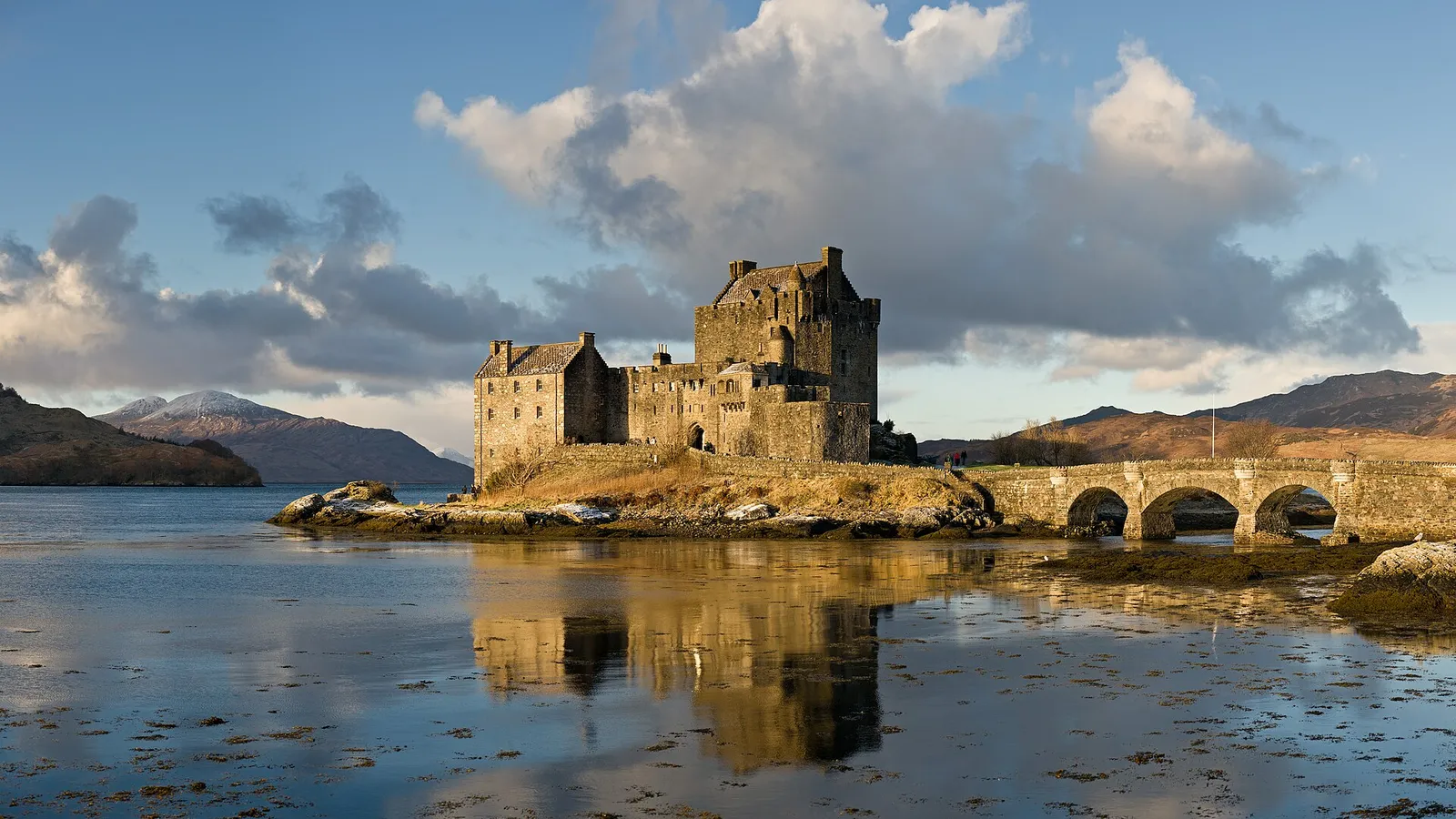

Eilean Donan Castle
Contents
Isn't this the ancient, unbroken Highland stronghold postcards suggest? Not quite — the castle that photographs so convincingly as medieval Scotland was a roofless ruin for nearly two centuries before a twentieth-century rebuilding project gave it the form visitors see today.
TL;DR
- established Eilean Donan has foundations dating to the 13th century, confirmed by archaeological and documentary evidence of early fortification on the island.
- established The castle was destroyed in 1719 after a Jacobite garrison of Spanish troops was bombarded by Royal Navy ships during the Jacobite rising of that year — this is recorded in military and government accounts of the time.
- established The castle lay as a roofless ruin for nearly 200 years until Lt Col John MacRae-Gilstrap funded a reconstruction between 1912 and 1932 — this is documented through building records and the family's own account of the project.
- traditional Much of what is popularly described as a "faithfully restored ancient castle" is more accurately a twentieth-century reconstruction built on the footprint and surviving fragments of earlier phases — the distinction matters because large portions of the fabric visitors see are modern, not medieval, work.
- established The castle remains the property and symbolic home of Clan MacRae and operates today as one of Scotland's most-photographed paid visitor attractions — a matter of current institutional record.
Key Facts
- Location
- Small tidal island at the meeting of Loch Duich, Loch Long, and Loch Alsh, near Dornie, Highland, Scotland
- Era/Period
- Origins 13th century; present form largely 1912–1932 reconstruction
- Type
- Island castle / clan stronghold
- Managed/Owned by
- Conchra Charitable Trust, on behalf of Clan MacRae
- Visitor status
- Open seasonally, paid admission; one of Scotland's most visited privately managed castles
- Notable feature
- Connected to the mainland by a stone footbridge, added during the 20th-century reconstruction
Scottish Impact Index (SI Score)
- National Significance
- 7/10
- Historical Continuity
- 8/10
- Human & Economic Importance
- 7/10
- Landscape / Architectural Distinctiveness
- 9/10
- Cultural & Historical Legacy
- 8/10
- Recognition
- 10/10
49/60
Ranked =34th of 43 in Locations
A Note on Claims and Evidence
Eilean Donan is a textbook case for the documented/traditional/legend-myth framework because its physical fabric spans genuinely medieval foundations, a long documented destruction, and an openly acknowledged modern rebuild — yet popular coverage frequently blurs these into a single "ancient castle" narrative. The documented tier covers the 13th-century origins, the 1719 bombardment and destruction (recorded in contemporary military correspondence), and the 1912–1932 reconstruction (recorded in the MacRae-Gilstrap family's own building accounts). The traditional tier covers claims about the castle's medieval appearance and continuous habitation prior to 1719, which rest on fragmentary archaeological remains rather than full documentary certainty. There is comparatively little outright legend-myth material specific to the castle itself, though it is frequently used in tourism and film contexts in ways that imply an unbroken ancient pedigree the physical building does not actually have.
Timeline
Earliest fortification established on the island, associated with the Earls of Ross and used as a royal stronghold.
Castle destroyed and rebuilt on a smaller plan more than once during conflicts tied to the subjugation of the Lordship of the Isles.
A rectangular tower-keep and courtyard constructed, forming the core layout later reconstructed in the 20th century.
Castle garrisoned and strengthened with an artillery outwork during a period of government military presence.
Jacobite rising: a small garrison of Spanish troops supporting the rebellion occupies the castle; it is bombarded and substantially destroyed by Royal Navy ships, with its gunpowder magazine exploding.
Castle remains a roofless ruin for close to two centuries.
Lt Col John MacRae-Gilstrap begins planning and funding reconstruction, working with architect and clan historian Farquhar MacRae.
Full reconstruction of the castle undertaken, including a new stone footbridge connecting the island to the mainland; much of the structure visitors see dates from this period.
Castle opens to the public as a heritage attraction, administered via a charitable trust.
Managed by the Conchra Charitable Trust on behalf of Clan MacRae; operates as a seasonal, paid visitor attraction and a frequently used film and tourism location.
Details
Origins at the meeting of three lochs
Eilean Donan's setting — a small tidal island at the point where Loch Duich, Loch Long and Loch Alsh converge — made it a natural defensive and strategic position controlling maritime and land routes through the western Highlands. Its documented origins go back to the 13th century, when the Earls of Ross established fortification there, reflecting the site's long-standing value to whoever controlled this stretch of coastline. Like many Highland strongholds of the period, the castle's early history is tied closely to the turbulent politics of the Lordship of the Isles; during the fifteenth-century campaigns to subdue the Lords of the Isles, the castle was destroyed and rebuilt more than once, each time to a somewhat different, often smaller, plan — a reminder that "the castle" as a continuous physical object did not exist in any simple sense even before its eighteenth-century destruction.
Architectural character
The core structure recognisable in the present castle — a rectangular tower-keep set within a defended courtyard — dates principally from construction undertaken in the sixteenth century, by which point the MacRae family had become closely associated with the site as constables for the Clan MacKenzie. Seventeenth-century additions, including an artillery outwork, reflect the castle's continued military function during a period of government garrisoning. It is this layout and footprint — rather than any single unbroken building — that the twentieth-century reconstruction worked from, making the present castle a composite of surviving medieval and early-modern foundations with substantial new building layered on top.
The 1719 destruction
The defining event in the castle's physical history is its destruction in 1719. During the Jacobite rising of that year, a small garrison of Spanish troops sent to support the rebellion occupied the castle. Royal Navy ships bombarded the position, and the explosion of the castle's own gunpowder magazine caused catastrophic damage, leaving much of the structure in ruins. Unlike many Scottish castles that were later repaired or adapted for continued use, Eilean Donan was simply abandoned, its roofless walls left standing but unoccupied for close to two hundred years — a genuinely dramatic gap in the building's working life that is easy to lose sight of given its polished modern presentation.
Reconstruction and reinvention
The castle visitors see today owes its existence to an early twentieth-century reconstruction project led by Lt Col John MacRae-Gilstrap, who inherited both the romantic attachment of the MacRae name to the site and the financial means to act on it. Working between 1911 and 1932 with Farquhar MacRae, an architect and clan historian, MacRae-Gilstrap rebuilt the castle essentially from its ruined footprint, adding a stone footbridge connecting the island to the mainland — itself an entirely new feature, not a restoration of any earlier crossing. This means a very large proportion of what tourists photograph, and what appears in film and television productions set in "medieval" or "ancient" Scotland, is twentieth-century construction built in a historicist style rather than surviving original fabric. This is not a secret — the reconstruction is openly documented — but it is frequently elided in popular tourism material, which tends to present the castle as a seamlessly ancient structure.
A clan symbol and tourism icon today
Eilean Donan's position as one of Scotland's most photographed castles rests less on unbroken historical pedigree than on the success of its reconstruction as an image of Highland Scotland — picturesque, dramatically sited, and visually "complete" in a way many genuinely unaltered ruins are not. It functions today as the clan home of the MacRaes, administered through the Conchra Charitable Trust, and draws substantial visitor numbers precisely because its reconstructed state allows the kind of fully furnished, walkable interior experience that a true ruin cannot offer. Its use as a filming location has further entrenched its image as a quintessential "ancient Highland castle" in global popular culture, even though the building people are actually looking at is, in large part, less than a century old in its current form.
Did You Know?
- The stone footbridge connecting Eilean Donan to the mainland is not an ancient feature — it was built as part of the 1912–1932 reconstruction.
- The castle stood as a roofless ruin for nearly 200 years after its 1719 destruction, longer than the span of its original medieval construction to that destruction.
- The 1719 attack involved Spanish troops garrisoning the castle in support of the Jacobite cause — a reminder of the international dimension of Jacobite risings, often remembered as a purely domestic Scottish affair.
- Much of the castle's interior fittings and furnishings date from the 20th-century rebuild and subsequent curation, rather than surviving medieval or early-modern originals.
- The reconstruction was personally funded and overseen by Lt Col John MacRae-Gilstrap, reconnecting the MacRae clan to a site they had been associated with for centuries.
- The castle's setting at the meeting of three lochs gave it genuine strategic value controlling western Highland sea routes, a role easy to overlook given its now primarily scenic reputation.
- Despite its turbulent destruction history, the castle was rebuilt more than once even before 1719, during 15th-century conflicts tied to the Lordship of the Isles.
- Eilean Donan is frequently used as a filming location for productions set in "ancient" or "medieval" Scotland, reinforcing a public perception of antiquity that understates how much of the structure is modern.
FAQ
1Is Eilean Donan Castle actually medieval?
Its foundations and site are medieval, dating to the 13th century, but most of the structure visitors see today was rebuilt between 1912 and 1932.
2Why was the castle destroyed in 1719?
Royal Navy ships bombarded it after a Jacobite garrison, including Spanish troops, occupied it during the 1719 Jacobite rising; the castle's own gunpowder magazine then exploded.
3How long was the castle a ruin?
Close to 200 years, from 1719 until reconstruction began in 1911–1912.
4Who rebuilt Eilean Donan?
Lt Col John MacRae-Gilstrap, working with architect and clan historian Farquhar MacRae, funded and oversaw the reconstruction between 1912 and 1932.
5Is the footbridge original?
No — it was built as part of the 20th-century reconstruction and has no medieval precedent at the site.
6Who owns the castle today?
It is held for Clan MacRae via the Conchra Charitable Trust.
7Can visitors go inside?
Yes, the castle is open seasonally as a paid visitor attraction with furnished interiors.
8Is Eilean Donan linked to a specific clan?
Yes, principally Clan MacRae, who served historically as constables of the castle for the Clan MacKenzie and later funded its reconstruction.
9Has the castle been used in films?
Yes, it is a frequently used filming location for productions depicting historic or fantasy versions of Scotland.
10Was the castle always on this exact footprint?
Largely, though 15th-century conflicts saw it destroyed and rebuilt more than once to varying plans before the structure stabilised into the layout later reconstructed in the 20th century.
11Is this one of the oldest castles in Scotland?
Its origins are old (13th century), but its current fabric is, by proportion, one of the more recently reconstructed major castles in Scotland.
12Does the castle have any connection to the Jacobite risings beyond 1719?
Its best-documented Jacobite connection is the 1719 destruction; it is less central to the larger 1715 and 1745–46 risings than sites such as Stirling or Culloden.
Sources and Further Reading
Primary/Institutional
- Conchra Charitable Trust / Eilean Donan Castle official visitor information
- Highland Historic Environment Record (HER), Monument MHG45372, Eilean Donan Castle
Scholarly/Critical
- Canmore (RCAHMS) site record, Eilean Donan Castle
- University of the West of Scotland research on "Reconstructing the Dream: Eilean Donan Castle, Cultural Tourism and History"
- Country Life, feature coverage of the Conchra Charitable Trust and the castle's ownership history
General
- Wikipedia, "Eilean Donan" — en.wikipedia.org/wiki/Eilean_Donan
- The Castle Guide, Eilean Donan Castle overview
- Great Castles, Eilean Donan Castle history summary
Caveats: Myths and Disputed Claims
- Do not describe Eilean Donan as an unbroken, continuously standing ancient castle. It was a roofless ruin from 1719 to the early 20th century.
- Do not present the current structure as a faithful medieval restoration. It is accurately described as a 20th-century reconstruction built on medieval and early-modern foundations, incorporating a significant amount of entirely new building.
- Do not state the stone footbridge is an ancient or original feature; it was added during the 1912–1932 rebuild.
- Avoid implying the castle's dramatic, "complete" appearance in photographs reflects an unaltered historic structure — its visual completeness is substantially a product of the 20th-century reconstruction, not survival.
Card 003 · Locations