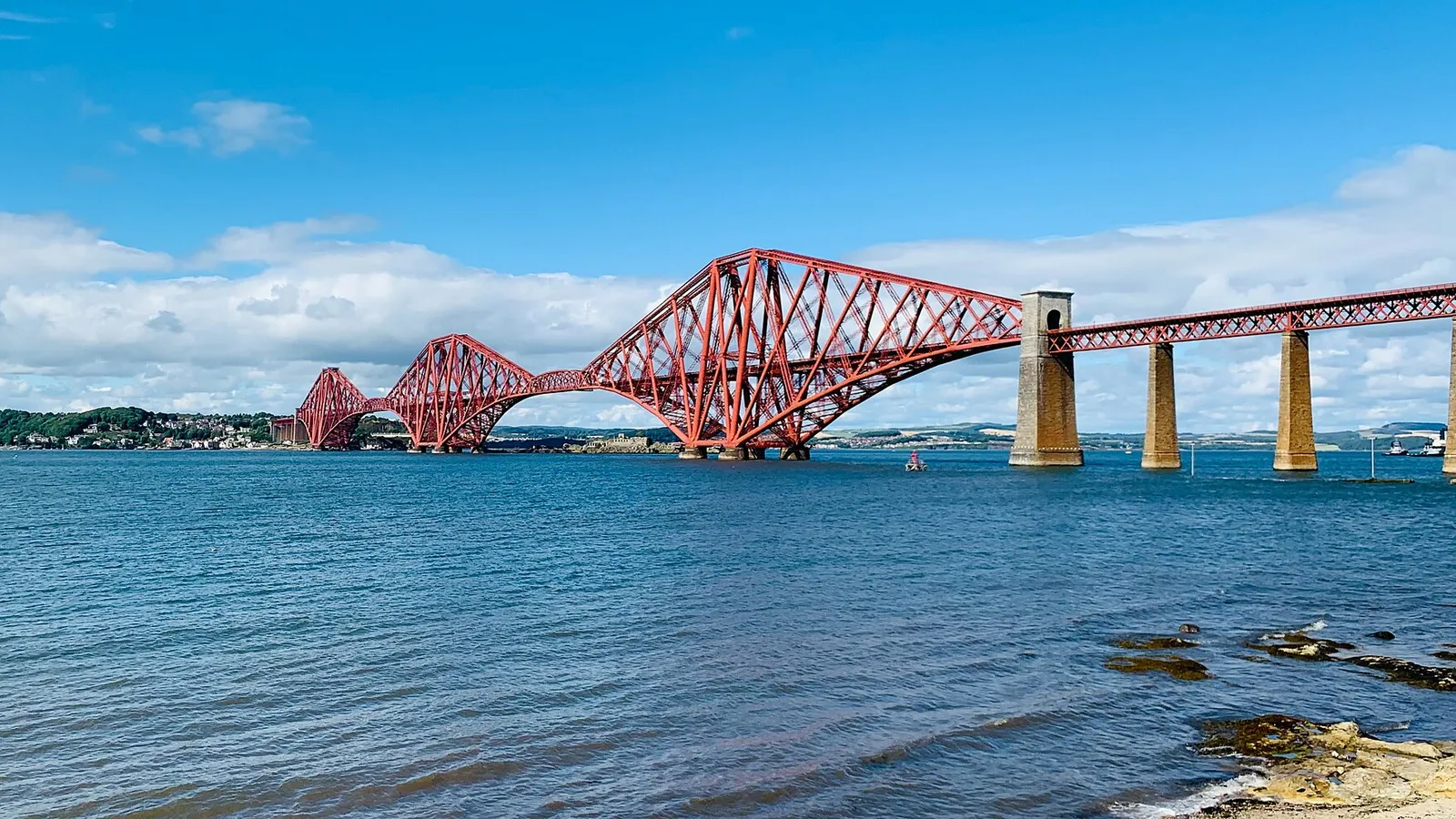

Forth Bridge & the Firth of Forth
Contents
Not to Be Confused With...
Three separate crossings now span the Firth of Forth at Queensferry: the 1890 Forth Bridge (rail, cantilever, the UNESCO World Heritage structure this article covers), the 1964 Forth Road Bridge (suspension, now restricted mostly to buses/pedestrians/cyclists), and the 2017 Queensferry Crossing (cable-stayed, the main road crossing today). All three are visible from the same viewpoint and are frequently confused in casual writing. This article is about the 1890 rail bridge alone; the others are noted only for context and contrast.
TL;DR
- established The Forth Bridge, opened in 1890, is a cantilever rail bridge roughly 2.5 km long, built from around 55,000 tonnes of steel — figures confirmed by Network Rail and the original engineering records, not estimate.
- established The bridge's design was a direct engineering response to the 1879 Tay Bridge disaster, which killed everyone aboard a train crossing an earlier, structurally inadequate bridge; this is stated plainly because it is well documented in the official inquiry and in the Forth Bridge's own design history.
- disputed The number of workers who died constructing the bridge was long cited as 57, but 2019 archival research raised this to as many as 73 or more documented deaths; this article uses the higher, more recently researched figure and flags the discrepancy rather than repeating the older, likely undercounted number as settled fact.
- established The Forth Bridge became a UNESCO World Heritage Site in 2015, a documented international designation distinct from — and more significant than — informal "wonder of the world" rankings.
- traditional The phrase "like painting the Forth Bridge," meaning a never-ending task, reflects a genuine historical maintenance regime, but it is no longer strictly accurate since a modern 25-year coating system was applied between 2002 and 2011, so the idiom now describes the bridge's reputation more than its current practice.
Key Facts
- Category
- Detail
- Location/Region
- Firth of Forth, between South Queensferry and North Queensferry, near Edinburgh
- Scale/Date
- Opened 4 March 1890; total length c. 2,467 m (8,094 ft); two main cantilever spans of 521 m (1,710 ft) each; height 110 m (361 ft) above high water; c. 55,000 tonnes of steel
- Engineer(s)
- Sir John Fowler and Sir Benjamin Baker (design); Sir William Arrol (contractor/construction)
- Type
- Cantilever railway bridge
- Protected/heritage status
- UNESCO World Heritage Site (2015); Category A Listed Building
- Managed/Owned by
- Network Rail (ownership and maintenance, via contracted engineering teams)
- Access notes
- Not open to pedestrians or vehicles — a working rail bridge; best viewed from South Queensferry, North Queensferry, Hawes Pier, or the Forth Bridges viewpoint; boat tours operate beneath it
Scottish Impact Index (SI Score)
- National Significance
- 10/10
- Historical Continuity
- 9/10
- Human & Economic Importance
- 10/10
- Landscape / Architectural Distinctiveness
- 10/10
- Cultural & Historical Legacy
- 10/10
- Recognition
- 10/10
59/60
Ranked =2nd of 43 in Locations
A Note on Claims and Evidence
The Forth Bridge's engineering facts — dimensions, materials, dates, and heritage status — are unusually well documented, drawn from original construction records, parliamentary and inquiry reports, and modern Network Rail and UNESCO documentation, and are marked established throughout. The construction death toll, by contrast, illustrates why a single-tier "it's all history" approach fails real places: the long-repeated figure of 57 deaths has been directly challenged by more recent archival research identifying additional, previously unrecorded fatalities among labourers whose deaths were not formally logged at the time. This article treats the higher, better-researched figure as the more credible current estimate while noting the dispute explicitly, rather than either repeating an outdated number or inventing false certainty where none exists.
Timeline
First Forth railway bridge proposal (a suspension design by Thomas Bouch) approved by Parliament.
The Tay Bridge disaster (Bouch's earlier Tay Bridge collapses in a storm, killing all aboard a train) leads to the abandonment of Bouch's Forth design and the discrediting of his reputation.
Construction begins on the new Forth Bridge, designed by Sir John Fowler and Sir Benjamin Baker, built by contractor Sir William Arrol.
Construction proceeds using a then-novel cantilever design and extensive use of steel rather than wrought iron; peak workforce reaches roughly 4,600.
Bridge formally opened by the Prince of Wales (later King Edward VII), who drove home a final, gold-plated rivet.
Forth Road Bridge opens nearby, providing the first dedicated road crossing and relieving the rail bridge of informal pedestrian/cycle traffic that had sometimes used its maintenance walkways.
Major repainting and recoating project applies a modern 25-year coating system, substantially ending the need for a permanent, continuous painting crew.
Forth Bridge inscribed as a UNESCO World Heritage Site.
Queensferry Crossing opens as the primary road crossing, further reducing pressure on the older Forth Road Bridge (now largely restricted to buses, cyclists, and pedestrians).
Archival research substantially revises the known construction death toll upward from the long-cited figure of 57.
Around 190–200 trains cross daily; the bridge remains a fully operational part of Scotland's rail network as well as a protected heritage monument.
Details
Why the Forth Bridge exists: the shadow of Tay Bridge
The Forth Bridge cannot be understood without its predecessor's failure. In 1879, a bridge across the nearby Firth of Tay — designed by engineer Thomas Bouch, who had also been engaged to design a Forth crossing — collapsed during a storm while a train was crossing it, killing everyone aboard. The subsequent official inquiry found serious design and construction faults, and Bouch's reputation and ongoing commissions, including his Forth Bridge design, were abandoned as a direct result. This is not a minor footnote: the Forth Bridge that was eventually built is, in its very design philosophy — enormous overengineered strength, redundancy, and a conspicuously robust cantilever form rather than a lighter suspension structure — a direct engineering and public-confidence response to that disaster. Sir John Fowler and Sir Benjamin Baker, commissioned afresh, designed a structure intended to be visibly, reassuringly massive, in a period when public trust in major bridge engineering had been severely shaken.
The cantilever principle and why it mattered
The Forth Bridge's defining engineering feature is its cantilever construction: three enormous double-cantilever towers, each a self-supporting structure extending outward from a central pier without need of continuous support from below during construction, connected by suspended central spans. Unlike a suspension bridge, which depends on tension cables, a cantilever bridge of this kind depends on balanced compression and tension within rigid steel lattice towers — a design well suited to the exceptionally strong tidal currents and depth of the Firth of Forth, which made the construction of conventional piers and falsework far more difficult than at many other crossing sites. The bridge was also one of the first major structures in the world built predominantly from steel rather than wrought iron, a material choice that allowed greater strength-to-weight ratios and longer spans than had previously been achievable, making the Forth Bridge, at the time of completion, one of the longest-spanning bridges anywhere.
Human cost and its recent correction
Constructing the bridge required a peak workforce of around 4,600 men working at height, over water, and with materials and safety standards far below modern expectations. For well over a century, the commonly cited death toll was 57. Archival research published in 2019, examining parish and hospital records more thoroughly than earlier studies, identified a substantially higher number of deaths connected to the project — commonly cited now as around 73, and by some researchers potentially higher still, reflecting labourers whose deaths went unrecorded in the original official tally, particularly among itinerant or lower-status workers. This article treats the revised, higher figure as the more credible current estimate, consistent with the site's own "accuracy over patriotism" standard: a lower, more flattering number should not be repeated simply because it is more familiar.
Opening, reception, and "painting the Forth Bridge"
The bridge opened on 4 March 1890, formally inaugurated by the Prince of Wales (later King Edward VII), who drove home a ceremonial gold-plated final rivet. It was received internationally as a landmark of Victorian engineering ambition and, at the time, among the most technically advanced structures in the world. Its ongoing maintenance needs — a vast steel structure exposed to a maritime, corrosive environment — gave rise to the enduring English idiom "like painting the Forth Bridge," describing a task so continuous it is never finished, reflecting a genuine historical maintenance regime of continuous repainting that persisted for most of the 20th century. That regime effectively ended between 2002 and 2011, when a modern 25-year protective coating system was applied, meaning the idiom today describes the bridge's reputation and cultural memory rather than its literal current maintenance schedule — a distinction worth making precisely rather than repeating the old claim uncritically.
Three bridges, one crossing point — and why they shouldn't be confused
The Forth Bridge is frequently, and incorrectly, conflated in casual writing with its two road-crossing neighbours at the same stretch of water: the Forth Road Bridge, a suspension bridge opened in 1964 as the first dedicated road crossing (now largely restricted to buses, cyclists, and pedestrians), and the Queensferry Crossing, a cable-stayed bridge opened in 2017 as the main road crossing today. All three structures are visible together from the same shoreline viewpoints, producing one of the most photographed infrastructure panoramas in the world, but they are different bridges serving different purposes built more than a century apart, using entirely different engineering principles (cantilever, suspension, and cable-stayed respectively). This article is concerned specifically with the 1890 rail bridge; the other two are noted here only for clarity and should not be described as part of "the Forth Bridge" itself.
Heritage recognition and present-day status
In 2015, the Forth Bridge was inscribed as a UNESCO World Heritage Site, in recognition of its role as "a daring and unprecedented feat of engineering" and its enduring influence on bridge design worldwide — a formal international designation that followed rigorous technical and historical assessment, distinct from informal popularity rankings (the bridge was also voted "Scotland's greatest man-made wonder" in a public poll the following year, a separate and much less rigorous distinction worth noting as such). Today the bridge remains fully operational, owned and maintained by Network Rail, carrying around 190 to 200 trains daily across the Firth of Forth — a rare case of a major UNESCO World Heritage industrial structure still performing its original working function rather than existing purely as a heritage monument.
Did You Know?
- The Forth Bridge's design is a direct consequence of the 1879 Tay Bridge disaster, which killed everyone aboard a train on a structurally inadequate earlier bridge designed by the same engineer originally engaged for the Forth crossing.
- Long-cited figures put construction deaths at 57, but 2019 archival research suggests the real toll was significantly higher — a correction this article adopts rather than the older, more familiar number.
- The bridge used around 55,000 tonnes of steel, making it one of the first major structures in the world built predominantly from that material rather than wrought iron.
- Its three double-cantilever towers are each independently self-supporting, a design feature specifically suited to the strong tidal currents of the Firth of Forth, which made conventional pier-building difficult.
- The phrase "like painting the Forth Bridge" entered everyday English as shorthand for a never-ending task, but a modern coating system applied between 2002 and 2011 means the bridge no longer actually requires continuous repainting.
- The bridge opened with a ceremonial gold-plated rivet driven home by the future King Edward VII.
- There are three separate bridges at this crossing point — rail (1890), road suspension (1964), and road cable-stayed (2017) — frequently confused with one another in casual references.
- The bridge remains a fully working railway structure today, carrying around 190–200 trains a day, making it one of the few UNESCO World Heritage industrial sites still performing its original job.
FAQ
1Can you walk or drive across the Forth Bridge?
No. It is a working rail-only bridge with no pedestrian or vehicle access; nearby road bridges serve that purpose.
2Why was it built the way it was?
Largely in direct response to the 1879 Tay Bridge disaster, which led engineers to favour an overengineered, highly robust cantilever design over a lighter suspension structure.
3How many people died building it?
Traditionally cited as 57, but 2019 archival research suggests a higher figure, commonly cited around 73, reflecting previously unrecorded deaths.
4When did it open, and who opened it?
It opened on 4 March 1890, inaugurated by the Prince of Wales, later King Edward VII.
5Is this the same bridge as the Forth Road Bridge?
No — that is a separate 1964 suspension bridge for road traffic, located alongside the rail bridge.
6What about the Queensferry Crossing?
That is a third, separate bridge, opened in 2017, now carrying most road traffic across the Forth.
7Is it true the bridge needs constant repainting?
That was historically true for most of the 20th century, but a modern long-life coating applied 2002–2011 has largely ended the need for continuous painting.
8When did it become a UNESCO World Heritage Site?
In 2015.
9What makes its engineering significant?
It was among the earliest major structures built predominantly from steel, and its cantilever design was a globally influential response to the structural failures that caused the Tay Bridge disaster.
10How long is the bridge?
About 2,467 metres (8,094 feet) in total length, with two main spans of 521 metres each.
11Can you see all three Forth bridges at once?
Yes — several viewpoints around Queensferry show the rail bridge, road bridge, and Queensferry Crossing together.
12Is the bridge still used for regular passenger trains?
Yes, it remains an active part of Scotland's main rail network, carrying both passenger and freight services.
Sources and Further Reading
Primary/Institutional
- Network Rail — Forth Bridge engineering and maintenance information
- UNESCO World Heritage Centre — Forth Bridge inscription (2015)
- Historic Environment Scotland — listed building record
Scholarly/Critical
- 2019 archival research revising construction-era fatality figures
- Official inquiry records into the 1879 Tay Bridge disaster and its influence on Forth Bridge design
General
- Forth Bridge — Wikipedia
- Structurae — Forth Bridge engineering record
- Quality press coverage of the Forth Bridge's UNESCO inscription and 2019 death-toll revision
Caveats: Myths and Disputed Claims
- Do not state the construction death toll as a settled "57" — more recent archival research indicates this figure likely undercounts actual deaths; state both figures and the dispute.
- Do not refer to the Forth Road Bridge or the Queensferry Crossing as "the Forth Bridge" — all three are distinct structures with different dates, designs, and purposes.
- Do not claim the bridge still requires continuous manual repainting — a modern long-life coating system (2002–2011) has substantially changed this.
- Do not present "Scotland's greatest man-made wonder" (a 2016 public poll) as equivalent in authority to the bridge's UNESCO World Heritage status (2015) — the two are very different kinds of recognition.
- Do not imply Thomas Bouch designed the bridge that was eventually built — his original Forth design was abandoned after the Tay Bridge disaster, and the structure that exists today is by Fowler and Baker.
Card 033 · Locations