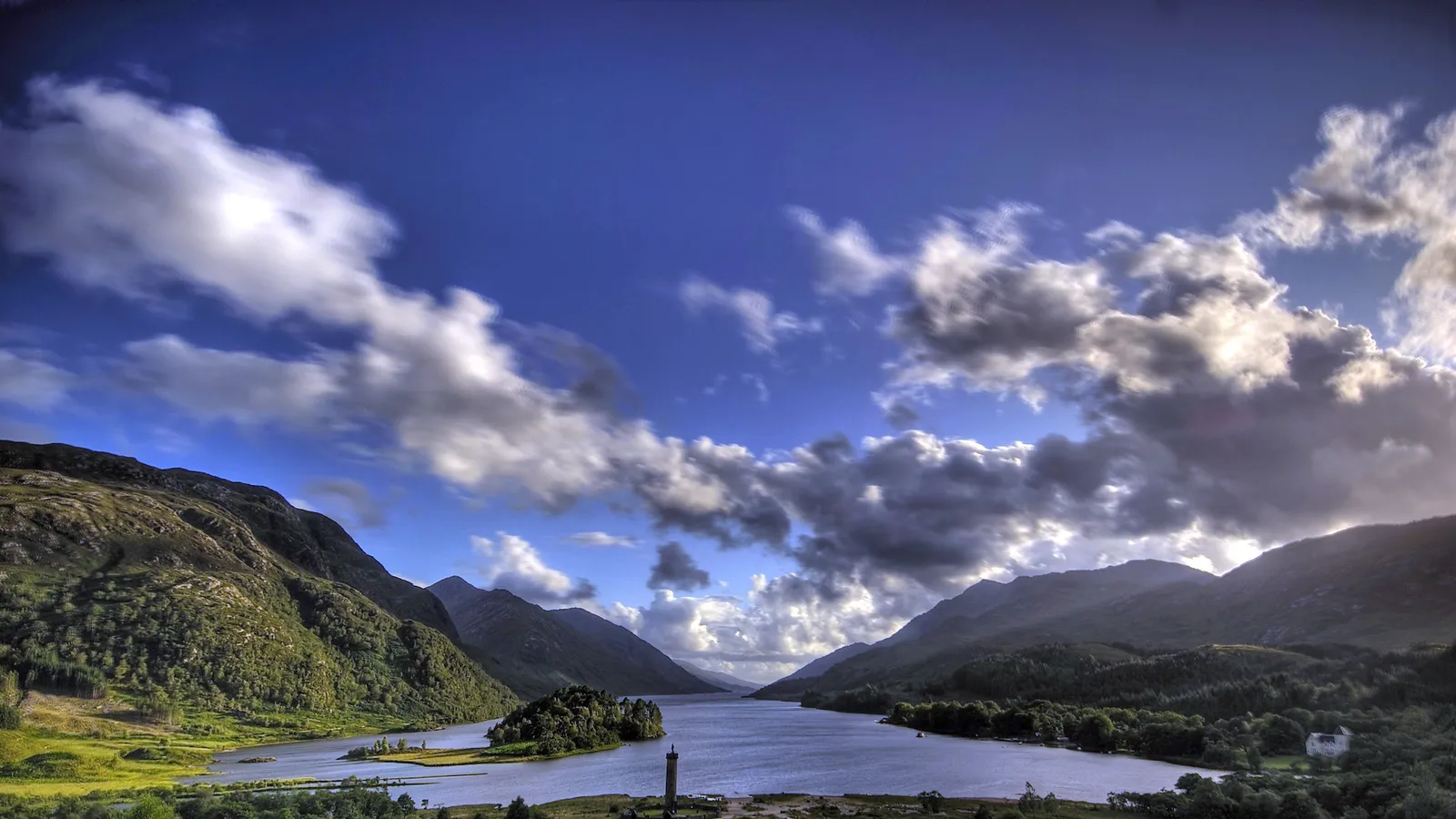

Glenfinnan & Loch Shiel
Contents
The myth worth correcting
Glenfinnan is often treated as one seamless "Jacobite and railway" story, with the famous curved viaduct presented as somehow part of the 1745 drama. It is not. The viaduct is a piece of late-Victorian civil engineering built 150 years after the standard was raised, with no Jacobite content whatsoever beyond sharing the glen. Its fame today comes overwhelmingly from the Harry Potter films, not from Bonnie Prince Charlie.
TL;DR
- established On 19 August 1745, Prince Charles Edward Stuart raised his standard at Glenfinnan, at the head of Loch Shiel, formally launching the Jacobite Rising — this is recorded in contemporary accounts and widely corroborated, so it is stated as fact.
- traditional The specific clan contingents and ceremonial details present that day (a Macfie piper, brandy shared among the gathered men) come down through later retellings rather than a single contemporaneous eyewitness record, so are treated as traditional detail layered onto a documented event.
- established The Glenfinnan Monument was erected around 1815 — seventy years after the rising, not at the time — by Alexander Macdonald of Glenaladale, and was partly funded by wealth from Jamaican slave plantations; this ownership and funding history is documented and should not be omitted for romantic effect.
- established The Glenfinnan Viaduct is a Victorian railway structure, built 1897–1901 by Robert McAlpine using mass (unreinforced) concrete, and has no historical connection to the Jacobite rising — it is included here as a landscape feature, not as 1745 history, because the two are frequently and wrongly conflated in casual accounts.
- traditional Prince Charles is traditionally said to have been rowed the length of Loch Shiel to reach Glenfinnan for the standard-raising — a widely repeated detail consistent with the geography and timeline, but resting on tradition rather than a single definitive logbook or eyewitness account.
Key Facts
- Location/Region
- Lochaber, Scottish Highlands, at the head of Loch Shiel, c. 18 miles west of Fort William
- Scale
- Loch Shiel: 28.16 km (17.5 miles) long, up to 128 m deep. Monument: 18 m tower. Viaduct: 380 m long, 30 m high, 21 arches
- Type
- Historic landscape (standard-raising site and monument) combined with a long freshwater loch and a separate Victorian railway viaduct
- Protected/heritage status
- Glenfinnan Monument and visitor centre: National Trust for Scotland. Viaduct: Category A Listed Building (1971). Loch Shiel: Special Protection Area, Special Area of Conservation, part of a 13,045-hectare National Scenic Area
- Managed/owned by
- National Trust for Scotland (monument/visitor centre); Network Rail (viaduct, still in active use on the West Highland Line)
- Access notes
- Monument and visitor centre open seasonally with NTS admission; viaduct viewable from public viewpoints and footpaths; Loch Shiel largely accessible only by boat or on foot, with very limited road access along its shores
Scottish Impact Index (SI Score)
- National Significance
- 9/10
- Historical Continuity
- 9/10
- Human & Economic Importance
- 7/10
- Landscape / Architectural Distinctiveness
- 10/10
- Cultural & Historical Legacy
- 10/10
- Recognition
- 10/10
55/60
Ranked =16th of 43 in Locations
A Note on Claims and Evidence
This article separates claims into documented, traditional, and legend/myth tiers. The standard-raising on 19 August 1745 and the monument's 1815 construction date are documented: both rest on dated written record and surviving physical structures. The precise ceremonial details of the 1745 gathering — exact clan numbers, the piper, the brandy — are traditional: consistent across retellings but drawn from accounts written down after the event rather than a single verified contemporary witness statement. The viaduct's engineering history is documented civil-engineering record; its popular association with "Jacobite history" is a modern conflation this article explicitly corrects rather than perpetuates.
Timeline
Loch Shiel's long, narrow trench is carved by glacial action, typical of west Highland fjord-lochs.
Glen Finnan and Loch Shiel's shores settled by farming communities within the territories of Clan Donald, Clan Cameron, and related kin groups.
Prince Charles Edward Stuart raises his standard at Glenfinnan, formally beginning the Jacobite Rising of 1745–46.
The rising collapses after defeat at Culloden; Jacobite sympathisers in the area face reprisal in the following years.
The Glenfinnan Monument is erected by Alexander Macdonald of Glenaladale to commemorate the 1745 gathering.
A statue of an anonymous kilted Highlander, by sculptor John Greenshields, is added to the top of the monument tower.
During the Highland Clearances, women in the Loch Shiel area reportedly resist an eviction party, armed with shearing hooks and stone-filled aprons — a sharply different, and far less romantic, local history from the same landscape.
The Glenfinnan Viaduct is constructed by Sir Robert McAlpine for the West Highland Railway, using innovative mass-concrete technique.
The West Highland Line extension to Mallaig opens, bringing the viaduct into regular service.
The Glenfinnan Viaduct is designated a Category A Listed Building.
The viaduct appears in the Harry Potter film series, beginning with Chamber of Secrets, transforming it into an internationally recognised filming location.
Details
Two landscapes, one glen
Glenfinnan sits at the point where the River Finnan meets the head of Loch Shiel, one of the longest freshwater lochs in Scotland at just over 28 kilometres. Unlike Loch Lomond or Loch Ness, Loch Shiel has almost no road running along its shores for most of its length; access today is overwhelmingly by boat or on foot, which has kept its upper reaches markedly quieter than Scotland's better-connected lochs. This isolation is not incidental to its history — it is precisely the kind of remote, hard-to-reach country that made it useful to a prince trying to rally support without drawing the attention of government forces until he was ready.
The loch's ecological designations reflect that same remoteness: it is a Special Protection Area for breeding black-throated divers and golden eagles, and its shoreline oak and alder woodlands form a Special Area of Conservation. White-tailed sea eagles and ospreys both use the loch, and otters are regularly recorded along its banks.
The raising of the standard, 19 August 1745
On 19 August 1745, Prince Charles Edward Stuart — "Bonnie Prince Charlie" — raised his standard at Glenfinnan, at the head of Loch Shiel, formally declaring the Jacobite claim to the British throne and opening what became the last major Jacobite Rising. Tradition holds he was rowed the length of the loch to reach the gathering point, a detail consistent with the geography and timeline of his movements but not confirmed by a single definitive primary account, so it is treated here as traditional rather than certain.
Clan contingents gathered under figures including MacDonald of Glenaladale (sometimes recorded as "MacMaster of Glenaladale" in secondary retellings), with men of Clan Cameron, Clan Donald branches, and the Macfies among those present; a piper is traditionally said to have played and brandy to have been distributed to mark the occasion. These are the kinds of vivid, humanising details that survive well in oral and later written tradition but cannot be checked against a contemporaneous diary or official record, and so are presented here as traditional colour rather than verified fact. What is not in dispute is the outcome: the rising launched that day led, within little more than a year, to catastrophic defeat at Culloden in April 1746 and the beginning of a punitive British government crackdown on Highland clan society that reshaped the region for generations.
A monument built later, and built on slavery wealth
The tower that now dominates views of Glenfinnan was not raised in 1745; it was built around 1815, seventy years after the event it commemorates, by Alexander Macdonald of Glenaladale, a descendant of one of the clan leaders present at the original gathering. The 18-metre tower was designed by the architect James Gillespie Graham, and in 1835 a statue of an anonymous, generic kilted Highlander — not a portrait of any specific historical figure — was added by sculptor John Greenshields.
A detail frequently left out of romantic retellings, and one that this article states plainly in line with its editorial standard: part of the funding behind the monument's construction derived from wealth connected to Jamaican slave plantations. The memorial's commemorative purpose and its funding source are both documented facts, and presenting one without the other would misrepresent the history of how, and by whom, Jacobite memory was later constructed and financed in the nineteenth century.
It is also worth noting that the same landscape carries a far less celebrated history from less than a century later: in 1842, during the Highland Clearances, women in the Loch Shiel area are recorded as having resisted an eviction party, reportedly armed with shearing hooks and stones carried in their aprons. This episode receives none of the monumental commemoration given to 1745, a disparity in historical memory worth noting rather than glossing over.
The viaduct: Victorian engineering, not Jacobite history
The Glenfinnan Viaduct, which strides across the glen a short distance from the monument, has no connection whatsoever to the Jacobite rising. It was built between 1897 and 1901 by the contractor Robert McAlpine — nicknamed "Concrete Bob" for his pioneering, large-scale use of mass (unreinforced) concrete — as part of the West Highland Railway's extension to Mallaig. At 380 metres long, with 21 arches each spanning 15 metres and the structure rising 30 metres above the glen floor, it was, at the time, one of the most technically ambitious concrete structures built in Britain, and it remains a Category A Listed Building, recognised since 1971 for its engineering and architectural significance.
Its modern global fame rests almost entirely on a different source: its appearance, from 2002's Harry Potter and the Chamber of Secrets onward, as the bridge crossed by the Hogwarts Express — in the films, generally portrayed by the real-world Jacobite Steam Train, which still runs scheduled services across the viaduct each summer on the West Highland Line. This article treats the viaduct strictly as the Victorian engineering landmark it is, and notes — in line with the series' own planning — that a fuller account of its construction and film fame belongs on a dedicated Glenfinnan Viaduct card rather than being expanded further here.
Jacobite memory and tourism today
Today Glenfinnan functions as one of Scotland's most visited sites of Jacobite commemoration, run by the National Trust for Scotland, which operates a visitor centre interpreting the 1745 rising alongside the monument. The site sits at an unusual intersection of two quite different tourist draws — visitors arriving specifically for Jacobite and Scottish nationalist history, and visitors arriving primarily for the viaduct's Harry Potter associations — and the two audiences, and the two histories behind them, are genuinely separate, even though they occupy the same few hundred metres of glen.
Did You Know?
- The Glenfinnan Monument was built seventy years after the event it commemorates — not at the time of the 1745 rising itself.
- Part of the funding for the monument came from wealth connected to Jamaican slave plantations, a detail often omitted from tourist accounts.
- The Glenfinnan Viaduct has no historical connection to the Jacobite rising — it was built roughly 150 years later for an entirely unrelated railway project.
- The viaduct's builder, Robert McAlpine, earned the nickname "Concrete Bob" for his then-pioneering large-scale use of unreinforced mass concrete.
- Loch Shiel runs for over 28 kilometres with almost no road along most of its length — access is still largely by boat.
- In 1842, less than a century after the romanticised 1745 gathering, women near Loch Shiel physically resisted a Highland Clearance eviction party in the same landscape.
- The statue atop the Glenfinnan Monument depicts an anonymous generic Highlander, not a specific historical figure from the 1745 rising.
- The Jacobite Steam Train, which crosses the viaduct in summer and stood in for the Hogwarts Express on screen, runs on the same West Highland Line built by the viaduct's Victorian engineers.
FAQ
1Did the Jacobites build the Glenfinnan Viaduct?
No. The viaduct was built in 1897–1901, about 150 years after the 1745 Jacobite rising, as part of an unrelated Victorian railway project.
2Is the Glenfinnan Monument from 1745?
No. It was erected around 1815, seventy years after Prince Charles raised his standard there.
3What happened at Glenfinnan in 1745?
Prince Charles Edward Stuart raised his standard there on 19 August 1745, formally launching the Jacobite Rising.
4Is the Harry Potter bridge the same as the Jacobite monument site?
They sit in the same glen but are unrelated structures with unrelated histories — the viaduct is Victorian railway engineering, the monument is a nineteenth-century memorial to the 1745 rising.
5Was Prince Charles really rowed down Loch Shiel?
Tradition says so, and it fits the known geography and timeline, but no single definitive contemporary record confirms the detail, so it is treated as traditional rather than fully documented.
6Can you still ride a steam train over the viaduct?
Yes — the Jacobite Steam Train runs scheduled services across the Glenfinnan Viaduct on the West Highland Line during the summer season.
7Who funded the Glenfinnan Monument?
It was commissioned by Alexander Macdonald of Glenaladale; part of the funding is documented as deriving from wealth connected to Jamaican slave plantations.
8How long is Loch Shiel?
About 28.16 km (17.5 miles), making it one of Scotland's longer freshwater lochs.
9Is Loch Shiel easy to visit?
Its upper reaches are not easily road-accessible; most visitors see the loch from its Glenfinnan end or by boat.
10What happened to Jacobite supporters after 1745?
The rising ended in defeat at Culloden in April 1746, followed by a severe government crackdown on Highland clan society.
11Does the viaduct have listed status?
Yes, it has been a Category A Listed Building since 1971.
12Were there clearances near Glenfinnan?
Yes — a notable 1842 clearance resistance episode is recorded at Loch Shiel, distinct from and far less commemorated than the 1745 Jacobite history.
Sources and Further Reading
Primary/Institutional
- National Trust for Scotland — Glenfinnan Monument and the 1745 Rising: https://www.nts.org.uk
- Historic Environment Scotland — Category A listing record for Glenfinnan Viaduct
- NatureScot — Loch Shiel National Scenic Area special qualities documentation
Scholarly/Critical
- Academic and heritage-sector literature on Jacobite commemoration and nineteenth-century memorial funding
- Highland Clearances historiography covering Lochaber and Loch Shiel-area eviction resistance
General
- Wikipedia — "Glenfinnan," "Glenfinnan Viaduct," "Loch Shiel"
- The Scotsman — "On this day 1745: Jacobite standard raised at Glenfinnan"
- VisitScotland and regional tourism coverage of the West Highland Line and Jacobite Steam Train
Caveats: Myths and Disputed Claims
- Do not state that the Glenfinnan Viaduct has any connection to the Jacobite rising — it was built roughly 150 years later for an unrelated railway project. Correct phrasing: "a nearby Victorian railway structure, unconnected to the 1745 history."
- Do not imply the Glenfinnan Monument dates from 1745 — it was erected around 1815. Correct phrasing: "erected seventy years later, in the early nineteenth century."
- Do not present the exact ceremonial details of the 1745 gathering (piper, brandy, precise clan numbers) as verified eyewitness fact — treat as traditional detail. Correct phrasing: "tradition holds that..."
- Do not omit the monument's funding link to Jamaican slave-plantation wealth when discussing its construction — this is documented history relevant to understanding how Jacobite memory was financed. Correct phrasing: "funded in part by wealth connected to Jamaican plantations."
- Do not state as certain that Prince Charles was rowed the full length of Loch Shiel — present as a consistent but unverified tradition.
Card 022 · Locations