
Heart of Neolithic Orkney
Contents
A Prehistoric Monument Cluster, Not "Orkney" in General
This card is deliberately narrow: it covers the UNESCO World Heritage-inscribed cluster of Neolithic monuments — Skara Brae, Maeshowe, the Stones of Stenness, and the Ring of Brodgar — and their dating, construction, and significance. It does not cover Orkney's Norse heritage, modern island life, or general geography, which belong to a separate "Orkney Islands" card elsewhere in this collection. Where Norse history appears below (notably the Viking-era graffiti inside Maeshowe), it is included only because it is physically part of the monument's own documented history, not as general Orkney background.
TL;DR
- established Skara Brae was inhabited roughly 3200–2200 BC, making parts of it older than Stonehenge's main stone phase and the Great Pyramid of Giza, a comparison confirmed by radiocarbon dating rather than popular exaggeration.
- established Maeshowe, a monumental chambered cairn built around 2800 BC, required an estimated 39,000 to 100,000 hours of coordinated labour and uses flagstones weighing up to 30 tonnes, figures derived from structural and archaeological analysis.
- established Maeshowe is precisely aligned so that sunlight penetrates its 11-metre passage to illuminate the rear chamber wall specifically at the winter solstice, a deliberate astronomical engineering feature confirmed by direct observation and comparable to similar alignments at Newgrange in Ireland.
- established Maeshowe's interior contains around 33 runic inscriptions carved by Norse visitors who broke into the tomb in the 12th century AD — the largest single collection of runic graffiti known from any one site — a well-documented later chapter in the monument's history, not part of its original Neolithic purpose.
- established The Heart of Neolithic Orkney was inscribed as a UNESCO World Heritage Site in 1999, a formal international designation distinct from general claims about Orkney's prehistoric importance.
Key Facts
- Category
- Detail
- Location/Region
- Mainland, Orkney Islands, Scotland
- Scale/Date
- Skara Brae occupied c. 3200–2200 BC; Stones of Stenness c. 3100 BC; Maeshowe c. 2800 BC; Ring of Brodgar c. 2500 BC (dates approximate, based on radiocarbon and stratigraphic evidence)
- Type
- Neolithic settlement (Skara Brae), chambered cairn/tomb (Maeshowe), and two stone circles/henge monuments (Stones of Stenness, Ring of Brodgar)
- Protected/heritage status
- UNESCO World Heritage Site, "Heart of Neolithic Orkney," inscribed 1999; all four sites independently Scheduled Monuments
- Managed/Owned by
- Historic Environment Scotland
- Access notes
- Skara Brae and Maeshowe have visitor centres/guided access (Maeshowe interior access by guided tour only, due to conservation needs); Stenness and Brodgar are freely accessible outdoor sites
Scottish Impact Index (SI Score)
- National Significance
- 10/10
- Historical Continuity
- 10/10
- Human & Economic Importance
- 8/10
- Landscape / Architectural Distinctiveness
- 10/10
- Cultural & Historical Legacy
- 10/10
- Recognition
- 10/10
58/60
Ranked =6th of 43 in Locations
A Note on Claims and Evidence
The Heart of Neolithic Orkney sites benefit from extensive modern archaeological investigation, including radiocarbon dating, stratigraphic excavation, and detailed structural analysis, giving most core facts here strong evidentiary backing marked established. Precise construction dates for individual monuments nonetheless carry margins of error inherent to radiocarbon dating and incomplete excavation, so date ranges are given as approximate rather than exact. The Norse runic inscriptions inside Maeshowe are separately and independently well documented from the 1861 excavation onward, and are treated as a distinct, later historical layer rather than conflated with the monument's original Neolithic purpose or meaning, which remains genuinely uncertain and is not claimed here beyond what the evidence supports.
Timeline
Skara Brae settlement established on the Bay of Skaill, Mainland Orkney.
Stones of Stenness erected, among the earliest stone circles/henge monuments in the British Isles.
Maeshowe chambered cairn constructed, requiring an estimated tens of thousands of hours of coordinated labour.
Ring of Brodgar erected.
Skara Brae abandoned, for reasons not fully understood (environmental change, including possible coastal erosion or sand inundation, is the leading hypothesis, though this remains debated).
Norse visitors break into Maeshowe and carve approximately 33 runic inscriptions on its interior walls, the largest known single collection of runic graffiti at one site.
A severe storm strips away the sand dune that had concealed and preserved Skara Brae for millennia, exposing the settlement for the first time in the modern era.
Antiquarian and MP James Farrer conducts the first modern excavation of Maeshowe, discovering the Norse runic inscriptions while clearing debris.
Further systematic excavation of Skara Brae (notably by V. Gordon Childe in the 1920s–30s) establishes much of the modern understanding of the settlement's layout and dating.
The Heart of Neolithic Orkney (Skara Brae, Maeshowe, Stones of Stenness, and Ring of Brodgar, together with their surrounding landscape) inscribed as a UNESCO World Heritage Site.
Excavations at the nearby Ness of Brodgar (just outside the core World Heritage designation but within the same prehistoric ceremonial landscape) reveal an extensive Neolithic complex, substantially expanding understanding of the wider site's scale and significance.
Details
Older than the Pyramids: putting the dates in context
Skara Brae's occupation, beginning around 3200 BC, predates the completion of the Great Pyramid of Giza (c. 2560 BC) by several centuries and is contemporary with or earlier than the main sarsen stone phase at Stonehenge (c. 2500 BC) — a frequently cited comparison that is genuinely accurate, confirmed by radiocarbon dating rather than popular exaggeration. This makes the Heart of Neolithic Orkney sites among the oldest substantially intact architectural complexes anywhere in North-West Europe, and places Orkney, somewhat counterintuitively given its position at the northern edge of Britain, among the most architecturally and socially advanced regions of Neolithic Europe during this period.
Skara Brae: daily life preserved in stone
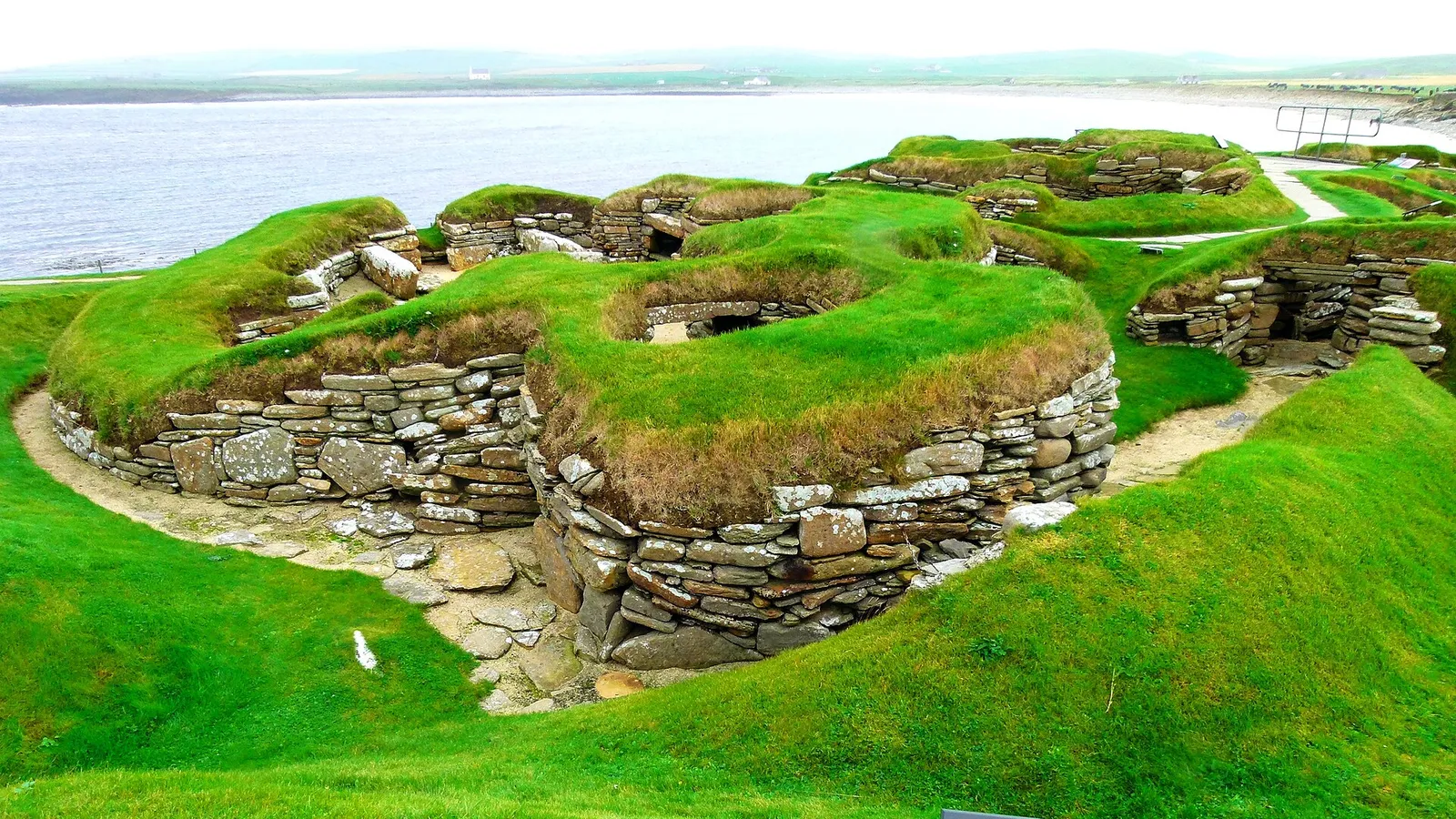
Skara Brae is exceptional not for its scale but for its preservation: its ten interconnected stone houses, buried for millennia beneath a protective sand dune on the Bay of Skaill, retain not just wall structures but stone furniture — box beds, dressers, and storage features — built directly into the house fabric using the same flagstone construction technique throughout, since timber was scarce in treeless Neolithic Orkney. This gives Skara Brae an unusually direct, tangible window into the domestic arrangement and material culture of a Neolithic community, rare anywhere in the world for this period. The settlement was concealed until a severe storm in 1850 stripped away its covering dune, exposing it for the first time in the modern era; systematic excavation followed, notably under archaeologist V. Gordon Childe in the 1920s and 1930s, establishing much of today's understanding of its layout, dating, and eventual abandonment around 2200 BC — the reasons for which (most likely environmental change affecting the surrounding coastal landscape) remain somewhat debated rather than definitively settled.
Maeshowe: engineering, astronomy, and a monumental tomb
Maeshowe, constructed around 2800 BC, represents an extraordinary feat of Neolithic engineering: a grass-covered mound 35 metres in diameter and over 7 metres high, concealing an 11-metre entrance passage leading to a nearly square central chamber roofed with a corbelled stone ceiling and built using flagstone slabs weighing up to 30 tonnes. Archaeological analysis estimates its construction required somewhere between 39,000 and 100,000 hours of coordinated labour — a figure that speaks to a level of social organisation, planning, and available labour force well beyond what might be assumed of a small, remote island community at this period. The monument's most celebrated feature is deliberate rather than accidental: its passage is precisely aligned so that sunlight penetrates the full length of the chamber specifically around the winter solstice, illuminating the rear wall — an astronomical alignment directly comparable to the similarly famous solstice alignment at Newgrange in Ireland, and clear evidence that Neolithic Orcadians possessed sophisticated observational astronomical knowledge integrated directly into monumental architecture.
An unplanned second chapter: Norse graffiti
Maeshowe's documented history includes a dramatic, well-evidenced later episode entirely separate from its original Neolithic purpose: in the 12th century AD, Norse visitors broke into the long-sealed tomb and carved approximately 33 runic inscriptions across its interior walls — the largest single collection of runic graffiti known from any one site anywhere. The inscriptions range from names and boastful claims of runic skill to more mundane remarks, and were rediscovered during the first formal excavation of the site in July 1861 by antiquarian and MP James Farrer. This episode is included here specifically because it is physically embedded within the monument itself and independently well documented, not as a general gesture toward Orkney's separate Norse-era history (which belongs to this collection's dedicated Orkney Islands card).
Stenness and Brodgar: ceremonial monuments on a shared landscape
The Stones of Stenness (c. 3100 BC) and the Ring of Brodgar (c. 2500 BC) are two of the earliest and most significant stone circle/henge monuments in the British Isles, situated within sight of one another and of Maeshowe, on a narrow strip of land between the Lochs of Stenness and Harray. Their precise original function remains genuinely uncertain — likely ceremonial or ritual in nature, based on comparative archaeology, but not conclusively established by direct textual or unambiguous physical evidence — and this article does not claim more specific purpose than the evidence supports. Excavations since 2003 at the nearby Ness of Brodgar, a large Neolithic complex situated between the two stone circles but just outside the core UNESCO-designated boundary, have substantially expanded understanding of the scale and sophistication of this entire prehistoric ceremonial landscape, suggesting a far larger and more continuously used ritual complex than was appreciated when the Heart of Neolithic Orkney was originally inscribed in 1999.
Did You Know?
- Parts of Skara Brae predate the completion of the Great Pyramid of Giza and are contemporary with or older than Stonehenge's main stone phase.
- Skara Brae's stone furniture — beds, dressers, and storage features — survives because timber was scarce in Neolithic Orkney, forcing builders to construct everything from the same local flagstone.
- Skara Brae remained hidden beneath a protective sand dune for millennia until a storm in 1850 exposed it for the first time in the modern era.
- Maeshowe's passage is precisely engineered so that sunlight reaches its rear chamber wall only around the winter solstice, a deliberate astronomical alignment comparable to Newgrange in Ireland.
- Maeshowe contains the largest single collection of Viking-era runic graffiti known from any site in the world, carved by 12th-century Norse visitors who broke into the already-ancient tomb.
- Some flagstones used in Maeshowe's construction weigh up to 30 tonnes, requiring an estimated 39,000 to 100,000 hours of coordinated Neolithic labour.
- The original purpose of the Stones of Stenness and Ring of Brodgar remains genuinely uncertain — likely ceremonial, but not definitively established.
- Ongoing excavation at the nearby Ness of Brodgar, begun in 2003, continues to reveal a far larger Neolithic ceremonial landscape than was known when this site was first inscribed as a World Heritage Site in 1999.
FAQ
1What exactly does this UNESCO designation cover?
Skara Brae, Maeshowe, the Stones of Stenness, and the Ring of Brodgar, together with their surrounding prehistoric landscape — inscribed in 1999.
2Is this the same as the general "Orkney Islands" heritage?
No — this card covers specifically the Neolithic monument cluster; general Orkney history, including its Norse heritage and modern island life, belongs to a separate card.
3How old are these sites compared to Stonehenge and the Pyramids?
Skara Brae and the Stones of Stenness are older than or contemporary with Stonehenge's main stone phase, and predate the completion of the Great Pyramid of Giza.
4What was Skara Brae?
A small Neolithic settlement of interconnected stone houses, inhabited roughly 3200–2200 BC, exceptionally well preserved due to centuries buried beneath a sand dune.
5How was Skara Brae discovered?
A severe storm in 1850 stripped away the covering sand dune, exposing the settlement for the first time in the modern era.
6What is Maeshowe?
A monumental Neolithic chambered cairn (tomb), built around 2800 BC, famous for its precise winter solstice solar alignment.
7Why does Maeshowe have Viking runes inside it?
Norse visitors broke into the already-ancient tomb in the 12th century AD and carved around 33 runic inscriptions, discovered during a 19th-century excavation.
8What were the Stones of Stenness and Ring of Brodgar used for?
Likely ceremonial or ritual purposes, based on comparative archaeology, though their precise original function is not definitively established.
9Can you go inside Maeshowe?
Yes, but only via guided tour due to the site's conservation needs.
10Is the Ness of Brodgar part of the UNESCO site?
It lies just outside the core designated boundary but within the same prehistoric landscape, and ongoing excavations there continue to inform understanding of the wider site.
11Why is this cluster significant globally, not just for Scotland?
Because it represents one of the best-preserved, most architecturally and astronomically sophisticated Neolithic complexes anywhere in North-West Europe.
12When should I visit, and is access seasonal?
Skara Brae and Maeshowe have visitor centres with seasonal opening hours; Stenness and Brodgar are freely accessible outdoor sites year-round, weather permitting.
Sources and Further Reading
Primary/Institutional
- Historic Environment Scotland — Heart of Neolithic Orkney site management and visitor information
- UNESCO World Heritage Centre — Heart of Neolithic Orkney inscription (1999)
Scholarly/Critical
- Archaeological excavation reports on Skara Brae (including V. Gordon Childe's foundational 20th-century work) and Maeshowe
- Ness of Brodgar excavation project publications (2003–ongoing)
General
- Maeshowe — Wikipedia
- Encyclopaedia Britannica — Skara Brae
- VisitScotland and Orkney.com visitor information
Caveats: Myths and Disputed Claims
- Do not state the precise original purpose of the Stones of Stenness or Ring of Brodgar as definitively known — ceremonial/ritual use is the leading interpretation, not a proven fact.
- Do not state Skara Brae's abandonment cause as definitively settled — environmental change is the leading hypothesis but remains debated among archaeologists.
- Do not conflate this card's Neolithic focus with Orkney's separate Norse and modern island history — only the Maeshowe runic graffiti, as a documented physical feature of the monument itself, is included here.
- Do not treat the Ness of Brodgar as formally part of the 1999 UNESCO inscription — it sits within the same prehistoric landscape but just outside the core designated boundary.
- Do not round or exaggerate the age comparisons with Stonehenge or the Pyramids beyond what radiocarbon dating supports — state the comparison as approximate contemporaneity, not a dramatic "thousands of years older" claim.
Card 038 · Locations