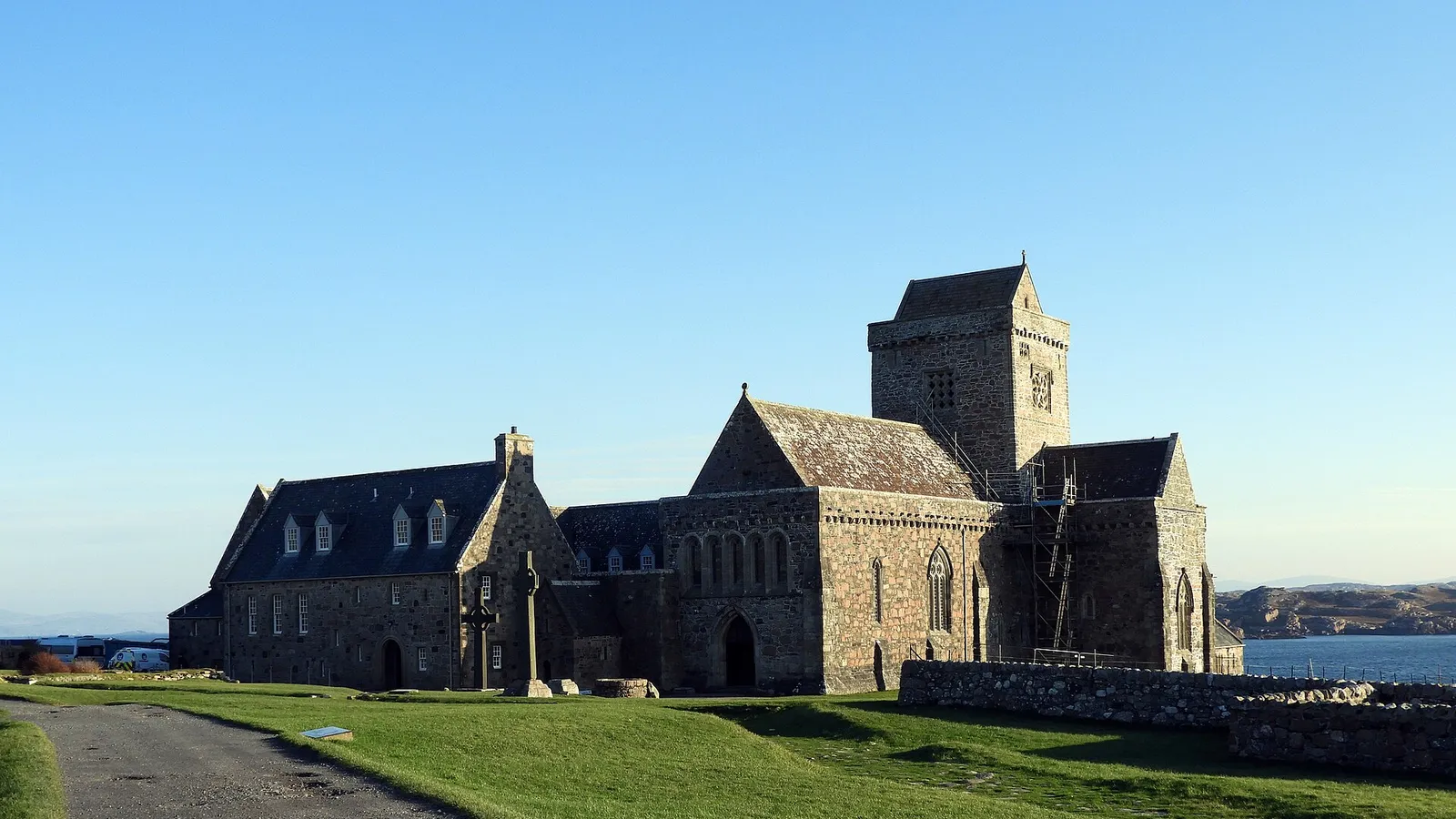

Iona & Iona Abbey
Contents
The myth worth correcting
Iona is often presented as having a single, continuous 1,460-year religious history running unbroken from St Columba's 563 AD landing to today. It does not. The island's monastery was repeatedly devastated by Viking raids, effectively abandoned as a major relic centre by the late ninth century, refounded as a Benedictine house under entirely different religious authority in the twelfth century, reduced to ruin after the Reformation, and only substantially rebuilt in the twentieth century. Its spiritual significance is real; its institutional continuity is not.
TL;DR
- traditional St Columba is traditionally said to have founded a monastery on Iona in 563 AD after arriving from Ireland with twelve companions — this date and the "twelve companions" detail come from later hagiographical and chronicle tradition rather than a contemporary 6th-century document, so it is presented as traditional dating, not a precisely verified fact.
- established Iona's monastery suffered repeated, dated Viking raids in 795, 802, 806, and 825, including an attack in 806 that reportedly killed 68 monks at what is now called Martyrs' Bay — this is recorded across multiple historical chronicle sources and is treated as established history.
- established The Book of Kells was probably produced by Iona's monastic community in the years leading up to 800 AD, before relics and manuscript production shifted to Kells in Ireland — this is the consensus scholarly position based on art-historical and manuscript analysis, not settled with absolute certainty but strongly supported.
- established The medieval Benedictine abbey on Iona was a 12th-century refoundation under Clan Donald's ancestor Somerled and his son Ranald, religiously and institutionally distinct from Columba's original Irish-rite monastery — this is documented ecclesiastical history, stated directly to avoid implying false continuity.
- established The present abbey buildings were substantially ruined after the Reformation and were restored across the 20th century, notably through the Iona Community founded by George MacLeod in 1938, with the most recent major renovation completed in 2021 — this is recent, dated, well-documented restoration history.
Key Facts
- Location/Region
- Isle of Iona, Inner Hebrides, off the southwest tip of the Isle of Mull, Argyll and Bute
- Scale
- Island c. 5.6 km long by 2.4 km wide; Abbey precinct comprises church, cloister, and Reilig Odhrain burial ground
- Type
- Island religious/historic site — former monastery, later Benedictine abbey, now restored ecumenical centre
- Protected/heritage status
- Scheduled monument and historic building in care of Historic Environment Scotland; part of a wider National Scenic Area
- Managed/owned by
- Historic Environment Scotland (site and ruins, since 2000); Iona Cathedral Trust (ownership structure since 1899); operated in partnership with the Iona Community
- Access notes
- Reached via ferry from Fionnphort on Mull (itself reached by ferry from Oban); abbey open to visitors with seasonal hours; no vehicle access for general tourists on Iona itself
Scottish Impact Index (SI Score)
- National Significance
- 10/10
- Historical Continuity
- 10/10
- Human & Economic Importance
- 7/10
- Landscape / Architectural Distinctiveness
- 10/10
- Cultural & Historical Legacy
- 10/10
- Recognition
- 10/10
57/60
Ranked =10th of 43 in Locations
A Note on Claims and Evidence
This article separates Iona's history into three tiers. Documented history includes the Viking raid dates, the 12th-century Benedictine refoundation under Somerled and Ranald, the 1899 transfer to the Iona Cathedral Trust, the 1938 founding of the Iona Community, and the 2021 renovation — all resting on chronicle, charter, or modern institutional record. traditional material includes the core Columba founding narrative: the 563 AD date, the number of companions, and much of the detail of Columba's early life on the island, which derive substantially from later hagiography (especially writings composed well after Columba's death) rather than contemporary sixth-century documentation, and should be read as the Church's and later historians' best reconstruction rather than a precisely verified account. Readers seeking a dedicated account of Columba's life and legend are directed to this collection's separate Columba biography card; this article keeps its focus on the island and abbey site itself.
Timeline
St Columba arrives on Iona from Ireland, traditionally with twelve companions, and founds a monastery; the precise date and detail rest on later chronicle and hagiographical tradition.
Iona flourishes as a major artistic centre, producing carved stone crosses and manuscript illumination.
The Book of Kells is probably produced by Iona's monastic community, shortly before conditions on the island deteriorate.
Iona's monastery suffers repeated, dated Viking raids; the 806 raid reportedly kills 68 monks at what is now Martyrs' Bay.
Columba's principal relics are moved away from Iona (to Kells and/or Dunkeld) for safekeeping, reflecting the island's declining security as a monastic centre.
St Oran's and St Martin's crosses are carved, both showing harpers playing four-sided harps.
Somerled, ancestor of Clan Donald, becomes patron of Iona and builds St Oran's Chapel as a family burial place.
Somerled's son Ranald refounds the monastery as a Benedictine abbey, shifting its religious allegiance from the Irish Church toward continental European monastic practice.
The Iona Psalter, with King David playing the harp, is made in Oxford for use on Iona.
Clan Donald lords, using Iona as an ecclesiastical capital, substantially expand the abbey church.
Post-Reformation decline leaves the abbey buildings ruined and largely abandoned as an active religious institution.
The Duke of Argyll transfers the ruined abbey to the newly formed Iona Cathedral Trust.
Reverend George MacLeod founds the Iona Community, which undertakes the physical rebuilding of the abbey.
Historic Scotland (now Historic Environment Scotland) formally assumes care of the site.
A £3.75 million renovation of the abbey is completed and the site reopens to visitors.
Details
An island shaped by, but larger than, one man's story
Iona is a small island, roughly 5.6 kilometres long, lying just off the southwest tip of Mull in the Inner Hebrides. Its fame rests overwhelmingly on its role as the traditional landing place and monastic base of St Columba, an Irish churchman who, according to later tradition, arrived in 563 AD with twelve companions and founded a monastery that became one of the most influential religious centres in the British Isles. It is worth being precise about the nature of this evidence: the detailed narrative of Columba's arrival, the number of his companions, and much of the colour of his early years on Iona come down to us chiefly through hagiographical writing composed generations after his death, most notably by later biographers working within a genre explicitly designed to celebrate sanctity rather than record neutral fact. This does not mean the core outline — an Irish churchman founding an influential monastery on Iona in the mid-sixth century — is false; it means the specific date and details should be understood as the best reconstruction available from later tradition, not a contemporaneously verified record, and this article flags that distinction rather than stating 563 AD as unqualified fact.
A golden age, then catastrophe
Whatever the precise founding circumstances, Iona's monastery demonstrably became a major centre of early medieval Christian scholarship and art from the eighth century onward, producing illuminated manuscripts and elaborately carved stone crosses. The most celebrated product associated with this period is the Book of Kells, one of the most lavishly decorated surviving medieval manuscripts; the current scholarly consensus holds it was probably produced by Iona's monks in the years leading up to 800 AD, before later events forced the manuscript (and the community's main relics) elsewhere.
Those events were a sustained sequence of Viking raids that this article states plainly rather than softening: dated attacks struck the island in 795, 802, 806, and 825. The 806 raid is particularly severe in the record, reportedly killing 68 monks at a site still known today as Martyrs' Bay. The practical consequence of this sustained violence was a gradual institutional retreat: Columba's principal relics were moved away from Iona, to Kells in Ireland and to Dunkeld in Scotland, by 878, as the island's exposed position on a major Norse raiding route made it increasingly untenable as a secure monastic headquarters. Iona's "golden age" and its Viking-era devastation are not separate, unrelated chapters of island history; the second directly ended the first.
A different church entirely: the Benedictine refoundation
What followed was not a simple continuation of Columba's Irish-rite monastery but a genuinely new religious institution under new political patronage. In the mid-twelfth century, Somerled — a Gaelic-Norse lord and the ancestor of Clan Donald — became Iona's patron, building St Oran's Chapel as a family burial place. His son Ranald went further, refounding the site as a Benedictine abbey: a formal shift away from the older Irish monastic tradition toward the continental European Benedictine order, bringing Iona's religious life into line with mainstream Western European Catholic practice rather than the distinct Celtic Christian tradition Columba's foundation had represented. Under successive Clan Donald lords, who used Iona as something close to an ecclesiastical capital, the abbey church was substantially expanded in the fifteenth century. This medieval Benedictine abbey — not Columba's original sixth-century foundation — is, physically, the building whose ruins and later restoration visitors see today.
Ruin, rebuilding, and a modern ecumenical identity
The Reformation ended Iona's role as an active Catholic monastic institution, and the abbey buildings fell into ruin over the following centuries, becoming a picturesque but non-functioning historic site. Restoration began in earnest only in 1899, when the Duke of Argyll transferred the ruined abbey to the newly established Iona Cathedral Trust. The most significant modern transformation came in 1938, when the Reverend George MacLeod, a Church of Scotland minister, founded the Iona Community — an ecumenical Christian organisation that undertook the physical work of rebuilding the abbey's roofless buildings, combining manual construction labour by volunteers (including unemployed Glasgow tradesmen and young ministers working side by side) with a deliberately justice-and-peace-oriented, cross-denominational spiritual mission. That organisation, headquartered in Glasgow, still describes Iona Abbey as its spiritual home today.
Formal heritage stewardship passed to Historic Scotland (now Historic Environment Scotland) in 2000, and the site underwent a further substantial, £3.75 million renovation completed in 2021. Iona today therefore represents something more layered than a single unbroken sacred site: a traditionally dated sixth-century foundation, overtaken by Viking-era catastrophe, replaced by a wholly different twelfth-century Benedictine institution, reduced to Reformation-era ruin, and rebuilt as a distinctly twentieth-century ecumenical project — with each layer still visible, in different ways, in the stones and in the site's current religious use. Reilig Odhrain, the adjoining burial ground, carries its own long-standing tradition of early Scottish, and even some Norse and Irish, royal burials, though — in keeping with this article's evidence framework — the specific identities and number of kings traditionally said to be buried there rest on later tradition rather than a complete, verifiable medieval burial register.
Harps in Iona's stone and books
established The cross harpers. Iona holds some of the oldest images of harpers in Scotland. Keith Sanger and Alison Kinnaird, in Tree of Strings (1992), their history of the harp in Scotland, drew on the Royal Commission's survey of Iona to describe them. St Oran's Cross, probably of the mid to late 8th century, shows a seated figure playing a four-sided harp. St Martin's Cross, still standing and better preserved, shows a harper on a small stool facing a player of multiple pipes, probably King David and his musicians. These are the only quadrangular harps carved in Scotland, and they match the instruments on Irish high crosses. Elsewhere in early Scotland, on Pictish cross-slabs in the east, the harp is shown with a triangular frame, which is why Iona's harpers matter to the long argument over where the triangular harp began.
Later carvings. A capital in the south choir of the abbey church shows an angel playing a small triangular harp for the Virgin Mary. Sanger and Kinnaird attributed it, as probable, to the 15th-century mason Donald Ó Brolcháin, whose name is carved elsewhere in the church. A 14th- or 15th-century grave slab from Reilig Odhrain, now in the abbey museum, shows a horseman and a harper seated in what looks like a small boat; its harp has a strongly bowed forepillar like the surviving medieval clàrsachs.
The Iona Psalter. The Iona Psalter, now in the National Library of Scotland, was made in Oxford in the late 12th or early 13th century for an Augustinian canoness with a special devotion to the Iona saints, Columba, Baithéne, Adomnán and Odrán. Sanger and Kinnaird suggested she may have been Beathag, daughter of Somerled and first prioress of the Iona nunnery. Inside a decorated initial C, King David plays a light harp with a curved forepillar, which a small blue dog is biting.
The Statutes of Iona
established Iona gave its name to one of the most important acts in the history of the Highlands. In 1609 nine Highland chiefs met the king's commissioners on the island and agreed to the Statutes of Iona (or Icolmkill). The historical geographer Charles Withers, in Gaelic in Scotland 1698–1981 (1984), highlights the sixth statute, which required every gentleman or yeoman in the Isles worth sixty cattle to send his eldest son, or eldest daughter, to school in the Lowlands until they could "speik, reid, and wryte Inglische". Withers judges that it probably had little practical effect but was the first of many acts aimed directly at Gaelic. Iona's own prestige lingered in the language: in 1795 the minister of the neighbouring parish on Mull wrote that its Gaelic "was reckoned very pure, by its vicinity to I".
Did You Know?
- The name "Iona" likely derives from a medieval mistranscription of the island's earlier name, "Hy" or "Hii."
- The Book of Kells, one of the most famous illuminated manuscripts in the world, was probably made on Iona, not in Kells, before later being moved to Ireland.
- A single Viking raid in 806 reportedly killed 68 monks at what is now called Martyrs' Bay.
- The medieval Benedictine abbey whose ruins stand on Iona today is a twelfth-century refoundation, not a direct continuation of Columba's original sixth-century monastery.
- The physical rebuilding of Iona Abbey in the twentieth century was carried out partly by unemployed Glasgow tradesmen working alongside trainee ministers.
- Iona's abbey underwent a £3.75 million renovation as recently as 2021.
- St Oran's Chapel on Iona was built as a family burial place for the ancestors of Clan Donald, not for any religious order.
- St Oran's and St Martin's crosses on Iona carry the only four-sided harps carved in early medieval Scotland.
- In the Iona Psalter, King David's harp is being bitten by a small blue dog.
- Columba's own relics did not stay on Iona permanently — they were moved to Kells and Dunkeld by 878 due to the danger of further raids.
FAQ
1Did St Columba really arrive on Iona in 563 AD?
That date comes from later chronicle and hagiographical tradition rather than a contemporary sixth-century record, so it is best described as traditional dating rather than a precisely verified fact.
2Is the abbey on Iona today the same building Columba founded?
No. The present ruins and restored buildings are substantially a twelfth-century Benedictine refoundation under Clan Donald's ancestor Somerled and his son Ranald, later expanded, ruined after the Reformation, and rebuilt in the twentieth century.
3Was the Book of Kells made on Iona?
Most likely yes, in the years leading up to about 800 AD, before conditions forced the community's manuscripts and relics elsewhere.
4Did Vikings really attack Iona's monastery?
Yes, repeatedly and severely — documented raids struck in 795, 802, 806, and 825, with the 806 raid alone reportedly killing 68 monks.
5Who rebuilt Iona Abbey in modern times?
The Iona Community, founded by George MacLeod in 1938, carried out much of the physical rebuilding; Historic Environment Scotland has managed the site since 2000.
6Is Iona Abbey still used for religious purposes?
Yes, it remains the spiritual home of the Iona Community, an ecumenical Christian organisation, and continues as an active pilgrimage and retreat destination.
7Are Scottish kings really buried on Iona?
Tradition holds that early Scottish, and some Irish and Norse, kings were buried at Reilig Odhrain beside the abbey, but the specific identities and numbers rest on later tradition rather than a complete verified medieval record.
8How do you get to Iona?
By ferry from Fionnphort on the Isle of Mull, which is itself reached by ferry from Oban on the Scottish mainland.
9Can visitors bring cars to Iona?
General tourist vehicle access is not available; most visitors travel on foot once on the island.
10Why did Iona's religious importance decline after the Vikings?
Repeated raids made the island untenable as a secure major relic centre, prompting relocation of relics and a gradual institutional shift away from Iona as the primary seat of Columba's monastic tradition.
11What happened to Iona Abbey after the Reformation?
It fell into ruin and remained a non-functioning historic site for centuries until restoration began in 1899 and accelerated from 1938 onward.
12Are there harps carved on Iona?
Yes. St Oran's and St Martin's crosses (8th century) show harpers with four-sided harps, a capital in the abbey church shows an angel with a small triangular harp, and a late medieval grave slab in the abbey museum shows a harper in a boat.
13Is there a separate article about St Columba himself?
Yes — this card focuses on the island and abbey site; a fuller biography of Columba is covered elsewhere in this collection.
Sources and Further Reading
Primary/Institutional
- Historic Environment Scotland — Iona Abbey and Nunnery history
- Iona Community — history and current mission
- Church of Scotland — coverage of the 2021 Iona Abbey restoration
Scholarly/Critical
- University of Glasgow — archaeological research on St Columba's cell and early Iona settlement
- Academic art-historical scholarship on the Book of Kells' Iona origins
- Charles W. J. Withers, Gaelic in Scotland 1698–1981: The Geographical History of a Language (John Donald, 1984; ebook Birlinn, 2021)
Specialist
- Keith Sanger and Alison Kinnaird, Tree of Strings: Crann nan Teud. A History of the Harp in Scotland (Kinmor Music, 1992), chapters 2 and 4
General
- Wikipedia — "Iona Abbey"
- Historic UK — "St Columba and the Isle of Iona"
- VisitScotland and Mull & Iona tourism resources
Caveats: Myths and Disputed Claims
- Do not state 563 AD as a precisely documented founding date — present it as traditional dating derived from later chronicle and hagiographical sources. Correct phrasing: "traditionally dated to 563 AD."
- Do not imply the current abbey ruins are Columba's original sixth-century building — they are substantially a twelfth-century Benedictine refoundation, later expanded and restored. Correct phrasing: "the medieval Benedictine abbey, refounded in the twelfth century on the site of Columba's earlier monastery."
- Do not present the exact number and identity of kings buried at Reilig Odhrain as a settled historical fact — treat as long-standing tradition. Correct phrasing: "tradition holds that..."
- Do not describe the harps on St Oran's and St Martin's crosses as triangular Gaelic harps; they are four-sided instruments of the Irish type.
- Do not present Iona's religious history as an unbroken continuity from 563 AD to today — it includes a near-collapse after Viking raids, a change of religious order in the twelfth century, post-Reformation ruin, and twentieth-century rebuilding.
Card 027 · Locations