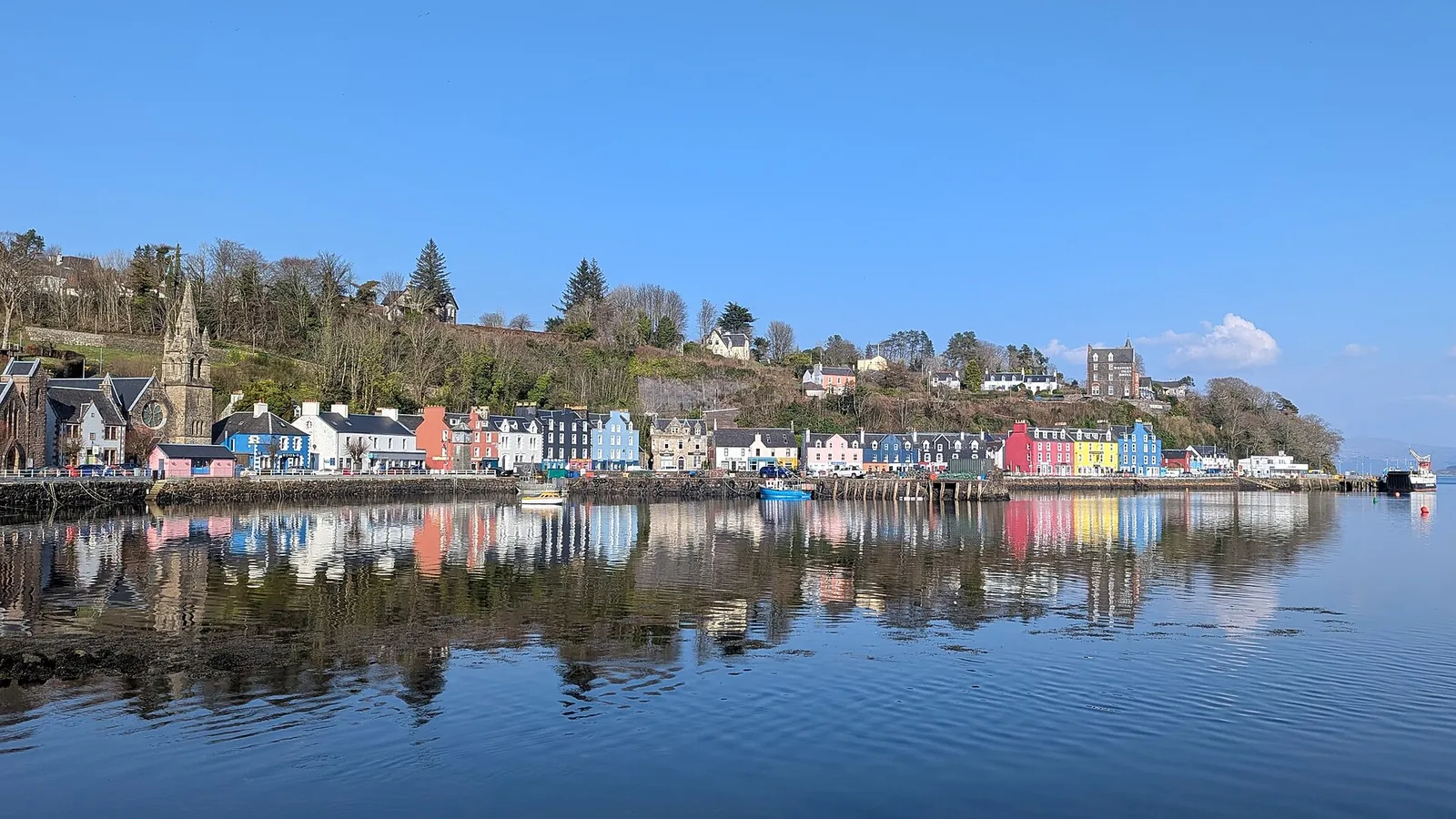

The Isle of Mull and Tobermory
Contents
Mull is the second-largest island of the Inner Hebrides, a mountainous island of sea lochs, castles and white-tailed eagles, and the gateway to Iona. Its main town, Tobermory, was founded in 1788 as a planned fishing port, and its brightly painted harbour front became famous to a generation of children as the setting of Balamory. Mull's history also includes the Clearances, famine and emigration, which over a century cut its population by more than two-thirds, and the legend of a sunken Armada galleon full of gold. This card tests the island's story and its legends.
TL;DR
- established Mull covers about 338 square miles, the largest island in the Inner Hebrides after Skye. Its highest point is Ben More, at 3,169 feet.
- established Tobermory was founded in 1788 by the British Fisheries Society as a fishing port. Its name comes from the Gaelic Tobar Mhoire, "Mary's well".
- established Mull's population fell from a peak of about 10,000 in the early 19th century to 3,809 in 1911 and under 3,000 later in the 20th century, through clearance, the potato famine and long-running emigration. In 2011 it was about 2,800.
- established White-tailed eagles, reintroduced from Rùm, now have a stronghold on Mull, and ferries from Fionnphort carry visitors to Iona.
- shared A Spanish Armada ship sank in Tobermory Bay in 1588, but which ship it was is disputed, and no significant treasure has been found.
Key Facts
- Gaelic name
- Muile
- Area
- About 338 square miles
- Highest point
- Ben More, 3,169 ft
- Population
- About 2,800 (2011 census)
- Tobermory founded
- 1788, British Fisheries Society
- Tobermory's population
- About 1,045 (2022)
- Name
- Tobar Mhoire, "Mary's well"
- Tobermory Distillery
- Founded 1798 as Ledaig
- Armada wreck
- 1588, Tobermory Bay
- Main ferries
- Oban–Craignure; Kilchoan–Tobermory; Lochaline–Fishnish
- Balamory
- BBC children's series set in Tobermory, early 2000s
A Note on Claims and Evidence
Each major claim carries one of three labels. established means supported by primary records, official bodies or several independent reliable sources. shared means the core fact is sound but sources disagree on details, dates or interpretation. traditional means widely repeated but not traceable to a primary or independent source.
Tobermory's founding is documented in the records of the British Fisheries Society and in Canmore, Scotland's national record of the historic environment. The island's population history comes from census records. The Armada wreck is real, but its identity and the stories of treasure are disputed, and sources differ on how far Thomas Telford was involved in planning the town.
Timeline
A chapel and well dedicated to the Virgin Mary stand above Tobermory Bay.
After the fall of the Lordship of the Isles, the Macleans take control of much of Mull.
A ship of the Spanish Armada sinks in Tobermory Bay.
The British Fisheries Society begins building Tobermory.
The Society builds a harbour, custom house, inn and storehouse.
Thomas Telford surveys the progress of the works.
The Ledaig distillery, now Tobermory Distillery, is founded.
Lord Selkirk's agents recruit families from Mull, Skye and the Uists for Prince Edward Island.
Tobermory agent Archibald MacNiven arranges passages for about 16,000 Highland emigrants to British North America, by his own account given in 1841.
Lord Teignmouth sees 200 self-funded Outer Hebridean emigrants leave Tobermory.
Dr David Boyter recruits for New South Wales from Tobermory.
The potato famine and the Clearances begin a steep fall in Mull's population.
Emigrants from Mull and Tiree suffer heavy cholera deaths at Hamilton, Ontario.
Witnesses on Mull give Sir John McNeill conflicting evidence on whether the people wished to emigrate.
Balamory begins on BBC television.
The census records about 2,800 people on Mull.
Details
An island of mountains and sea lochs
established Mull covers about 338 square miles, making it the largest island in the Inner Hebrides after Skye and the fourth-largest island around Great Britain. Its mountainous centre rises to Ben More, at 3,169 feet. Most people live in or near Tobermory in the north. The island is reached by ferries from Oban to Craignure, from Kilchoan to Tobermory and from Lochaline to Fishnish.
Tobermory: a planned port
established The British Fisheries Society founded Tobermory in 1788. Between 1789 and 1794 it planned and partly built a harbour, custom house, inn and storehouse; designs were submitted by James Maxwell and Robert Mylne, and Thomas Telford surveyed the progress of the work in 1790. The town's name comes from the Gaelic Tobar Mhoire, "Mary's well", after a medieval well and chapel on the hill above the bay. The Ledaig distillery, now Tobermory Distillery, was founded in 1798 by John Sinclair of Lochaline.
shared Some accounts say Tobermory was built to designs by Thomas Telford; the Canmore record says he surveyed the works, while others prepared the designs. Telford's link came through the society's governor, his patron Sir William Pulteney. Julian Glover, in his biography Man of Iron (2017), lists harbour work at Tobermory among Telford's dock and harbour projects, dated 1801–1814, but does not describe it; this was later work on the harbour, not the original layout of the town.
The Armada galleon
shared In 1588 a ship of the Spanish Armada, fleeing after the defeat in the Channel, sank in Tobermory Bay. It is usually identified as the Florencia, but another candidate, the San Juan de Sicilia, is recorded as carrying troops rather than treasure. Stories of a fortune in gold on the seabed have inspired many salvage attempts, but no significant treasure has been recovered.
Clearance and decline
established Mull's population was about 10,000 before the Clearances of the 18th and 19th centuries. From the mid-19th century the potato famine, evictions and emigration drove it down steeply, and the island's economy collapsed. The fall continued long after the famine: the census counted 3,809 people in 1911 and 2,197 in 1981. By 2011 the population was about 2,800, and in 2022 it was 3,063.
Tobermory and emigration
established Tobermory was also a port of departure. The historian Marjory Harper, in Adventurers and Exiles (2003), describes Archibald MacNiven of Tobermory as the leading emigration agent for the west coast and the Inner Hebrides; in 1841 he claimed to have arranged ships over the previous twenty years for 16,000 Highlanders bound for British North America, more than half of them for Cape Breton. In 1835 Lord Teignmouth watched 200 emigrants from the Outer Hebrides leave Tobermory; he wrote that they had received no help from anyone and were "in high spirits", encouraged by letters from friends who had gone before. In August 1839 Dr David Boyter, the agent recruiting Highlanders for New South Wales under the government bounty scheme, was based at Tobermory. Earlier, in 1802, Lord Selkirk's agents had signed up families from Mull, Skye and the Uists for his colony on Prince Edward Island.
shared Opinion on Mull divided during the famine of the late 1840s. Charles McQuarrie, a merchant at Bunessan, told Sir John McNeill in 1851 that he saw "no prospect of relief for the population, without emigration", and that a thousand emigrants from the Duke of Argyll's Mull property "would not be too much". McNeill was told that the people of Kilfinichen, in the Ross of Mull, especially the poorest, were "not inclined to emigrate". Harper argues that the willingness reported by officials should be "taken with a pinch of salt", because the desire to leave was generated by poverty.
established The journey could be deadly. In 1849 a party of emigrants from Mull and Tiree reached Hamilton, Ontario, during a cholera epidemic. A correspondent quoted by Harper reported that they lay on the wharf for eight days with no shelter; 48 caught cholera and none had yet left the hospital alive. The survivors went on to take up uncleared land at Owen Sound. Others did well: the McGregor brothers, whose parents had moved from Mull to Canada in the 1850s, became major sheep farmers in Washington State from 1882.
Eagles and Iona
established Mull is home to more than 250 species of birds. White-tailed eagles, reintroduced to Scotland on the nearby island of Rùm, now have a stronghold on Mull, and eagle-watching draws many visitors. From Fionnphort at the island's south-western tip, ferries cross to Iona. Duart Castle, on the east coast, is open to the public for much of the year; the Macleans took control of much of the island after the Lordship of the Isles collapsed in 1493.
Balamory
established In the early 2000s Tobermory's row of brightly painted harbour-front buildings became the setting of the BBC children's programme Balamory, bringing families from across Britain to see it. The town is also home to the Mull Museum and to an aquarium that releases its animals back into the sea.
Gaelic on Mull
established Mull remained overwhelmingly Gaelic-speaking into the nineteenth century. The naturalist John Walker reported in 1764 that only about 335 people on the island, some 6 per cent, could follow a sermon in English. The minister of Kilninian wrote in 1795 that English was "daily gaining ground, and would make more rapid progress, were schools more encouraged". These and later reports are collected by the historical geographer Charles Withers in Gaelic in Scotland 1698–1981 (1984).
established In 1843 the minister of Torosay described a balance that he did not expect to last. Islanders kept their English "til they have occasion to address those who do not understand Gaelic", and children were taught to read in both languages; but by comparing the two versions of the Bible, he wrote, they "daily add to their vocabulary of English words". Many Mull people moved south: Withers records that many of the Gaelic speakers at the Gaelic chapel in Rothesay in the 1830s were immigrants from Mull.
Did You Know?
- Tobermory's name means "Mary's well".
- The town was founded by the British Fisheries Society in 1788.
- Its distillery was founded in 1798.
- A ship of the Spanish Armada lies in Tobermory Bay.
- Mull lost about two-thirds of its population between the early 19th century and 1911.
- A Tobermory agent, Archibald MacNiven, claimed in 1841 to have shipped 16,000 Highlanders to British North America in twenty years.
- White-tailed eagles have a stronghold on Mull.
- Ferries cross from Mull to Iona at Fionnphort.
- Tobermory was the setting of the BBC's Balamory.
FAQ
1How big is Mull?
About 338 square miles, second only to Skye in the Inner Hebrides.
2What is the highest point on Mull?
Ben More, at 3,169 feet.
3When was Tobermory founded?
In 1788, by the British Fisheries Society.
4What does Tobermory mean?
"Mary's well", from the Gaelic Tobar Mhoire.
5Did Telford design Tobermory?
He surveyed the works in 1790; sources differ on whether he designed the town.
6Is there treasure in Tobermory Bay?
An Armada ship sank there in 1588, but no significant treasure has been found.
7Why did Mull's population fall?
Because of the Clearances and the potato famine of the 19th century, followed by emigration and migration to the Lowlands that continued well into the 20th century.
8Did emigrants leave from Tobermory?
Yes. In the first half of the 19th century the Tobermory agent Archibald MacNiven arranged passages for thousands of Highlanders, many to Cape Breton, and recruiters for Australia worked from the town.
9Did Mull people want to emigrate during the famine?
Witnesses disagreed. A Bunessan merchant told Sir John McNeill in 1851 that emigration was the only relief, while others reported that the poorest people of Kilfinichen were not inclined to go.
10How do you get to Mull?
By ferry from Oban, Kilchoan or Lochaline.
11How do you get to Iona?
By ferry from Fionnphort on Mull.
12Was Balamory filmed in Tobermory?
Yes. Its colourful harbour front was the show's setting.
Sources and Further Reading
Primary/Institutional
- Canmore, "Mull, Tobermory", site 22322 (canmore.org.uk)
Scholarly/Critical
- Charles W. J. Withers, Gaelic in Scotland 1698–1981: The Geographical History of a Language (John Donald, 1984; ebook Birlinn, 2021)
- Marjory Harper, Adventurers and Exiles: The Great Scottish Exodus (Profile Books, 2003)
- Julian Glover, Man of Iron: Thomas Telford and the Building of Britain (Bloomsbury, 2017), chapter 8 and list of works.
General
- Wikipedia, "Tobermory, Mull" (en.wikipedia.org)
- Wikishire, "Isle of Mull" (wikishire.co.uk)
- Wikipedia, "Isle of Mull", https://en.wikipedia.org/wiki/Isle_of_Mull (census figures 1911–2022)
Caveats: Myths and Disputed Claims
- Do not say the Armada galleon was full of gold or that treasure has been found.
- Do not name the Armada ship as certain.
- Do not say Telford designed Tobermory without qualification.
- Do not give population figures from different years as current.
- Do not treat Archibald MacNiven's figure of 16,000 emigrants as an audited count; it is his own claim, made in 1841.
Card 018 · Locations