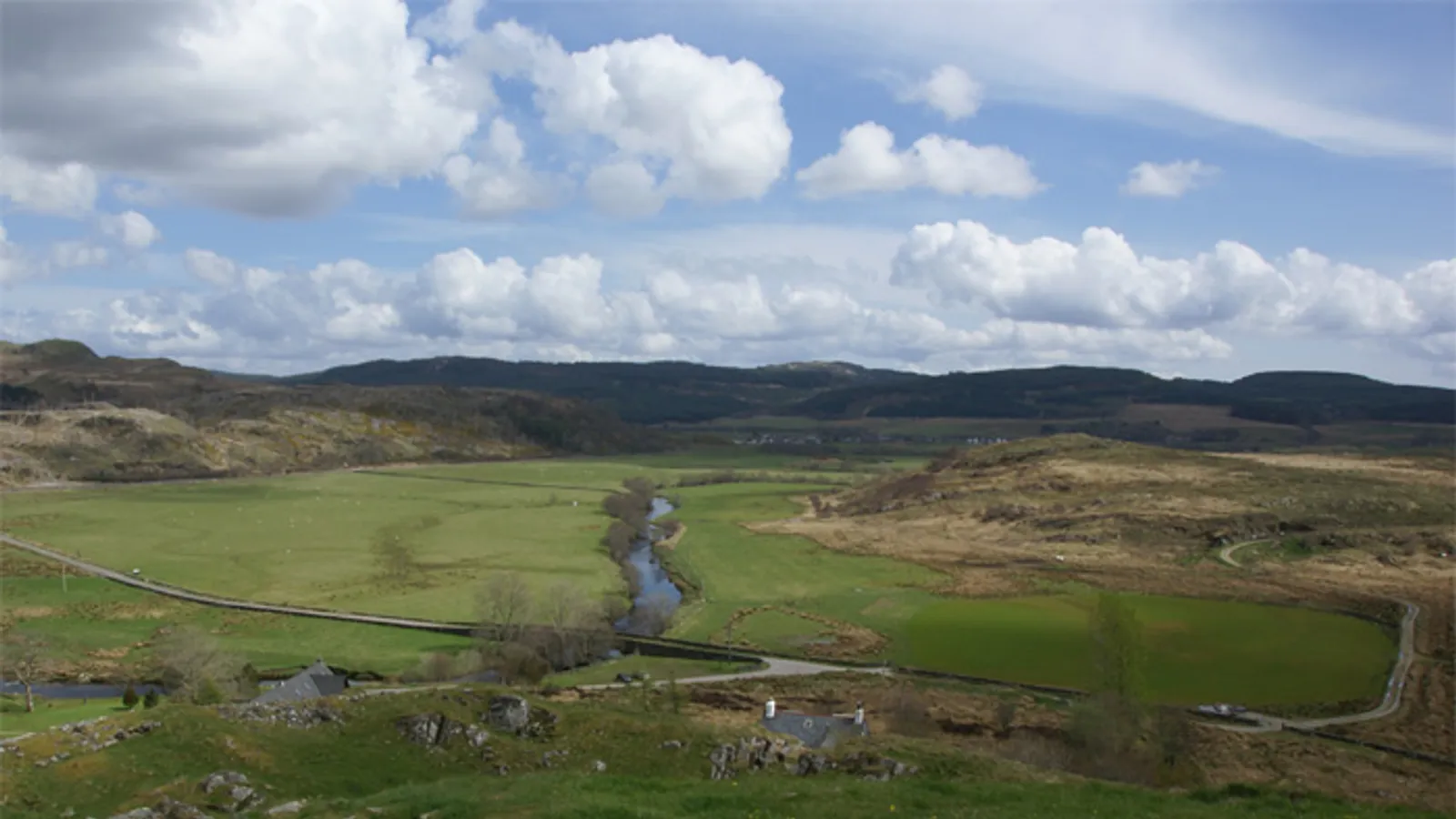

Kilmartin Glen
Contents
Legend/Myth Opener
Kilmartin Glen is sometimes presented as a single ancient "site," as if it were one monument like a castle or an abbey. It isn't. It is an entire valley in Argyll containing over 800 recorded archaeological monuments — more than 150 of them prehistoric — spanning roughly five thousand years of continuous human activity, from Neolithic chambered cairns through Bronze Age standing stones to an early medieval royal fortress. Treating it as one thing to "see" rather than a landscape to explore undersells it badly.
TL;DR
- established Kilmartin Glen contains more than 800 archaeological monuments within a six-mile radius, including over 150 classified as prehistoric — this is a matter of systematic archaeological survey and recorded by Historic Environment Scotland. established
- established The glen's monuments span roughly five thousand years, from Neolithic chambered cairns (fourth millennium BC) through the Bronze Age and Iron Age to the early medieval fortress of Dunadd (occupied c. AD 500s–800s) — the dating is established through typology and excavation across multiple sites. established
- established A "linear cemetery" of burial cairns runs for roughly three miles south-southwest of Kilmartin village, with the Nether Largie South cairn, a Neolithic chambered tomb, as its oldest surviving element — this sequence is documented through excavation and survey. established
- traditional Dunadd Fort, at the glen's southern edge, is traditionally identified as a royal power centre of the Gaelic kingdom of Dál Riata, and carved footprint and basin marks there are widely interpreted as inauguration features used in kingship ceremonies — this is stated as traditional/interpretive because, while the fort's royal status is well supported by historical sources and excavation, the precise ceremonial use of the carvings rests on interpretation rather than a surviving description of the ritual itself. traditional
- established Rock art featuring cup-and-ring marks is found at multiple locations across the glen, among the richest concentrations of this prehistoric art form in Scotland — this is an established feature of the surviving archaeological record, though the meaning of the carvings remains debated. established
Key Facts
- Location/Region
- Kilmartin Glen, Argyll, around the village of Kilmartin
- Era/Date
- Neolithic (4th millennium BC) through Bronze Age, Iron Age, to early medieval (Dunadd, c. AD 500s–800s)
- Type
- Prehistoric landscape: chambered cairns, standing stones, henge, cup-and-ring rock art, hillfort/royal centre
- Heritage/Protected Status
- Multiple Scheduled Monuments across the glen; Dunadd and linear cairn cemetery individually protected
- Managed/Owned by
- Historic Environment Scotland; Kilmartin Museum (independent charitable trust) interprets and supports the wider landscape
- Access/Visitor Notes
- Many monuments freely accessible outdoors year-round via waymarked paths; Kilmartin Museum in the village provides interpretation, exhibitions and visitor orientation
Scottish Impact Index (SI Score)
- National Significance
- 8/10
- Historical Continuity
- 10/10
- Human & Economic Importance
- 5/10
- Landscape / Architectural Distinctiveness
- 9/10
- Cultural & Historical Legacy
- 9/10
- Recognition
- 7/10
48/60
Ranked =39th of 43 in Locations
A Note on Claims and Evidence
The sheer density and chronological range of monuments in Kilmartin Glen is documented through decades of systematic archaeological survey and excavation — the counts, dates, and monument types given here reflect the established record. Where more care is needed is in questions of meaning: why cup-and-ring marks were carved, what specific rituals took place at the linear cairn cemetery over the many centuries it was used and reused, and precisely how the carved footprints at Dunadd functioned in royal inauguration. These are traditional scholarly interpretations, generally well-grounded in comparative archaeology, but not matters of direct documentary record from the period itself — no contemporary written account describes a Dunadd inauguration ceremony step by step, for instance. This article distinguishes clearly between what excavation has established and what remains informed inference.
Timeline
Earliest monuments constructed, including the Nether Largie South chambered cairn, the oldest surviving element of the linear cairn cemetery.
Continued Neolithic and early Bronze Age activity: standing stones, a henge monument, and cup-and-ring rock art carved across multiple sites in the glen.
Additional cairns in the linear cemetery constructed and existing monuments reused for burial over following centuries.
Hillforts and settlement activity across the glen, including early occupation at the Dunadd outcrop.
Dunadd flourishes as a power centre associated with the Gaelic kingdom of Dál Riata; carved footprint and basin marks created or used, traditionally linked to royal inauguration.
Antiquarian and then systematic archaeological survey and excavation document the glen's monuments in increasing detail.
Kilmartin Museum established in the village to interpret the landscape; ongoing conservation and research by Historic Environment Scotland and affiliated archaeologists.
One of the densest and most intensively studied prehistoric landscapes in Scotland, with waymarked visitor routes connecting major monuments.
Details
A landscape, not a single site
What sets Kilmartin Glen apart from almost anywhere else in Scotland is scale and density rather than any single spectacular structure. Within a roughly six-mile radius around the village of Kilmartin, archaeologists have recorded more than 800 monuments, over 150 of them prehistoric — an extraordinary concentration that reflects the glen's long-standing attractiveness to human settlement: fertile, sheltered, well-watered, and positioned on routes connecting the sea to the interior of Argyll. Rather than one era leaving its mark and then being abandoned, Kilmartin shows layer upon layer of activity across roughly five thousand years, from the first Neolithic farming communities through Bronze Age ritual and burial practice, Iron Age settlement, and finally an early medieval royal centre.
The linear cemetery and the ritual landscape
The best-known single feature within the glen is the "linear cemetery": a chain of burial cairns running for about three miles south-southwest from Kilmartin village, visible from considerable distances across the valley floor. The oldest of these, Nether Largie South, is a Neolithic chambered cairn, while others in the sequence — including Nether Largie North, Nether Largie Mid, and Glebe Cairn — date to the Bronze Age, showing that this strip of landscape was treated as significant for burial and ceremony across an enormous span of time, with later communities deliberately building near and within sight of monuments raised by their much earlier predecessors. Alongside the cairns, the glen contains standing stones, at least one henge monument, and numerous cists (small stone-lined burial chambers), together constituting one of the richest surviving ritual landscapes in Britain.
Scattered across the glen's rock outcrops is an unusually dense concentration of cup-and-ring rock art — abstract carved motifs of circles, cups, and connecting grooves whose purpose and meaning remain genuinely uncertain. As with similar carvings elsewhere in Atlantic Europe, interpretations range from territorial marking to ritual or cosmological symbolism to purposes that may simply be lost to us; no single explanation has scholarly consensus, and this article does not endorse one.
Dunadd: from Iron Age outcrop to royal seat
At the southern end of the glen, rising from the boggy expanse of Moine Mhor ("the great moss"), the rocky outcrop of Dunadd carries a very different kind of significance. Occupation here stretches back roughly two thousand years into the Iron Age, but Dunadd's historical importance lies chiefly in its later role, from around the 6th to 9th centuries AD, as a power centre associated with the Gaelic kingdom of Dál Riata, which spanned parts of western Scotland and northeastern Ireland. Carved into the rock near the fort's summit are a basin, an incised boar figure, and — most famously — a pair of carved footprint shapes, which are traditionally interpreted as having played a role in the inauguration of new kings: the new ruler symbolically placing a foot in the carving as part of a ceremony asserting authority over the land. This remains the leading interpretation among historians and archaeologists studying the site, grounded in comparative evidence from other early medieval Gaelic and Pictish inauguration traditions, but it should be presented as a well-supported scholarly reading rather than a directly attested historical fact — no contemporary written account of a specific Dunadd inauguration survives to confirm the details.
Rediscovery, protection, and the glen today
Antiquarian interest in Kilmartin's monuments dates back well into the 19th century, but the systematic archaeological survey and excavation that underpins modern understanding of the glen is largely a 20th- and 21st-century achievement, building gradually through successive campaigns of fieldwork. Today the glen's major monuments are protected as Scheduled Monuments under Historic Environment Scotland's care, while Kilmartin Museum, based in the village, provides exhibition space, research support, and public interpretation of the wider landscape — serving as the natural starting point for visitors wanting context before setting out to see the monuments themselves. Within Scottish archaeology and heritage tourism, Kilmartin Glen is frequently cited as one of the most important and intensively studied prehistoric landscapes in the country, valued precisely because of the breadth of monument types and the sheer length of time they collectively document — a continuous record of human presence and changing ritual, burial, and political practice stretching from the Neolithic to the early medieval kingdom-building that would eventually help shape the idea of Scotland itself.
Did You Know?
- Kilmartin Glen contains over 800 recorded archaeological monuments within a roughly six-mile radius — one of the densest concentrations anywhere in Scotland.
- The glen's "linear cemetery" of burial cairns was used and added to across both the Neolithic and Bronze Age periods, meaning the cairns were not all built at once but accumulated over many centuries.
- The carved footprint at Dunadd is one of several known early medieval Scottish and Irish "inauguration stones" believed to have been used symbolically in royal ceremonies.
- Dunadd sits on a rocky outcrop rising from Moine Mhor, a large bog whose Gaelic name simply means "the great moss."
- Cup-and-ring rock art at Kilmartin is among the richest concentrations of this prehistoric carving tradition in Britain, yet its meaning remains unresolved among archaeologists.
- Some of the standing stones and cairns in the glen were deliberately positioned to be visible from each other across considerable distances, suggesting the landscape itself was treated as meaningful, not just individual monument sites.
- Occupation at Dunadd stretches back roughly 2,000 years to the Iron Age, long before its most famous role as a Dál Riata power centre.
- Kilmartin Museum, though based in a small Argyll village, holds a significant archaeological collection interpreting one of Scotland's most important prehistoric landscapes.
FAQ
1What exactly is Kilmartin Glen?
It is a valley in Argyll containing an exceptionally dense concentration of prehistoric and early medieval monuments — over 800 recorded sites, more than 150 of them prehistoric.
2How old are the oldest monuments?
The oldest surviving monuments, including the Nether Largie South chambered cairn, date to the Neolithic period, around the fourth millennium BC.
3What is the "linear cemetery"?
A chain of burial cairns running for about three miles south-southwest of Kilmartin village, built and used across both the Neolithic and Bronze Age.
4What is Dunadd?
A rocky hillfort at the southern end of the glen, occupied from the Iron Age and later serving as a royal power centre of the Gaelic kingdom of Dál Riata, roughly AD 500s–800s.
5What are the carved footprints at Dunadd for?
They are traditionally believed to have played a role in king-making or inauguration ceremonies, though the exact ritual details are not directly recorded and rest on scholarly interpretation.
6What is cup-and-ring rock art?
Abstract carved motifs of circles and connecting grooves found on natural rock surfaces across the glen; their original meaning and purpose are not well understood.
7Can you visit the monuments freely?
Many are freely accessible outdoors via waymarked paths, though visitors should check current access information, particularly for sites on working land.
8Is there a museum?
Yes, Kilmartin Museum in Kilmartin village interprets the glen's archaeology and holds exhibitions and collections relevant to the wider landscape.
9How does Kilmartin Glen compare to other prehistoric landscapes in Scotland?
It is frequently cited as one of the richest and most intensively studied prehistoric landscapes in the country, notable for both the number and variety of monument types.
10Is Dunadd connected to the origins of Scotland?
It is associated with the Gaelic kingdom of Dál Riata, which played a significant role in the political and cultural history that eventually contributed to the formation of the Scottish kingdom, though this was a long and complex process rather than a single direct line.
11Are all the monuments in the glen protected?
Major monuments are designated Scheduled Monuments and managed or overseen by Historic Environment Scotland.
12How much time should visitors allow?
Given the scale of the landscape, visitors interested in seeing multiple monuments typically allow at least a half or full day, often starting at Kilmartin Museum for orientation.
Sources and Further Reading
Primary/Institutional
- Historic Environment Scotland — Kilmartin Glen: Dunadd Fort, Temple Wood Stone Circle, Nether Largie cairns, and Glebe Cairn pages
- Kilmartin Museum — official visitor and research information
Scholarly/Critical
- Archaeological survey and excavation reports on the Kilmartin linear cairn cemetery and Dunadd
- Comparative scholarship on early medieval Gaelic/Pictish inauguration sites and rock art interpretation
General
- Wikipedia — Kilmartin Glen
- History Hit and VisitScotland visitor overviews of Kilmartin Glen
Caveats: Myths and Disputed Claims
- Do not describe Kilmartin Glen as a single monument or site; it is an extensive landscape of over 800 recorded monuments spanning roughly five thousand years.
- Avoid stating the exact ceremonial procedure used at Dunadd's carved footprint as established historical fact; it is a well-supported traditional interpretation, not a directly documented ritual.
- Do not assert a single confirmed meaning for the glen's cup-and-ring rock art; its purpose remains unresolved among archaeologists.
- Avoid implying all the cairns in the linear cemetery were built at the same time; they span both the Neolithic and Bronze Age and were added to over many centuries.
- Do not overstate certainty about continuous, unbroken use of every site across the full five-thousand-year span; activity at individual monuments varied, with gaps and changes of use over time.
Card 042 · Locations