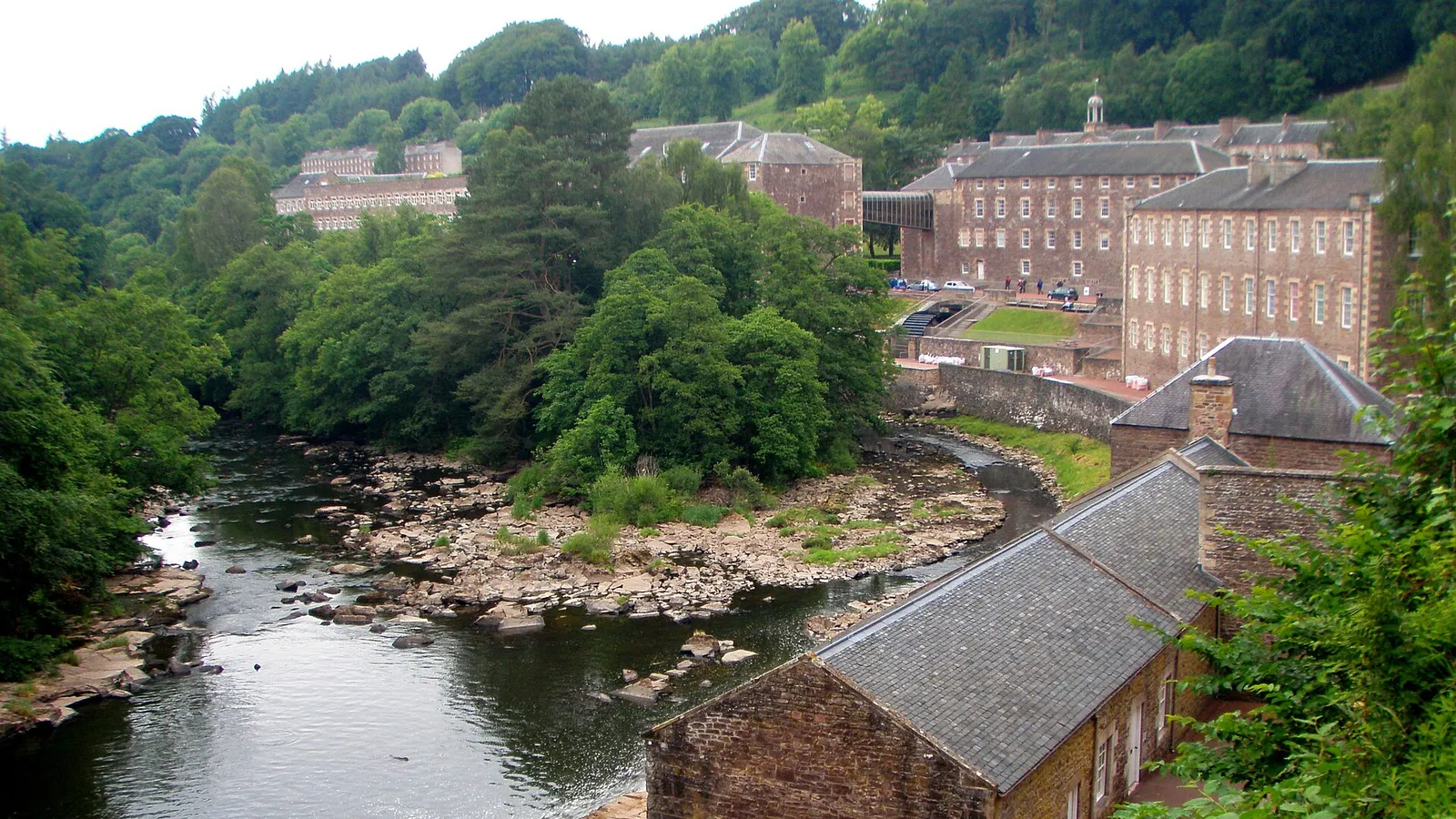

New Lanark
Contents
Legend/Myth Opener
New Lanark is often presented simply as the birthplace of enlightened, humane factory work — a tidy counter-story to the grim "dark satanic mills" of the Industrial Revolution. The reality is more complicated. Robert Owen's reforms at New Lanark were real and historically significant, but the village was also a tightly controlled environment in which workers' private lives, leisure, and even moral conduct were closely supervised by the mill owner. Both things are true at once, and a serious account of New Lanark has to hold them together rather than choosing the flattering half.
TL;DR
- established New Lanark was founded as a cotton-spinning mill village in 1786 by David Dale, and became internationally famous after Robert Owen took over management in 1800 — this is well documented through mill records, contemporary accounts, and Owen's own writings. established
- established Owen introduced reduced working hours, banned the employment of very young children, built a school and an "Institute for the Formation of Character," and ran a village store selling goods at fair prices — these reforms are documented in Owen's own publications and in independent visitor accounts of the time. established
- disputed Owen's model is traditionally celebrated as proof that profitable industry and worker welfare were compatible, but historians have long debated how much of it reflected genuine partnership with workers versus close paternalistic control over their behaviour, movements, and morals — this is stated as disputed because serious modern scholarship on Owen explicitly frames his system as a tension between benevolence and control, not a settled triumph. disputed
- established The mill operated continuously for nearly 200 years before closing in 1968, and the site was designated a UNESCO World Heritage Site in 2001 for its combined industrial, architectural, and social history significance — both facts are matters of public record. established
- established New Lanark is managed today as a living site by the New Lanark Trust, in partnership with South Lanarkshire Council and Historic Environment Scotland, and operates as a major visitor attraction — this is stated directly by Historic Environment Scotland's own site description. established
Key Facts
- Location/Region
- New Lanark, near Lanark, South Lanarkshire, on the River Clyde
- Era/Date
- Founded 1786; Owen's management and reforms 1800–1825; mill closed 1968
- Type
- Planned cotton-mill industrial village (mills, worker housing, school, village store, institute)
- Heritage/Protected Status
- UNESCO World Heritage Site (2001); multiple listed buildings
- Managed/Owned by
- New Lanark Trust, in partnership with South Lanarkshire Council and Historic Environment Scotland
- Access/Visitor Notes
- Operating visitor attraction with mill buildings, Robert Owen's house, historic classroom, mill worker housing and museum exhibits; within an hour of Glasgow and Edinburgh
Scottish Impact Index (SI Score)
- National Significance
- 9/10
- Historical Continuity
- 10/10
- Human & Economic Importance
- 8/10
- Landscape / Architectural Distinctiveness
- 9/10
- Cultural & Historical Legacy
- 10/10
- Recognition
- 9/10
55/60
Ranked =16th of 43 in Locations
A Note on Claims and Evidence
The physical and institutional facts of New Lanark — when it was built, who ran it, what specific reforms Owen introduced, when the mill closed, when UNESCO inscribed the site — are solidly documented, drawn from mill records, Owen's own extensive published writings, contemporary visitor accounts, and the formal UNESCO nomination documents. Where this article is more careful is in how it frames the character of Owen's reforms. Whether New Lanark represented genuine worker empowerment, a sincere but limited paternalistic improvement, or primarily a tool of social control dressed in benevolent language, is a matter of ongoing historical interpretation, not settled fact — and the article treats it that way, flagging the debate explicitly rather than adopting either the celebratory or the purely critical reading as final.
Timeline
David Dale founds the New Lanark cotton mills on the River Clyde, exploiting the site's water power.
Robert Owen, Dale's son-in-law, becomes a partner and takes over management of the mills.
Owen implements his programme of social reform: reduced working hours, restrictions on child labour, the village store, a school, and the Institute for the Formation of Character.
The Institute for the Formation of Character opens, housing Owen's model infant school and adult education programmes.
Owen departs for the United States to found the New Harmony community, ending his direct management of New Lanark.
Mills continue operating under subsequent owners, with reforms partially retained but Owen's personal utopian project no longer actively driven.
Cotton mill production ceases after nearly two centuries of continuous operation.
Conservation and restoration efforts begin; New Lanark Conservation Trust (later New Lanark Trust) established to safeguard the site.
UNESCO inscribes New Lanark as a World Heritage Site.
Operates as a mixed-use living site: visitor attraction, museum, housing, and conference/hotel facilities, managed by the New Lanark Trust.
Details
From water-powered mill to social experiment
New Lanark began in 1786 as a straightforward commercial venture: David Dale, a Glasgow merchant, chose the site for its fast-flowing stretch of the River Clyde, ideal for powering cotton-spinning machinery. Like most mill villages of the period, it depended heavily on a captive workforce, including large numbers of pauper apprentice children sent from Edinburgh and Glasgow poorhouses. What changed New Lanark's trajectory — and its place in history — was Dale's son-in-law, the Welsh-born industrialist Robert Owen, who took over management around 1800 and used the mills as a testbed for his emerging social theories.
Owen's central conviction was that character was shaped by environment, not fixed by nature, and that a well-ordered, humane environment would produce better workers and better people. In practice at New Lanark, this meant a programme that was genuinely radical for its time: working hours were reduced, children under a certain age were barred from mill labour (with those too young for work sent to school instead), a village store sold provisions at fair prices rather than inflated company-store rates, and sickness and old-age funds supported workers through hardship. In 1816 Owen opened his most celebrated institution, the Institute for the Formation of Character, which combined an infant school, evening classes for adults, and recreational space — an early and influential experiment in what would later be called progressive education.
Reform or control — a real historical debate
It is important not to flatten New Lanark into a simple morality tale of enlightened management triumphing over industrial exploitation. Owen's system was paternalistic in the fullest sense: he did not merely improve material conditions, he actively supervised workers' private conduct, discouraged behaviours he disapproved of (drinking, certain forms of leisure), and expected gratitude and compliance in return for the benefits he provided. Contemporary critics, including the essayist William Hazlitt, objected precisely to this feature of Owen's thinking — that his model substituted, in Hazlitt's phrase, "benevolent direction for the dignity of freedom." Modern historians studying Owen's New Lanark experiment have continued this line of inquiry, examining the degree to which the village functioned as a genuine partnership between management and workers versus a tightly managed environment in which welfare provision was also a mechanism of discipline and control. Both readings have real evidentiary support, and this article treats the question as open rather than resolved: New Lanark was a significant, sincere improvement on the brutal conditions common elsewhere in early industrial Britain, and it was also a system of close social control exercised by one man over an entire community's behaviour. Presenting only the first half of that sentence would be bad history.
Decline, survival, and continuous use
Owen left New Lanark in 1825 to pursue a more ambitious and ultimately unsuccessful utopian community at New Harmony, Indiana, in the United States. Under subsequent ownership, the mills continued operating for well over a century, with some of Owen's welfare provisions persisting in diminished form while the utopian ambition faded. What makes New Lanark unusual among historic industrial sites is that it never became a ruin to be excavated: the mills kept producing cotton goods until 1968, meaning the site's "historic" status arrived only after nearly two full centuries of continuous working life — a very different trajectory from, say, a medieval ruin or an ancient monument.
Following closure, the site faced a real risk of demolition and decay, prompting a sustained conservation effort from the 1970s onward, culminating in the formation of a dedicated trust to restore and manage the buildings. That effort was validated in 2001, when UNESCO inscribed New Lanark as a World Heritage Site, recognising it as "a milestone in social and industrial history" for its combination of innovative architecture, water-powered industrial technology, and an explicitly humanitarian approach to factory welfare — albeit one bound up, as noted above, with significant managerial control.
New Lanark today
New Lanark is unusual among Scotland's heritage sites in that it is not simply preserved but actively inhabited and used: the village today combines a visitor attraction and museum with a working residential community, a hotel, and conference facilities, all managed by the New Lanark Trust in partnership with South Lanarkshire Council and Historic Environment Scotland. Visitors can tour the restored mill buildings, see Robert Owen's house and the historic schoolroom, and walk the planned worker housing that so impressed 19th-century reformers and social commentators from across Europe who travelled to see Owen's experiment firsthand. In Scottish and international industrial heritage, New Lanark occupies a genuinely significant place — not because it proves that early industrial capitalism could be painless, but because it shows, in unusually well-preserved physical form, one serious and consequential attempt to reconcile profit with welfare, and the real limits and contradictions that attempt ran into.
Recruiting Highland families
established Much of New Lanark's workforce came from the Highlands. The historical geographer Charles Withers, in Gaelic in Scotland 1698–1981 (1984), notes that David Dale employed many Highlanders and advertised widely in the Highlands for labour. An advertisement in the Aberdeen Journal in 1810 offered "constant employment, with every comfort that work people can desire" to "cleanly, industrious, and well behaved Families, in which there are three or more children, upwards of 10 years of age, natives of the Highlands or Lowlands of Scotland only".
Did You Know?
- New Lanark was founded a full 14 years before Robert Owen — the man most associated with it — ever took charge of the mills.
- Owen's Institute for the Formation of Character, opened in 1816, is regarded by some historians as one of the earliest examples of purpose-built early-years education in Britain.
- The mills at New Lanark operated continuously for nearly 200 years, only closing in 1968 — meaning the site spent far longer as a working factory than it has so far spent as a heritage attraction.
- Visitors travelled from across Europe and beyond during Owen's lifetime specifically to see New Lanark, making it one of the most internationally famous workplaces of the early 19th century.
- The village store Owen set up to sell goods to workers at fair prices is often cited as an early precursor to the cooperative retail movement.
- Owen left New Lanark in 1825 to found an even more ambitious utopian community, New Harmony, in Indiana, USA — which ultimately failed within a few years.
- Despite Owen's reputation as a social reformer, contemporary critics such as William Hazlitt directly attacked his system for substituting managerial control for individual freedom.
- New Lanark remains a genuinely lived-in village today, with residents, a hotel and a working visitor attraction all sharing the restored 18th- and 19th-century buildings.
FAQ
1Who founded New Lanark?
David Dale founded the mills in 1786; his son-in-law Robert Owen took over management in 1800 and introduced the social reforms for which the site is famous.
2What reforms did Robert Owen introduce?
Reduced working hours, restrictions on child labour, a fair-price village store, sickness and welfare funds, and an education institute combining an infant school and adult classes.
3Was New Lanark genuinely good for its workers?
In material terms, conditions were significantly better than at most contemporary mills. However, Owen also exercised close control over workers' personal conduct and behaviour, and historians continue to debate how much the system reflected partnership versus paternalistic control.
4When did the mill stop operating?
Cotton production continued until 1968, after nearly 200 years of continuous operation.
5Why is New Lanark a UNESCO World Heritage Site?
It was inscribed in 2001 for its significance as a milestone in social and industrial history, combining innovative industrial architecture with an explicitly welfare-oriented approach to factory management.
6Can you still visit New Lanark today?
Yes — it operates as a visitor attraction with a museum, mill buildings, Robert Owen's house, and a historic schoolroom, and is also a living residential community.
7Is New Lanark related to the cooperative movement?
Owen's fair-price village store and broader social philosophy influenced later cooperative and socialist thinkers, though New Lanark itself was not organised as a worker cooperative.
8What happened to Robert Owen after he left New Lanark?
He emigrated to the United States in 1825 to found a new utopian community, New Harmony, in Indiana, which collapsed within a few years.
9Did children work at the New Lanark mills?
Before and in the early period of Owen's management, child labour (including pauper apprentices) was common; Owen's reforms raised the minimum working age and prioritised schooling for younger children, though this did not eliminate child labour entirely in the mill's earlier decades.
10How far is New Lanark from Glasgow and Edinburgh?
It is within about an hour's drive of both cities, near the town of Lanark in South Lanarkshire.
11Who manages the site now?
The New Lanark Trust, in partnership with South Lanarkshire Council and Historic Environment Scotland.
12Is New Lanark the same as the modern town of Lanark?
No — New Lanark is a distinct, purpose-built mill village adjacent to the older town of Lanark.
Sources and Further Reading
Primary/Institutional
- Historic Environment Scotland — New Lanark World Heritage Site
- UNESCO World Heritage Centre — New Lanark
- New Lanark Trust — official visitor and site information
Scholarly/Critical
- The Open University, OpenLearn — "Robert Owen and New Lanark", including contemporary critiques such as William Hazlitt's
- Robert Owen's Experiment at New Lanark: From Paternalism to Socialism (Palgrave Studies in Utopianism) — scholarly treatment of the paternalism debate
- Charles W. J. Withers, Gaelic in Scotland 1698–1981: The Geographical History of a Language (John Donald, 1984; ebook Birlinn, 2021)
General
- Wikipedia — New Lanark
- VisitScotland — New Lanark World Heritage Site
Caveats: Myths and Disputed Claims
- Do not present Robert Owen's reforms at New Lanark as a simple, uncomplicated triumph of humane management; historians continue to debate how much his system reflected genuine partnership with workers versus close paternalistic control over their private conduct and behaviour.
- Avoid implying Owen founded New Lanark itself — the mills were established by David Dale in 1786, before Owen took over management in 1800.
- Do not suggest child labour was entirely eliminated under Owen's management; his reforms raised minimum ages and expanded schooling but operated within a system that still depended on mill labour by older children and young workers.
- Avoid describing New Lanark as a ruin or abandoned site; it operated continuously as a working mill until 1968 and remains a lived-in community today.
- Do not present New Lanark's later utopian influence (on cooperative or socialist thought) as something Owen explicitly intended at New Lanark itself — his most ambitious utopian project was the later, separate, and ultimately failed New Harmony community in the United States.
Card 040 · Locations