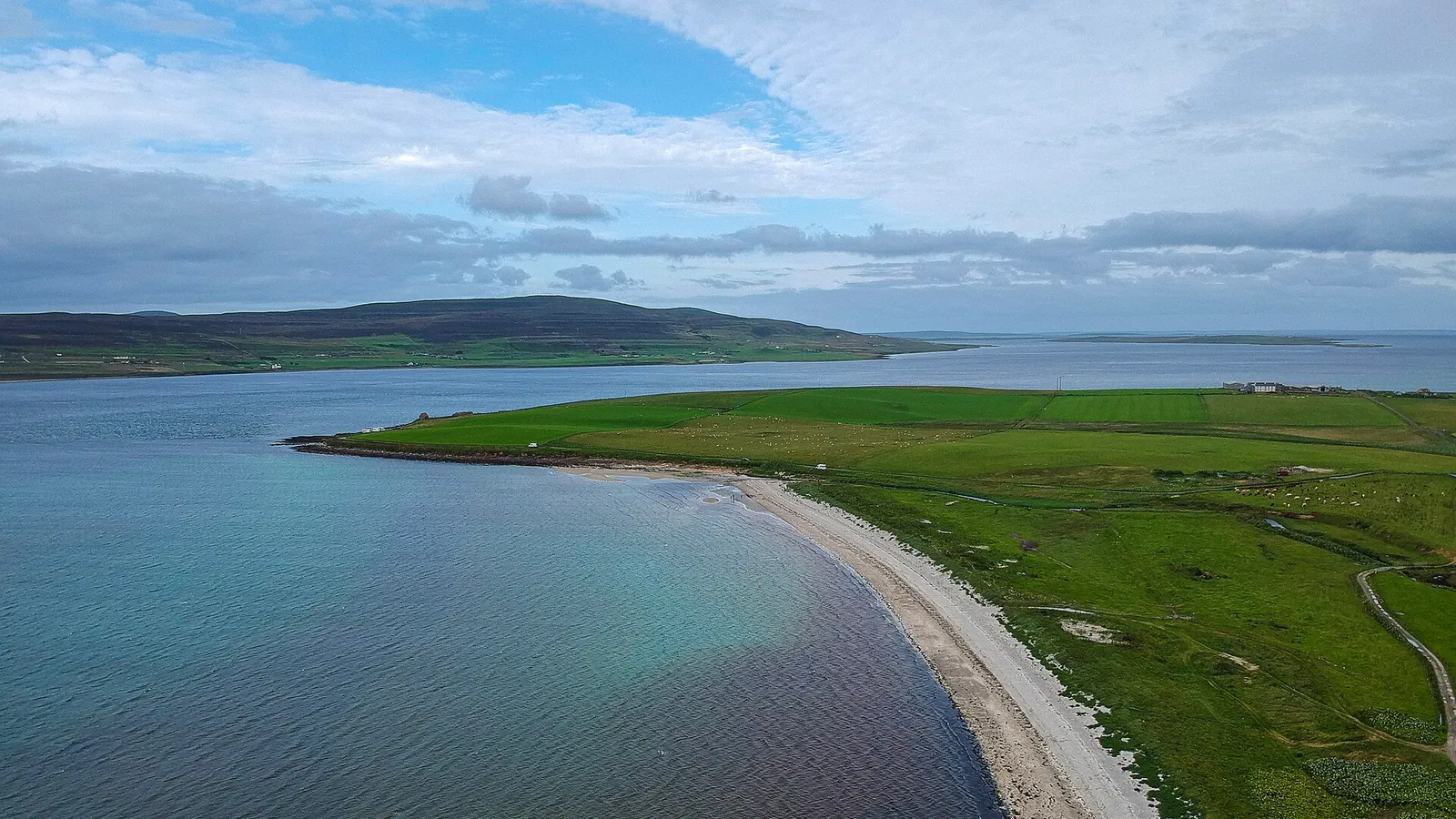

Orkney Islands
Contents
TL;DR
- established Orkney comprises more than 70 islands and islets, of which only around 20 are inhabited, lying roughly 20 miles north of the Scottish mainland across the Pentland Firth — this is settled geographic fact drawn from survey record, not estimate.
- established Orkney was ruled as a Norse earldom, under Norwegian political authority, from the ninth century until 1468, when it was pledged — not sold — to the Scottish crown as part of a royal dowry arrangement that was never actually redeemed — this is documented constitutional and dynastic history with a specific, verifiable mechanism, not a vague "became Scottish" narrative.
- established Orkney's Norn language, a North Germanic tongue descended from Old Norse, survived in everyday use into the late eighteenth century, centuries after the islands' formal political transfer to Scotland — this is documented linguistic history showing Norse cultural identity persisted long after 1468/1472.
- established Scapa Flow served as a major Royal Navy anchorage in both World Wars, the site of the 1919 scuttling of the interned German High Seas Fleet and the 1939 sinking of HMS Royal Oak with the loss of 835 lives — these are precisely dated military history events.
- traditional Popular tourist framing sometimes treats Orkney's Norse character as a simple, uninterrupted continuation of Viking-era identity; in practice it is a living culture that has absorbed Scottish, British, and now renewable-energy-driven modern influences over centuries, and this article treats "Norse heritage" as one strand within a more layered modern island identity rather than its entirety.
Key Facts
- Location/Region
- North of the Scottish mainland, across the Pentland Firth, Northern Isles
- Scale
- More than 70 islands/islets; around 20 inhabited; total land area roughly 990 km²
- Type
- Archipelago — low-lying farmland islands, cliffs, and the sheltered anchorage of Scapa Flow
- Protected/heritage status
- St Magnus Cathedral and multiple scheduled monuments (Historic Environment Scotland); separate UNESCO World Heritage status applies specifically to the Neolithic sites of the Heart of Neolithic Orkney (covered on a dedicated card in this collection)
- Managed/owned by
- Orkney Islands Council (unitary local authority); mixed private and crofting land tenure; Scapa Flow partly managed for historic wreck diving and marine heritage
- Access notes
- Ferries from Scrabster, Gills Bay, and Aberdeen; air links to Kirkwall; inter-island ferries and some causeway/bridge links (notably via the Churchill Barriers) connect several of the inhabited islands
Scottish Impact Index (SI Score)
- National Significance
- 10/10
- Historical Continuity
- 10/10
- Human & Economic Importance
- 8/10
- Landscape / Architectural Distinctiveness
- 10/10
- Cultural & Historical Legacy
- 10/10
- Recognition
- 9/10
57/60
Ranked =10th of 43 in Locations
A Note on Claims and Evidence
Orkney's Norse political history — the earldom, the 1468 pledge, and the persistence of Norn into the eighteenth century — is documented, resting on charter, chronicle, and linguistic record. The two World War naval episodes at Scapa Flow are similarly well-documented military history with precise casualty and vessel records. Where this article is more cautious is in how it frames Orkney's "Norse identity" as a living, present-day cultural fact: Orkney's modern Norse-heritage tourism and cultural pride is a genuine and long-standing feature of island self-understanding, but it sits alongside — rather than erasing — centuries of subsequent Scottish and British political, religious, and economic influence, and this article avoids implying an unbroken, unchanged Viking-to-present continuity.
Timeline
Norse settlers begin establishing a presence in Orkney, gradually displacing or absorbing the earlier Pictish population.
Harald Fairhair (Harold Hårfagre), king of Norway, subdues Norse raiders operating from Orkney and formally annexes Orkney and Shetland to Norway.
Orkney is governed by a line of Norse earls (jarls) under Norwegian overlordship, developing a distinct Norse-Scottish hybrid aristocratic culture.
The original Norse jarl line in Orkney ends, with the earldom subsequently passing through various, increasingly Scottish-connected, noble families while remaining nominally under Norwegian/Danish crown authority.
Christian I, King of Denmark and Norway, pledges Orkney to the Scottish crown as security for the unpaid dowry of his daughter Margaret, betrothed to James III of Scotland.
With the dowry never redeemed, the Scottish Parliament formally annexes Orkney to the Scottish crown.
The Norn language, descended from Old Norse, finally falls out of everyday use, centuries after formal political transfer to Scotland.
Britain's last known breeding great auks are killed on Papa Westray.
Fulmars first breed in Orkney, on Hoy.
The interned German High Seas Fleet is scuttled by its own crews at Scapa Flow following the WWI armistice.
HMS Royal Oak is sunk by a German U-boat inside Scapa Flow, with the loss of 835 lives.
Sixteen Blackburn Skua dive-bombers, named after the seabird, fly from Orkney to Bergen and sink the German cruiser Königsberg.
The Churchill Barriers are constructed to seal several of Scapa Flow's eastern approach channels, also creating permanent causeway links between several islands.
Fieldfares nest in Orkney, the first recorded breeding in Britain.
The Orkney Field Club's junior members build a great auk cairn at Fowl Craig, Papa Westray.
Orkney develops a significant renewable energy and marine-technology sector, leveraging its strong tidal and wind resources.
Details
More islands than most people assume
Orkney is not a single island but an archipelago of more than 70 islands and islets, of which only around 20 support permanent populations today. This matters for understanding the islands' character: Orkney's culture has never been a single homogeneous unit but a network of distinct island communities — Mainland (the largest island, home to Kirkwall and Stromness), Hoy, Sanday, Westray, South Ronaldsay, and many smaller islands among them — each with its own particular blend of farming, fishing, and increasingly, energy-related livelihoods. The islands lie across the often-rough Pentland Firth from the Scottish mainland, a strip of water whose strong tidal currents have shaped both historical seafaring and, more recently, tidal-energy development.
Norse rule, and a transfer that was never actually paid for
Orkney's governing political framework for roughly six centuries was Norwegian, not Scottish. Norse settlement from the eighth century culminated in 875, when King Harald Fairhair of Norway formally annexed Orkney (and Shetland) to the Norwegian crown, establishing an earldom that would be ruled, with varying degrees of independence, by a succession of Norse jarls into the thirteenth century. This produced a genuinely distinct hybrid Norse-Scottish aristocratic culture, visible today in surviving place names, legal terminology, and monumental architecture such as St Magnus Cathedral in Kirkwall, founded by a Norse earl in the twelfth century.
The mechanism by which Orkney eventually became Scottish is worth stating precisely, because it is often glossed over. In 1468, Christian I, King of Denmark and Norway, pledged Orkney to the Scottish crown as security for the dowry owed on the marriage of his daughter Margaret to James III of Scotland. This was a pledge, not a sale or conquest — a financial security arrangement. The dowry was, as a matter of documented historical record, never actually paid, and in 1472 the Scottish Parliament formally annexed Orkney outright, converting what had begun as a temporary financial pledge into permanent Scottish sovereignty. Orkney has therefore been Scottish, in strict legal terms, for over 550 years — but it got there through an unredeemed debt rather than invasion or straightforward purchase.
A Norse identity that outlasted Norse rule by centuries
What makes Orkney's Norse heritage more than a historical footnote is how long it persisted culturally after political control shifted to Scotland. Norn, a North Germanic language descended directly from Old Norse and closely related to Faroese and Icelandic, continued as an everyday spoken language in Orkney well after the 1468–1472 transfer, surviving into the late eighteenth century before finally being displaced by Scots and English as settlement and administrative pressure from the Scottish mainland increased. This three-centuries-plus gap between political transfer and linguistic assimilation is a useful corrective to any simple narrative in which "becoming Scottish" instantly erased Norse culture; in Orkney's case, cultural Norse identity substantially outlived Norse political rule.
Scapa Flow: two world wars in one sheltered anchorage
Orkney's other major historical identity, layered on top of its Norse past, is as a strategically vital naval anchorage. Scapa Flow, the large, sheltered body of water enclosed by several of Orkney's southern islands, served as a principal Royal Navy base in both World Wars. Its most dramatic documented episode came in 1919, when the crews of the German High Seas Fleet, interned there following the WWI armistice while the Treaty of Versailles negotiations continued, deliberately scuttled their own ships rather than see them handed over to the Allies — one of history's largest single acts of self-inflicted naval destruction, and a chapter now central to Orkney's wreck-diving and marine-heritage tourism.
The Second World War brought tragedy rather than drama: on 14 October 1939, a German U-boat penetrated Scapa Flow's defences and torpedoed HMS Royal Oak at anchor, sinking the battleship with the loss of 835 lives. The disaster prompted construction of the Churchill Barriers, a set of causeways built across several of Scapa Flow's eastern approach channels to close the security gap the U-boat had exploited — engineering works that, as an incidental but lasting side effect, also created permanent road links between several previously separate Orkney islands, physically reshaping the archipelago's internal connectivity.
Eagles, auks and Looma Chun: Orkney's bird history
established Orkney's relationship with birds is ancient. At Isbister on South Ronaldsay, a Neolithic tomb held the remains of about 342 people together with the carcasses of 35 large birds of prey, two-thirds of them white-tailed eagles. Mark Cocker and Richard Mabey, in Birds Britannica (2005), note that the bodies appear to have been laid out for birds to strip before burial, and suggest the eagles' presence points to a ritual attachment. Diver bones turn up in Pictish middens south of Kirkwall, and shag bones in an early medieval broch. Later attitudes were harsher: Orkney crofters ran a bounty in which every household in the parish paid a chicken, or eight pence, to anyone who killed a sea eagle.
established The islands hold one of the best-known extinction stories in British natural history. The last known British breeding pair of great auks lived on Papa Westray, where islanders called them the "King and Queen o' the Aaks". The female was stoned to death on her nest in 1812, and the male was killed the following year for the collector William Bullock, who later sold it for £16 5s 6d. In 1988 junior members of the Orkney Field Club built a cairn and monument to the species at Fowl Craig, in the RSPB's North Hill reserve on Papa Westray. Orkney also lost a small breeding colony of whooper swans in the eighteenth century to egg collectors and disturbance.
established Orkney's bird names are a living record of Norn and Scots. The red-throated diver is still the loon, and "Looma Chun", "lochan of the divers", appears as a place name on Rousay, on Hoy and in both West and East Mainland; the book notes that all of these sites still had breeding divers. The great northern diver's old name, immer goose, comes from Norn. Other Orcadian names include mallimack or mallie for the fulmar, aak for the guillemot, pickie and ritto for the Arctic tern, moosiehaak for the kestrel, skeldro for the shelduck, and skitter-broltie for the corn bunting, "one who shits on the braithes", the cross-ropes of a corn stack. Orkney then held the most northerly corn buntings in the world.
established New birds have arrived as well as lost ones. Fulmars, spreading from Shetland, first bred on Hoy in 1896 and now nest on old crofts and byres; the book calls meeting one swaying on a low flagstone roof, ready to spit oil, "one of the more unnerving facets of Orcadian life". In 1967 a pair of fieldfares nested in Orkney and raised three young, the first ever recorded breeding in Britain. North Ronaldsay holds one of Britain's largest winter gatherings of purple sandpipers, which feed on the island's old cobbled slipways.
Orkney today: farming, fishing, and a renewable-energy frontier
Modern Orkney's economy continues to rest substantially on farming (particularly cattle) and fishing, but the islands have become notable in recent decades as a significant centre for renewable energy research and deployment, exploiting the same strong winds and powerful tidal currents in the Pentland Firth and surrounding waters that have always made Orkney's seas formidable. This gives Orkney's modern identity a distinctive double character: a place that markets its deep Norse heritage and Viking-era place names to visitors, while simultaneously functioning as a working laboratory for cutting-edge marine energy technology — two identities that sit comfortably together rather than in tension, both reflecting a small island community's long history of working closely with, rather than against, a difficult northern sea. Readers interested in Orkney's considerably older Neolithic archaeology — the Ring of Brodgar, Standing Stones of Stenness, and related World Heritage sites — are directed to this collection's dedicated Heart of Neolithic Orkney card, which this article does not duplicate.
Did You Know?
- Orkney has more than 70 islands, but only about 20 are inhabited today.
- Orkney became Scottish not through conquest or purchase, but because a 1468 royal dowry was never actually paid.
- The Norse language Norn survived as an everyday spoken language in Orkney for over three centuries after the islands formally became Scottish.
- In 1919, the crews of the interned German High Seas Fleet scuttled their own ships at Scapa Flow rather than hand them to the Allies.
- HMS Royal Oak was sunk at anchor inside Scapa Flow in 1939 with the loss of 835 lives, prompting the construction of the Churchill Barriers.
- The Churchill Barriers, built for wartime defence, also created permanent road causeways linking several Orkney islands that had previously only been reachable by boat.
- St Magnus Cathedral in Kirkwall was founded by a Norse earl in the twelfth century, physical evidence of Orkney's hybrid Norse-Scottish aristocratic culture.
- Orkney islanders called Britain's last breeding great auks, on Papa Westray, the "King and Queen o' the Aaks".
- A Neolithic tomb at Isbister on South Ronaldsay held the remains of more than 20 white-tailed eagles alongside its human dead.
- The Orcadian name for the corn bunting, skitter-broltie, means "one who shits on the cross-ropes of a corn stack".
- Orkney's modern renewable energy sector exploits the same powerful tidal currents in the Pentland Firth that have shaped and challenged seafaring there for over a thousand years.
FAQ
1How many islands make up Orkney?
More than 70 islands and islets, of which only around 20 are permanently inhabited.
2Was Orkney ever part of Norway?
Yes — Orkney was formally annexed to Norway in 875 and remained under Norwegian (later Danish-Norwegian) political authority until 1468/1472.
3How did Orkney become part of Scotland?
It was pledged to the Scottish crown in 1468 as security for an unpaid royal dowry; since the debt was never settled, the Scottish Parliament formally annexed the islands in 1472.
4Do people in Orkney still speak Norse?
No living Norse-descended language remains in everyday use — Norn, the historic Orkney Norse tongue, died out by the late eighteenth century — but Norse-derived place names and words remain common.
5What happened to the German fleet at Scapa Flow?
Its crews scuttled the entire interned High Seas Fleet in 1919 rather than surrender the ships to the Allies.
6What was lost when HMS Royal Oak sank?
835 lives were lost when the battleship was torpedoed at anchor inside Scapa Flow in October 1939.
7What are the Churchill Barriers?
Wartime causeways built across several of Scapa Flow's eastern channels to prevent further U-boat attacks; they also now serve as permanent road links between several Orkney islands.
8Is Orkney the same as Shetland?
No — they are separate archipelagos with related but distinct Norse histories; Shetland lies further north and has its own separate card in this collection.
9Does Orkney have Neolithic sites too?
Yes, including the Ring of Brodgar and the Standing Stones of Stenness, covered in detail on this collection's dedicated "Heart of Neolithic Orkney" card rather than duplicated here.
10How do you get to Orkney?
By ferry from Scrabster, Gills Bay, or Aberdeen, or by air to Kirkwall; inter-island ferries and some causeways connect the inhabited islands.
11What is Orkney's main town?
Kirkwall, on the Mainland (the largest island), home to St Magnus Cathedral.
12What happened to the great auk in Orkney?
The last known British breeding pair lived on Papa Westray. The female was killed in 1812 and the male in 1813, for a collector; a cairn at Fowl Craig has commemorated them since 1988.
13What does "Looma Chun" mean?
"Lochan of the divers", an Orkney place name found on Rousay, Hoy and Mainland at lochans where red-throated divers, still called loons in Orkney, breed.
14What does Orkney's economy rely on today?
Farming and fishing remain significant, alongside a growing renewable energy and marine-technology sector.
Sources and Further Reading
Primary/Institutional
- Orkney Islands Council — official council information
- Historic Environment Scotland — St Magnus Cathedral and Scapa Flow heritage records
- Royal Navy / Imperial War Museum — Scapa Flow World War history records
Scholarly/Critical
- Academic linguistic scholarship on the Norn language's decline
- Cambridge University Press and related historical scholarship on the Earldom of Orkney and the 1468–1472 transfer to Scotland
- Mark Cocker and Richard Mabey, Birds Britannica (Chatto & Windus, 2005)
General
- Wikipedia — "History of Orkney," "Earldom of Orkney"
- Encyclopaedia Britannica — "Orkney Islands"
- VisitScotland and Orkney.com tourism resources
Caveats: Myths and Disputed Claims
- Do not describe Orkney as having been "sold" or "conquered" by Scotland in 1468 — it was pledged as dowry security, and the transfer became permanent only because the debt was never repaid. Correct phrasing: "pledged, then permanently annexed after the debt went unpaid."
- Do not imply Orkney's Norse identity ended abruptly in 1468/1472 — the Norn language persisted in everyday use for roughly three further centuries. Correct phrasing: "Norse cultural and linguistic identity persisted long after political transfer to Scotland."
- Do not conflate Orkney's Norse/later history with the separate Neolithic "Heart of Neolithic Orkney" World Heritage material — that belongs on its own dedicated card.
- Do not present modern Orkney's Norse-heritage branding as an unbroken, unchanged continuation of Viking-era culture — it is a modern identity drawing on, but not identical to, historical Norse rule.
Card 029 · Locations