
Palace of Holyroodhouse
Contents
At the foot of the Royal Mile, the Palace of Holyroodhouse grew from the guesthouse of a twelfth-century abbey into the principal royal residence in Scotland. Its oldest part, James V's tower, holds the rooms where Mary, Queen of Scots lived, married two of her three husbands and saw her secretary David Riccio stabbed to death. This card separates the palace's documented history from the stories told about it.
TL;DR
- established The palace grew out of the guesthouse of Holyrood Abbey, founded by David I in 1128 — this origin is documented in the abbey's founding charter and subsequent monastic and royal records.
- established James IV built the original Gothic quadrangle palace (1501–1505) and James V added the northwest tower (1528–1536), still the palace's oldest surviving structure — confirmed by surviving fabric and building accounts.
- established David Rizzio, Mary, Queen of Scots' private secretary, was murdered in her chambers on 9 March 1566 by a group including Lord Darnley — recorded in multiple contemporary accounts, though exact details (such as the number of wounds) vary slightly between sources.
- established Mary married Lord Darnley in her private chapel at Holyrood on 29 July 1565, and the Earl of Bothwell in the palace's great hall by Protestant rites on 15 May 1567. Darnley was buried in the royal vault of the abbey church in February 1567.
- established The palace's present classical form dates largely from a major rebuilding under Charles II (1671–1678) by architect Sir William Bruce, funded by the Privy Council to assert Edinburgh's status as a royal capital — documented in state and architectural records.
- established Holyroodhouse remains a working royal palace, owned by the Crown and administered for public access by the Royal Collection Trust, with the Monarch traditionally resident for one ceremonial week each year — a matter of current institutional record.
Key Facts
- Location
- Foot of the Royal Mile, Edinburgh, Scotland
- Era/Period
- Abbey founded 1128; palace developed 1501 onward; present form largely 1671–1678
- Type
- Royal palace with adjoining ruined abbey
- Managed/Owned by
- The Crown (owner); Royal Collection Trust (public access and revenue administration)
- Visitor status
- Open to the public most of the year, paid admission; closed during royal residencies and state occasions
- Adjoining feature
- Ruined Holyrood Abbey, within the palace grounds
Scottish Impact Index (SI Score)
- National Significance
- 9/10
- Historical Continuity
- 10/10
- Human & Economic Importance
- 8/10
- Landscape / Architectural Distinctiveness
- 9/10
- Cultural & Historical Legacy
- 10/10
- Recognition
- 9/10
55/60
Ranked =16th of 43 in Locations
A Note on Claims and Evidence
Holyroodhouse benefits from an unusually continuous documentary record, spanning monastic foundation charters, royal building accounts, and now official Royal Collection Trust institutional history, including a first official history of the palace published by the Trust itself. The documented tier covers the abbey's 1128 founding, the identifiable building campaigns of James IV, James V, and Charles II, and the Rizzio murder, all independently attested across multiple sources. The traditional tier is comparatively thin here compared to older castles, since Holyroodhouse's history is well recorded from its monastic origins onward; where variation exists — such as precise details of the Rizzio murder — this article notes it rather than asserting false precision.
Timeline
David I founds Holyrood Abbey; the early royal residence is the abbey's guesthouse.
The Parliament of Scotland convenes at Holyrood on seven occasions, reflecting the abbey's growing administrative importance.
The king begins occupying dedicated royal lodgings separate from the abbey guesthouse.
James IV constructs the original Gothic palace around a quadrangle adjacent to the abbey.
James V adds the northwest tower, including a drawbridge and probable moat; this tower remains the palace's oldest surviving structure.
The Earl of Hertford's army burns Edinburgh and ransacks the palace and abbey church during the "War of the Rough Wooing"; English campaigns to 1547 cause significant damage.
Mary, Queen of Scots lands at Leith and rides to Holyrood; she lives in the James V Tower apartments until 1567.
Protestants riot in the courtyard during Mary's first Mass in her private chapel.
Mary's first interview with John Knox at Holyrood.
Mary marries Lord Darnley in her private chapel.
David Rizzio is murdered in Mary's chambers by a group including Lord Darnley.
Shortly after midnight, Mary and Darnley escape through the cellars and ride to Dunbar.
Darnley is buried by night in the royal vault of the abbey church.
Mary marries the Earl of Bothwell in the great hall by Protestant rites.
After her surrender at Carberry Hill, Mary is held at Holyrood for a few hours before being taken to Lochleven.
Charles II commissions a major rebuilding under architect Sir William Bruce, funded by the Privy Council, creating the largely classical palace structure seen today.
Palace continues as an official royal residence in Scotland, administered for public access by the Royal Collection Trust.
The Monarch traditionally resides at Holyroodhouse for one ceremonial week annually ("Holyrood Week"); the palace otherwise operates as a major paid visitor attraction.
Details
Monastic origins at the foot of the Royal Mile
Holyroodhouse's history begins not as a palace at all, but as an abbey. David I founded Holyrood Abbey in 1128, and for its first centuries the site's royal significance derived from its function as a place of monastic hospitality rather than residence — the early "royal residence" was simply the abbey's guesthouse, used when monarchs required lodging in Edinburgh. The abbey's status grew considerably over the following centuries; it became significant enough administratively that the Parliament of Scotland convened there on seven separate occasions between 1256 and 1410, reflecting Holyrood's emergence as a site of genuine state importance well before any dedicated royal palace existed on the grounds.
Building a royal palace alongside the abbey
The shift from guesthouse to purpose-built royal palace began in earnest under James IV, who between 1501 and 1505 constructed a Gothic palace around a quadrangle immediately adjacent to the abbey. His son James V extended this considerably between 1528 and 1536, adding the northwest tower that remains, to this day, the oldest surviving structural element of the palace — a fortified addition complete with a drawbridge and likely moat, reflecting the genuine defensive concerns of a sixteenth-century Scottish monarch rather than purely ceremonial ambition. This early palace suffered serious damage during the "War of the Rough Wooing" in the 1540s, a conflict rooted in English attempts to force a marriage alliance between the infant Mary, Queen of Scots, and the son of Henry VIII — a reminder that Holyroodhouse's fabric, like so many Scottish royal buildings, carries physical scars from England's repeated military intervention in Scottish dynastic politics.
Mary, Queen of Scots and the Rizzio murder
Mary, Queen of Scots lived at Holyroodhouse between 1561 and 1567, occupying apartments within James V's tower, and the palace's most notorious single event belongs unambiguously to this period. On the night of 9 March 1566, David Rizzio, Mary's Italian-born private secretary and a figure resented by rival nobles for his influence over the queen, was murdered within her own chambers. The attack was carried out by a group that included Mary's husband, Lord Darnley, acting in concert with nobles opposed to Rizzio's position at court. Contemporary accounts describe a brutal, frenzied killing — some sources cite as many as fifty-seven stab wounds — though exact figures vary between retellings, and this article treats the broad fact of the murder and Darnley's involvement as firmly documented while noting that precise forensic details should not be stated with false certainty.
Arrival and the first Mass. established The historian John Guy, in his biography of Mary (2004), describes her arrival. She landed at Leith on 19 August 1561 after thirteen years in France and rode straight to Holyrood, where the rooms had stood empty since her mother's death. Her own furniture was still at sea. Guy suggests that James V's tower was modelled on the Francis I tower at Chambord, where Mary had often stayed, a likely but unproven link (shared). On her first Sunday, while she heard Mass in her private chapel, Protestants led by the Master of Lindsay rioted in the courtyard and demanded the priest's death. Her half-brother Lord James Stewart guarded the chapel door. It was here, on 4 September 1561, that Mary held the first of her interviews with John Knox.
Two weddings. established Mary married Lord Darnley in her private chapel shortly before six in the morning on Sunday 29 July 1565, wearing the white mourning of a widow. Darnley left before the nuptial Mass, and the next day heralds proclaimed him King of Scots to a silent crowd. Less than two years later the Earl of Bothwell, newly created Duke of Orkney in the abbey church, married Mary on 15 May 1567 in the palace's great hall by Protestant rites, before very few witnesses.
The Riccio murder room by room. established Guy reconstructs the plot from the conspirators' own accounts and Mary's. Around eight in the evening Darnley led Lord Ruthven up a private stair from his own apartments to Mary's bedchamber on the floor above. Mary, six months pregnant, was at supper with Riccio and a few friends in a small closet off the bedchamber, about twelve feet by nine. Morton and some eighty armed men waited on the main stair. Riccio clung to Mary's skirts before he was dragged through the bedchamber into the outer presence chamber and stabbed to death near the door to the main stair. Mary's own account, sent to Paris, gives fifty-six wounds; other sources say fifty-seven or more. shared Guy rejects the theory that the plotters aimed to kill Mary or cause a miscarriage, since Darnley's claim to rule depended on her staying alive.
The escape. established Mary won Darnley back to her side within two days. Shortly after midnight on 11–12 March 1566, the pair slipped out of the palace through a passage from the wine cellars and rode about twenty-five miles to Dunbar. Mary did not return to live at Holyrood until the danger had passed, and she gave birth to her son at Edinburgh Castle that June.
Burial and the end. established Darnley, murdered at Kirk o' Field on 10 February 1567, was buried quietly at night on 14 February in the royal vault of the abbey church. After her surrender at Carberry Hill on 15 June 1567, Mary was brought back to Holyrood under guard for a few hours, then taken across the Forth to Lochleven. She never saw the palace again.
Rebuilding under Charles II
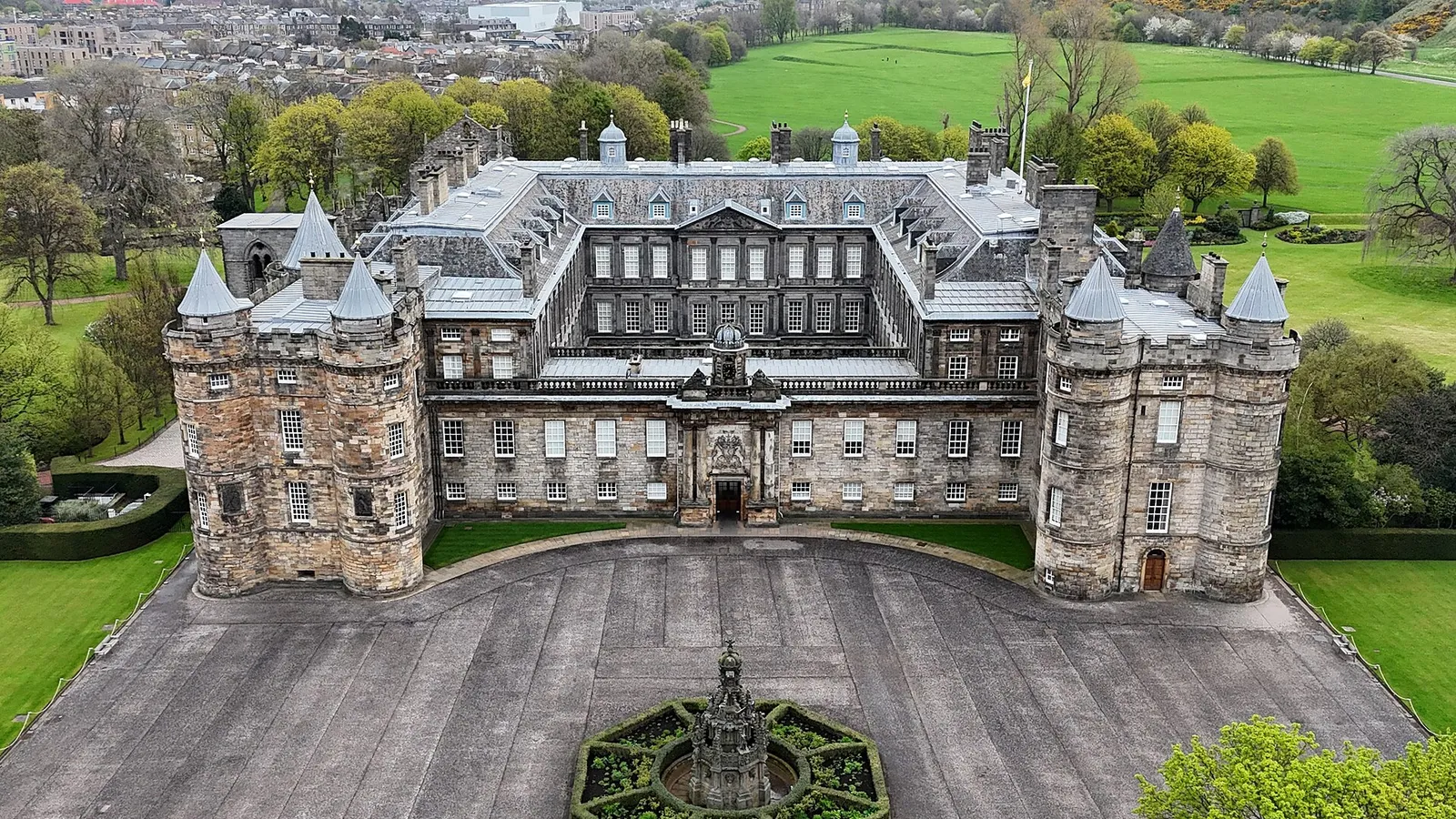
The palace most visitors see today owes its overall classical form not to the Stuart monarchs of Mary's era but to a later, deliberate act of royal image-making. Between 1671 and 1678, Charles II commissioned architect Sir William Bruce to rebuild Holyroodhouse comprehensively, with funding specifically provided by the Privy Council to reinforce Edinburgh's standing as a royal capital at a time when the monarch resided primarily in London following the 1603 Union of the Crowns. Bruce's design retained James V's northwest tower — itself proof of the project's willingness to incorporate rather than erase the palace's earlier history — while adding a matching tower and a symmetrical classical facade that transformed Holyroodhouse's overall character from fortified royal lodging to a dignified, formally composed state residence appropriate to late-seventeenth-century taste.
A living palace today
Holyroodhouse's distinctive position among Scotland's great royal buildings is that it remains, unlike Stirling or Edinburgh Castle, an actively used royal residence rather than a purely historic monument. The Crown retains ownership, while the Royal Collection Trust manages public access and uses resulting revenue to support its broader custodianship of the Royal Collection. The Monarch traditionally spends one ceremonial week at Holyroodhouse each year, during which the palace closes to visitors for official engagements and investitures — a working rhythm that distinguishes it from state-owned heritage sites administered purely as museums. The adjoining ruined Holyrood Abbey, roofless since the eighteenth century, remains within the palace grounds as a visible reminder of the site's monastic origins, its evocative decay contrasting deliberately with the palace's maintained grandeur.
Did You Know?
- Holyroodhouse began life not as a palace but as the guesthouse of an abbey founded in 1128 — the "palace" function developed centuries later.
- The Parliament of Scotland met at Holyrood Abbey on seven occasions between 1256 and 1410, well before any dedicated royal palace existed there.
- James V's northwest tower, complete with drawbridge and probable moat, remains the oldest surviving structural part of the palace.
- The War of the Rough Wooing, rooted in a failed forced marriage scheme targeting the infant Mary, Queen of Scots, caused significant damage to the early palace.
- Accounts of David Rizzio's 1566 murder vary in gruesome detail, including the exact number of stab wounds, between different contemporary sources.
- The palace's now-familiar classical appearance dates largely from a 1670s rebuilding under Charles II, who never actually lived to see it completed during a visit.
- Holyrood Abbey, adjoining the palace, has stood roofless and ruined since the eighteenth century.
- Mary married two of her three husbands at Holyrood: Darnley in her private chapel in 1565 and Bothwell in the great hall in 1567.
- The room where Mary was at supper when Riccio was seized measured only about twelve feet by nine.
- After the murder, Mary and Darnley escaped from the palace at night through a passage from the wine cellars.
- The Monarch's traditional one-week residency at Holyroodhouse each year closes the palace to the public during that period.
FAQ
1Is Holyroodhouse still used by the royal family?
Yes, the Monarch traditionally resides there for one ceremonial week each year, during which the palace closes to visitors.
2Who owns the Palace of Holyroodhouse?
The Crown owns it; the Royal Collection Trust manages public access and visitor revenue.
3What happened to David Rizzio?
He was murdered in Mary, Queen of Scots' chambers on 9 March 1566 by a group including her husband, Lord Darnley.
4What is the oldest part of the palace?
The northwest tower, added by James V between 1528 and 1536.
5Why does the palace look mostly classical rather than medieval?
Its present overall form dates largely from a major rebuilding under Charles II in the 1670s.
6What is Holyrood Abbey's relationship to the palace?
The abbey, founded in 1128, predates the palace and gave rise to it; the abbey's ruins remain within the palace grounds today.
7Can visitors tour the palace?
Yes, it is open to the public for most of the year, with paid admission, except during royal residencies and state occasions.
8Did Mary, Queen of Scots live at Holyroodhouse?
Yes, she resided there from 1561 to 1567.
9Did Mary marry at Holyrood?
Yes, twice. She married Lord Darnley in her private chapel on 29 July 1565 and the Earl of Bothwell in the great hall on 15 May 1567.
10Where is Lord Darnley buried?
In the royal vault of Holyrood Abbey, where he was buried at night on 14 February 1567, four days after his murder.
11How did Mary escape after Riccio's murder?
She persuaded Darnley to change sides. Shortly after midnight on 11–12 March 1566 they left through a passage from the cellars and rode to Dunbar.
12Is Holyrood Abbey still used for worship?
No, it has been roofless and ruined since the eighteenth century.
13Who built the first dedicated royal palace at Holyrood?
James IV, between 1501 and 1505.
14Is Holyroodhouse connected to the Scottish Parliament?
Historically, yes — the medieval Parliament of Scotland met at Holyrood Abbey on several occasions, though this predates the modern Scottish Parliament building nearby.
15What architect is most associated with the palace's current appearance?
Sir William Bruce, who led the 1670s rebuilding under Charles II.
Sources and Further Reading
Primary/Institutional
- Royal Collection Trust, official history and visitor information for the Palace of Holyroodhouse
- Royal Collection Trust press release on the palace's first official published history
Scholarly/Critical
- Historical and architectural studies of Sir William Bruce's work at Holyroodhouse
- Academic accounts of the 1566 Rizzio murder and its political context within Mary, Queen of Scots' reign
- John Guy, "My Heart is My Own": The Life of Mary Queen of Scots (Fourth Estate, 2004; US edition Queen of Scots: The True Life of Mary Stuart, Houghton Mifflin, 2004)
- Andrea Thomas, "The Renaissance", in T. M. Devine and Jenny Wormald (eds), The Oxford Handbook of Modern Scottish History (Oxford University Press, 2012) — further reading on royal building under the Stewarts
General
- Wikipedia, "Holyrood Palace" — en.wikipedia.org/wiki/Holyrood_Palace
- Country Life, feature coverage of the Palace of Holyroodhouse
- History of Royal Women, Palace of Holyroodhouse and Holyrood Abbey overview
Caveats: Myths and Disputed Claims
- Do not state a precise, single number of stab wounds inflicted on David Rizzio as settled fact; contemporary accounts vary, and this article notes the figure of fifty-seven as commonly cited rather than definitively confirmed.
- Do not describe the palace's present appearance as medieval in character; its dominant classical form dates from the 1670s rebuilding under Charles II, which incorporated but substantially altered the earlier Tudor-period structure.
- Do not imply the abbey and palace are the same building; Holyrood Abbey predates and is physically distinct from the palace, standing today as a roofless ruin within the grounds.
- Do not present the nursery rhyme "Mary, Mary, quite contrary" as being about Mary's garden at Holyrood. John Guy repeats the reading (the bells of her chapel, the cockleshells of pilgrims, the four Maries), but the rhyme is first recorded in print only in the eighteenth century and the link is tradition.
- Do not say Mary married Bothwell in her Catholic chapel; it was a Protestant service in the great hall, conducted by Adam Bothwell, Bishop of Orkney.
Card 009 · Locations