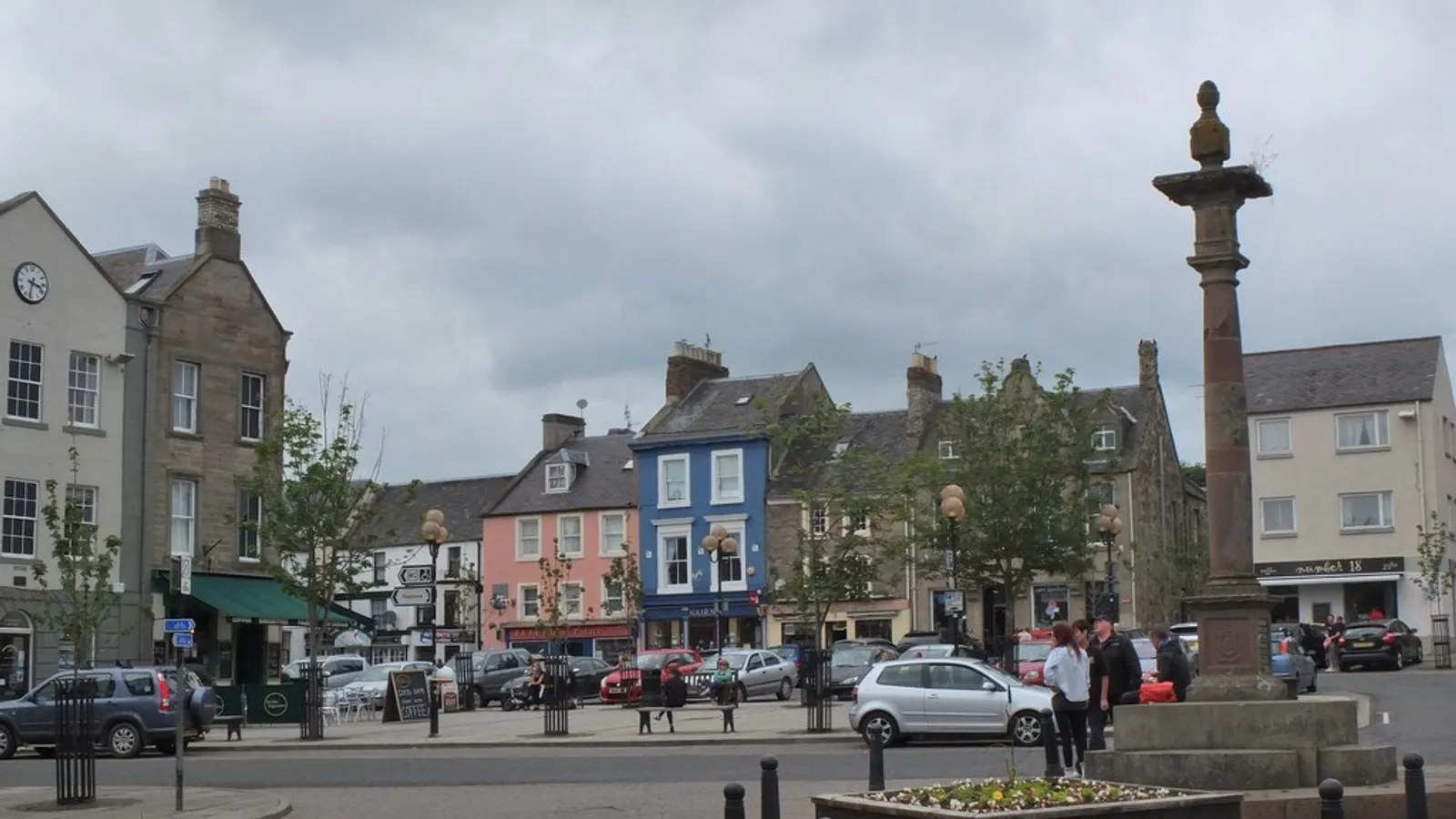

Scottish Borders & Tweed Valley
Contents
Not a Single-Abbey Card — A Landscape of Conflict and Faith
This card treats the Scottish Borders and the Tweed Valley at landscape level: centuries of Anglo-Scottish frontier conflict, the river valley's great ruined abbeys as a group, and the region's agricultural and textile character. A separate reserve card elsewhere in this collection may cover Melrose Abbey in dedicated depth; this article deliberately keeps its abbey coverage brief and comparative rather than duplicating a full architectural or monastic history of any single site.
TL;DR
- established The Scottish Borders were, for roughly three centuries (c.1300s–1603), one of the most genuinely lawless frontier regions in Britain, afflicted by organised cross-border raiding ("reiving") carried out by both Scottish and English riding families — a documented social and legal phenomenon, not folklore or romanticised banditry.
- established The word "blackmail" derives from Border protection payments of the reiving era. "Bereave" is much older (Old English berēafian): it shares a root with "reive", meaning to rob, but was not coined by the reivers.
- established All four major Border abbeys — Melrose, Dryburgh, Jedburgh, and Kelso — were founded in the 12th century under King David I and were repeatedly damaged or destroyed by English raids over subsequent centuries, a pattern of destruction documented in historical and architectural record rather than vague "ancient ruin" framing.
- disputed Reiver-era families are often romanticised in modern heritage and clan tourism as swashbuckling folk heroes; this article treats that framing as a later romantic reinterpretation, not a neutral account of what was, for the ordinary people living through it, a brutal and destructive several-hundred-year period of violence and theft.
- traditional The Border country's reputation as a defining "frontier" landscape of raids and reivers remains strong in regional identity and tourism branding today, a living cultural tradition rather than settled fact about the present-day region, which has long since become a peaceful agricultural and tourism area.
Key Facts
- Category
- Detail
- Location/Region
- South-east Scotland, along the River Tweed and the Anglo-Scottish border, including the towns of Melrose, Dryburgh, Jedburgh, Kelso, Peebles, and Hawick
- Scale/Date
- Reiving era: roughly 13th century to 1603; major abbeys founded 1100s–1150s under David I
- Type
- River valley and frontier region; cluster of ruined medieval monastic sites; agricultural and textile-manufacturing landscape
- Protected/heritage status
- Melrose, Dryburgh, Jedburgh, and Kelso Abbeys are all Scheduled Monuments in the care of Historic Environment Scotland (varying degrees of ruin)
- Managed/Owned by
- Historic Environment Scotland (abbey sites); Scottish Borders Council (region); private agricultural and estate land throughout the valley
- Access notes
- Abbeys open to visitors (Historic Environment Scotland admission at most sites); Tweed Valley accessible via the A68, A7, and the Borders Railway (reopened 2015); walking/cycling routes including the Borders Abbeys Way
Scottish Impact Index (SI Score)
- National Significance
- 8/10
- Historical Continuity
- 10/10
- Human & Economic Importance
- 8/10
- Landscape / Architectural Distinctiveness
- 9/10
- Cultural & Historical Legacy
- 9/10
- Recognition
- 8/10
52/60
Ranked =28th of 43 in Locations
A Note on Claims and Evidence
The Border Reivers and the Border abbeys are both unusually well documented historical subjects: reiving-era violence is recorded in extensive Warden court records, contemporary complaints, and cross-border diplomatic correspondence, while the abbeys' founding and destruction are confirmed by architectural and documentary evidence, and these facts are marked established throughout. The genuine evidentiary caution needed here concerns tone rather than fact: modern tourism and clan heritage material frequently romanticises reiver culture as swashbuckling adventure, a framing this article treats as a later reinterpretation rather than a neutral historical account, and flags as disputed in emphasis even where the underlying events are not in dispute.
Timeline
Melrose Abbey (1136), Kelso Abbey (early 1100s), Jedburgh Abbey (1138, elevated to abbey status 1154), and Dryburgh Abbey (1150) all founded under King David I, part of a deliberate royal strategy to strengthen Scottish religious and economic presence near the English frontier.
Escalating Anglo-Scottish wars (including the Wars of Scottish Independence) repeatedly draw the Border region into direct conflict; Border abbeys suffer early raids and destruction, including Dryburgh's 1322 burning by Edward II's forces.
The "Border Reivers" phenomenon intensifies: organised raiding, cattle theft, extortion, kidnapping, and arson carried out by riding families on both the Scottish and English sides of the border, often with limited regard for national allegiance, exploiting the weak and overlapping jurisdiction of the Anglo-Scottish frontier.
A formal "Warden of the Marches" system attempts to administer and police the frontier through a structure of Scottish and English border jurisdictions ("Marches"), with only partial success in controlling reiving.
Kelso Abbey suffers its final major destructive attack, reducing most of the structure to ruin.
The Grahams hold thirteen towers on the western border, according to George MacDonald Fraser's The Steel Bonnets as cited by Fischer.
The Johnstone–Maxwell feud reaches its bloodiest point at Dryfe Sands, where Lord Maxwell is killed.
Royal officials reportedly order that no quarter be given to anyone named Rutherford or Hall.
The Union of the Crowns (James VI of Scotland becomes James I of England) removes the legal and political basis for a hostile Anglo-Scottish frontier; the new king, now ruling both sides of the border directly, launches a sustained and often brutal crackdown on reiving families, effectively ending large-scale organised reiving within a generation.
Further damage and neglect affect the Border abbeys as monastic life ends across Scotland.
British emigration registers show that 73 per cent of emigrants from the Scottish border counties travel in family groups, and only 1 per cent as indentured servants.
The Border region develops a significant woollen textile manufacturing industry (notably in towns such as Hawick and Galashiels), building on the valley's long sheep-farming tradition.
Sir Walter Scott, who lived at nearby Abbotsford, does much to popularise and romanticise Border history, including reiver-era ballads and legends, directly shaping the region's enduring romantic image.
The Borders Railway reopens between Edinburgh and Tweedbank, improving access to the Tweed Valley after the original line's 1969 closure.
The Scottish Borders function as a quiet agricultural, textile-heritage, and tourism region, with the ruined abbeys and the Borders Abbeys Way walking route forming a central part of its heritage identity.
Details
A frontier shaped by three centuries of organised violence
For roughly three hundred years, from around the 1300s until 1603, the Anglo-Scottish border country — overlapping what is now the Scottish Borders and the northern English border counties — was genuinely one of the most lawless and dangerous regions in Britain. This lawlessness is well documented through extensive court and administrative records: both Scottish and English border families, often referred to by their "riding surnames" (such as Armstrong, Elliot, Graham, Kerr, and Scott, among many others on both sides), conducted organised cross-border raids — known as "reiving" — involving cattle and goods theft, extortion, kidnapping, arson, and periodic killing, frequently with limited regard for which side of the border they or their victims happened to live on. This should not be understated as minor banditry: reiving was sustained, organised, and economically significant enough that both the Scottish and English crowns established a formal administrative structure, the Wardens of the Marches, specifically to attempt (with only partial success) to police and adjudicate cross-border disputes and raids.
The reiver era also left a lasting, documented mark on the English language. The word "blackmail" derives from Border Reiver-era practice of extracting payment (often in cattle or goods, as opposed to legitimate "white" rent paid in silver) in exchange for protection from raiding — a genuine etymological fact rather than popular myth. The Oxford English Dictionary, as quoted by the historian David Hackett Fischer, defines blackmail as a tribute "exacted from farmers and small owners in the border counties of England and Scotland" in return for protection from plunder. "Bereaved" is often added to the list, but wrongly: "bereave" goes back to Old English, centuries before the reivers, and is only a cousin of "reive", which comes from Middle English reven, to take by force. These linguistic survivals are a useful, concrete reminder of how deeply this period shaped not just the Border landscape but the wider language still spoken today.
Romance versus reality
Modern heritage tourism, clan societies, and popular retelling frequently present the reiver families in a romantic light — bold, resourceful frontier folk operating by their own code in a wild landscape, a framing substantially shaped by 19th-century writers, above all Sir Walter Scott, whose Border ballads and historical fiction (written from his home at nearby Abbotsford) did enormous work in reinventing reiver history as romantic national heritage. This article notes that reframing explicitly rather than repeating it uncritically: for the farmers, villagers, and monastic communities actually living through three centuries of raiding, reiving meant real, repeated loss of livestock, property, and sometimes life, and the eventual, often brutal royal crackdown that ended it after 1603 was experienced by reiving families themselves as a harsh and sometimes indiscriminately violent suppression, not a tidy historical conclusion.
Clans, towers and cabins: how frontier life was organised
established The historian David Hackett Fischer, in Albion's Seed (1989), gathers much of the standard evidence on how three centuries of raiding shaped Border society. Kinship came first. The riding families were clans in the plain sense: related households living close together, sharing a surname and banding together when threatened. Drawing on George MacDonald Fraser's The Steel Bonnets (1971), Fischer records that the Armstrongs, one of the largest of them, were reputed able to put 3,000 mounted men in the field, and that the Grahams held thirteen towers on the western border in 1552. The Johnstone–Maxwell feud ran for generations and reached its height at Dryfe Sands in 1593, where Lord Maxwell was killed.
shared Some of Fischer's details are more colourful than secure. He repeats that royal officials in 1598 ordered no quarter for anyone named Rutherford or Hall, and that the Johnstones decorated their houses with the flayed skins of Maxwells. Both come from secondary retellings rather than a document he quotes, and the second should be treated as tradition. He also names the families of the Debatable Land as Taylors, Bells, Grahams and Bankheads, "Scottish when they will, and English at their pleasure"; the Armstrongs and Grahams are the names more usually associated with that strip of disputed ground.
established Insecurity also shaped buildings. Lairds lived in peles, stone towers of three or four storeys with a windowless ground-floor store. William Camden wrote that "there is not a man amongst them of the better sort that hath not his little tower or pele." Poorer tenants built cabins of turf, stone or wattle that could be put up in a few hours and lost without ruin. An English soldier marching near Duns, just north of the Tweed, wrote that the "husbandmen's houses … resemble our swine coates", one storey high and roofed with clods of earth (as quoted by Fischer). Tenure made matters worse. The Scottish historian John Mair (Major) observed in 1521 that country people held land only on leases of four or five years at the lord's pleasure, and so did not dare to build good houses even where stone was plentiful.
shared Fischer argues that the "pacification" after 1603 was as violent as the world it ended: gallows on the English side, reivers drowned in batches on the Scottish side, whole surnames outlawed, and the Grahams transported to Ireland. He goes further and claims that Border clans, cabins, feuding and ideas of "natural liberty" were carried, through Ulster and directly, to the American backcountry. Much of his evidence for this comes from Cumberland and Westmorland rather than the Scottish Borders, and reviewers have argued that he blurs Lowland Scots, Ulster Presbyterians and northern English into one "North British" culture. His thesis is best read as an influential argument, not settled history.
Emigration from the Borders
established The Borders took part in the great eighteenth-century movement from North Britain to America. Fischer counts Roxburgh and Berwick among the five Scottish counties of his "border region", with Ayr, Dumfries and Wigtown. Using British emigration registers for 1773–76, he reports that 73 per cent of emigrants from the Scottish border counties travelled in family groups, and that indentured servants made up only about 1 per cent of them. These were mostly tenants, labourers and craftsmen with enough money to pay their own passage, not the destitute.
The Border abbeys: faith on a battle line
The Scottish Borders are also home to four of Scotland's most significant medieval monastic ruins — Melrose, Dryburgh, Jedburgh, and Kelso Abbeys — all founded within a few decades of each other in the 12th century under King David I, as part of a deliberate royal strategy to strengthen Scotland's religious, economic, and symbolic presence close to the English frontier. Each abbey belonged to a different monastic order (Melrose: Cistercian; Dryburgh: Premonstratensian; Jedburgh: Augustinian; Kelso: Tironensian), reflecting the wide range of continental monastic traditions King David actively invited into Scotland. Their location directly on the Anglo-Scottish frontier, however, made all four repeated targets of English military raids over the following centuries — Dryburgh was burned in 1322 after English soldiers heard its bells ringing during a retreat; Kelso suffered a final devastating attack in 1545 that reduced most of its structure to ruin; Melrose's surviving fabric dates largely to a late-1300s rebuild following earlier destruction. Further damage and neglect followed the Scottish Reformation, as organised monastic life across Scotland ended. The abbeys survive today as evocative ruins rather than complete structures specifically because of this repeated frontier violence, not simply the ordinary passage of time — a point this article states directly rather than leaving the ruin unexplained.
From battleground to borderland economy
With the Union of the Crowns in 1603 and the subsequent suppression of reiving, the Border region gradually transformed from a violent frontier into one of Scotland's most productive agricultural and, later, textile-manufacturing landscapes. The long-established sheep-farming tradition of the Tweed Valley fed a significant 18th- and 19th-century woollen textile industry centred on towns including Hawick and Galashiels, producing the woollen cloth and knitwear that gave the valley's river its now-famous namesake textile association ("tweed" cloth, though the exact etymology connecting the river and the fabric name is itself debated among textile historians). This economic transition — from contested military frontier to productive borderland economy — underpins the region's present-day character far more than its romanticised reiver past, even as that past remains central to local identity and tourism branding.
Did You Know?
- The word "blackmail" comes directly from Border Reiver-era protection payments, distinguishing illegitimate "black" payments from legitimate "white" (silver) rent.
- All four major Border abbeys — Melrose, Dryburgh, Jedburgh, and Kelso — were founded within a few decades of each other under a single king, David I, as part of a deliberate frontier strategy.
- Dryburgh Abbey was burned in 1322 specifically because English soldiers, already retreating, heard its bells ringing and turned back to attack it.
- Reiver-era "riding surnames" operated on both sides of the border and did not always respect national loyalty, often raiding neighbours of either nationality indiscriminately.
- The organised Border raiding that defined the region for roughly three centuries ended within a generation of the 1603 Union of the Crowns, once a single monarch controlled both sides of the frontier.
- Sir Walter Scott, who lived nearby at Abbotsford, did more than almost any other single figure to romanticise and popularise the Border Reiver story for a 19th-century audience.
- Melrose Abbey is traditionally said to hold the buried heart of King Robert the Bruce.
- The Armstrongs were reputed able to field 3,000 mounted men in the sixteenth century.
- "Bereave" is not a reiver word: it is Old English, though it shares a root with "reive".
- In the 1770s nearly three in four emigrants from the Scottish border counties left in family groups.
- The Borders Railway, reopened in 2015, restored direct rail access to the Tweed Valley for the first time since the original line's closure in 1969.
FAQ
1Who were the Border Reivers?
Organised raiding families from both the Scottish and English sides of the Anglo-Scottish border, active roughly from the 1300s to 1603, engaged in cattle theft, extortion, and violence across the frontier.
2Were the Reivers only Scottish?
No — reiving families operated on both sides of the border, and raids crossed both ways.
3When did reiving end?
Effectively within a generation of the 1603 Union of the Crowns, once James VI/I ruled both Scotland and England and launched a sustained crackdown.
4Why are the Border abbeys ruined?
Due to repeated English military raids over several centuries (given their frontier location), followed by further damage and neglect after the Scottish Reformation.
5Which abbey is the most intact?
Jedburgh Abbey retains the most complete exterior church structure among the four main Border abbeys.
6Is Melrose Abbey covered in detail here?
No — this article covers it only briefly at landscape level; a separate dedicated card may cover Melrose Abbey specifically.
7What does "blackmail" have to do with the Borders?
The word originates from Border Reiver-era protection-payment practices, distinguishing illegitimate from legitimate rent payments.
8Does "bereaved" come from the reivers?
No. "Bereave" is Old English. It shares a root with "reive", to rob, but long predates the Border raiding era.
9What was a pele tower?
A small stone tower house of three or four storeys, with a windowless ground-floor store, built by Border lairds for defence against raids.
10Did Border people emigrate to America?
Yes. The Scottish border counties took part in the large eighteenth-century emigration to North America, mostly in family groups. The historian David Hackett Fischer argues that they carried Border customs with them, though that wider claim is contested.
11Is the Scottish Borders region dangerous or lawless today?
No — it has been a peaceful agricultural, textile, and tourism region for centuries; its "lawless frontier" reputation refers specifically to the historical reiving era.
12What is the Borders Abbeys Way?
A long-distance walking route connecting the region's major ruined abbeys.
13Why is the river called "the Tweed"?
The connection between the river's name and the woollen "tweed" cloth associated with the valley is traditional but its precise etymology is debated among historians.
14Can you visit all four Border abbeys?
Yes, all four (Melrose, Dryburgh, Jedburgh, Kelso) are open to visitors under Historic Environment Scotland's care, with varying levels of surviving structure.
15How do you get to the Tweed Valley today?
By road (A68, A7) or via the Borders Railway, which reopened to Tweedbank in 2015.
Sources and Further Reading
Primary/Institutional
- Historic Environment Scotland — Border abbeys (Melrose, Dryburgh, Jedburgh, Kelso) heritage documentation
- Scottish Borders Council — regional heritage and tourism information
Scholarly/Critical
- Academic and archival scholarship on the Border Reivers, Warden of the Marches system, and Anglo-Scottish frontier conflict
- Etymological scholarship on "blackmail" and related Reiver-era vocabulary
- David Hackett Fischer, Albion's Seed: Four British Folkways in America (Oxford University Press, 1989)
General
- Reiver — Wikipedia
- VisitScotland — Scottish Borders and Borders Abbeys Way information
- Sir Walter Scott's Border ballads and historical fiction (as a primary example of 19th-century romanticisation, read critically)
Caveats: Myths and Disputed Claims
- Do not romanticise the Border Reivers purely as folk heroes or adventurers — this is a later 19th-century reinterpretation; contemporary experience of reiving involved real, sustained violence and loss.
- Do not state the Border abbeys' ruined state as simply the result of age or natural decay — their destruction is specifically and repeatedly tied to documented English military raids and later Reformation-era neglect.
- Do not claim reiving was exclusively a Scottish activity directed at England, or vice versa — both Scottish and English riding families raided across and along the border, including against their own nominal countrymen.
- Do not say "bereaved" was coined by or derives from the reivers; "bereave" is Old English.
- Do not present Fischer's "borderlands to backcountry" thesis as settled, or use his Cumbrian (English) evidence as evidence about the Scottish Borders.
- Do not present the connection between the River Tweed's name and "tweed" cloth as definitively settled — textile historians debate the precise etymology.
- Do not write a full architectural or monastic history of Melrose Abbey here — keep coverage landscape-level and brief, cross-referencing any separate dedicated Melrose Abbey card in this collection.
Card 037 · Locations