
St Kilda
Contents
The myth worth correcting
St Kilda's 1930 evacuation is routinely mythologised in two opposite, equally inaccurate directions: either as a tragic forced clearance imposed on helpless islanders, or as a simple, uncomplicated voluntary choice with no real distress attached. Neither is accurate. The surviving 36 islanders formally requested evacuation themselves, after years of mounting crop failure, illness, death, and unsustainable depopulation — but that request was the product of genuine desperation, not an easy decision, and islanders reportedly wept as their home receded from view on the day they left.
TL;DR
- established The 1930 evacuation of St Kilda was carried out at the islanders' own formal request, following years of population collapse, crop failures, and a fatal illness in early 1930 that proved decisive — this is documented in contemporary record and is stated plainly because it is both the historically accurate version and one commonly distorted in both directions.
- established St Kilda's population had already fallen from 73 in 1920 to just 37 by 1928, a decline substantially driven by earlier mass emigration, including 36 islanders who left for Australia in 1852 under the Highland and Island Emigration Society and sailed on the Priscilla, a loss the community never fully recovered from — this is documented demographic history with named figures and a dated earlier departure.
- established St Kilda holds UNESCO World Heritage status for both its natural and cultural significance — one of a very small number of sites worldwide recognised under both categories — reflecting over two millennia of continuous human occupation in extreme conditions alongside internationally outstanding seabird colonies — this is a formal UNESCO designation, not informal description.
- established Hirta, St Kilda's main island, holds roughly 1,260 dry-stone storage structures called cleits, with a further 170 on the outlying islands — a precisely surveyed, documented archaeological count reflecting an entire subsistence economy built around storing seabirds, eggs, and crops.
- traditional Some popular retellings compress St Kilda's entire history into "primitive isolation ending in abandonment"; archaeological evidence instead shows a continuously adapting subsistence culture across more than 2,000 years, and this article treats that longer, more complex continuity as the better-supported picture rather than a simple isolation-to-collapse narrative.
Key Facts
- Location/Region
- Outer Hebrides, Scotland, approximately 66 km west of Benbecula — among the remotest inhabited-then-abandoned parts of the British Isles
- Scale
- Archipelago of four main islands (Hirta, Soay, Boreray, Dùn) and associated sea stacs; Hirta is the largest
- Type
- Remote island archipelago — abandoned village, cliff-nesting seabird colonies, and relict agricultural landscape
- Protected/heritage status
- UNESCO World Heritage Site (inscribed 1986 for natural criteria; cultural significance added 2004) — a dual natural/cultural listing; National Nature Reserve
- Managed/owned by
- National Trust for Scotland (owner/manager since 1957), working with NatureScot (formerly Scottish Natural Heritage) and the Ministry of Defence, which maintains a radar base established after 1966
- Access notes
- No scheduled public ferry; reached by specialist boat charter or NTS working-party/volunteer trips from the Outer Hebrides or mainland; weather-dependent and logistically demanding
Scottish Impact Index (SI Score)
- National Significance
- 10/10
- Historical Continuity
- 10/10
- Human & Economic Importance
- 6/10
- Landscape / Architectural Distinctiveness
- 10/10
- Cultural & Historical Legacy
- 10/10
- Recognition
- 9/10
55/60
Ranked =16th of 43 in Locations
A Note on Claims and Evidence
The 1930 evacuation's voluntary, islander-requested nature, the specific population figures through the 1920s, the UNESCO dual designation, and the cleit count on Hirta are all documented, resting on contemporary record, formal petition, UNESCO nomination documents, and modern archaeological survey. Where this article is more careful is in characterising St Kilda's earlier, pre-20th-century history: much of what is known about daily life across the preceding two millennia comes from archaeological evidence and later visitor accounts (some from the 17th–19th centuries) rather than contemporaneous written record from the islanders themselves, and is presented as the best supported reconstruction rather than a complete first-person history.
Timeline
Archaeological evidence documents the beginning of continuous human occupation of the St Kilda archipelago, centred on a subsistence economy built around seabird harvesting and small-scale crofting.
Martin Martin visits and records the islanders' dependence on fulmars, gannets, auks and their eggs, published in A Voyage to St Kilda (1698).
A small, continuously inhabited community persists on Hirta, population fluctuating but remaining in the broad range of 75–112 through much of the 18th and early 19th centuries, visited and documented periodically by outside travellers and officials.
Fowlers on Stac an Armin catch and kill a great auk, almost certainly the last seen in Britain.
Each family's rent is about seven St Kildan stone (168 lb) of fulmar, gannet and puffin feathers.
36 islanders leave in September under the Highland and Island Emigration Society and sail from Birkenhead for Port Phillip on the Priscilla; measles kills many on the voyage, and the remaining community never fully recovers from the loss.
The St Kildans' centuries-old gannet harvest on the stacks ends.
The island's population stands at 73.
Four islanders die in an influenza outbreak, a severe blow to an already small community.
Successive crop failures further undermine the community's ability to sustain itself.
Population has fallen to 37.
A young woman, Mary Gillies, dies of appendicitis — an event widely described as "the last straw" prompting the decision to leave.
The remaining 36 inhabitants are evacuated to Morvern on the Scottish mainland, at their own formal request.
The National Trust for Scotland becomes owner and manager of St Kilda.
The Ministry of Defence establishes a radar tracking station on Hirta, bringing a continuous, though small, human presence back to the island.
St Kilda is inscribed as a UNESCO World Heritage Site for its natural significance.
St Kilda's listing is extended to recognise its cultural significance, making it one of a small number of sites worldwide with dual natural and cultural World Heritage status.
Details
The remotest corner of the British Isles
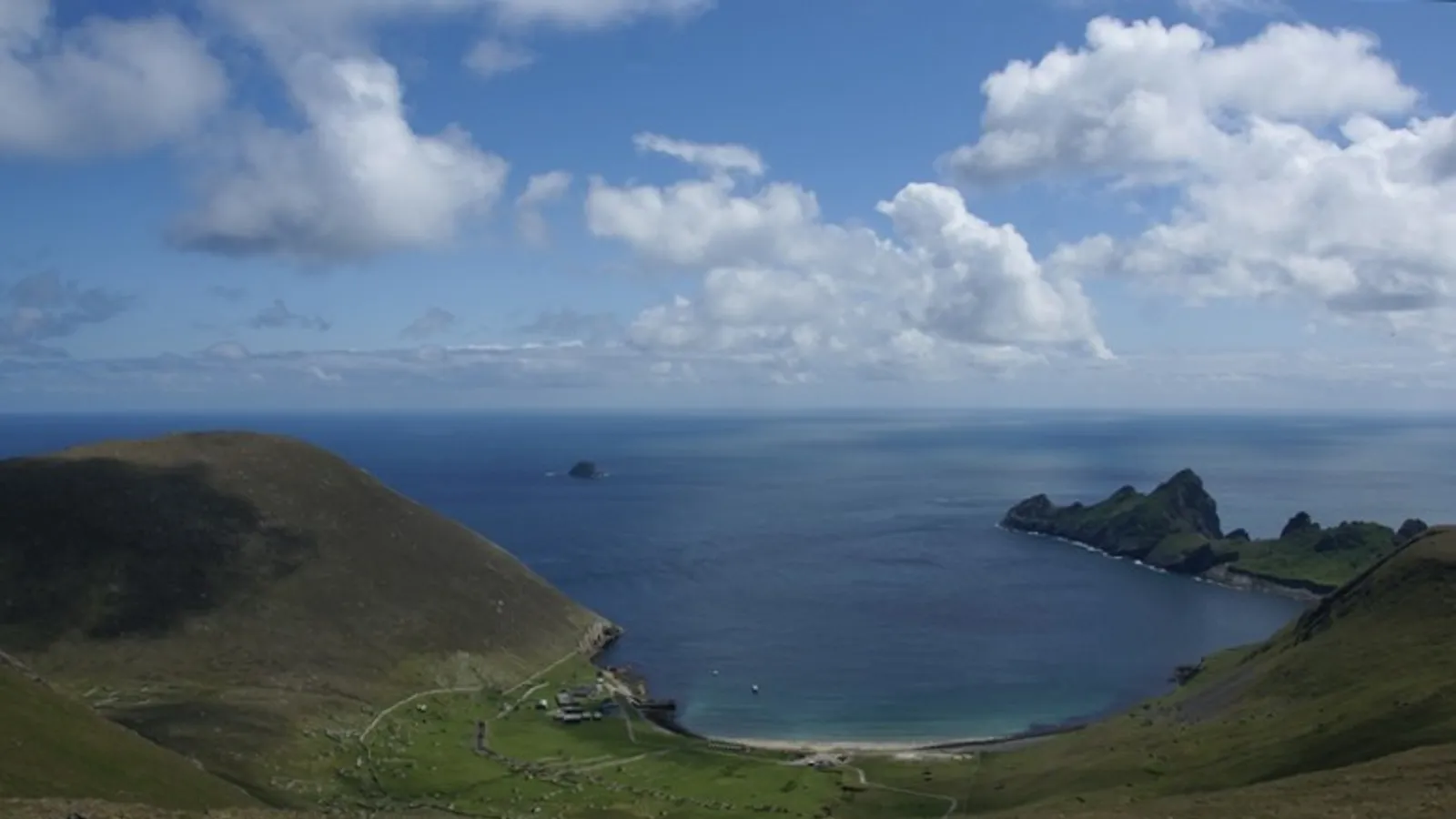
St Kilda lies approximately 66 kilometres west of Benbecula in Scotland's Outer Hebrides, a position that makes it, by most measures, the remotest inhabited-then-abandoned part of the British Isles. The archipelago consists of four main islands — Hirta (by far the largest and the only one permanently settled historically), Soay, Boreray, and Dùn — along with dramatic associated sea stacs. Its cliffs are among the highest in Europe, and this exposed, isolated position shaped every aspect of how its community survived, and eventually, how that community's survival became impossible.
More than two thousand years of adaptation, not primitive stasis
It is worth stating clearly, because popular retelling frequently compresses St Kilda's history into a single story of "primitive isolation ending in abandonment": archaeological evidence documents continuous human occupation of the archipelago spanning over two thousand years, representing a long, adapting subsistence culture rather than an unchanging, static one. The most visually striking physical evidence of this culture is Hirta's extraordinary concentration of cleits — small, dry-stone storage structures with turf or slate roofing, used to store seabirds, eggs, feathers, harvested crops, peat, and turf. Approximately 1,260 of these structures survive on Hirta alone, with a further 170 on the outlying islands — a density of specialised storage architecture found nowhere else in Britain, and direct physical testimony to a subsistence economy built overwhelmingly around the harvesting of seabirds rather than conventional farming.
That seabird-based economy was sustained by, and in turn helped protect, one of the most significant seabird colonies in the North Atlantic. St Kilda is formally recognised as the most important seabird breeding station in northwest Europe, hosting internationally significant colonies of gannets, puffins, and fulmars, among other species, nesting on cliffs that rank among the highest in Europe. The islands also retain Soay sheep, considered descendants of one of the most primitive domestic sheep forms surviving in Europe, closely resembling Neolithic-era breeds — living evidence, alongside the cleits, of just how long and continuously this landscape has supported both human and animal life adapted specifically to its extreme conditions.
Fowlers of the stacks: St Kilda's seabird economy
established Mark Cocker and Richard Mabey, in Birds Britannica (2005), describe St Kilda as Britain's last bastion of the hunter-gatherer life, and the birds were its foundation. The islanders used almost every seabird that bred there, in Martin Martin's day including the now-extinct great auk, but the staple was the fulmar. From at least medieval times until 1878, when fulmars colonised Foula in Shetland, St Kilda was the only place in Britain where the species bred. The main harvest fell between about 12 and 26 August, when the downy chicks were plumpest, and the whole community took part. The men climbed the cliffs and seized each young bird from behind, before it could spit its stream of foul-smelling oil. The women and children then pressed the oil out through the bill into containers made from dried gannet stomachs. Fulmars supplied food, fuel, fertiliser and medicine; Martin called giben, the fat of their fowls, the islanders' "great and beloved catholicon". James Fisher calculated that until the end more than 100 fulmars a year went into every man, woman and child, and the islanders were still living on salted fulmar a few months before they left in 1930. As the population fell, the annual take dropped from around 12,000 birds to about 4,000.
established Feathers paid the rent. Until the 1890s they were the islanders' main means of meeting it: in 1847 each family owed about seven St Kildan stone (168 lb) of fulmar, gannet and puffin feathers, and about 80 fulmars yielded a stone. Puffins were taken in huge numbers with horsehair snares laid across boulders; some estimates put the catch at around 90,000 birds a year.
established Gannets came from the stacks around Boreray, which the book described in 2005 as the largest gannetry in the world. The men climbed almost sheer faces to reach the birds on Stac Lee and Stac an Armin, the two highest sea stacks in Britain. Adults were taken in spring, and the eggs could be kept for up to eight months in beds of peat ash. In August came the guga hunt for the fat young birds. Teams stayed overnight in stone shelters on the stacks and worked through the dark, sometimes killing 1,100 birds in six hours, then threw them down to the boats below. Nothing was wasted: the breastbone served in oil lamps, the fat as medicine and the cured stomach as a storage bag. The St Kilda gannet harvest ended in 1910; the annual guga hunt by the men of Ness, in Lewis, on Sula Sgeir is its last Scottish survivor.
established Eggs mattered as much as birds. Martin reckoned that he and his crew were given 16,000 eggs in three weeks, and a nineteenth-century visitor watched islanders lower 17 baskets of 400 guillemot eggs each from Stac Biorach. Even well-incubated eggs were eaten, and were thought a delicacy. Demand for Manx shearwater eggs from outside dealers nearly wiped out that species on the islands. The harvest was stored in the cleits that still cover Hirta. One footnote shows how closely some birds were tied to the people: the islands' rock doves, like the St Kilda house mouse, died out after the evacuation, while the St Kilda wren, with its own subspecies, carried on.
A population in genuine, irreversible decline
St Kilda's community persisted at a broadly stable size — typically in the range of 75 to 112 residents — through much of the eighteenth and early nineteenth centuries. The first major, documented rupture came in 1852, when 36 islanders emigrated to Australia aboard the ship Priscilla, a departure from which the remaining community never fully recovered. From that point on, St Kilda's population was on a long-term, essentially irreversible downward trajectory, with the island's small size and isolation making it extremely vulnerable to the loss of any significant number of working-age residents.
The 1852 emigration to Australia
established The St Kildans left under the Highland and Island Emigration Society, which between 1852 and 1857 helped almost 5,000 people from the western Highlands and Islands to emigrate to Australia, where pastoral labour was short because men had left for the gold fields. According to ScotlandsPeople, the 36 islanders left in September 1852, reached the Broomielaw in Glasgow on 1 October by way of Skye, and went on by steamer to Birkenhead, where they waited several weeks before boarding the Priscilla. The voyage to Port Phillip took 98 days. Measles swept the ship: the St Kildans were about 12 per cent of the passengers but, on Eric Richards's figures, 45 per cent of the deaths. ScotlandsPeople gives the probable toll as 19 of the 36, leaving 17 survivors.
shared One survivor became the island's most travelled son. The historian Marjory Harper, in Adventurers and Exiles (2003), follows Ewen "California" Gillies, drawing on Tom Steel's The Life and Death of St Kilda (1975). Gillies worked first as a brickmaker in Victoria, was dismissed after six months and went to the gold fields, where he made enough to buy a farm, which later failed. After digging for gold in New Zealand he came back to find that his wife had remarried. He went to the United States, served in the Civil War, deserted to join a Californian gold rush and, Harper writes, made a fortune there. He revisited St Kilda in 1871 for four weeks and later lived there again with a second wife, but the islanders turned against him and forced the couple out, and in 1889 they settled in Canada. Harper uses him to show that Society emigrants did not always stay in the pastoral work they had been sent to do. Details of his life rest largely on later accounts and should be treated as a biography assembled from varied sources.
The last decades
The twentieth century accelerated this decline sharply. The population stood at 73 in 1920, but a severe influenza outbreak in 1926 killed four islanders, and successive crop failures through the 1920s further weakened the community's ability to sustain itself. By 1928, only 37 people remained. The event most consistently described as decisive came in January 1930, when a young woman, Mary Gillies, died of appendicitis — a death widely recorded as "the last straw" that finally convinced the remaining islanders their community could no longer function.
A request, not a clearance — but not an easy one either
On 29 August 1930, the last 36 inhabitants of St Kilda were evacuated to Morvern on the Scottish mainland, and the historical record is clear and specific on a point frequently blurred in popular retelling: this evacuation happened at the islanders' own formal request, not as an imposed Clearance-style removal by a landowner or government. This distinction matters, and this article states it precisely rather than letting St Kilda's story drift, by lazy association, into the same category as nineteenth-century forced Highland Clearances — the mechanism here was fundamentally different.
At the same time, "voluntary" should not be mistaken for "easy" or "painless." The decision followed years of genuine hardship — illness, death, agricultural failure, and a population that had simply fallen below the level needed to sustain a functioning community on one of the most physically demanding inhabited landscapes in Britain. Contemporary accounts describe islanders remaining outwardly cheerful through much of the evacuation process itself, yet giving way to tears as the island receded from view on the day of departure — a combination of resolve and genuine grief entirely consistent with a community making a necessary but deeply painful choice, rather than either a forced removal or a simple, regret-free decision.
After the people, a different kind of presence
St Kilda did not remain entirely empty after 1930. The National Trust for Scotland became owner and manager of the archipelago in 1957, and sometime after 1966 the Ministry of Defence established a radar tracking station on Hirta, bringing a small, continuous — though entirely different in character — human presence back to the island, supporting monitoring operations and, notably, also enabling limited year-round visitor access that would otherwise be far harder to sustain logistically. This military and conservation presence today coexists with St Kilda's status as one of the relatively few sites in the world holding UNESCO World Heritage recognition for both natural and cultural significance: inscribed in 1986 for its outstanding natural value, principally its seabird colonies, and extended in 2004 to recognise its cultural landscape — the cleits, the abandoned village, and the archaeological record of over two millennia of human adaptation to one of the most extreme inhabited environments in Europe. Access today remains deliberately limited and weather-dependent, via specialist boat charter or organised National Trust for Scotland work parties, preserving both the fragility of the natural site and something of the hard-won remoteness that shaped St Kilda's entire human history.
Gaelic and the first school
established St Kilda had one of the first schools of the Society in Scotland for Propagating Christian Knowledge. The historical geographer Charles Withers, in Gaelic in Scotland 1698–1981 (1984), notes that the Society's earliest surviving instructions, sent in 1710 to its schoolmaster on the island, Alexander Buchan, told him to teach the people "to read English but also to write" and "their duty to their superiors". Martin Martin in 1703 and later observers found the islanders entirely Gaelic-speaking. At the end of the eighteenth century St Kilda's Gaelic was said to be "entirely unadulterated, having no communication with strangers, to corrupt it with other languages".
Did You Know?
- St Kilda's 1930 evacuation was requested by the islanders themselves, not imposed as a forced clearance — though it followed years of genuine hardship and loss.
- The death that is widely described as "the last straw" prompting the evacuation request was a young woman's fatal appendicitis in January 1930.
- St Kilda's population had already been in decline for nearly 80 years before the evacuation, following a mass 1852 emigration to Australia.
- Of the 36 St Kildans who sailed on the Priscilla in 1852, probably 19 died, mostly of measles, before or soon after reaching Port Phillip.
- Hirta holds around 1,260 dry-stone cleits — specialised storage structures found nowhere else in Britain in such density.
- St Kilda is one of a very small number of sites worldwide recognised by UNESCO for both natural and cultural World Heritage significance.
- St Kilda's Soay sheep are considered among the most primitive surviving domestic sheep breeds in Europe, closely resembling Neolithic-era animals.
- A Ministry of Defence radar station has operated on Hirta since sometime after 1966, bringing a small human presence back to the island decades after the 1930 evacuation.
- Archaeological evidence shows St Kilda was continuously inhabited for over two thousand years before its 1930 evacuation.
- In 1847 each St Kilda family paid its rent in seabird feathers: about 168 lb of fulmar, gannet and puffin feathers a year.
- St Kilda was the only British breeding place of the fulmar until the bird colonised Foula in Shetland in 1878.
- Gannet-catching teams on the stacks could kill 1,100 birds in a single six-hour night.
FAQ
1Was the 1930 St Kilda evacuation forced?
No — it was carried out at the islanders' own formal request, though that request followed years of genuine hardship, illness, and unsustainable population decline.
2How many people left St Kilda in 1930?
The last 36 inhabitants were evacuated, to Morvern on the Scottish mainland.
3Why did St Kilda's population decline so much?
A combination of long-term emigration (beginning with a mass departure to Australia in 1852), a 1926 influenza outbreak, 1920s crop failures, and a fatal 1930 illness collectively made the small community unsustainable.
4Does anyone live on St Kilda today?
No permanent civilian residents, though Ministry of Defence personnel staff a radar station on Hirta, and National Trust for Scotland staff and volunteers visit seasonally.
5Who owns St Kilda now?
The National Trust for Scotland, which has owned and managed the archipelago since 1957.
6Why is St Kilda a UNESCO World Heritage Site?
It holds dual recognition for both natural significance (its internationally important seabird colonies) and cultural significance (its archaeological and cultural landscape), one of relatively few sites worldwide with both designations.
7What are cleits?
Small dry-stone storage structures, roughly 1,260 of which survive on Hirta alone, used historically to store seabirds, eggs, crops, and peat.
8Can you visit St Kilda?
Yes, but only via specialist boat charter or organised National Trust for Scotland trips; there is no scheduled public ferry, and access is weather-dependent.
9What animals are St Kilda famous for?
Soay sheep, among Europe's most primitive surviving domestic sheep breeds, and vast colonies of gannets, puffins, and fulmars.
10How long were people living on St Kilda before 1930?
Archaeological evidence documents continuous human occupation spanning over two thousand years.
11Is St Kilda's evacuation the same as a Highland Clearance?
No — Highland Clearances typically involved landowners forcibly removing tenants; St Kilda's 1930 evacuation was formally requested by the remaining islanders themselves.
12What did the St Kildans live on?
Above all seabirds. Fulmars were the staple, eaten fresh and salted; gannets, puffins and auk eggs were taken in large numbers; and feathers paid the rent until the 1890s.
13How did the islanders catch the birds?
By climbing the cliffs and sea stacks: fulmar chicks were seized by hand, puffins caught with horsehair snares, and young gannets killed at night on the stacks and thrown down to waiting boats.
14When did the St Kildans emigrate to Australia, and what happened to them?
In 1852, 36 islanders left under the Highland and Island Emigration Society and sailed from Birkenhead on the Priscilla. Measles broke out on board, and probably 19 of them died; the survivors settled in Victoria.
15What happened to the St Kilda islanders after 1930?
They were resettled on the Scottish mainland, principally in Morvern, ending permanent civilian habitation of the archipelago.
Sources and Further Reading
Primary/Institutional
- National Trust for Scotland — St Kilda history and 90th anniversary evacuation feature
- UNESCO World Heritage Centre — St Kilda nomination and listing documentation
- National Records of Scotland — St Kilda historical feature archive
Scholarly/Critical
- Academic archaeological literature on St Kilda's cleits and long-term settlement record
- UNESCO Advisory Body evaluation documents on St Kilda's dual natural/cultural significance
- Charles W. J. Withers, Gaelic in Scotland 1698–1981: The Geographical History of a Language (John Donald, 1984; ebook Birlinn, 2021)
- Mark Cocker and Richard Mabey, Birds Britannica (Chatto & Windus, 2005)
- Marjory Harper, Adventurers and Exiles: The Great Scottish Exodus (Profile Books, 2003)
Specialist
- ScotlandsPeople, "Scotland's History: Emigration – St Kilda", https://www.scotlandspeople.gov.uk/article/scotlands-history-emigration-st-kilda (1852 departure, the Priscilla voyage and deaths)
- Tom Steel, The Life and Death of St Kilda (1975), as cited by Harper for Ewen Gillies
General
- Wikipedia — "History of St Kilda"
- The Scotsman — "On this day 1930: the evacuation of St Kilda"
- HistoryScotland.com — coverage of the 1930 evacuation anniversary
Caveats: Myths and Disputed Claims
- Do not describe the 1930 evacuation as a forced clearance imposed by a landowner or the government — it was formally requested by the remaining islanders themselves. Correct phrasing: "an evacuation carried out at the islanders' own request."
- Do not present the evacuation as an easy, regret-free decision — contemporary accounts describe genuine grief alongside outward resolve as islanders left. Correct phrasing: "a difficult decision made necessary by years of hardship."
- Do not compress St Kilda's history into a story of unchanging "primitive isolation" — archaeological evidence shows over two thousand years of continuous, adapting human occupation. Correct phrasing: "a long-sustained, adapting subsistence culture."
- Do not date the emigration on the Priscilla to 1851. The islanders left St Kilda in September 1852 and sailed from Birkenhead that autumn.
- Do not imply St Kilda has been completely uninhabited since 1930 — a Ministry of Defence radar station has maintained a small human presence on Hirta since sometime after 1966.
Card 031 · Locations