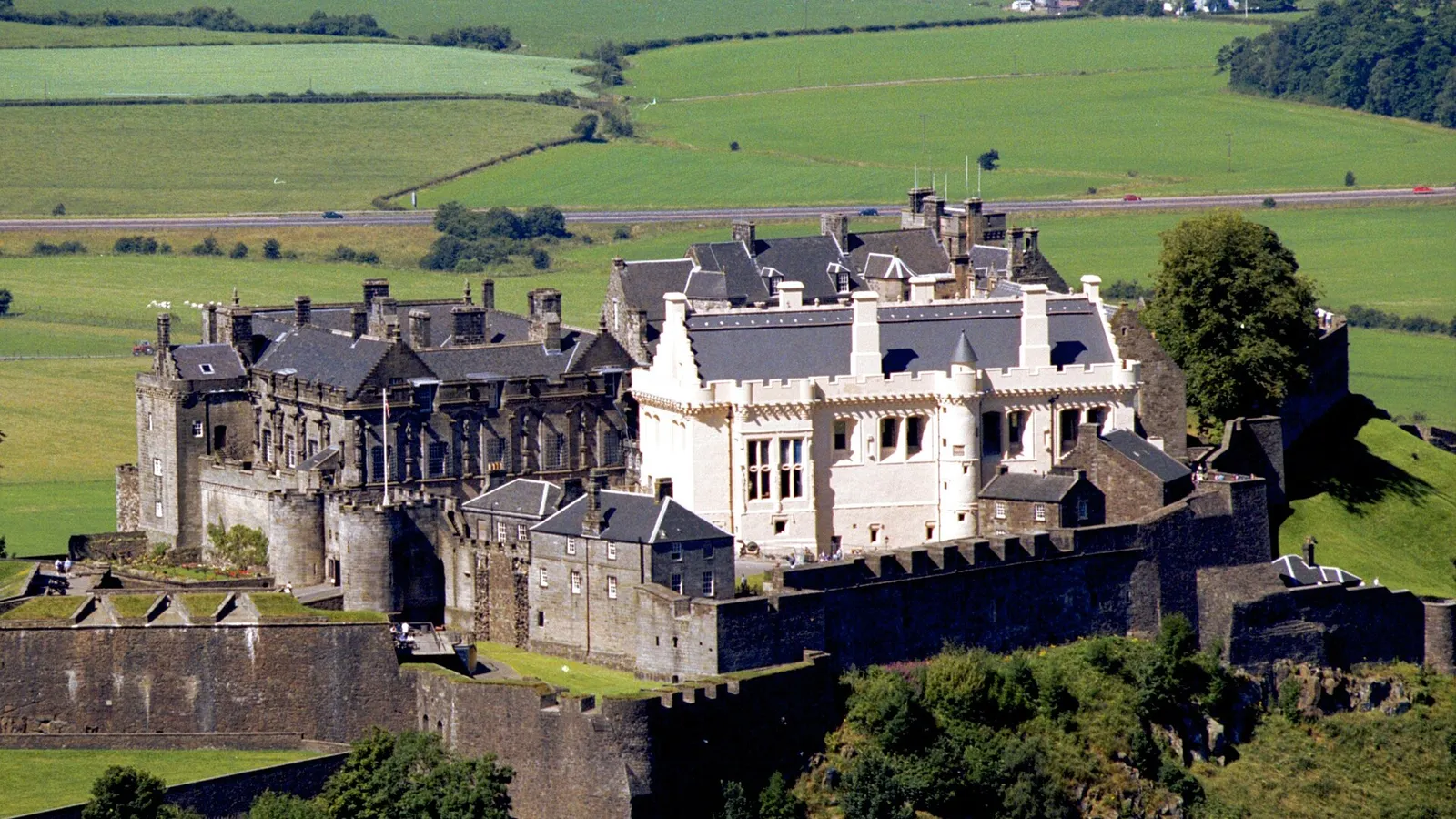

Stirling Castle
Contents
TL;DR
- established Stirling Castle's first firm documentary reference dates to around 1110, when Alexander I dedicated a chapel there — this rests on written record, not archaeology, since no structure from that period survives above ground.
- traditional Popular accounts link the site to Roman-era occupation under Agricola and to early "Dark Age" strongholds, but archaeological evidence only supports occupation from the later medieval period onward — this gap between the stated and the dug-up record keeps the Roman connection in the traditional rather than documented tier.
- established James IV's Great Hall (after 1497) and James V's Renaissance palace (1530s) are documented through building accounts, masons' records, and surviving fabric — making this one of the best-evidenced architectural histories of any Scottish royal site.
- established Mary, Queen of Scots was crowned in the Chapel Royal at Stirling on 9 September 1543, aged nine months, and spent most of her first four years there — recorded in contemporary chronicles and state papers.
- established Her son, the future James VI, was baptised in the castle on 17 December 1566 and grew up there; he was crowned in the town's parish church, the Church of the Holy Rude, on 29 July 1567.
- established The castle endured at least eight sieges, the last an unsuccessful Jacobite attempt in 1746, and is now managed by Historic Environment Scotland as a major paid visitor attraction — both facts are matters of institutional and documentary record.
Key Facts
- Location
- Castle Hill, Stirling, Stirlingshire, Scotland
- Coordinates
- 56.1238° N, 3.9470° W
- Era/Period
- Documented from c. 1110; peak royal/Renaissance building 1490s–1540s
- Type
- Royal castle and Renaissance palace
- Managed/Owned by
- Historic Environment Scotland
- Visitor status
- Open year-round, paid admission; c. 600,000+ visitors annually (pre/post-pandemic range)
- Military tenant
- Regimental home of the Argyll and Sutherland Highlanders
Scottish Impact Index (SI Score)
- National Significance
- 10/10
- Historical Continuity
- 10/10
- Human & Economic Importance
- 8/10
- Landscape / Architectural Distinctiveness
- 10/10
- Cultural & Historical Legacy
- 10/10
- Recognition
- 9/10
57/60
Ranked =10th of 43 in Locations
A Note on Claims and Evidence
Stirling Castle presents an unusually clean split between its well-documented Renaissance heyday and its murkier early centuries. The documented tier covers the castle from its first written mention around 1110 through its heavily recorded sixteenth-century building campaigns, royal coronations, and sieges — much of this backed by masons' accounts, state papers, and chronicle entries. The traditional tier covers claims of earlier occupation — Roman garrisoning, pre-Alexander I strongholds — repeated in guidebooks but not confirmed archaeologically. There is comparatively little outright legend-myth material attached to Stirling itself, though it sits adjacent to heavily mythologised battles (Stirling Bridge, Bannockburn) fought nearby, which this article keeps clearly distinguished from the castle's own documented history.
Timeline
First documentary reference: Alexander I dedicates a chapel at Stirling Castle.
Castle develops as a royal stronghold controlling the lowest fordable crossing of the River Forth.
Wars of Scottish Independence; castle changes hands repeatedly, besieged during the campaigns culminating at nearby Stirling Bridge (1297) and Bannockburn (1314).
James I holds his first parliament partly at Stirling; castle increasingly used as a royal residence.
James IV commissions the Great Hall, the largest secular medieval hall built in Scotland.
James V commissions the Royal Palace, among the earliest Renaissance palace buildings in the British Isles.
Mary of Guise brings the infant Mary, Queen of Scots, from Linlithgow to Stirling, her own dower castle.
Mary is crowned in the Chapel Royal, the first occasion on which the crown, sceptre and sword of state are used together.
After the Scottish defeat at Pinkie, Mary is moved for safety to Inchmahome Priory on the Lake of Menteith.
On her first progress, Mary's bed curtains catch fire at Stirling; Lord James Stewart and Argyll stop her chaplains celebrating High Mass in the Chapel Royal.
Mary courts Lord Darnley at Stirling and nurses him through illness; on 15 May she makes him Earl of Ross there.
Mary moves her infant son to Stirling under guard, in the care of the Earl and Countess of Mar.
James is baptised at Stirling by Catholic rites, amid three days of festivities.
Mary sees her son at Stirling for the last time.
James VI is crowned in the Church of the Holy Rude, Stirling; John Knox preaches.
The Regent Lennox, James's grandfather, is mortally wounded in a raid on Stirling by Mary's supporters.
Castle involved in Civil War-era conflict and briefly held by Royalist and Covenanter forces at different points.
Final, unsuccessful Jacobite siege during the '45 Rising.
Castle repurposed as a military barracks; parts of the Renaissance interiors altered or subdivided for soldiers' use.
Return of the Argyll and Sutherland Highlanders as resident regiment; conservation work begins.
Major Historic Scotland/Historic Environment Scotland conservation and re-presentation of the Royal Palace interiors, including reconstructed tapestries and painted ceilings.
Managed by Historic Environment Scotland; open year-round as one of Scotland's principal heritage sites.
Details
Origins and strategic position
Stirling Castle occupies a volcanic crag with sheer drops on three sides, positioned to command what was, until the building of road bridges in the 1890s, the lowest crossing point of the River Forth capable of bearing an army. That strategic chokepoint — control Stirling and you controlled movement between the Lowlands and the Highlands — explains why the castle featured in nearly every major medieval Scottish conflict, even though the fortress itself saw less direct combat than the battles fought in its shadow at Stirling Bridge and Bannockburn. The earliest secure documentary reference is Alexander I's dedication of a chapel around 1110; claims of earlier Roman or "Dark Age" use are repeated in guidebooks and popular histories but are not supported by excavated evidence, so this article treats them as traditional rather than established.
Architectural character: medieval hall to Renaissance palace
What makes Stirling distinct among Scottish royal castles is the density and ambition of its late-medieval and Renaissance building campaigns, both unusually well documented through masons' accounts and royal expenditure records. James IV's Great Hall, begun after 1497, was the grandest secular hall built in Scotland in the period — a vast space with hammerbeam-style roofing intended to project royal magnificence to visiting embassies. His son James V went further: the Royal Palace, built in the 1530s, combined French Renaissance massing with elaborately carved decorative stonework (including the famous "Stirling Heads," carved roundels of royal and classical figures) influenced by German and French court fashions James V had encountered abroad. Historians regularly describe it as among the earliest fully Renaissance palace buildings anywhere in the British Isles, built a full generation before comparable English Tudor work reached similar sophistication.
Royal cradle and battleground
Stirling's roll of royal association is dense: it hosted coronations, baptisms, and long periods of royal residence, most famously the 1543 coronation of the infant Mary, Queen of Scots, and the December 1566 baptism of her son, the future James VI, celebrated with lavish entertainments intended to rival continental European courts. The castle also repeatedly changed hands or came under siege during Scotland's wars — including, crucially, as the strategic objective behind the 1297 Battle of Stirling Bridge and the 1314 Battle of Bannockburn, both fought nearby rather than at the castle itself. It is a common conflation in popular retellings to treat the castle as the site of these battles; properly, it was their strategic prize, not their battlefield.
Mary, Queen of Scots and her son at Stirling
The coronation of 1543. established The historian John Guy, in his biography of Mary (2004), explains why Stirling mattered to her mother. The castle was part of Mary of Guise's dower, the one royal fortress the governor, the Earl of Arran, could not seize, and it stood near enough to the sea to keep her link with France. On 27 July 1543 she brought her daughter from Linlithgow with an escort of 2,500 horse and 1,000 foot. On 9 September, the thirtieth anniversary of Flodden, the nine-month-old queen was carried from her nursery to the Chapel Royal and crowned. Arran carried the crown, the Earl of Lennox the sceptre and the Earl of Argyll the sword, the first time the three Honours were used together. Cardinal Beaton held the crown, far too big for a child, over her head and anointed her. Guy records that she cried throughout, and the long recital of her genealogy was dropped. Banquets and dancing followed in the great hall, which could seat three hundred.
A refuge in wartime. established Stirling remained Mary's home for about four years. When the Earl of Hertford's army burned Edinburgh in May 1544, she was safe behind its walls and was taken further north to Dunkeld as a precaution. After the defeat at Pinkie in September 1547 she was carried by night to Inchmahome Priory, before leaving for France from Dumbarton in 1548.
Courtship and a cradle. established Mary returned on progress in September 1561, when a candle set her bed curtains alight and Lord James Stewart and Argyll prevented her chaplains from holding a High Mass in the chapel where she had been crowned. In April and May 1565 she courted Lord Darnley at Stirling, nursing him through an illness in the royal apartments and making him Earl of Ross on 15 May. After the birth of their son, she moved him to Stirling in August 1566 for safety, guarded by five hundred musketeers, and left him with the Earl and Countess of Mar.
The baptism of 1566. established Prince James was baptised in the Chapel Royal on 17 December 1566 by Catholic rites. Guy describes three days of masques, partly scripted by George Buchanan, a mock siege and a fireworks display for which gunpowder and cannon were hauled up the castle rock by night. At the final banquet the courses were brought in on a moving platform worked by men dressed as satyrs and nymphs, until it collapsed. Mary borrowed £12,000 from Edinburgh merchants to pay for it. Elizabeth I, the godmother, sent a gold font of 333 ounces. The Protestant lords stood outside the chapel door, and Darnley, though in the castle, stayed away.
Separation and coronation. established On 21–23 April 1567 Mary came to Stirling to take her son back, but the Earl of Mar refused to give him up; she kissed him goodbye and never saw him again. The confederate lords then made Stirling their base against Mary and Bothwell. On 29 July 1567, five days after her forced abdication at Lochleven, James was crowned in the Church of the Holy Rude below the castle, with Morton swearing the oath for him and John Knox preaching. James grew up in the castle under the Mars and his tutor George Buchanan.
Decline, military use, and restoration
After the union of the Scottish and English crowns in 1603 and the loss of a resident royal court, Stirling's role as a palace declined sharply. By the eighteenth century it had been converted into a garrison and barracks, a function that persisted for roughly two centuries and led to significant alteration of its Renaissance interiors — partitioned for soldiers' quarters, stripped of much of their original decorative finish. The twentieth century brought a decisive reversal: following the departure of long-term military tenancy pressures and growing heritage interest, Historic Scotland (now Historic Environment Scotland) undertook an ambitious, decades-long conservation and reinterpretation programme culminating around 2011, which saw the Royal Palace interiors re-presented with reconstructed tapestries, painted ceilings and furnishings aimed at showing the building as it would have appeared to James V's court — a reconstruction based on documentary and archaeological research rather than surviving original decoration, which had long since been lost.
National identity and tourism today
Stirling Castle today functions as one of the clearest physical expressions of Scotland's late-medieval and Renaissance royal ambition, distinct from the more purely military or ceremonial associations of Edinburgh Castle. Its continued role as home to the Argyll and Sutherland Highlanders' regimental traditions sits alongside a now heavily visitor-oriented presentation emphasising court life, Renaissance art, and craftsmanship. Combined with its proximity to the Wallace Monument and the Bannockburn battlefield site, it anchors a wider Stirling-area heritage landscape that looms large in Scottish national memory — though, as above, the castle's own documented history and the mythologised battles fought near it are frequently blurred in popular retelling and should be kept distinct.
Did You Know?
- In 1365 King David II told the French chronicler Jean Froissart that Stirling Castle was "Snowdon", the court of King Arthur. By 1431 the crown had a "Snawdoun Herald", and Stirling's 1296 burgh seal already proclaimed a British past (Steve Boardman, 2002).
- The Great Hall's distinctive golden-yellow exterior render ("King's Gold") is a modern recreation based on paint analysis, not an invented colour choice — but it still surprises first-time visitors expecting grey stone.
- The carved "Stirling Heads" roundels, removed from the palace ceiling in the 18th century after safety concerns, survive today in a dedicated gallery rather than in their original location.
- Stirling changed hands between Scottish and English forces more often during the Wars of Independence than almost any other Scottish castle.
- Mary, Queen of Scots' coronation on 9 September 1543 fell on the thirtieth anniversary of the Battle of Flodden. It came amid political uncertainty over Henry VIII's plan to marry her to his son; the English invasions of the "Rough Wooing" followed in 1544.
- Elizabeth I sent a font of solid gold weighing 333 ounces for the baptism of Prince James at Stirling in 1566.
- The castle's Renaissance palace interiors visitors see today are a modern reconstruction based on research, not surviving original 16th-century decoration, which did not survive centuries of military use.
- Stirling was besieged at least eight times across its history, with the final attempt coming during the 1746 Jacobite Rising.
- The castle's strategic value rested on controlling the Forth crossing — a function that ended only with the construction of road bridges in the 1890s.
- The resident Argyll and Sutherland Highlanders regiment maintains a historical presence connecting the castle's military past to the present day.
FAQ
1Was Stirling Castle the site of the Battle of Bannockburn?
No — the castle was the strategic objective, but the 1314 battle itself was fought nearby, not within the castle's walls.
2Is the current Royal Palace interior original?
No. The interiors visitors see today are a modern, research-based reconstruction completed around 2011; the original 16th-century decoration did not survive centuries of military use.
3Who manages Stirling Castle today?
Historic Environment Scotland.
4Was Mary, Queen of Scots crowned at Stirling?
Yes, in the Chapel Royal on 9 September 1543, aged nine months.
5Was James VI baptised or crowned at Stirling?
Both. He was baptised in the castle's Chapel Royal on 17 December 1566 and crowned in the town's Church of the Holy Rude on 29 July 1567.
6Is Stirling Castle still used by the military?
It is the regimental home of the Argyll and Sutherland Highlanders, though it functions primarily as a heritage and visitor site today.
7How old is the earliest documented reference to the castle?
Around 1110, referring to a chapel dedication by Alexander I.
8Did the Romans occupy Stirling Castle?
This is a traditional claim repeated in popular accounts, but it is not confirmed by archaeological evidence.
9What is the Great Hall?
A vast secular hall built after 1497 by James IV, regarded as the grandest of its kind built in medieval Scotland.
10Why is James V's palace considered important architecturally?
It is widely cited by historians as among the earliest Renaissance palace buildings in the British Isles.
11Can visitors see the Stirling Heads?
Yes, the surviving carved roundels are displayed in a dedicated gallery within the castle.
12How many sieges has Stirling Castle withstood?
At least eight, spanning from the Wars of Independence to the 1746 Jacobite Rising.
13Is Stirling Castle a UNESCO World Heritage Site?
No — it is a nationally significant site managed by Historic Environment Scotland but does not hold UNESCO designation.
Sources and Further Reading
Primary/Institutional
- Historic Environment Scotland, "Stirling Castle: History" — historicenvironment.scot
- Historic Environment Scotland, Royal Palace restoration project documentation
Scholarly/Critical
- Steve Boardman, "Late Medieval Scotland and the Matter of Britain", in Edward J. Cowan and Richard J. Finlay (eds), Scottish History: The Power of the Past (Edinburgh University Press, 2002).
- Royal Commission on the Ancient and Historical Monuments of Scotland (RCAHMS)/Canmore records for Stirling Castle
- Academic architectural histories of Scottish Renaissance palace building (e.g. studies of the Stirling Heads and James V's building campaigns)
- Andrea Thomas, "The Renaissance", in T. M. Devine and Jenny Wormald (eds), The Oxford Handbook of Modern Scottish History (Oxford University Press, 2012) — further reading on the 1566 baptism and royal building at Stirling
- John Guy, "My Heart is My Own": The Life of Mary Queen of Scots (Fourth Estate, 2004; US edition Queen of Scots: The True Life of Mary Stuart, Houghton Mifflin, 2004)
- Jenny Wormald, "Reformed and Godly Scotland?", in T. M. Devine and Jenny Wormald (eds), The Oxford Handbook of Modern Scottish History (Oxford University Press, 2012) — further reading on the Stirling presbytery records
General
- Wikipedia, "Stirling Castle" — en.wikipedia.org/wiki/Stirling_Castle
- History Hit, "Stirling Castle: History and Facts"
- VisitScotland, Stirling Castle visitor information
Caveats: Myths and Disputed Claims
- Do not state that the Battle of Bannockburn or the Battle of Stirling Bridge were fought "at Stirling Castle." Both were fought in the surrounding area; the castle was their strategic objective, not the battlefield.
- Do not assert Roman occupation of the castle site as fact. This is a traditional claim without confirmed archaeological support and should be flagged as such.
- Do not present the current Royal Palace interiors as original 16th-century decoration. They are a well-researched modern reconstruction completed around 2011.
- Avoid implying continuous occupation of the site from before the 12th century; the first secure documentary reference dates to around 1110.
- Do not date James VI's baptism to 1567 or place his coronation in the castle. He was baptised in the Chapel Royal in December 1566 and crowned in the Church of the Holy Rude in July 1567.
Card 002 · Locations