
The Cuillin
Contents
Legend/Myth Opener
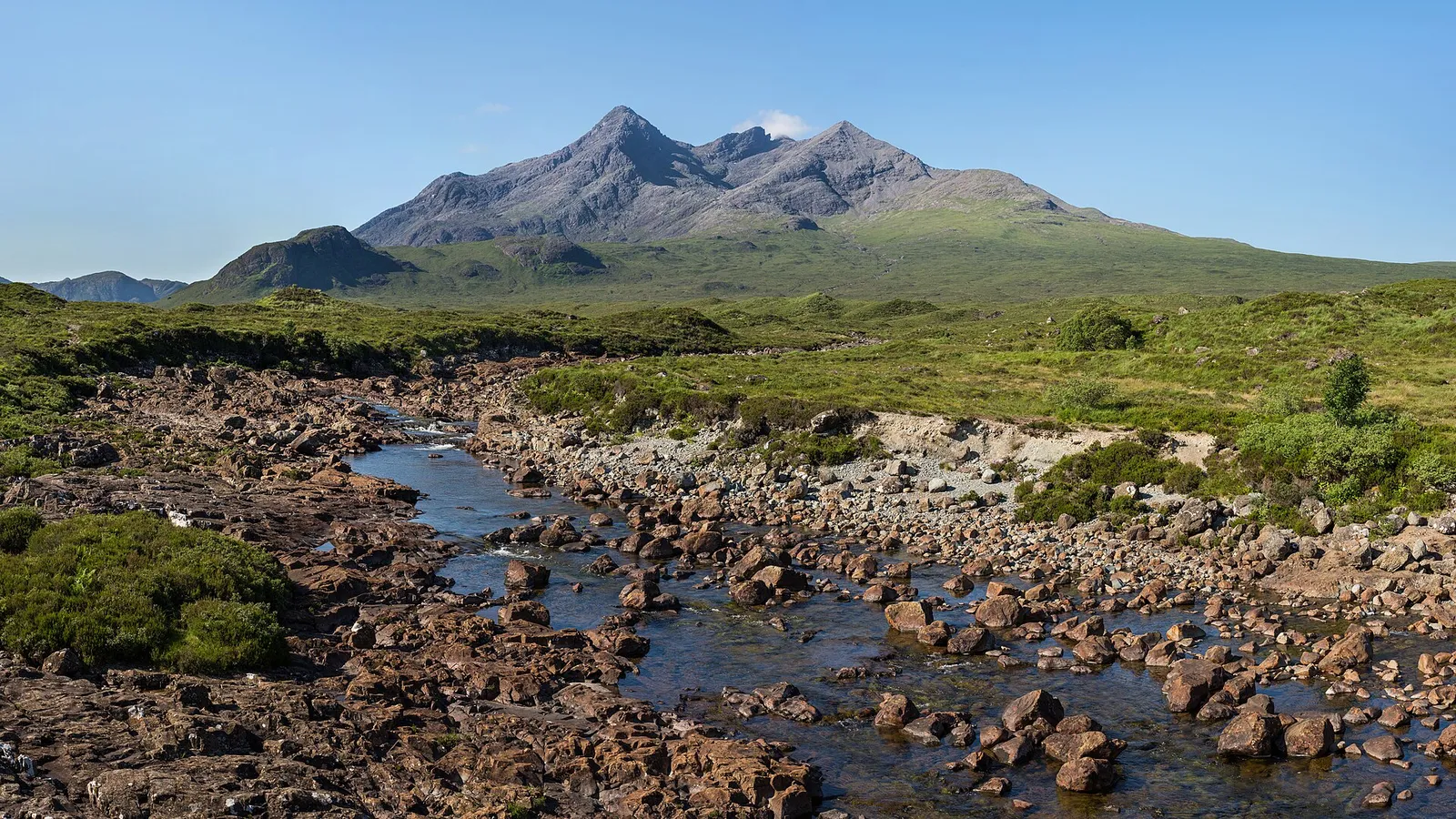
The Cuillin ridge on Skye is sometimes described as a single unbroken mountain range of uniform character. In fact it comprises two geologically and visually distinct ranges — the dark, jagged gabbro of the Black Cuillin and the paler, rounder granite of the Red Cuillin — and even the Black Cuillin's famous ridge is not a single continuous walking route but a serious mountaineering traverse requiring rock climbing, exposed scrambling, and in places abseiling, a fact routinely softened in tourist photography that frames the skyline as simply dramatic rather than genuinely dangerous.
TL;DR
- established The Black Cuillin is built predominantly of gabbro and basalt from an eroded Tertiary-period igneous complex around 60 million years old, confirmed by field geology, not simply "ancient rock" as loosely stated in tourism copy.
- established Sgùrr Alasdair, the Cuillin's highest point at 992 m (3,255 ft), and the Inaccessible Pinnacle on Sgùrr Dearg are both part of the range's twelve Munro summits — stated precisely because visitor materials sometimes round or conflate separate peaks.
- established The Inaccessible Pinnacle is the only Munro summit in Scotland that requires rock climbing, not just walking, to reach — a distinction worth stating directly because many hillwalkers who have "completed the Munros" by broader definitions have in fact avoided or been assisted up this one peak.
- traditional Clan MacLeod's historic association with the Cuillin and nearby Dunvegan Castle is well attested in estate records and tradition, but some place-name folklore linking individual peaks to specific clan legends lacks firm documentary support and should be read as traditional rather than verified history.
- established Ownership of the Cuillin massif became a matter of public dispute in the early 2000s when the MacLeod estate proposed selling the range, a controversy resolved only through a negotiated gift arrangement — stated directly because it corrects any assumption that iconic "wild" mountain land in Scotland sits outside ordinary property law and estate finance.
Key Facts
- Location/Region
- Isle of Skye, Highland, Scotland; the range dominates the island's southern-central interior
- Height/Area/Scale
- Sgùrr Alasdair (Black Cuillin high point): 992 m (3,255 ft); Sgùrr Dearg / Inaccessible Pinnacle: c. 986 m (3,235 ft); Sgùrr a' Ghreadaidh: c. 973 m (3,192 ft); 12 Munro summits in the Black Cuillin ridge
- Geology/Formation
- Black Cuillin: gabbro and basalt from a Palaeocene/early Tertiary (c. 60 million years ago) igneous centre, since deeply eroded and glaciated; Red Cuillin: paler granite, forming more rounded hills
- Protected status
- Within the Cuillin Hills National Scenic Area, one of Scotland's 40 such designations; parts also covered by SSSI designations for geology and montane habitat
- Managed/Owned by
- Historically the MacLeod of MacLeod estate (Dunvegan Castle); ownership was publicly disputed in the early 2000s and later resolved through a gift/trust arrangement rather than open sale
- Access notes
- The main ridge traverse is a serious, multi-day mountaineering undertaking requiring rock climbing skill, not a walking route; the Inaccessible Pinnacle specifically requires climbing both up and down; many individual peaks are accessible to experienced scramblers via established paths from Glen Brittle and Sligachan
Scottish Impact Index (SI Score)
- National Significance
- 8/10
- Historical Continuity
- 8/10
- Human & Economic Importance
- 6/10
- Landscape / Architectural Distinctiveness
- 10/10
- Cultural & Historical Legacy
- 8/10
- Recognition
- 9/10
49/60
Ranked =34th of 43 in Locations
A Note on Claims and Evidence
As with the rest of this collection, claims here are tiered as documented (the gabbro/basalt geology and its approximate Tertiary age, surveyed summit heights, Munro status, the 2000s ownership dispute), traditional (long-standing clan and place-name associations recorded in estate and local history but not independently verified in every detail), and legend-myth (romanticised claims with no solid evidential basis, such as any suggestion the ridge has been "conquered" in full by casual walkers, or folklore detail invented for tourism rather than rooted in older sources). The Cuillin's reputation for extreme difficulty is documented fact, not dramatic flourish, and this article treats it accordingly.
Timeline
Intense igneous activity associated with the opening of the North Atlantic produces the gabbro and basalt intrusions that form the core of the Black Cuillin.
Erosion strips away overlying rock, exposing the resistant gabbro core.
Glaciers carve the jagged pinnacles, corries, and knife-edge ridgelines that define the range's present profile.
The Cuillin and surrounding land fall within the territory and estate of Clan MacLeod, centred on Dunvegan Castle.
Early recorded ascents of major Cuillin peaks by scientific and mountaineering visitors begin the documented climbing history of the range.
First ascent of the Inaccessible Pinnacle, the last Munro summit in Scotland to be climbed.
First sub-24-hour traverse of the full Black Cuillin ridge.
Public dispute over the proposed sale of the Cuillin by the MacLeod estate, tied to funding Dunvegan Castle repairs, is resolved through a negotiated arrangement rather than open market sale.
The range remains part of the Cuillin Hills National Scenic Area and is Scotland's foremost traditional mountaineering and scrambling destination, distinct from the gentler Trotternish ridge landscape further north on Skye (see the companion "Isle of Skye & Trotternish" card).
Details
Geological formation
The Cuillin is, geologically, two ranges wearing one name. The Black Cuillin — the range most people mean when they picture Skye's famous jagged skyline — is built from gabbro and basalt, dense, dark igneous rocks that solidified from magma roughly 60 million years ago during the Palaeocene, as part of the same North Atlantic volcanic activity that also produced the Giant's Causeway in Northern Ireland and much of the volcanic geology of the Inner Hebrides. The gabbro in particular is prized by climbers for its exceptional grip, a property that has made the range one of Britain's premier rock-climbing destinations despite — or because of — its difficulty. Separated from the Black Cuillin by Glen Sligachan lies the Red Cuillin, a distinctly different, paler, more rounded range composed largely of granite, locally known as na Beanntan Dearga ("the red mountains"). The two ranges' contrasting rock types produce their contrasting silhouettes: the Black Cuillin's knife-edge ridges and pinnacled summits are a product of resistant gabbro being carved by Ice Age glaciers into narrow arêtes and corries, while the Red Cuillin's granite erodes into smoother, more rounded forms.
Human history and mountaineering associations
The Cuillin and the wider Skye landscape fall historically within the territory of Clan MacLeod, whose seat at Dunvegan Castle remains one of the island's defining historic sites; estate and clan tradition link numerous place names across the range to MacLeod history, though not every individual legend attached to a specific peak or corrie carries firm documentary support, and such details should be treated as traditional local lore rather than settled fact. The documented climbing history of the range begins in earnest in the 19th century, as scientific travellers and early mountaineers began recording systematic ascents from around 1836 onward. The range's most storied individual summit is the Inaccessible Pinnacle on Sgùrr Dearg — a narrow blade of rock that was, tellingly, the last of Scotland's 282 Munro summits to be climbed, first ascended only in 1880, and which remains today the only Munro that cannot be reached by walking alone; those completing the full list of Munros must either climb it or, in some documented cases, have been winched or assisted to its top. The full ridge traverse, linking all the Black Cuillin's major summits in one continuous mountaineering outing, was first completed in under 24 hours in 1911, and the route remains one of the most demanding classic mountain challenges in the British Isles, now tackled by elite fell runners in a few hours but requiring most parties several days with technical climbing gear. In the early 2000s, the Cuillin's land ownership became a matter of considerable public controversy when the MacLeod estate proposed selling the range — valued at the time at around £10 million — partly to fund repairs to Dunvegan Castle; the proposal provoked strong public and conservation-sector objection to the idea of a landmark of this cultural significance passing into unclear private ownership, and the matter was eventually resolved through a negotiated gift/trust arrangement rather than open market sale, a resolution that itself underlines how "wild" Highland landscapes remain embedded in ordinary, and sometimes contested, property law.
Ecology and distinctive natural features
The Cuillin's steep, rocky terrain supports a specialised montane flora adapted to thin soils and high exposure, including arctic-alpine plant communities on the higher ridges, while golden eagle and other upland raptors range across the massif. The range's SSSI and National Scenic Area designations recognise both this ecological value and its outstanding geological interest as one of the clearest exposed examples of a deeply eroded Tertiary igneous centre in Britain. The contrast between the acidic, nutrient-poor gabbro of the Black Cuillin and the different soil chemistry produced by the Red Cuillin's granite creates genuinely distinct plant communities across the two ranges, despite their visual proximity.
Place in Scottish identity, mountaineering, and tourism
The Cuillin skyline, seen from almost anywhere on Skye or across the water from the mainland, functions as one of the single most recognisable mountain silhouettes in Scottish tourism imagery, and the range anchors Skye's reputation as a premier mountaineering destination distinct from its gentler northern landscapes around Trotternish. Unlike many of Scotland's iconic landscapes, however, the Cuillin resists casualisation: its difficulty is not exaggerated marketing but a documented operational reality for mountain rescue services, who respond to incidents on the ridge regularly, particularly involving walkers who underestimate the rock-climbing skill the main ridge traverse demands. This combination of visual drama and genuine technical seriousness gives the Cuillin a distinct identity within Scottish mountain culture: it is revered by serious mountaineers specifically because, unlike Ben Nevis or many Munros, it cannot be reduced to a strenuous walk.
Did You Know?
- The Inaccessible Pinnacle was the last of Scotland's 282 Munro summits to be climbed, first ascended only in 1880 — centuries after most other major Scottish peaks had been summited.
- Some Munro "completers" have been winched or lowered onto and off the Inaccessible Pinnacle rather than climbing it conventionally, since it is the only Munro requiring technical rock climbing.
- The Black Cuillin's gabbro rock is prized by climbers specifically for its unusually good grip, a direct consequence of its mineral composition and rough weathered texture.
- The Cuillin ridge traverse record has fallen to around three hours for elite fell runners, compared with the several days most mountaineering parties need with full technical gear.
- The Red and Black Cuillin, though part of the same general massif and separated only by Glen Sligachan, are made of entirely different rock types — granite and gabbro respectively — producing their strikingly different colours and shapes.
- The Cuillin's igneous rocks are roughly 60 million years old, formed during the same North Atlantic volcanic episode that produced the Giant's Causeway in Northern Ireland.
- In the early 2000s the Cuillin was effectively put up for sale by its traditional owning estate, a controversy that forced a public reckoning with who actually owns one of Scotland's most iconic mountain landscapes.
- Blaven, one of the Cuillin's twelve Munros, is physically separated from the main ridge by Glen Sligachan and is often climbed as a standalone outing.
FAQ
1Can beginners walk the Cuillin ridge?
No — the main Black Cuillin ridge traverse requires rock climbing and scrambling skills, exposure tolerance, and often ropes; it is not suitable for inexperienced walkers.
2What is the highest peak in the Cuillin?
Sgùrr Alasdair, at 992 m (3,255 ft), is the highest point of the Black Cuillin and of the whole Cuillin range.
3What is the Inaccessible Pinnacle?
A narrow rock spire on Sgùrr Dearg that is the only Munro summit in Scotland requiring technical rock climbing to reach; it was the last Munro to be climbed, in 1880.
4What is the difference between the Black Cuillin and Red Cuillin?
The Black Cuillin is composed of dark gabbro and basalt forming jagged peaks; the Red Cuillin, separated by Glen Sligachan, is composed of paler granite forming smoother, rounder hills.
5Is the Cuillin the same as the Trotternish landscape on Skye?
No — Trotternish, with features like the Old Man of Storr and the Quiraing, is a separate landscape in northern Skye with different geology and much easier walking access; see the separate Trotternish card for that area.
6How many Munros are in the Cuillin?
Twelve, all within the Black Cuillin, including Blaven, which is separated from the main ridge.
7Who owns the Cuillin?
The range has historically been linked to the MacLeod of Dunvegan estate; a proposed sale in the early 2000s was controversial and was ultimately resolved through a negotiated gift arrangement rather than open sale.
8Is it dangerous to climb in the Cuillin?
Yes, genuinely — the terrain is serious mountaineering ground, and mountain rescue incidents occur regularly, particularly among walkers who underestimate the technical difficulty.
9What is the nearest town to the Cuillin?
Portree is Skye's main town; Glen Brittle and Sligachan, both close to the range, offer the main walking and climbing access points.
10When is the best time to attempt the Cuillin?
Late spring to early autumn offers the most stable conditions; winter conditions add serious additional technical difficulty and risk.
11Do you need a guide to walk in the Cuillin?
Most visitors without mountaineering experience are strongly advised to hire a qualified mountain guide for any route beyond the lower approach paths.
12Is the Cuillin part of a National Park?
No — it is within the Cuillin Hills National Scenic Area rather than a formally designated National Park.
Sources and Further Reading
Primary/Institutional
- NatureScot — National Scenic Area and SSSI documentation for the Cuillin Hills
- Mountaineering Scotland — Cuillin ridge route and safety guidance
- Dunvegan Castle and MacLeod estate historical records
Scholarly/Critical
- British Geological Survey — Palaeogene igneous centres of the Scottish Hebrides
- Peer-reviewed geological studies of Skye's Tertiary volcanic complex
General
- Cuillin — Wikipedia
- Walkhighlands — Cuillin route descriptions and trip reports
- VisitScotland — Skye and Cuillin visitor information
Caveats: Myths and Disputed Claims
- Do not describe the Cuillin ridge traverse as a "walk" or suitable for general hillwalkers — it is documented mountaineering terrain requiring rock-climbing skill, and should be described as such consistently.
- Avoid conflating the Black Cuillin and Red Cuillin as a single uniform range; they differ in rock type, age, and visual character and should be distinguished in any factual description.
- Place-name folklore tying specific peaks to detailed clan legends should be labelled traditional, not treated as verified historical fact, absent a documentary source.
- The 2000s ownership dispute is sometimes retold with exaggerated figures or simplified "the mountain was for sale" framing; the more accurate description is a proposed estate sale tied to castle restoration funding, resolved by negotiated arrangement rather than open market transaction.
- Do not state that "all" Munro completers have climbed the Inaccessible Pinnacle unaided; some have been assisted or lowered, a detail some personal completion accounts omit.
Card 013 · Locations