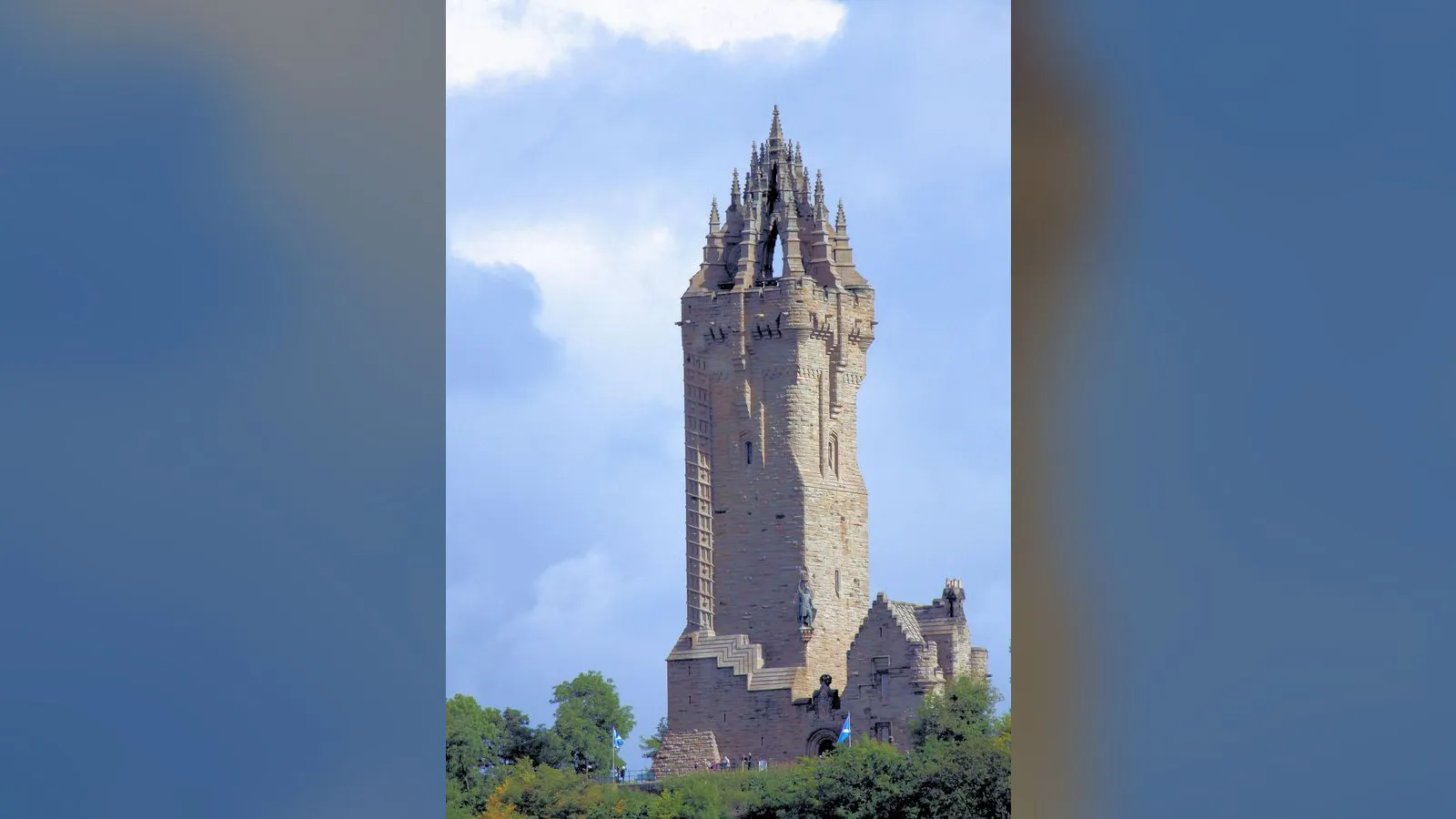

Wallace Monument & Abbey Craig
Contents
Legend/Myth Opener
Visitors sometimes assume the tall Gothic tower overlooking Stirling must itself be medieval — a surviving piece of William Wallace's own era, or perhaps built on the exact spot where the Battle of Stirling Bridge was fought. It is neither. The National Wallace Monument is a 19th-century Victorian structure, completed in 1869, built not on the battlefield itself but on Abbey Craig, a hill with a strong traditional (though not proven) connection to the battle as a vantage point rather than a combat site.
TL;DR
- established The National Wallace Monument was built between 1861 and 1869 on Abbey Craig, near Stirling, as a 19th-century commemorative tower, not a medieval structure — construction dates, architect, and cost are well documented through contemporary records. established
- established It was designed by architect John Thomas Rochead in Victorian Gothic style, stands around 67 metres (220 feet) tall, and was funded by public subscription, including international contributions, reflecting a wider 19th-century resurgence of Scottish national and historical identity — this funding and design history is documented. established
- traditional Abbey Craig is traditionally said to be the hill from which William Wallace watched the gathering of King Edward I's army before the Battle of Stirling Bridge in 1297, which is why the monument was sited there — this is flagged as traditional because, while plausible given the hill's commanding view over the crossing point, it rests on later tradition rather than a contemporary 1297 account confirming Wallace's exact vantage point. traditional
- established The actual Battle of Stirling Bridge was fought at the River Forth crossing below Abbey Craig, not on the hill itself or at the monument's location — this distinction is well established and important, since visitors sometimes conflate the memorial site with the battle site. established
- established The monument is managed today as a visitor attraction with a Hall of Heroes, a statue of Wallace, and panoramic views from its crown, and is not accessible to disabled visitors due to its narrow historic spiral staircase — this is stated directly by the monument's own visitor information. established
Key Facts
- Location/Region
- Abbey Craig, near Stirling, central Scotland
- Era/Date
- Built 1861–1869 (19th-century monument); commemorates events of 1297
- Type
- Victorian Gothic commemorative tower/monument
- Heritage/Protected Status
- Listed building; privately/charitably managed heritage attraction
- Managed/Owned by
- Stirling District Tourism (operating the visitor attraction)
- Access/Visitor Notes
- Paid visitor attraction; 246-step spiral staircase to the crown viewing platform; not accessible to disabled visitors due to the historic staircase
Scottish Impact Index (SI Score)
- National Significance
- 8/10
- Historical Continuity
- 8/10
- Human & Economic Importance
- 6/10
- Landscape / Architectural Distinctiveness
- 9/10
- Cultural & Historical Legacy
- 9/10
- Recognition
- 9/10
49/60
Ranked =34th of 43 in Locations
A Note on Claims and Evidence
The monument's own history — when it was built, who designed it, how it was funded, and what it contains — is fully documented through 19th-century subscription records, architectural accounts, and the monument's own archives. Separately, the Battle of Stirling Bridge itself, fought in 1297, is a documented historical event known from medieval chronicle sources. Where this article is careful is in the connecting link between the two: the claim that Wallace specifically watched the English army gather from Abbey Craig before the battle is a traditional account, repeated for generations and plausible given the hill's clear sightline over the river crossing, but not something a contemporary 1297 source confirms in so many words. The monument's site was chosen for this traditional association and its commanding visibility, not because the battle was fought there.
Timeline
Battle of Stirling Bridge fought at the River Forth crossing near Stirling; William Wallace and Andrew de Moray lead Scottish forces to victory over an English army under John de Warenne.
Fundraising campaign for a national monument to William Wallace begins in Glasgow, part of a wider 19th-century revival of interest in Scottish history and national identity.
National meeting in Stirling launches the monument movement; Lajos Kossuth speaks in support.
Foundation stone of the National Wallace Monument laid on Abbey Craig, reportedly by the Duke of Atholl.
Monument constructed to the design of architect John Thomas Rochead, funded by public subscription, including international contributions.
Monument completed and opened, standing roughly 67 metres tall.
Monument becomes an established feature of Stirling's landscape and a focal point for Scottish historical and nationalist commemoration.
Monument operated as a visitor attraction, including the Hall of Heroes exhibition and crown viewing platform; ongoing conservation of the Victorian structure.
Managed by Stirling District Tourism; remains one of the most visually prominent historic monuments in central Scotland, visible for miles across the Forth valley.
Details
A Victorian monument, not a medieval one
The National Wallace Monument is, straightforwardly, a product of the 19th century. Construction began in 1861 and finished in 1869, funded through a public subscription campaign that began in Glasgow in 1851 and drew contributions from across Scotland and abroad, including, notably, from the Italian nationalist leader Giuseppe Garibaldi — a detail that underlines how thoroughly the monument was bound up with the broader European 19th-century language of national revival and historical commemoration, not purely local or medieval sentiment. Designed by architect John Thomas Rochead in a dramatic Victorian Gothic style, the tower rises roughly 67 metres (220 feet) over four main levels, topped with a crown-like viewing platform reached via a narrow, 246-step spiral staircase — a historic feature striking for visitors but one that also means the monument is not accessible to visitors with mobility impairments. None of this should be confused with anything built in Wallace's own era; the monument is a 19th-century act of historical commemoration, built roughly 570 years after the events it honours.
Abbey Craig's traditional connection to 1297
The monument's location on Abbey Craig, a prominent rocky hill overlooking the River Forth near Stirling, was not chosen arbitrarily. Tradition holds that William Wallace used this hill as a vantage point to observe the gathering of King Edward I's army on the opposite side of the river before the Battle of Stirling Bridge in 1297, and it is this association — alongside the hill's obvious dramatic visibility across the surrounding landscape — that made it the natural choice for a national Wallace memorial in the 19th century. This is a reasonable and long-repeated tradition, consistent with the hill's commanding sightline over the relevant stretch of the Forth, but it should be presented as traditional association rather than a documented, contemporaneously recorded fact; no surviving 1297 source specifically places Wallace on Abbey Craig at a particular moment.
The battle itself was fought elsewhere
It is worth stating clearly, because visitors often conflate the two: the Battle of Stirling Bridge itself was fought down at the river crossing below Abbey Craig, not on the hill or at the monument's location. In the battle, Scottish forces under William Wallace and Andrew de Moray exploited the narrow wooden bridge crossing to defeat a much larger English army piecemeal as it crossed the river, a victory that became one of the signature successes of the early Wars of Scottish Independence. The modern road bridge and surrounding development have altered the immediate crossing area considerably since 1297, and like many medieval battle sites, the precise original ground has not been preserved as a dedicated, clearly marked battlefield in the way Culloden or Bannockburn have been. The Wallace Monument, standing above and at some distance from this crossing, functions as a commemorative landmark overlooking the general area of the battle rather than a marker placed directly on the fighting itself.
A monument of its own era and purpose
Understanding the Wallace Monument properly requires holding two things in view at once: the medieval event it commemorates, and the specific 19th-century moment that produced the monument itself. The mid-1800s saw a significant revival of interest in Scottish medieval history and national figures, part of a broader Victorian-era fascination with national origin myths and historical heroism across Europe, and the Wallace Monument is very much a product of that movement — ambitious, dramatic, and explicitly designed to inspire contemporary national feeling rather than simply to mark a historical spot with quiet accuracy. Inside, the Hall of Heroes houses busts of notable Scots including Robert the Bruce, Robert Burns, and David Livingstone, reflecting this same 19th-century instinct to connect Wallace to a wider pantheon of national historical achievement rather than treating him in narrow isolation. The monument also displays a large sword long associated with Wallace, though, in line with the rest of this article's cautious framing, its direct physical connection to Wallace himself should be treated as traditional attribution rather than proven provenance.
The site today
Today the National Wallace Monument remains one of the most visually prominent landmarks in central Scotland, visible for a considerable distance across the Forth valley, and operates as a well-established visitor attraction managed by Stirling District Tourism. Visitors can climb the spiral staircase to the crown viewing platform for panoramic views, explore the Hall of Heroes, and learn about both the medieval battle and the monument's own 19th-century construction story. Its enduring popularity reflects Wallace's continued prominence in Scottish national memory, a prominence the monument itself helped considerably to shape and reinforce over the past century and a half.
A Monument to Unionist-Nationalism
Colin Kidd and James Coleman, in the Oxford Handbook of Modern Scottish History (2012), explain why Victorian Scots built the monument. They saw Wallace not as a symbol of separation but as the founder of a Scottish liberty that made an equal Union with England possible, a view historians call "unionist-nationalism". At the national meeting that launched the movement in Stirling in June 1856, Provost Melville of Edinburgh credited Wallace with "the first germ of that civil and religious liberty which we now enjoy". At the laying of the foundation stone in 1861, the speaker James Dodds claimed that without Wallace the Scots would be fighting the same "awful and terrible contest" as Poland, Italy and Hungary.
European nationalists were drawn in. The exiled Hungarian leader Lajos Kossuth spoke at a meeting in Stirling in 1856, saying he shared two things with Wallace: struggling for national independence, "and that of being unfortunate". To prove the movement's credentials and raise funds, organisers solicited letters of encouragement from Kossuth, Garibaldi and Mazzini, and framed them in fragments of "the Wallace Oak". Kidd and Coleman note that the monument belongs to a European fashion for hero monuments, such as the Hermann monument in Germany (completed 1875) and the statue of Vercingetorix in France. Little was known about such heroes, so each generation could make them fit its own concerns: for the Victorians, Wallace stood for self-reliance, hard work and merit.
Wallace in stone across Victorian Scotland
The monument on Abbey Craig was the largest of many. Graeme Morton lists statues of Wallace across Lowland Scotland, from Dryburgh (1814) to Aberdeen (1888), at Ayr (1819, 1831 and 1837) and Robroyston (1900). He also traces the campaign's political roots: when the National Association for the Vindication of Scottish Rights broke up in the mid-1850s, some of its members moved into the committee raising subscriptions for the monument. One of them, the Glasgow lawyer William Burns, had argued in letters to Lord Palmerston for local rather than central government and a "just observance of the Treaty of Union". For these campaigners, Wallace was a hero of Scottish liberty within the Union, not a symbol of separation.
Did You Know?
- The monument movement was launched in 1856 with the Earl of Elgin, who claimed descent from Robert the Bruce, in the chair. He told the meeting that the struggle begun at Stirling and completed at Bannockburn was what made the Union with England "honourable" to Scotland (David McCrone, 2002).
- Victorian Scotland put up statues of William Wallace from Dryburgh (1814) to Aberdeen (1888) and Robroyston (1900); Ayr alone added three between 1819 and 1837.
- The exiled Hungarian patriot Lajos Kossuth spoke in Stirling in 1856 in support of the Wallace Monument.
- The Wallace Monument is a 19th-century structure, built more than five and a half centuries after the Battle of Stirling Bridge it commemorates.
- Italian nationalist leader Giuseppe Garibaldi was among the international contributors to the monument's 1851 fundraising campaign.
- The crown viewing platform at the top is reached by 246 steps up a narrow historic spiral staircase, which means the monument is not wheelchair accessible.
- The monument stands roughly 67 metres tall, making it visible across much of the Forth valley and from considerable distances around Stirling.
- The Battle of Stirling Bridge was actually fought at the river crossing below Abbey Craig, not on the hill where the monument now stands.
- The Hall of Heroes inside the monument includes busts of Scots from well beyond Wallace's own era, including the explorer David Livingstone and the poet Robert Burns.
- A large sword long associated with Wallace is displayed at the monument, though its direct physical link to Wallace himself rests on tradition rather than confirmed provenance.
- Abbey Craig's selection as the monument's site rests on a long-standing tradition that Wallace used the hill to observe the English army's approach before the battle — a plausible but not documentarily confirmed detail.
FAQ
1Is the Wallace Monument a medieval building?
No — it is a 19th-century structure, built between 1861 and 1869, commemorating the medieval figure William Wallace rather than dating from his era.
2Who designed it?
Architect John Thomas Rochead, in the Victorian Gothic style.
3Was the Battle of Stirling Bridge fought at the monument's location?
No — the battle was fought at the river crossing below Abbey Craig, not on the hill itself.
4Why was Abbey Craig chosen as the site?
Tradition holds that Wallace used the hill as a vantage point to watch the English army gather before the battle, and the hill's dramatic visibility made it a natural choice for a national monument.
5How tall is the Wallace Monument?
Approximately 67 metres (220 feet).
6Can you go inside and climb it?
Yes — visitors can climb a 246-step historic spiral staircase to a crown viewing platform, though this means the monument is not accessible to visitors with mobility impairments.
7Who paid for the monument?
It was funded by public subscription beginning in 1851, with contributions from across Scotland and abroad, including from Italian nationalist leader Giuseppe Garibaldi.
8What is the Hall of Heroes?
An exhibition inside the monument displaying busts of notable Scots, including Robert the Bruce, Robert Burns, and David Livingstone, alongside material on Wallace himself.
9Is the sword displayed at the monument really Wallace's?
It is traditionally associated with Wallace, but its exact provenance and direct connection to him are not conclusively proven.
10Who manages the monument today?
Stirling District Tourism operates it as a visitor attraction.
11Why is Wallace so significant in Scottish history?
He led Scottish forces to a major victory at Stirling Bridge in 1297 during the Wars of Scottish Independence and remains a central figure in Scottish national memory.
12Is there a separate memorial at the actual battle site?
The battle site itself, at the river crossing, is not preserved as a dedicated marked battlefield in the way some other Scottish battle sites are; the monument on Abbey Craig serves as the primary commemorative landmark for the event.
Sources and Further Reading
Primary/Institutional
- National Wallace Monument — official visitor information, Stirling District Tourism
- Listed building records for the Wallace Monument, Abbey Craig
Scholarly/Critical
- David McCrone, "Tomorrow's Ancestors: Nationalism, Identity and History", in Edward J. Cowan and Richard J. Finlay (eds), Scottish History: The Power of the Past (Edinburgh University Press, 2002).
- Graeme Morton, "Identity within the Union State, 1800–1900", in T. M. Devine and Jenny Wormald (eds), The Oxford Handbook of Modern Scottish History (Oxford University Press, 2012)
- Colin Kidd and James Coleman, "Mythical Scotland", in T. M. Devine and Jenny Wormald (eds), The Oxford Handbook of Modern Scottish History (Oxford University Press, 2012)
- Historical scholarship on 19th-century Scottish national monument-building and the Victorian revival of medieval historical memory
- Academic accounts of the Battle of Stirling Bridge (1297) and the early Wars of Scottish Independence
General
- Wikipedia — Wallace Monument
- Undiscovered Scotland — visitor overview of the Wallace Monument and Stirling Bridge
Caveats: Myths and Disputed Claims
- Do not describe the Wallace Monument as a medieval structure; it was built between 1861 and 1869, over five centuries after the events it commemorates.
- Avoid stating as confirmed fact that Wallace watched the English army gather from Abbey Craig; this is a long-standing tradition, not a contemporaneously documented detail.
- Do not imply the Battle of Stirling Bridge was fought at or near the monument itself; the battle took place at the river crossing below the hill.
- Avoid presenting the sword displayed at the monument as definitively Wallace's own weapon; its provenance rests on tradition, not conclusive proof.
- Do not overstate the monument's accessibility; the historic spiral staircase to the crown is not wheelchair accessible.
Card 046 · Locations