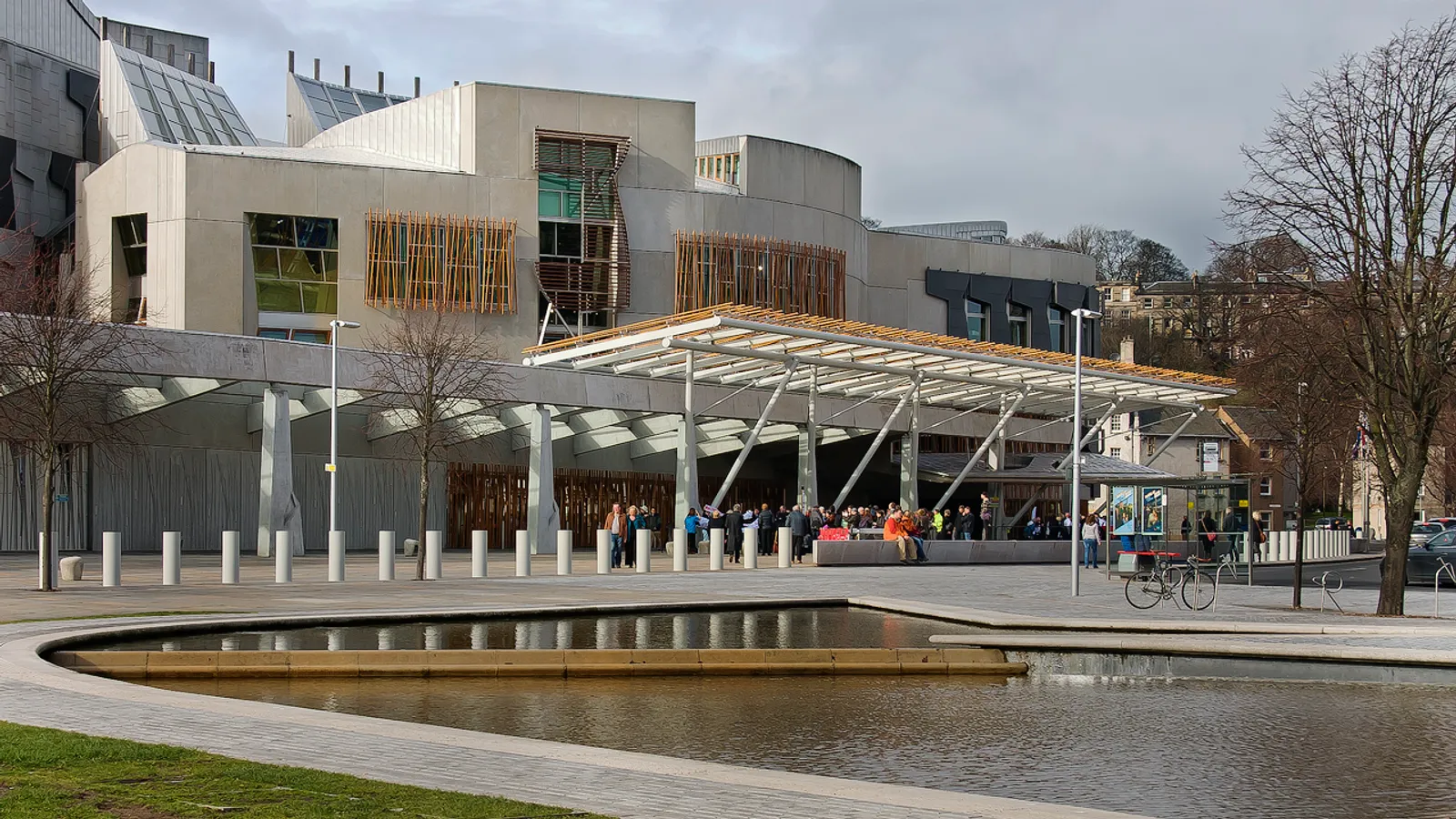

The Holyrood Building
Contents
An estimated £10–40 million project became a £414 million building, three years late, after the death of its own architect before construction was even finished. The Scottish Parliament building at Holyrood is now widely admired as architecture — but its construction history is one of the most thoroughly scrutinised public-spending failures in modern Scottish governance, examined in forensic detail by its own dedicated public inquiry.
TL;DR
- established The Holyrood building's final cost was £414.4 million, against an original 1997 estimate of between roughly £10 million and £40 million — a cost overrun of roughly ten to forty times the initial figure, confirmed in the official 2007 cost reconciliation.
- established The building's architect, Enric Miralles, died on 3 July 2000, before construction was complete, meaning he never saw the finished building he designed.
- established The Fraser Inquiry, chaired by Lord Fraser of Carmyllie and announced in May 2003, concluded in September 2004 that over 2,000 design changes were a major driver of cost escalation, and found Lord Fraser "astonished" that government ministers had remained inadequately informed about cost increases year after year.
- disputed Responsibility for the overrun is contested between the construction management procurement method chosen, the design process itself (extensive late changes, partly linked to Miralles's ambitious and evolving design), civil service oversight failures, and ministerial decisions — the Fraser Inquiry apportioned criticism broadly rather than identifying a single decisive cause.
- established The building opened on 9 October 2004, over three years later than the original planned opening of 2001, and has since received significant architectural recognition, including the 2005 Stirling Prize for architecture.
Key Facts
- Aspect
- Detail
- Original cost estimate (1997)
- £10–40 million
- Final cost
- £414.4 million (confirmed February 2007)
- Architect
- Enric Miralles (EMBT, with RMJM)
- Architect's death
- 3 July 2000, before completion
- Planned opening
- 2001
- Actual opening
- 9 October 2004
- Public inquiry
- The Fraser Inquiry, announced May 2003, reported September 2004
- Key inquiry finding
- Over 2,000 design changes; approx. £150 million attributed to design delays and unclear authority structures
- Later recognition
- Stirling Prize, Royal Institute of British Architects, 2005
Scottish Impact Index (SI Score)
- National Consequence
- 6/10
- Enduring Effects
- 6/10
- Human & Material Cost
- 5/10
- Historical Significance
- 7/10
- Consequential Legacy
- 6/10
- Recognition
- 9/10
39/60
Ranked #44 of 45 in Shadow
A Note on Claims and Evidence
The Holyrood building's cost figures and the Fraser Inquiry's findings are drawn directly from the Inquiry's own published report and subsequent official cost reconciliations, and are treated here as established fact rather than estimate or opinion. Apportioning blame among the several contributing factors the Inquiry identified — procurement method, design process, civil service management, and ministerial decision-making — involves judgement calls the Inquiry itself made explicitly and which remain subject to continued debate among architects, civil servants, and politicians; this article presents the Inquiry's own stated conclusions as established, while noting that assigning relative weight among causes remains interpretive.
Timeline
Initial cost estimates for a new Scottish Parliament building are put at roughly £10–40 million, as part of the broader devolution settlement covered on this series' companion card.
Catalan architect Enric Miralles, of the firm EMBT, working with Scottish firm RMJM, wins the international design competition for the new building at Holyrood, Edinburgh.
Construction begins; the project proceeds under a "construction management" procurement approach, allowing work to start before the full design was finalised — a decision later scrutinised heavily by the Fraser Inquiry.
Enric Miralles dies, aged 45, before the building's completion; his design partner and widow, Benedetta Tagliabue, continues to oversee the project's realisation.
Original planned opening date passes with the building still under construction and costs continuing to rise.
The Scottish Executive announces the Fraser Inquiry, chaired by Lord Fraser of Carmyllie, to investigate the causes of the cost and time overruns.
The Scottish Parliament building formally opens, over three years later than planned, with Queen Elizabeth II in attendance.
The Fraser Inquiry reports, identifying over 2,000 design changes as a major cost driver and criticising the adequacy of ministerial and civil service oversight of the project.
The building wins the Royal Institute of British Architects' Stirling Prize, the UK's most prestigious architecture award.
Final confirmed cost reconciliation puts the total project cost at £414.4 million.
Details
Origins: an ambitious building for a new institution
The decision to build a new, purpose-designed home for the Scottish Parliament, rather than reuse an existing building, reflected the symbolic weight attached to the newly devolved institution established under the 1997 referendum and the Scotland Act 1998, covered in detail on this series' companion card on devolution. An international design competition was held, and the Catalan architect Enric Miralles, working with the Scottish firm RMJM, won with a strikingly unconventional design intended to echo Scottish landscape forms and avoid a conventional, monumental seat-of-power aesthetic — a deliberate design choice that itself later became part of the public and political debate over the project, as its complexity and ambition contributed to the scale of the eventual cost and schedule overrun.
The initial cost estimates put forward in 1997, in the range of roughly £10 to £40 million, proved wildly unrealistic against what was ultimately delivered — a gap commentators and the Fraser Inquiry itself later attributed not to a single dishonest initial estimate but to the genuinely preliminary, underdeveloped state of the project's scope and design at the point the early figures were first published, compounded by the decision to proceed with construction before the design was fully resolved.
Construction and crisis: design changes, deaths, and delay
Construction began in 1999 under a "construction management" procurement approach, a method that allows building work to begin in parallel with ongoing design development, rather than waiting for a complete, fixed design before any construction starts. This approach can, in principle, compress overall project timescales, but it also removes much of the cost certainty that a fixed-price, fixed-design contract would otherwise provide, and the Fraser Inquiry later identified it as a central structural factor behind the project's cost exposure, since changes made after construction had already begun on related elements became substantially more expensive to implement than they would have been at an earlier design stage.
The project suffered a further, deeply consequential disruption on 3 July 2000, when Enric Miralles died suddenly at the age of 45, before the building's completion. His design partner and widow, Benedetta Tagliabue, took on responsibility for overseeing the project's continued realisation, ensuring Miralles's original design intent was carried through to completion — a notable act of professional and personal continuity given the circumstances, though one that occurred against the backdrop of an already-troubled and increasingly costly construction process that continued for a further four years after his death.
By the time the original 2001 opening date arrived, the building remained substantially incomplete and costs had continued to escalate well beyond the initial estimates, prompting sustained political and media criticism and, eventually, the Scottish Executive's decision in May 2003 to establish a formal independent public inquiry into the causes of the overruns.
The Fraser Inquiry: forensic accountability
The Fraser Inquiry, chaired by Lord Fraser of Carmyllie, conducted a detailed examination of the project's procurement, design, and management, reporting in September 2004, shortly after the building's eventual opening. Its findings were pointed and specific: the Inquiry identified over 2,000 individual design changes made over the course of the project as a major driver of cost escalation, and it attributed approximately £150 million of the total cost to design delays, overly optimistic initial scheduling, and unclear lines of authority between the various parties responsible for the project — the Scottish Office/Scottish Executive as client, the architects, the construction managers, and the contractors. Lord Fraser stated he was "astonished" that government ministers had remained inadequately informed about the scale and pace of cost escalation year after year, a finding that placed significant weight on failures of oversight and communication within government, alongside the structural procurement and design issues identified elsewhere in the report.
The Inquiry's findings should be read as establishing a documented, multi-causal account of the overrun — procurement method, design complexity and late changes, and inadequate oversight all featured — rather than identifying one single decisive culprit. This matters for an accurate account of the episode: popular narratives sometimes compress the story into either pure architectural extravagance or pure government incompetence, when the Inquiry's own conclusions distributed responsibility across several interacting factors.
Impact and legacy: cost, controversy, and eventual acclaim
The final, confirmed cost of £414.4 million, reconciled in February 2007, represented a multiple of roughly ten to forty times the original 1997 estimate, depending on which end of that initial range is used as the baseline — an overrun that became, and for some years remained, a significant point of public and political controversy in Scotland, feeding into broader scepticism about the costs and competence of the newly devolved institution during its first years of operation. This controversy existed in genuine tension with the building's architectural reception: Holyrood went on to win the Royal Institute of British Architects' Stirling Prize in 2005, the UK's most prestigious architecture award, and has subsequently been widely praised by architectural critics internationally as an innovative and successful work of contemporary parliamentary architecture, a reception that sits uneasily, for some observers, alongside its origin as what was, by any standard measure, a severely over-budget and significantly delayed major public construction project.
Legacy and ongoing debate
The Holyrood building's construction history remains a frequently cited case study in UK public sector procurement and major-project management, referenced in subsequent discussions of how to structure and oversee ambitious public construction projects. Its specific lessons — about the risks of construction management procurement for architecturally ambitious and evolving designs, about the importance of clear, continuously updated ministerial oversight of cost escalation, and about the genuine tension between architectural ambition and budgetary discipline — continue to inform, and to be invoked in, debates over subsequent major Scottish and UK public infrastructure projects, even as the building itself has become a settled, respected, and symbolically significant feature of devolved Scottish governance.
Did You Know?
- The original 1997 cost estimate for the Holyrood building was as low as £10 million — around 2.4% of the eventual confirmed final cost.
- Enric Miralles died at just 45 years old, four years before the building he designed was completed.
- His widow and design partner, Benedetta Tagliabue, personally oversaw the project through to completion after his death.
- The Fraser Inquiry identified more than 2,000 individual design changes made over the course of construction.
- Lord Fraser's own stated reaction to the pattern of ministerial unawareness about cost escalation was that he was "astonished."
- The building opened more than three years later than its original planned 2001 opening date.
- Despite its troubled construction history, Holyrood won the UK's top architecture prize, the Stirling Prize, within a year of opening.
- The final cost reconciliation of £414.4 million was not confirmed until February 2007, more than two years after the building opened.
FAQ
1What was the Holyrood building's final cost?
£414.4 million, confirmed in a February 2007 cost reconciliation.
2What was it originally supposed to cost?
Early 1997 estimates ranged from roughly £10 million to £40 million, far below the eventual final figure.
3Who designed the building, and did they see it finished?
Catalan architect Enric Miralles, working with the Scottish firm RMJM, won the design competition in 1998 but died on 3 July 2000, before construction was complete.
4What was the Fraser Inquiry?
An official public inquiry, chaired by Lord Fraser of Carmyllie and announced in May 2003, established to investigate the causes of the Holyrood project's cost and schedule overruns; it reported in September 2004.
5What did the Fraser Inquiry conclude caused the overrun?
It identified over 2,000 design changes as a major driver of cost escalation, attributed around £150 million to design delays and unclear authority structures, and criticised inadequate ministerial awareness of ongoing cost increases.
6Did the Inquiry blame one single person or decision for the overrun?
No. Its findings spread responsibility across several factors — the construction management procurement method, extensive late design changes, and oversight failures — rather than identifying a single decisive cause.
7When did the building actually open?
9 October 2004, more than three years later than the originally planned 2001 opening.
8Has the building been recognised for its architecture despite the cost controversy?
Yes. It won the Royal Institute of British Architects' Stirling Prize in 2005, the UK's top architecture award, and has received significant international critical acclaim since.
9What procurement method was used, and why does it matter?
A "construction management" approach, allowing building work to start before the design was fully finalised; the Fraser Inquiry identified this as a key structural factor increasing cost exposure to later design changes.
10Was Enric Miralles's death itself a cause of the delays?
The Inquiry's findings focus on procurement, design-change volume, and oversight rather than attributing the overrun primarily to the architect's death, though his death did require a significant transition in creative leadership during an already complex project.
11Is the Holyrood building still considered a cautionary tale today?
Yes, it continues to be cited in discussions of UK major-project procurement and public-sector oversight, even as the building itself has become a well-regarded and settled feature of Scottish governance.
Sources and Further Reading
Primary/Institutional
- The Fraser Inquiry, official final report (September 2004), Scottish Parliament archive
- Scottish Government/Scottish Parliament, official cost reconciliation statement (February 2007)
Scholarly/Critical
- Wikipedia, "Scottish Parliament Building," cross-referenced against Fraser Inquiry primary findings
- Architectural press analysis of the Stirling Prize-winning design (RIBA, 2005)
General
- The Scotsman, "Scottish Parliament at 20: £414m, endless recrimination, and finally, an iconic building"
- BBC News archive coverage of the Fraser Inquiry and the building's 2004 opening
Caveats: Myths and Disputed Claims
- Myth: the overrun was caused by one single decision or individual. The Fraser Inquiry explicitly distributed responsibility across procurement method, design-change volume, and oversight failures rather than naming one decisive cause.
- Oversimplification: treating the original cost estimate as a deliberate lowball deception. The Inquiry's findings point to the genuinely preliminary, underdeveloped state of the project's early scope and design as a significant contributing factor, alongside later management failures, rather than establishing deliberate initial deception.
- Tension to note, not resolve: architectural acclaim versus budgetary failure. The building's later Stirling Prize win and critical praise exist in real tension with its documented cost and schedule overrun; this article presents both facts without resolving which should carry more weight in an overall judgement of the project.
- Risk of exaggeration: describing the overrun multiple imprecisely. Depending on which end of the original £10–40 million estimate range is used, the final £414.4 million cost represents roughly a tenfold to fortyfold increase; both figures should be stated with their basis, not rounded to a single misleading multiple.
Card 019 · Shadow