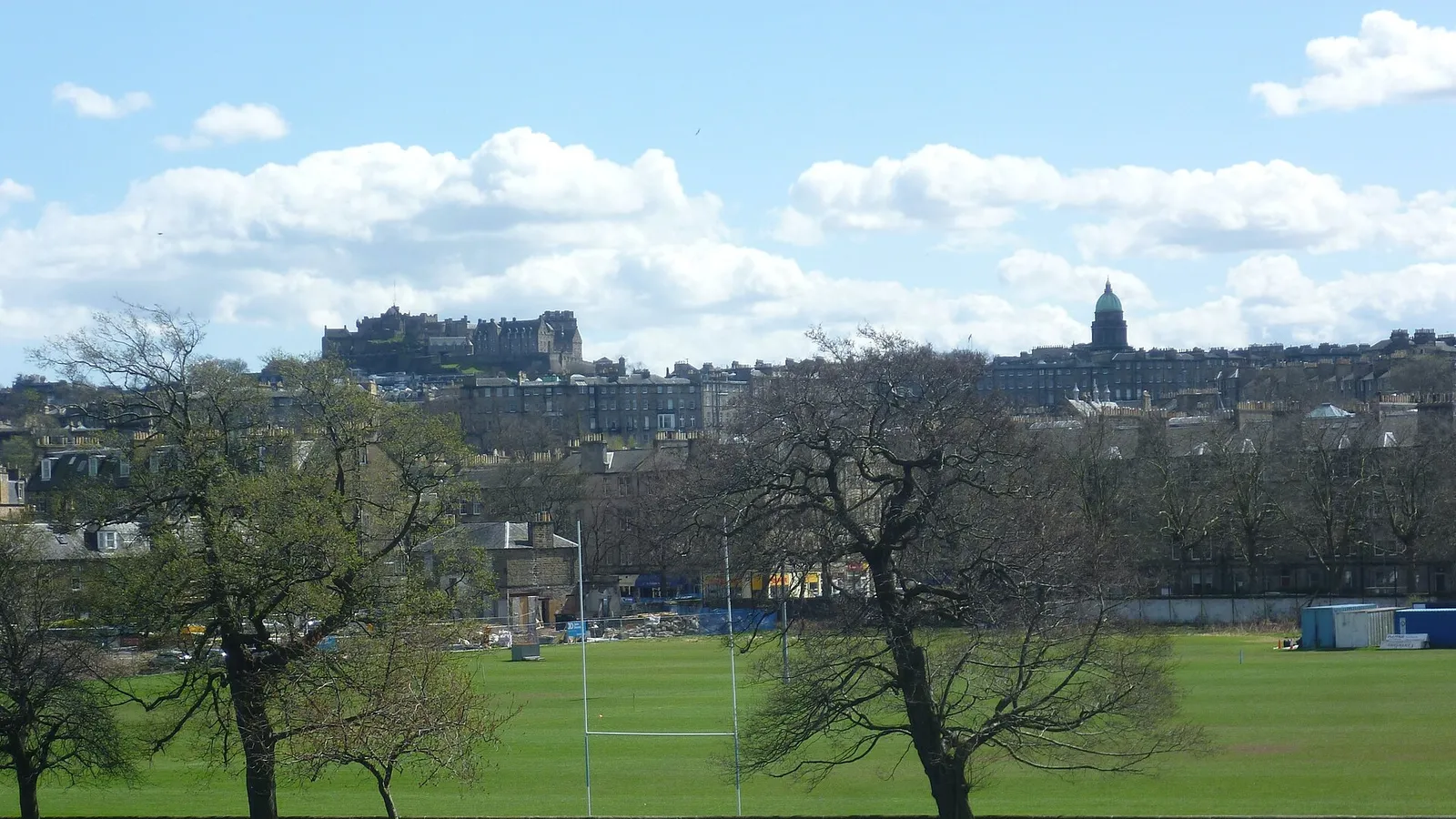

The First Rugby International, 1871
Contents
Legend/Myth Opener
It is often loosely said that rugby's first international was "a Scottish invention" that simply formalised an existing fixture. In fact it was a deliberate, almost defiant Scottish challenge, issued in response to a newspaper insult questioning Scotland's right to call its football "the national sport" — and it was played to a set of rules, and in a format, unrecognisable to the modern game: 20 players a side, tries that scored no points of their own, and a Scottish win recorded not in points but in goals and tries.
TL;DR
- established The match was played on 27 March 1871 at Raeburn Place, Edinburgh, between Scotland and England — the date and venue are well documented by the Scottish Rugby Union, Raeburn Place Foundation, and contemporary press.
- established Scotland won, scoring one goal and two tries to England's one try — this result is consistently recorded across institutional and historical sources, though it is worth noting goals (successful kicks after a try) rather than tries themselves decided the match under the scoring conventions of the day.
- established The match was played 20-a-side across two 50-minute halves, a format wholly different from the modern 15-a-side game — this is documented in match accounts and rugby history sources.
- established The match did not create the Rugby Football Union. The RFU was founded in London on 26 January 1871, two months before the match, after the Scottish challenge had been published in December 1870; the need to answer it was one spur among several, alongside the urgent need for common rules in England.
- traditional The challenge is traditionally said to have been prompted by a newspaper claim that football in Scotland meant association football, not rugby — this origin story is widely repeated in rugby histories but rests on a specific contemporary account rather than a neutral documentary record, so it is flagged as traditional rather than verified beyond dispute.
Key Facts
- Category
- Detail
- Date
- 27 March 1871
- Venue
- Raeburn Place, Edinburgh (home of Edinburgh Academicals FC)
- Teams
- Scotland v England
- Result
- Scotland won: one goal and two tries to England's one try
- Format
- 20 players per side; two 50-minute halves
- Scottish Captain
- Hon. Francis Moncreiff (also captain, Edinburgh Academicals FC)
- England captain
- Frederick Stokes of Blackheath; Benjamin Burns, also of Blackheath, helped organise the English side
- Challenge Issued By
- Captains of five senior Scottish clubs: West of Scotland FC, Edinburgh Academicals FC, Merchistonian FC, Glasgow Academicals FC, St Salvator FC
- Attendance
- Approximately 4,000 spectators
- Admission
- One shilling; gate receipts exceeded £200
- Challenge published
- 8 December 1870, in the London sporting weekly Bell's Life, and in the Scottish press
- Rugby Football Union
- Founded 26 January 1871 in London, before the match; the Scottish Football Union followed in 1873
- Status Today
- Scotland v England remains the oldest fixture in international rugby union, now part of the Six Nations Championship
A Note on Claims and Evidence
The core facts of this match — date, venue, participants and final result — are well documented across institutional sources (the Scottish Rugby Union, the Raeburn Place Foundation, and RFU histories) and are stated here as established fact. The specific trigger for the challenge — a newspaper claim that "football" in Scotland properly meant the dribbling (association) game rather than rugby's handling game — is a traditional account, repeated consistently in rugby histories, but it rests on retellings of a contemporary slight rather than a single universally agreed primary document, so it is presented as the traditional origin story rather than beyond-dispute fact. The one popular claim that the dates disprove is that the match led to the founding of the RFU, which in fact came first. Beyond that, the main correction is popular confusion about the scoring and format, which this card addresses directly: readers accustomed to the modern 15-a-side game and points-based scoring should not assume either applied in 1871.
Timeline
The captains of five Scottish clubs (West of Scotland, Edinburgh Academicals, Merchistonian, Glasgow Academicals and St Salvator's) publish a challenge to a side "selected from the whole of England" to play 20-a-side under rugby rules.
The Rugby Football Union is founded at a London restaurant by representatives of 21 clubs.
The match is played at Raeburn Place, Edinburgh, 20 players a side, two 50-minute halves, before roughly 4,000 spectators.
Scotland wins by one goal and two tries to England's one try.
The Scottish Football Union, forerunner of the Scottish Rugby Union, is founded.
Rugby takes root among the textile workers of the Border burghs, giving a middle-class game a working-class heartland.
A return fixture is established at Kennington Oval in London, beginning the alternating home-and-away pattern of the Scotland–England rugby rivalry.
Raeburn Place remains Scotland's preferred home ground for international rugby.
The Scotland–England fixture continues as the oldest international rugby rivalry in the world, now contested annually within the Six Nations Championship (and, in alternate years, the Calcutta Cup).
Details
A Challenge Born of Insult
The match at Raeburn Place on 27 March 1871 did not arise from quiet institutional planning; tradition holds that it was provoked. A contemporary newspaper piece, in the account repeated across rugby histories, asserted that "football" as properly understood in Scotland meant the dribbling, kicking game — what would become association football — rather than the handling-and-running game played at schools and clubs like Edinburgh Academicals and Merchistonian. Scottish rugby-playing clubs took this as a direct challenge to their legitimacy, and the captains of five of the country's senior clubs — West of Scotland, Edinburgh Academicals, Merchistonian, Glasgow Academicals, and St Salvator's — jointly issued a formal challenge to England to settle the matter on the field. This origin is best understood as a traditional account rather than an iron-clad documentary fact, but it is consistent with the combative, club-driven character of early Scottish rugby organisation, in an era before either country had a unified governing body for the sport.
The Match Itself
On 27 March 1871, Scotland and England met at Raeburn Place, the Edinburgh ground belonging to Edinburgh Academicals FC. The game bore only a loose resemblance to the sport known today. Twenty players took the field for each side — nine more per team than the modern game's fifteen — and the match was divided into two 50-minute halves rather than the current 40. Scoring, too, worked on entirely different logic: a try did not itself put points on the board but instead earned the scoring side the right to attempt a conversion kick at goal, and it was the successful kick — the goal — that counted. There were no penalty goals; the prevailing ethos of the time held, in the memorable phrasing of the era, that "gentlemen would not cheat," making deliberate infringement to prevent scoring an almost unthinkable tactic rather than something requiring a specific sanction. Scotland's captain was the Hon. Francis Moncreiff, who also captained Edinburgh Academicals, while England's side was represented and organised through Benjamin Burns, Secretary of Blackheath Football Club. Scotland won the match, recorded as one goal and two tries to England's single try — with the crucial detail, often lost in casual retellings, being that it was the successful conversion that gave Scotland the decisive goal, since tries alone carried no score. Roughly 4,000 spectators attended, paying one shilling admission, with gate receipts exceeding £200 — a substantial sum for a single sporting fixture in 1871, and an early sign of the public appetite that would sustain international rugby thereafter.
Consequences: Governing Bodies and a Fixture
established A common claim is that the match led to the founding of the Rugby Football Union later in 1871. The dates do not allow it. The Scottish challenge appeared on 8 December 1870, and the RFU was founded at a meeting of 21 mainly London clubs on 26 January 1871, two months before the game. The challenge may have added urgency, since England needed a body to pick a side, but the RFU's founders were also driven by the need to agree common rules among English clubs. In Scotland the match came first and the governing body second: the Scottish Football Union, later the Scottish Rugby Union, was formed in 1873. A return match was subsequently established at Kennington Oval in London, setting the pattern of alternating home venues that would come to define the fixture, and Scotland continued to favour Raeburn Place as its preferred home ground for international rugby for around the next 25 years.
Rugby's Place in Scottish Society
shared The clubs that issued the 1871 challenge were former-pupil and university clubs from Edinburgh, Glasgow and St Andrews, and rugby kept that social character. The historian Christopher Harvie, in "Sport and the Scottish state", a chapter of Grant Jarvie and Graham Walker (eds), Scottish Sport in the Making of the Nation (1994), describes rugby as organisationally biased towards the anglicised middle class, though it gained a working-class following among the textile workers of the Border burghs in the 1870s. He also notes that Border antiquarians of the 1880s tried to give the game a local pedigree by linking it to the old ba' games. Harvie quotes the novelist Eric Linklater, who in his novel Magnus Merriman contrasted the tall, tanned crowd at an Edinburgh rugby international with the pale supporters of Hearts and Hibs, a social divide Harvie sees as working against a single national sporting community.
shared In the same book the media scholars Neil Blain and Raymond Boyle argue that rugby became the main ritual contest between Scotland and England after football's annual Home International was abandoned in 1989, and that the 1990 Grand Slam decider against England at Murrayfield was reported almost as a re-run of the Wars of Independence. The book's editors note that the Scottish Rugby Union's adoption of "Flower of Scotland" before internationals, at a time when the football authorities were still using "God Save the Queen", was a striking choice for so conservative an institution.
Legacy and the Oldest Rivalry in Rugby
The 1871 Raeburn Place match is now recognised as the founding fixture of international rugby union — the first time two national representative sides met under agreed rugby rules in a contest explicitly framed as international. It established Scotland v England as the oldest international rivalry in the sport, a status it retains to this day. The fixture has evolved enormously since 1871 — from 20-a-side amateur club representative sides playing under rules with no points for tries, to the professional 15-a-side international game contested today within the Six Nations Championship, with the Calcutta Cup awarded in alternating seasons as a symbol of the rivalry's continuity. What has not changed is the basic fact that this one match, provoked by a question of national sporting identity and decided by a solitary successful kick at goal, set the template — international representative teams, agreed rules, a home-and-away fixture pattern — on which the entire subsequent history of international rugby union has been built.
Did You Know?
- The 1871 match was played 20-a-side, not the 15-a-side format familiar today — nine extra players on each side of the pitch.
- Tries in 1871 scored no points by themselves; they only earned the right to attempt a conversion kick, and it was that kick (the "goal") that actually counted on the scoreboard.
- There were no penalty goals in the 1871 game, reflecting an amateur-era assumption that deliberate foul play to prevent a score simply wouldn't happen among "gentlemen."
- Roughly 4,000 people attended, paying one shilling each — a notable crowd and gate for any single sporting fixture in 1871 Britain.
- The Rugby Football Union is often said to have been founded because of this match, but it was formed on 26 January 1871, two months before it.
- England's captain was Frederick Stokes of Blackheath.
- Raeburn Place remained Scotland's preferred home venue for international rugby for roughly a quarter of a century after this match.
- The challenge that led to the match is traditionally said to have been provoked by a newspaper suggesting Scotland had no legitimate claim to a national "football" distinct from the dribbling (association) game.
- Scotland v England, inaugurated at Raeburn Place in 1871, remains the oldest fixture in international rugby union history.
FAQ
1When and where was the first rugby international played?
27 March 1871, at Raeburn Place in Edinburgh, between Scotland and England.
2Who won the first rugby international?
Scotland won, scoring one goal and two tries to England's single try.
3How many players were on each side?
Twenty per side — not the fifteen used in the modern game.
4How long did each half last?
Fifty minutes per half, longer than the modern game's 40-minute halves.
5Did tries score points in 1871?
No. A try only earned the scoring team an attempt at a conversion kick; it was the successful kick (the goal) that actually counted toward the result.
6Were there penalty kicks in the 1871 match?
No. The amateur ethos of the time held that deliberate fouling to prevent a score was not something that needed to be legislated against.
7Who captained each side?
The Hon. Francis Moncreiff captained Scotland (he was also captain of Edinburgh Academicals FC); Frederick Stokes of Blackheath captained England, whose side was organised with help from Benjamin Burns, also of Blackheath.
8What prompted the challenge to England?
Tradition holds it was provoked by a newspaper suggestion that Scotland had no legitimate claim to a national "football" distinct from the dribbling (association) game — a slight that senior Scottish rugby clubs responded to directly.
9Did this match lead to the founding of a governing body?
Not directly. The Rugby Football Union was founded on 26 January 1871, after the Scottish challenge was published but two months before the match. Scotland's own body, the Scottish Football Union, followed in 1873.
10Was rugby a middle-class game in Scotland?
Largely, in the cities: the 1871 challenge came from former-pupil and university clubs. But the historian Christopher Harvie notes that it won a working-class following among Border textile workers from the 1870s.
11How many spectators attended?
Approximately 4,000, paying one shilling admission, with gate receipts exceeding £200.
12Is Scotland v England still the oldest international rugby fixture?
Yes, it remains the oldest international rivalry in rugby union, now played annually as part of the Six Nations Championship, with the Calcutta Cup contested between the two sides.
13Was this also the first ever rugby match of any kind?
No — rugby football as a club sport predates 1871 by decades. This was specifically the first full international representative match between two national sides.
Sources and Further Reading
Primary/Institutional
- Scottish Rugby Union — official history of the Scotland–England fixture
- Rugby Football Union (RFU) — founding history, 1871
- World Rugby Museum, "RFU150: the Rugby Football Union" — https://worldrugbymuseum.com/from-the-vaults/twickenham-stadium/rfu150-the-rugby-football-union
Scholarly/Critical
- Christopher Harvie, "Sport and the Scottish state", and Neil Blain and Raymond Boyle, "Battling along the boundaries: the marking of Scottish identity in sports journalism", in Grant Jarvie and Graham Walker (eds), Scottish Sport in the Making of the Nation: Ninety Minute Patriots? (Leicester University Press, 1994)
- Raeburn Place Foundation, interactive timeline, "1871 - Scotland and England play first international" — https://www.raeburnplacefoundation.org/rugby-beginnings/interactive-timeline/scotland-and-england-play-first-international
General
- Wikipedia, "Raeburn Shield" — https://en.wikipedia.org/wiki/Raeburn_Shield
- Wikipedia, "1871 Scotland versus England rugby union match" — https://en.wikipedia.org/wiki/1871_Scotland_versus_England_rugby_union_match
- Sky Sports, "150th anniversary of first international rugby match" — https://www.skysports.com/rugby-union/news/12040/12258606/150th-anniversary-of-first-international-rugby-match
- ESPN, "Auld enemies" — https://www.espn.co.uk/rugby/story/_/id/15295985/auld-enemies
Caveats: Myths and Disputed Claims
- Do not state the 1871 match was played under rules identical or near-identical to the modern 15-a-side game. Correct phrasing: it was played 20-a-side over two 50-minute halves, with tries scoring no points directly — a materially different format from today's game.
- Do not state flatly, as settled documentary fact, that a specific newspaper article caused the challenge. Correct phrasing: tradition and repeated rugby histories attribute the challenge to a perceived newspaper slight about Scotland's claim to "football," but this should be presented as the traditional account rather than an unimpeachable primary-source fact.
- Do not say the match led to the founding of the Rugby Football Union; the RFU was founded on 26 January 1871, before the match.
- Do not describe the result in modern points terms (e.g., stating a numeric score such as "4-1" in points) without clarifying the actual 1871 scoring convention. Correct phrasing: Scotland won by one goal and two tries to England's one try, under a system where only the successful conversion kick (the goal) counted toward the result.
Card 012 · Sport