
Burns Night and the Burns Supper
Contents
Every year around 25 January, millions of people in Scotland and around the world hold a Burns Supper: the haggis is piped in, the "Address to a Haggis" is recited, toasts are made to the poet's memory and to the "lassies", and the night ends with "Auld Lang Syne". The tradition really does go back to 1801, but much of the familiar ritual was added later. This card tests where the supper came from, which parts are original, and some popular claims about haggis.
TL;DR
- established Robert Burns was born in Alloway on 25 January 1759 and died in Dumfries on 21 July 1796, aged 37. He is widely called Scotland's national poet, but that is a traditional title, not an official office.
- established The first Burns Supper was a memorial dinner for nine men at Burns Cottage, Alloway, on 21 July 1801, the fifth anniversary of his death. The best-known account was published by its organiser, the Rev. Hamilton Paul, in 1819.
- established The Greenock Burns Club held the first supper on the poet's birthday in 1802, but on the wrong date, 29 January. Much of today's running order, including the Toast to the Lassies, was added later.
- established The Selkirk Grace is older than Burns; it was known in the 17th century as the Galloway or Covenanters' Grace. The earliest known haggis recipes are English, from around 1430.
- shared The University of Glasgow estimates that more than 9.5 million people celebrate Burns Night each year in nearly 150 countries; that is a scholarly estimate, not a count.
Key Facts
- Robert Burns born
- 25 January 1759, Alloway
- Died
- 21 July 1796, Dumfries
- "Address to a Haggis"
- Written 1786; published 20 December 1786
- First Burns Supper
- 21 July 1801, Burns Cottage, Alloway; nine men
- Account published
- 1819, by the Rev. Hamilton Paul
- Greenock Burns Club
- Founded 1801; first birthday supper 29 January 1802
- Burns Federation founded
- 1885
- Earliest haggis recipes
- English, c.1430
- Selkirk Grace
- Known in the 17th century as the Galloway Grace
- Official national poet
- The Makar, created by the Scottish Government in 2004
- Celebrants
- More than 9.5 million a year (estimate)
Scottish Impact Index (SI Score)
- Cultural Reach
- 9/10
- Continuity of Tradition
- 9/10
- Social & Economic Importance
- 7/10
- Scottish Distinctiveness
- 10/10
- Cultural Legacy
- 10/10
- Recognition
- 10/10
55/60
Ranked =8th of 19 in Traditions
A Note on Claims and Evidence
Each major claim carries one of three labels. established means supported by primary records, official bodies or several independent reliable sources. shared means the core fact is sound but sources disagree on details, dates or interpretation. traditional means widely repeated but not traceable to a primary or independent source.
The first supper is documented, but mainly through an account written by its organiser and published in 1819, so it is a participant's record rather than an independent one. The running order grew over the following two centuries. Participation and economic figures are estimates. Some popular claims, about the Selkirk Grace, the origin of haggis, and a woman supposedly at the first supper, are wrong.
Timeline
William Dunbar's Flyting of Dunbar and Kennedy contains an early Scottish mention of haggis.
Robert Burns is born in Alloway.
Burns publishes Poems, Chiefly in the Scottish Dialect and writes "Address to a Haggis".
Burns writes his version of "Auld Lang Syne".
Burns recites the grace at the Earl of Selkirk's table.
Burns dies in Dumfries.
The first Burns Supper is held at Burns Cottage, Alloway.
The Greenock Burns Club is founded.
The Greenock club holds the first birthday supper, on the wrong date.
Hamilton Paul publishes his account of the first supper.
The Ayr Burns Festival procession is held.
The Burns Federation is founded.
A US rule bans the sale of food containing livestock lungs, including traditional haggis.
The Scottish Government creates the post of Makar, the national poet.
Details
Robert Burns: the biography that anchors the tradition
Robert Burns was born on 25 January 1759 in a cottage in Alloway, near Ayr, the eldest of seven children of William Burnes, a tenant farmer, and Agnes Broun. Largely self-educated despite grinding rural poverty, he published Poems, Chiefly in the Scottish Dialect (the "Kilmarnock volume") on 31 July 1786, which brought him fame and led him to abandon plans to emigrate to Jamaica. He died on 21 July 1796 in Dumfries at the age of 37. These facts are consistently attested across Encyclopaedia Britannica, the National Trust for Scotland, the Scottish Poetry Library and the National Records of Scotland.
His designation as Scotland's "national poet" or "national bard" is universal in reputable sources but is an honorific consensus, not a formal office. The distinction matters for accuracy: Scotland's official, government-appointed national poet is the Makar, an office created by the Scottish Government under First Minister Jack McConnell in February 2004. Holders serve fixed terms: Edwin Morgan (2004–2010), Liz Lochhead (2011–2016), Jackie Kay (2016–2021), Kathleen Jamie (2021–2024) and Peter Mackay/Pàdraig MacAoidh (from 2 December 2024). Burns predates and stands apart from this office; calling him "national poet" is accurate as a cultural description but should not be presented as an official or legal status.
The first supper: documented, but reconstructed from an 1819 account
The first Burns Supper was held at Burns Cottage in Alloway on 21 July 1801 — the fifth anniversary of Burns's death. Nine men attended. The idea is attributed to John Ballantine, former Provost of Ayr, and the evening was organised by Rev. Hamilton Paul, who acted as "Chaplain & Laureate" and composed an ode. The menu was haggis and sheep's head; the group recited Burns's verse (including Address to a Haggis) and toasted his memory.
Crucially, the widely circulated narrative rests on a record attributed to Hamilton Paul himself — described by the Robert Burns Birthplace Museum as "his own minute" — and the influential public account appeared in Paul's 1819 edition, The Poems and Songs of Robert Burns, roughly eighteen years after the event. It is therefore a participant-organiser's record, not an independent contemporaneous press report from July 1801. Dr Clark McGinn, whose 2014 University of Glasgow PhD thesis ("'Every Honour Except Canonisation': the global development of the Burns Supper: 1801 to 2009") is the leading academic study of the Burns Supper, characterises the founding event as a "convivial club dinner… using invented ritual paying homage to Freemasonry," with key elements "grafted onto the running order." This is a clean and genuine origin story, but it is best stated as "documented via the organiser's own later account" rather than as an independently verified real-time record.
A frequently repeated embellishment — that a woman named "Primrose Kennedy" attended the first supper, supposedly honouring women's role — is false: "Primrose Kennedy" was Captain Kennedy, an Ayrshire military figure. The early suppers were male-only; Ladies' Burns Clubs emerged much later (e.g. Shotts 1920, Annan Ladies 1928). Attendees are said to have included lawyer Robert Aiken ("Orator Bob"), dedicatee of "The Cotter's Saturday Night."
The date and how it became 25 January
The Greenock Burns Club, "The Mother Club," is the earliest extant Burns club (founded 1801 by Ayrshire-born merchants, some of whom had known Burns). It held its first anniversary supper on 29 January 1802, believing that to be Burns's birthday — an error traceable to biographer James Currie, whose 1800 collected Works of Robert Burns was the first official biography. In 1803, examination of the Ayr parish birth register revealed the correct date, 25 January 1759, and the celebration migrated to that date (though the Greenock club's own history notes that early members in fact chose "various dates in January… mainly for convenience" for some years afterward). The University of Glasgow's Centre for Robert Burns Studies distinguishes the private 1801 Alloway gathering from the Greenock event, which it calls the first public Burns Supper.
The running order — separating original from accreted
- Piping in guests / the haggis: The ceremonial piping is central to the modern supper; on the music and the instrument itself, see the companion Great Highland Bagpipe article rather than duplicating it here.
- Selkirk Grace: A later, traditional element, not documented at 1801. The grace predates Burns by nearly a century (the 17th-century "Galloway Grace"/"Covenanters' Grace") and was attached to his name after he recited it at the Earl of Selkirk's table at St Mary's Isle in 1794. Notably, Burns delivered it in a more anglicised form; the broad Scots ("Lallans") version now standard at suppers is the older variant.
- Address to a Haggis: Written 1786; recited from the first supper onward. Documented.
- Immortal Memory: The act of toasting Burns's memory dates to 1801; the formal name and set-piece speech are later developments. Caroline Smith of the Robert Burns Birthplace Museum describes the 1801 toast as "where the 'Immortal Memory' comes from in today's Burns Suppers."
- Toast to the Lassies and Reply: Modern additions — the Toast to the Lassies is roughly a 20th-century development (per Burns scholars, within the last 70–80 years), and the Reply ("Reply to the Laddies") reflects the move away from male-only events.
- Auld Lang Syne close: Now standard. Burns's version of the song dates to 1788 (based on older material, with a first verse resembling James Watson's 1711 "Old Long Syne"); the familiar words-and-tune pairing was published by George Thomson in 1799. The tradition of singing it with linked, crossed hands emerged in the mid-19th century, connected to Masonic and fraternal "chain of union" rituals, per University of Edinburgh musicologist Morag Grant, who identified a newspaper report of an 1879 Ayrshire lodge Burns Supper describing "the circle of unity."
McGinn's two-phase model is useful: a "charismatic period" from 1801 (informal, among those who knew Burns), and a "traditional period" through the Victorian era — the Ayr Burns Festival Procession of 1844 and the founding of the Burns Federation in 1885 — when the format standardised into what we recognise today. The 1815/1816 Edinburgh suppers (the 1816 attended by Sir Walter Scott) marked the shift toward grand formal public dinners. The Burns Federation (founded 1885 in Kilmarnock, now the Robert Burns World Federation) helped globalise and codify the tradition.
Haggis: ancient, widespread, and not originally Scottish
The evidence that haggis is not a uniquely Scottish invention is strong and comes from reputable food history. The earliest known written recipes for a dish of the name appear in English sources around 1430 — the Lancashire verse cookbook Liber Cure Cocorum ("hagese") and another English cookbook ("hagws of a schepe"). An even earlier related dish appears in Richard II's The Forme of Cury (1390). Food historian Catherine Brown drew attention in 2009 to Gervase Markham's The English Huswife (1615), which describes the dish as popular in England; her findings, aired in a TV documentary, prompted heated Scottish rebuttals. Offal-in-stomach dishes are far older and cross-cultural: food writer Alan Davidson traces "products of the haggis type" to the ancient Romans, and a comparable preparation appears in Homer's Odyssey (Book 20). The etymology is genuinely uncertain, with proposed roots including Anglo-French/Old French words for chopping and Old Norse "hoggva" (to hew). Haggis is Scotland's national dish today largely because of Burns's 1786 poem — a case of cultural adoption and elevation rather than invention.
A related canard — that haggis came to Scotland from France via the Auld Alliance — has little historical support and is generally dismissed; if anything the transmission may have run the other way.
The haggis and the supper table in McNeill's record
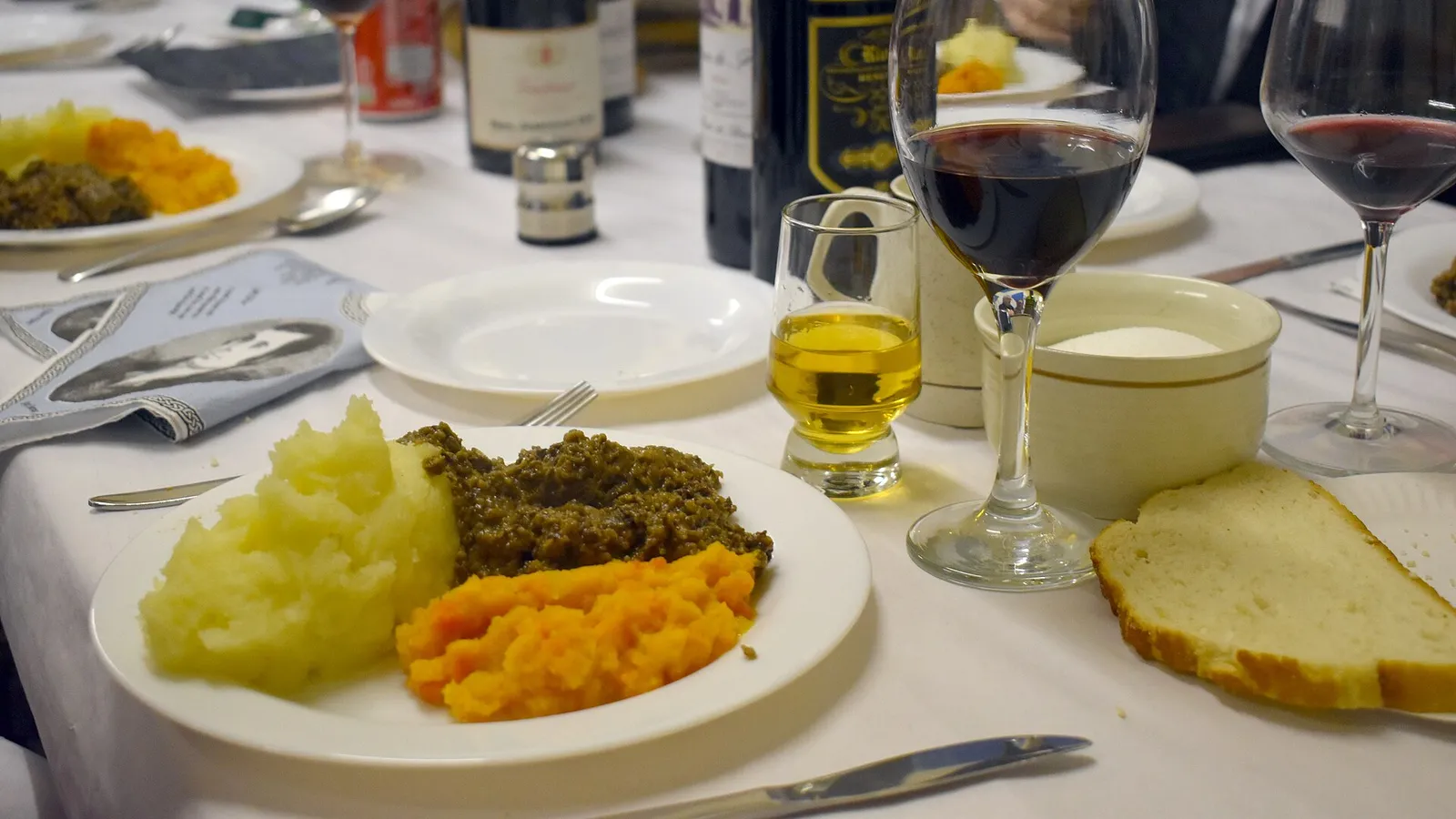
established The folklorist F. Marian McNeill, in The Scots Kitchen (1929), was already sceptical of the French story. She rejects the derivation of "haggis" from French hachis, preferring a root in "hag", to chop, and calls the haggis "simply a super-sausage", once common to many lands; she points to a Roman recipe in Apicius stuffed and pricked in the same way. Her earliest Scottish literary witness is William Dunbar's Flyting of Dunbar and Kennedy (c.1500), which jeers at an opponent gaping "as thou wald for ane haggies". Her traditional recipe fills a cleaned sheep's stomach a little over half full with the minced heart, lights and part of the liver, suet, onion and toasted oatmeal, highly peppered, and boils it for about three hours, pricking it as it swells so that it does not burst. The usual accompaniments she gives are mashed potatoes and mashed turnips, or the two mashed together as clapshot. She also notes that some carvers begin by cutting a St Andrew's cross on the top.
established Before it was a Burns Night dish, haggis belonged to the winter slaughter. McNeill's calendar of festival foods lists haggis and black and white puddings for Martinmas (11 November), when the "mart", the beast salted for winter, was killed, and sheep's head and haggis for St Andrew's Day. She quotes Katherine Grant's account of Appin in Argyll, where the filling of the winter mutton barrel was "a time of general feasting on fragrant haggis". In poorer homes, she quotes T. F. Henderson, the haggis was set in the middle of the table and everyone ate from it with horn spoons.
shared Early Burns Club dinners were not built around a single dish. McNeill reprints a bill of fare from Meg Dods's Cook and Housewife's Manual (first published 1826) intended "for St Andrew's Day, Burns Clubs, or other Scottish national dinners": haggis is one dish among more than twenty, alongside Friar's chicken soup, sheep's head broth, two tups' heads with trotters, minced collops, salt cod, solan goose and a haunch of venison. McNeill does not say which edition the bill comes from, so it shows the style of a national dinner in the early to mid-nineteenth century rather than a dated menu. Her own "Modern Burns Supper" bill of fare, written in Scots for the 1963 edition, is closer to today's: cock-a-leekie and hare soup, fish, the haggis with "clapshot or tatties and neeps", roast turkey and sirloin, then sweets and cheese with oatcakes. McNeill gives no dates for the early Burns Club suppers, so her book neither confirms nor contradicts the 1801 and 1802 dates above.
established McNeill prints the Selkirk Grace in its Scots form ("Some hae meat that canna eat") under the heading "The Covenanter's Grace", noting, after Robert Chambers, that the lines were current in the south-west before Burns repeated them at the Earl of Selkirk's table. This agrees with the account above.
established Haggis-making was competitive long before modern awards. McNeill quotes Meg Dods and the Noctes Ambrosianae dialogues in Blackwood's Magazine on a sweepstake for haggises held in Edinburgh, at which the Cleikum Club's haggis, made to Meg Dods's recipe, took the prize.
The wild haggis: a documented joke, correctly labelled
The "wild haggis" is a deliberate modern joke, not folklore to be debunked as though anyone seriously believed it historically. It belongs to the same class of invented tourist-teasing creatures as the American jackalope and Australian drop bear. It is often described as having legs of different lengths so it can run around steep hills. The earliest known written reference is a 1924 satirical poem in the New York Tribune by James J. Montague. Its cultural notoriety was cemented by the Hall's of Broxburn survey of 1,000 US visitors (released 26 November 2003), which found 33% believed the creature was real and 23% said they had come to Scotland to catch one. The correct framing is: a good-humoured, self-aware Scottish joke about outsiders' unfamiliarity with the real dish.
Modern celebration and status
Burns Night is now a global phenomenon. The University of Glasgow's Centre for Robert Burns Studies estimates more than 9.5 million people celebrate annually across nearly 150 countries, from Vancouver to Melbourne to the summit of Kilimanjaro, and its 225th-anniversary research mapped more than 1,000 suppers across 75 countries in a single year. Professor Murray Pittock's 2020 Scottish Government-funded study valued Burns's overall annual contribution to the Scottish economy at £203 million and his brand value at £139.5 million, with tourism (just under £155 million) the largest component; Burns Night itself has a turnover of around £11 million in Scotland. The Scottish Parliament regards Burns Night as a key cultural heritage event, and Scottish Enterprise uses the occasion to promote trade and investment.
On heritage status: as of 2026, Burns Night does not hold UNESCO recognition. The Centre for Robert Burns Studies is running "The Burns Supper at 225 Years: Scottish Tradition, Global Reinvention," building a crowdsourced global archive and interactive map (to launch July 2026, the 225th anniversary of the first supper) explicitly as a step toward recognition on the UK's Inventory of Living Heritage (launched December 2025 by the Department for Culture, Media and Sport) and, ultimately, UNESCO inscription as Intangible Cultural Heritage. This should be reported as an aspiration/process in progress, not an achieved status.
A practical modern footnote: authentic haggis containing sheep's lung has been banned for sale in the United States since a 1971 USDA rule (9 CFR 310.16) prohibiting livestock lungs in human food. Scottish producers and governments have repeatedly lobbied to lift or work around the ban, and lung-free "compliant" versions have been developed (Macsween of Edinburgh among them).
Burns and the Victorian diaspora
The supper spread overseas with Scottish emigrants. The historian Graeme Morton describes the St Andrew's and Caledonian societies that sustained Scottish business, social and religious networks across the empire and the Americas, and the surge of Burns celebrations around the centenary of his birth in 1859. At the Burns Club of New York that year the St Andrew's cross hung beside the flag of St George and the Stars and Stripes, and toasts were drunk to "the genius of Burns", "Scotland, the land of our fathers" and "America, the land we live in". In the same city the Burns Anniversary Association, meeting in Mozart Hall on Broadway, declared that Scotland had had only two great kings: John Knox and Robert Burns. A statue of Burns was unveiled in New York's Central Park in 1880, beside an earlier one of Walter Scott. Morton notes that these were men's gatherings until later in the century: women were invited to admire the tables and parade in their gowns, but before the drinking began. The familiar toast to the "twa lands", he suggests, captures the double identity of Scots abroad: a heightened Britishness alongside a Scottishness rooted in new communities.
Before the American suppers. established The Burns Night that reached America landed among Scots who already met to eat, drink and sing. The literary historian Andrew Hook, in Scotland and America (1975), describes the centenary of the St Andrew's Society of Charleston in 1829, when members marched to church behind soldiers whose officers wore Highland bonnets, and the speaker, the Rev. Mitchell King, named Ramsay, Burns and Hector Macneill among the poets who had made Scotland "full of song and poetry" (as quoted by Hook). Around 1830 the Scottish traveller James Stuart found Scots meeting over Scottish dishes in Mrs Mackay's tavern in Nassau Street, New York, whose sign was a half-length portrait of Burns with two lines from "Tam o' Shanter". Burns's songs were already familiar: the traveller John Melish found settlers on Lake Erie who relished them.
shared Hook also warns that the Scotland toasted at such dinners was partly a literary creation. During the American Revolution many Scots in America were loyalists and Scots were widely disliked, a picture, he notes, very different from what is usually proposed at St Andrew's Nights and Burns Suppers in America. In his account it was Scottish literature, Burns, Ossian and above all Scott, that replaced that hostile image with a romantic one in the decades after 1783.
Highland dress at the supper
Formal Burns Suppers often feature Highland dress. For the accurate history of the kilt and its accessories (including the sgian-dubh), cross-reference the companion Kilt and Sgian-dubh articles rather than repeating those attribution debates here. Likewise, for the music of the evening see the companion Ceilidh, Fiddle Tradition and Great Highland Bagpipe articles.
Did You Know?
- The first Burns Supper marked the anniversary of Burns's death, not his birth.
- Only nine men attended the first supper.
- The first birthday supper was held on the wrong day, 29 January.
- The Selkirk Grace was not written by Burns.
- The earliest known haggis recipes are English.
- The "wild haggis" is a joke played on tourists.
- Traditional haggis containing sheep's lung cannot be sold in the United States.
- Scotland's official national poet is the Makar, not Burns.
- Haggis was also a Martinmas dish, made when the winter beef and mutton were killed and salted.
- An early-nineteenth-century bill of fare for Burns Club dinners listed haggis as one of more than twenty dishes.
FAQ
1When was the first Burns Supper?
On 21 July 1801, at Burns Cottage in Alloway.
2Why is Burns Night on 25 January?
It is Burns's birthday. Clubs moved the supper to his birthday from 1802.
3Did Burns write the Selkirk Grace?
No. It was known before him as the Galloway or Covenanters' Grace.
4Is haggis Scottish?
It is now Scotland's national dish, but the earliest known recipes are English.
5Is the wild haggis real?
No. It is a modern joke.
6What is the Immortal Memory?
The main toast to Burns's memory. The toast goes back to 1801; the set-piece speech developed later.
7Is the Toast to the Lassies old?
No. It is a 20th-century addition.
8Is Burns officially Scotland's national poet?
No. The title is traditional; the official post is the Makar.
9How many people celebrate Burns Night?
The University of Glasgow estimates more than 9.5 million in nearly 150 countries.
10Did a woman attend the first supper?
No. "Primrose Kennedy" was a man, Captain Kennedy.
11Did Scots in America celebrate Burns before the big Victorian suppers?
Yes, informally. By around 1830 a New York tavern kept by a Scotswoman used Burns's portrait as its sign, and St Andrew's societies such as Charleston's (founded 1729) were already holding grand Scottish celebrations at which Burns was honoured.
12What is traditionally served with haggis?
Mashed potatoes and mashed turnips ("tatties and neeps"), or the two mashed together as clapshot.
13Was haggis always the centre of the Burns Supper?
It was eaten at the first supper in 1801, but early club dinners served it among many other Scottish dishes. Its ceremonial place grew with the running order.
Sources and Further Reading
Scholarly/Critical
- Andrew Hook, Scotland and America: A Study of Cultural Relations, 1750–1835 (Blackie, 1975)
- Graeme Morton, "Identity within the Union State, 1800–1900", in T. M. Devine and Jenny Wormald (eds), The Oxford Handbook of Modern Scottish History (Oxford University Press, 2012)
Specialist
- F. Marian McNeill, The Scots Kitchen: Its Traditions and Lore with Old-Time Recipes (Blackie, 1929; 2nd edn 1963)
Further reading
- Clark McGinn, The Ultimate Burns Supper Book (Luath Press, 2006)
- Robert Crawford, The Bard: Robert Burns, a Biography (Jonathan Cape, 2009)
Caveats: Myths and Disputed Claims
- Do not say Burns wrote the Selkirk Grace.
- Do not say haggis is uniquely or originally Scottish.
- Do not say haggis came from France through the Auld Alliance.
- Do not call Burns Scotland's official national poet.
- Do not say a woman attended the first supper.
- Do not present the 9.5 million celebrants or economic figures as exact.
- Do not confuse the 1801 Alloway memorial supper with the 1802 Greenock birthday supper.
- Do not present any single origin for the word "haggis" as settled.
- Do not take the patriotic picture of Scots and America offered at American Burns and St Andrew's dinners as history. In the Revolution many Scots in America were loyalists.
Card 016 · Traditions