
Doon the Watter: Glasgow, Clyde Steamers and the Culture of the Seaside Escape
Contents
Not a route name but a ritual — how an industrial city turned a river into its road to the sea.
Series: Culture & Traditions
TL;DR
- Established/Documented: "Doon the Watter" is Scots for "down the water" and became shorthand for a whole culture — Glaswegians leaving the city by Clyde steamer for the Firth of Clyde resorts (Rothesay, Dunoon, Largs, Millport, Arran, the Kyles of Bute, and on longer trips Campbeltown and Loch Fyne). It grew from genuine 19th-century steam-tourism expansion, was supercharged by the industrial Glasgow Fair holiday, and remains a living phrase today — used by contemporary Clyde cruise operators, a 2026 Dunoon music festival, and a modern children's theatre production.
- Shared/Traditional: The romantic image of a purely working-class "doon the watter" day out. The evidence instead shows a genuinely mixed social world — from professional families taking a Clyde villa for the season, to artisan families renting lodgings for Fair Fortnight, to a single day-excursion for the lowest-paid — all sharing the same steamer routes without sharing identical holidays.
- Disputed / archival gap: The exact first printed or spoken use of the phrase "doon the watter" has not been securely dated; this card does not attach it to a specific year or coiner. The precise statistical weight of car ownership, rail rationalisation and changing holiday habits in the post-war decline of the Clyde fleet also awaits confirmation from traffic and company-account records.
- Legend/Myth or unproven — flagged here: A direct, continuous historical line from Victorian steamer pier catering to today's mobile seaside chip vans. Fish and chips are well documented as part of the shipboard experience; a documented unbroken pier-side chip-van tradition specific to the Clyde is not established in the sources reviewed.
This card treats "Doon the Watter" as a Scottish social ritual, not a transport history: the act of temporarily escaping an industrial city by water, the food and music of the boat, the anticipation of the pier, and the way a transport system became one of western Scotland's most durable repositories of cultural memory.
Key Facts
- Meaning
- Scots for "down the water" — travelling down the Clyde from Glasgow towards the Firth and the sea, by steamer, for a day trip, weekend, or holiday | The exact first printed/spoken use of the phrase itself
- Earliest documented steamer leisure
- Glasgow merchant Adam Bald records Gourock's "saltwater" leisure culture in the 1790s; by 1826 he describes a "gaudy steamer" carrying crowds along the coast | Precise early-vessel chronology needs further archival confirmation
- Mass-participation driver
- The Glasgow Fair holiday concentrated industrial and leisure time, turning the practice into mass excursion culture by the later 19th/early 20th century | —
- Flagship excursion vessel
- TS Queen Mary (1933–1977), built by William Denny & Brothers for Williamson-Buchanan Steamers, certificated for 2,086 passengers — the largest vessel ever built specifically for the Clyde excursion trade | —
- Surviving vessel
- PS Waverley, maiden voyage 1947, the last sea-going paddle steamer, withdrawn from commercial service 1973, saved for £1 in 1974, back in passenger service 1975, and still sailing the Clyde in 2026 | —
- Affordability
- A 1933 House of Commons debate over a proposed 2d+2d pier charge at Largs, Wemyss Bay, Gourock and Fairlie shows small fare changes were politically significant to "scores of thousands" of weekly travellers | Precise historic fare tables require direct transcription from original timetables, not catalogue summaries
- Modern continuity
- Waverley's 2026 programme still sails Glasgow–Dunoon–Rothesay, Kyles of Bute, Arran, Loch Fyne and Campbeltown; the phrase itself titles a 2026 Dunoon music festival and a children's theatre production | No confirmed historic mobile "chip van" tradition specific to Clyde piers
A Note on Claim Status
This card applies the site's standard evidence framework — Established/Documented, Shared/Traditional, disputed, and Legend/Myth — with particular care around two points the underlying research flagged explicitly: the phrase's undated origin (treated here as a living idiom of unknown first use, not assigned a coiner or year), and the attractive but unproven link between historic shipboard fish-and-chip culture and today's mobile pier-side chip vans (kept here as an interpretation, not a documented lineage).
Timeline
Glasgow merchant Adam Bald records Gourock's "saltwater mania" — coastal leisure culture already present before mass steam tourism
Bald describes crowds travelling "along the coast in gaudy steamer paddling" — early evidence of excursion-style steamer leisure
Scottish tourism broadens decisively from an elite pursuit to middle- and working-class holidays and excursions
A Rothesay "Torchlight Cruises" postcard documents onboard entertainers (bagpipers, dancers, musicians) — evidence of a mature evening-cruise entertainment culture before WWI
Glasgow Fair imagery records holiday traffic to Clyde and Ayrshire resorts by both steamer and train — industrial holidays and mass tourism firmly linked
LMS/Caledonian Steam Packet publishes a dense Clyde Coast summer excursion programme — evidence of a mature, integrated railway-steamer leisure network
TS Queen Mary enters service; the same year, Parliament debates Clyde pier charges, treating a few pence as a politically significant burden on workers and trippers
Queen Mary II remains on the Gourock–Dunoon service and undertakes tender duties during WWII — wartime repurposing, not simple suspension
The present Waverley launches (2 October 1946) and enters service (16 June 1947), built as a post-war replacement for an earlier Waverley lost during the Dunkirk operations
The Clyde Coast timetable still lists a substantial fleet — Queen Mary II, Waverley, Caledonia, Jeanie Deans and numerous "Maid" vessels — showing the traditional system remained extensive into the early 1960s
Waverley, by then the last sea-going paddle steamer, is withdrawn from normal commercial service
Waverley is transferred to the Paddle Steamer Preservation Society for the symbolic price of £1
Following fundraising and refit, Waverley returns to passenger service
Queen Mary is withdrawn from service
Queen Mary returns to the Clyde as the focus of a major conservation project
National Historic Ships names Waverley its National Flagship
Waverley publishes another wide Clyde summer programme; the phrase "Doon the Watter" simultaneously titles a Dunoon music festival and a children's theatre production — evidence the practice survives as living tourism and cultural shorthand
Details
What "Doon the Watter" Actually Meant
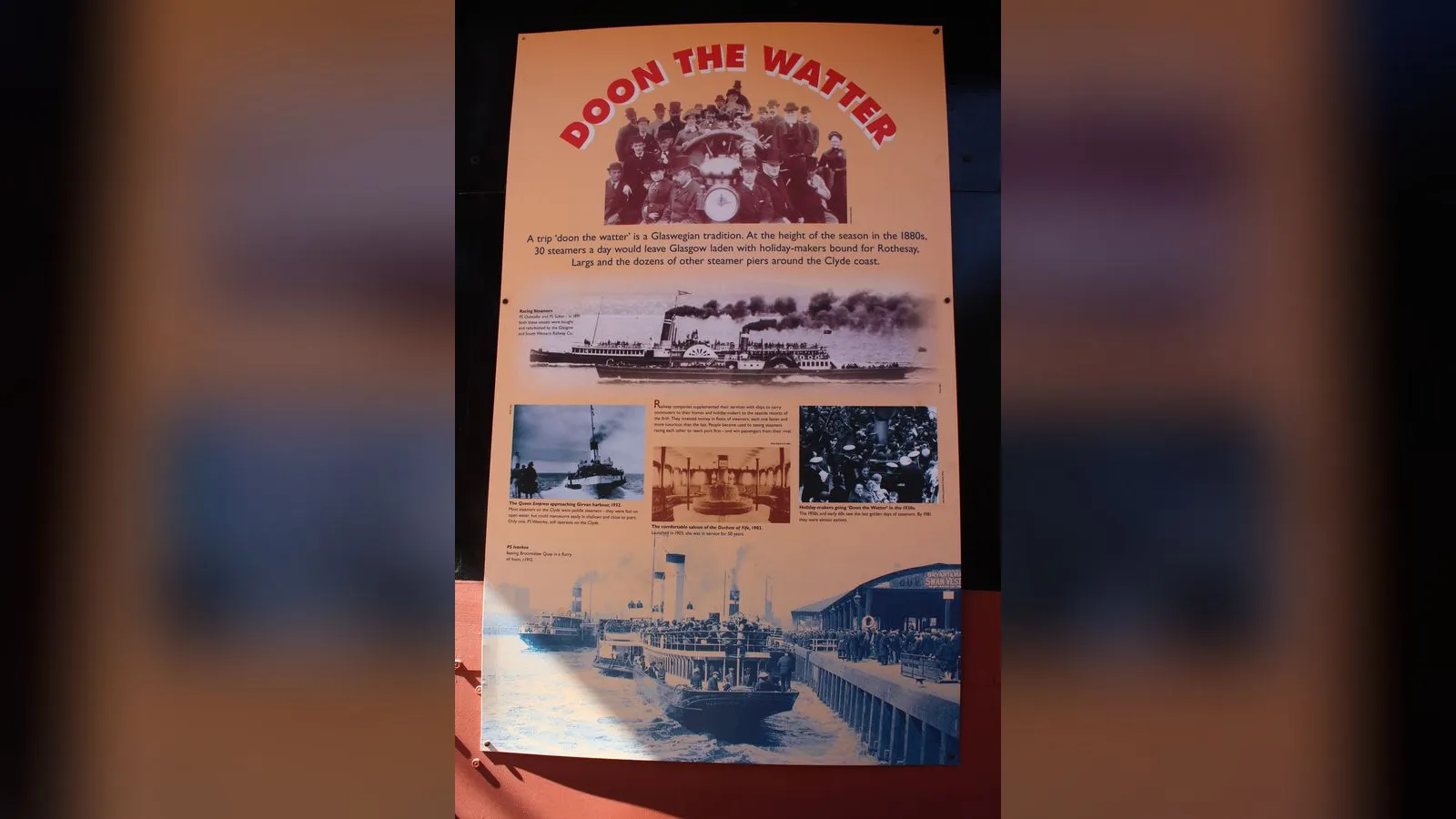
"Doon" and "watter" are Scots renderings of "down" and "water," but the phrase names more than a direction — it names a whole social ritual: leaving industrial Glasgow and Clydeside by steamer for the cleaner air, scenery and amusements of the Firth of Clyde. It is best understood as an idiomatic cultural phrase rather than the formal name of one fixed route: a person could go "doon the watter" for a single day trip, a weekend, the Glasgow Fair fortnight, or as the first stage of a longer summer stay, to any of a recurring set of destinations — Rothesay, Dunoon, Largs, Millport, the Kyles of Bute, Arran, Tighnabruaich, Loch Long, and on longer excursions Campbeltown and Loch Fyne.
This card is careful not to claim a precise date or origin-point for the phrase itself. No sufficiently authoritative source establishes its first printed occurrence, and it very plausibly lived in speech well before it appears reliably in print. The responsible position, consistent with this card's evidence standard, is that the phrase's exact origin remains an open archival question, best pursued through the National Library of Scotland's newspaper collections and the Mitchell Library.
Before Mass Tourism: A Practice That Predates the Phrase
The social practice of Clyde coastal leisure predates the familiar phrase considerably. Glasgow merchant Adam Bald visited Gourock in the 1790s and described relatives caught up in a "saltwater mania," joining in fishing and sailing — valuable evidence precisely because Bald belonged to Glasgow's emerging mercantile middle class, showing that early Clyde coastal leisure depended heavily on having both time and means. By 1826, Bald could describe the coast in verse with steamers already carrying crowds:
"Along the Coast in gaudy steamer paddling"
His account is an unusually early eyewitness glimpse of the social world that would eventually mature into mass "Doon the Watter" culture. Over the following decades this transformation was profound: by the end of the 19th century, Scottish seaside tourism had ceased to be the preserve of the wealthy. Professionals might remove their families to coastal lodgings for weeks at a time; the middling classes could board with a landlady; and industrial workers increasingly gained access to day excursions, holiday weekends and organised outings — even children from poor households might experience an outing through a Sunday school or charitable institution.
The Glasgow Fair Effect: Industrial Time Meets Leisure Time
The industrial holiday calendar concentrated demand in a way that gave "Doon the Watter" its true mass character. Glasgow Fair became strongly associated with workers leaving the city — initially for day excursions, increasingly for full holiday stays — with period imagery from 1925 showing holidaymakers using both rail and paddle-steamer routes to the Firth of Clyde and Ayrshire. This is one reason the practice became culturally larger than an ordinary boat trip: it brought together industrial time and leisure time — factories and trades closed together, families had a defined window in which to travel, and a mature excursion infrastructure already existed to move large numbers of people towards the coast at once.
A Transport Ecosystem, Not Just a Boat Service
The Clyde excursion system worked because railway companies, steamship operators, piers and timetables interlocked as a single leisure geography, rather than functioning as separate services. Passengers could travel from an inland or Glasgow station to a railhead such as Gourock or Wemyss Bay, transfer to a steamer, and continue across the Firth; alternately, some steamers sailed from Glasgow itself, turning the passage past the industrial Clyde into part of the excursion experience. The surviving archival structure of this system — separate record groups for the Caledonian Steam Packet Company, Clyde Coast Pool, Gourock Harbour Company, Greenock and Wemyss Bay Railway, and Williamson-Buchanan Steamers — is itself evidence of how tightly rail and steamer operations were bound together.
Crucially, the system mixed transport with entertainment from an early stage. Boats did not simply deliver passengers; they sold the journey itself, through round trips, evening cruises, scenic circuits and multi-resort calls. TS Queen Mary is a clear example: an excursion vessel by design, certificated for 2,086 passengers, and described by National Historic Ships as the largest vessel ever built specifically for the Clyde excursion trade.
Fares Mattered — Because Everyone Was Travelling
Affordability sat at the centre of mass excursion culture, and the strongest evidence for this is political rather than commercial. In July 1933, MPs debated an LMS proposal to allow pier charges of up to 2d on boarding and a further 2d on return, at Largs, Wemyss Bay, Gourock and Fairlie. MP Neil Maclean warned that "scores of thousands" travelled weekly to Clydeside resorts, while George Buchanan stressed that even an extra fourpence could burden both day-trippers and people travelling daily to work on the same routes. The episode illustrates a genuinely important point: very small changes in price were politically significant precisely because the Clyde excursion network had become part of ordinary working- and lower-middle-class life, not a luxury service for the few. (Detailed historical fare tables survive in period timetables but require direct transcription from the original documents rather than reliance on catalogue summaries, and this card presents fares only as illustrative snapshots for this reason.)
The Resort Geography — and What Steamers Built Ashore
The recurring destination map — Rothesay, Dunoon, Largs, Millport, Arran, Tighnabruaich and the Kyles of Bute, with longer sailings to Campbeltown, Loch Fyne, Loch Long and Loch Goil — is remarkably persistent: modern Waverley timetables still reproduce much of it. A representative 2026 sailing left Glasgow at 10:00, reached Dunoon at 12:15 and Rothesay at 13:15, allowing time ashore before a return to Glasgow at 18:00 — a structure closely recognisable from the classic excursion pattern.
Rothesay in particular offers vivid evidence of what steamer tourism did to a town. Historic-environment and local-authority assessments describe its emergence as a major Victorian and early-20th-century resort, with its promenade, piers, villas and visitor infrastructure reflecting the wealth generated by holiday traffic; a surviving 1930 cabmen's shelter beside the waterfront recalls a local transport economy built specifically around steamer arrivals. More broadly, tourism income across 19th-century coastal Scotland extended well beyond ticket sales — into accommodation, food, guiding, souvenirs and, on Arran, seasonal home-letting — generating real seasonal employment even in relatively remote communities.
Notable Vessels: Queen Mary and Waverley
TS Queen Mary is the ideal vessel for understanding the mass-leisure era. Completed in 1933 by William Denny & Brothers of Dumbarton for Williamson-Buchanan Steamers at a contract price of £61,000, she later passed through Caledonian Steam Packet and Caledonian MacBrayne ownership, carrying hundreds of thousands of excursionists until her withdrawal in 1977. Her design reveals the real aspiration behind mass excursion travel: expansive promenade decks, restaurants and hospitality rooms, with original interiors of teak seating, mahogany furniture and an oak-panelled smoking room. Until 1950 she retained two classes of accommodation — a useful reminder that popular leisure could be genuinely democratic in scale without being socially classless in character. (A curious footnote: her 1934–35 renaming to Queen Mary II arose from an agreement releasing the name for Cunard's new ocean liner.)
PS Waverley represents the paddle-steamer tradition and its remarkable survival. Launched 2 October 1946 and entering service 16 June 1947 — built for the LNER as a replacement for an earlier Waverley lost during the Dunkirk operations — she became, by 1973, the last sea-going paddle steamer still in commercial service, and was withdrawn at the end of that season. Named individuals mattered as much as institutions in her rescue: Douglas McGowan, Terry Sylvester and Peter Reid are credited among the leaders of the campaign that saw the Paddle Steamer Preservation Society's associated company take ownership for the symbolic price of £1 in August 1974, followed by public fundraising that returned her to passenger service in 1975.
Who Actually Went: There Was No Single Clyde Tourist
One of the most useful corrections to the romantic image of "Doon the Watter" is that no single social experience defines it. The better-off could spend long periods away — professional and middle-class households took proper summer vacations at coastal retreats, with cheaper boarding houses providing another rung between expensive hotels and day excursions. An artisan family might instead rent lodgings for Fair Fortnight; a lower-paid worker might manage only a single day excursion; a child might travel through a church or institutional outing. All of these different holidays occupied the same shared Clyde leisure geography, travelling the same steamer routes without sharing identical experiences once ashore.
Queen Mary physically embodied this overlap: capable of carrying huge passenger numbers and affectionately remembered as "the Glasgow Boat," while still retaining differentiated accommodation and waiter-service dining until 1950.
Families and children sit firmly at the centre of post-war memory of the tradition, recalled as a characteristic school-holiday treat. Women were plainly present as travellers, workers and entertainers — the 1904 Rothesay Torchlight Cruises postcard, held at Glasgow University Library, documents performers and is indexed for women, girls, fashions, hats, bagpipers, dancers and musicians — but this card is careful not to overstate what a handful of images can establish about the overall gender balance of Clyde excursion crowds; that would require passenger records, resort visitor data or newspaper reporting not yet assembled.
The Boat as Entertainment Venue
The passage itself was never simply dead travelling time — the journey was part of the holiday. The 1904 Torchlight Cruises postcard documents pre-war evening cruises from Rothesay with onboard entertainment including bagpipes, dancers, drums and musicians, transforming the steamer into a floating entertainment space rather than a mere ferry. Post-war recollections preserve the same sensory pattern: one recorded Glasgow memory recalls a fish-and-chip tea, an accordionist, and passengers joining in communal singing on the way home, while a later Waverley memoir captures "the accordions playing, the irresistible smell of fish and chips." Food, music, sociability, scenery and movement fused into a single, remembered experience.
Alcohol was genuinely part of this social world, though the evidence supports describing it as ordinary licensed hospitality rather than caricaturing Clyde excursions as drunken affairs: Queen Mary had a smoking room and restaurant, and the modern Waverley today carries bars, a dining saloon and tearoom, listing draught and bottled beer, wine, spirits and malt whisky alongside meals, cakes, tea and coffee.
Fish Suppers — and the Unproven Chip-Van Question
Fish and chips deserve real prominence in this card rather than a passing mention, and provide a natural cross-reference to this site's separate Scottish Chippy article. Two independent cultural-memory sources tie fried fish suppers directly to the Clyde steamer experience — but in the evidence reviewed, the fish and chips were served aboard ship, in the vessel's own restaurant, not sold from a van waiting at the pier.
This card is deliberately cautious about extending that connection further. Mobile chip vans are genuinely part of contemporary Scottish waterfront and event culture — documented, for instance, at Tobermory's waterfront and referenced by contemporary visitor reports around Hunter's Quay — but no robust primary evidence was found establishing a continuous historic line from Clyde steamer pier catering to today's mobile chip vans. The honest formulation, and the one this card adopts, is: today the food may come from a café, an onboard galley or a mobile chippy rather than a Victorian refreshment room, but eating by the water remains part of the excursion ritual — an interpretation of continuity in spirit, not a documented lineage of direct descent.
Ashore: Piers, Promenades and Resort Architecture
The arrival mattered nearly as much as the voyage. Piers opened directly onto promenades, transport stands and resort streets; Rothesay's surviving cabmen's shelter shows how an entire last-mile transport economy gathered specifically around steamer arrivals. Visitors could promenade, eat, take in local attractions, travel onward, or simply return to the vessel after a few hours ashore, while longer-stay holidaymakers generated demand for hotels, boarding houses and rented rooms. Resort architecture — piers, esplanades, pavilions and villas, including the later, still-prominent Rothesay Pavilion — should be read as material evidence of the steamer economy, not merely as scenic backdrop.
Songs, Postcards and the Folklore of the Excursion
Few cultural artefacts capture the unruly social side of Clyde holidaymaking as well as "The Day We Went to Rothesay, O," a song belonging to the oral repertoire surrounding excursions to Scotland's most famous Clyde resort, surviving in recorded tradition (a version by singer George Hamilton, collected by folklorist Hamish Henderson, is held by Tobar an Dualchais) and performed in more recent tradition by Ewan McVicar. Its real value for this card is less as a literal documentary record than as evidence of how Rothesay entered urban folklore: the seaside trip could be remembered through drinking, mishap, sociability and comic disorder, as well as scenery.
Postcards sat at the intersection of advertising, memory and communication. The 1904 Torchlight Cruises postcard (Glasgow University Library Special Collections, Jimmy Logan Collection, ref. STA JLC PP 347) is an especially rich single visual object, combining music, costume, gender and excursion travel in one image. Period railway and steamship timetables — such as the 1931 LMS/Caledonian Steam Packet programme and the 1961 Clyde Coast Steamer Services timetable — are equally valuable, showing how leisure was organised visually: a family could read a timetable and convert the geography of the Firth into a menu of possible days out.
War, Decline and Preservation
It would be too simple to say the world wars merely stopped the steamers — ships and crews were repurposed rather than idled. During the Second World War, Queen Mary II was painted grey and spent more than six years maintaining the Gourock–Dunoon service while also acting as a tender to ocean-going vessels, her draught having made her unsuitable for minesweeping duty. The present Waverley was itself born from this same wartime disruption, built as a post-war replacement for an earlier Waverley lost during the Dunkirk operations.
The post-war decline of the classic excursion fleet was gradual rather than sudden. Rising private car ownership, improved roads, the restructuring of railway and ferry services, and widening choices in domestic and foreign holidays together eroded the conditions that had made high-volume excursion steamers commercially viable. By the early 1970s the classic fleet had contracted dramatically: Waverley was withdrawn in 1973 and Queen Mary followed in 1977. This card does not attempt to weight these causes precisely against one another — that would require statistical verification from traffic figures and company accounts not yet assembled from the archival record — and presents the decline as multi-causal rather than attributing it to any single factor.
Preservation changed the meaning of the journey rather than ending it. Waverley survived because enthusiasts transformed a declining transport asset into living heritage: offered to the Paddle Steamer Preservation Society in November 1973, formally transferred for £1 on 8 August 1974, and returned to passenger service in 1975 after fundraising and refit work. Before preservation, an excursion steamer was simply commonplace infrastructure; afterwards, the steam engine, paddles and vessel itself became part of the attraction. Yet that distinction should not be overstated — the basic form of the day out remains strikingly familiar. Waverley's 2026 Glasgow programme again offers Rothesay visits, Kyles of Bute cruises, Arran, Loch Long, Loch Fyne and Campbeltown, recreating the same temporal shape as the classic excursion: a morning departure, several hours on the water, time ashore, and an evening return to Glasgow.
A Distinctively Clyde Tradition, Within a Wider British One
"Doon the Watter" is specifically Clyde language and Clyde cultural geography, but it belongs to a larger British tradition of pleasure-steamer and railway excursion culture. On Scotland's west coast, Oban developed its own steamer itineraries to Mull, Iona, Staffa and Fort William, and Waverley's modern national programme extends the comparison directly — in 2026 she also sailed routes in the Bristol Channel and South Wales, North Wales and the Mersey, the South Coast and Isle of Wight, and the Thames Estuary, alongside her Clyde sailings, while the Paddle Steamer Preservation Society separately supports the surviving Kingswear Castle on the River Dart in Devon. What makes the Clyde case distinctive, on the evidence reviewed, is the exceptional concentration of an industrial city, a navigable river, railheads, sea lochs, islands and seaside resorts within a comparatively compact excursion system — a conclusion well supported by the historical route density in Clyde timetables, though it remains an interpretation rather than a formally measured comparison.
The Phrase Survives
The clearest evidence that "Doon the Watter" remains living culture, not merely history, is its continued active use. A contemporary Clyde cruise operator still markets a trip under the exact name "Doon the Watter," explicitly connecting it to Glasgow workers leaving factories and shipyards for Clyde resorts. Dunoon's 2026 Doon the Watter Revival Music Festival uses the phrase to market a waterfront weekend of Mod, Ska, Northern Soul and Indie music — not a literal recreation of a Victorian steamer excursion, but proof the phrase still evokes west-coast leisure, escape and nostalgia to a contemporary audience. A 2026 children's theatre production uses Doon the Watter as the title of a seaside adventure in which two sisters travel to a favourite island — revealing evidence that the phrase now functions as cultural shorthand for a waterside family adventure even for audiences far removed from the original industrial-holiday economy that produced it.
Meanwhile, Waverley provides literal, physical continuity: named National Historic Ships' National Flagship in 2024, she continues in 2026 to carry passengers from Glasgow towards the same Clyde resorts that generations of Glasgow families visited before them — and Queen Mary, returned to the Clyde in 2016 as a major ongoing conservation project, preserves the physical fabric of the excursion era even as her own operational future continues to evolve.
Did You Know?
- Glasgow merchant Adam Bald was writing about crowds travelling the Clyde coast by "gaudy steamer" as early as 1826 — decades before "Doon the Watter" became a mass working-class institution.
- A 1933 House of Commons debate treated a proposed extra fourpence in Clyde pier charges as a serious political issue, because "scores of thousands" of ordinary people travelled the routes every week.
- TS Queen Mary, launched in 1933, was certificated to carry 2,086 passengers — more than any vessel ever built specifically for the Clyde excursion trade — yet still kept two classes of accommodation until 1950.
- The current PS Waverley only exists because an earlier ship of the same name was lost during the Dunkirk evacuation.
- Waverley was saved from scrapping in 1974 for a purchase price of just £1, thanks to a campaign led by Douglas McGowan, Terry Sylvester and Peter Reid.
- A 1904 postcard of Rothesay's "Torchlight Cruises" shows bagpipers, dancers, drummers and musicians entertaining passengers on evening steamer trips — proof the party atmosphere long predates modern nostalgia about it.
- The phrase "Doon the Watter" is still very much alive: it now names a 2026 Dunoon music festival featuring Mod, Ska, Northern Soul and Indie acts, and a 2026 children's theatre production about two sisters travelling to a favourite island.
- Despite fish and chips being well documented as part of the Clyde steamer experience — served aboard ship — there is no solid archival evidence of a genuine historic Clyde pier chip-van tradition connecting to today's mobile seaside vans.
FAQ
1
- What does "Doon the Watter" actually mean?
It's Scots for "down the water" — travelling down the River Clyde from Glasgow towards the Firth of Clyde and the sea, traditionally by steamer, for anything from a single day excursion to a full summer holiday.
2
- Where did people go "doon the watter" to?
A recurring set of Firth of Clyde resorts and destinations: Rothesay, Dunoon, Largs, Millport, Arran, the Kyles of Bute, Tighnabruaich and, on longer trips, Campbeltown and Loch Fyne.
3
- When did the phrase first appear?
This is genuinely unresolved. No sufficiently authoritative source establishes its first printed use, so this card does not attach it to a specific year or coiner — treat any confident single date you see elsewhere with caution.
4
- Was "Doon the Watter" purely a working-class tradition?
No — this is an oversimplification. Professional and middle-class families could afford extended coastal stays; artisan families typically took lodgings for Glasgow Fair fortnight; and lower-paid workers more often managed a single day excursion. All shared the same steamer routes without sharing the same holiday.
5
- What made the Glasgow Fair so important to this tradition?
It concentrated industrial and leisure time together — factories and trades closing in the same window gave large numbers of workers a defined period to travel, which the existing rail-and-steamer excursion network was built to serve at scale.
6
- What was TS Queen Mary?
The largest vessel ever built specifically for the Clyde excursion trade, launched in 1933, certificated for 2,086 passengers, and affectionately remembered as "the Glasgow Boat." She served until her withdrawal in 1977.
7
- Is it true you can still go "doon the watter" today?
Yes. PS Waverley — the world's last sea-going paddle steamer — still sails Glasgow–Dunoon–Rothesay and other classic Clyde routes every summer, including in 2026, alongside a wider UK excursion programme.
8
- How did Waverley survive when the rest of the fleet didn't?
She was withdrawn from commercial service in 1973 but transferred to the Paddle Steamer Preservation Society for a symbolic £1 in August 1974; public fundraising and refit work returned her to passenger service in 1975.
9
- Was music and entertainment really part of the trip?
Yes, genuinely and from early on — a 1904 postcard documents onboard entertainers (bagpipers, dancers, drummers) on Rothesay evening "Torchlight Cruises," and later 20th-century memories consistently recall accordion music and communal singing on the way home.
10
- Is the link between Clyde steamers and today's seaside chip vans historically proven?
No — this is an important distinction this card makes deliberately. Fish and chips are well documented as part of the onboard steamer experience; a continuous historic line to today's mobile pier-side chip vans is a plausible but currently unproven connection.
11
- Why did the classic Clyde steamer fleet decline after WWII?
A combination of factors — rising car ownership, improved roads, railway and ferry restructuring, and changing domestic and foreign holiday habits — gradually eroded the conditions that had made mass excursion steamers profitable. The precise weight of each cause is not yet established from traffic and company-account records.
12
- Is "Doon the Watter" only historical, or is it still culturally active?
Very much still active. It names a contemporary Clyde cruise product, Dunoon's 2026 "Doon the Watter Revival" music festival, and a 2026 children's theatre show — evidence the phrase still carries real cultural meaning well beyond its original industrial-holiday context.
Sources and Further Reading
Primary / Institutional
- National Records of Scotland — British Railways fonds (Caledonian Steam Packet Company, Clyde Coast Pool, Gourock Harbour Company, Greenock and Wemyss Bay Railway, Williamson-Buchanan Steamers; timetables and marine records)
- National Historic Ships UK — TS Queen Mary and PS Waverley vessel histories and National Historic Fleet records
- University of Glasgow Archives & Special Collections — William Denny & Brothers papers (UGD 3); Jimmy Logan Collection (1904 Torchlight Cruises postcard, ref. STA JLC PP 347)
- Historic Environment Scotland / Argyll & Bute local-authority records — Rothesay resort architecture, piers, promenades and the cabmen's shelter
- Waverley Excursions / Paddle Steamer Preservation Society — historic and modern timetables, preservation history
Scholarly
- Alastair Durie (ed.), Scottish History Society edition of early Scottish travellers' journals, including Adam Bald's Gourock and Clyde coast accounts (1790s–1826)
- Tobar an Dualchais / Scotland's Sounds — "The Day We Went to Rothesay, O," recorded from singer George Hamilton, collected by Hamish Henderson
- Scots Language Centre — performance of "The Day We Went to Rothesay, O" by Ewan McVicar
General
- TheGlasgowStory — Glasgow Fair (1925) and post-war Clyde excursion memory (fish-and-chip tea, accordion, communal singing)
- Robin McKelvie — contemporary Argyll tourism memoir recalling childhood Waverley trips
- Reporting on Dunoon's 2026 "Doon the Watter Revival" music festival and a 2026 children's theatre production titled Doon the Watter
- Contemporary Clyde cruise operator marketing material using "Doon the Watter" as a branded trip name
Caveats: Myths and Disputed Claims
- Do not assign "Doon the Watter" a specific coiner or first-use date — this remains an unresolved archival question, not an established fact.
- Do not present "Doon the Watter" as a purely working-class tradition — the evidence shows a genuinely mixed social world, from extended middle-class coastal stays to single-day working-class excursions, sharing the same routes without sharing the same holiday.
- Do not state precise historic ticket fares as verified figures without noting they require direct transcription from original timetable documents rather than catalogue summaries.
- Do not make confident claims about the gender balance of Clyde excursion crowds based on the available photographic evidence alone — this would need passenger records or resort visitor data not yet assembled.
- Do not attribute the post-war decline of the Clyde excursion fleet to a single cause (e.g. "the car killed it") — the evidence points to multiple simultaneous factors whose relative weight is not yet statistically established.
- Do not present a continuous, documented historical line from Victorian steamer pier catering to today's mobile seaside chip vans — fish and chips are well documented aboard ship, but a specific historic Clyde pier chip-van tradition is not established in the sources reviewed; treat any stated connection as interpretation, not documented fact.
- Do not reduce this subject to a transport or engineering history — the ships and timetables matter here specifically because of the culture and social ritual they made possible, which is the card's actual subject.
Card 039 · Traditions