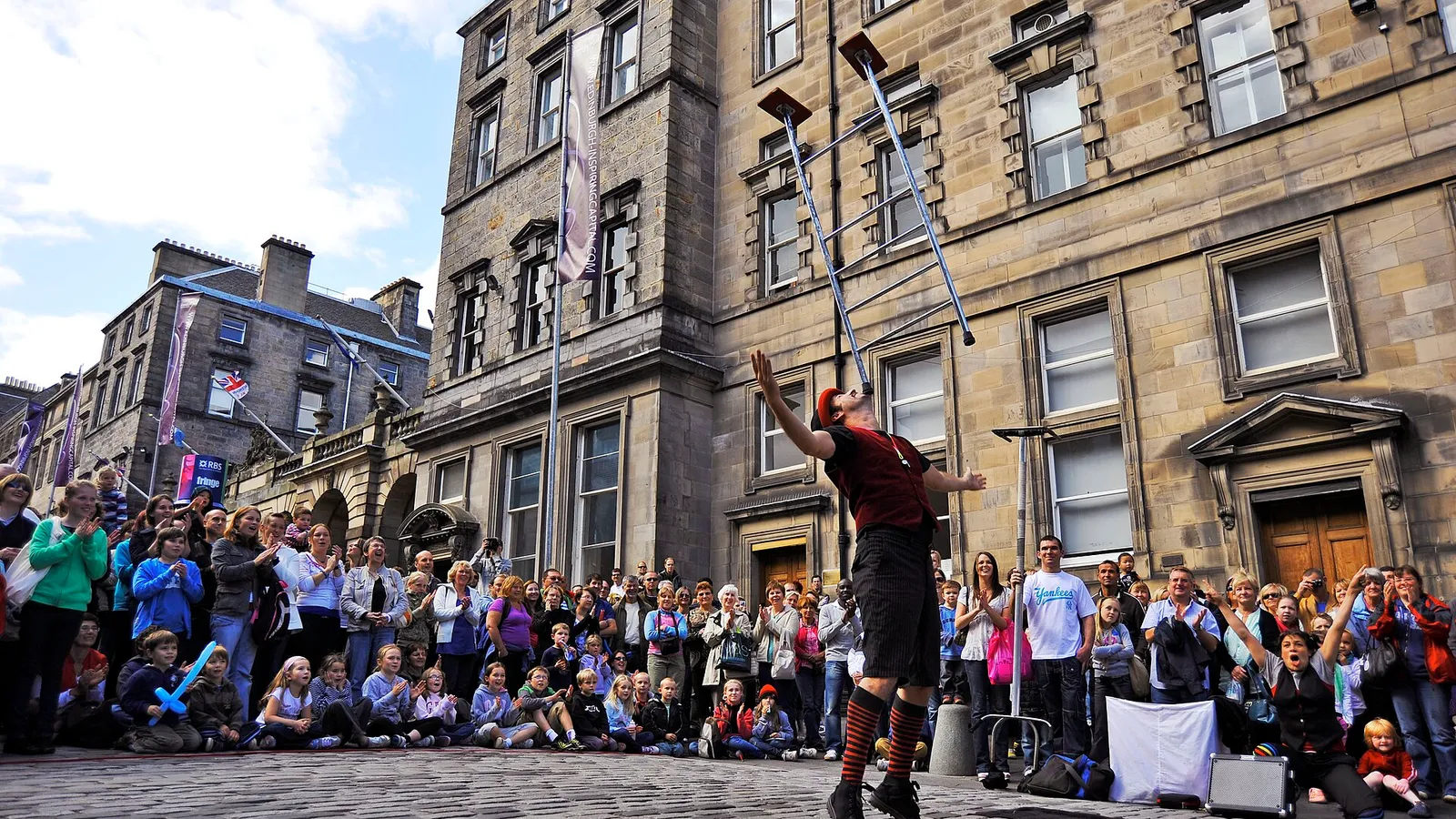

The Edinburgh Festival Fringe
Contents
Every August, Edinburgh hosts the largest open arts festival in the world: thousands of shows of comedy, theatre, music and everything else, in hundreds of venues from theatres to lecture halls and cupboards. The Fringe began in 1947 when eight theatre groups who had not been invited to the new Edinburgh International Festival turned up and performed anyway. This card tests its origins, its claims to size, and the pressures on it now.
TL;DR
- established The Edinburgh International Festival was founded in 1947 to reunite people through art after the Second World War. Its first director was Rudolf Bing.
- established In the same year, eight theatre groups who had not been invited performed in Edinburgh and Dunfermline anyway. They did not coordinate; the idea of a planned "revolt" is a later simplification.
- established The name "fringe" was popularised in 1948, when the playwright Robert Kemp wrote of drama "round the fringe" of the official festival.
- established The Fringe is open access: there is no selection committee, and anyone may put on a show. In 2025 it issued an estimated 2.6 million tickets for 3,893 shows in 301 venues.
- shared The claim that the Edinburgh festivals are the third-largest ticketed event in the world, after the Olympics and the World Cup, is widely repeated but comes from the festivals' own promotion.
Key Facts
- International Festival founded
- 1947 (first director Rudolf Bing)
- First uninvited groups
- 8 (six Scottish, two English), 1947
- "Fringe" popularised
- Robert Kemp, Edinburgh Evening News, 14 August 1948
- Festival Fringe Society
- Formed 1958–59
- Principle
- Open access: no selection
- Fringe First awards
- Founded 1973 by Allen Wright of The Scotsman
- Comedy awards
- Perrier Award from 1981; now the Edinburgh Comedy Awards
- 2025
- c.2.6 million tickets; 3,893 shows; 53,942 performances; 301 venues; 62 countries
A Note on Claims and Evidence
Each major claim carries one of three labels. established means supported by primary records, official bodies or several independent reliable sources. shared means the core fact is sound but sources disagree on details, dates or interpretation. traditional means widely repeated but not traceable to a primary or independent source.
The Fringe's history is well recorded, and its annual figures are published by the Fringe Society. The weak points are superlatives: comparisons with the Olympics and the World Cup are promotional, and ticket figures are "issued" tickets, including free ones, rather than sales. Some founding details, such as the year the Fringe Society was formed, differ between sources.
Timeline
Plans for an Edinburgh International Festival are announced.
The first Edinburgh International Festival is held; eight uninvited theatre groups perform alongside it.
Robert Kemp's article "More that is Fresh in Drama" describes activity "round the fringe" of the festival.
First discussions of a body to coordinate the Fringe.
The Festival Fringe Society is formed.
The Scotsman introduces the Fringe First awards for new writing.
The first Perrier Award for comedy goes to the Cambridge Footlights.
The comedy prizes are relaunched as the Edinburgh Comedy Awards.
The Fringe issues an estimated 2.6 million tickets for 3,893 shows.
Details
A festival to heal a continent
established The Edinburgh International Festival was announced in November 1945 and first held in 1947. Its founding idea was to bring people together through great art after the darkness and division of the war. Rudolf Bing, an Austrian-born opera manager, became its first director, working with the Lord Provost, the City of Edinburgh Council and the British Council. Rationing was still in force: when the Minister for Fuel and Power banned floodlighting the castle, residents gave up their own coal rations so it could be lit for four nights.
The eight who weren't invited
established In 1947 eight theatre groups who had not been invited to the official festival came and performed anyway: six Scottish and two English. They included Glasgow Unity Theatre, Edinburgh's Christine Orr Players and the Manchester Marionette Theatre, playing in venues such as the YMCA on South St Andrew Street, the Pleasance Little Theatre and the Gateway Theatre on Leith Walk; one production was staged in Dunfermline Abbey.
shared The Fringe is often described as an organised act of defiance. In fact the groups do not appear to have coordinated or even contacted each other. Their shared act was simply turning up uninvited.
The name
established The word "fringe" took hold after a 1948 article by the Scottish playwright and journalist Robert Kemp in the Edinburgh Evening News, which described the drama happening "round the fringe" of the official festival. A critic had already used the phrase in 1947, describing the Dunfermline Abbey production as being "on the fringe of the Festival".
Open access
established The Fringe's defining rule is open access: there is no selection committee, and anyone may take part with any kind of show. The Festival Fringe Society, formed at the end of the 1950s, does not choose the programme; it publishes it, sells tickets and supports the performers. That openness is why the Fringe grew so large and so varied, and why it became the starting point for generations of comedians, writers and actors.
Awards
established The Scotsman's Fringe First awards, created in 1973 by its arts editor Allen Wright, reward new plays and new translations. The Perrier Award for comedy began in 1981, when the Cambridge Footlights won; after Perrier ended its sponsorship, the prize was relaunched in 2010 as the Edinburgh Comedy Awards.
How big is it?
established In 2025 the Fringe issued an estimated 2,604,404 tickets for 3,893 shows, in 53,942 performances across 301 venues, with performers from 62 countries.
shared The Fringe is widely described as the world's largest arts festival. The further claim that the Edinburgh festivals together are the third-largest ticketed event in the world, after the Olympics and the FIFA World Cup, is repeated often but comes from the festivals' own promotion rather than independent measurement.
The cost of taking part
established The Fringe's openness is under pressure from cost. Accommodation in Edinburgh in August has become very expensive for performers and audiences, alongside registration fees and venue hire. In 2025 the Fringe Society's chief executive, Tony Lankester, said there were "no easy answers" to the cost of participating, and called on the city and the Scottish and UK governments to keep working with performers on it.
Did You Know?
- The Fringe began with eight groups who had not been invited.
- One of the first Fringe shows was staged in Dunfermline Abbey.
- Edinburgh residents gave up coal rations to light the castle during the first festival.
- The word "fringe" took hold after a 1948 newspaper article.
- No one selects which shows appear at the Fringe.
- The first Perrier comedy award went to the Cambridge Footlights in 1981.
- In 2025 there were 53,942 Fringe performances.
- Performers came from 62 countries in 2025.
FAQ
1How did the Fringe start?
In 1947 eight theatre groups not invited to the new Edinburgh International Festival performed anyway.
2Was it an organised protest?
No. The groups did not coordinate; they each simply turned up.
3Who named it the Fringe?
The term took hold after Robert Kemp's 1948 article about drama "round the fringe" of the festival.
4What does "open access" mean?
Anyone can perform; there is no selection committee.
5How big is the Fringe?
In 2025, an estimated 2.6 million tickets for 3,893 shows in 301 venues.
6Is it the third-biggest ticketed event in the world?
That is a promotional claim, not an independently verified ranking.
7What is the Edinburgh International Festival?
The curated festival founded in 1947, alongside which the Fringe grew.
8What are the Fringe Firsts?
Awards for new writing, created by The Scotsman in 1973.
9What is the Edinburgh Comedy Award?
The successor to the Perrier Award, first given in 1981.
10Why is the Fringe so expensive for performers?
Mainly because of accommodation, venue hire and registration costs in August.
Sources and Further Reading
Primary/Institutional
- Edinburgh Festival Fringe Society, "An exciting and energising Edinburgh Festival Fringe 2025 comes to a close" (edfringe.com)
- Edinburgh International Festival, "Our history" (eif.co.uk)
General
- Wikipedia, "Edinburgh Festival Fringe 1947" (en.wikipedia.org)
- Wikipedia, "Edinburgh Festival Fringe" (en.wikipedia.org)
Caveats: Myths and Disputed Claims
- Do not describe the 1947 groups as a coordinated revolt.
- Do not date the word "fringe" to 1947 as the festival's name; it took hold in 1948.
- Do not present the "third-largest ticketed event after the Olympics and World Cup" claim as independently verified.
- Do not confuse tickets issued, which include free tickets, with tickets sold.
Card 019 · Traditions