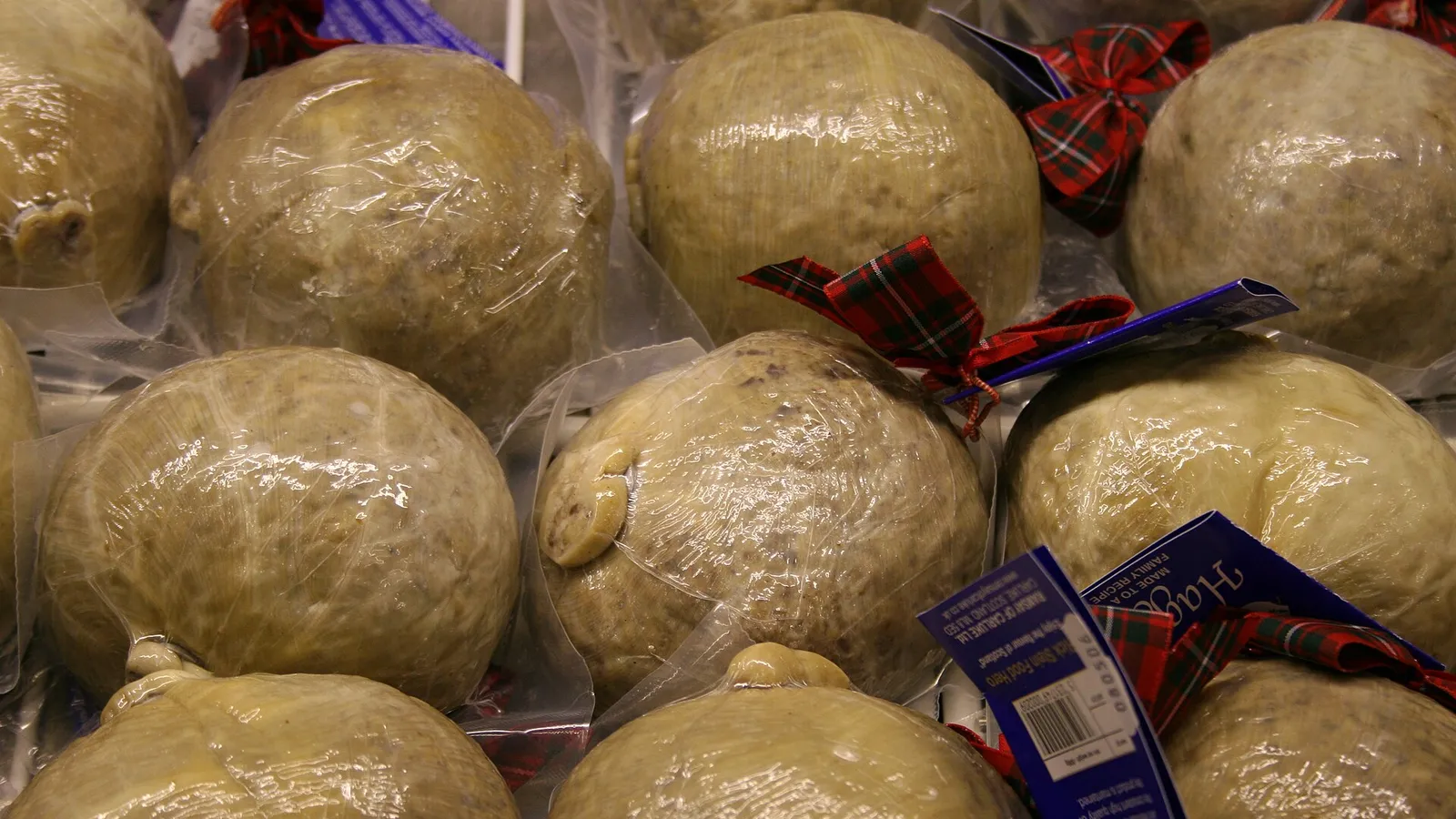

Haggis: Scotland's National Dish
Contents
Haggis is a savoury pudding of sheep's offal, oatmeal, suet, onion and spice, cooked in a casing that was traditionally the animal's stomach. It is the centrepiece of every Burns Supper and Scotland's best-known dish. Yet the oldest surviving recipe is English, the word's origin is unknown, and offal puddings like it are found across Europe. This card tests what is genuinely Scottish about haggis: not its invention, but the long Scottish history that made it a national symbol.
TL;DR
- established Haggis was eaten in Scotland long before Burns. The Dictionary of the Older Scottish Tongue dates the word in Scots to c.1500–1512, in William Dunbar's Flyting.
- established The oldest surviving haggis recipe is English: "hagese" in Liber Cure Cocorum, a Lancashire cookery book in verse from around 1430.
- established The origin of the word is unknown. Theories link it to French hacher, "to chop", or to Norse and Scots words meaning "to hew"; none is proven.
- established Robert Burns's poem "To a Haggis" (1786) did not invent the dish's Scottishness. Scholars at Glasgow argue he took an existing national symbol and "supercharged" it.
- established Haggis made the traditional way cannot legally be sold in the United States, because US meat rules bar livestock lungs from human food. Versions without lung, and vegetarian haggis, can be.
Key Facts
- What it is
- A savoury pudding of sheep's heart, liver and lungs with oatmeal, suet, onion and spice
- Traditional casing
- Sheep's stomach (modern haggis often uses an artificial casing)
- Oldest surviving recipe
- "Hagese", Liber Cure Cocorum, Lancashire, c.1430
- Earliest Scots use of the word
- c.1500–1512, Dunbar's Flyting
- Origin of the word
- Unknown
- Burns's poem
- "To a Haggis", 1786
- First Burns Supper
- 21 July 1801, Burns Cottage, Alloway
- First commercial vegetarian haggis
- Macsween, 1984
- US position
- Livestock lungs barred from human food (9 CFR 310.16)
Scottish Impact Index (SI Score)
- Cultural Reach
- 10/10
- Continuity of Tradition
- 10/10
- Social & Economic Importance
- 8/10
- Scottish Distinctiveness
- 10/10
- Cultural Legacy
- 10/10
- Recognition
- 10/10
58/60
Ranked =2nd of 19 in Traditions
A Note on Claims and Evidence
Each major claim carries one of three labels. established means supported by primary records, official bodies or several independent reliable sources. shared means the core fact is sound but sources disagree on details, dates or interpretation. traditional means widely repeated but not traceable to a primary or independent source.
The weakest parts of the haggis story are its deep origins. Dictionaries agree the word's origin is unknown, and claims that haggis descends from Roman, Greek or Viking dishes show only that offal puddings are ancient and widespread, not that haggis came from any one of them. Sales and market-share figures for modern producers come from the companies themselves.
Timeline
"Hagese" appears in Liber Cure Cocorum, a Lancashire verse cookery book: the oldest surviving haggis recipe.
William Dunbar's Flyting of Dunbar and Kennedie gives the earliest recorded use of the word in Scots.
Gervase Markham's The English Huswife includes haggis among English dishes.
Allan Ramsay's The Gentle Shepherd mentions "haggies".
Tobias Smollett describes haggis in Humphry Clinker.
Robert Fergusson praises haggis in verse, a direct influence on Burns.
Robert Burns publishes "To a Haggis".
The first Burns Supper is held at Burns Cottage, Alloway.
Meg Dods's Cook and Housewife's Manual puts haggis at the head of its "Scotch National Dishes".
F. Marian McNeill's The Scots Kitchen records the cottage method, festival uses and literary lore of haggis (second edition 1963).
Charlie and Jean Macsween open a butcher's shop in Bruntsfield, Edinburgh.
Robin Dunseath invents "haggis hurling" as a joke.
John Macsween creates a vegetarian haggis to mark the opening of the Scottish Poetry Library.
Macsween opens a dedicated haggis factory at Loanhead.
Dunseath admits haggis hurling was a hoax.
A US doctor petitions the Department of Agriculture to allow livestock lungs as food.
Details
A dish older than Burns, and older than Scotland's claim to it
established The oldest recipe for haggis is English. Liber Cure Cocorum, a Lancashire cookery book written in verse around 1430, gives a recipe for "hagese": minced offal mixed with oatmeal, suet, onion and spices, stuffed into a sheep's stomach and boiled. Gervase Markham's The English Huswife (1615) treats it as an ordinary English dish. Similar offal puddings were made across Europe as a thrifty way to use the parts of an animal that spoil first.
established Haggis was also part of Scottish food long before Burns. The Dictionary of the Older Scottish Tongue records the word "haggeis" from c.1500–1512, in the Flyting of Dunbar and Kennedie, a poetic duel of insults at the court of James IV. A chain of later Scottish writers mention it: Allan Ramsay in 1725, Tobias Smollett in 1771, and Robert Fergusson in 1773, whose verse Burns knew well.
traditional One common explanation for why haggis became Scottish rather than English is that the English, growing wealthier in the 17th and 18th centuries, gave up offal while poorer Scots kept eating it. It is a plausible story, but it is an interpretation rather than a documented fact.
Where does the word come from?
established No one knows. The Dictionary of the Older Scottish Tongue gives the origin as unknown and records Middle English forms such as "hagese" from about 1420. Three ideas compete. One links the word to French hacher, "to chop", the root of "hash". Another links it to Norse and Scots words meaning "to hew" or "chop", which supports the romantic idea that haggis arrived with the Vikings. A third, now little favoured, links it to French agasse, "magpie". None is proven, so the claim that haggis is definitely a Viking word should not be repeated as fact.
shared The folklorist F. Marian McNeill, in The Scots Kitchen (1929; second edition 1963), records that the name was "commonly thought" to come from French hachis, but in the 1963 text she preferred a native root, hag, "to hack or chop", following the Scottish National Dictionary. She dismissed the idea that haggis was a French legacy at all. She also passed on, without a source, the claim that the French called it le pain bénit d'Écosse, "the blessed bread of Scotland"; that phrase should be treated as traditional.
What goes into it
established A traditional haggis uses a sheep's pluck: the heart, liver and lungs. These are minced and mixed with suet, toasted oatmeal, onion, stock, salt and pepper, and spices such as nutmeg or mace, then packed into a cleaned sheep's stomach and simmered gently for several hours, below boiling so that it does not burst. Much modern haggis uses an artificial casing, and recipes have always varied. Meg Dods's 1826 recipe, for example, used beef suet and stock.
established Haggis belongs to the same family as black and white pudding: a sausage or pudding made from parts of the animal that would otherwise go to waste. McNeill called it "simply a super-sausage", reading Burns's "great chieftain o' the puddin-race" as chief of the sausage family.
shared McNeill pointed to a stuffed sheep's paunch that bursts in Aristophanes' comedy The Clouds, and to a Roman stuffed-paunch recipe of pork, suet and spices in the cookery book attributed to Apicius. These show that paunch puddings are ancient and once common to many lands. They do not show that haggis descends from either.
How it was made, served and kept
established McNeill gives a traditional cottage recipe that shows the old method in detail. The oatmeal was pinhead (coarse) meal, toasted or "birstled" before the fire. The sheep's pluck was boiled with the windpipe hung over the side of the pot so that impurities could drain away. The heart and lights were minced and about half the liver grated, then mixed with suet, onion, pepper and salt and moistened with the pluck liquor or stock. The stomach bag was filled only about five-eighths full, because the oatmeal swells, pricked with a large needle as it began to swell, and boiled for about three hours. She notes that some housewives held that a pinch of cayenne "makes all the difference".
established She records that the usual accompaniments were mashed potatoes and mashed turnips, or the two mashed together with dripping as the Orkney dish clapshot. A haggis could be kept for a time buried in oatmeal in the girnel, the household meal chest. She also gives shortcuts already in use in her day: haggis steamed in a buttered jar or basin, and "haggis-in-the-pan", cooked loose like a stew with no casing.
established Older and grander versions survive through McNeill's sources. Meg Dods's recipe (1826) added small scalded onions and a squeeze of lemon or vinegar, and her "Haggis Royal" was made of chopped leg of mutton, marrow, anchovies, egg yolks and red wine, baked in a veal caul. McNeill also prints a deer haggis "from the kitchen of a Highland chief", using the deer's heart, liver and suet, boiled in a basin under a paste crust.
established At table, McNeill quotes T. F. Henderson's Old-World Scotland on the peasant haggis set in the middle of the table, with everyone gathered round with horn spoons. Some carvers, she notes, began by cutting a St Andrew's cross on the top. In her calendar of festival dishes, haggis belongs to Martinmas (11 November), when the winter mart, or beef animal, was killed and salted, along with black and white puddings, and to St Andrew's Day (30 November), with singed sheep's head.
established Not every visitor approved. McNeill quotes the English traveller in Smollett's Humphry Clinker, who was "not yet Scotchman enough to relish their singed sheep's head and haggis", and on the other side George Saintsbury, the Edinburgh professor and food writer, who called those who refused haggis and sheep's head "fools". She also records that Queen Victoria tried haggis at Blair Castle and "really liked very much".
Burns and the making of a national symbol
established Robert Burns's "To a Haggis", published in 1786, is the reason haggis is carried in to bagpipes at Burns Suppers around the world. But Burns did not make haggis Scottish from nothing. In research presented in January 2026, Professor Gerard Carruthers of the University of Glasgow and Dr Paul Malgrati of the University of the Highlands and Islands argued that Burns "supercharged" a symbol that already existed. His mock-heroic poem built on earlier writers, including Allan Ramsay and Robert Fergusson, who praised plain Scottish food against foreign luxury. The first Burns Supper was held at Burns Cottage in Alloway on 21 July 1801.
established By 1826 haggis was formally a national dish. Meg Dods's Cook and Housewife's Manual, written under that pen name by the journalist Christian Isobel Johnstone, placed it at the head of its chapter on "Scotch National Dishes".
The modern haggis
established Macsween of Edinburgh began as a butcher's shop opened in Bruntsfield in 1953 by Charlie and Jean Macsween. Their son John took over in 1975, turned the business towards haggis, and in 1984 created a vegetarian haggis to mark the opening of the Scottish Poetry Library. It is widely credited as the first commercial vegetarian haggis. In 1996 the family opened what it describes as the world's first dedicated haggis factory, at Loanhead. Other major producers include Simon Howie of Perthshire.
traditional Haggis now appears far beyond the Burns Supper: as haggis suppers in chip shops, in fine-dining restaurants, and in Scottish-Asian dishes such as haggis pakora, which grew out of Glasgow's South Asian restaurants. Producers' figures for how many haggises are sold each year come from the companies themselves.
Why traditional haggis is banned in the United States
established US meat inspection rules state that "livestock lungs shall not be saved for use as human food" (9 CFR 310.16). The rule followed US Department of Agriculture studies around 1969 that found contaminants in animal lungs. It is not a ban on haggis as such, but because traditional haggis contains sheep's lung, it cannot be sold in the US. Lung-free and vegetarian versions can be. In January 2023 a Philadelphia doctor, Jonathan Reisman, petitioned the department to allow lungs as food again; the petition was sent for review.
Haggis hurling: an invented tradition
established Throwing a haggis for distance is often described as an ancient Highland sport. It is not. Robin Dunseath invented it in 1977, placing a newspaper advertisement for a world championship at the Gathering of the Clans in Edinburgh. He admitted the hoax in 2004, saying he had wanted to "gauge the gullibility of the Scots". It survives as a charity novelty event; the record of 217 feet was set by Lorne Coltart at the Milngavie Highland Games on 11 June 2011.
Did You Know?
- The oldest surviving haggis recipe is from Lancashire, written in verse around 1430.
- The first recorded use of the word in Scots is in a poetic exchange of insults, the Flyting of Dunbar and Kennedie.
- Haggis does contain lung, which is why traditional haggis is banned in the United States.
- The first Burns Supper was held in July 1801, on the fifth anniversary of Burns's death, not on his birthday.
- Vegetarian haggis was first made commercially in 1984, to celebrate the opening of the Scottish Poetry Library.
- Haggis hurling was invented as a joke in 1977.
- Meg Dods, who put haggis at the head of Scotland's national dishes in 1826, was a pen name.
- Nobody knows for certain where the word "haggis" comes from.
- Some carvers began by cutting a St Andrew's cross on top of the haggis, McNeill records.
- A haggis could be stored buried in oatmeal in the household meal chest.
FAQ
1Is haggis Scottish?
It is Scotland's national dish and has been eaten in Scotland for at least five centuries, but the oldest surviving recipe is English and similar dishes exist across Europe.
2What is haggis made of?
Traditionally sheep's heart, liver and lungs, minced with oatmeal, suet, onion and spices and cooked in a sheep's stomach.
3What is the oldest haggis recipe?
"Hagese" in Liber Cure Cocorum, a Lancashire cookery book of about 1430.
4When was haggis first mentioned in Scotland?
In William Dunbar's Flyting, dated c.1500–1512.
5Where does the word "haggis" come from?
Its origin is unknown. French, Norse and Scots roots have all been suggested.
6Did Burns invent haggis as a national dish?
No. He made it famous with "To a Haggis" in 1786, building on earlier Scottish writers who already praised it.
7Why is haggis banned in the US?
US rules bar livestock lungs from human food. Haggis without lung, and vegetarian haggis, can be sold.
8Is there a vegetarian haggis?
Yes. Macsween made the first commercial one in 1984.
9Is haggis hurling an ancient sport?
No. It was invented in 1977 and admitted as a hoax in 2004.
10What is the haggis hurling record?
217 feet, set by Lorne Coltart at the Milngavie Highland Games in 2011.
11Is there one authentic haggis recipe?
No. Recipes have varied for centuries, and modern haggis often uses an artificial casing.
12Is the "wild haggis" a real animal?
No. It is a joke told to visitors.
13How was haggis traditionally cooked?
The stuffed stomach was boiled for about three hours, filled only part full and pricked as it swelled so that it would not burst, according to F. Marian McNeill's The Scots Kitchen (1929).
14What is haggis traditionally served with?
Mashed potatoes and turnips ("tatties and neeps"), or the two mashed together as the Orkney dish clapshot.
15Was haggis eaten only at Burns Suppers?
No. McNeill links it to Martinmas, when the winter beef animal was killed, and to St Andrew's Day, as well as to everyday cottage eating.
Sources and Further Reading
Primary/Institutional
- Dictionaries of the Scots Language, Dictionary of the Older Scottish Tongue, "Haggeis" (dsl.ac.uk)
- University of Glasgow, "New research reveals the centuries-old roots of Scotland's most famous haggis dish and poem", 12 January 2026 (gla.ac.uk)
- Macsween of Edinburgh, "About us" (macsween.co.uk)
Scholarly/Critical
- F. Marian McNeill, The Scots Kitchen: Its Traditions and Lore with Old-Time Recipes (Blackie, 1929; 2nd edn 1963)
- Gerard Carruthers and Paul Malgrati, "Scottish Food Patriotism and the Literary Antecedents of Robert Burns's 'To a Haggis'", Centre for Robert Burns Studies Conference, January 2026 (as reported by the University of Glasgow)
General
- North West Nature and History, "Northwest Recipes: Hagese", January 2025 (northwestnatureandhistory.co.uk)
- Food Safety News, "Would you like some lungs with that?", January 2023 (foodsafetynews.com)
- Museum of Hoaxes, "The Ancient Sport of Haggis Hurling" (hoaxes.org)
- Wikipedia, "Haggis" (en.wikipedia.org)
Caveats: Myths and Disputed Claims
- Do not say haggis was invented in Scotland. The oldest surviving recipe is English, and offal puddings are found across Europe.
- Do not say the word "haggis" is definitely Norse or that haggis arrived with the Vikings. The origin is unknown.
- Do not say Burns made haggis Scottish. It was eaten and written about in Scotland for nearly three centuries before him.
- Do not call haggis hurling an ancient sport. It was invented in 1977.
- Do not say haggis is banned in the US because it is unsafe as a whole. The rule bars livestock lungs.
- Do not present the wild haggis as anything but a joke.
- Do not claim haggis descends directly from Roman, Greek or Viking dishes.
- Do not quote "le pain bénit d'Écosse" as a documented French name for haggis; McNeill gives it without a source.
Card 022 · Traditions