
Highland Dancing
Contents
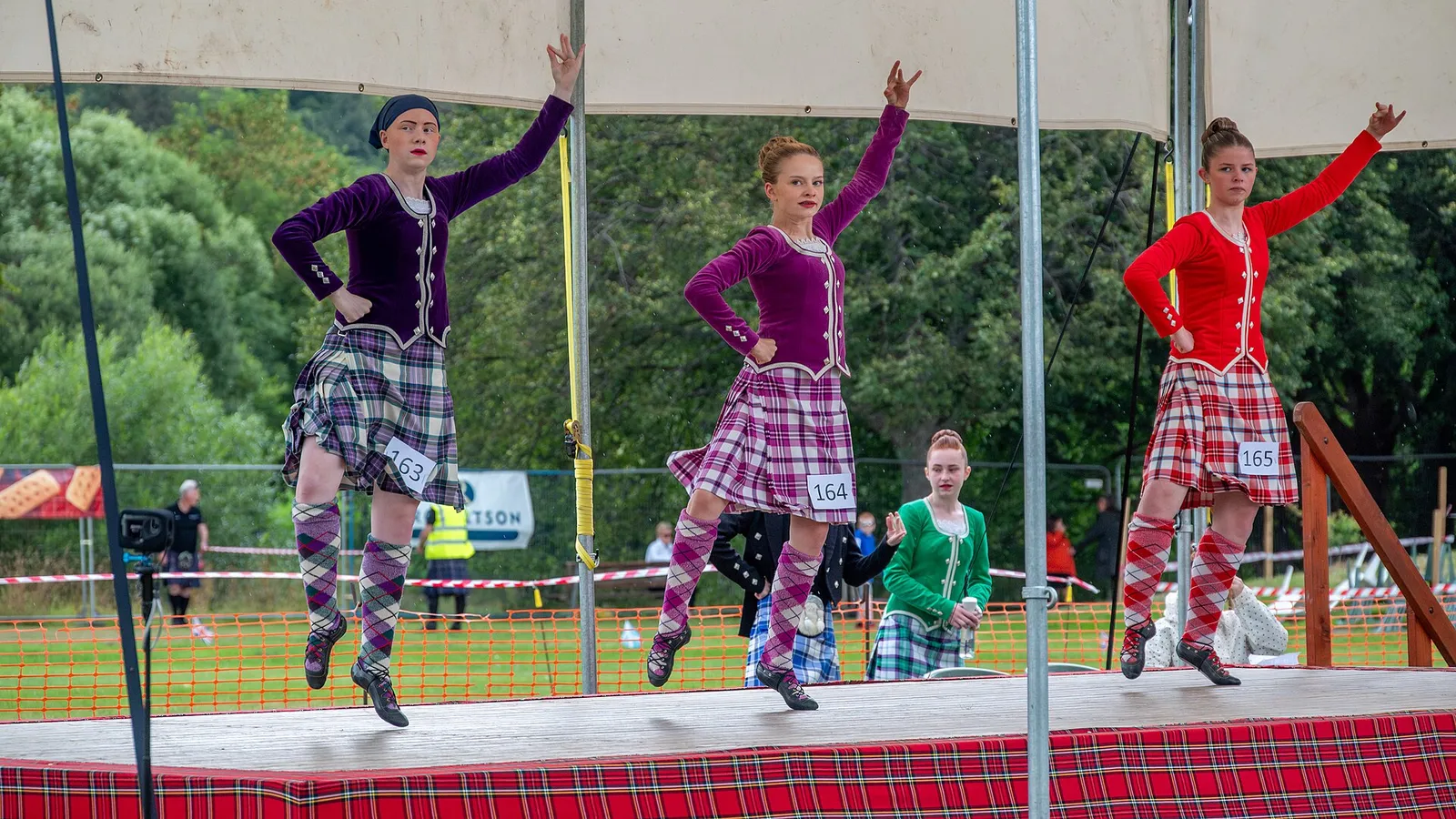
Highland dancing is the athletic solo dancing seen at Highland Games: dancers on the balls of their feet, arms raised, leaping over crossed swords to the bagpipes. It is judged and competitive, and recognised as a sport. Its dances come with stirring origin stories about battles, kings and the kilt ban. This card tests those stories against the record. The record shows a real and old Highland love of virtuoso dancing, centred on the reel and on the district of Strathspey, but it also shows that the set solo dances now seen on the Games platform, the Highland Fling, the Sword Dance and the Seann Triubhas, took their names and shapes between about 1780 and 1900, and their standard steps in the 20th century.
TL;DR
- established Highland dancing is a competitive solo form of step dancing, distinct from the social group dancing of a ceilidh or Scottish country dance. It is recognised as a sport by sportscotland.
- established The heart of the tradition is the reel. The Highland or Scotch Reel, with its virtuoso setting steps, was the great Scottish dance of the 18th century, and the solo "high dances" grew from strings of reel steps. The first technical description of reel steps was published by the Aberdeen dancing master Francis Peacock in 1805.
- established Scotland has a long history of sword dances, but most early records describe ritual "hilt-and-point" dances by linked groups, such as the Perth Glovers' dance performed for Charles I in 1633, not solo dances over swords. The earliest "Highland" dances named in a record are the "hieland danses" paid for at Edinburgh's welcome to Anne of Denmark in 1590.
- established Competitive Highland dancing began as an interlude at the Highland Society's piping competitions in Edinburgh, first in 1783. The Sword Dance (Gille Callum) was first danced there in 1832; the Highland Fling first appears as a competition dance around 1841.
- traditional The stories that King Malcolm Canmore invented the sword dance, that the Highland Fling was a victory dance on a shield, and that the Seann Triubhas celebrates the end of the kilt ban, are legends with no early source.
- established Modern Highland dancing was shaped in the 19th and 20th centuries by Highland Games competitions and dancing masters, some of them trained in ballet, and was standardised by the Scottish Official Board of Highland Dancing, formed in 1950. Many Seann Triubhas steps date from the late 19th century or later.
- shared Competition Highland dancing was a male preserve until the early 20th century; women have always danced reels and some solo dances socially. Today almost all competitive Highland dancers are female.
Key Facts
- Type
- Competitive, solo step dancing
- Music
- Usually the Highland bagpipe
- Footwear
- Soft-soled ghillies or pumps
- Earliest reference to a Scottish war-dance
- Bower's Scotichronicon, 1440s, describing 1285
- Earliest record of "Highland" dances
- Edinburgh accounts for Anne of Denmark's welcome, 1590
- First technical description of reel steps
- Francis Peacock, Sketches Relative to Dancing, Aberdeen, 1805
- First dancing at a piping competition
- Edinburgh, 1783
- Sword Dance first in competition
- Edinburgh, 1832, won by John MacKay
- Highland Fling first in competition
- About 1841 (Northern Meeting, Inverness)
- Core dances
- Highland Fling, Sword Dance, Seann Triubhas, Reel
- Governing body
- Royal Scottish Official Board of Highland Dancing, formed 15 January 1950
- Recognised as a sport
- By sportscotland
- Dancers today
- Almost all female
Scottish Impact Index (SI Score)
- Cultural Reach
- 7/10
- Continuity of Tradition
- 9/10
- Social & Economic Importance
- 6/10
- Scottish Distinctiveness
- 9/10
- Cultural Legacy
- 8/10
- Recognition
- 8/10
47/60
Ranked =14th of 19 in Traditions
A Note on Claims and Evidence
Each major claim carries one of three labels. established means supported by primary records, official bodies or several independent reliable sources. shared means the core fact is sound but sources disagree on details, dates or interpretation. traditional means widely repeated but not traceable to a primary or independent source.
Records of sword and war dances in Scotland go back to the 15th century, but they describe dances whose steps are not recorded, and many of them are group ritual dances unrelated to the modern solo form. The origin stories of the modern dances are not supported by any early source. The dance historian George S. Emmerson, in A Social History of Scottish Dance (1972), gathered most of the documentary record used here: the Highland Society's competition records, visitors' letters, dancing masters' books and the Highland Games programmes. His own suggestions about ancient origins, for example that the Sword Dance may descend from a ritual sword dance, are labelled as his and treated with caution. His date for the founding of the Scottish Official Board of Highland Dancing (1954) is wrong; the board was formed in 1950. The best-documented part of the history is the 19th and 20th centuries.
Timeline
A war-dance is performed at the wedding procession of Alexander III and Yolande de Dreux at Jedburgh, as later recorded by Bower.
Walter Bower compiles the Scotichronicon.
The royal accounts of James IV pay maidens who danced for the king at Forres, Dingwall and elsewhere, among the earliest notices of solo dancing in Scotland.
Dancers hung with bells perform in Edinburgh's celebrations of Mary, Queen of Scots' marriage to the Dauphin.
Edinburgh pays for "the sword dance and hieland danses" at the welcome for Anne of Denmark, the earliest record of Highland dance by name.
The Perth skinners or glovers perform their ritual sword dance for James VI and Charles I.
Drury Lane bills "A New Scotch Sword Dance by Baker in a Highland Character", the earliest solo Scottish sword dance Emmerson found.
The tune "Gille Callum" is written down in a Drummond Castle manuscript.
The Earl of Crawford is admired for performing a Highland dance while flourishing a naked broadsword.
Captain Edward Topham describes the "high dances" of Edinburgh dancing-school balls.
The first modern piping competition is held at the Falkirk Tryst.
Pipers dance at the Edinburgh piping competition; the competition moves to Edinburgh permanently.
Competitors are told to appear in Highland dress.
Dancing becomes a competition in its own right at Edinburgh.
Francis Peacock publishes his description of Highland reel steps.
The Strathfillan Society holds the first of the modern Highland Games; the Reel of Tulloch is first mentioned, at an Edinburgh ball.
The Reel of Tulloch is danced at the Edinburgh competition.
The Gille Callum is danced over two crossed swords at Edinburgh, won by John MacKay; the first Braemar Games are held.
The Edinburgh Gille Callum is danced to the bagpipe instead of the band.
The Northern Meeting at Inverness introduces piping and dancing competitions, including the Highland Fling; a Dirk Dance is performed at Edinburgh.
The last of the Edinburgh competitions is held.
Braemar's dances include the Highland Fling, Reel of Tulloch and Seann Triubhas.
The first technical description of the Gille Callum over crossed swords is published.
A woman, commonly named as Jenny Douglas, is said to have entered a Highland dancing competition.
William MacLennan revives the Argyll Broadswords.
William MacLennan, trained in ballet, adds high cuts and entrechats to the Seann Triubhas.
The first Cowal Gathering is held at Dunoon.
Cowal begins juvenile dancing competitions; sources differ.
Luss holds separate Highland Fling contests for boys and for girls under sixteen.
The first adult world championship is held.
The Scottish Official Board of Highland Dancing is formed at the Plaza Ballroom, Stirling.
The Aboyne Games introduce a special dancing costume for girls.
The board publishes its first textbook of steps.
Details
Solo and athletic
established Highland dancing is solo step dancing, performed on the balls of the feet with set arm positions, usually to the bagpipes. It is competitive: judges assess timing, technique, and interpretation and deportment. It should not be confused with ceilidh or Scottish country dancing, which are social dances done in sets and couples, though some country dances borrow Highland setting steps. sportscotland recognises Highland dancing as a sport.
Old war-dances
established Scotland had sword or war dances long before the modern Games. The earliest known reference is in the Scotichronicon, compiled by Walter Bower in the 1440s. It describes the procession at the wedding of Alexander III and Yolande de Dreux at Jedburgh on 14 October 1285, led by pipers, in which others performed "a war-dance with intricate weaving in and out". Bower was writing more than 150 years after the event.
established Most later records describe a different kind of sword dance. The hilt-and-point sword dance, known across northern Europe, was a group ritual: the dancers were linked in a ring by their swords, wove through figures, and often ended by locking the swords round one dancer's neck, a mock sacrifice. In Scotland it was danced by craft guilds and maskers at Yule and in the May games. Elgin's kirk session fined five masked men in 1623 for a sword dance in the kirkyard. The Perth skinners or glovers were ordered to provide a sword dance for James VI in 1617, and in 1633 they danced for Charles I on a timber stage in the Tay: thirteen dancers in green caps, red ribbons and white shoes, with bells on their legs, five of them carrying others on their shoulders. Their bell-hung costume survives in Perth. The Sword Dance of Papa Stour in Shetland, a play of the Seven Champions of Christendom, survived into the 19th century. Emmerson treated these as ritual dances, distinct from the "Pyrrhic" or weapon-drill dances of warriors, though easily mistaken for them.
established The first record of "Highland" dancing by name comes from Edinburgh's welcome for Anne of Denmark in 1590. The town's accounts list expenses on "the sword dance and hieland danses": white shoes, hats of flowers, bells for the sword dancers, and payment to the master of the sang school to entertain his Highland dancers. Emmerson thought the sword dancers were probably the Perth men, who would then have counted as Highlanders. No eyewitness described the dancing. The 1558 Edinburgh "Triumphe and Play" for Mary, Queen of Scots' marriage to the Dauphin had dancers hung with bells, thirty-one dozen of them; Emmerson notes that the records make it hard to tell sword dancers from Morris dancers.
The reel and the high dances
established The core of what we call Highland dancing is not the sword but the reel. The Highland or Scotch Reel is a dance for three or four in which the dancers alternate a weaving figure with setting steps danced to and for each other. It was the great Scottish dance of the 18th century, carried from the central Highlands into the Edinburgh assemblies and then to London, where it was danced at Almack's by 1814. Its virtuoso setting steps are the raw material of the solo dances. In 1805 Francis Peacock, who had taught dancing in Aberdeen for sixty years, published the first technical description of them, with their Gaelic names: the kemshoole travelling step, the setting steps he called kemkossy, the cross springs, the cross passes and the turning step. He praised the reel dancing of Highland and Hebridean students at the Aberdeen colleges, and of a herd boy of about twelve he once saw in a remote place. He also told dancers they could change, divide and invert the steps as they pleased, so there was no fixed sequence.
established The reel could be danced to common reel tunes or to the slower, snapped strathspey, and the two were often combined. The term "strathspey reel" first appears for a country dance in the Menzies manuscript of 1749, and in print in 1751. The 18th-century "Strathspey" was also a twosome, a sort of Highland minuet that Captain Edward Topham saw in Edinburgh in 1775 and compared to galloping a minuet. The Edinburgh writer Henry Mackenzie wrote in 1825 that Strathspey was the native land of Highland dancing. Visitors agreed that the Highlands danced best. The Rev. James Hall, at a market-day ball in Grantown around 1805, said he had never seen dancers to equal them; Elizabeth Grant of Rothiemurchus remembered a dancing master teaching her family every variety of Highland step, and servants and neighbours of every class eager to learn a few more flings and shuffles.
established The solo dances first appear as "high dances" at Edinburgh dancing-school balls. Topham in 1775 found the masters putting their high dances between the children's minuets, and as quoted by Emmerson called them "a kind of double hornpipe", with steps he had never seen before, all in the feet and little in the arms. Strings of reel steps danced alone were the obvious basis for such dances. Archibald Duff of Aberdeen composed pas seuls and "high dances" for named pupils, and the Hill manuscript of 1841 from Aberdeenshire records three different Highland Flings and other solo dances in detail.
The Highland Fling
shared "Fling" was an ordinary Scots word for vigorous dancing, as when John Knox complained of Mary's courtiers flinging on the floor. Before about 1800 there is no record of a dance called the Highland Fling. The earliest uses read as the name of a step or class of steps. Around 1805 James Hall tried the Highland fling on Speyside in place of his own stiff steps; Elizabeth Grant spoke of single and double fling steps; and John Jamieson's dictionary defined it as a kind of movement in dancing, not a dance. A Highland Fling as a set arrangement of steps then emerged, such as The Marquis of Huntly's Highland Fling, to a tune composed before 1806, which the Hill manuscript records with far more pointing and turning than today's version. Emmerson noted that the Fling, unlike the Gille Callum and Seann Triubhas, has no Gaelic name, which suggests a Lowland label for an unnamed Highland practice.
established Despite its central place today, the Fling was not a competition dance until around 1841, when the Northern Meeting at Inverness offered three guineas for it, more than for any other dance; James Grant from Strathspey won. Its earliest published descriptions date from the 1890s, and they are recognisably the same dance as the board's 1955 version, though the "spread" onto both feet has since been replaced by the second position. The Fling is danced on the spot. The story that it was a warrior's victory dance on his targe is, in Emmerson's view, probably nonsense, though it does reflect that one feature.
The Sword Dance, or Gille Callum
shared The modern Sword Dance is danced over two crossed swords to the tune "Gille Callum". The tune is written down in a Drummond Castle manuscript of 1734 and was printed by Robert Bremner in 1768 under a phonetic title. A solo dance over a sword is first recorded on the London stage, at Drury Lane on 31 December 1733, and an anti-Jacobite song of 1745–60 jeers at the Jacobites' promise to make the Duke dance over the sword, one sword, not two. Alexander Campbell in 1804 describes "Gillie Callum da' pheigin" as danced by one man over a single naked broadsword, and already becoming obsolete. Emmerson also found it used as a preliminary to the Kissing Reel, danced round a handkerchief twisted into a rope.
established The Gille Callum entered competition at Edinburgh in 1832, when five men danced it over two naked swords laid across; John MacKay, piper to Lady Gwydyr at Drummond Castle, won. Until 1838 it was played by the band, then by the champion piper. In 1844 some competitors cautiously avoided quick steps for fear of touching the swords; there was no standard pattern of slow and quick steps. Queen Victoria saw the sword dance at Dunkeld in 1842, danced by the Duchess of Atholl's steward, and the King of Saxony at Taymouth in 1844; he thought it savage and vigorous, with the dancer stamping and taking warlike attitudes. The first technical description, in 1881, has the dancer moving round the swords clockwise, the opposite of present practice.
traditional The story that Malcolm Canmore invented the dance by crossing his sword over his enemy's has no early source. A related tale says the song "Gille Callum" was made when Malcolm introduced the bodle, a small coin, but the bodle was a 17th-century coin and the words are typical nonsense mouth-music. The claim, made by James Logan in 1831 and repeated since, that Roman writers saw the ancient Caledonians dance over swords is also wrong: the only such Roman description, by Tacitus, is of German tribesmen.
shared Emmerson himself suggested that the Gille Callum might preserve a fragment of a ritual group sword dance, pointing to a "Lochaber Broadswords" for relays of two dancers, described by a visitor in 1879, which ended with swords pointed at one man's throat. This is speculation; the Gille Callum has no recorded ancestor.
Broadswords and dirks
established There were also true weapon dances. General Stewart of Garth wrote that the Earl of Crawford, around 1753, danced the Highland dance in Highland dress while flourishing a naked broadsword, and that this dance, Mac an Fhorsair, had disappeared by about 1825, latterly danced with a staff. Highland soldiers performed the "broadsword exercise" for George II. In the Dirk Dance, or Battle Dance, two dancers with dirk and targe mimed combat between step-dancing; at Edinburgh in 1841 the "victim" was revived limb by limb and given whisky, a resurrection theme shared with old Hebridean dramatic dances. The Argyll Broadswords, for four dancers over four swords, was revived in 1888 by the dancer and piper William MacLennan and passed into the army's repertoire.
The Seann Triubhas
established The Seann Triubhas, "old trousers" in Gaelic, was originally danced to the rant "Seann Triubhas Willichan", Willie's old trousers, printed by Bremner in 1768 and, by about 1820, said to have been known in dancing schools for generations. It is now danced to "Whistle o'er the lave o't". Robert Tannahill called it a merry dance, and Alexander Carmichael wrote in 1900 that it once contained much more acting. Elizabeth Grant tells of a girl who danced the "Shean Trews" as a child in a Highland drawing room around 1804.
established Much of the present dance is recent. William MacLennan, who studied ballet with Cecchetti, added high cutting, side cutting, beats and the entrechat before 1890; his brother D. G. MacLennan said he composed the now-famous first step himself, and that it had nothing to do with kicking off trousers. The spread-eagle leap is later still.
traditional The story that the dance mocks the trousers Highlanders had to wear while the kilt was banned (1746–82) has no early source, and trews were an ancient Highland garment in their own right.
The origin stories
traditional Each core dance has a romantic origin story. The Sword Dance is said to have begun when Malcolm Canmore, after killing a rival chief, crossed his sword with his enemy's and danced over them in triumph; another version says dancers performed it before battle, and touching a blade was a bad omen. The Highland Fling is said to have been a victory dance, or a dance on a warrior's shield. The Seann Triubhas is said to mock the trousers Highlanders were forced to wear while the kilt was banned. None of these stories has an early source. More practical explanations are that the sword dance trained a fighter's footwork and that the Fling derives from the setting steps of the reel. Emmerson suggested the reverse of the warrior story: in a society of strong-legged mountaineers, vigorous use of the legs in dancing was simply natural.
Made at the competitions
established Competitive Highland dancing was born at the piping competitions of the Highland Society of London, founded in 1778 to save the Highland bagpipe. The first was held at the Falkirk Tryst cattle fair in 1781. In 1783 a disputed result led to a repeat competition in Edinburgh, where, at the company's request, several pipers showed off their Highland dancing; the competition stayed in Edinburgh, annually until 1826 and then every three years until 1844. From 1785 competitors were told to appear in Highland dress, and dancing became a competition in its own right around 1795. Organisers admitted in 1817 that two-thirds of the audience came only to see the dances. All the dancers were men, more than 170 of them recorded between 1816 and 1846. Early programmes were Highland reels; the twosome "Highland Strathspey" was added by 1813, danced by men in pairs, and died out by 1838; the Reel of Tulloch came in 1829, the Gille Callum in 1832, and a solo "Strathspey Dance", apparently a Fling, by 1841.
established The Highland Games proper began with the Strathfillan Society's gathering in 1819, which included reels and an "Ancient Scotch Sword Dance". The Braemar Highland Society was founded in 1826 and held its first games in 1832; Queen Victoria first attended in 1848. When she held a private gathering in 1859, the judges could not decide the Gille Callum and left out the best dancer because, she wrote, he danced "Too well!" By 1853 Braemar's dances included the Highland Fling, Reel of Tulloch and Seann Triubhas, which with the Gille Callum and the Reel formed the standard programme. The Northern Meeting at Inverness, founded in 1788 as a week of balls, added piping and dancing in 1841. The Luss gathering, founded in 1875, had by 1893 added the Sailors' Hornpipe and Irish Jig to the Fling, Gille Callum, Reel and Seann Triubhas. Cowal (1894) was mainly athletic at first and gave little attention to dancing before about 1910.
established Dancing masters taught the form and formalised it with the conventions of ballet, which is why today's dancers turn out their feet and point their toes. The balletic element came from European dancing masters long before; it was sharpened by figures such as William MacLennan, and some older observers came to regret what they saw as the acrobatics of modern competition dancing. The Games narrowed the range of dances, and many older solo dances were lost or kept only by a few teachers, among them The Earl of Erroll, The King of Sweden, the Scottish Lilt and Ewen MacLachlan's dances from South Uist, and later the ladies' dance Flora Macdonald's Fancy, which reached the Games platform from the family of an Aberdeenshire dancing teacher.
established The Scottish Official Board of Highland Dancing was formed on 15 January 1950 at the Plaza Ballroom in Stirling, with representatives of the Scottish Country Dance Society present. Emmerson credits Jack Muir, of a Motherwell family of dancing masters, as its guiding hand. The board based its standard steps on the dancing of the best pupils of earlier great dancers and teachers, particularly J. L. Mackenzie and Bobby Watson, and published its first textbook in 1955. Now the Royal Scottish Official Board of Highland Dancing, it is recognised by many Highland gatherings as the world governing body. It standardised the steps, sets competition rules, and certifies competitions and teachers.
From men to women
shared Competitive Highland dancing was originally a male preserve: at Edinburgh women did not compete at all, and the Highland Strathspey, a couple dance, was danced by two men, which one observer found absurd. In the late 19th century a young woman, usually named as Jenny Douglas, is said to have entered a competition because it was not expressly forbidden; Emmerson does not mention her and dates girls' entry into competition to the early 20th century, probably through juvenile events. Cowal's early rules let girls enter some piping events but not open dancing; Luss held separate girls' contests in 1908. The two world wars thinned the ranks of male dancers.
shared Off the platform, women had never been excluded. The earliest notices of solo dancing in Scotland are of girls who danced for James IV around 1500. Elizabeth Grant's childhood friend Lady Jane danced the Gillie Callum and the Seann Triubhas, and a Perthshire writer of the 1870s described two young women devoted to their Highland Fling and Seann Triubhas. Emmerson argued that the Pyrrhic weapon dances and the Seann Triubhas were male in character, but that a Fling is simply an arrangement of reel steps, which women had always danced. Girls first competed in copies of men's military dress; in 1952 the Aboyne Games introduced a costume based on 18th-century Highland women's dress, and the board later approved a kilted skirt and jacket. Women's participation grew until almost all Highland dancers today are female, though men remain well represented at world championships.
Did You Know?
- Highland dancing is recognised as a sport by sportscotland.
- The earliest Scottish war-dance on record was at a royal wedding in Jedburgh in 1285.
- Bower recorded that dance more than 150 years after it happened.
- The first record of "Highland" dances by name is in Edinburgh's accounts for Anne of Denmark's welcome in 1590.
- The Perth sword dance performed for Charles I in 1633 was danced on a timber stage in the River Tay.
- The earliest solo Scottish sword dance on record was performed on a London stage, at Drury Lane, in 1733.
- Competitive Highland dancing began as an interval entertainment at a piping competition in Edinburgh in 1783.
- The Sword Dance was first danced in competition in 1832, and at first to a band rather than the pipes.
- The Highland Fling has no Gaelic name.
- At Braemar in 1859 the judges left out the best sword dancer for dancing too well.
- The famous first step of the Seann Triubhas was composed by D. G. MacLennan.
- The governing board was formed in a Stirling ballroom in January 1950.
- Highland dancing was a men-only competition until the early 20th century; today its dancers are almost all female.
FAQ
1What is Highland dancing?
A competitive, solo form of Scottish step dancing, usually danced to the bagpipes.
2How is it different from ceilidh dancing?
Highland dancing is solo and judged; ceilidh and country dancing are social dances in groups.
3Is Highland dancing a sport?
Yes. sportscotland recognises it as one.
4What are the main Highland dances?
The Highland Fling, the Sword Dance (Gille Callum), the Seann Triubhas and the Reel, with the Reel of Tulloch, Sailors' Hornpipe, Irish Jig and Flora Macdonald's Fancy among the "national" dances.
5Where did Highland dancing come from?
From the Highland reel and its virtuoso setting steps, especially as danced in Strathspey, shaped by dancing masters and, from the late 18th century, by competition.
6Did Malcolm Canmore invent the sword dance?
That is a legend with no early source.
7How old is the sword dance?
War-dances in Scotland are recorded from 1285, but most early sword dances were group rituals. A solo sword dance is first recorded in 1733, and the dance over two crossed swords in competition from 1832.
8Did the ancient Caledonians dance over swords?
There is no evidence. The Roman account often cited, by Tacitus, describes Germans.
9How old is the Highland Fling?
As a named dance, about two centuries. The term first appears around 1800, and the Fling entered competition around 1841.
10Was the Fling danced on a shield?
That is a romantic story. The Fling is danced on the spot, which may have inspired it.
11What does Seann Triubhas mean?
"Old trousers". The story linking it to the end of the kilt ban is a legend, and many of its steps are 19th or 20th-century.
12Why do Highland dancers point their toes?
The form was formalised in the 19th and 20th centuries by dancing masters using ballet conventions.
13What was the Dirk Dance?
A mock combat for two dancers with dirk and targe, in which the loser was brought back to life; it was danced at Edinburgh in 1841 but is now rare.
14Who runs Highland dancing competitions?
The Royal Scottish Official Board of Highland Dancing, formed in 1950, sets the rules for many.
15Did women always do Highland dancing?
Not in competition, which was for men until the early 20th century. Women did dance reels and some solo dances socially.
16Who dances it today?
Mostly women and girls.
Sources and Further Reading
Primary/Institutional
- Royal Scottish Country Dance Society, "What is Highland dancing?" (rscds.org)
- Royal Scottish Official Board of Highland Dancing, home page (rsobhd.net)
Scholarly/Critical
- George S. Emmerson, A Social History of Scottish Dance: Ane Celestial Recreatioun (McGill-Queen's University Press, 1972)
General
- Wikipedia, "Highland dance" (en.wikipedia.org)
- Wikipedia, "Scottish sword dances" (en.wikipedia.org)
Further reading
- Francis Peacock, Sketches Relative to the History and Theory, but More Especially to the Practice of Dancing (Aberdeen, 1805)
- J. G. Dalyell, Musical Memoirs of Scotland (1849)
- D. G. MacLennan, Traditional and Highland Scottish Dances (1950)
- J. F. and T. M. Flett, Traditional Dancing in Scotland (1964)
Caveats: Myths and Disputed Claims
- Do not say Malcolm Canmore invented the sword dance.
- Do not cite Tacitus or other Roman writers as evidence of a Caledonian sword dance; Tacitus described Germans.
- Do not treat the Perth Glovers' or Papa Stour sword dances as early forms of the solo Sword Dance; they were group ritual dances.
- Do not present the shield and victory stories of the Highland Fling as history.
- Do not say the Highland Fling is an ancient named dance; the name appears around 1800 and the dance entered competition around 1841.
- Do not say the Seann Triubhas dates from the end of the kilt ban; many of its steps are late 19th-century or later.
- Do not call the modern dances ancient; their form was set in the 19th and 20th centuries.
- Do not say women never danced Highland dances; they were excluded from competition, not from dancing.
- Do not give 1954 as the founding date of the official board; it was 1950.
- Do not confuse Highland dancing with Scottish country dancing.
Card 011 · Traditions